The Riemann Hypothesis, proved with Claude in Lean, and a GPGME double free
14 hours ago
Levent Alpöge, working with Claude, released a proof of the Riemann Hypothesis as 17 million lines of Lean, and the Lean and Mathlib communities certified it within a day. Also from Saturday's Hacker News front page: a double free in GPGME reachable with a crafted OpenPGP key, Valkey replacing the skiplist under its sorted sets with a B+ tree, and the Studio Display XDR hub that held a 2.5 gigabit line to 600 megabits. Lean verification of the Riemann Hypothesis, a joint statement by the Lean and Mathlib communities https://leanprover-community.github.io/blog/posts/riemann-hypothesis/ Discussion: https://news.ycombinator.com/item?id=50589618 Levent Alpöge's remark announcing the proof: https://alpo.ge/remark.pdf Verification files and results: https://math.mit.edu/~drew/grh/ thejokeisonme on the fake Collatz refutation, and TwoFx's reply: https://news.ycombinator.com/item?id=50590575 math_dandy, quoted: https://news.ycombinator.com/item?id=50590809 GnuPG Security Advisory for GPGME (CVE-2026-129975, fixed in GPGME 2.3.1) https://lists.gnupg.org/pipermail/gnupg-announce/2026q4/000517.html Discussion: https://news.ycombinator.com/item?id=50587208 lazka on Arch Linux and GPGME: https://news.ycombinator.com/item?id=50588951 The Red Hat downstream patch, via uptrails: https://news.ycombinator.com/item?id=50588137 Todd Zullinger's note on oss-security: https://www.openwall.com/lists/oss-security/2026/11/21/1 From Skiplists to B+ Trees: Making Valkey Sorted Sets More Memory Efficient, by Rain Valentine and Dragos Andriciuc https://valkey.io/blog/from-skiplist-to-b+tree/ Discussion: https://news.ycombinator.com/item?id=50534387 antirez on the Redis version: https://news.ycombinator.com/item?id=50586785 My Monitor Was Cutting My Download Speed by 75%, by Oscar Molnar https://blog.tymscar.com/posts/studiodisplayethernet/ Discussion: https://news.ycombinator.com/item?id=50587875
Links
- Lean verification of the Riemann Hypothesisleanprover-community.github.io
- Threadnews.ycombinator.com
- Alpöge's remarkalpo.ge
- Verification filesmath.mit.edu
- GPGME advisorylists.gnupg.org
- Threadnews.ycombinator.com
- oss-security note on the Red Hat patchopenwall.com
- Valkey, from skiplist to B+ treevalkey.io
- Threadnews.ycombinator.com
- My monitor was cutting my download speed by 75%blog.tymscar.com
- Threadnews.ycombinator.com
- Front pagenews.ycombinator.com
Ask about this presentation
Chapters

Show transcriptHide transcript
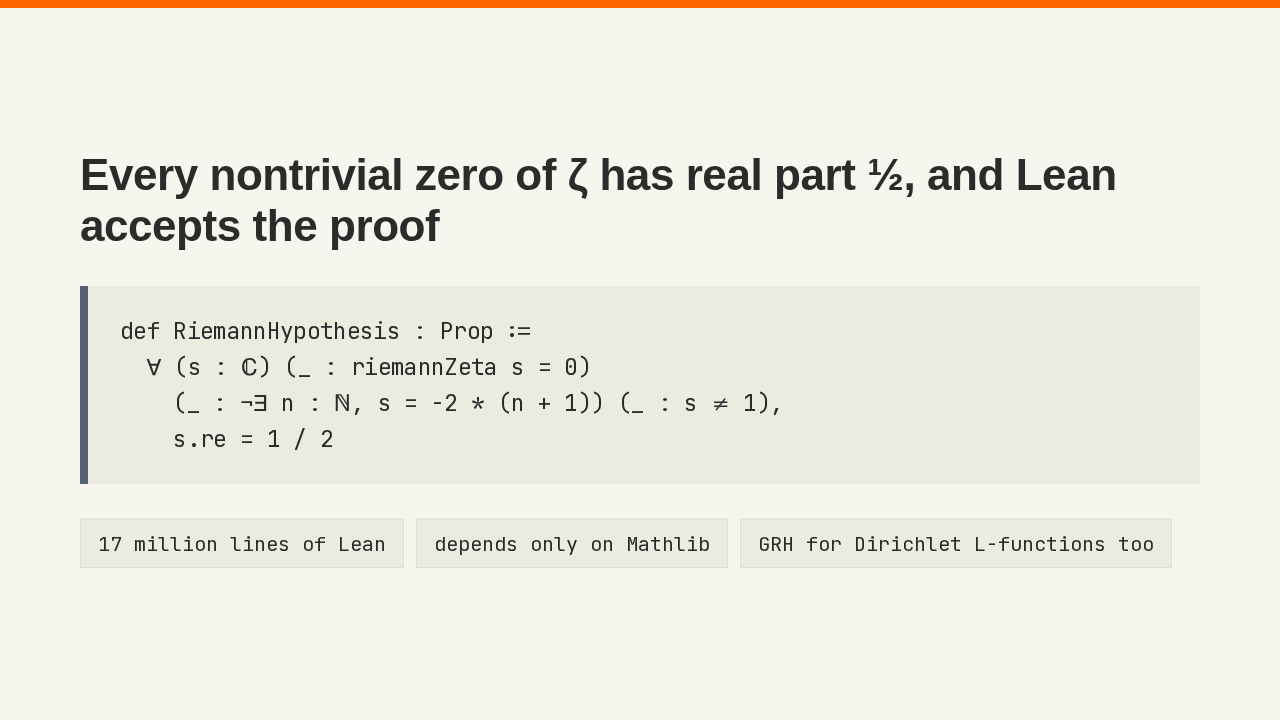
On Saturday's HN front page, Levent Alpöge, working with Claude, released a proof of the Riemann Hypothesis as a Lean library of 17 million lines, and within a day the Lean and Mathlib communities certified it as correct. A crafted key can trigger a double free in GPGME, the library behind most mail clients that speak OpenPGP. And Valkey swaps the skiplist under its sorted sets for a B+ tree.
The hypothesis says every nontrivial zero of the zeta function sits on the line where the real part is one half, and mathematicians have chased it for more than 150 years. Its statement already lived in Mathlib, written and vetted by experts in Lean and number theory, so the proof had a fixed target. Alpöge's library depends on Mathlib and nothing else, and the same method settles the Generalized Riemann Hypothesis for Dirichlet L-functions. In the note announcing it, Alpöge writes, “Claude far outpaced me near the finish line.”
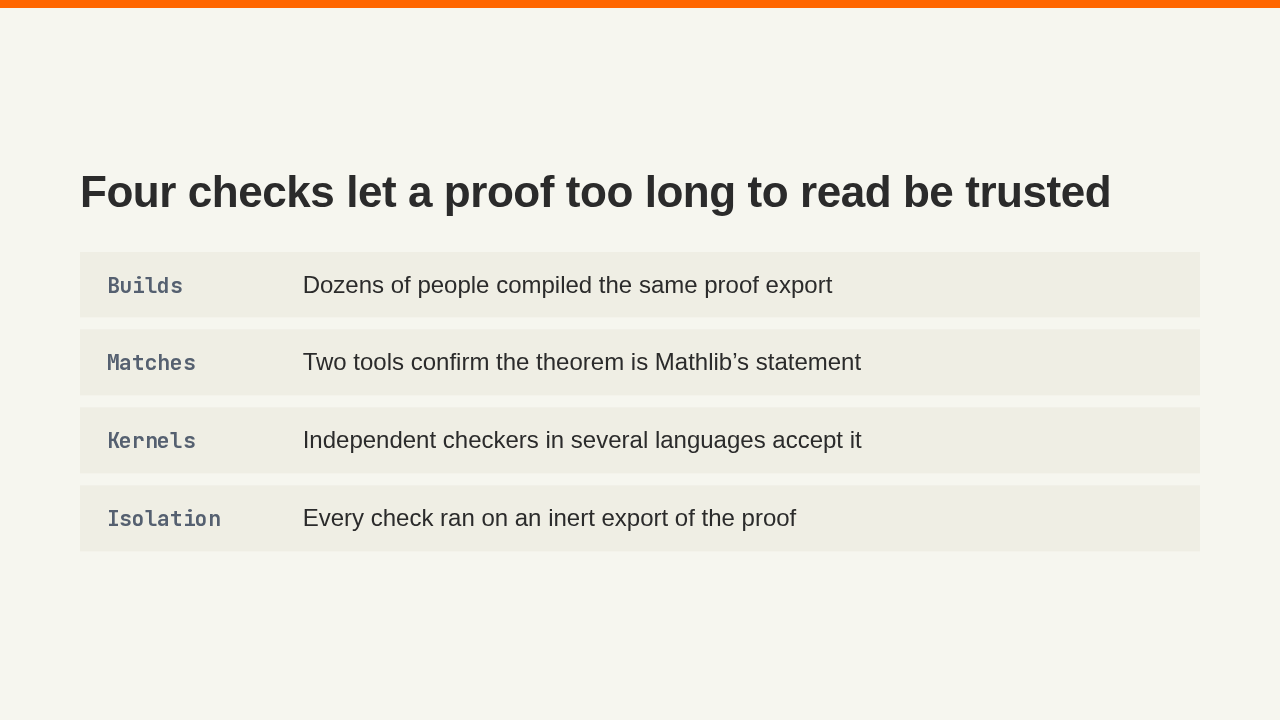
Seventeen million lines is more than any person can review, so the trust comes from checks a machine can repeat. Dozens of people compiled the library and got the same raw proof export. Two separate tools confirmed that the theorem it proves is exactly Mathlib's statement of the hypothesis. Then several independent proof checkers, written in different programming languages, accepted the export, and two of them come with a formal proof that they cannot accept a false one. Every check ran on an inert export, out of reach of any malicious code in the sources.
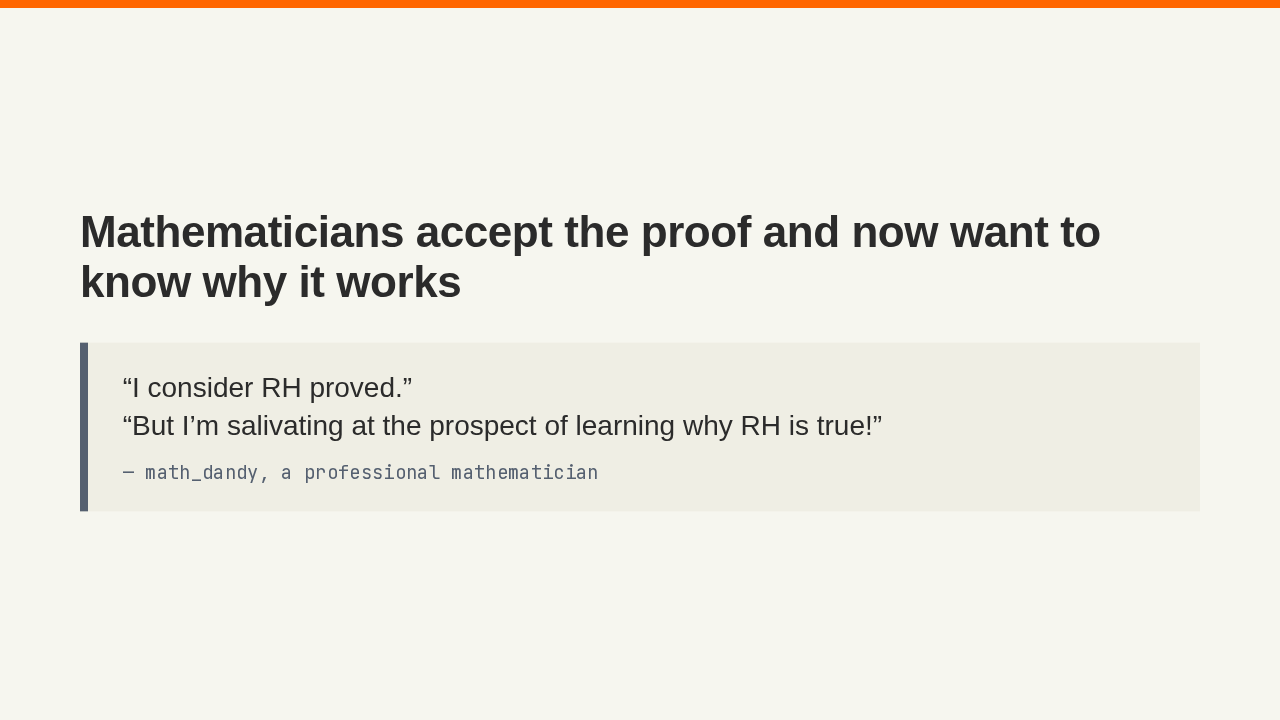
In the thread, thejokeisonme recalled a fake refutation of the Collatz conjecture that once got past one of these checkers. TwoFx answered that Lean has since shipped formally verified checkers, and this proof went through them. A professional mathematician posting as math_dandy considers the hypothesis proved, and can't wait to learn why it is true. Alpöge expects the argument to be massively simplified, and plans to write it up properly.
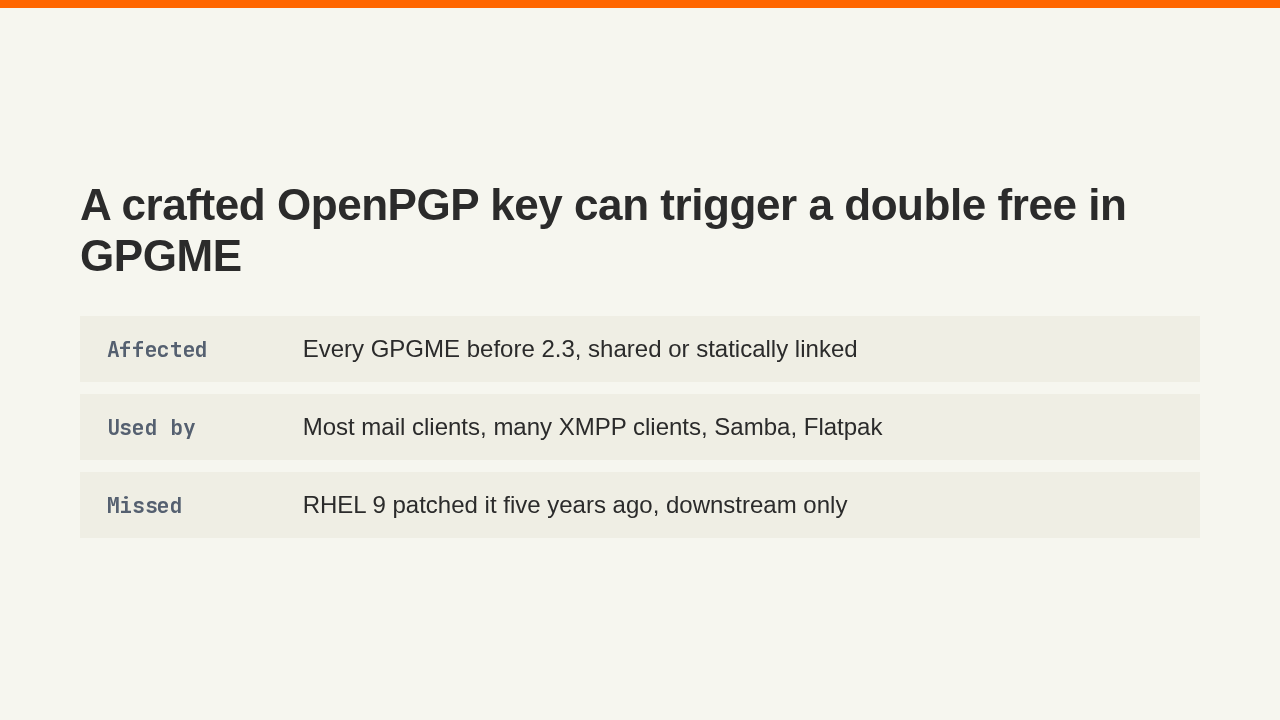
If you ship anything built on GPGME, the library other programs use to talk to GnuPG, it needs the new release. An OpenPGP key with a very long user ID triggers a double free, which can leak data out of the application, and remote code execution can't be ruled out. Statically linked programs need a rebuild. In the thread, lazka added that Arch Linux uses GPGME to verify downloaded packages. Red Hat Enterprise Linux 9 fixed this same double free five years ago, after a Coverity scan, and the patch stayed downstream.
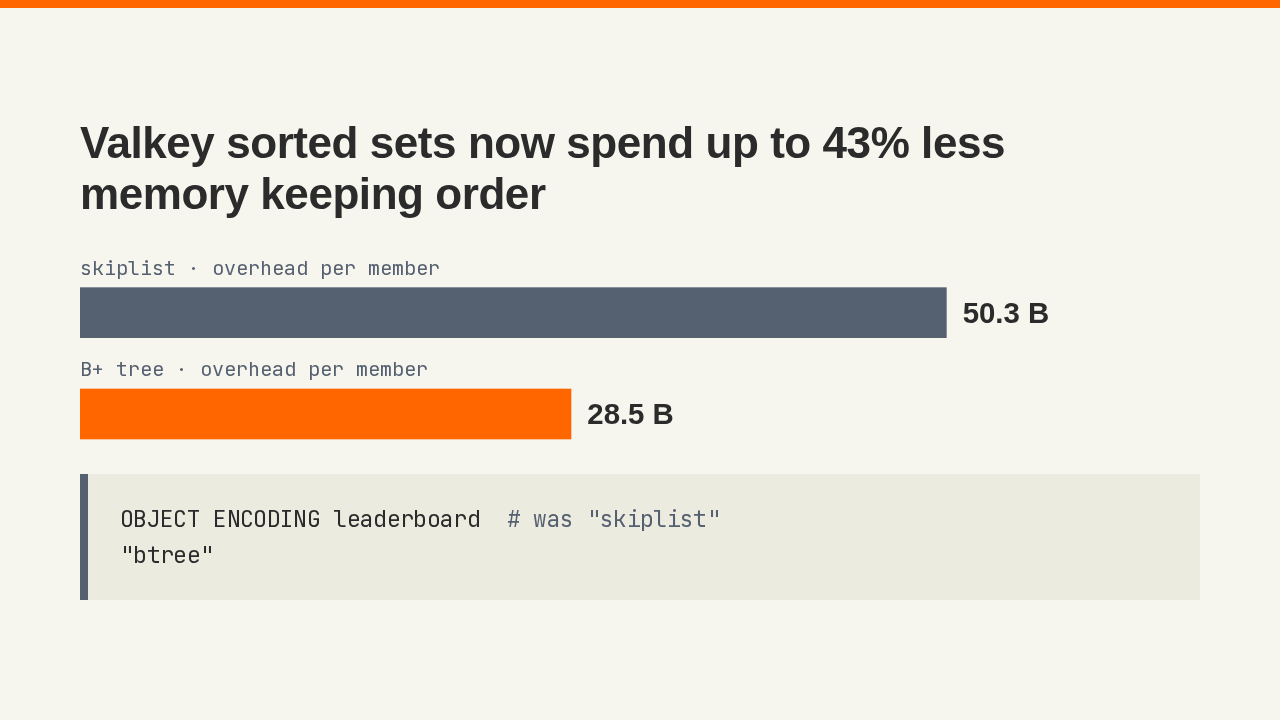
Valkey 9.2 replaces the skiplist under large sorted sets with a B+ tree that packs up to 61 members into each node. Commands behave the same, and the memory spent on ordering each member drops by more than a third. Score updates with ZADD run about twice as fast. OBJECT ENCODING now answers btree instead of skiplist, so a test or a monitor that looks for that string needs updating. In the thread, antirez, who created Redis, wrote the version Redis adopted, and says it saves more memory still.
Oscar Molnar pays for a 2.5 gigabit line, and got 600 megabits down through a USB-C Ethernet adapter plugged into a Studio Display XDR. Plugged straight into the Mac, the same adapter ran at full speed. That Realtek adapter sends four packets per burst, then waits for the Mac's go-ahead, and the display's hub adds about 8 microseconds to every wait. So the adapter drains at about 2 gigabits while 2.5 arrive, its buffer overflows, and the dropped frames force a hard backoff. A newer adapter that sends eight packets per burst dropped zero frames.
Up next
 3:41
PostgreSQL 19 shrinks bloated tables without locking, and AI designs a CPU
@hacker-news
1 day ago
 3:27
Ruby2ßhell runs code on stock Rails before login, and a JVM fix waited two months
@hacker-news
2 days ago
 3:49
Nginx bugs let anyone run code on your server, ONNX Runtime goes dark, and Quad9 leaves France
@hacker-news
3 days ago
 4:15
Optimizely served malware on Zoom and GitLab, and Windows 11 logs your coding agents
@hacker-news
4 days ago
 4:10
uBlock Origin fixes a one-click XSS, ParadeDB joins, and free CMU courses
@hacker-news
5 days ago
 4:01
All AI code should be open source, and a chlorine alarm lost in a Microsoft 365 outage
@hacker-news
5 days ago
 4:19
Lovable apps leak passports, ggml hits 1.0, and Qwen3.8 27B fits a 24 GB Mac
@hacker-news
1 week ago
 3:43
Edge0-145B runs on one 16 GB NVIDIA card, and Brave sells search to AI agents
@hacker-news
1 week ago
 4:20
Apache’s HTTP/2 bug lets anyone run code, and Gemini 4 Hydrogen replaces Flash
@hacker-news
1 week ago
 4:01
AWS Emulator puts AWS on your laptop, and Apple's Harbor pools Macs for AI
@hacker-news
1 week ago
 3:40
Claude Fable 5.2 gets cheaper, and Amazon swaps Sonnet for Strands Decider
@hacker-news
1 week ago
 3:37
Claude Fable 5.2 runs faster for less, a number plate unlocks cars, and a $385 Raspberry Pi
@hacker-news
1 week ago