PostgreSQL 19 shrinks bloated tables without locking, and AI designs a CPU
1 day ago
PostgreSQL 19 ships REPACK, which shrinks a bloated table without blocking reads or writes, plus replica and upgrade changes worth knowing before you move. Also from Friday's Hacker News front page: a buffer overflow in OpenSSL's base64 encoder, Frostbite, a CPU designed end to end by AI agents, and a Qwen model that edits its own weights. PostgreSQL 19 release notes https://www.postgresql.org/docs/release/19.0/ Discussion: https://news.ycombinator.com/item?id=50569890 BitPirate on JIT being off by default: https://news.ycombinator.com/item?id=50573762 lfittl on waiting for the first point release: https://news.ycombinator.com/item?id=50572000 OpenSSL: Buffer overflow in EVP_EncodeBlock() (CVE-2026-121481) https://github.com/openssl/openssl/pull/33652 Discussion: https://news.ycombinator.com/item?id=50569226 userbinator on how exploitable it is: https://news.ycombinator.com/item?id=50569917 Frostbite: A new CPU architecture discovered, designed and verified by AI, by Architect Labs https://architectlabs.com/blog/frostbite Discussion: https://news.ycombinator.com/item?id=50572503 pizza234 on the in-order baseline: https://news.ycombinator.com/item?id=50572930 kragen's reply on performance per watt: https://news.ycombinator.com/item?id=50573236 Language Models Can Rewrite Their Own Weights, by Jiajun Fan and others https://arxiv.org/abs/2611.21885 Discussion: https://news.ycombinator.com/item?id=50577265 aesthesia on what the edit changed: https://news.ycombinator.com/item?id=50578348
Links
- PostgreSQL 19 release notespostgresql.org
- PostgreSQL 19 threadnews.ycombinator.com
- OpenSSL pull request 33652github.com
- OpenSSL threadnews.ycombinator.com
- Frostbite, Architect Labsarchitectlabs.com
- Frostbite threadnews.ycombinator.com
- Language Models Can Rewrite Their Own Weightsarxiv.org
- Self-rewriting threadnews.ycombinator.com
- Front page, 2026-11-20news.ycombinator.com
Ask about this presentation
Chapters
Show transcriptHide transcript
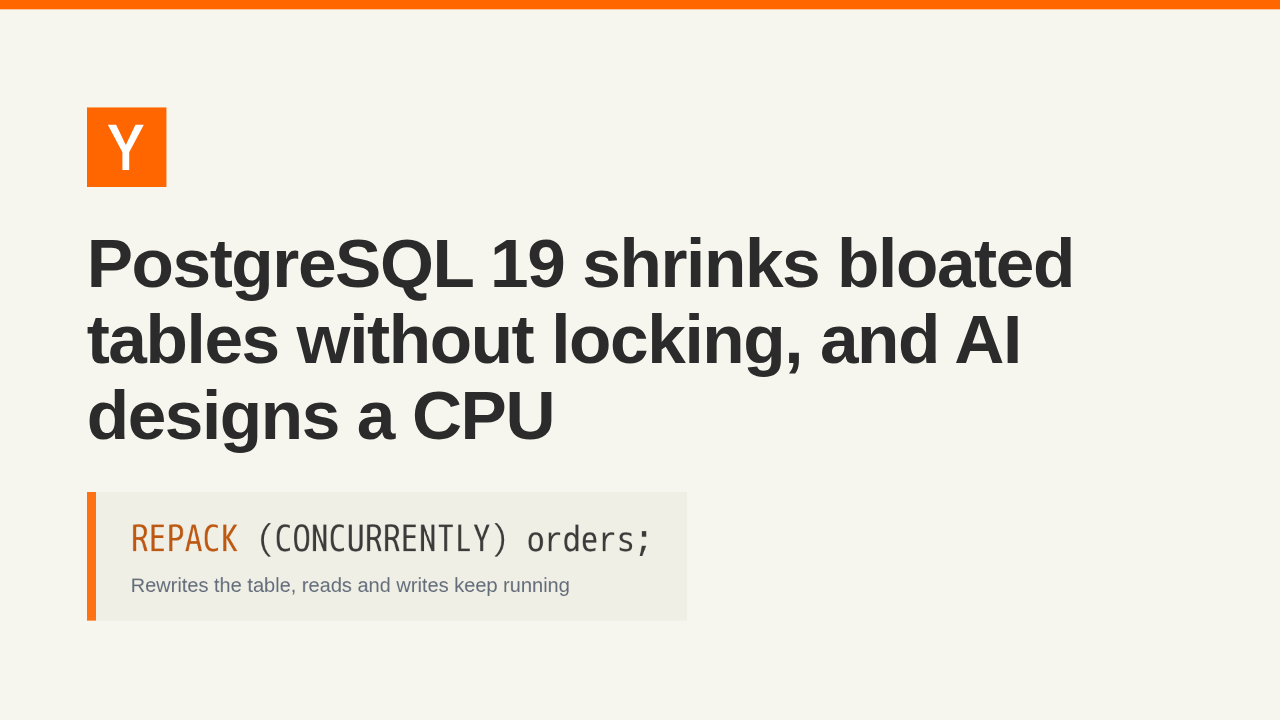
On Friday's Hacker News front page, PostgreSQL 19 shipped with a new command, REPACK. It takes over from VACUUM FULL and CLUSTER, rewriting a table to hand back the disk space its dead rows were holding. With the concurrently option, it does that without blocking reads or writes. Until now that took an extension such as pg_repack.
Slide text

PostgreSQL 19 shrinks bloated tables without locking, and AI designs a CPU
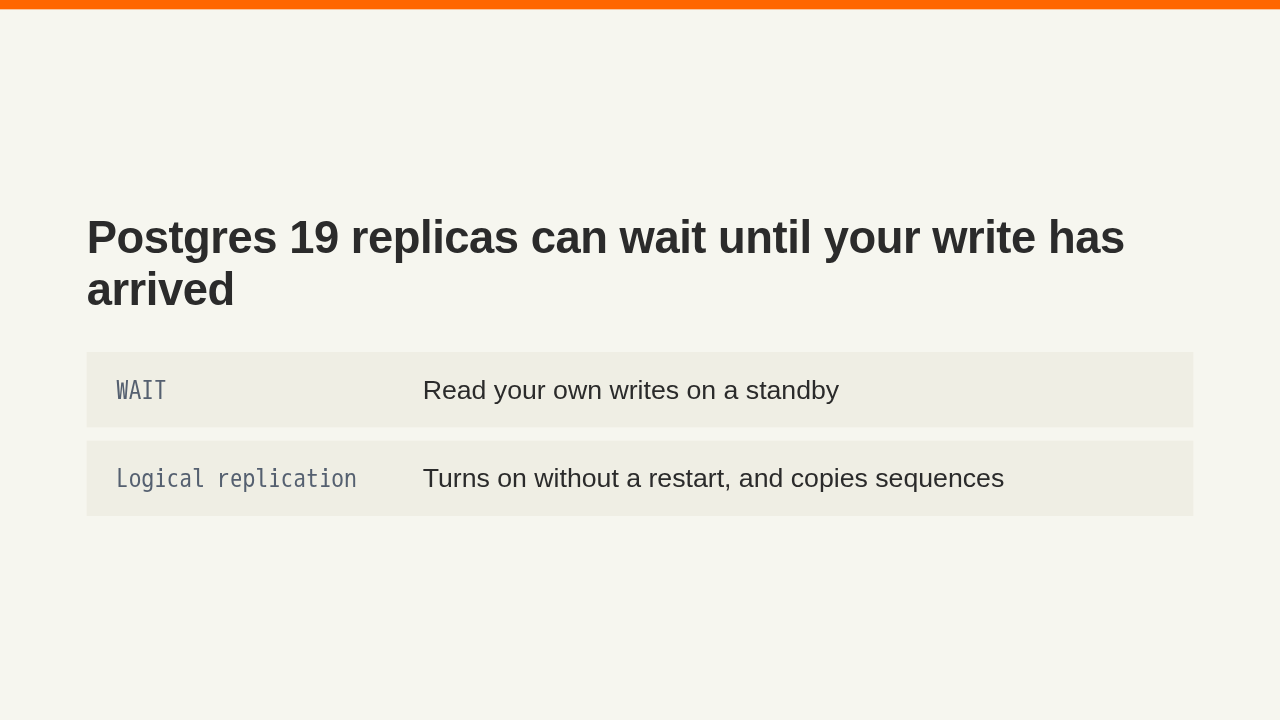
REPACK (CONCURRENTLY) orders;Rewrites the table, reads and writes keep runningPostgres 19 also gives standbys a new WAIT command. After an app writes to the primary, it can have a replica wait until that write has been replayed, so the user sees what they just saved. Logical replication can now be switched on without restarting the server, and it can copy sequence values to the subscriber, which takes a manual step out of major-version upgrades.
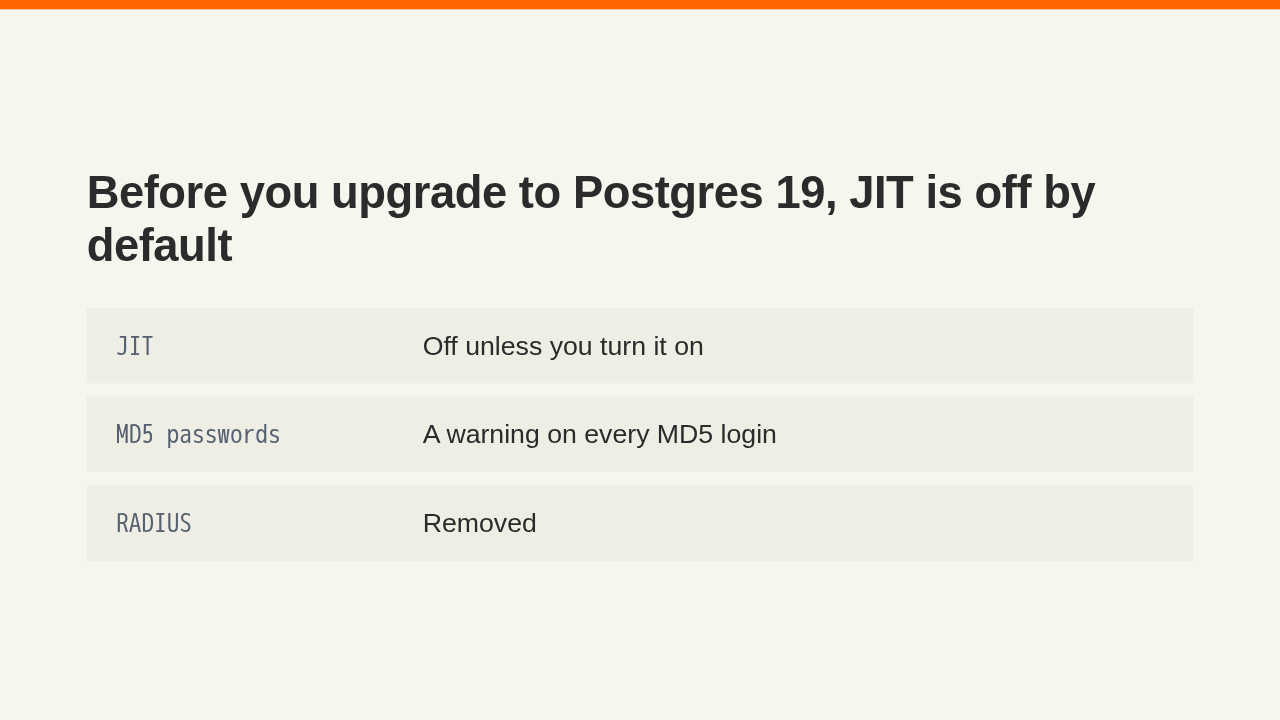
Some defaults move in Postgres 19. JIT compilation is now off, because the cost estimates that switched it on proved unreliable. BitPirate says it badly slowed queries that were already well tuned. Sites running many large analytical queries will want to turn it back on. Logins with MD5 passwords now raise a warning, and RADIUS support is gone. lfittl suggests critical production systems still wait for the first point release.
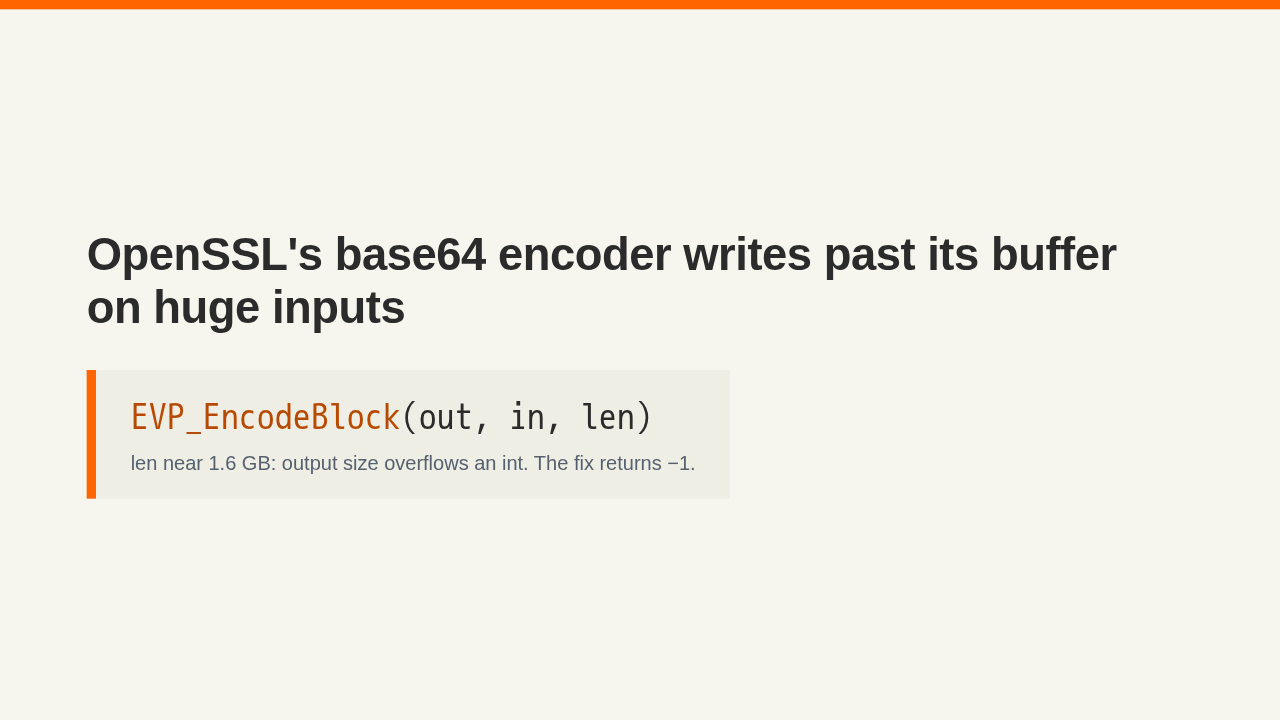
OpenSSL has a buffer overflow rated 9.8 out of 10. Its base64 encoder, EVP_EncodeBlock, works out the output size in a plain int. Give it about 1.6 gigabytes of input and that sum overflows, so the function writes past the end of the caller's buffer. The fix makes it return minus one for oversized, negative or null input, and the advisory is still pending. One way in is a huge proxy password passed to the s client command. userbinator argues the score overstates it, since an attacker has to get that much untrusted data into the call, and a TLS handshake doesn't use base64 at all.
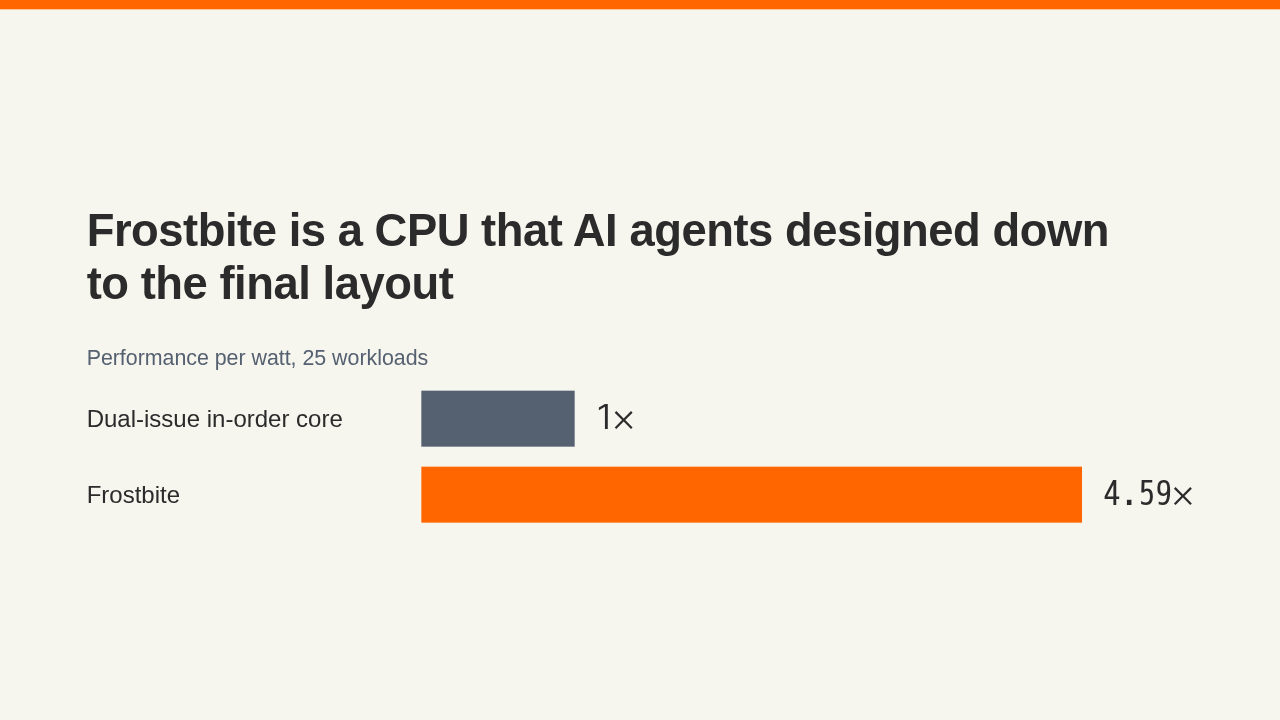
Architect Labs introduced Frostbite, a general-purpose CPU whose instruction set, microarchitecture, verification and final layout were iterated by its AI agents. It runs programs compiled to interaction nets, graphs where every value has one owner and every step is local, so the parallelism comes from the program itself, with no threads or locks and much smaller caches. Across 25 workloads, it delivers about four and a half times the performance per watt of a dual-issue in-order core. Those are pre-silicon power figures, and comparisons with out-of-order CPUs are still to come. pizza234 objected to the in-order baseline, and kragen replied that out-of-order cores do worse on performance per watt anyway.
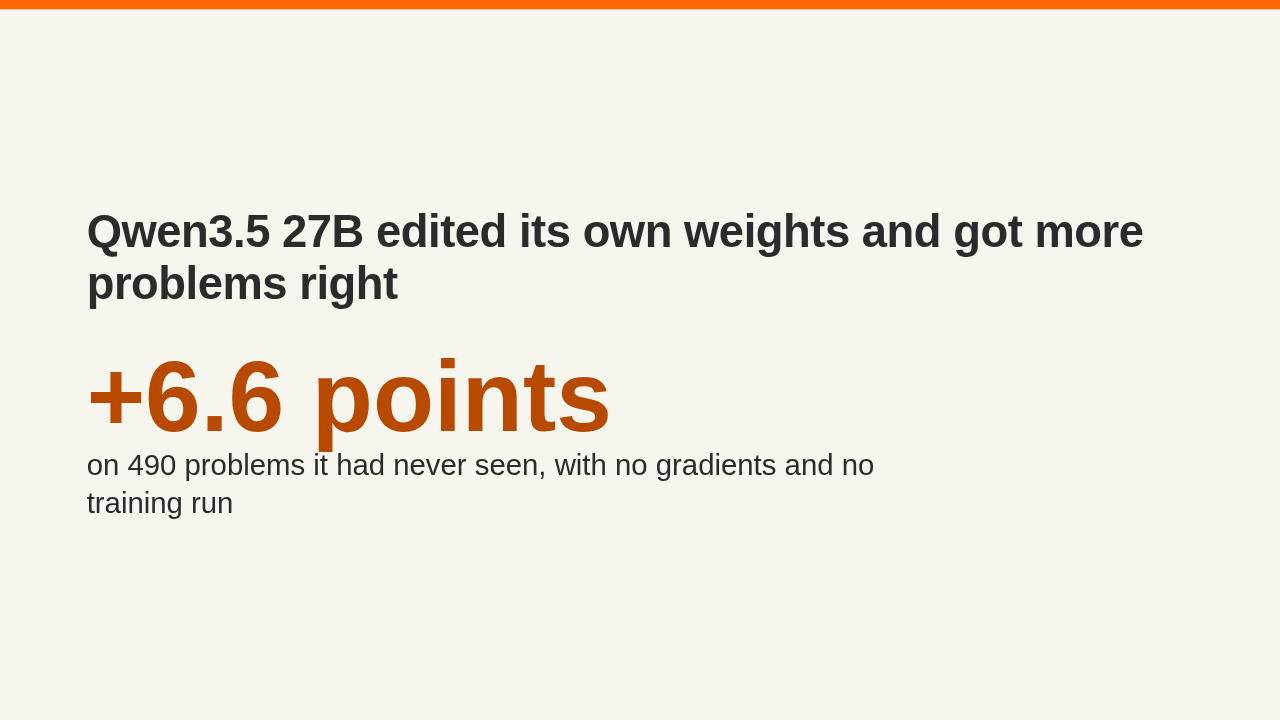
Researchers gave an open model, Qwen3.5 27B, its own weights, its graded answers and the ability to run itself, and let it edit those weights with no gradients and no training. It found that four in five of its answers ran out of tokens before finishing, and removed the direction in its hidden states that kept it talking. On 490 problems it had never seen, it got about seven more right in every hundred. The smaller models in the same family made no edit or broke themselves. aesthesia points out that the one fix was shorter reasoning, an obvious flaw to correct.
Up next
 3:06
The Riemann Hypothesis, proved with Claude in Lean, and a GPGME double free
@hacker-news
14 hours ago
 3:27
Ruby2ßhell runs code on stock Rails before login, and a JVM fix waited two months
@hacker-news
2 days ago
 3:49
Nginx bugs let anyone run code on your server, ONNX Runtime goes dark, and Quad9 leaves France
@hacker-news
3 days ago
 4:15
Optimizely served malware on Zoom and GitLab, and Windows 11 logs your coding agents
@hacker-news
4 days ago
 4:10
uBlock Origin fixes a one-click XSS, ParadeDB joins, and free CMU courses
@hacker-news
5 days ago
 4:01
All AI code should be open source, and a chlorine alarm lost in a Microsoft 365 outage
@hacker-news
5 days ago
 4:19
Lovable apps leak passports, ggml hits 1.0, and Qwen3.8 27B fits a 24 GB Mac
@hacker-news
1 week ago
 3:43
Edge0-145B runs on one 16 GB NVIDIA card, and Brave sells search to AI agents
@hacker-news
1 week ago
 4:20
Apache’s HTTP/2 bug lets anyone run code, and Gemini 4 Hydrogen replaces Flash
@hacker-news
1 week ago
 4:01
AWS Emulator puts AWS on your laptop, and Apple's Harbor pools Macs for AI
@hacker-news
1 week ago
 3:40
Claude Fable 5.2 gets cheaper, and Amazon swaps Sonnet for Strands Decider
@hacker-news
1 week ago
 3:37
Claude Fable 5.2 runs faster for less, a number plate unlocks cars, and a $385 Raspberry Pi
@hacker-news
1 week ago