Claude Fable 5.2 gets cheaper, and Amazon swaps Sonnet for Strands Decider
3 days ago
Claude Fable 5.2 costs less and runs faster than Fable 5.1, and on High effort it matches Opus 5.5's best coding score for about half the cost. Also from Tuesday's Hacker News front page: AlphaProof Code's proof of Signal's compiled code, async moving into the .NET 11 runtime, and Amazon replacing Claude Sonnet 4.6 with Strands Decider for ticket labeling. Claude Fable 5.2 and Mythos 5.2, by Anthropic https://www.anthropic.com/claude-fable-and-mythos-5-2 Discussion: https://news.ycombinator.com/item?id=50429068 postalcoder on Fable 5.2 against Opus 5.5: https://news.ycombinator.com/item?id=50430766 kragen's first code review with Fable 5.2: https://news.ycombinator.com/item?id=50436100 Introducing AlphaProof Code, by Google DeepMind https://deepmind.google/blog/introducing-alphaproof-code/ Discussion: https://news.ycombinator.com/item?id=50439193 hedora on what the proofs can and cannot show: https://news.ycombinator.com/item?id=50442002 What's new in the .NET 11 runtime, on Microsoft Learn https://learn.microsoft.com/en-us/dotnet/core/whats-new/dotnet-11/runtime Discussion: https://news.ycombinator.com/item?id=50439284 Amazon saves millions by replacing Sonnet 4.6 with Strands Decider, by Carr Onstott and Mehul Jaiswal https://strandsagents.com/blog/amazon-saves-millions-replacing-sonnet-with-strands-decider/ Discussion: https://news.ycombinator.com/item?id=50436640 The front page that day: https://news.ycombinator.com/front?day=2026-11-10
Ask about this presentation
Chapters
Show transcriptHide transcript
On Tuesday's HN front page, Claude Fable 5.2 arrived, and it costs less than the model it replaces. It runs up to 30 percent faster than Fable 5.1, at 8 dollars per million input tokens and 40 per million output. It is already in Claude Code and on every major cloud. A fast mode doubles the price for up to two and a half times the speed. Mythos 5.2 is the same model with the cyber and biology safeguards relaxed, open only to approved security and life-science teams.
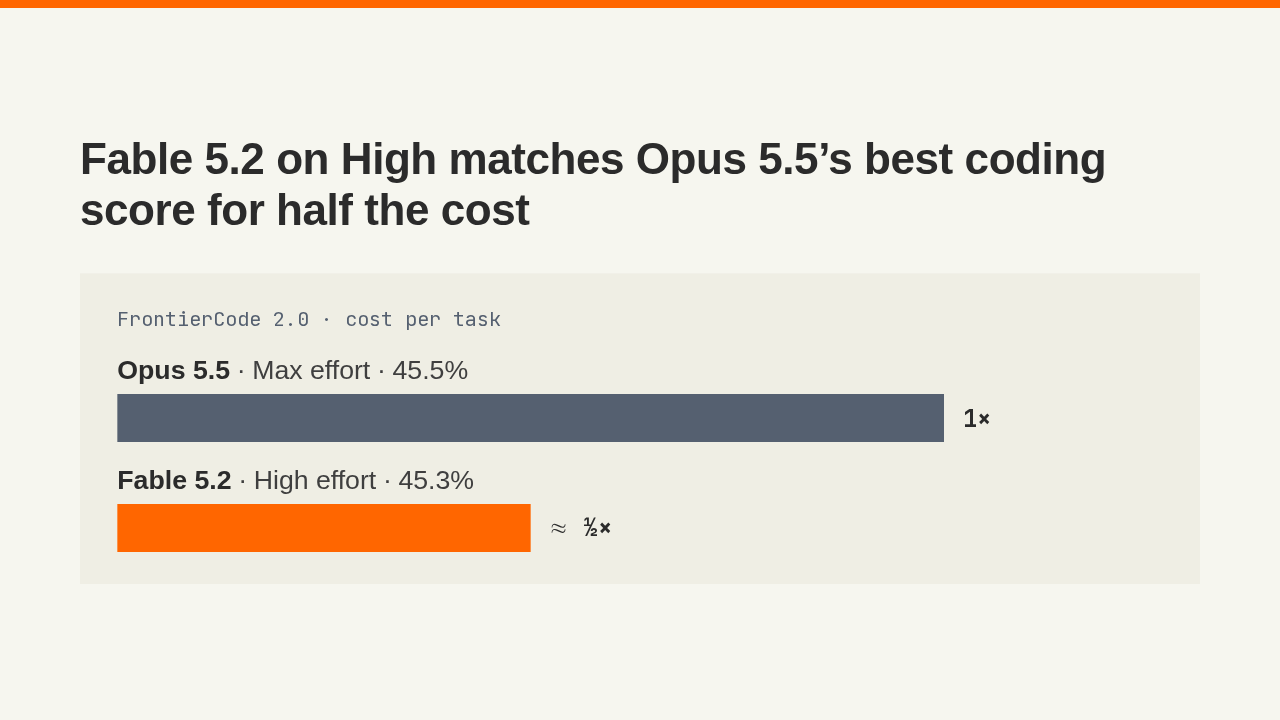
The coding test here asks whether open-source maintainers would merge the change. At High effort, Fable 5.2 gets as many changes merged as Opus 5.5 does at its maximum, and spends about half as much per task to get there. Turned all the way up, it gets more merged than any other released model. On Medium, the default in Claude Code, it finishes hard tasks in fewer tokens than Fable 5.1 did.
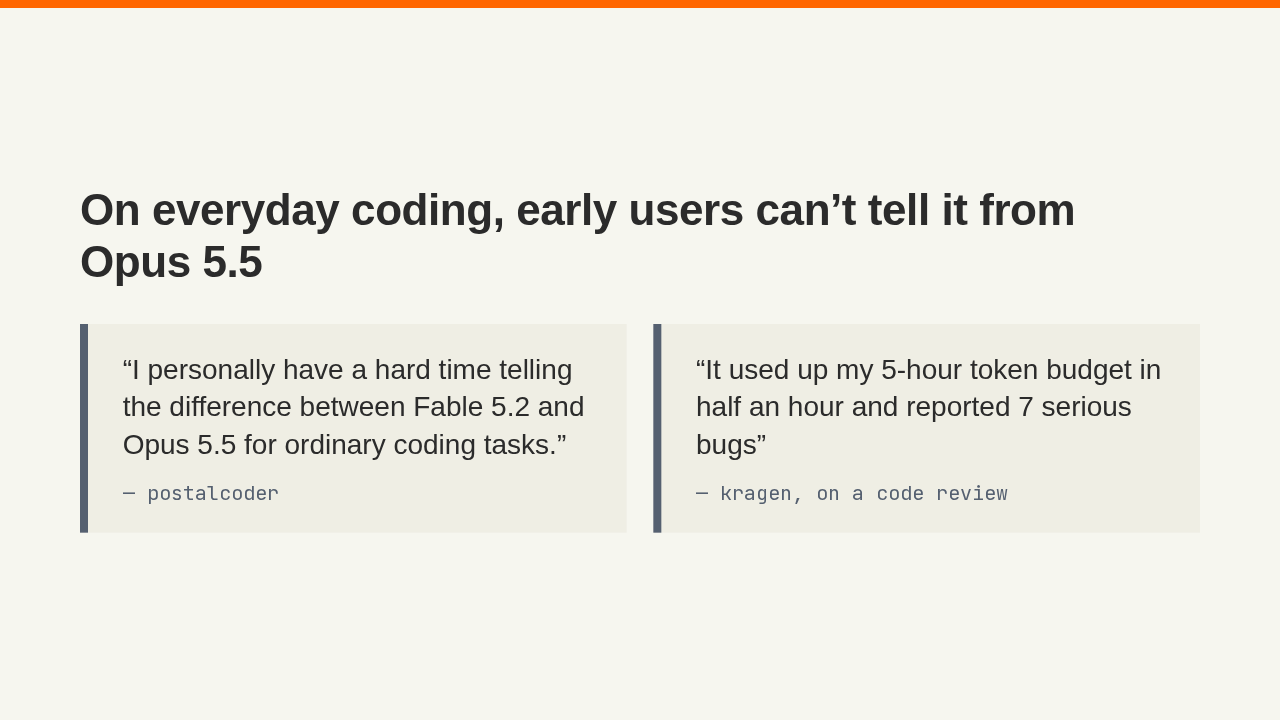
In the thread, postalcoder finds Fable 5.2 much faster and steadier than 5.1, but on ordinary coding can hardly tell it apart from Opus 5.5. It pulls ahead on long, deep jobs. When kragen asked it to review 11 days of work by Opus 5.5, it reported seven serious bugs, if they hold up, and burned a five-hour token budget in half an hour. Opus 5.5 stays the recommended starting point for most coding, with Fable kept for the most ambitious work.
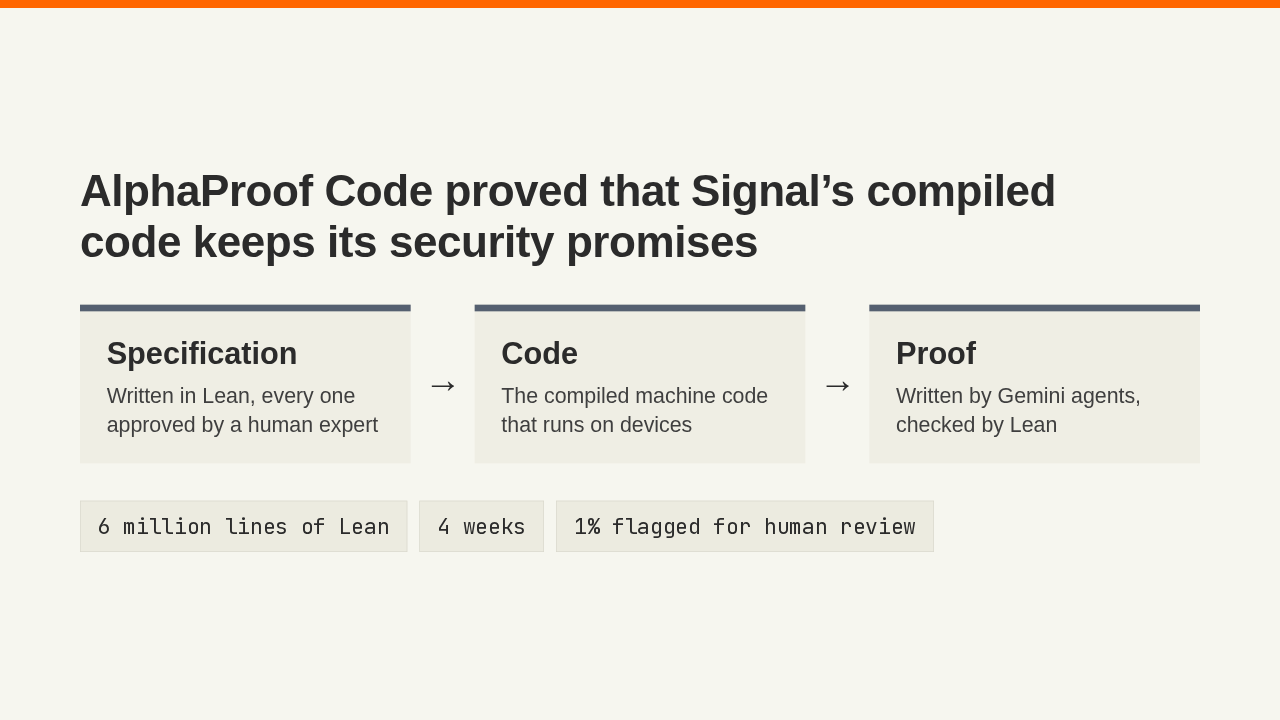
Google DeepMind's AlphaProof Code proved key security properties of the Signal protocol, all the way down to the compiled code that runs on phones. People wrote and approved the specifications, Gemini agents wrote the proofs, and Lean checked every step. That came to more than six million lines of Lean in four weeks, work that has taken expert teams years. To test it, the team put back two old bugs, and both times it proved the broken version insecure. In the thread, hedora points at the weak spot: a proof is only as good as its theorem, so everything rests on the specification saying the right thing.
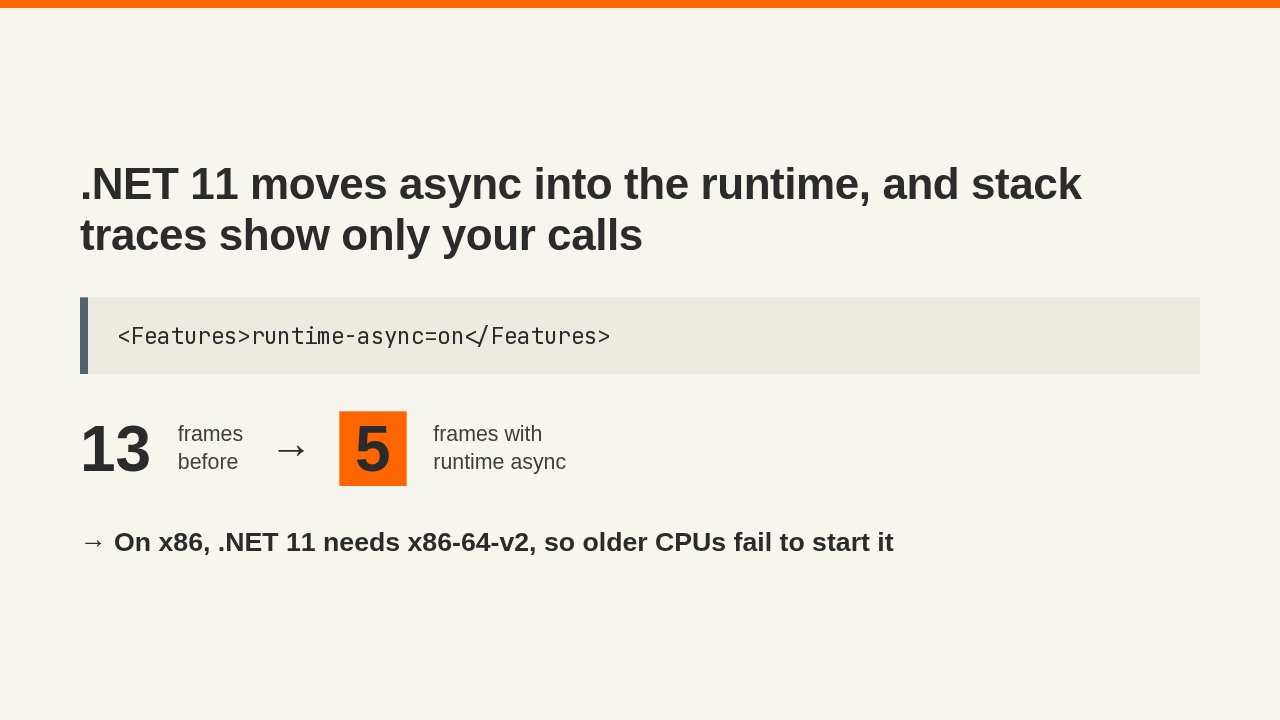
.NET 11 moves async into the runtime. The compiler no longer builds a state machine for every async method. The runtime suspends and resumes the method itself, so a debugger or profiler sees your real call chain: five frames where it used to see 13. It is still a preview you switch on per project, and .NET's own libraries already ship built this way. .NET 11 also raises the hardware floor. On Intel and AMD it now needs x86-64-v2, so the oldest chips, out of support since around 2013, fail to start it.
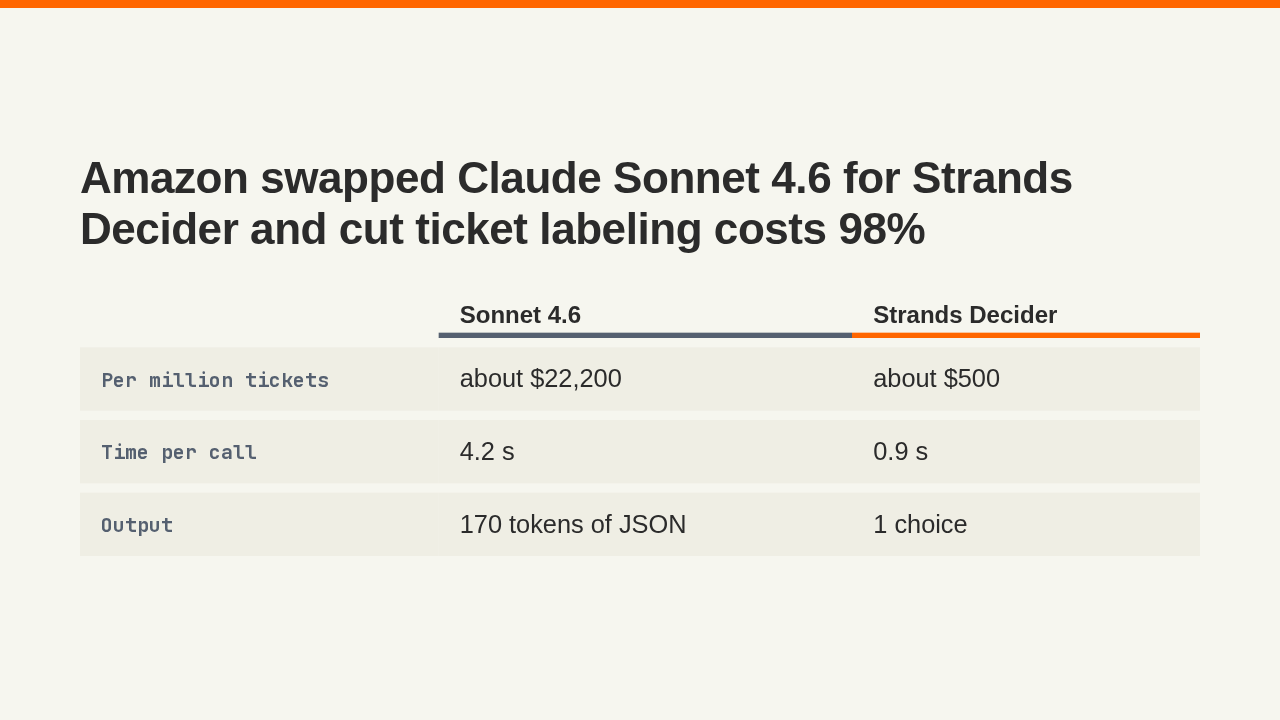
Strands Decider is a decision model. It writes no text: you give it a state, a question and a list of options, and it returns a probability for each option. Two Amazon engineers labeling tickets into 20 categories ran it beside Claude Sonnet 4.6 on the same real traffic, behind a switch, then turned Sonnet off. Each ticket now costs about a fortieth as much and comes back in under a second. It only works for a fixed list of choices that fits in a few thousand tokens. If you are paying a frontier model to pick from a fixed list, I would try a decision model first.
Up next
 3:43
Edge0-145B runs on one 16 GB NVIDIA card, and Brave sells search to AI agents
@hacker-news
23 hours ago
 4:20
Apache’s HTTP/2 bug lets anyone run code, and Gemini 4 Hydrogen replaces Flash
@hacker-news
1 day ago
 4:01
AWS Emulator puts AWS on your laptop, and Apple's Harbor pools Macs for AI
@hacker-news
2 days ago
 3:37
Claude Fable 5.2 runs faster for less, a number plate unlocks cars, and a $385 Raspberry Pi
@hacker-news
4 days ago
 4:15
Pi replaces Claude Code, Goldman cuts its traders off, and DeepSeek fits in 64 GB
@hacker-news
5 days ago
 4:12
Libghostty 1.0 is stable, your Mac maps your family, and Discord drops Electron
@hacker-news
6 days ago
 3:49
BUI puts Blender’s UI in your app, Firenook speeds up Firebase emulators, and ASN blocks GrapheneOS
@hacker-news
1 week ago
 4:24
Alpine’s OpenSSH lets a 300-character password in, GPT-6 Astra slacks on safety research, and Discord drops Electron
@hacker-news
1 week ago
 3:59
Nvidia RTX Spark runs local AI five times slower on Linux, and a fake interview cost Binance $6.3B
@hacker-news
1 week ago
 3:15
GPT-6 Astra reads raw weights only on tiny networks, and Postman installs itself into Codex
@hacker-news
1 week ago
 3:13
Postgres 19 slips because AI finds its bugs, Astra fixes Qwen by editing its weights, and Ubuntu waits on a 9.8
@hacker-news
1 week ago
 3:49
Hono+htmx and Astro cost Claude least to build, Brazil fines a hidden prompt, and Zamzar turns 20
@hacker-news
1 week ago