All AI code should be open source, and a chlorine alarm lost in a Microsoft 365 outage
2 days ago
Jakub Jankiewicz argues that all AI-generated code should be open source, and the thread answers with what US copyright law already says about prompts and human edits. Also from Sunday's Hacker News front page: a hotel pool's chlorine alarm that went only to email during a Microsoft 365 outage, the DRAM supply suit against Samsung, SK Hynix and Micron going ahead, and the flicker in the OLED MacBook Pro. All AI-generated code should be Open Source, by Jakub T. Jankiewicz https://jakub.jankiewicz.org/blog/ai-code-open-source/ Discussion: https://news.ycombinator.com/item?id=50507303 jrmg on the US Copyright Office's conclusions: https://news.ycombinator.com/item?id=50507828 glitchc on why no license can govern uncopyrightable code: https://news.ycombinator.com/item?id=50507718 US Copyright Office, Copyright and Artificial Intelligence, Part 2: Copyrightability: https://www.copyright.gov/ai/Copyright-and-Artificial-Intelligence-Part-2-Copyrightability-Report.pdf Microsoft 365 outage leads to chlorine gas poisoning of 15 hotel guests (WDR, in German) https://www1.wdr.de/nrw/rheinland/rhein-erft-kreis/technischer-defekt-chlor-phantasialand-100.html Discussion: https://news.ycombinator.com/item?id=50509411 amluto on how closed-loop chlorination fails: https://news.ycombinator.com/item?id=50511665 Court denies motion to dismiss DRAM price fixing case https://litnews.ai/articles/garciaguirre-samsung-sk-hynix-micron-dram-conspiracy-suit-survives-dismissal Discussion: https://news.ycombinator.com/item?id=50502988 jeremyjh on why only three makers are left: https://news.ycombinator.com/item?id=50509027 The MacBook Pro's OLED PWM problem, by MacAnorak https://macanorak.com/the-macbook-pros-oled-pwm-problem-when-a-better-display-becomes-worse-to-use/ Discussion: https://news.ycombinator.com/item?id=50506719
Links
- All AI-generated code should be Open Sourcejakub.jankiewicz.org
- Threadnews.ycombinator.com
- US Copyright Office, Part 2 Copyrightability reportcopyright.gov
- WDR on the Phantasialand chlorine accidentwww1.wdr.de
- Threadnews.ycombinator.com
- LitNews on the DRAM rulinglitnews.ai
- Threadnews.ycombinator.com
- The MacBook Pro's OLED PWM problemmacanorak.com
- Threadnews.ycombinator.com
- Front pagenews.ycombinator.com
Ask about this presentation
Chapters
Show transcriptHide transcript
On Sunday's Hacker News front page, the developer Jakub Jankiewicz argued that every line of code an AI writes for you should be released as open source. The essay aims it at companies as well as individual developers, and above all at unreviewed code whose only human input was the prompt. Many of the replies came from developers who direct coding agents on closed products and say that work is theirs.
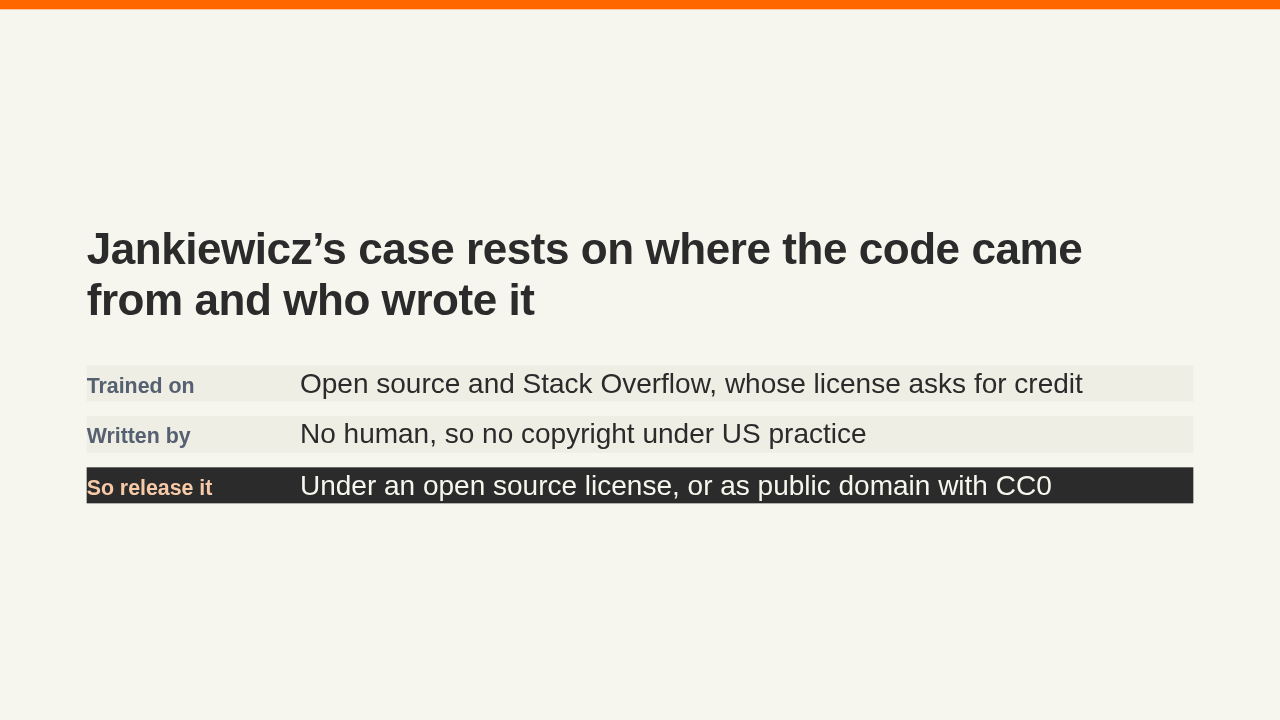
The models learned from decades of open source code and from Stack Overflow answers, which carry a Creative Commons license that requires attribution. Turning that into closed code is license laundering, in Jankiewicz's words. Code a machine wrote has no human author, and since the monkey selfie case, American law gives a non-human no copyright. Because Britain and other countries treat machine-made work differently, Jankiewicz wants developers to settle it themselves: an open source license, or a Creative Commons Zero dedication to the public domain.
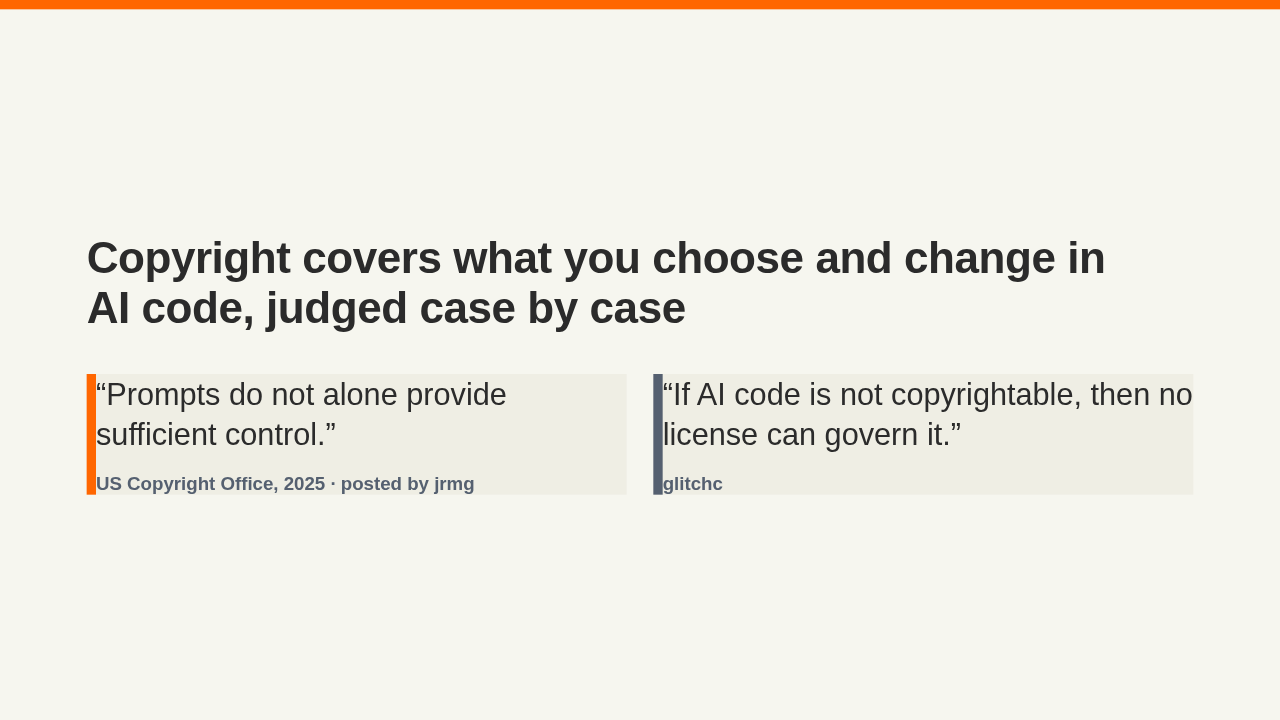
In the thread, jrmg posted the United States Copyright Office's conclusions on AI from last year. Output you only prompted for gets no copyright. What you select, arrange or change by hand stays protected, judged case by case. So the part of a codebase you shaped is yours, whatever wrote the first draft. glitchc found the gap in the essay: a license is permission granted by a copyright holder, so if AI code has no copyright, an open source license can't bind it either.
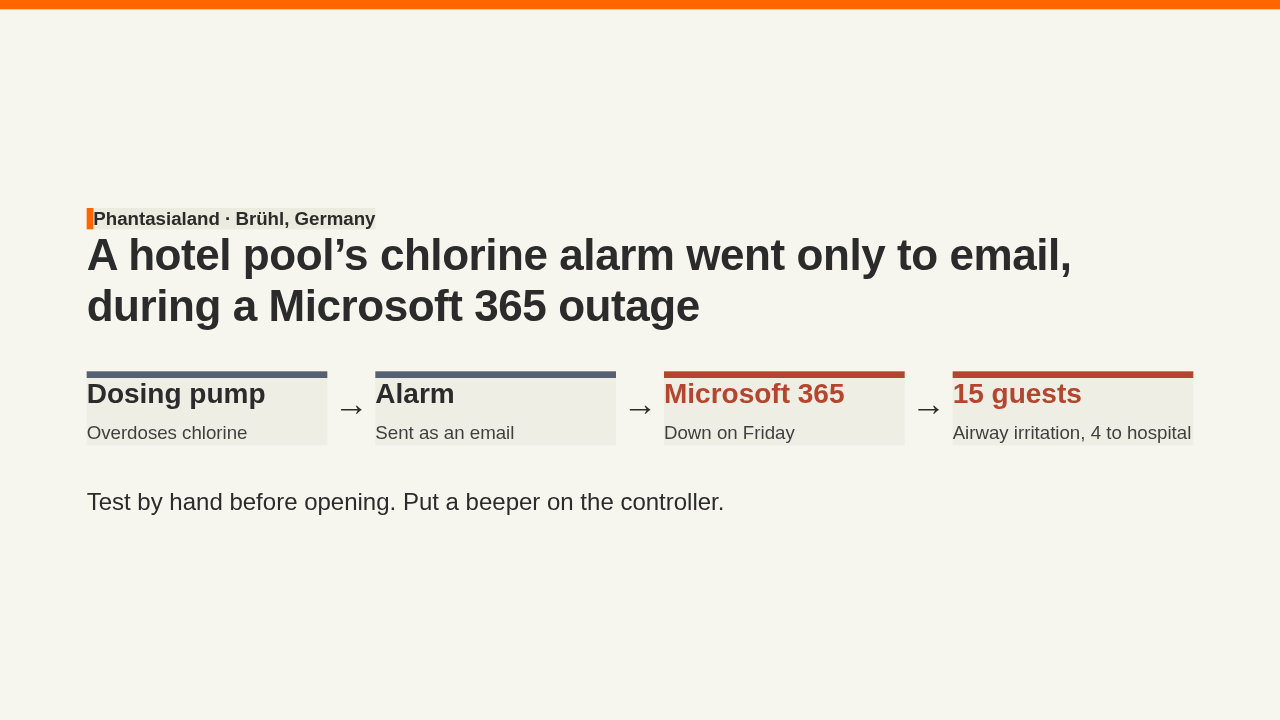
At the Phantasialand theme park's hotel near Cologne, the pool's automatic dosing pump broke and pumped in far too much chlorine. The safety system raised the alarm by email, on the Friday Microsoft 365 went down, so the alarm never arrived. Fifteen guests were hurt, most with irritated airways, and four went to hospital. A security architect put the fault with the hotel: a warning system that protects people can't depend on one inbox. amluto, who runs a closed-loop chlorination system, added that the sensors in these systems tend to fail by reading low, which makes the pump add more. Their rule is a hand test every day before the pool opens, and a controller that beeps.
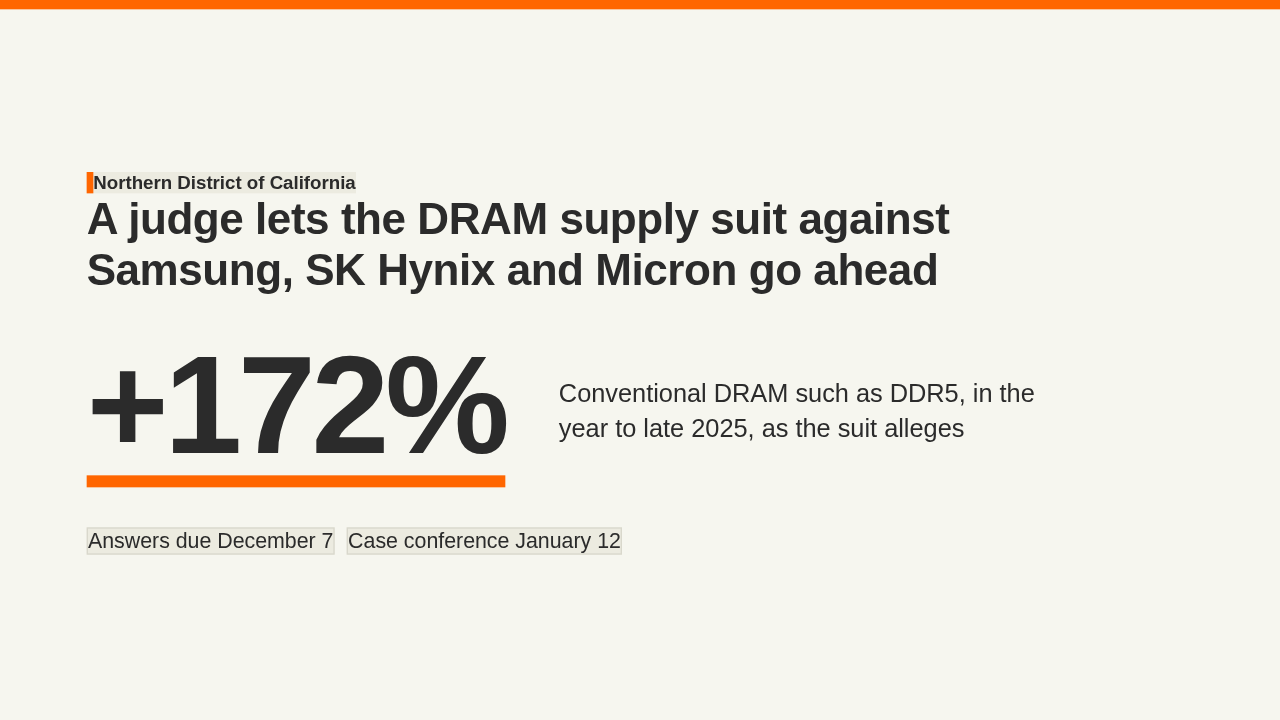
If you have priced RAM for a workstation this year, this case is about you. Judge Noël Wise refused to dismiss a class action claiming that Samsung, SK Hynix and Micron agreed to cut ordinary DRAM, the DDR5 in a desktop PC, and move their factories to HBM for AI chips. The suit puts the rise in ordinary memory prices at about 170 percent in one year. The judge wrote that the three companies looked less like hawks watching each other than hawks flying in formation. The companies answer by December 7, and the first case conference is in January. In the thread, jeremyjh argued that only three makers are left because rivals went bust building factories for demand that had faded by the time they opened.
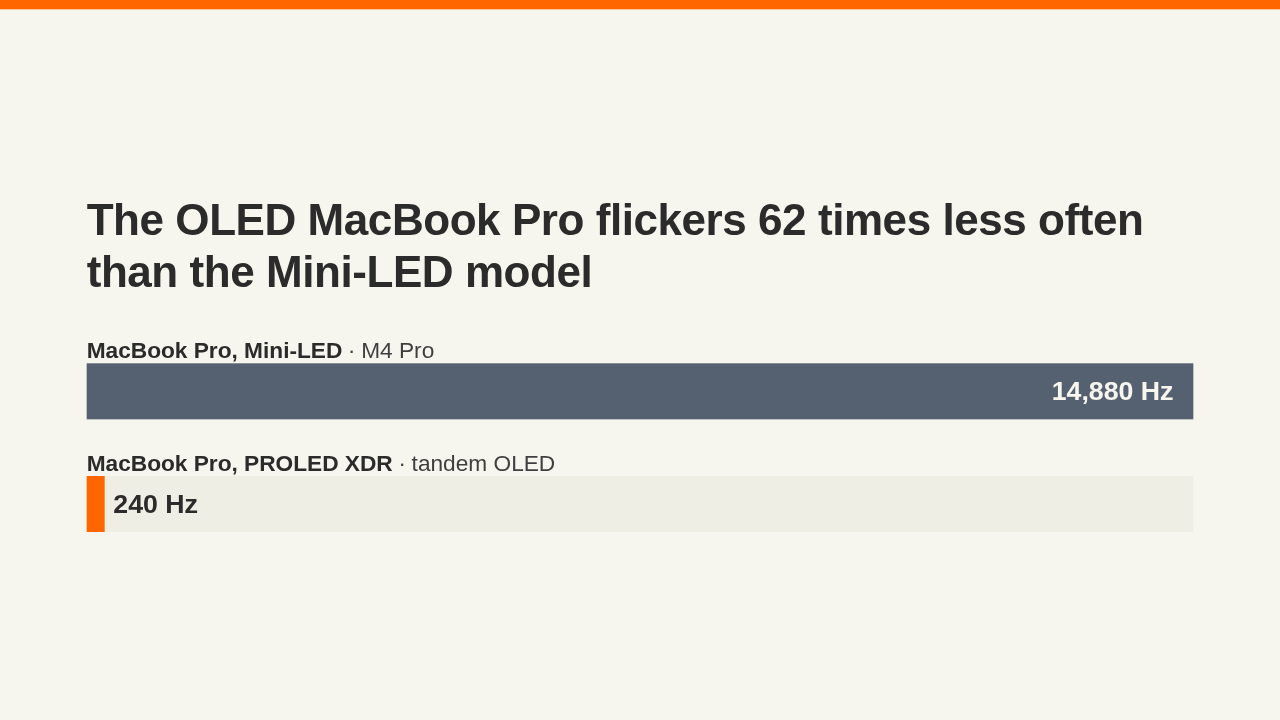
Apple's new MacBook Pro with the tandem OLED display controls brightness partly by flickering, and it does it slowly. It flickers about 240 times a second at nearly every brightness setting. The Mini-LED MacBook Pro flickers almost 15,000 times a second. Some owners who used OLED iPhones for years without trouble report headaches and dizziness, and are sending the laptop back. The iPhone has a setting that smooths the flicker; the Mac doesn't yet. If you look at a screen all day, try the OLED model for a full working day before you buy, or choose the Mini-LED model, which Apple still sells.
Up next
 3:27
Ruby2ßhell runs code on stock Rails before login, and a JVM fix waited two months
@hacker-news
5 hours ago
 3:49
Nginx bugs let anyone run code on your server, ONNX Runtime goes dark, and Quad9 leaves France
@hacker-news
1 day ago
 4:15
Optimizely served malware on Zoom and GitLab, and Windows 11 logs your coding agents
@hacker-news
2 days ago
 4:10
uBlock Origin fixes a one-click XSS, ParadeDB joins, and free CMU courses
@hacker-news
2 days ago
 4:19
Lovable apps leak passports, ggml hits 1.0, and Qwen3.8 27B fits a 24 GB Mac
@hacker-news
5 days ago
 3:43
Edge0-145B runs on one 16 GB NVIDIA card, and Brave sells search to AI agents
@hacker-news
6 days ago
 4:20
Apache’s HTTP/2 bug lets anyone run code, and Gemini 4 Hydrogen replaces Flash
@hacker-news
1 week ago
 4:01
AWS Emulator puts AWS on your laptop, and Apple's Harbor pools Macs for AI
@hacker-news
1 week ago
 3:40
Claude Fable 5.2 gets cheaper, and Amazon swaps Sonnet for Strands Decider
@hacker-news
1 week ago
 3:37
Claude Fable 5.2 runs faster for less, a number plate unlocks cars, and a $385 Raspberry Pi
@hacker-news
1 week ago
 4:15
Pi replaces Claude Code, Goldman cuts its traders off, and DeepSeek fits in 64 GB
@hacker-news
1 week ago
 4:12
Libghostty 1.0 is stable, your Mac maps your family, and Discord drops Electron
@hacker-news
1 week ago