Libghostty 1.0 is stable, your Mac maps your family, and Discord drops Electron
1 day ago
Libghostty 1.0 makes Ghostty's terminal core a stable C library that JetBrains IDEs already run on and Neovim is adopting. Also from Saturday's Hacker News front page: the knowledge graph and family classifier inside every Mac, Pivot's faster top-K GROUP BY, and Discord's Rust client that replaces Electron. Libghostty 1.0, by Mitchell Hashimoto https://mitchellh.com/writing/libghostty-1-0 Discussion: https://news.ycombinator.com/item?id=50399933 Every Mac comes with an (undocumented) family member classifier, by Dario Pasquini and Michał Bazyli https://8rank.ai/game/apple-intelligence-personal-knowledge-graph Discussion: https://news.ycombinator.com/item?id=50403097 aetherspawn on why the graph exists: https://news.ycombinator.com/item?id=50403752 Can GROUP BY still be optimized after all these years? https://pivotlake.io/blog/know-your-limit-faster-top-k-aggregation/ Discussion: https://news.ycombinator.com/item?id=50354097 malisper on the count-min sketch: https://news.ycombinator.com/item?id=50402082 Every Windows 11 app should kill Electron, and Discord just showed why, by Windows Latest https://www.windowslatest.com/2026/11/06/every-windows-11-app-should-kill-electron-and-discord-just-showed-why-no-starting-screen-and-70-less-ram-even-with-two-accounts-signed-in/ Discussion: https://news.ycombinator.com/item?id=50403507 Doohickey-d on Electron's accessibility: https://news.ycombinator.com/item?id=50404391 The front page that day: https://news.ycombinator.com/front?day=2026-11-07
Ask about this presentation
Chapters
Show transcriptHide transcript
On Saturday's HN front page, libghostty reached 1.0. It is the terminal emulator at the core of Ghostty, pulled out into a portable C library, and as of this release both the library and its C ABI are stable. You can now build a terminal in about 1,500 lines of C that beats most terminals you can install on features and speed.
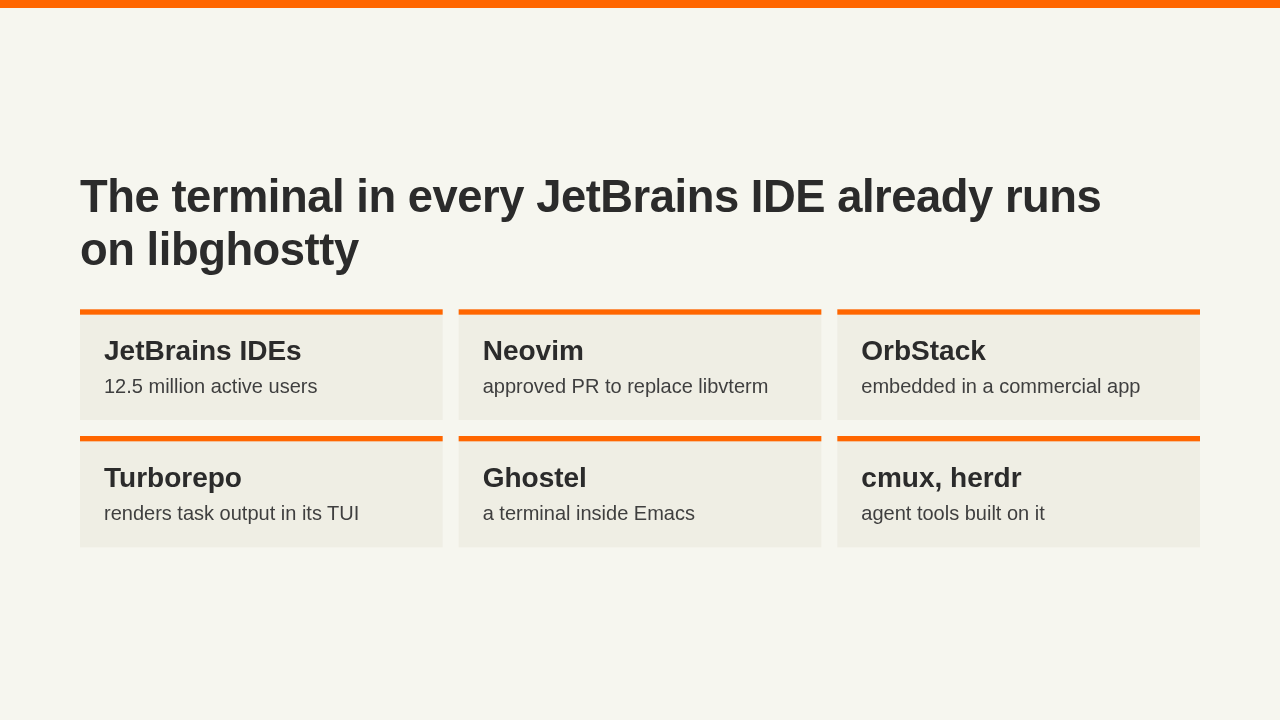
If you use IntelliJ, PyCharm or GoLand, you are already typing into it: that is more than 12 million people. Neovim has approved a pull request that swaps libvterm for libghostty and closes a ten-year-old bug about reflowing scrollback on resize. Its maintainers were waiting for a tagged release so distributions could package it, and 1.0 is that release. More people now use a terminal built on libghostty than use Ghostty itself.
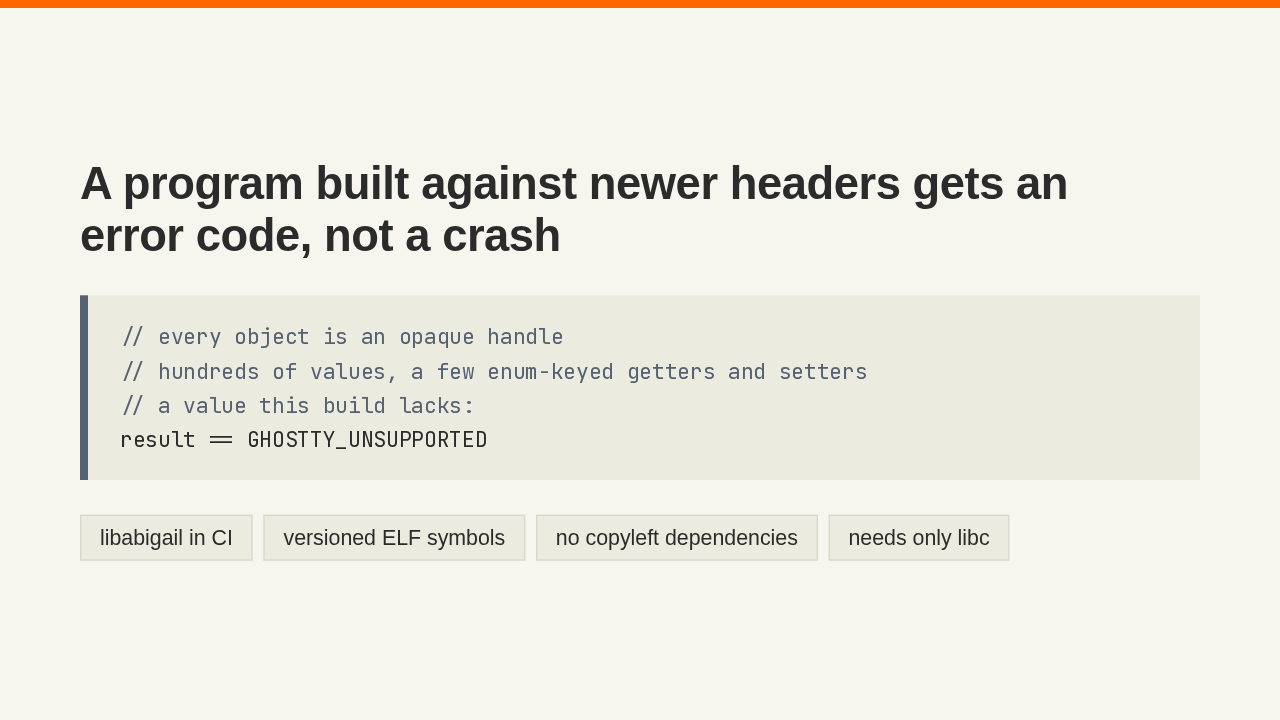
That stability lets a distribution ship one shared copy for every app to link against. Every object is an opaque handle, and new settings go through the same few getters and setters, so adding one never adds a symbol. Link newer headers against an older library and you get an unsupported result instead of undefined behavior. Every change is checked against a committed ABI baseline in CI. At runtime it needs only libc, and the WebAssembly build is under a megabyte.
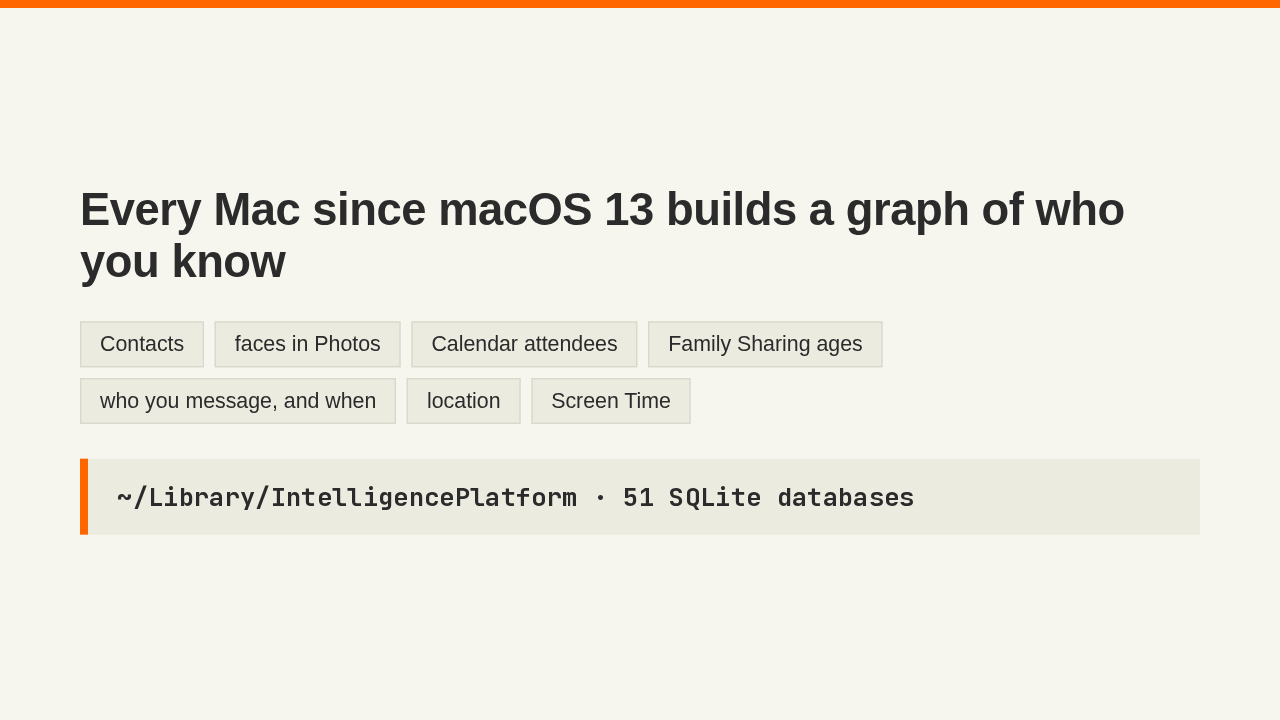
Two background daemons on every Mac since 2022 build a personal knowledge graph, and Apple's only documentation for them is a short man page. They cross-reference your contacts, the faces in your photos, calendar invites, the ages in Family Sharing, a log of who you message and when, and where you go. It all lands in 51 plain SQLite databases in your Library folder, behind Full Disk Access. The message log keeps who and when, and leaves out what was said.
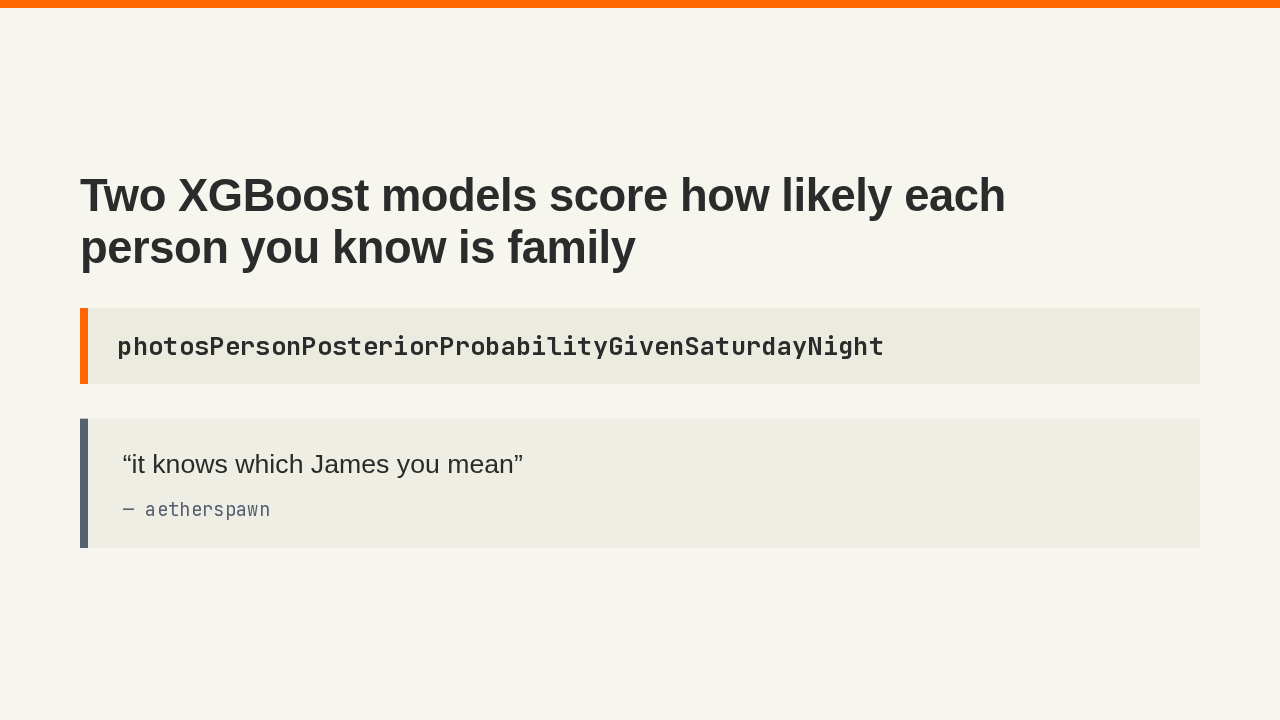
The graph also guesses relationships. Two small classifiers take 144 features and score each person on seventeen columns, from mother to coworker, recomputed every day. Most of those features track who you message and who is in your photos, by time of day. One is the chance a person is in your photos on a Saturday night. Apple gives you no general way to correct a wrong guess, but an open-source dashboard called iKnow lets you browse your own graph locally. In the thread, aetherspawn argues this is how Siri knows which James you mean, and it stays on the device.
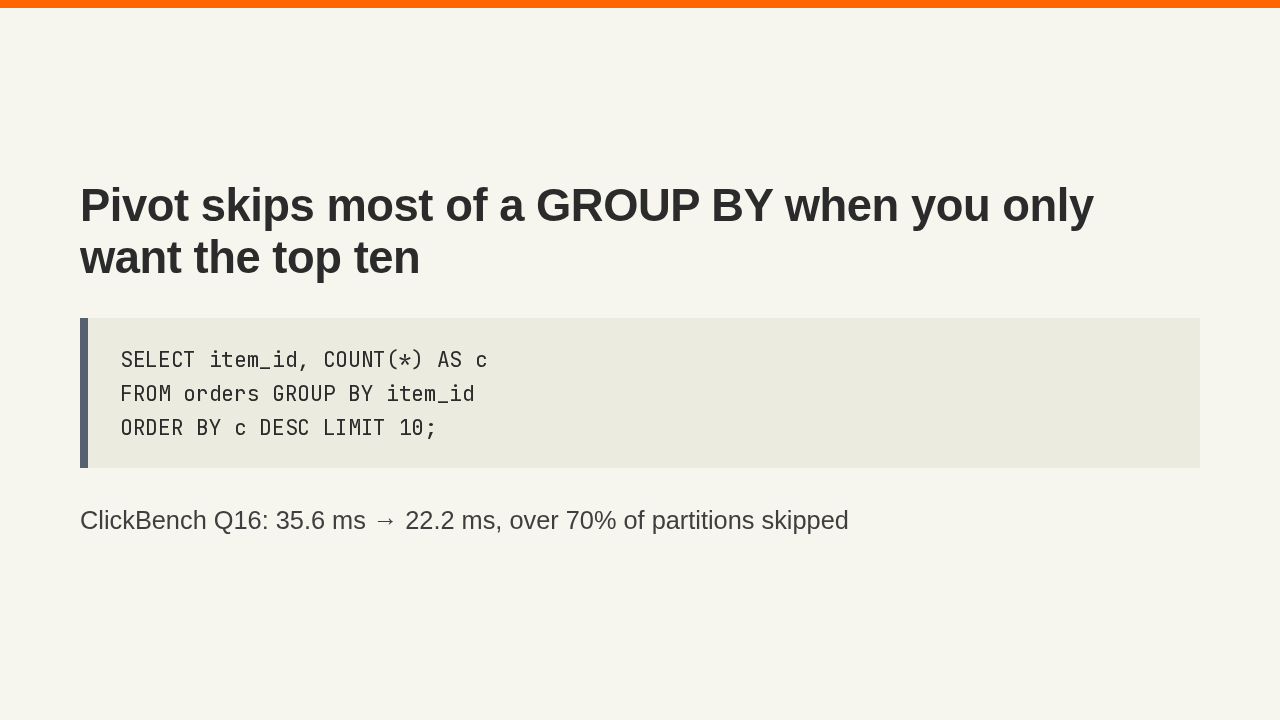
A query like this one splits its groups across many hash partitions and merges every one, even though the ten winners sit in ten of them at most. Pivot, an open-source analytics database, gives each partition a handful of counters, one per hash slot. If every slot is below the current tenth place, no group in that partition can win, so it skips the merge. On a ClickBench query of this shape, that cuts the time by more than a third. malisper points out in the thread that the structure is a count-min sketch.
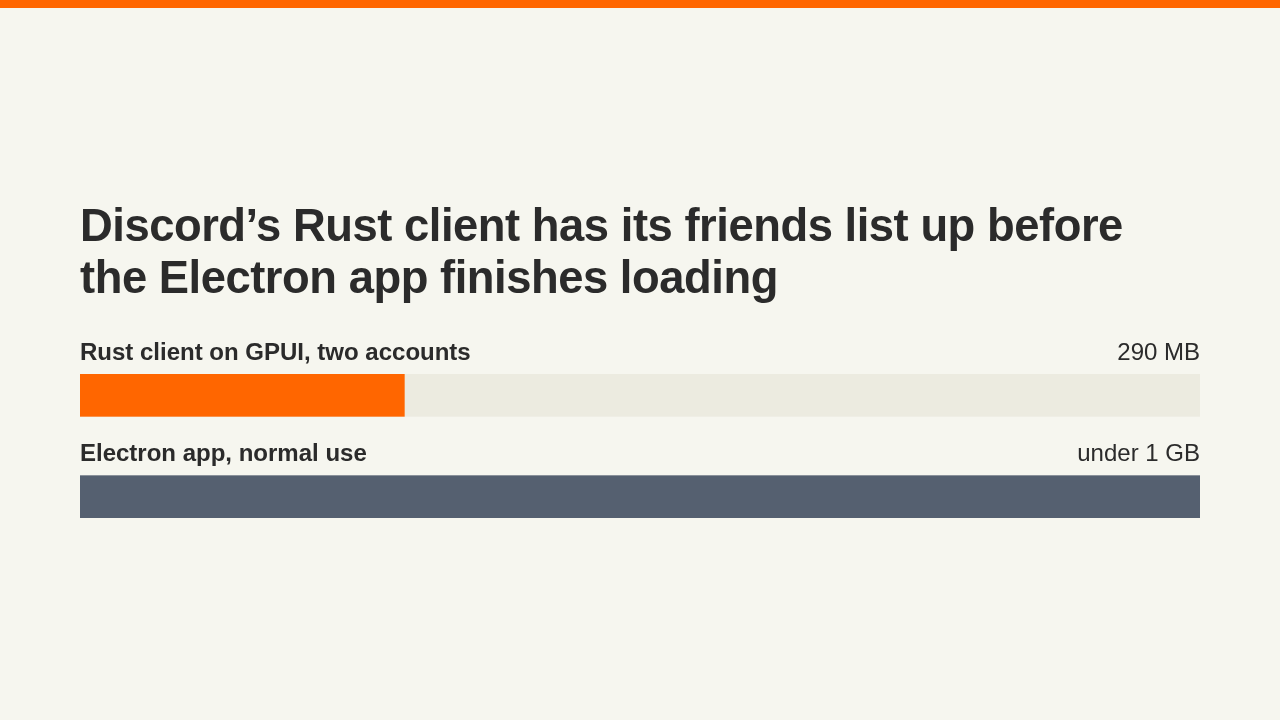
Discord is rebuilding its desktop app in Rust on GPUI, the GPU-drawn UI framework from the makers of Zed, with no HTML in it. In a cold-start clip on two Windows laptops, the new client skips the Starting screen and updates itself in the background. It held two accounts signed in at once in about 290 megabytes, where the Electron app normally sits under a gigabyte.
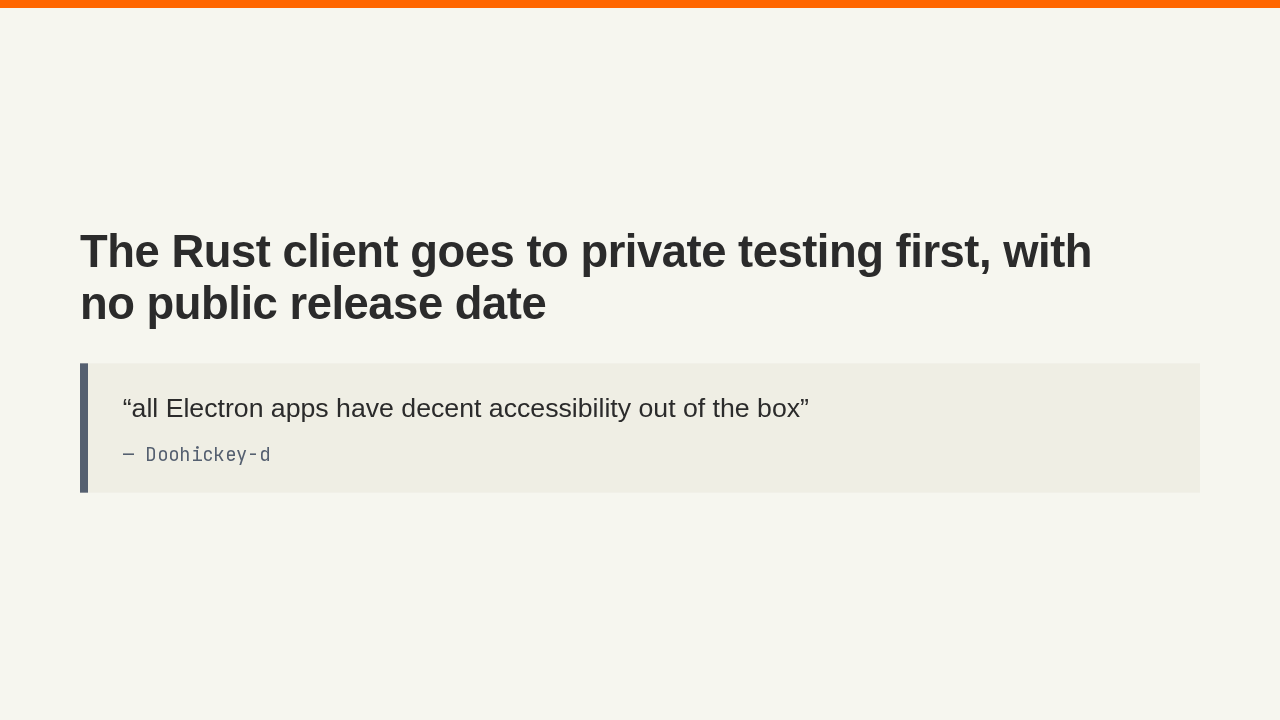
You can't install it yet. The client goes into private testing soon, on Windows, Mac and Linux. Doohickey-d points to what Electron gives you for free: screen readers and non-English input methods, where most Rust toolkits still lagged in 2025. For an app people leave open all day, I would take Discord's route. For a tool you open for a minute and quit, Electron is still a fair trade.
Up next
 4:15
Pi replaces Claude Code, Goldman cuts its traders off, and DeepSeek fits in 64 GB
@hacker-news
15 hours ago
 3:49
BUI puts Blender’s UI in your app, Firenook speeds up Firebase emulators, and ASN blocks GrapheneOS
@hacker-news
2 days ago
 4:24
Alpine’s OpenSSH lets a 300-character password in, GPT-6 Astra slacks on safety research, and Discord drops Electron
@hacker-news
3 days ago
 3:59
Nvidia RTX Spark runs local AI five times slower on Linux, and a fake interview cost Binance $6.3B
@hacker-news
4 days ago
 3:15
GPT-6 Astra reads raw weights only on tiny networks, and Postman installs itself into Codex
@hacker-news
5 days ago
 3:13
Postgres 19 slips because AI finds its bugs, Astra fixes Qwen by editing its weights, and Ubuntu waits on a 9.8
@hacker-news
6 days ago
 3:49
Hono+htmx and Astro cost Claude least to build, Brazil fines a hidden prompt, and Zamzar turns 20
@hacker-news
1 week ago
 3:49
Linux’s TCP bug can root Go servers, one ChatGPT link took your account, and HackerTube
@hacker-news
1 week ago
 3:13
Anthropic files its S-1, coding agents cost up to 75% less to run, and Microsoft offers 60,000 buyouts
@hacker-news
1 week ago
 3:50
Goose outruns safe Rust with no heap, and a 2015 CNN beats GPT-6 Astra at skin cancer
@hacker-news
2 weeks ago
 4:10
Brotli needs patching in Node, Python and curl, Roc nears C, and uv check runs ty
@hacker-news
2 weeks ago
 3:59
Claude proves 123 libraries' fuzz tests can't crash, Kimi K3.1 Pro, and Docker is weird
@hacker-news
2 weeks ago