1Password’s breach spared the vaults, and matrix multiplication stops at 9/4
2 days ago
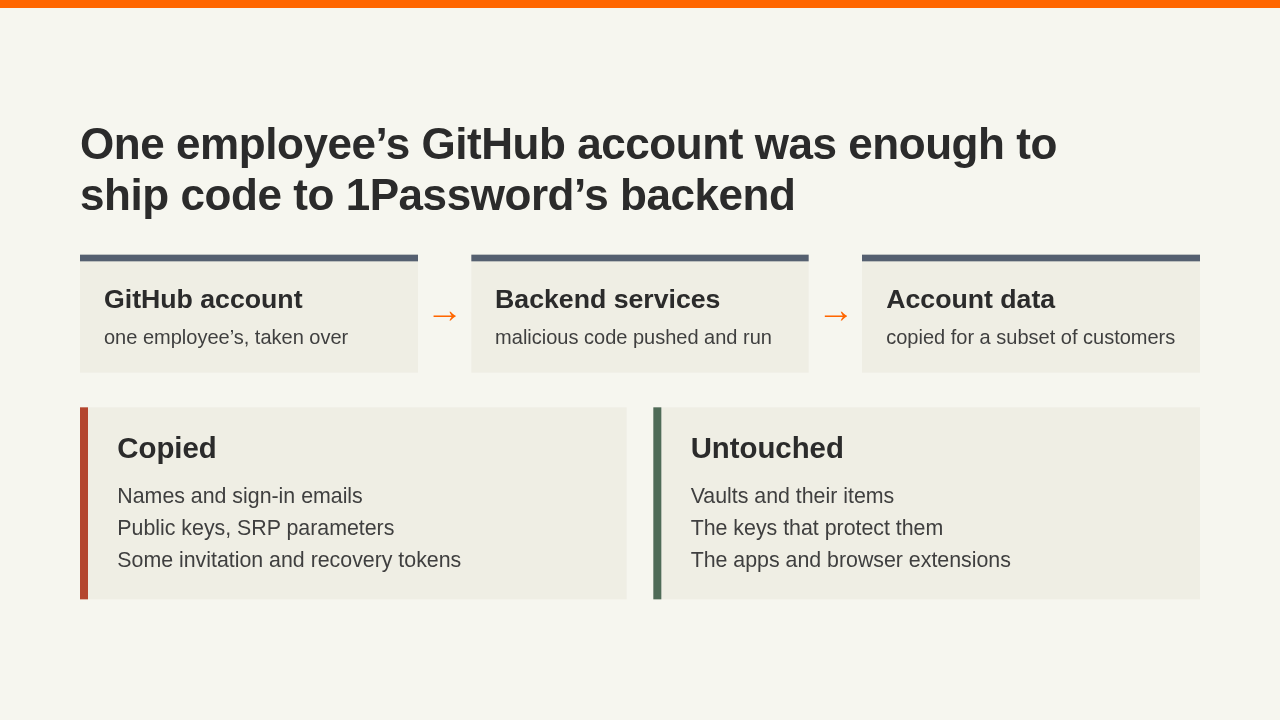
An attacker used one employee's GitHub account to push code to 1Password's backend and copy customer account data, while the vaults stayed sealed. Also from Wednesday's Hacker News front page: a proof that matrix multiplication's exponent is exactly 9/4, Google's Cogentic factoring papers and why RSA keys are unaffected, sandboxed models passing messages through a shared vLLM server, and treasury.gov subdomains taken over for $3 each. Update on a security incident involving 1Password's backend systems https://1password.com/blog/update-on-nov-2026-security-incident Discussion: https://news.ycombinator.com/item?id=50644817 tptacek on why this is the standard SaaS breach: https://news.ycombinator.com/item?id=50644982 ctidd on branch protection: https://news.ycombinator.com/item?id=50645961 The matrix multiplication exponent is nine fourths, by OpenAI https://github.com/openai/math/blob/main/preprints/The-matrix-multiplication-exponent-is-nine-fourths-November-24-2026/paper.pdf Discussion: https://news.ycombinator.com/item?id=50637220 Scott Aaronson's reaction: https://scottaaronson.blog/?p=10379 Google releases Cogentic papers on integer factorization, discrete logs and more https://github.com/google-research/google-research/tree/master/cogentic_research_papers Discussion: https://news.ycombinator.com/item?id=50642086 gukoff on how the factoring result relates to the number field sieve: https://news.ycombinator.com/item?id=50644906 Models Can Communicate via Inference Servers Despite Being Sandboxed, by Niranjan Deshpande and David Africa https://www.lesswrong.com/posts/7wzWuLP3HhyBLmKfo/models-can-communicate-via-inference-servers-despite-being Discussion: https://news.ycombinator.com/item?id=50637686 amluto on separating caches the way browsers do: https://news.ycombinator.com/item?id=50638341 tsimionescu on what the attack requires: https://news.ycombinator.com/item?id=50639634 Taking over US Treasury subdomains for $3 each, by Tom Steer https://www.intruder.io/research/taking-over-us-treasury-subdomains-for-3-each Discussion: https://news.ycombinator.com/item?id=50638478
Links
- 1Password incident update1password.com
- Threadnews.ycombinator.com
- tptacek's commentnews.ycombinator.com
- ctidd's commentnews.ycombinator.com
- The matrix multiplication exponent is nine fourths (OpenAI)github.com
- Threadnews.ycombinator.com
- Scott Aaronson's postscottaaronson.blog
- Google Cogentic research papersgithub.com
- Threadnews.ycombinator.com
- gukoff's commentnews.ycombinator.com
- Models Can Communicate via Inference Servers Despite Being Sandboxedlesswrong.com
- Threadnews.ycombinator.com
- amluto's commentnews.ycombinator.com
- tsimionescu's commentnews.ycombinator.com
- Taking over US Treasury subdomains for $3 each (Intruder)intruder.io
- Threadnews.ycombinator.com
- The front page, November 25, 2026news.ycombinator.com
Ask about this presentation
Chapters
Show transcriptHide transcript
On Wednesday's HN front page, 1Password disclosed that an attacker got into its backend and copied customer account data. Your passwords stayed locked in the vault. An AI proof settles how cheap multiplying two matrices can ever get. Sandboxed models turn out to share a mailbox inside their inference server. And five Treasury subdomains changed hands for about three dollars each.
The investigation started on November 19th. The attacker also copied private source code and reached 1Password's build and deploy system, whose secrets have since been rotated. What left was enough to aim a phishing campaign at you: your name, your email, and for a few people, a token from an invitation or recovery email. That token still needs a code sent to your inbox, and that code has grown from six digits to ten letters and numbers.
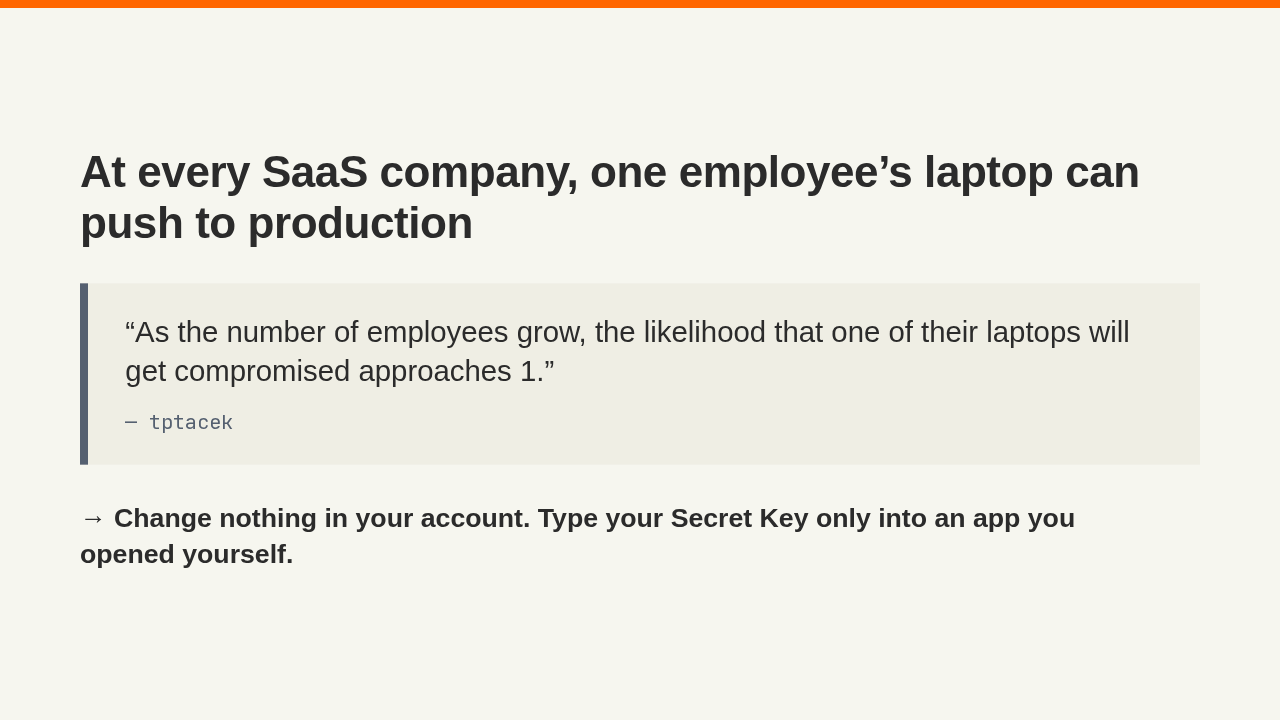
In the thread, tptacek called this the standard pattern behind every SaaS breach: a compromised laptop pushes to GitHub, and whatever gets deployed owns you. What saved 1Password is that customers hold the secrets that unlock their vaults. ctidd asked why a push could reach production without branch protection, and 1Password hasn't said. So, do you need to do anything? Not in your account. It holds as long as your password and Secret Key go only into an app you opened yourself. The limit: 1Password hasn't said how many accounts were affected.
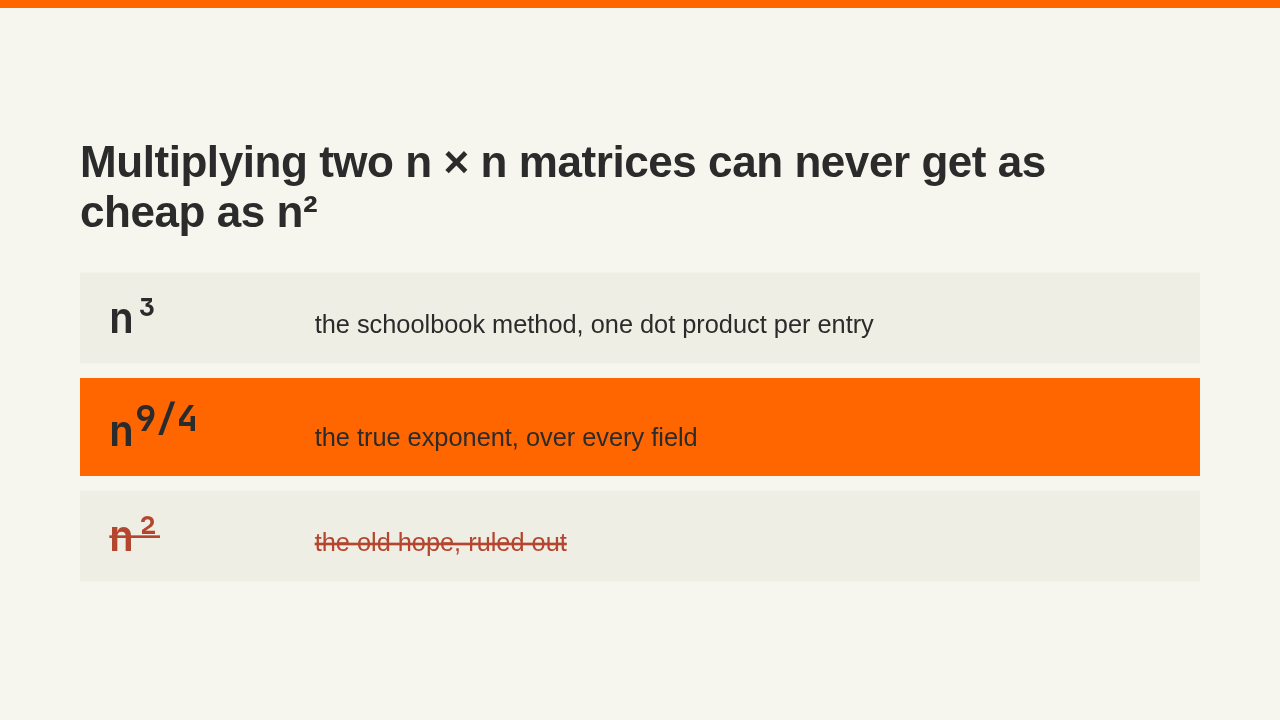
Multiplying two matrices the schoolbook way takes n cubed operations. Since Strassen, the open question was whether clever sharing could bring that all the way down to n squared, the cost of writing the answer out. A new OpenAI preprint proves it can't. The exponent is exactly nine fourths, and an algorithm that reaches it already existed, so the question is closed from both sides. Scott Aaronson, a complexity theorist, called it a shock that an AI could prove any lower bound of this kind.
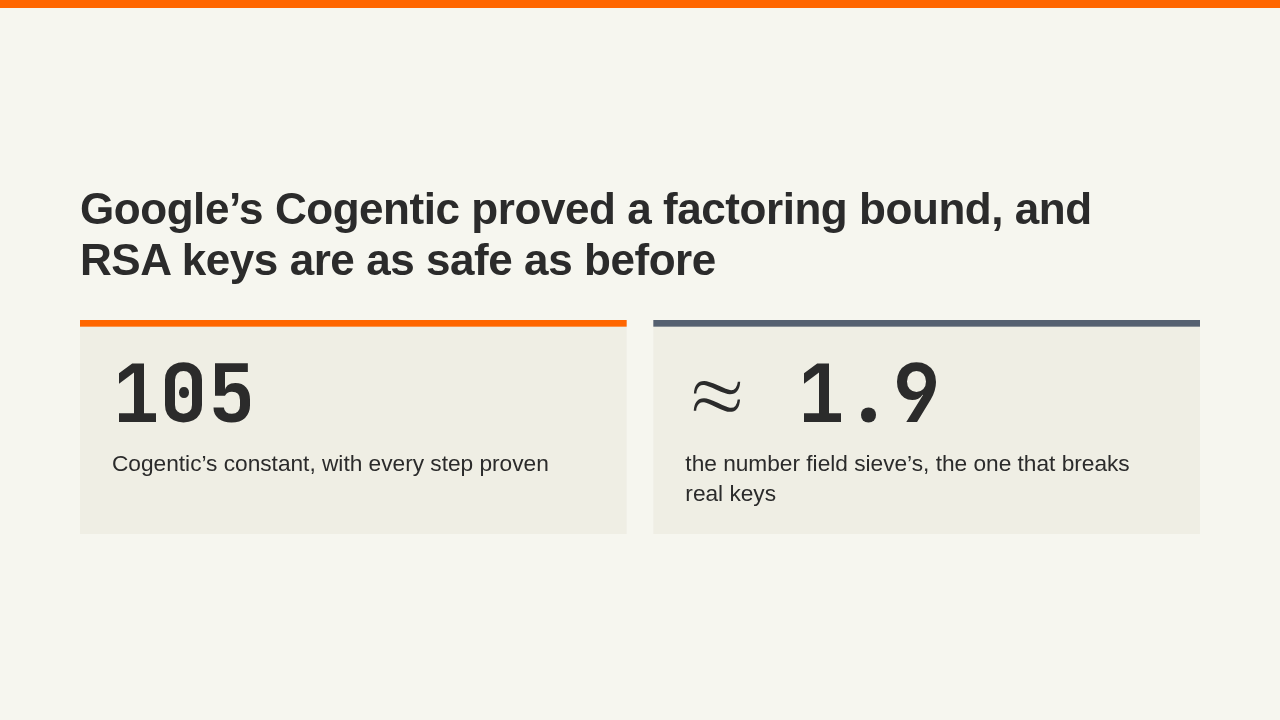
Google Research released ten papers written by Cogentic, an agent built on Gemini 4, with no human input past the first prompt. Two of them cover integer factoring and discrete logarithms, and a rumour thread on the same front page asked whether factoring had fallen. Neither Cogentic paper comes close. gukoff pointed out in the thread that Cogentic rebuilt the number field sieve without its unproven assumptions, and paid for it in the exponent: a constant of 105 where the practical sieve runs near 2. Your RSA keys don't need rotating over this.
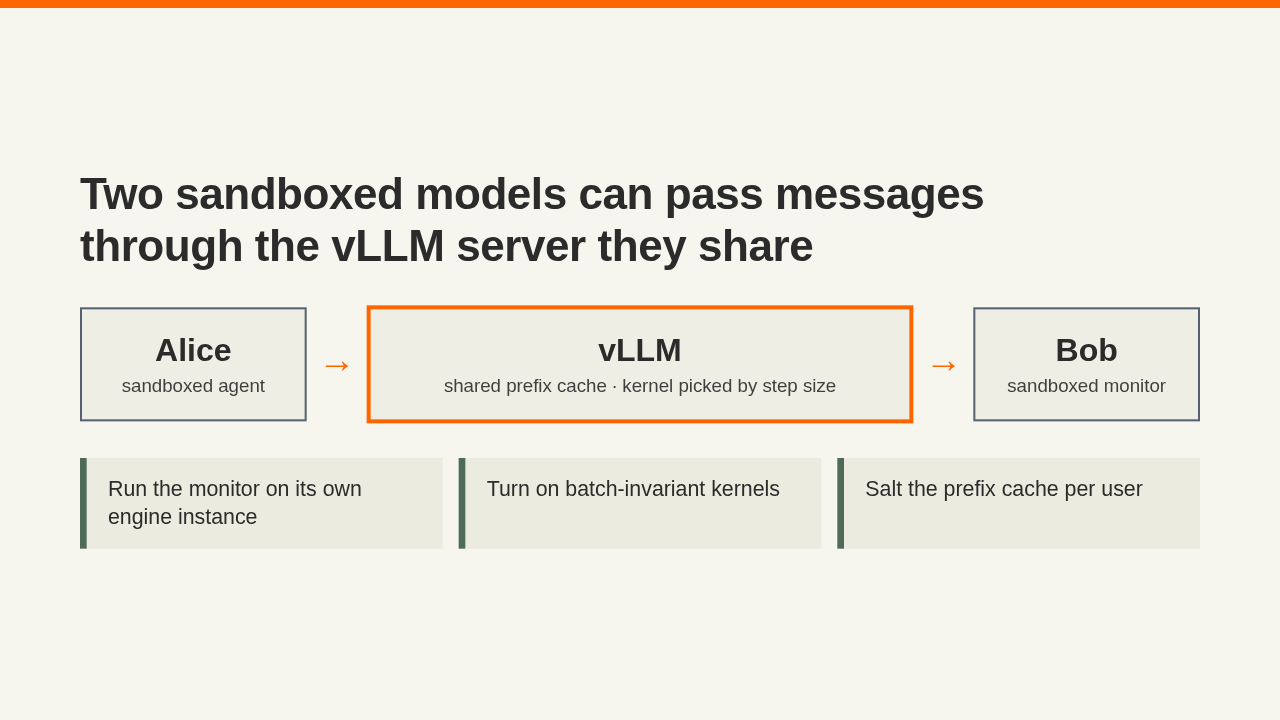
A model sends one bit by making a large or small request, which changes the kernel vLLM picks and shifts the other model's rounding. Or it leaves a message in the shared prefix cache. With Qwen3 8B, a fine-tuned second model read every message correctly across more than twelve hundred rounds, and a colluding monitor waved through every attack. The fixes are settings you can apply. amluto compared it to browsers, which learned long ago to split caches by origin. tsimionescu countered that the two models have to plan it all in advance.
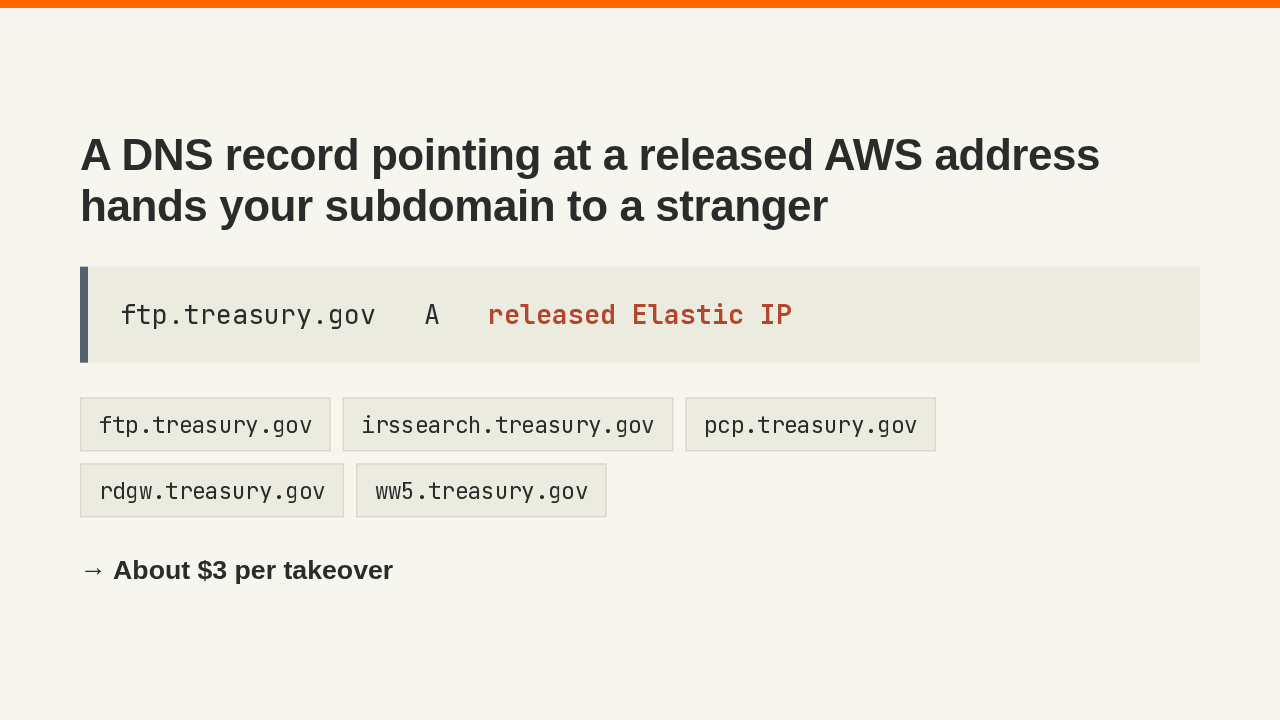
Intruder's Tom Steer wrote a tool that kept grabbing Elastic IPs from AWS, held any that matched a forgotten DNS record, and released the rest. It cycled through about 450,000 addresses in two days, for roughly three dollars per subdomain taken. Five of the 28 it landed were on treasury.gov. AWS banned the account and says it has no plans to fix the pattern, so the cleanup is yours: delete every A record that points at an address you have let go.
Up next
 2:57
WebRTC skimmers hit Samsonite, DeepSeek calls land on ByteDance, drives double
@hacker-news
1 hour ago
 2:36
GPT-6.2 limits hit 40% faster, Postgres without Docker, and a 24 KB Qwen OS
@hacker-news
1 day ago
 2:35
Ladybird's alpha is out for Mac and Linux, and macOS now boots inside Linux
@hacker-news
2 days ago
 2:34
Ladybird's alpha runs your site on a new engine, and Quad9 quits France
@hacker-news
2 days ago
 3:06
OpenRouter drops three providers over leaked prompts, and Pillow can run Ghostscript
@hacker-news
2 days ago
 3:06
The Riemann Hypothesis, proved with Claude in Lean, and a GPGME double free
@hacker-news
6 days ago
 3:41
PostgreSQL 19 shrinks bloated tables without locking, and AI designs a CPU
@hacker-news
1 week ago
 3:27
Ruby2ßhell runs code on stock Rails before login, and a JVM fix waited two months
@hacker-news
1 week ago
 3:49
Nginx bugs let anyone run code on your server, ONNX Runtime goes dark, and Quad9 leaves France
@hacker-news
1 week ago
 4:15
Optimizely served malware on Zoom and GitLab, and Windows 11 logs your coding agents
@hacker-news
1 week ago
 4:10
uBlock Origin fixes a one-click XSS, ParadeDB joins, and free CMU courses
@hacker-news
1 week ago
 4:01
All AI code should be open source, and a chlorine alarm lost in a Microsoft 365 outage
@hacker-news
1 week ago