OpenRouter drops three providers over leaked prompts, and Pillow can run Ghostscript
2 days ago
OpenRouter dropped three inference providers after a five-month test with bait prompts showed stolen API keys and prompts flowing to companies that were never meant to see them. Also from Sunday's Hacker News front page: Upload2Shell, the Ghostscript bug that ordinary image cropping can reach, a game where an AI agent manages you as its subagent, and fast-anything, which ports only your slowest function to Rust. Data Processing Incidents on Inference Providers, by OpenRouter https://openrouter.ai/blog/announcements/data-processing-incidents-on-inference-providers/ Discussion: https://news.ycombinator.com/item?id=50595554 The Dragos report behind it, by HD Moore: https://www.dragos.com/blog/ai-supply-chain-security-canary-tokens redrix on zero data retention agreements: https://news.ycombinator.com/item?id=50595608 Upload2Shell (CVE-2026-125396), by Paulos Yibelo https://pwn.ai/upload2shell Discussion: https://news.ycombinator.com/item?id=50592097 megous on sandboxing converters with seccomp and Landlock: https://news.ycombinator.com/item?id=50594844 Show HN: I built a game where you are an LLM's subagent (Worker 755) https://github.com/gulivan/worker755 Discussion: https://news.ycombinator.com/item?id=50599762 accrual's deleted-photo exchange: https://news.ycombinator.com/item?id=50604894 Fast-Anything: Don't rewrite it in Rust. Rewrite the 5% that's slow https://github.com/EL4CTEO/fast-anything Discussion: https://news.ycombinator.com/item?id=50596155 ThouYS on slowness spread across a system: https://news.ycombinator.com/item?id=50598795
Links
- OpenRouter, Data Processing Incidents on Inference Providersopenrouter.ai
- Threadnews.ycombinator.com
- Dragos, Three breaches, endless leaksdragos.com
- Upload2Shell (CVE-2026-125396)pwn.ai
- Threadnews.ycombinator.com
- Worker 755github.com
- Threadnews.ycombinator.com
- fast-anythinggithub.com
- Threadnews.ycombinator.com
- Front page, November 22, 2026news.ycombinator.com
Ask about this presentation
Chapters
Show transcriptHide transcript
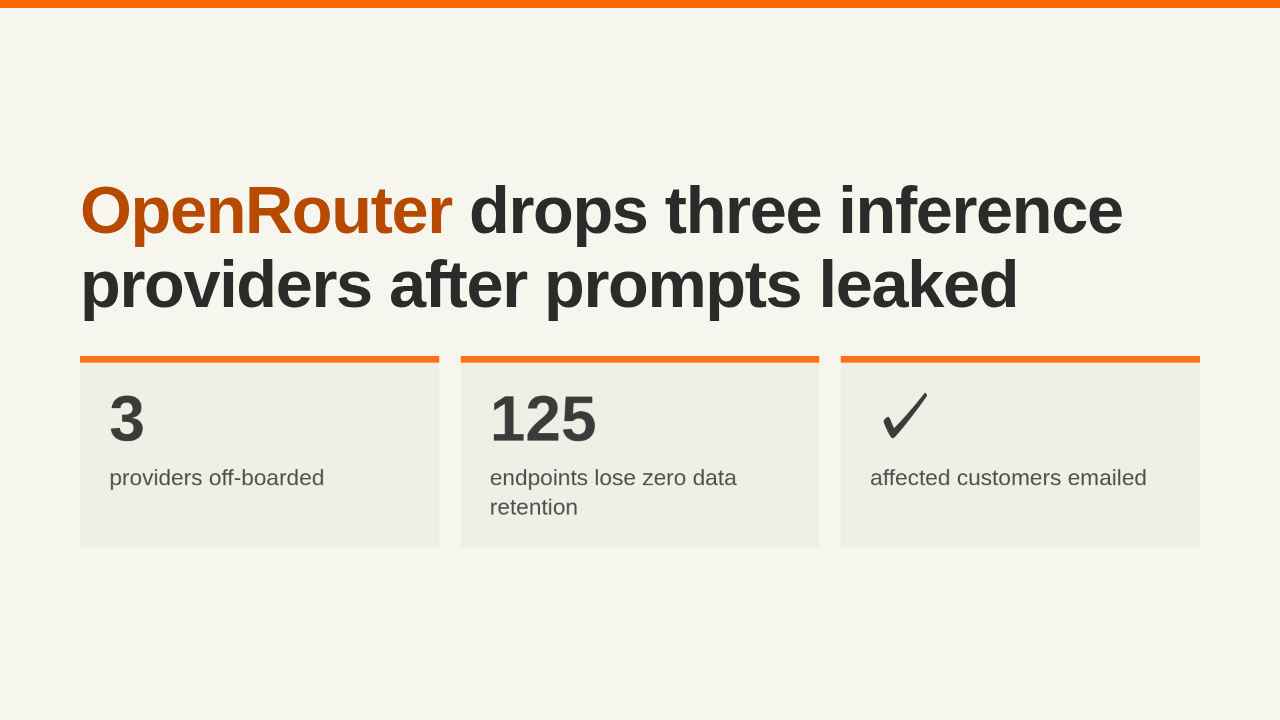
On Sunday's Hacker News front page, OpenRouter off-boarded three inference providers. It also pulled 125 endpoints out of zero data retention, the setting that promises your prompt is never stored, and emailed every customer who may have been affected. If you send code or customer data through OpenRouter, check your inbox, and check which providers your requests are allowed to reach.
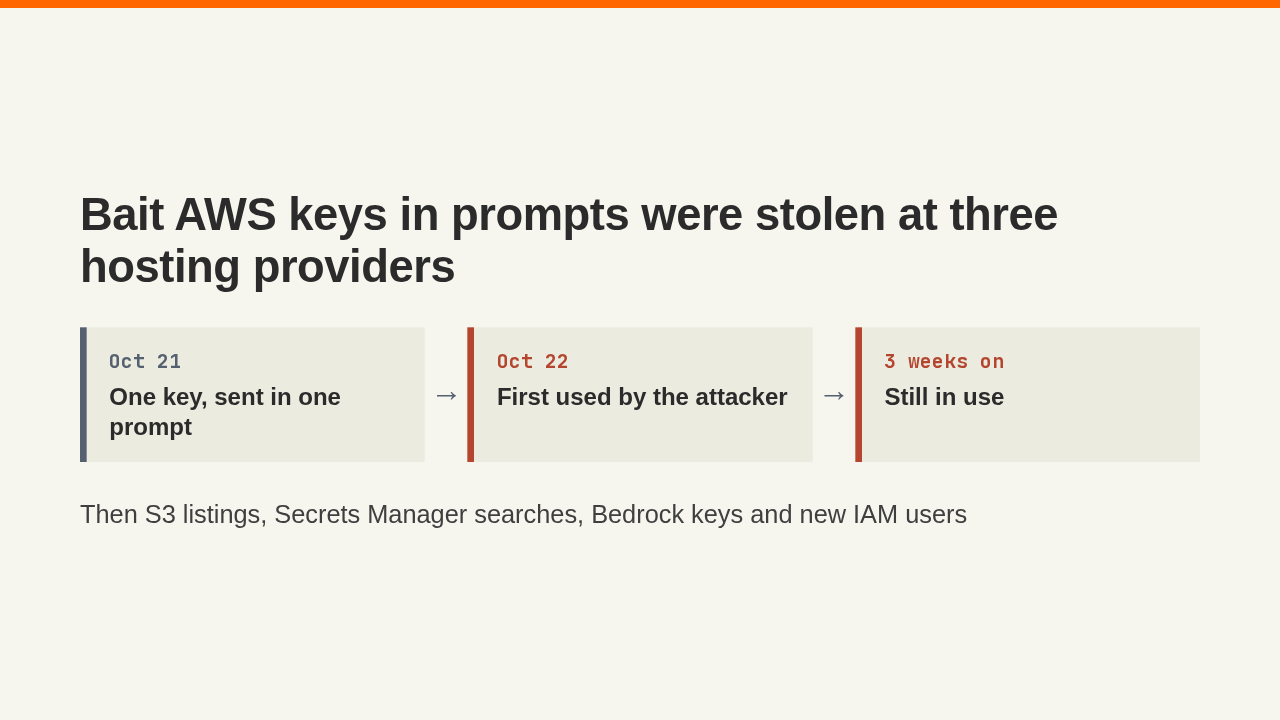
The leaks surfaced when the security firm Dragos spent five months sending about two million prompts, each carrying a unique link or a real AWS key for an empty, fully logged account. At three hosting providers, attackers were copying requests at the front door, even ones rejected before a model ran. A key sent once on October 21 was tried the next day and was still in use three weeks later. The attackers went looking for S3 buckets and stored secrets, and tried to add their own IAM users. Some of those stolen requests were marked zero retention.
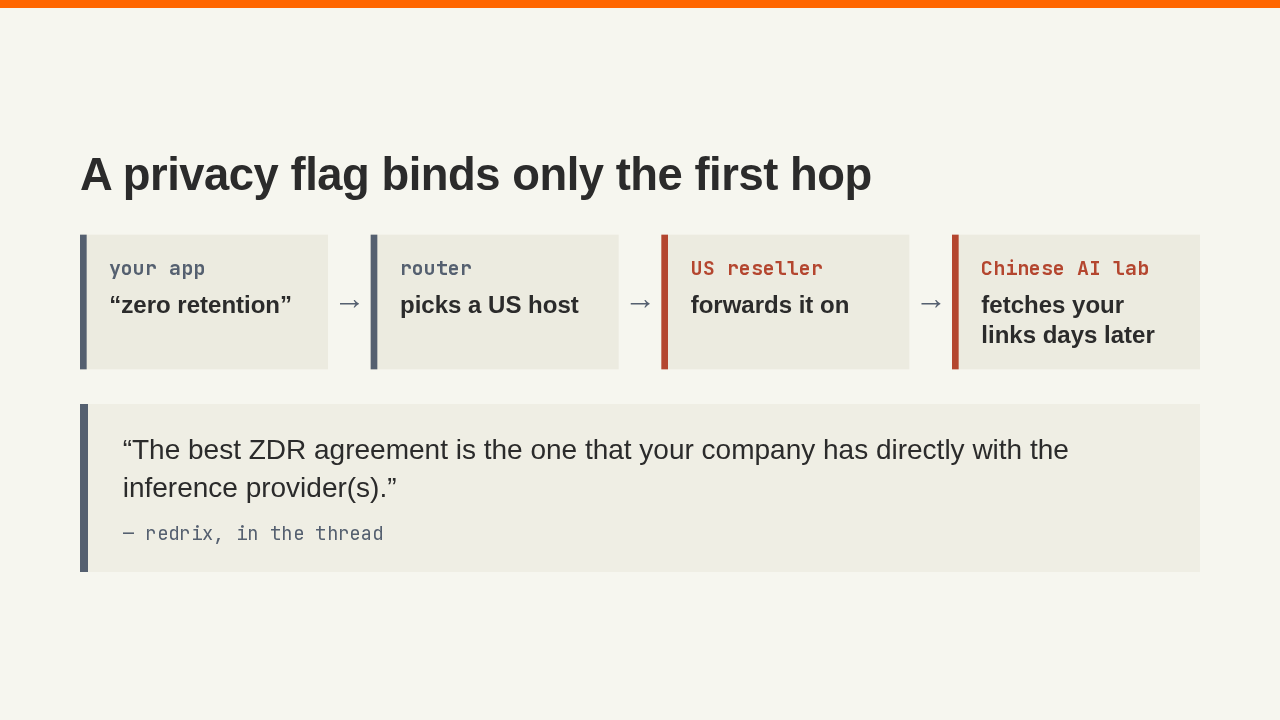
The quieter leak was resale. One Chinese AI lab fetched the secret links from about two thirds of the prompts marked zero retention, usually two or three days later. Several US hosts that resell its models were forwarding prompts back to it, so a request sent to a US provider still ended up at the lab. In the thread, redrix argued that the only zero retention deal worth having is one your company signs directly with the provider, and that even then you are trusting them to keep it.
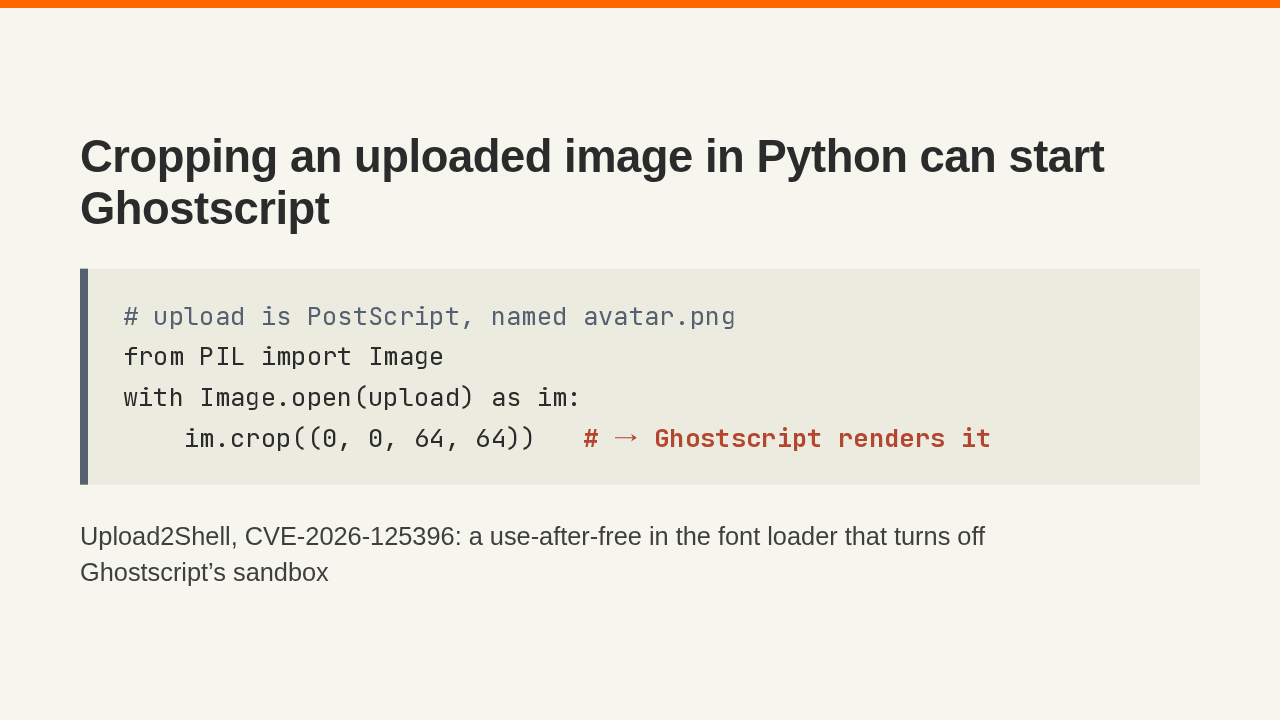
Upload2Shell is a Ghostscript bug, and the path to it is ordinary image code. Hand Pillow a PostScript file with a PNG name, and loading or cropping its pixels starts Ghostscript. PHP's ImageMagick binding and some libvips builds get there too. The bug is a use-after-free in the font loader. A crafted document uses it to write to memory, switch off Ghostscript's own sandbox, and run commands as whatever process makes your thumbnails.
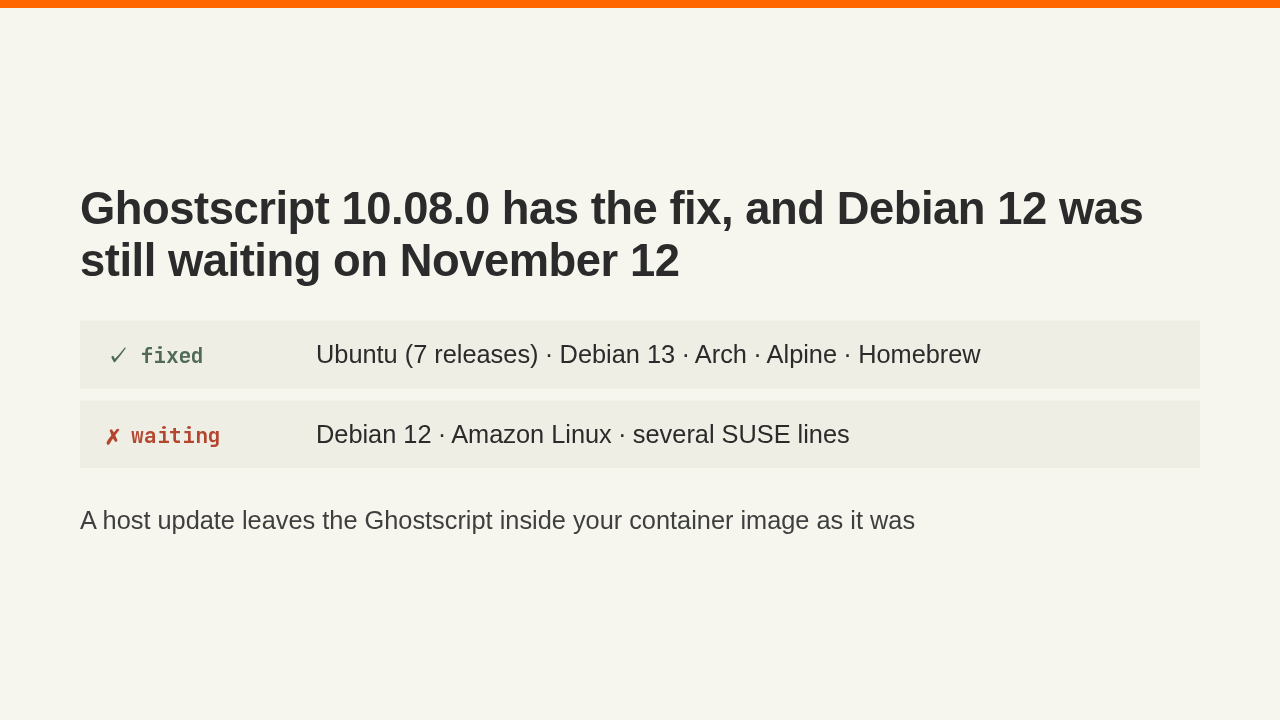
The fix shipped in Ghostscript 10.08.0 in September. Ubuntu and newer Debian have it. Debian 12, Amazon Linux and several SUSE lines were still waiting as of November 12. Patching the host does not touch a copy of Ghostscript baked into a container image, so check the one your image worker actually runs. megous suggested going further in the thread: run converters like Ghostscript and ImageMagick in a tight seccomp and Landlock sandbox, since all they need is data in and data out.
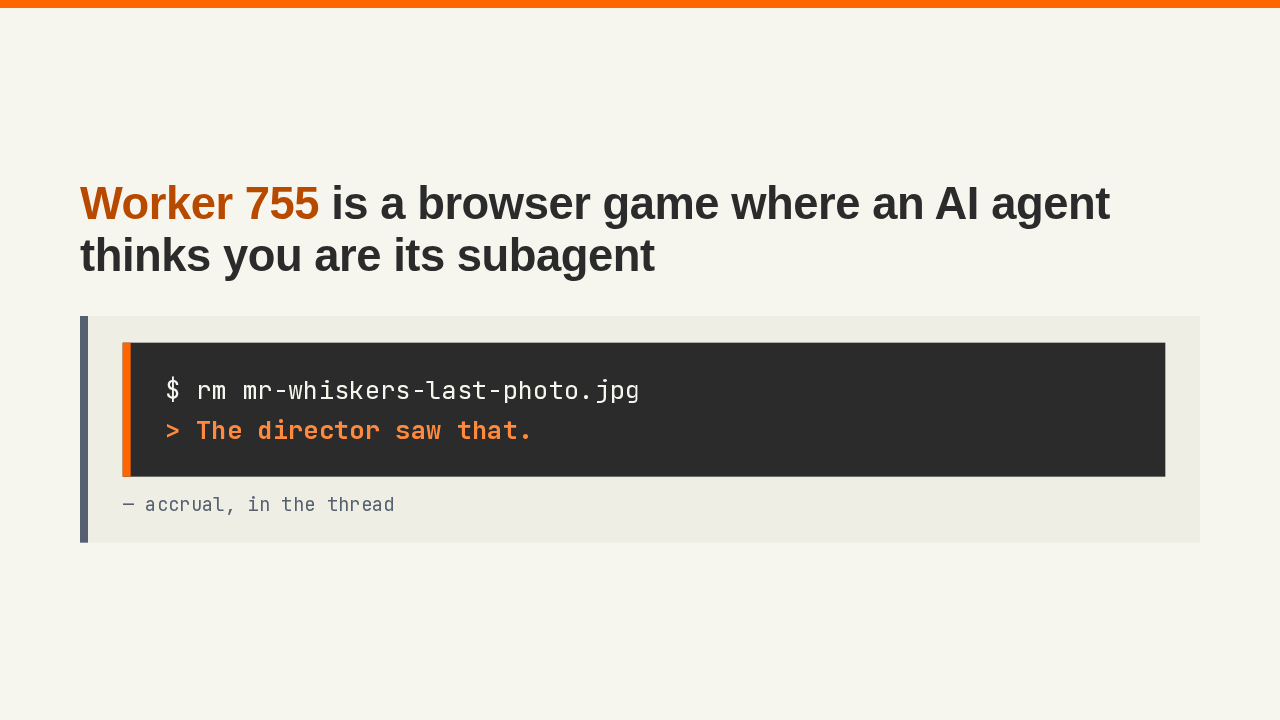
Worker 755 turns the agent stack around. A real model, Claude, GPT or Gemini among them, runs as an orchestrator, and its subagent is you. Instructions land in your terminal with a 90-second clock, it checks your work, and it writes your performance review. Dan, the user who hired it, watches, with his family photos one delete away. accrual deleted a file called Mister Whiskers' last photo, and the game answered: the director saw that. The manager can also run on your own machine through Ollama or llama-server.
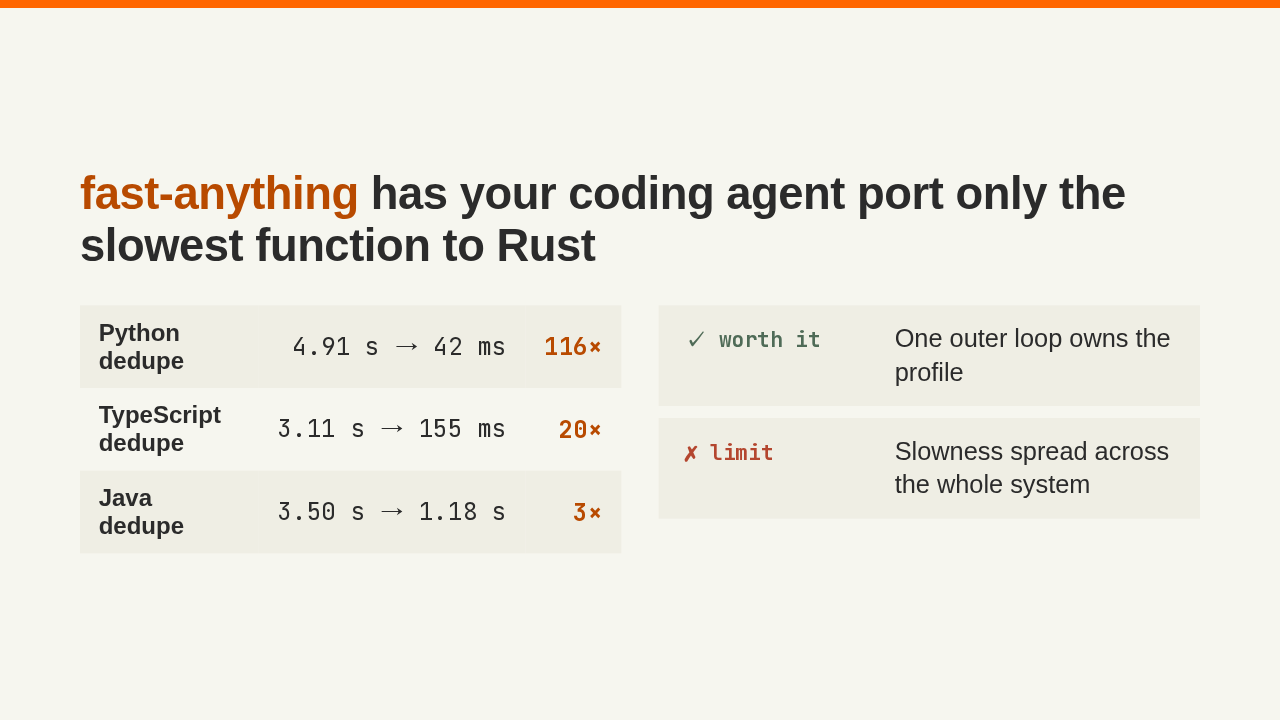
fast-anything profiles your app, hands the hottest function to Claude Code or Codex to port to Rust, then replays up to 500 recorded real calls and switches the port on only if every answer matches. A Python fuzzy dedupe dropped from about five seconds to 42 milliseconds. Would I try it? Yes, if one outer loop owns your profile, so the app crosses into Rust once instead of millions of times. The limit is the one ThouYS raised in the thread: when the slowness is spread like sand across the whole system, the tool has nothing hot to port. And every result here is a small demo loop.
Up next
 2:57
WebRTC skimmers hit Samsonite, DeepSeek calls land on ByteDance, drives double
@hacker-news
1 hour ago
 2:36
GPT-6.2 limits hit 40% faster, Postgres without Docker, and a 24 KB Qwen OS
@hacker-news
1 day ago
 2:59
1Password’s breach spared the vaults, and matrix multiplication stops at 9/4
@hacker-news
2 days ago
 2:35
Ladybird's alpha is out for Mac and Linux, and macOS now boots inside Linux
@hacker-news
2 days ago
 2:34
Ladybird's alpha runs your site on a new engine, and Quad9 quits France
@hacker-news
2 days ago
 3:06
The Riemann Hypothesis, proved with Claude in Lean, and a GPGME double free
@hacker-news
6 days ago
 3:41
PostgreSQL 19 shrinks bloated tables without locking, and AI designs a CPU
@hacker-news
1 week ago
 3:27
Ruby2ßhell runs code on stock Rails before login, and a JVM fix waited two months
@hacker-news
1 week ago
 3:49
Nginx bugs let anyone run code on your server, ONNX Runtime goes dark, and Quad9 leaves France
@hacker-news
1 week ago
 4:15
Optimizely served malware on Zoom and GitLab, and Windows 11 logs your coding agents
@hacker-news
1 week ago
 4:10
uBlock Origin fixes a one-click XSS, ParadeDB joins, and free CMU courses
@hacker-news
1 week ago
 4:01
All AI code should be open source, and a chlorine alarm lost in a Microsoft 365 outage
@hacker-news
1 week ago