REA reverse engineers any app for your coding agent, Telegram Desktop’s one-click leak, and Bitwarden’s new license
1 month ago
REA gives Claude Code, Codex, Cursor and other coding agents the tools to reverse engineer apps you have no source for. Also from Saturday's Hacker News front page: a Telegram Desktop flaw where one clicked link could hand over your account, Bitwarden's store apps moving to a commercial license, and WSL 3 benchmarked against WSL 2. REA: Reverse Engineer Anything https://rea.tools/ Code: https://github.com/morluto/rea Discussion: https://news.ycombinator.com/item?id=50028275 ethin asks what REA adds over Claude and Ghidra: https://news.ycombinator.com/item?id=50028470 tptacek's reply: https://news.ycombinator.com/item?id=50028484 Telegram Desktop: one-click account takeover via IPC injection, by beaksec https://beaksec.github.io/posts/telegram-desktop-one-click-account-takeover/ Discussion: https://news.ycombinator.com/item?id=50029123 Bitwarden: Published version update in app stores https://community.bitwarden.com/t/published-version-update-in-app-stores/102750 Discussion: https://news.ycombinator.com/item?id=50033407 josephcsible on the "dual license" title: https://news.ycombinator.com/item?id=50035279 WSL2 vs WSL3 Benchmarks: Performance, Memory, and Syscall Scaling, by Tony Metzidis https://tonym.us/wsl2-vs-wsl3-benchmarks.html Discussion: https://news.ycombinator.com/item?id=49998801 tonymet on the WSL 2 name: https://news.ycombinator.com/item?id=50034330
Links
Ask about this presentation
Chapters
Show transcriptHide transcript
On Saturday's HN front page, REA, short for Reverse Engineer Anything, gives Claude Code, Codex, Cursor and other coding agents the tools to take apart a program you have no source code for, and explain how a feature inside it works. Telegram Desktop closed a hole where one clicked link could hand a stranger your account. And Bitwarden changed the license on the apps you download from a store.
Slide text

REA reverse engineers any app for your coding agent, Telegram Desktop’s one-click leak, and Bitwarden’s new license
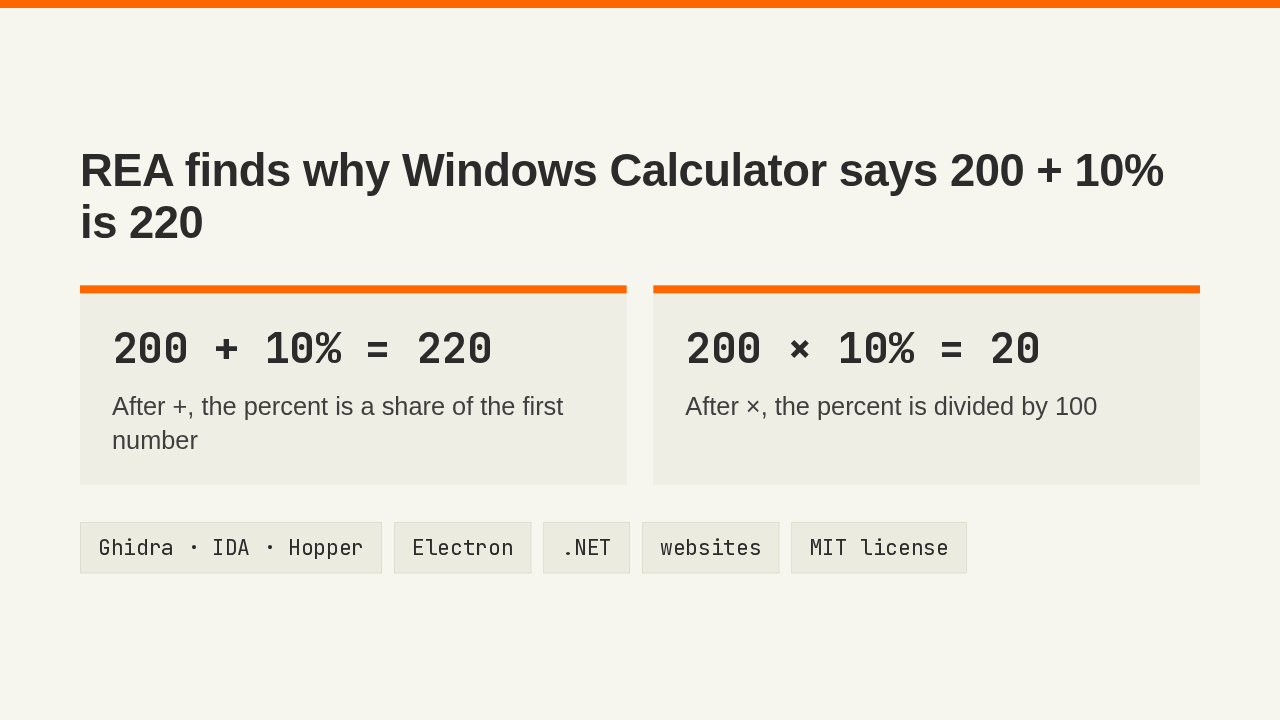
One npx command adds REA to your agent as an MCP server, and then you ask in plain English. The worked example asks why Windows Calculator turns 200 plus 10 percent into 220. REA pulls the percent handler out of the installed Calculator library, and the agent reads the rule. After a plus, the percent is a share of the first number. After a times, it is divided by 100. For native code REA drives Ghidra, IDA or Hopper, and it also maps Electron apps, .NET assemblies and websites. The analysis runs on your machine, and REA is open source under the MIT license.
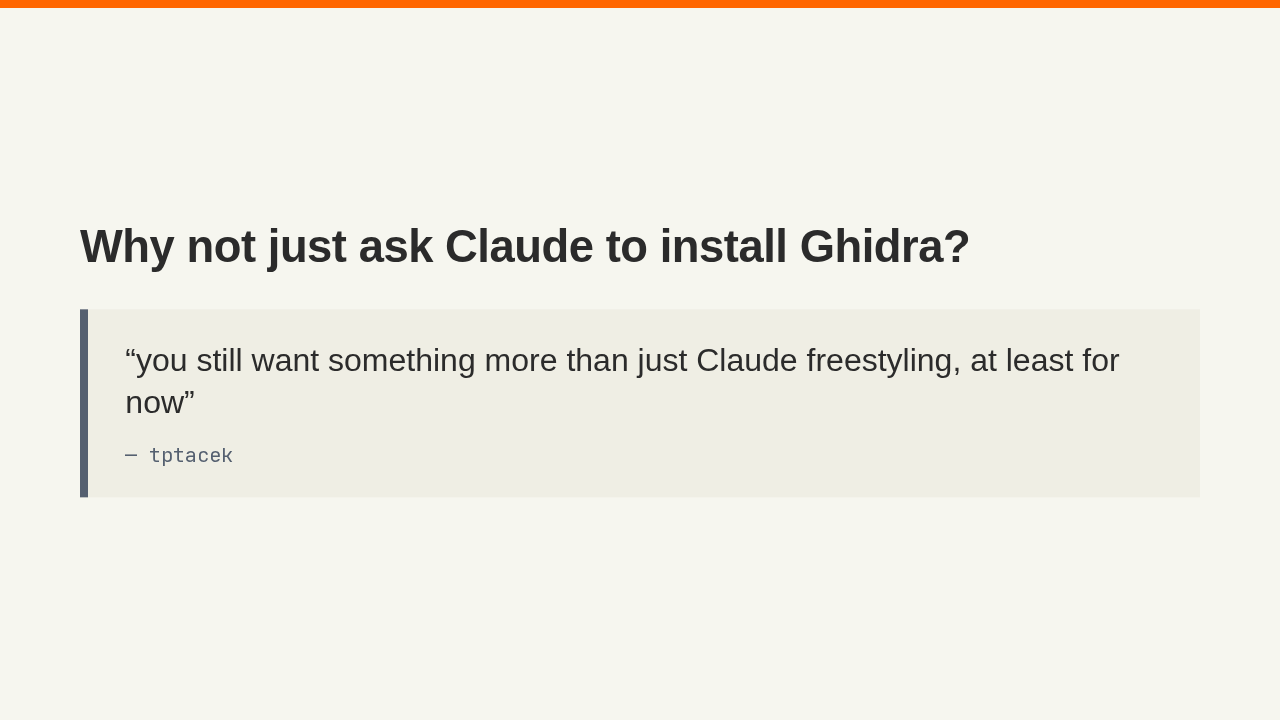
In the thread, a commenter posting as ethin asked what REA does that telling Claude to set up Ghidra on your own machine doesn't. tptacek answered that everyone who does this work keeps their own skills and scripts around a tool like Ghidra, and you still want something more than Claude freestyling, at least for now. REA packages that layer, the tools plus the workflow instructions it installs into your agent, so the answers come back with the evidence behind them.
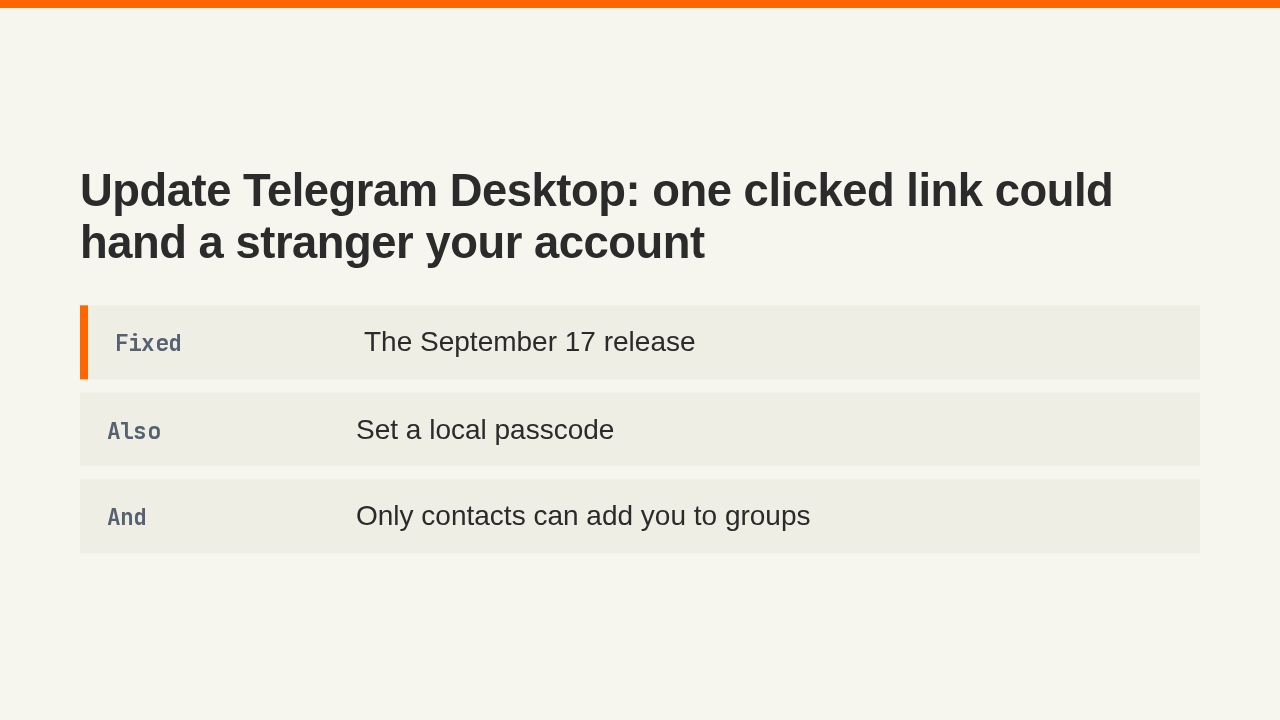
A stranger could add you to a Telegram group, post a few small text files and a link, and if you clicked that link, Telegram Desktop would upload files from your disk to the stranger's group without asking. Those can include the files that hold your login, and without a local passcode they are enough to open your account somewhere else. The fix shipped in the September 17 release, whose changelog mentions only a rendering fix. Update, set a local passcode, and limit who can add you to groups to your contacts.
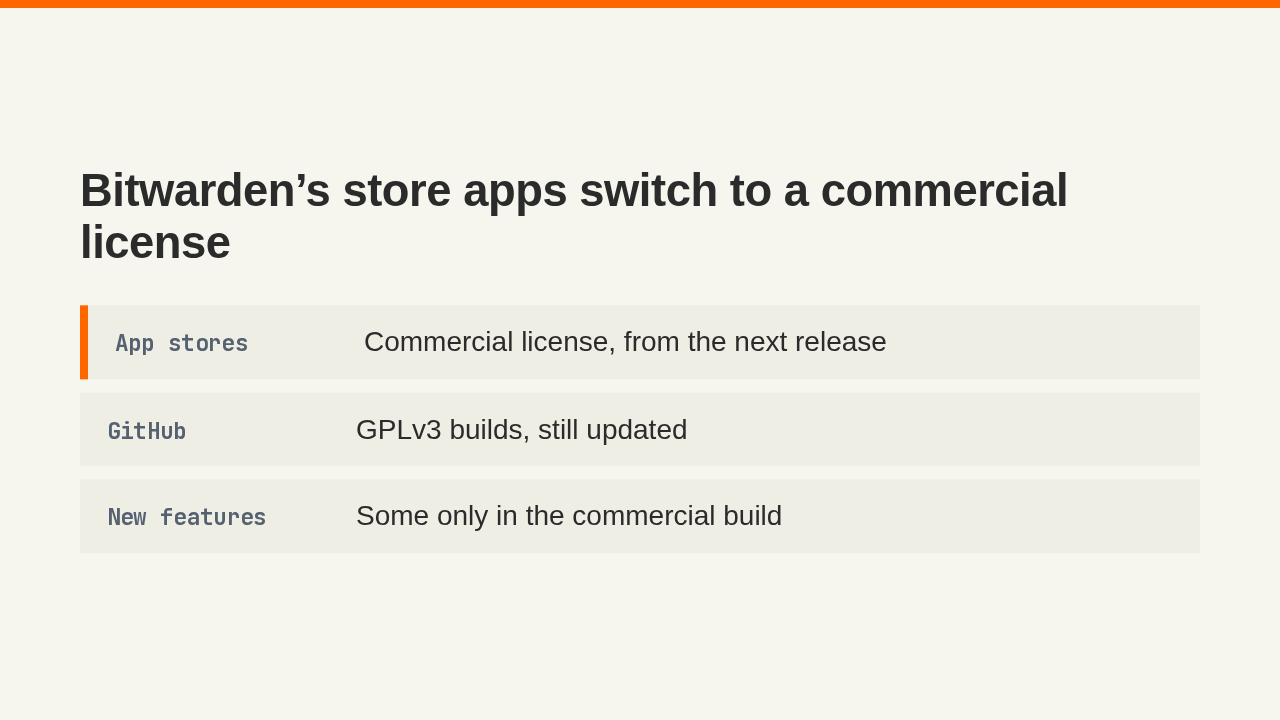
From its next release, the Bitwarden apps in the app stores, and the downloads on Bitwarden's own site, are commercially licensed builds. The GPLv3 version keeps being updated on GitHub, and every current feature is in both. New features are where the two split. Some future components will exist only in the commercial build, decided feature by feature, with that code still readable on GitHub. Self-hosting doesn't change. The license is aimed at anyone repackaging and reselling Bitwarden. In the thread, josephcsible pointed out that the announcement never uses the words dual license.
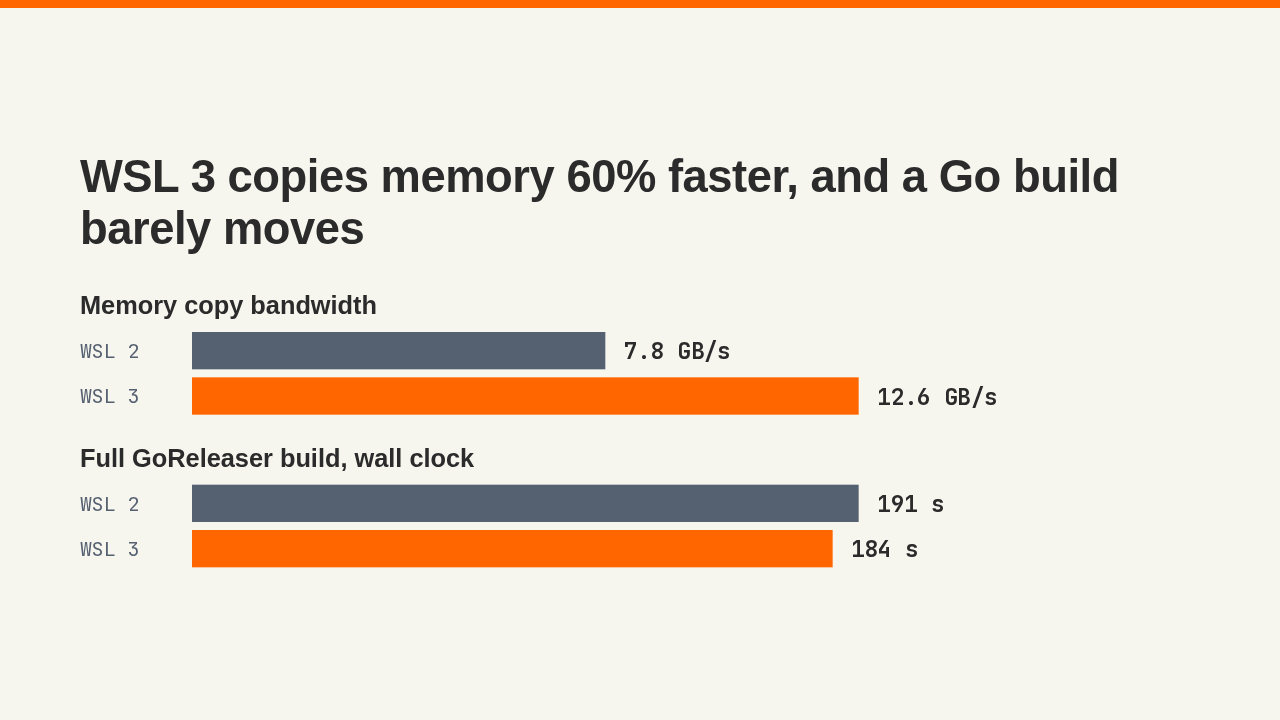
On Windows, the WSL 3 releases move the Linux kernel inside from the 6.6 line to 6.18. On a small six-core Intel desktop, memory copies ran about 60 percent faster, and switching between processes about 11 percent faster. A full Go build of GoReleaser finished only about 4 percent sooner, because compiling is mostly work in user space, bound by the two virtual CPUs it had. In-memory databases and busy containers gain the most. In the thread, tonymet, the post's author, added that Microsoft still calls the version 3 releases WSL 2.
Up next
 2:57
WebRTC skimmers hit Samsonite, DeepSeek calls land on ByteDance, drives double
@hacker-news
1 hour ago
 2:36
GPT-6.2 limits hit 40% faster, Postgres without Docker, and a 24 KB Qwen OS
@hacker-news
1 day ago
 2:59
1Password’s breach spared the vaults, and matrix multiplication stops at 9/4
@hacker-news
2 days ago
 2:35
Ladybird's alpha is out for Mac and Linux, and macOS now boots inside Linux
@hacker-news
2 days ago
 2:34
Ladybird's alpha runs your site on a new engine, and Quad9 quits France
@hacker-news
2 days ago
 3:06
OpenRouter drops three providers over leaked prompts, and Pillow can run Ghostscript
@hacker-news
2 days ago
 3:06
The Riemann Hypothesis, proved with Claude in Lean, and a GPGME double free
@hacker-news
6 days ago
 3:41
PostgreSQL 19 shrinks bloated tables without locking, and AI designs a CPU
@hacker-news
1 week ago
 3:27
Ruby2ßhell runs code on stock Rails before login, and a JVM fix waited two months
@hacker-news
1 week ago
 3:49
Nginx bugs let anyone run code on your server, ONNX Runtime goes dark, and Quad9 leaves France
@hacker-news
1 week ago
 4:15
Optimizely served malware on Zoom and GitLab, and Windows 11 logs your coding agents
@hacker-news
1 week ago
 4:10
uBlock Origin fixes a one-click XSS, ParadeDB joins, and free CMU courses
@hacker-news
1 week ago