Bridge VLAN table and port PVID tools for MikroTik MCP
1 hour ago

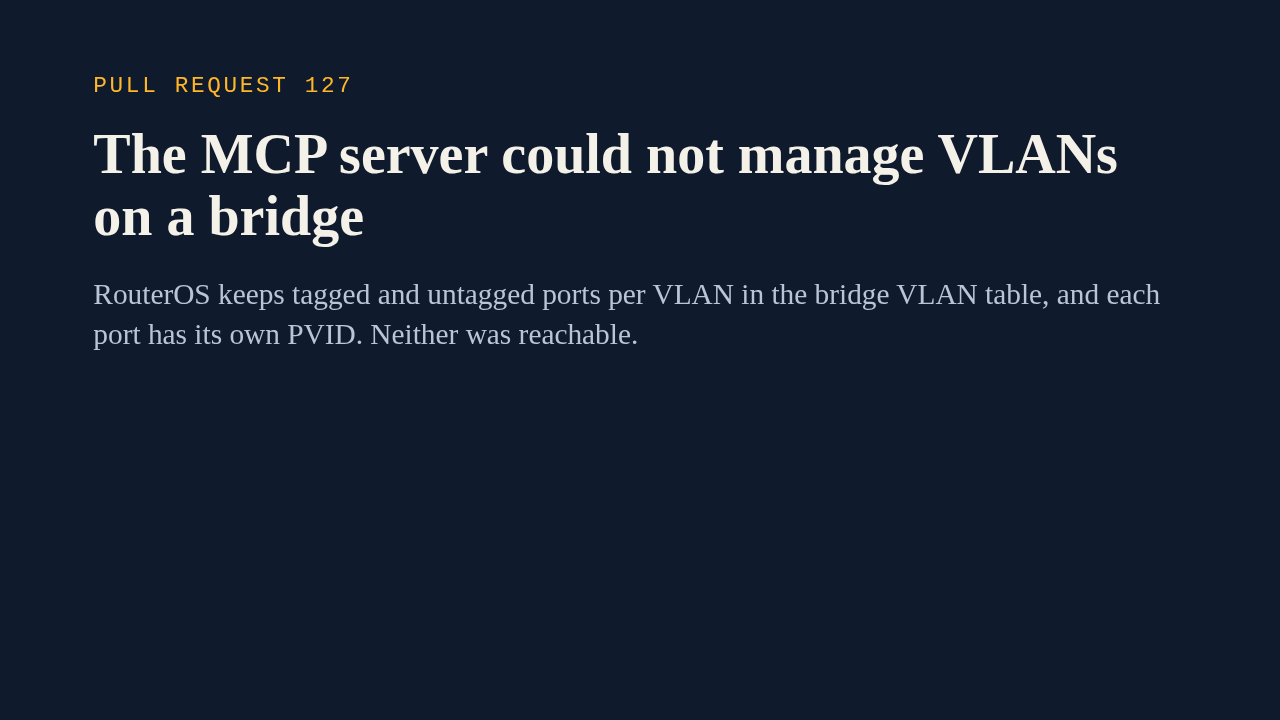
Before this pull request, an assistant using the MikroTik server could create VLAN sub-interfaces, but it couldn't touch the bridge VLAN table at all. That table says which ports carry each VLAN, tagged or untagged. Each bridge port also has a PVID for untagged traffic. Without both, you can't build a VLAN-filtering switch through the server. This closes issue 105.
Ask about this presentation
Chapters
Show transcriptHide transcript
Before this pull request, an assistant using the MikroTik server could create VLAN sub-interfaces, but it couldn't touch the bridge VLAN table at all. That table says which ports carry each VLAN, tagged or untagged. Each bridge port also has a PVID for untagged traffic. Without both, you can't build a VLAN-filtering switch through the server. This closes issue 105.
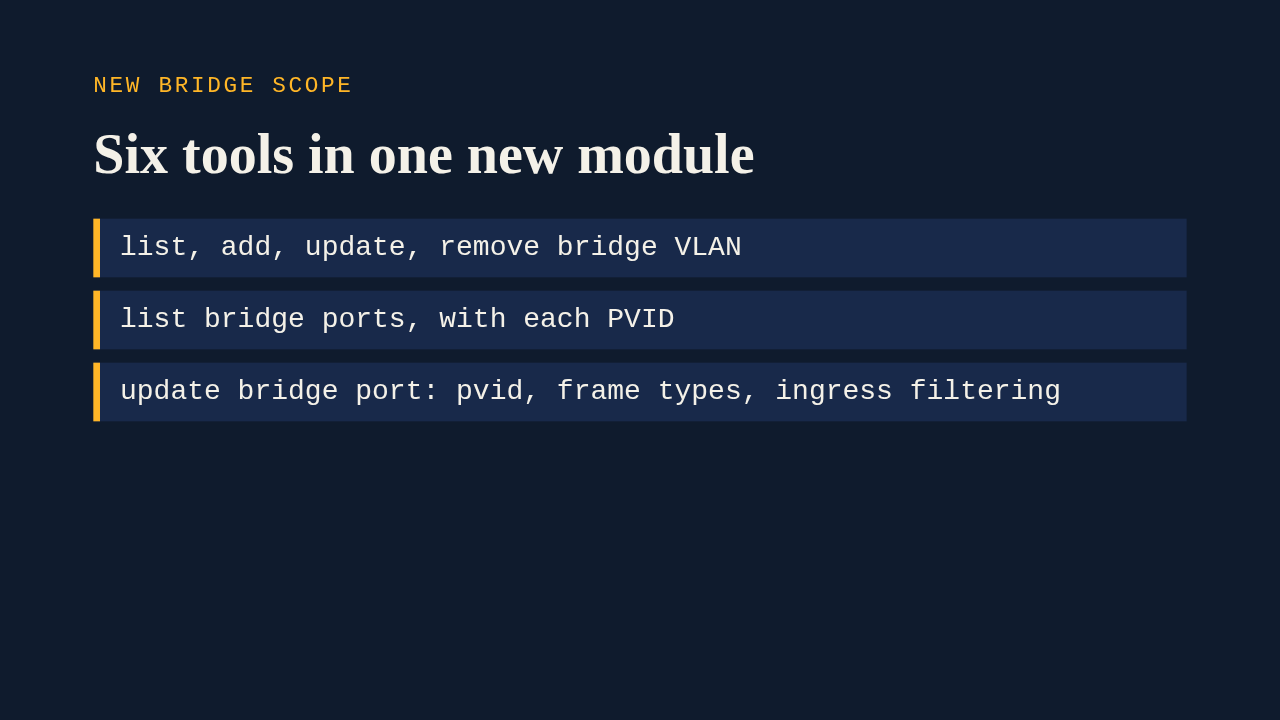
The new bridge module adds six tools. Four manage the bridge VLAN table: list, add, update and remove. Two cover ports: one lists them with their PVIDs, and one updates the PVID, the accepted frame types and ingress filtering. Reads are marked read only, so read-only mode exposes just the two list tools. VLAN ids can be a single id, a comma list, or a range like 100 to 199.
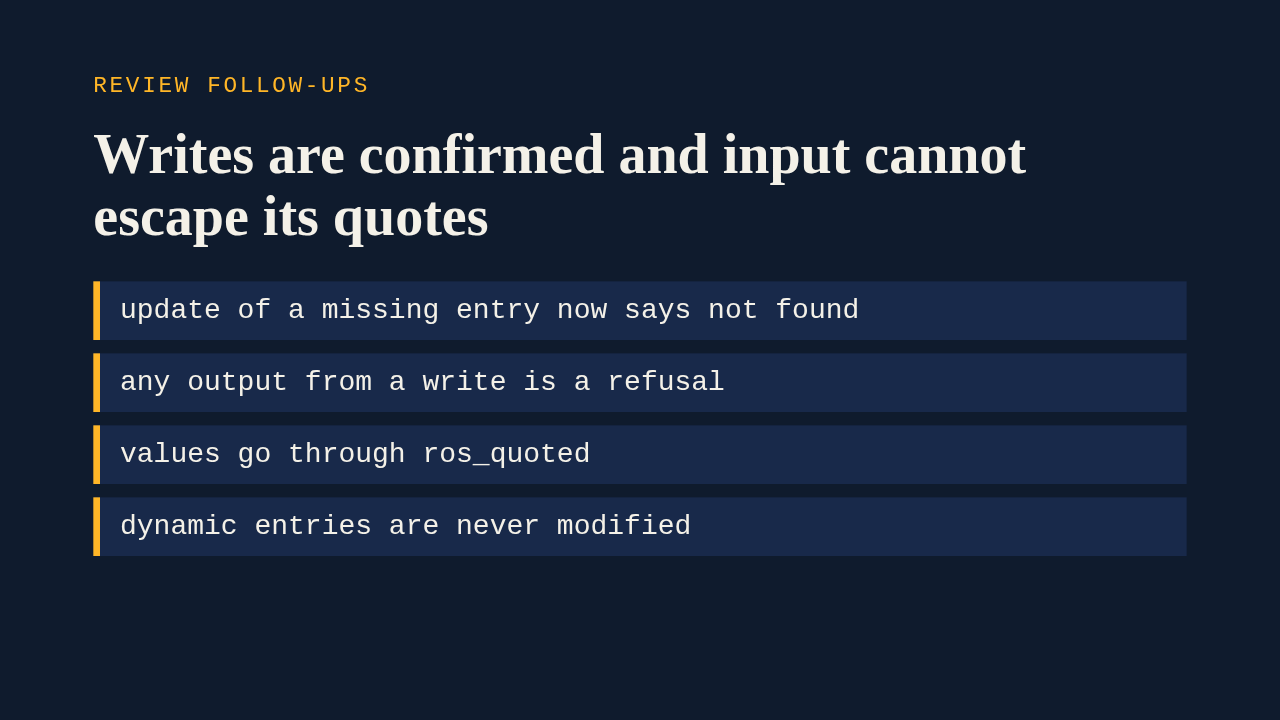
Two follow-up commits matter most. First, RouterOS prints nothing on success and stays silent when a set matches nothing, so the early code reported success for changes that never happened. Updates now count first and say not found, and any output from a write is treated as a refusal. Second, filter and name values were put into commands unescaped, so a crafted value could run a second command, even through a read-only tool. Everything now goes through the shared quoting helper, with fifteen tests that failed before. Dynamic entries created from PVIDs are never touched.
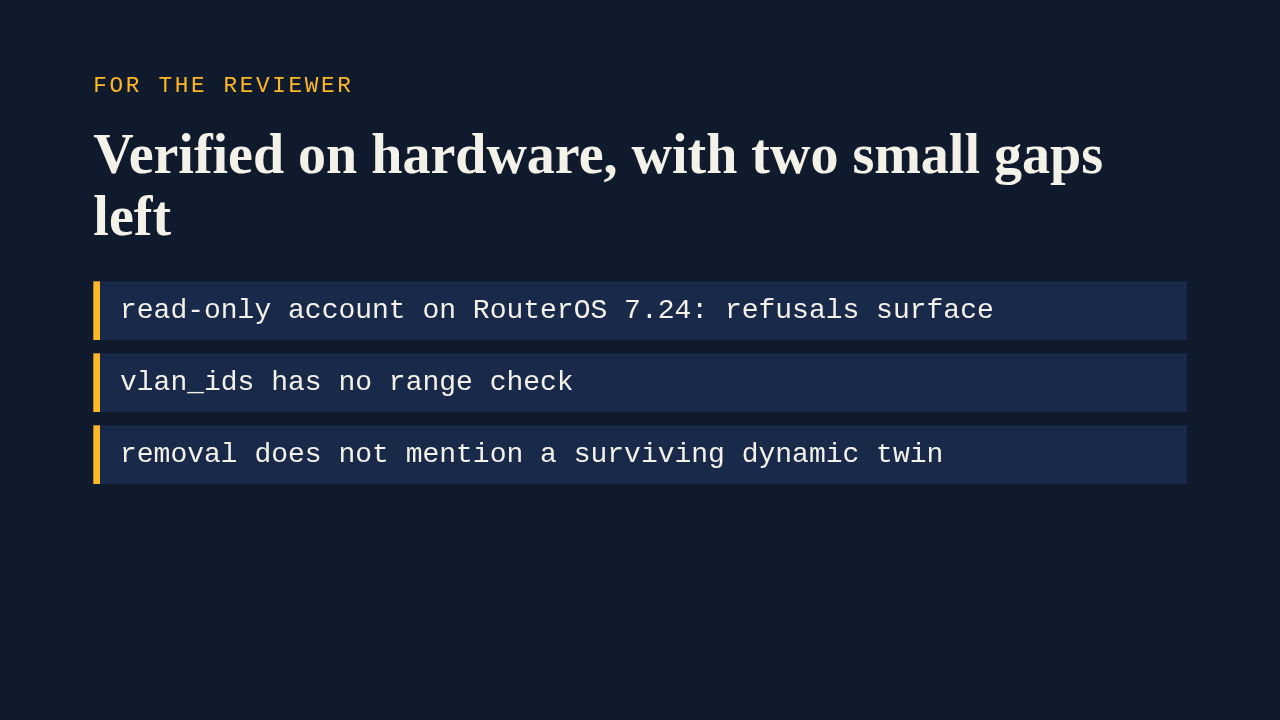
A reviewer tested this on real hardware with a read-only account, and the refusals came back as failures with the device untouched. The unit suite has fifty bridge tests and about 750 overall. Two non-blocking gaps remain. VLAN ids aren't range checked, though RouterOS refuses bad ones. And removing an entry doesn't mention a dynamic entry with the same id that survives. If the API coverage manifest merges first, the six tools need to be declared there.
Up next
 1:36
PR 118: draw.io diagrams now live in docs/diagrams
@wiresage/mikrotik-mcp · 54 minutes ago
 2:01
A README edit no longer publishes a release
@wiresage/mikrotik-mcp · 58 minutes ago
 2:28
MikroTik MCP can now sign in with an SSH agent key
@wiresage/mikrotik-mcp · 1 hour ago
 1:46
Read-only mode for MikroTik MCP: tools that can look but not change
@wiresage/mikrotik-mcp · 1 hour ago
 1:52
Sensitive-hiding mode keeps router secrets away from the model
@wiresage/mikrotik-mcp · 1 hour ago
 2:08
Safe Mode for MikroTik MCP: try a change, then keep it or drop it
@wiresage/mikrotik-mcp · 1 hour ago
 2:01
Migrating the MikroTik MCP server to mcp 2.0
@wiresage/mikrotik-mcp · 1 hour ago
 2:00
Pull request 47: the project moves from pip to uv
@wiresage/mikrotik-mcp · 1 hour ago
 1:33
Fleet article and multi-device prompt examples
@wiresage/mikrotik-mcp · 1 hour ago
 2:29
One MikroTik MCP server, many routers
@wiresage/mikrotik-mcp · 1 hour ago
 2:22
Escape quotes, backslashes, $ and non-ASCII in text sent to RouterOS
@wiresage/mikrotik-mcp · 1 hour ago
 2:02
Raw firewall tools for MikroTik MCP: 16 tools that drop traffic before connection tracking
@wiresage/mikrotik-mcp · 1 hour ago