What Montessori actually is
Not a brand. Not a school. Not the beige playroom.
The wooden rainbow costs eighty dollars. The preschool costs more than some colleges. And both are sold with the same word on the label: Montessori. So you could be forgiven for thinking Montessori is a brand. Or an aesthetic. Or a school for families with money to burn. It's none of those things. Strangest of all, the woman behind the name never sold a toy in her life. She was a scientist. And what she discovered, in one room in the poorest quarter of Rome, is something you can use in your own living room tonight, for free. By the end, you'll be able to say what Montessori actually is in one sentence.
Not a brand.A method.
Young children teach themselves. The method is everything one scientist learned about helping that along — instead of getting in its way.
Montessori is not a product. It's a method. A way of being with young children that is more than a century old, built by a physician out of years of watching real children in real rooms. And the whole thing rests on one claim: young children teach themselves. They're doing it right now, in your house, without a curriculum and without your permission. The method is everything one very patient scientist learned about helping that self-teaching along instead of getting in its way. Each piece of the sentence I promised is coming. And yes, the real version is mostly free.
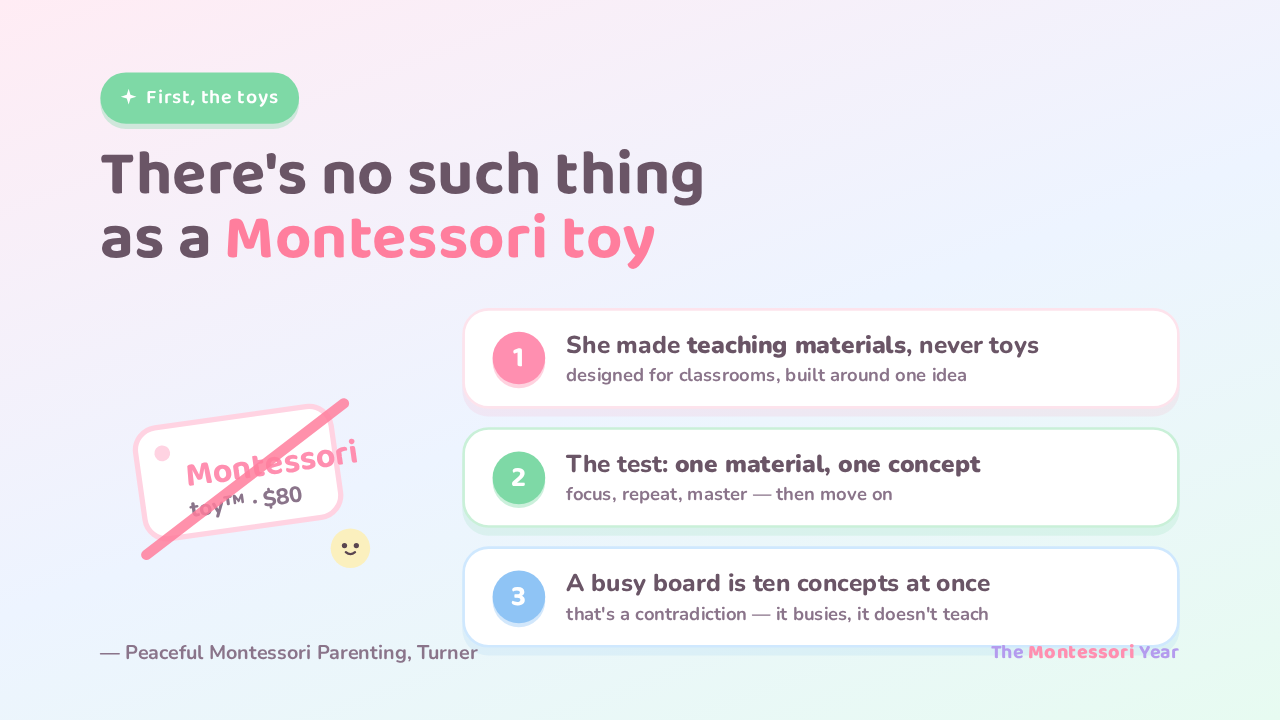
There's no such thingas a Montessori toy
She made teaching materials, never toysdesigned for classrooms, built around one idea
The test: one material, one conceptfocus, repeat, master — then move on
A busy board is ten concepts at oncethat's a contradiction — it busies, it doesn't teach
Start with the toys, because that's where most of us meet the word. Maria Montessori never made toys. She designed classroom teaching materials, each one built to isolate a single idea. One material, one concept, so the child can focus, repeat, and master it. In Peaceful Montessori Parenting, Haley Turner points out that the famous Montessori busy board is really a contradiction. Ten latches, a zipper, a spinner, and a squeaker on one board is a device for keeping a child busy. A Montessori material does the opposite. It hands the child one problem, and the quiet to solve it. So when a box says Montessori, that's marketing. The word on the box is not the method.
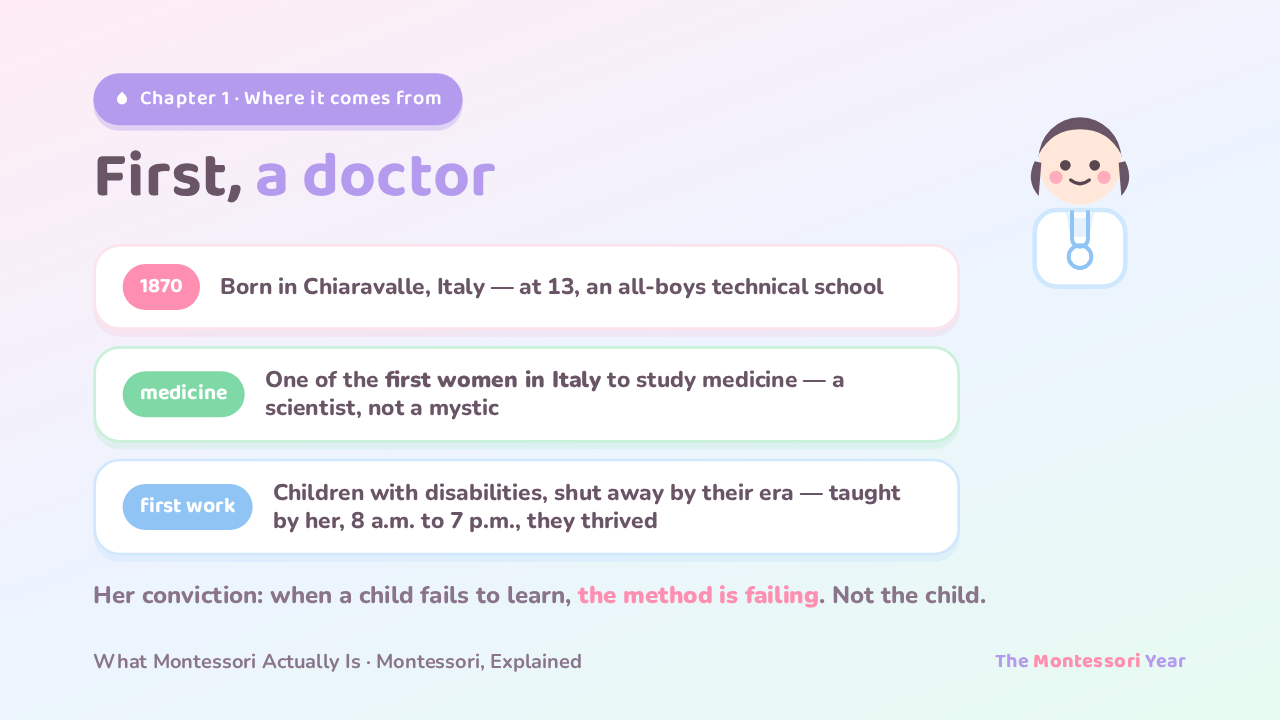
First, a doctor
Born in Chiaravalle, Italy — at 13, an all-boys technical school
One of the first women in Italy to study medicine — a scientist, not a mystic
Children with disabilities, shut away by their era — taught by her, 8 a.m. to 7 p.m., they thrived
Her conviction: when a child fails to learn, the method is failing. Not the child.
So who was she? Maria Montessori was born in Italy in eighteen seventy. At thirteen she enrolled in a technical school full of boys. She went on to become one of the first women in Italy to study medicine. She came to children through science, not through teaching. Her first work was with children with disabilities, children her era had written off and shut away in institutions. She built materials for them, and she taught them herself, from eight in the morning to seven at night. They learned far more than anyone believed they could. And that planted the conviction she would test on every child: when a child fails to learn, the method is failing. Not the child.
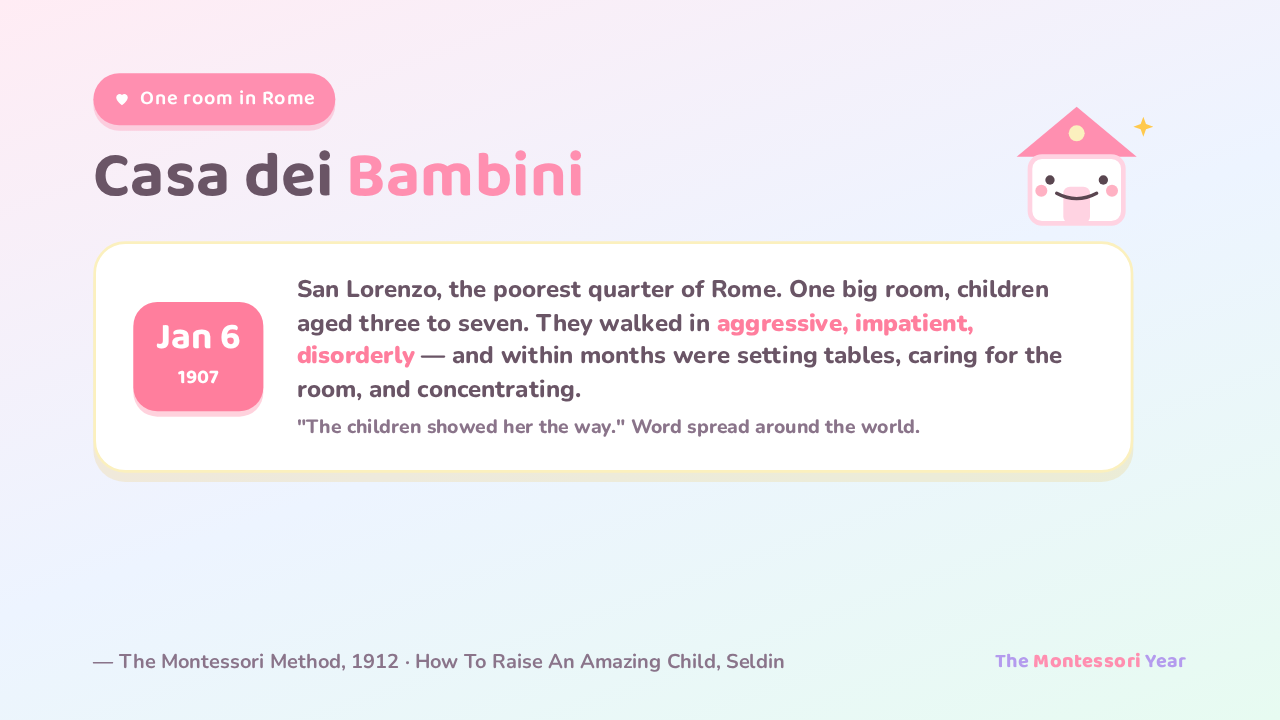
Casa dei Bambini
San Lorenzo, the poorest quarter of Rome. One big room, children aged three to seven. They walked in aggressive, impatient, disorderly — and within months were setting tables, caring for the room, and concentrating."The children showed her the way." Word spread around the world.
Her test came on January sixth, nineteen oh seven. A housing association in San Lorenzo, the poorest quarter of Rome, needed somewhere for the tenement's young children to spend the day while their parents worked. They handed the job to Dr. Montessori. One big room, children aged three to seven, and a friend christened it Casa dei Bambini. The Children's House. Tim Seldin describes the children who walked in as aggressive, impatient, and disorderly. Within months, the same children were setting tables, caring for the room, and concentrating with a calm no one could explain. Word spread around the world. And Montessori always insisted she hadn't trained them. She had watched them, kept changing the room around them, and, as she put it, the children showed her the way.
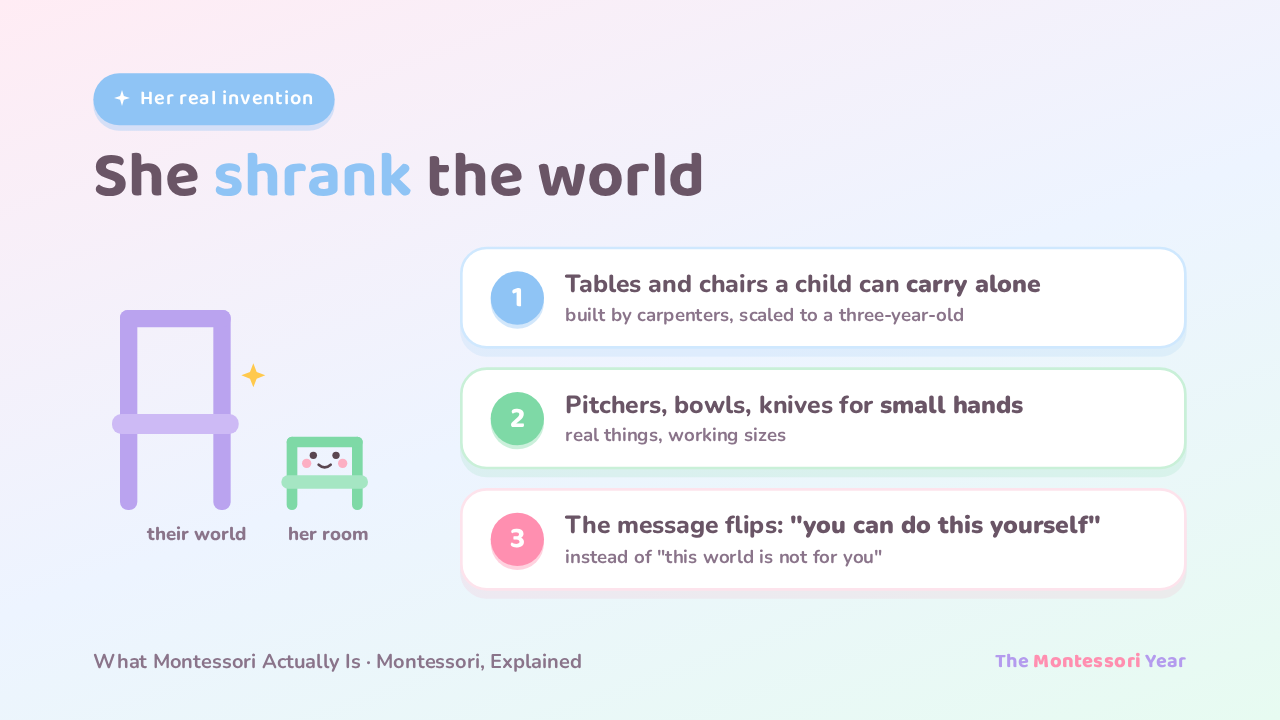
She shrank the world
Tables and chairs a child can carry alonebuilt by carpenters, scaled to a three-year-old
Pitchers, bowls, knives for small handsreal things, working sizes
The message flips: "you can do this yourself"instead of "this world is not for you"
Here's the first thing she changed. She had carpenters build tables and chairs scaled to a three-year-old, light enough for a child to carry across the room alone. She found miniature pitchers and bowls, and knives that fit a small hand. Nobody was doing this. Montessori had noticed that small children live in a land of giants, where every chair, cup, and door handle sends the same message: this world is not for you. Her little furniture said the opposite. You can do this yourself. That idea is so standard today that we forget someone had to have it first.
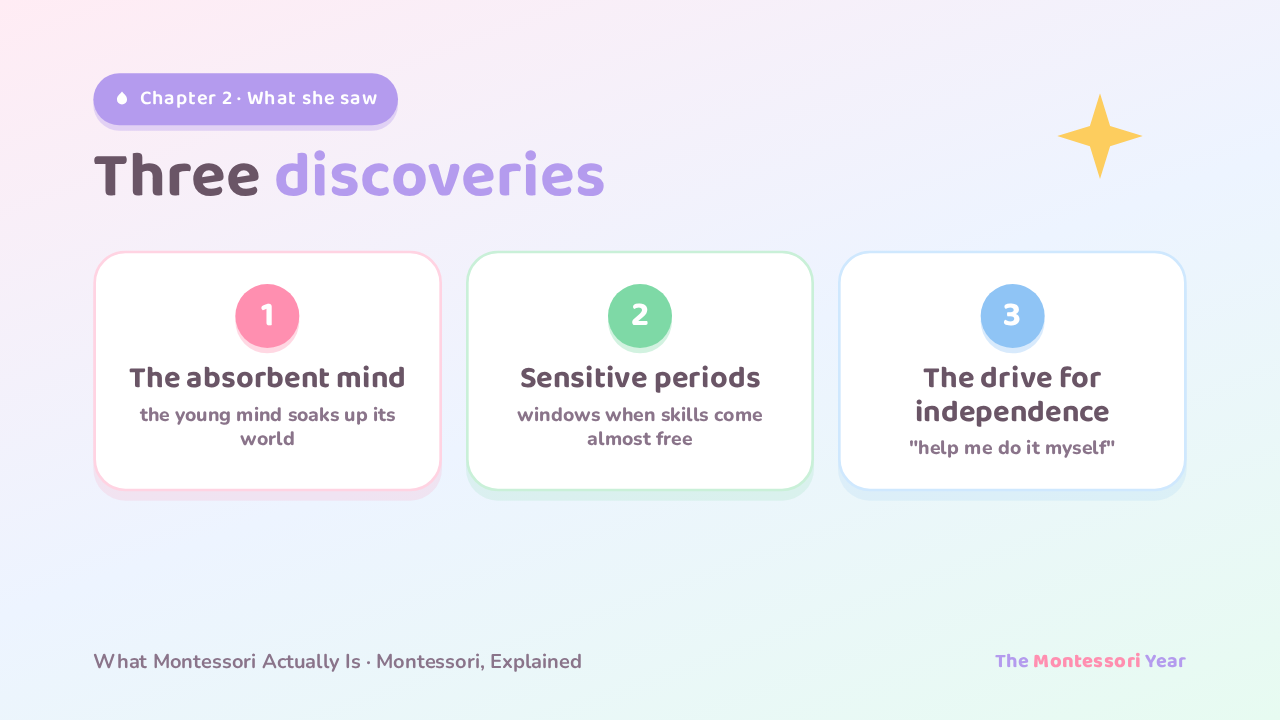
Three discoveries
The absorbent mind
the young mind soaks up its world
Sensitive periods
windows when skills come almost free
The drive for independence
"help me do it myself"
So, a doctor, a room, and some small furniture. That's the history, and history isn't why you're here. The method is what she saw once that room was ready, because those children did things the theories of her time could not explain. Out of years of watching came three discoveries about every young child. Not just the children of San Lorenzo. Every young child, including yours. Here's the first.
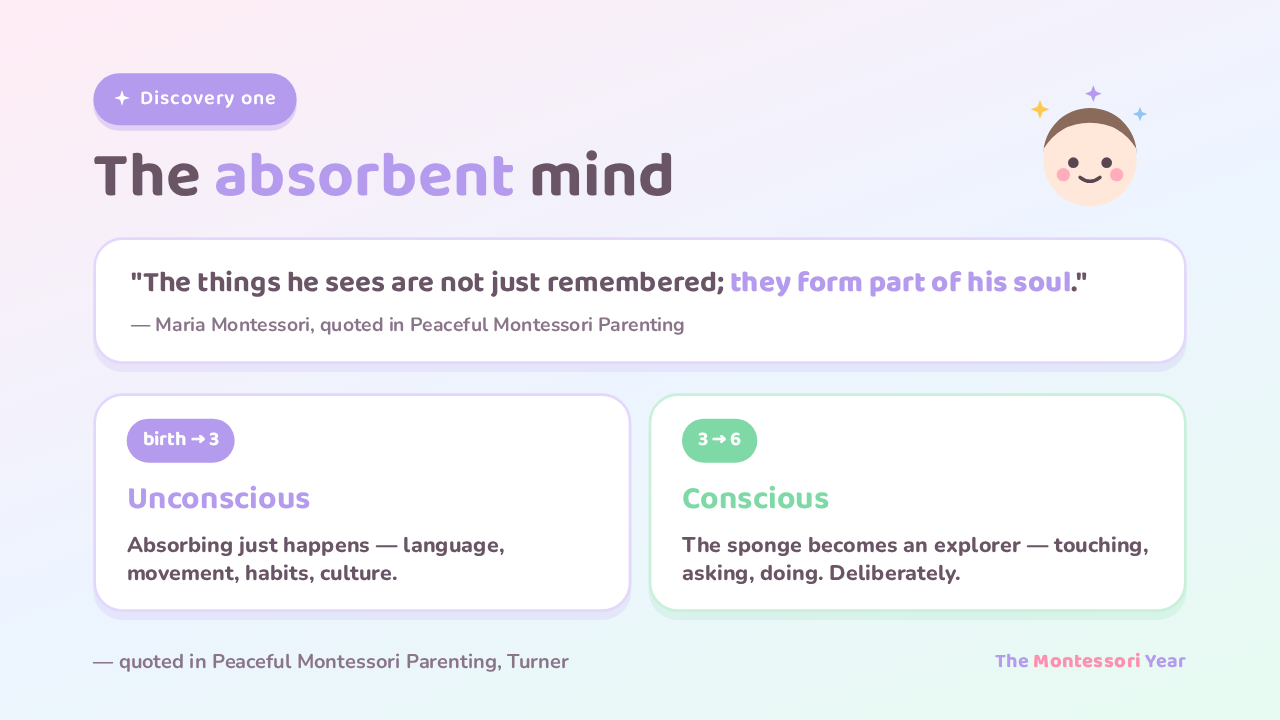
The absorbent mind
"The things he sees are not just remembered; they form part of his soul."
— Maria Montessori, quoted in Peaceful Montessori ParentingUnconscious
Absorbing just happens — language, movement, habits, culture.
Conscious
The sponge becomes an explorer — touching, asking, doing. Deliberately.
Discovery one. The young mind doesn't study the world. It absorbs it. Montessori called this the absorbent mind. From birth to around six, a child soaks up language, movement, habits, and culture simply by living inside them. No lessons, no effort. Nobody taught your child vocabulary lists, yet there they are, speaking your language, in your accent, with your gestures. Montessori's own words are worth hearing. The things a child sees are not just remembered, she wrote. They form part of his soul. For roughly the first three years, the absorbing is unconscious. It simply happens. From around three to six it turns conscious, and the sponge becomes an explorer who wants to touch, ask, and do everything.
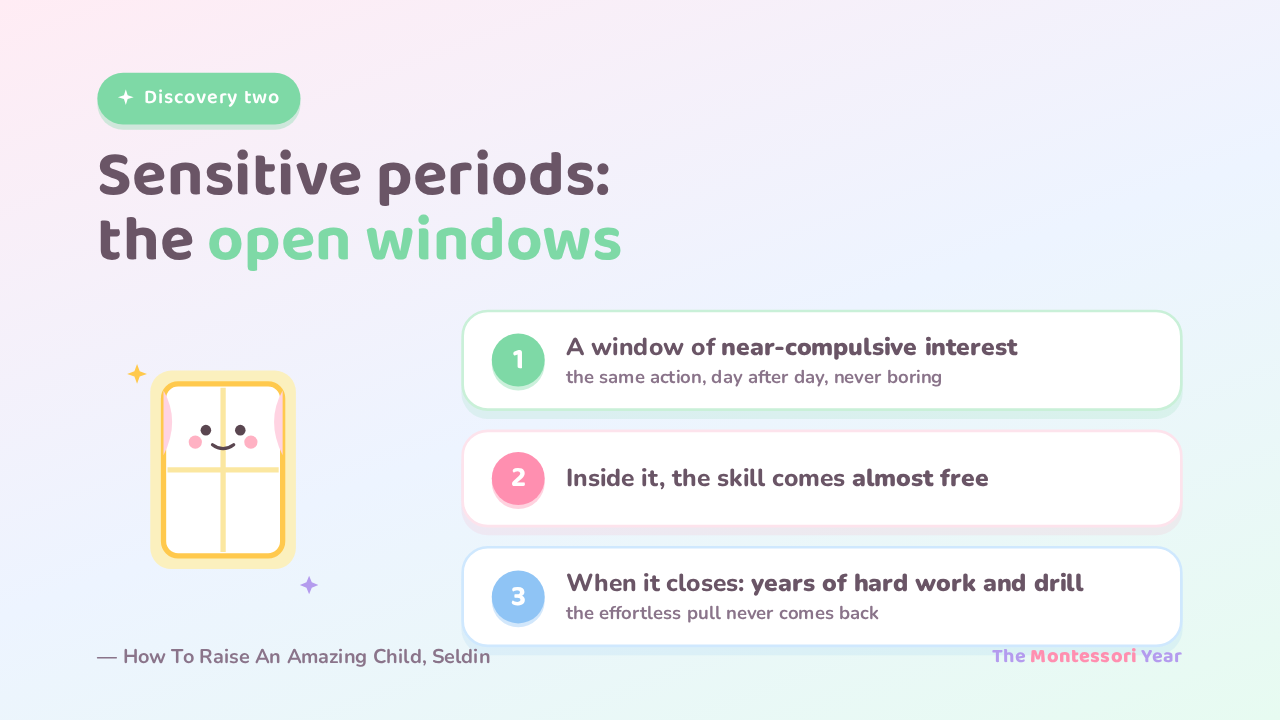
Sensitive periods:the open windows
A window of near-compulsive interestthe same action, day after day, never boring
Inside it, the skill comes almost free
When it closes: years of hard work and drillthe effortless pull never comes back
Discovery two. The absorbing isn't random. It arrives in waves that she called sensitive periods. Windows of time when a child is almost compelled to master one particular thing, and will repeat it day after day without ever getting bored. Inside the window, the skill comes easily, almost for free. Then the window closes, and that effortless pull never comes back. The skill can still be learned later, but, as Tim Seldin puts it, it may take years of hard work and drill. It's why a three-year-old absorbs a second language with a flawless accent while you and I sweat over an app for adults. Same skill. Different window.
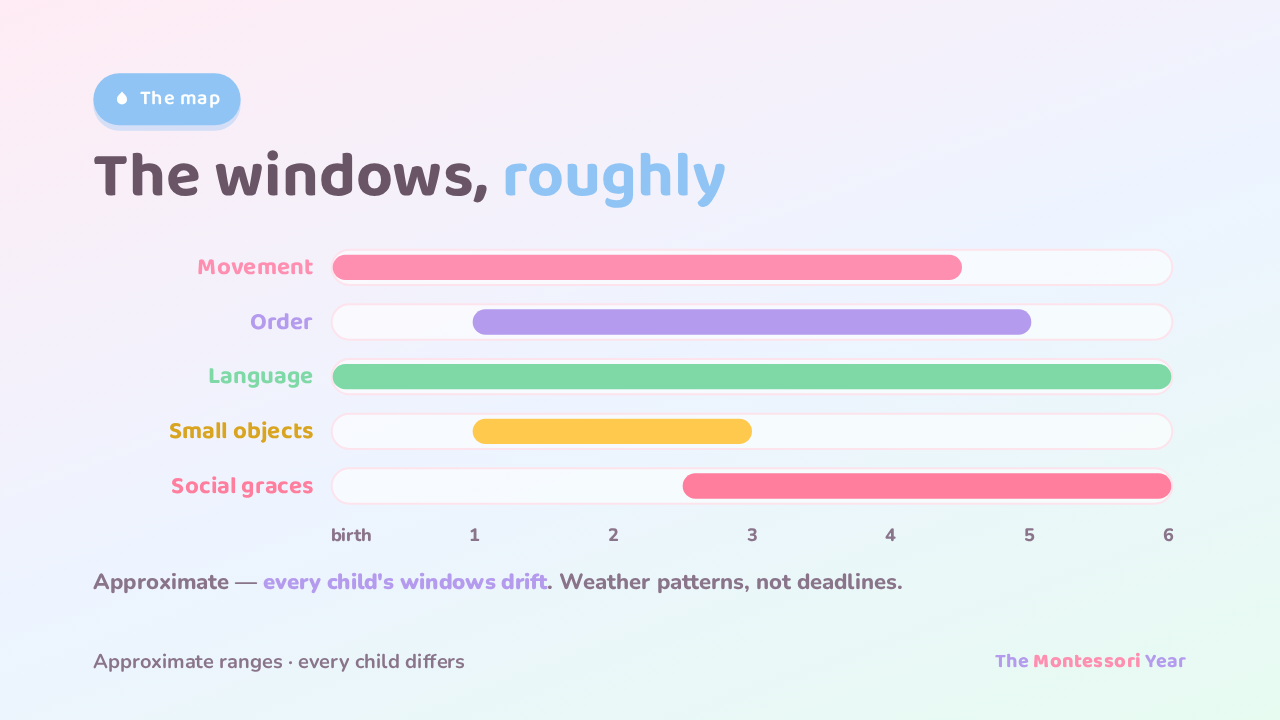
The windows, roughly
Approximate — every child's windows drift. Weather patterns, not deadlines.
Here's the rough map, and please hold it loosely, because every child's windows drift. Movement runs from birth through the preschool years. Order, that famous toddler insistence that everything happen the same way, in the same sequence, runs from late babyhood to around five. Language is the longest window of all, birth to six. A fascination with small objects shows up from around one to three. And from around two and a half, a window opens for manners and social graces, which is why little children love greeting, handing things over, and helping. None of these are deadlines. Think of them as weather patterns. Your job isn't to schedule the wind. It's to notice which way it's blowing.
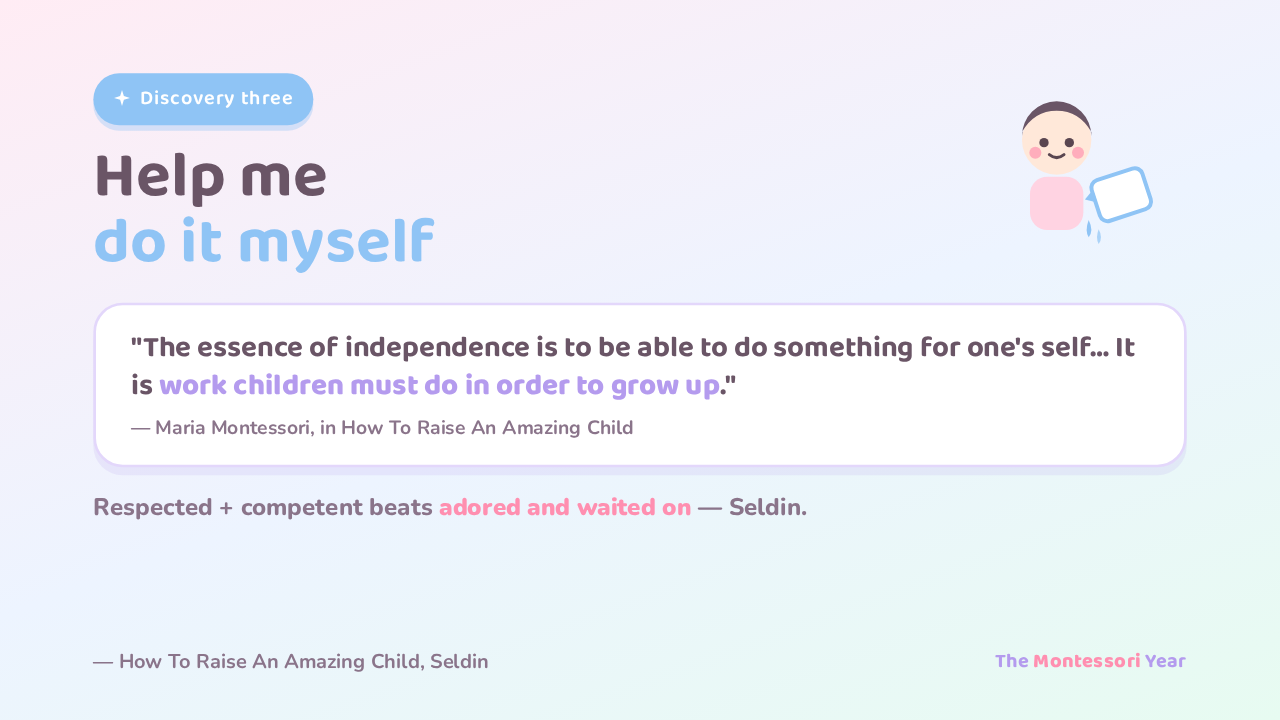
Help medo it myself
"The essence of independence is to be able to do something for one's self… It is work children must do in order to grow up."
— Maria Montessori, in How To Raise An Amazing ChildRespected + competent beats adored and waited on — Seldin.
Discovery three, and this is the heart of the whole method. Independence, Seldin writes, is the greatest drive of a young child. The meltdown when you zipped the coat they wanted to zip? That's not defiance. That's the drive. Montessori said it plainly: the essence of independence is to be able to do something for one's self. Such experience is not just play, she wrote. It is work children must do in order to grow up. And Seldin adds this: a child who feels respected and competent develops a far greater sense of emotional well-being than a child who is simply adored and waited on. Loved is not enough. They need to be capable too.
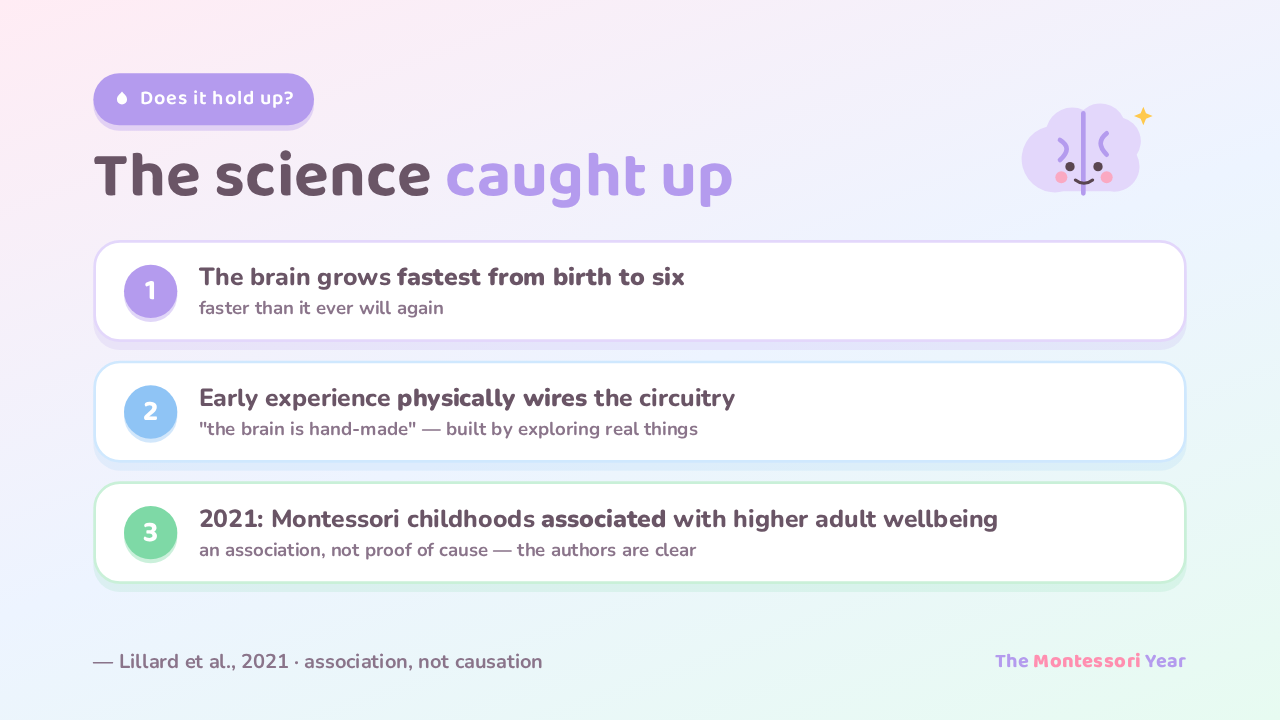
The science caught up
The brain grows fastest from birth to sixfaster than it ever will again
Early experience physically wires the circuitry"the brain is hand-made" — built by exploring real things
2021: Montessori childhoods associated with higher adult wellbeingan association, not proof of cause — the authors are clear
If a theory from nineteen oh seven sounds quaint, here's what modern science says. The brain grows faster from birth to six than it ever will again, and researchers can now watch early experience physically wire its circuitry. Montessori suggested the brain is, in a sense, hand made, built by children exploring and manipulating real things. Brain imaging has been kind to that idea. And one more, with a careful asterisk. In twenty twenty-one, researchers found that adults who had attended Montessori schools as children reported higher wellbeing decades later. It's an association, the authors are clear, not proof of cause. But for a method born in a Roman tenement, it has aged remarkably well.
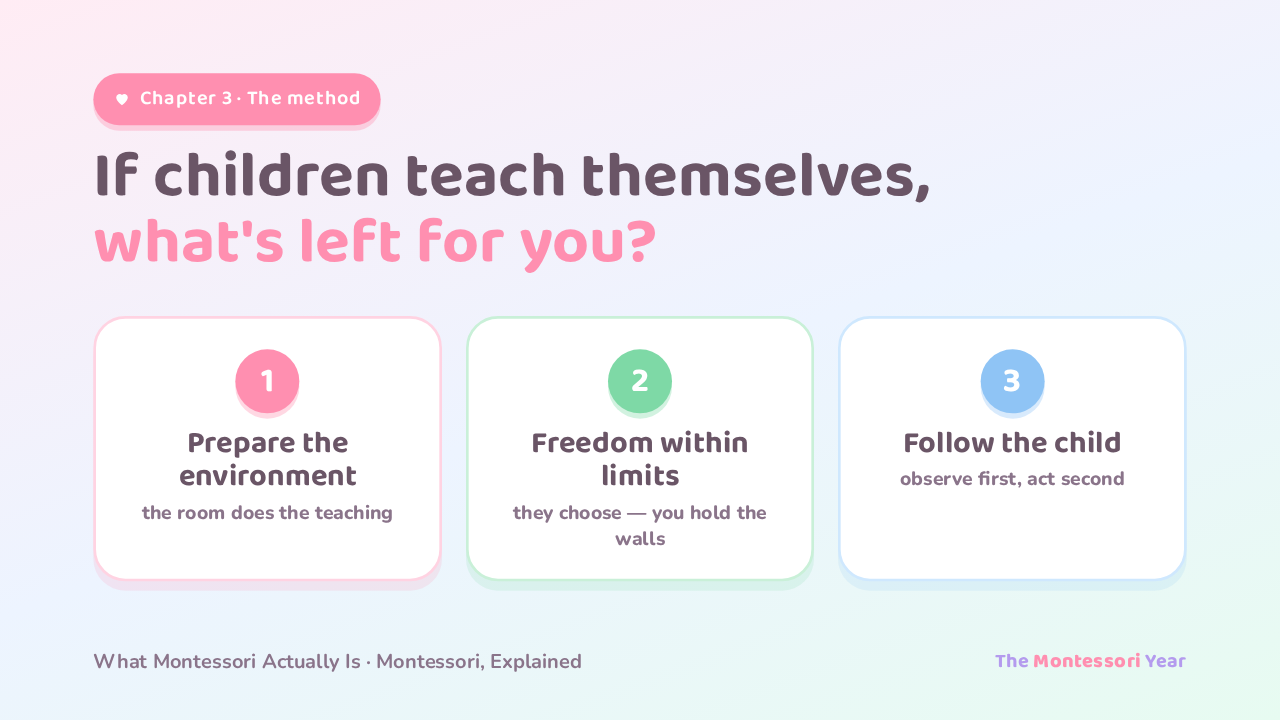
If children teach themselves,what's left for you?
Prepare the environment
the room does the teaching
Freedom within limits
they choose — you hold the walls
Follow the child
observe first, act second
Which brings us to you. Because if children teach themselves, you might wonder what's left for the parent to do. The answer is: everything. Just not the part you think. Not lecturing. Not correcting every mistake. Not entertaining them through the day. In this method the adult has exactly three jobs, and they are the same three whether you're a trained guide in a classroom or a tired parent on a Tuesday night. Job one is the room.
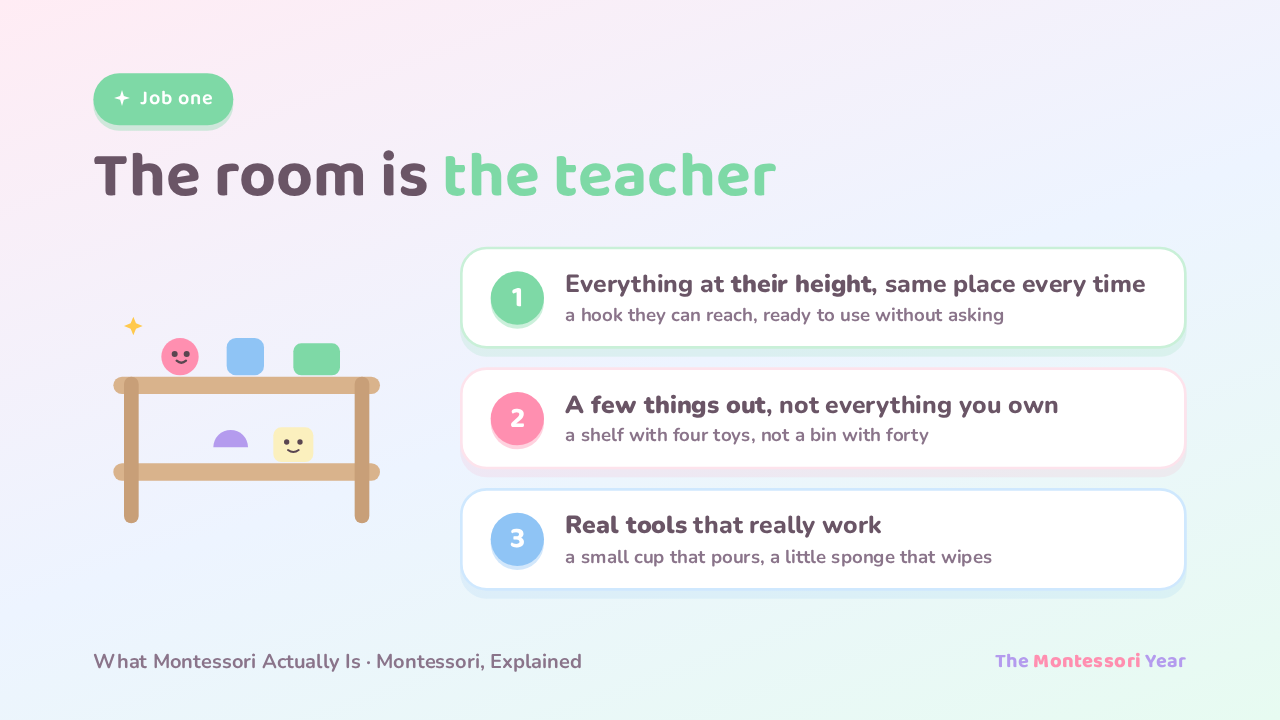
The room is the teacher
Everything at their height, same place every timea hook they can reach, ready to use without asking
A few things out, not everything you owna shelf with four toys, not a bin with forty
Real tools that really worka small cup that pours, a little sponge that wipes
Montessori called it the prepared environment, and it means the room does the teaching. Everything your child needs lives in the same place every time, at their height, ready to use without asking. A few things out, not everything you own. A hook they can actually reach. A shelf with four toys on it, not a bin with forty in it. Real tools that really work: a small cup that truly pours, a little sponge that truly wipes. When the world around a child is ordered and reachable, the child can act on her own idea without asking. Remember the order window. A toddler is already craving order on the inside. An orderly room outside is how you feed it.
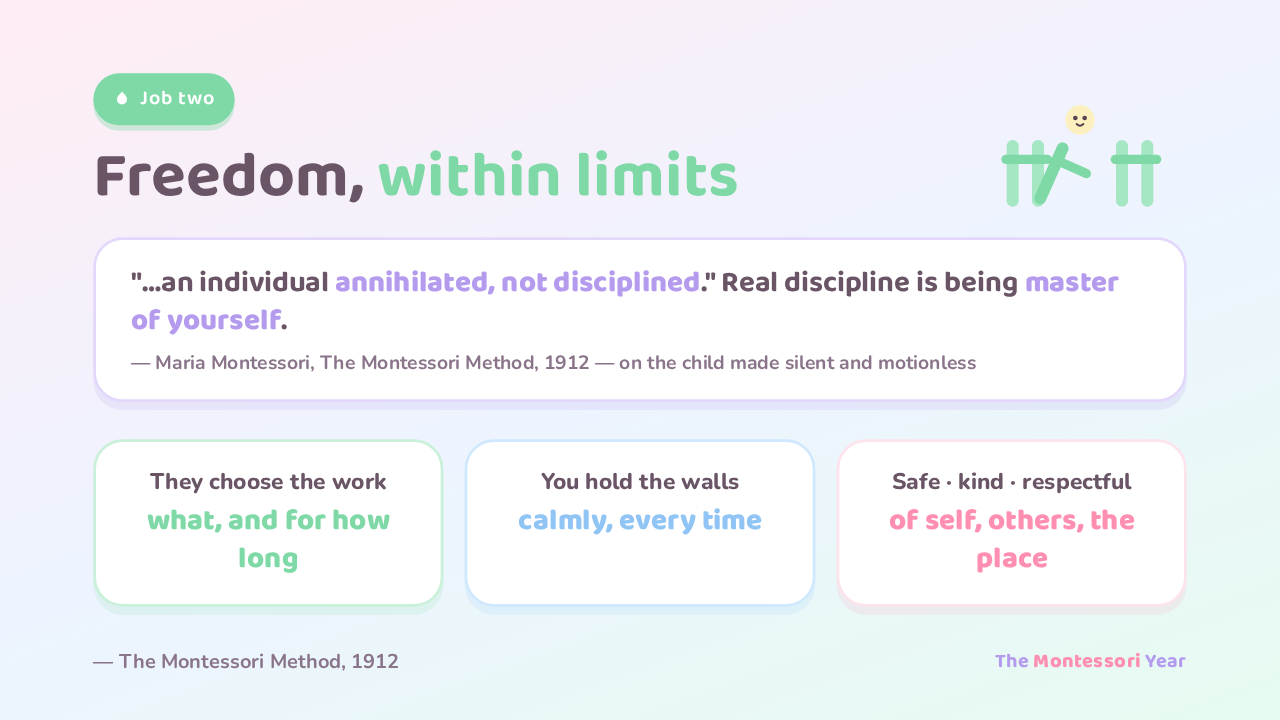
Freedom, within limits
"…an individual annihilated, not disciplined." Real discipline is being master of yourself.
— Maria Montessori, The Montessori Method, 1912 — on the child made silent and motionlessJob two. Freedom, within limits. And here the biggest myth about Montessori dies, because this is not permissive parenting. In her book from nineteen twelve, Montessori wrote that a child who has merely been made silent and motionless is not disciplined at all. He is, in her words, an individual annihilated, not disciplined. Real discipline, she said, is being master of yourself. And a child can only practice self-mastery by making real choices inside firm limits. So in a Montessori home the child chooses. Which activity, which order, how long. And the adult holds the walls, calmly and every time: we don't hurt ourselves, we don't hurt others, and we don't wreck the place. Free choice inside a fence. Never no fence.
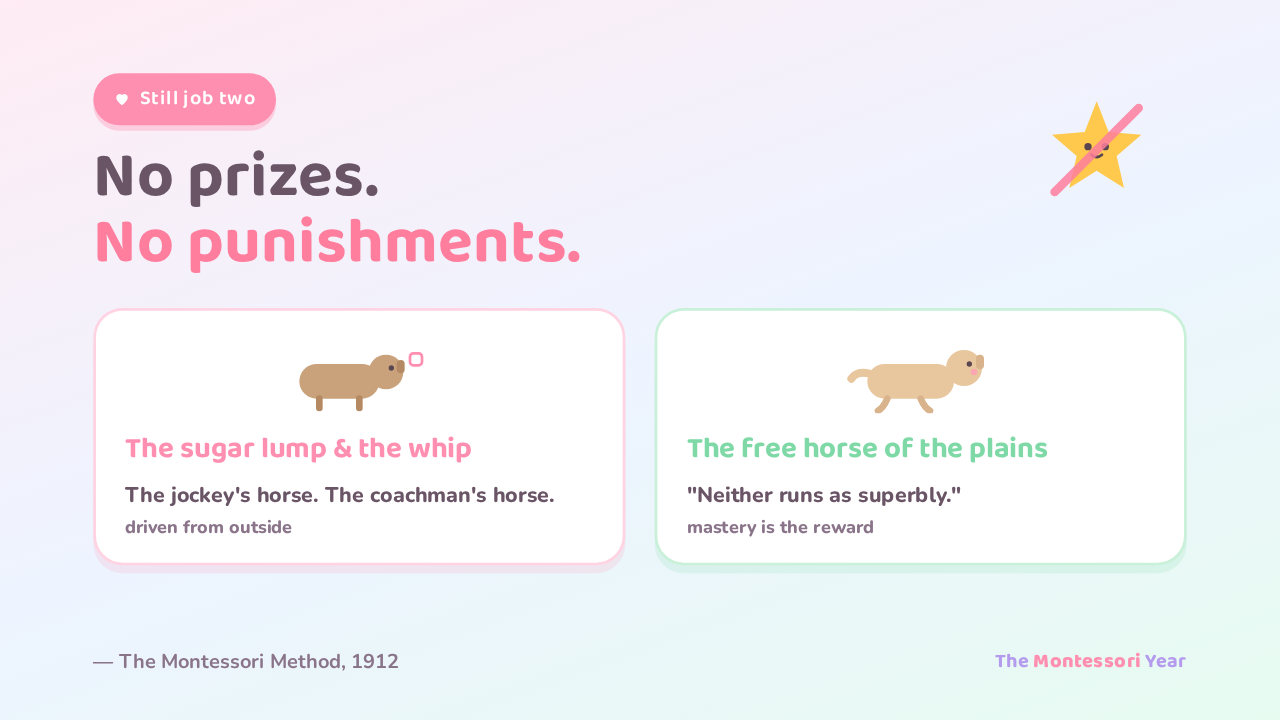
No prizes.No punishments.
The sugar lump & the whip
The jockey's horse. The coachman's horse.driven from outside
The free horse of the plains
"Neither runs as superbly."mastery is the reward
And inside that fence, no bribes. Montessori argued against punishing children, and against prizes, both at once, back in nineteen twelve. She called them the instrument of slavery for the spirit. Her image is hard to forget. A jockey offers his horse a lump of sugar. A coachman uses the whip. And neither animal, she wrote, runs as superbly as the free horse of the plains. You've seen this in your own child. A toddler who finally buttons a button doesn't look around for a sticker. The face says everything. The mastery is the reward, and every chart and treat we bolt on top quietly teaches them to work for us instead of for it.
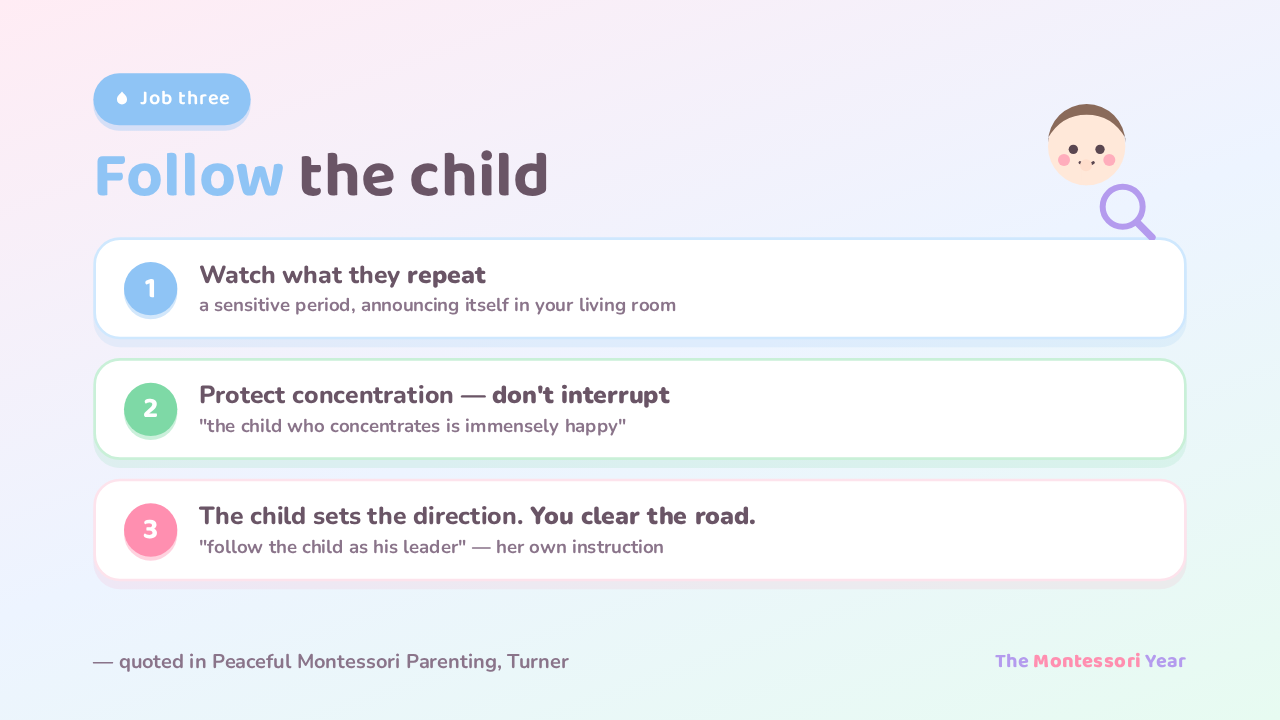
Follow the child
Watch what they repeata sensitive period, announcing itself in your living room
Protect concentration — don't interrupt"the child who concentrates is immensely happy"
The child sets the direction. You clear the road."follow the child as his leader" — her own instruction
Job three is the one she named the whole philosophy after. Follow the child. It means observation comes before action. Watch what your child reaches for, what they repeat, what they do when nobody directs them. That's a sensitive period announcing itself, live, in your living room. Then protect what you find. Montessori noticed that the child who concentrates is immensely happy, and concentration is exactly the thing we adults break all day long with the best intentions. A question here, a cheer there, a quick fix of their crooked tower. Let it finish. She even told her own followers not to honor her, but to follow the child as his leader. The child sets the direction. Your job is to clear the road.
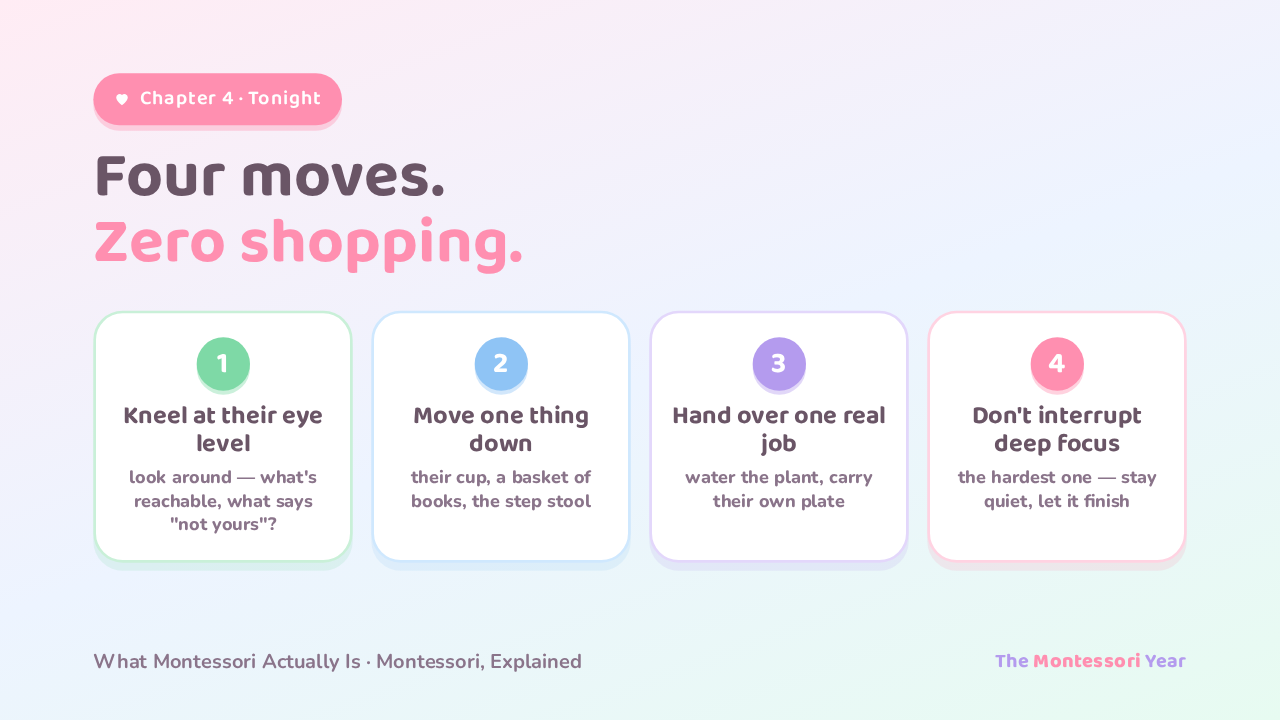
Four moves.Zero shopping.
Kneel at their eye level
look around — what's reachable, what says "not yours"?
Move one thing down
their cup, a basket of books, the step stool
Hand over one real job
water the plant, carry their own plate
Don't interrupt deep focus
the hardest one — stay quiet, let it finish
So here's the free version, starting tonight. One: get down on your knees at your child's eye level and look around the room. Notice what's reachable, and what quietly says "not yours." Two: move one thing they use every day down to their height. Their cup. A basket of books. The step stool to the sink. Three: hand over one real job, and mean it. Watering the plant. Carrying their own plate to the table. Wiping up their own spill with their own little cloth. Four, and this is the hardest one: the next time you find them deeply focused on something, even something odd, stay quiet and let it finish. That's it. Four moves. That's a Montessori home, tonight.
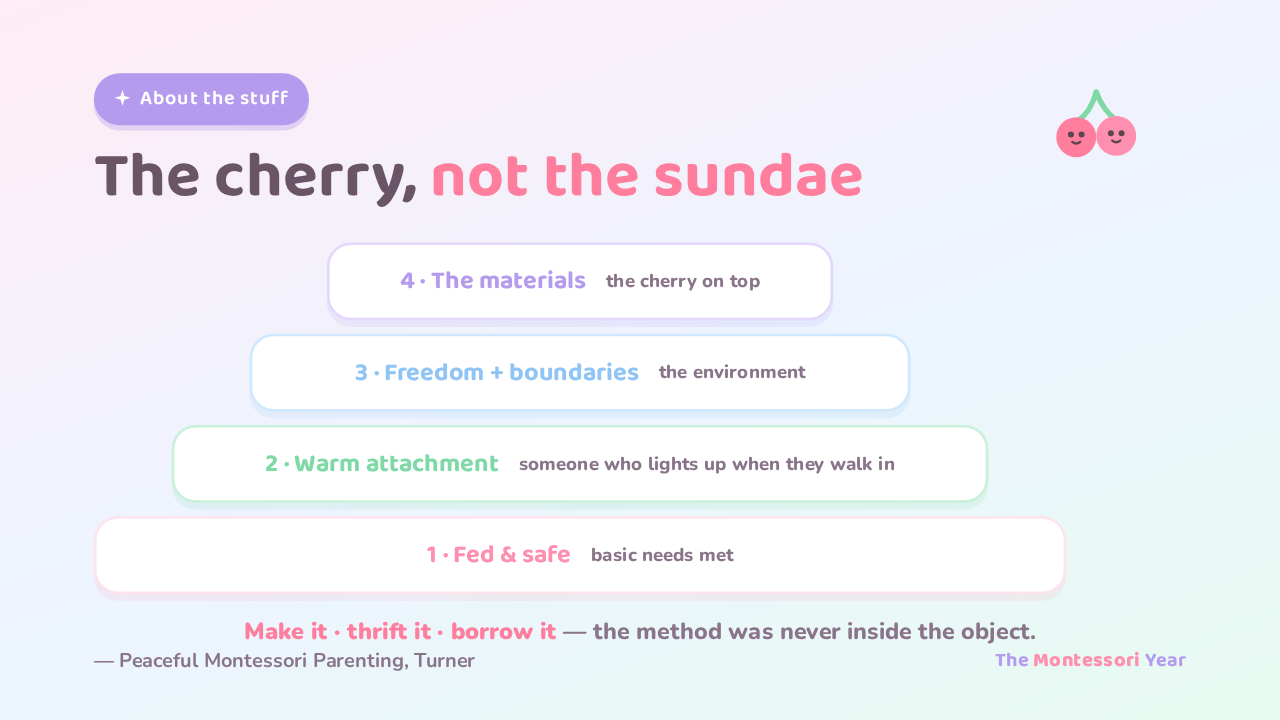
The cherry, not the sundae
1 · Fed & safe
basic needs met
2 · Warm attachment
someone who lights up when they walk in
3 · Freedom + boundaries
the environment
4 · The materials
the cherry on top
Make it · thrift it · borrow it — the method was never inside the object.
Before you buy a single thing, hear how Turner orders what a child actually needs. First, fed and safe. Second, a warm, secure attachment to someone who lights up when they walk in. Third, an environment that offers freedom inside boundaries. And only then, fourth, the materials and activities. The stuff, she says, is the cherry on top. So make it, thrift it, borrow it. A basket of real kitchen things to explore beats the eighty-dollar rainbow, because the method was never inside the object. It's in the freedom and the order around the object.
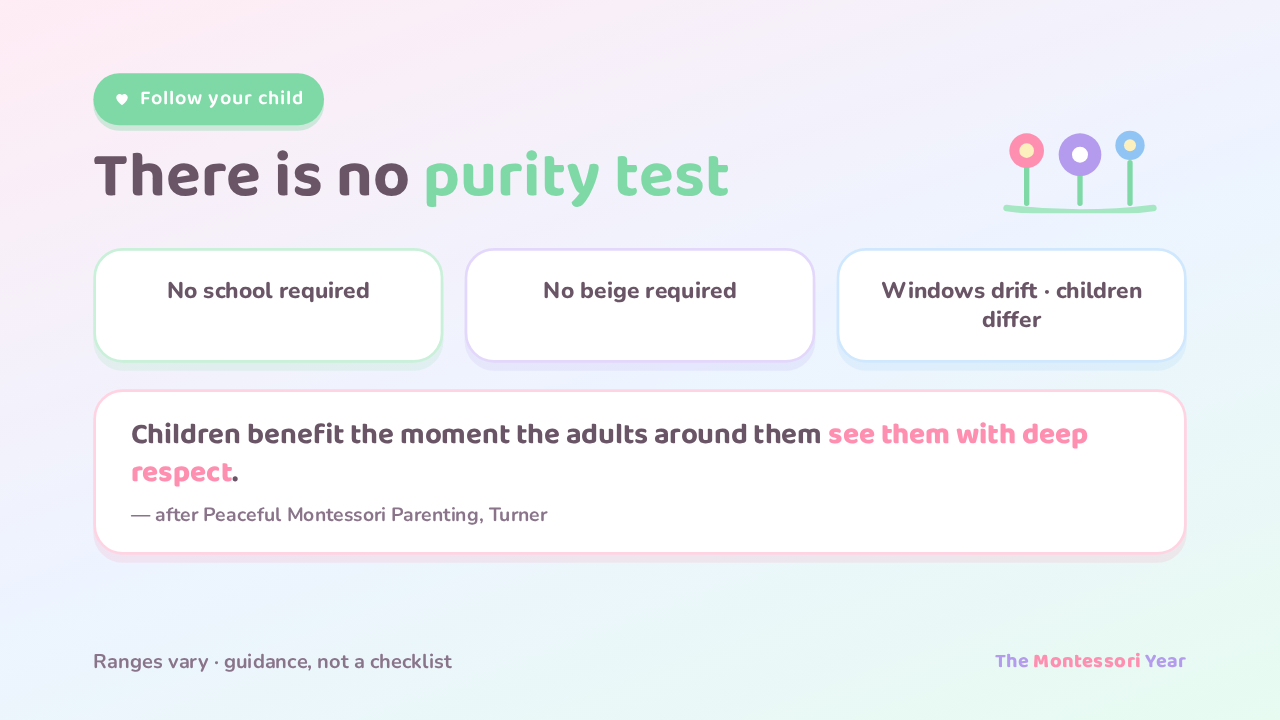
There is no purity test
Children benefit the moment the adults around them see them with deep respect.
— after Peaceful Montessori Parenting, TurnerAnd a calibration, because I will never gatekeep this for you. You don't need the school for your child to benefit. Turner is clear that children gain the moment the adults in their lives simply see them with deep respect and kindness. You don't need the beige playroom, the imported shelf, or a single wooden toy. The windows drift, so some children hit them early and some late, and both are fine. There's no test to pass and no purity to police. If you are watching your child with respect, and adjusting their little world to meet what you see, you are already doing the thing.
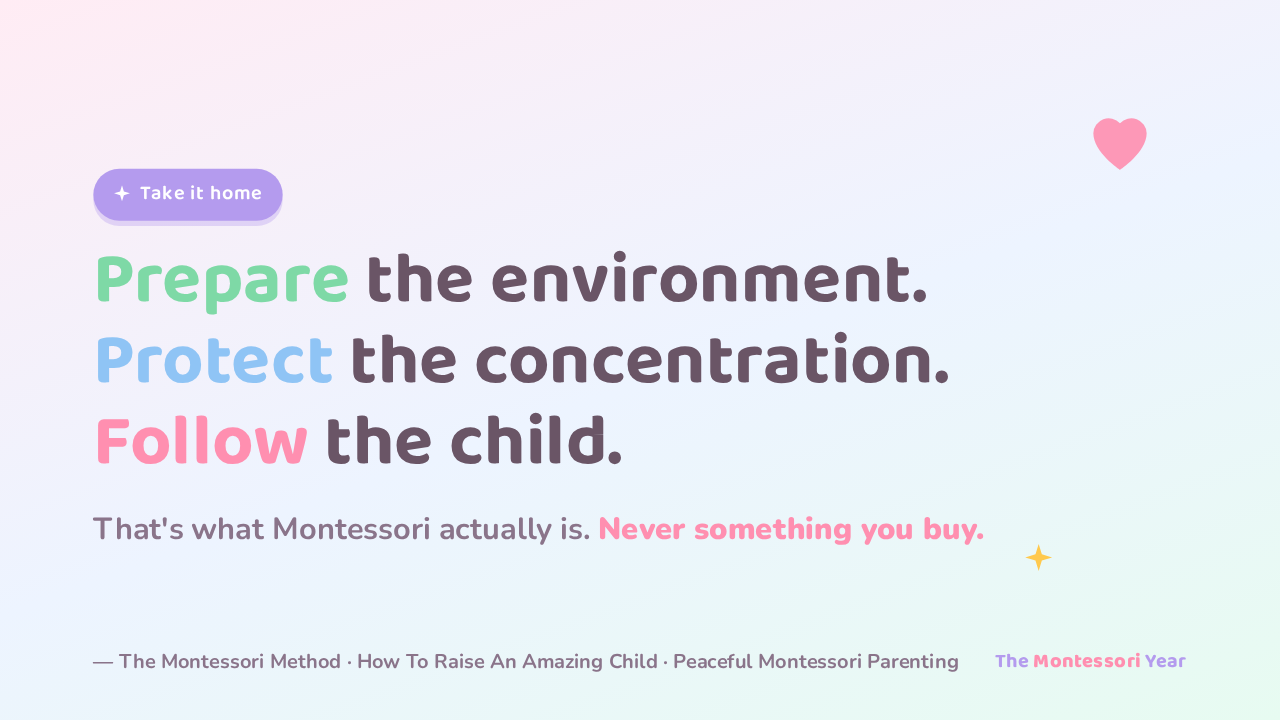
Prepare the environment.Protect the concentration.Follow the child.
That's what Montessori actually is. Never something you buy.
So here is the sentence I promised you. Prepare the environment. Protect the concentration. Follow the child. That's what Montessori actually is. Not a brand, not an aesthetic, and never something you buy. More than a century ago, a scientist looked at children everyone else had given up on and drew a conclusion the world is still catching up to: the child was never the problem. The room was. The hurry was. Fix those, and children teach themselves. Everything on this channel builds on that one idea. If you'd like the next layer, the sensitive periods get a full episode of their own, one window at a time. I'll see you there.