
First steps, in their own time
First steps,
in their own time ✿
The gift half your relatives brought to the shower is the one thing that can slow this moment down.
Your baby is standing at the edge of the sofa, shuffling sideways along it, one hand about to lift off. First steps are close. And in the corner sits the gift half your relatives brought to the shower: a baby walker, the wheeled seat your baby sits down inside and scoots around in. Here's the strange part. That gift is the one thing in the room that can actually slow this moment down.
Moves your baby vs. your baby moves it
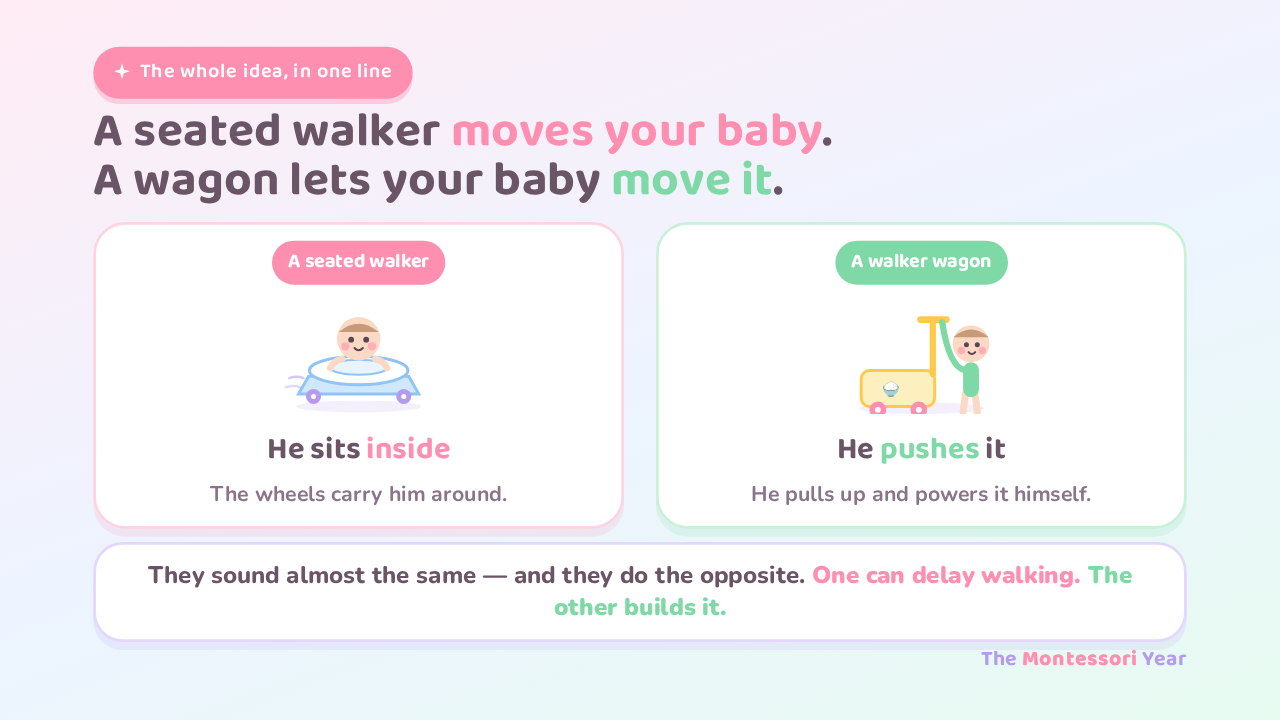
A seated walker moves your baby.
A wagon lets your baby move it.
He sits inside
The wheels carry him around.
He pushes it
He pulls up and powers it himself.
Here's the whole idea, in one line. A seated walker moves your baby. A walker wagon lets your baby move it. They sound almost the same, and they do the opposite. The seated walker is that wheeled seat. He sits down inside, and the wheels carry him around. The walker wagon is a little wooden wagon with a tall, fixed handle. He pulls himself up on it, and pushes it along on his own two feet. One of them can delay walking. The other one builds it.
A shortcut his body didn't earn
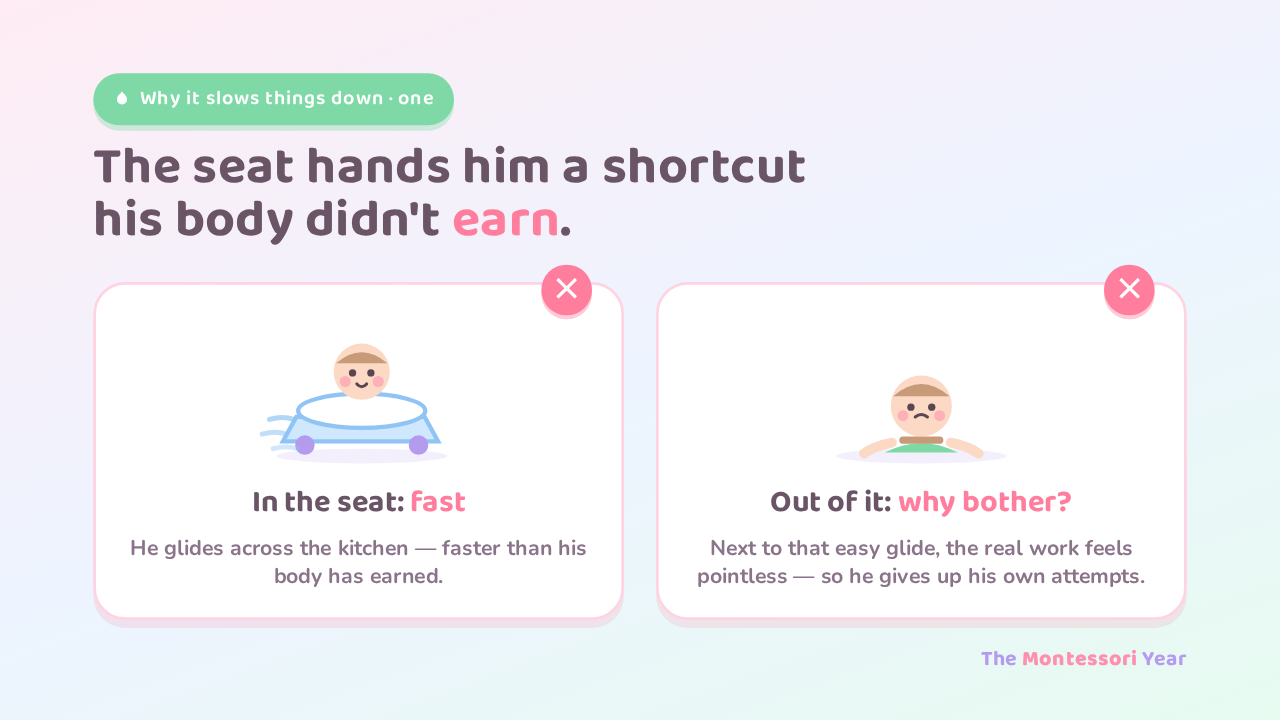
The seat hands him a shortcut
his body didn't earn.
In the seat: fast
He glides across the kitchen — faster than his body has earned.
Out of it: why bother?
Next to that easy glide, the real work feels pointless — so he gives up his own attempts.
So why would a walker slow things down? Two reasons. Here's the first. A seated walker makes your baby fast right away, faster than his own body has earned. He drops into the seat, pushes off with his toes, and glides across the kitchen. It feels like progress. But the hard, wobbly work of pulling up and edging along the furniture is what actually builds walking. And next to all that easy gliding, that work starts to feel pointless to him. So when you lift him out of the seat, he can simply give up on his own attempts. Why struggle across the floor, when the seat did it for free?
A made-up way to walk
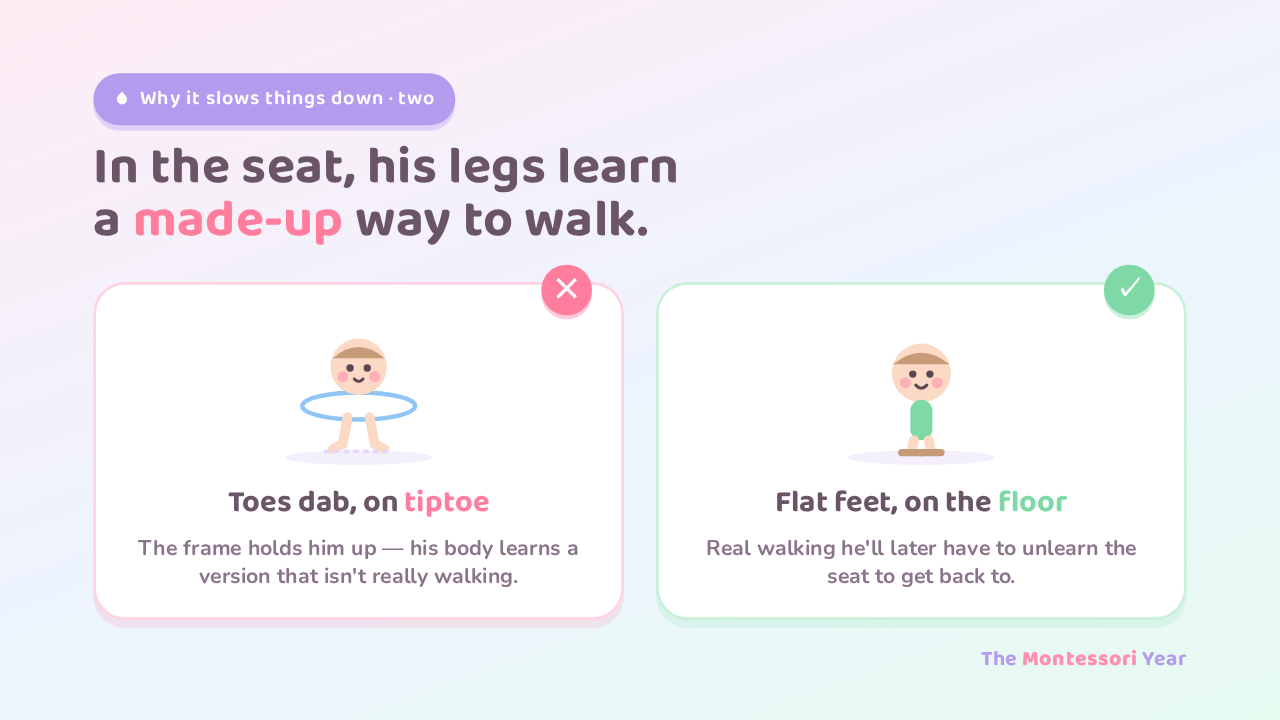
In the seat, his legs learn
a made-up way to walk.
Toes dab, on tiptoe
The frame holds him up — his body learns a version that isn't really walking.
Flat feet, on the floor
Real walking he'll later have to unlearn the seat to get back to.
Here's the second reason, and it's the sneaky one. In that seat, your baby is held up by the frame, not by his own legs. His feet dangle, his toes dab at the floor, and he shoves off on tiptoe. His body learns all of that as if it were walking. But it isn't. It's a made-up version, built around a seat that holds him up. It teaches him the wrong thing about where his own body ends, and how his legs actually work. Later, when there's no seat, he has to unlearn every bit of it before real walking can begin.
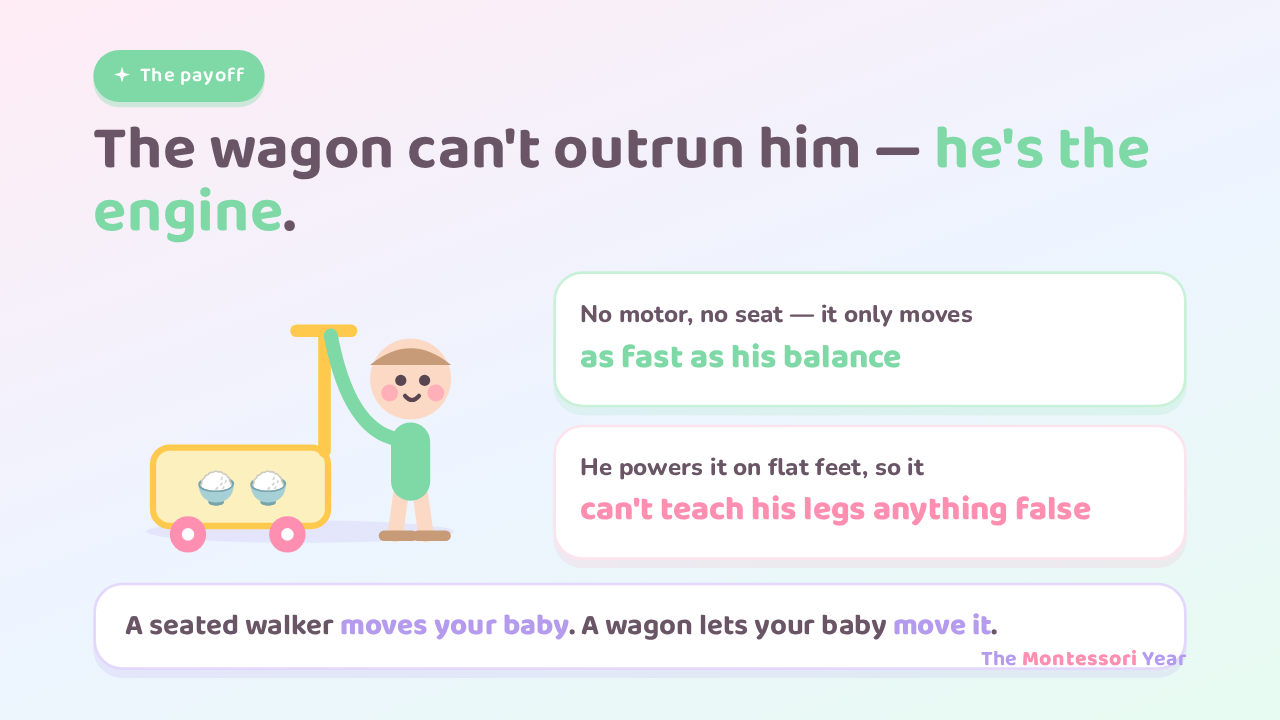
He's the engine
The wagon can't outrun him — he's the engine.
Now watch what the wagon does to both of those problems. It has no motor and no seat. It just sits there until your baby stands up, grabs the handle, and pushes. So it can only move as fast as his own balance carries it. It can never outrun his development the way the seat does. And because he is the engine, powering every step on his own two flat feet, it can't teach his legs anything false. That's the whole thing in one sentence. A seated walker moves your baby. A wagon lets your baby move it.
Children's doctors on baby walkers
Children's doctors want baby walkers off the market.
There's one more reason. The American Academy of Pediatrics, the group that speaks for children's doctors across the country, says baby walkers shouldn't even be made or sold. Those seats still send thousands of babies to the emergency room every year, most of them tumbling down a flight of stairs. Canada banned selling them in 2004. And these same doctors say walkers have no real benefit, and can actually delay when a baby starts to walk.
A track he can travel on his own
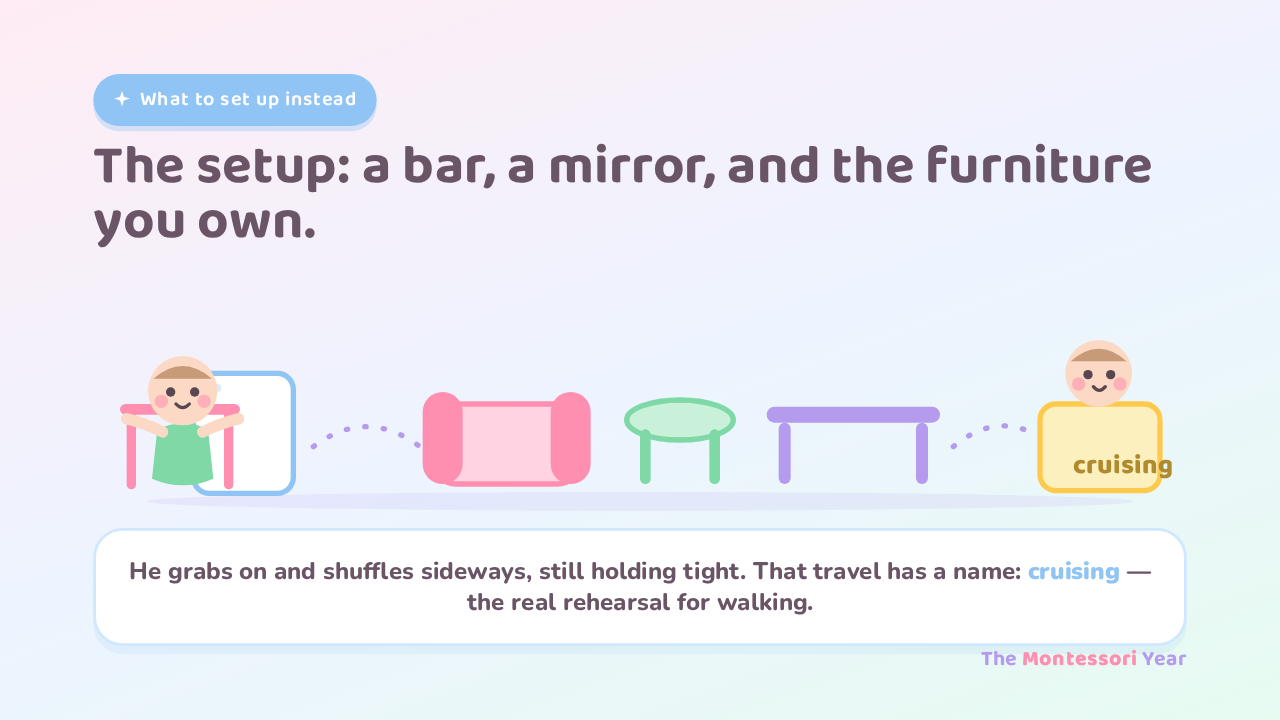
The setup: a bar, a mirror, and the furniture you own.
cruisingSo what do you set up instead? A track your baby can travel on his own. Start with a low bar fixed to the wall, with a mirror behind it, so he can pull up whenever he likes. Then let the furniture take over. A sturdy stool, a low table, the front of the sofa. He grabs on and shuffles sideways, still holding tight. That sideways travel has a name. It's called cruising, and it's the real rehearsal for walking.
Weight it first, then empty it
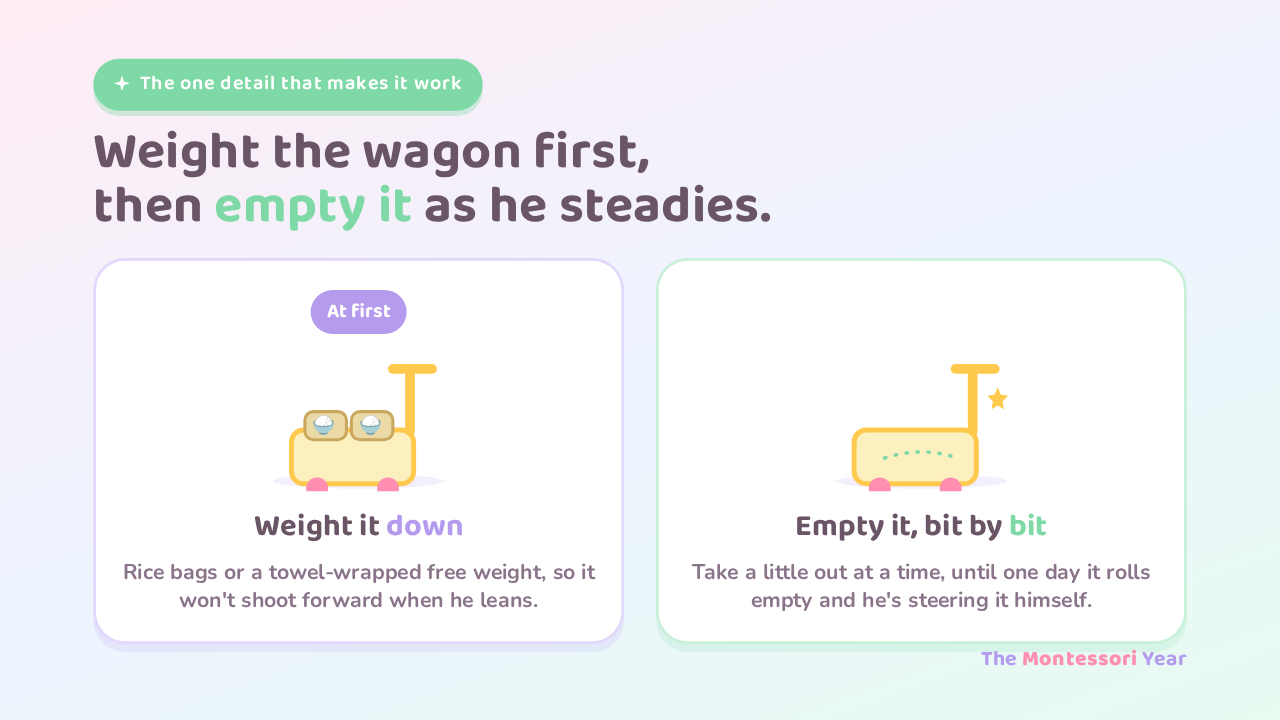
Weight the wagon first,
then empty it as he steadies.
Weight it down
Rice bags or a towel-wrapped free weight, so it won't shoot forward when he leans.
Empty it, bit by bit
Take a little out at a time, until one day it rolls empty and he's steering it himself.
Now the wagon itself, and the one detail that makes it or breaks it. At first, weight it down. A couple of bags of rice, or free weights wrapped in a towel, right in the bed of the wagon. That stops it from shooting forward the second he leans on the handle. Then, as his balance grows, take a little weight out at a time, until one day the wagon rolls empty and he is steering it himself.
Not both hands — one finger if he asks
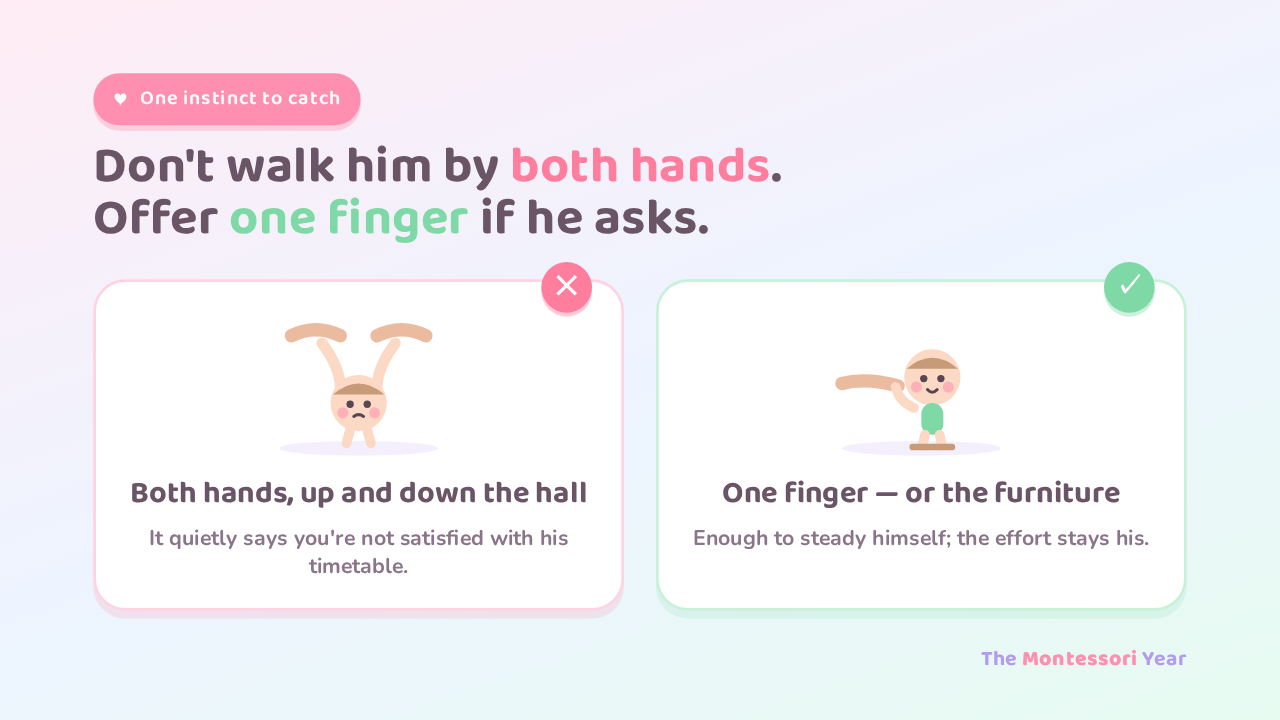
Don't walk him by both hands.
Offer one finger if he asks.
Both hands, up and down the hall
It quietly says you're not satisfied with his timetable.
One finger — or the furniture
Enough to steady himself; the effort stays his.
There's one instinct to catch, because nearly every parent has it. When your baby is cruising, it's so tempting to take both his hands and walk him up and down the hall. Try not to. Walking him around before he's ready sends a quiet message, that you are not satisfied with his own timetable, and it can leave him frustrated with his own attempts. If he reaches for you, offer a single finger to steady himself. Better still, let the furniture and the wagon be what he holds.
A window, not a deadline
Watch your baby,
not the calendar
It's a window, not a deadline. Some babies step early, some take their sweet time — and that spread is completely normal.
Walking early or late says nothing about how bright your child is. A guide for the home, not medical advice — anything about your child's development belongs with your pediatrician.
And here's the part I most want to land. This is a window, not a deadline. Some babies take their first steps early, some take their sweet time. That spread is completely normal. Walking early or walking late says nothing about how bright your child is. It isn't a competition, not for him, and not for you. So watch your baby, not the calendar. And as always, this is a guide for your home, not medical advice. Anything about your child's development belongs with your pediatrician.
Put the seat away
Put the seat away —
then step back ♥
First steps are coming — and when they come, they'll be entirely his, at just the right time for your child.
So this week: put the seat away. Give him a wagon he powers himself, a bar and some furniture to hold, and your own hands mostly in your pockets. First steps are coming. And when they come, they'll be entirely his, arriving joyfully, at just the right time for your child. I'll see you next week.