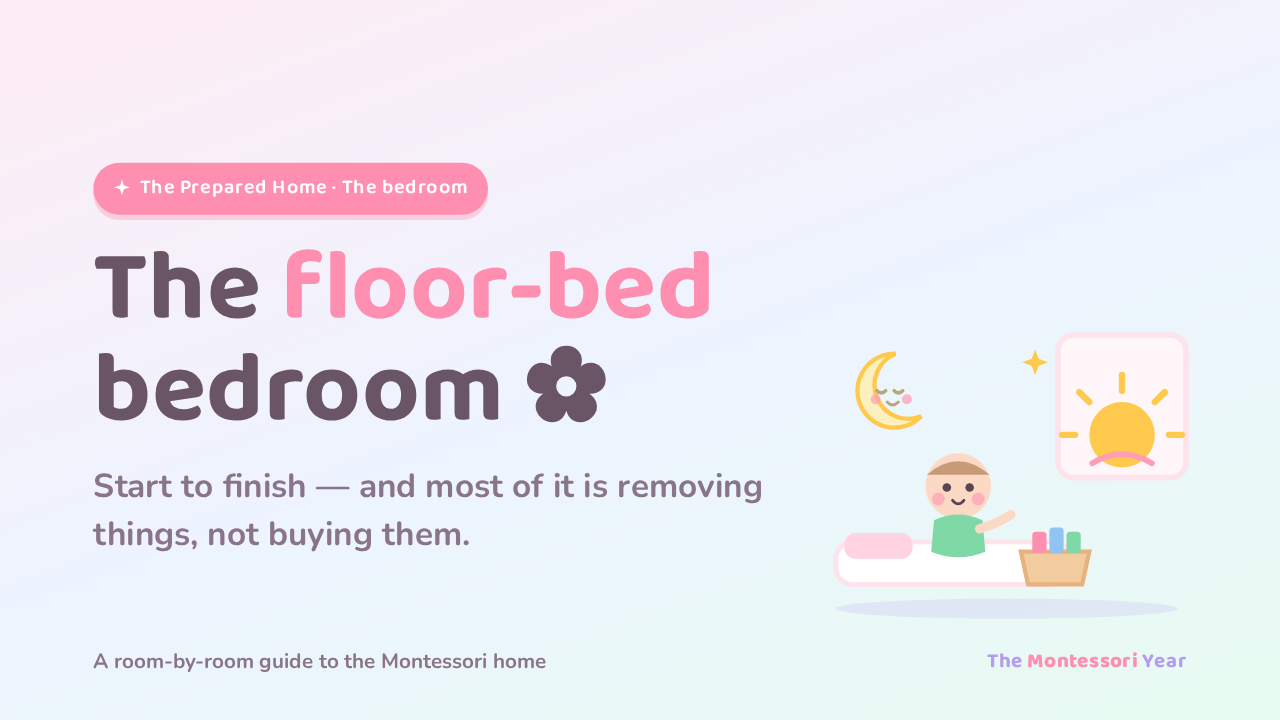




The floor-bedbedroom ✿
Start to finish — and most of it is removing things, not buying them.
It's six in the morning, and your baby is awake. Nobody is crying. Over the monitor you hear pages turning, and a basket being quietly emptied. They woke up, looked around their room, and went to work. That morning is a real thing, and it is built from the two cheapest materials in parenting: a mattress on the floor, and a room that took one weekend to prepare. Today in The Prepared Home we build the bedroom, start to finish. Why a floor bed, what has to be true about the room first, and the corners nobody tells you about. Almost all of it comes from removing things, not buying them.
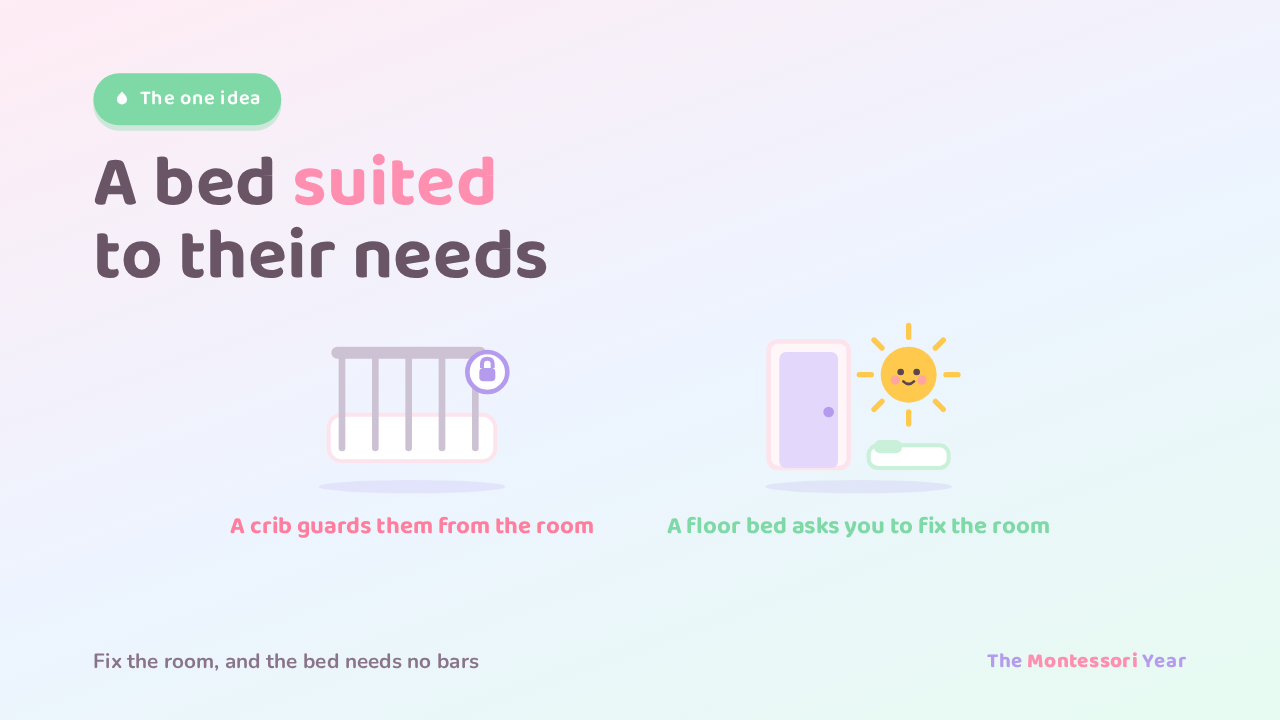
A bed suitedto their needs
Here's the idea under the whole room. A crib has one job: to protect your baby from the bedroom. The bars are an admission that the room is not safe. Montessori thinking flips that. Make the room itself completely safe, and the bed no longer needs walls. From their first weeks, your child lies in the middle of their world instead of behind a fence, watching all of it. And when moving arrives, the room is already theirs. Maria Montessori put it plainly: one of the greatest helps we can give a child's development is a bed suited to their needs. A bed suited to their needs is one they can leave.
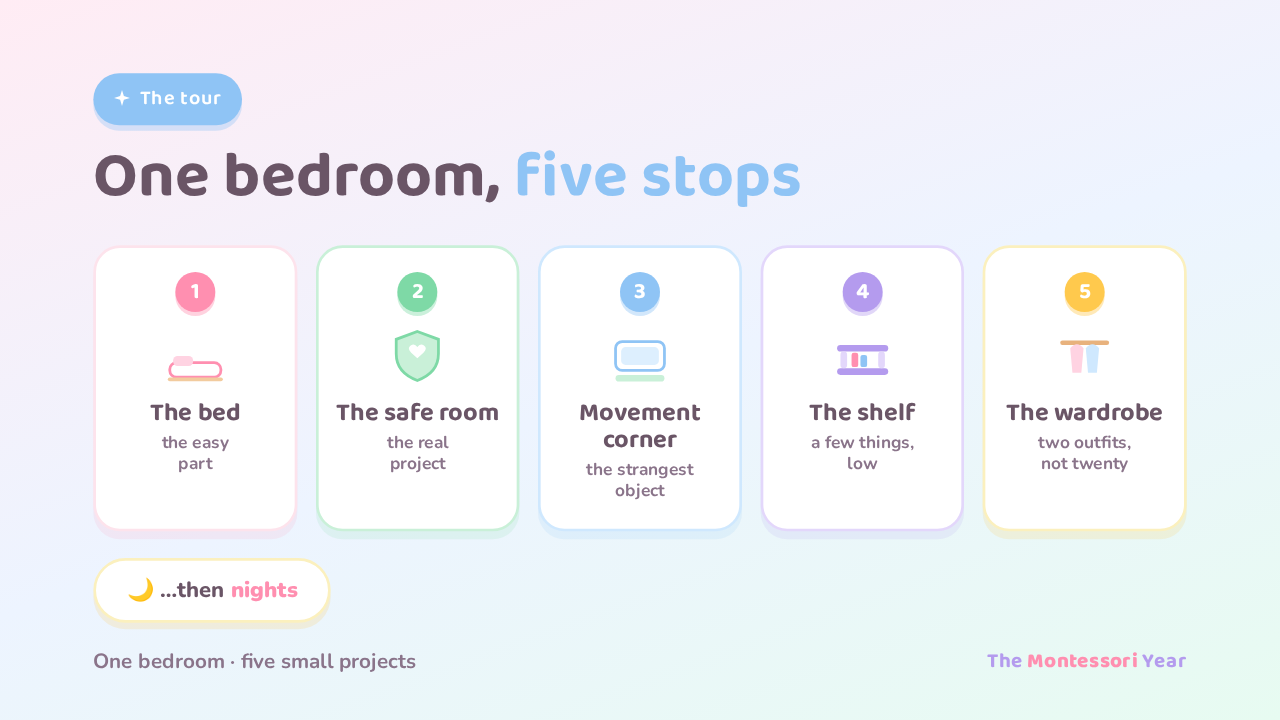
One bedroom, five stops
The bed
the easy
part
The safe room
the real
project
Movement corner
the strangest
object
The shelf
a few things,
low
The wardrobe
two outfits,
not twenty
So here's the map. Stop one, the bed itself, the easy part. Stop two, the room around it, which is the real project. Stop three, a movement corner with the strangest object on this tour. Stop four, a low shelf. Stop five, the wardrobe. And then we'll talk about nights, because I know that's the question you brought with you. First stop: the bed.
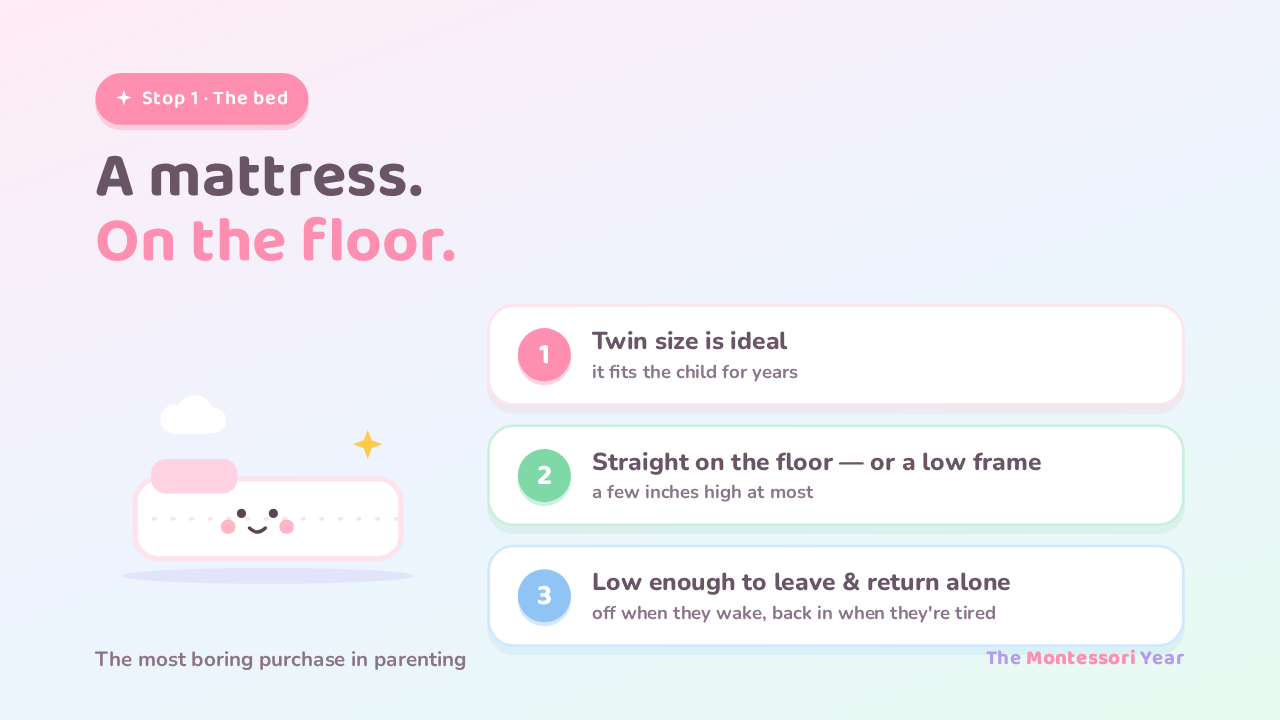
A mattress.On the floor.
Twin size is idealit fits the child for years
Straight on the floor — or a low framea few inches high at most
Low enough to leave & return aloneoff when they wake, back in when they're tired
A floor bed is exactly what it sounds like: a mattress on the floor, and a twin size is ideal, because it fits the child for years. Straight on a clean floor, or on a frame a few inches high. That's the entire product. Families in much of the world have always slept this way; there is nothing radical about it, and nothing to assemble. What matters is the height. It sits low enough that a child who can crawl can leave it when they wake, and climb back in when they're tired. The bed stops being a container. It becomes furniture they use.
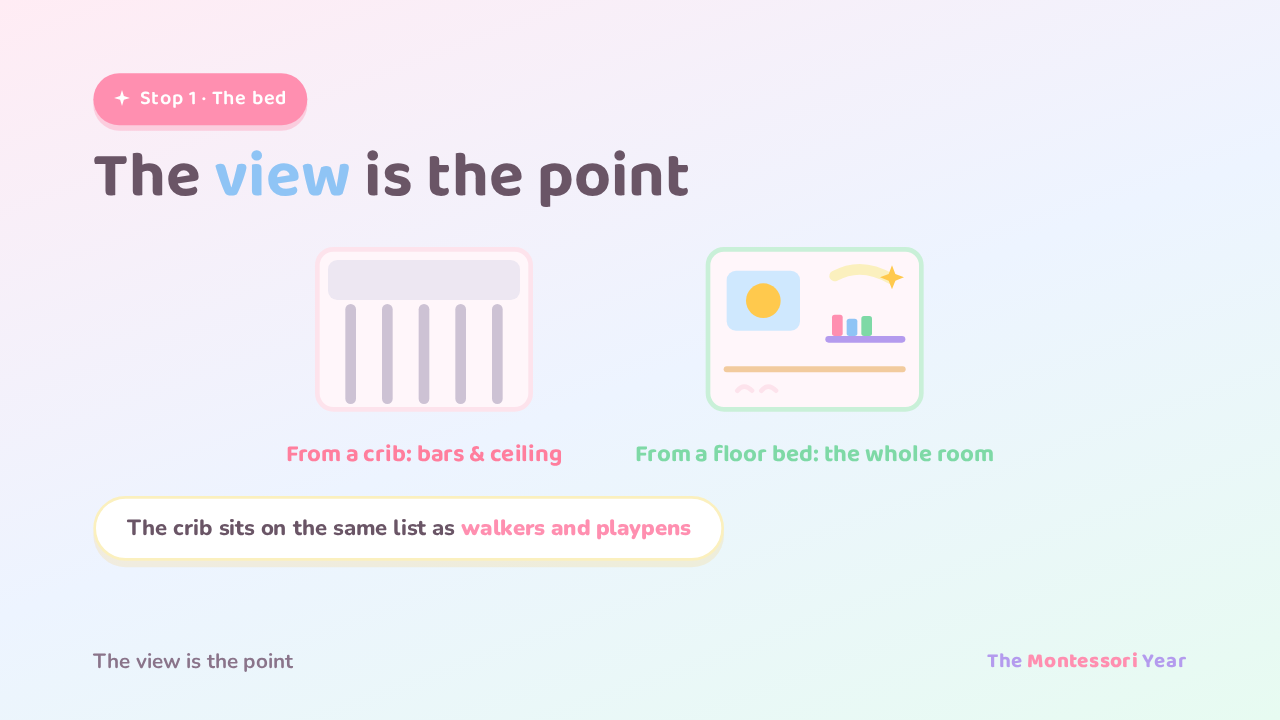
The view is the point
Lie a baby in a crib and their view is bars and ceiling. Lie the same baby on a floor bed and their view is the room: the shelf, the window, the light moving across the wall. That view is the point. In The Joyful Child, Susan Stephenson puts the crib on her short list of things that inhibit natural development, on the same line as walkers and playpens. Not because cribs are evil, but because bars limit looking and moving in exactly the months when looking and moving are the work. And there's a quieter benefit. A child who wakes able to see and reach their room has something to do. That does a lot to prevent the crying that's really just boredom.
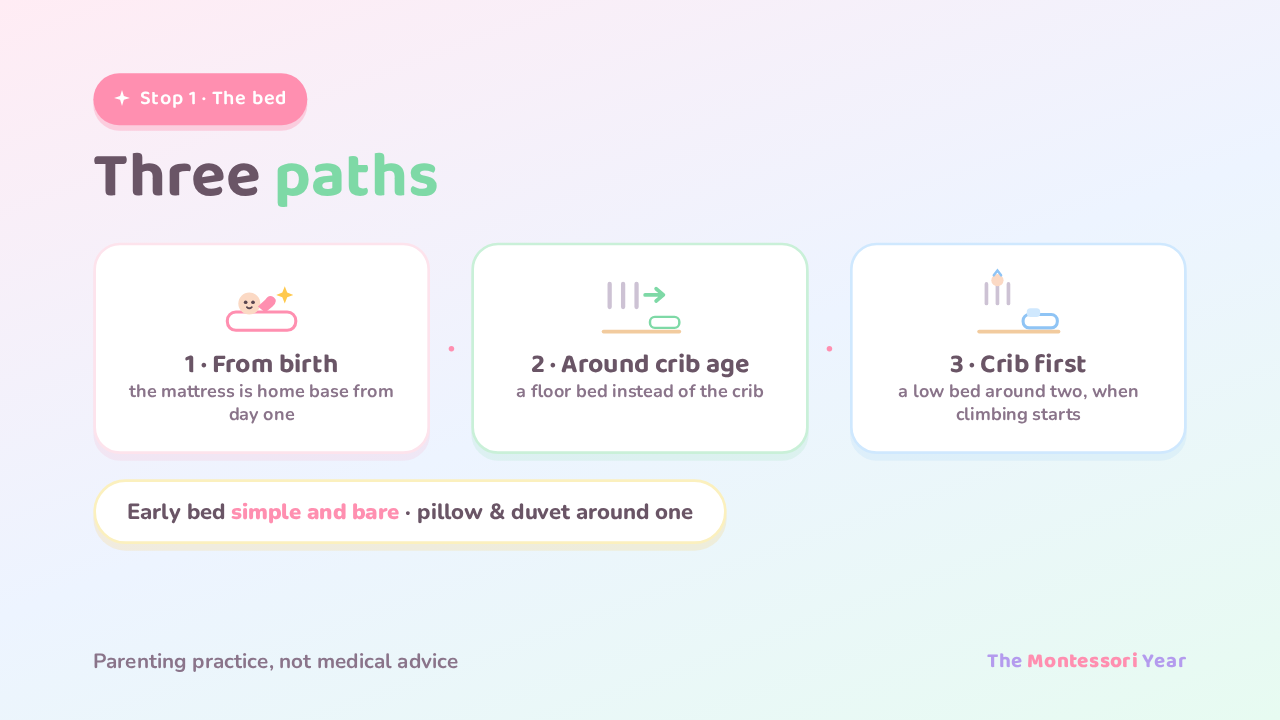
Three paths
1 · From birth
the mattress is home base from day one
2 · Around crib age
a floor bed instead of the crib
3 · Crib first
a low bed around two, when climbing starts
When do you start? The books offer three paths, and all of them work. Some families begin at birth, and the mattress is home base from the first weeks. Some start around the age a baby would otherwise move to a crib. And some keep the crib and switch to a low bed around two, often the day the crib-climbing acrobatics begin. The bedding grows with the child: keep the early bed simple and bare, and save the pillow and duvet until around one. One note, said once. This is parenting practice, not medical advice. For sleep-safety questions, positions, and bedding for your own baby, talk with your pediatrician.
The room isthe guardrail
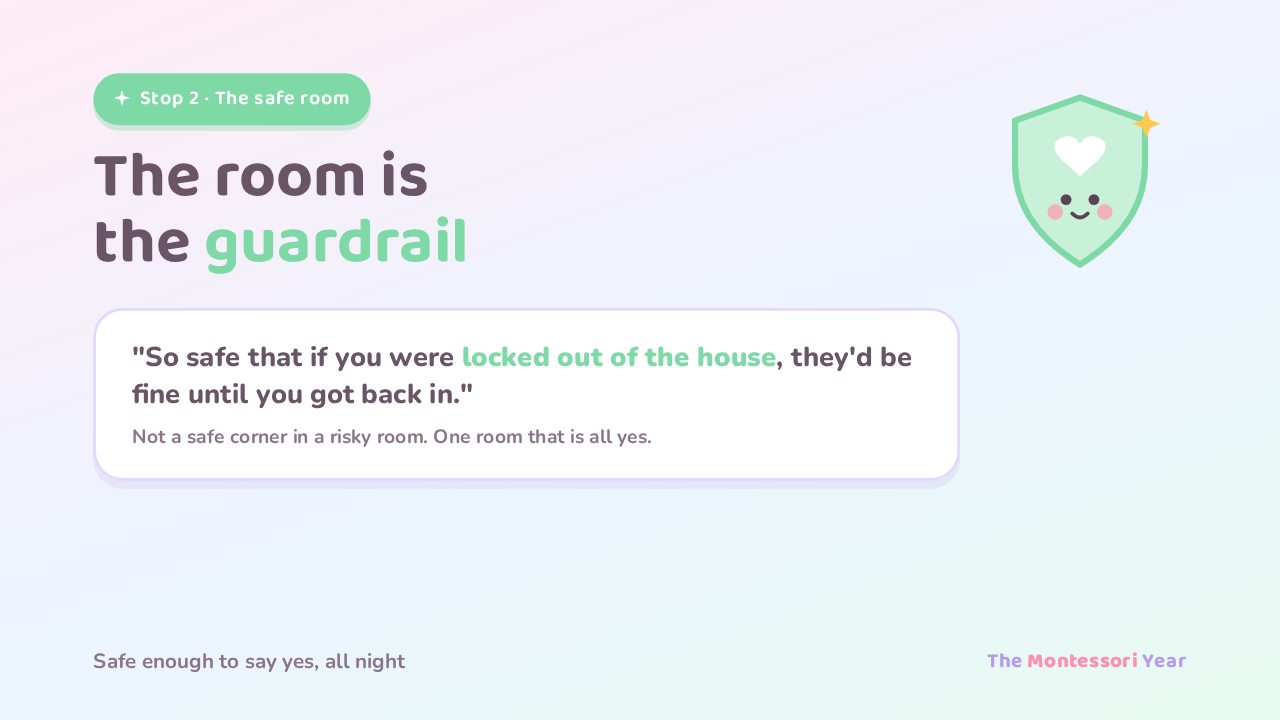
Now the real project, because the floor bed only works if the room deserves the trust. At some point your child will be awake in there without you. That isn't a failure of supervision; with a floor bed, it's the plan. So the whole room has to hold. Haley Turner passes along a standard from the infant educator Magda Gerber: prepare the space so completely that if some accident locked you out of the house, your child would be perfectly safe until you got back in. It's an extreme picture on purpose. That's the level. Not a safe corner in a risky room. One room that is all yes.
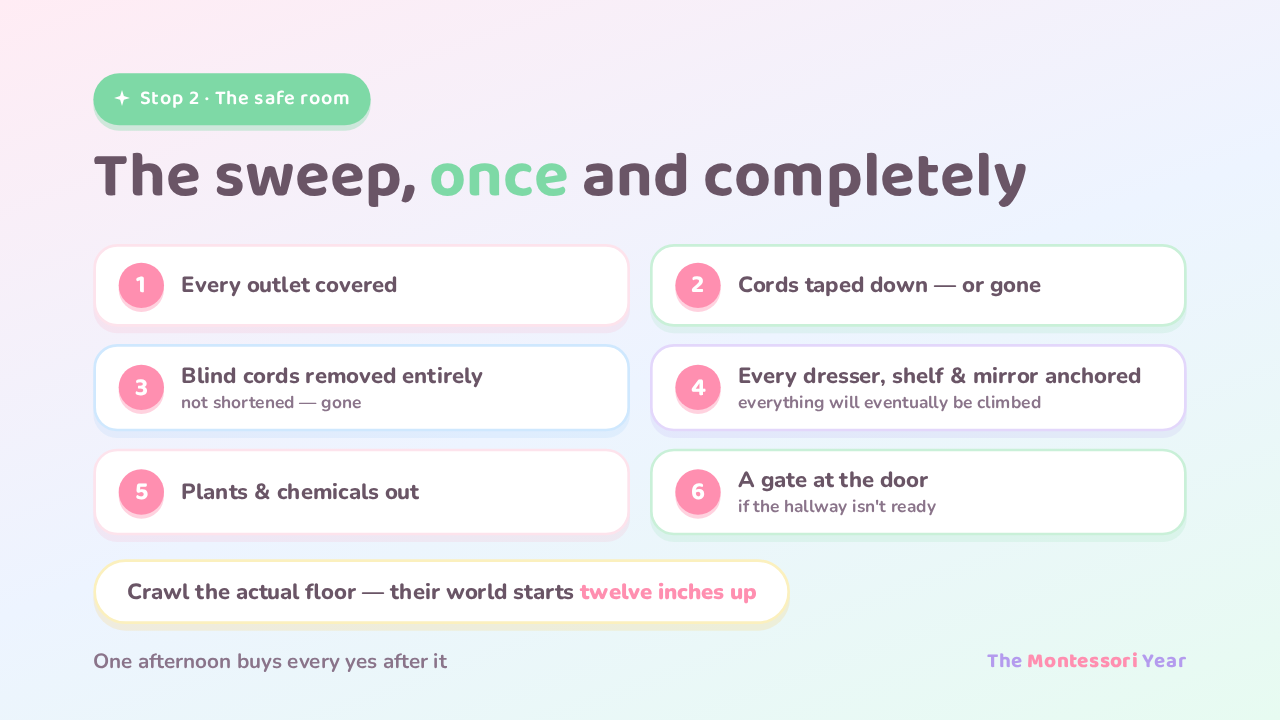
The sweep, once and completely
Every outlet covered
Cords taped down — or gone
Blind cords removed entirelynot shortened — gone
Every dresser, shelf & mirror anchoredeverything will eventually be climbed
Plants & chemicals out
A gate at the doorif the hallway isn't ready
Here is the sweep, once and completely. Get on your knees and crawl the actual floor of that room, because their world starts twelve inches up and everything interesting is at that height. Cover every outlet. Tape down or remove every cord. Take the blind cords away entirely, not shortened, gone. Anchor every dresser, every shelf, every mirror to the wall, because everything in the room will eventually be climbed. Move plants and anything chemical out. And if the hallway beyond isn't ready, a gate at the doorway makes the room the boundary. This is one unglamorous afternoon, and it buys every yes that follows.
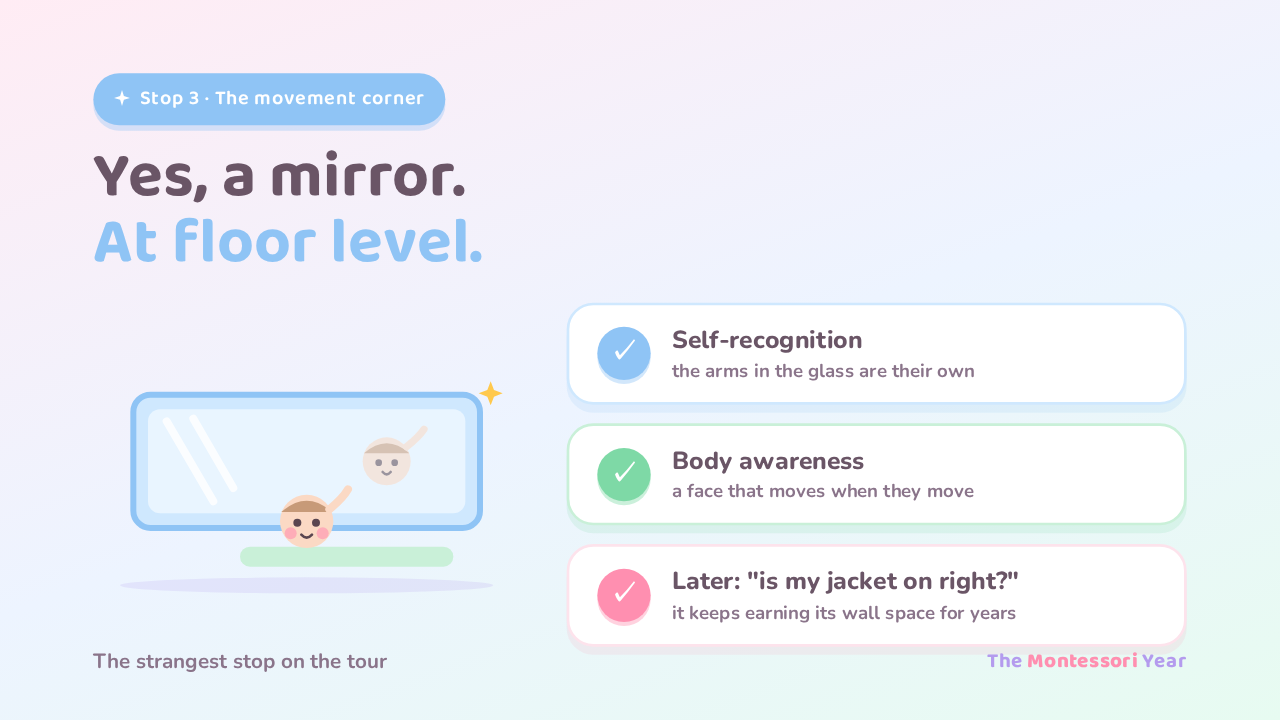
Yes, a mirror.At floor level.
Self-recognitionthe arms in the glass are their own
Body awarenessa face that moves when they move
Later: "is my jacket on right?"it keeps earning its wall space for years
Now the stop that makes visitors tilt their heads: a long mirror, mounted sideways, right at floor level. It looks like a design choice. It's equipment. A young baby on the mat sees a face that moves when they move, and slowly works out that the arms in the glass are their own. That's real work: self-recognition, body awareness, the map of me. And the same mirror keeps earning its wall space for years, because a three-year-old uses it to check their own jacket and their own breakfast face, with nobody's help. The mirror answers a question they would otherwise have to ask you. Securely mounted, like everything else in here.
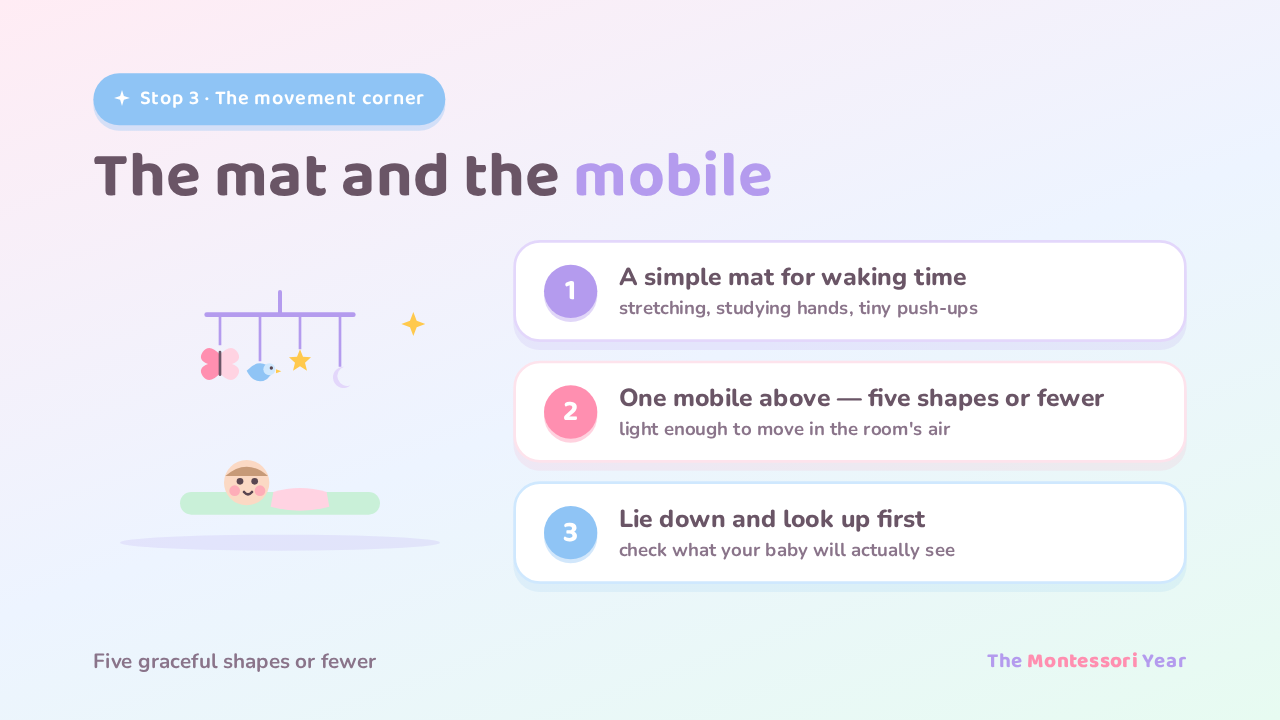
The mat and the mobile
A simple mat for waking timestretching, studying hands, tiny push-ups
One mobile above — five shapes or fewerlight enough to move in the room's air
Lie down and look up firstcheck what your baby will actually see
In the earliest months, the movement corner is just a simple mat where the baby spends waking time: stretching, studying their hands, doing tiny push-ups. Above it, one mobile, and this is a place where less is genuinely more. Five graceful shapes or fewer, light enough to move in the air currents of the room. Birds, butterflies, simple forms. And before you hang it, do the funny thing: lie down on the mat and look up. Check what your baby will actually see. If a ceiling light is glaring through it, move it. You're decorating their sky, not yours.
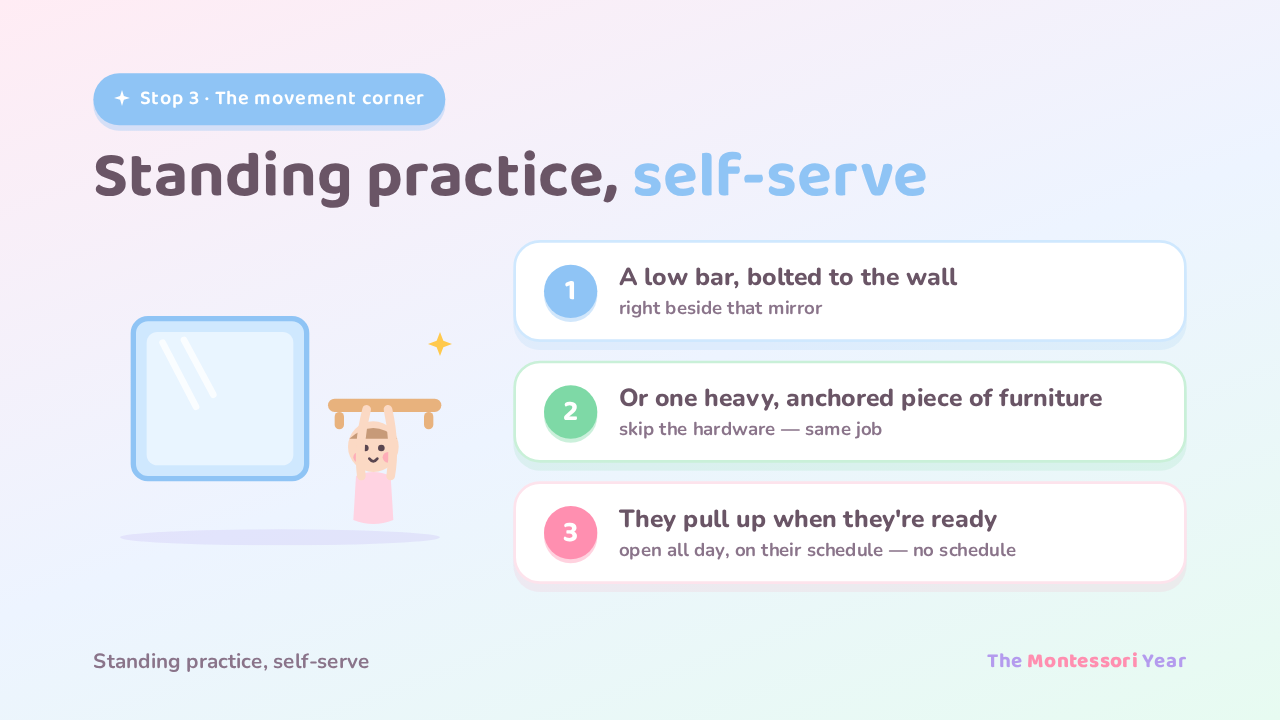
Standing practice, self-serve
A low bar, bolted to the wallright beside that mirror
Or one heavy, anchored piece of furnitureskip the hardware — same job
They pull up when they're readyopen all day, on their schedule — no schedule
When pulling up gets close, the corner grows one more piece: a low wooden bar fixed to the wall, right beside that mirror. Or skip the hardware and let one heavy, anchored piece of furniture do the same job. Either way, your child now has a standing-practice station that's open all day, on their schedule instead of yours. They pull up, wobble, drop, and try again, and the mirror lets them watch themselves do it. You didn't teach standing. You installed the place where standing teaches itself.
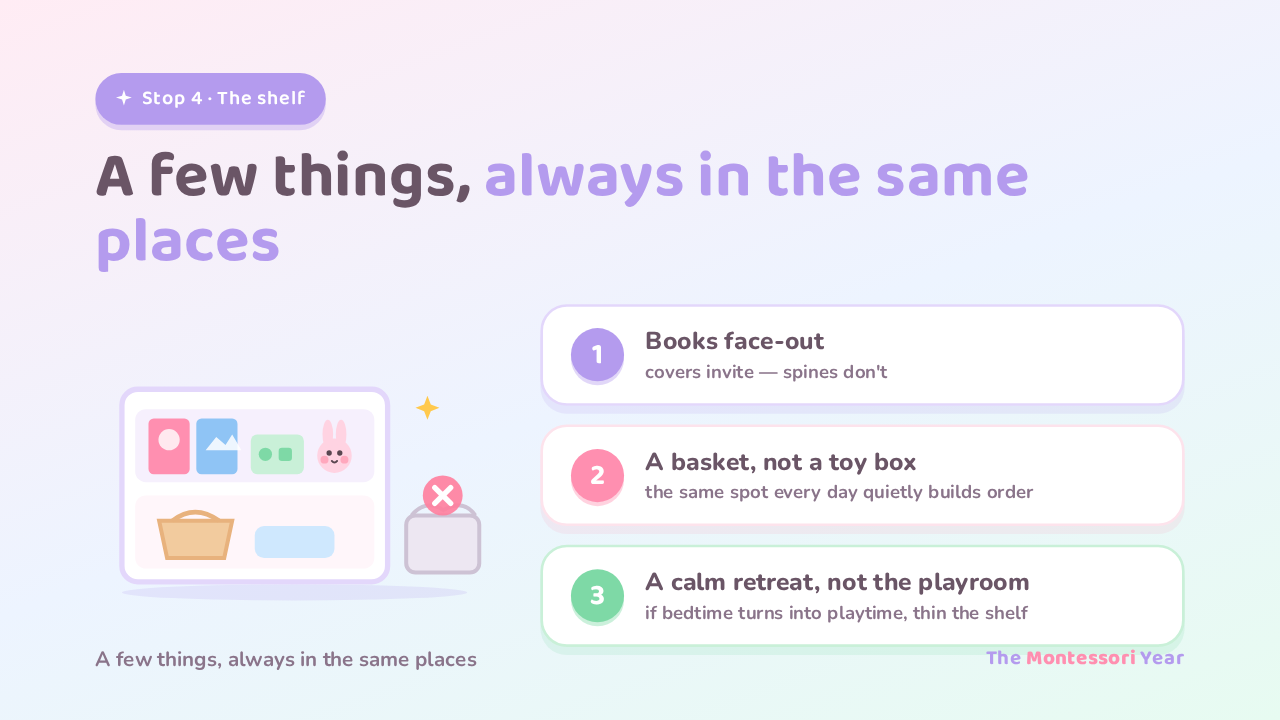
A few things, always in the same places
Books face-outcovers invite — spines don't
A basket, not a toy boxthe same spot every day quietly builds order
A calm retreat, not the playroomif bedtime turns into playtime, thin the shelf
Stop four: one low shelf, and restraint. A few things, always in the same places. Books displayed face-out, because covers invite and spines don't. A puzzle or two. A small basket. The stuffed animals. Not a toy box, because a bin where everything vanishes into a heap teaches nothing, while a shelf where the basket lives in the same spot every single day quietly builds order, and order, for a small child, feels like safety. Keep the bedroom's collection small and calm; this room is a retreat, not the playroom. And if bedtime keeps turning into playtime, believe what you're seeing and thin the shelf.
Art at their height
Hang it at their eye levelkneel down and see the wall they see
Real art, not licensed cartoonsa real print, a beautiful animal
Frames without glass · postcards countrotate the show whenever you like
While you're at that shelf, look at the walls, because your child certainly is. Most children grow up in rooms where every picture hangs at adult height, which means they grow up looking at the undersides of frames. Kneel down to their eye level and hang something there. Make it genuinely lovely: a real print, a beautiful animal, not a licensed cartoon. This costs nearly nothing. A frame with the glass removed and a good postcard taped inside is a gallery, and you can rotate the show whenever you like. These first years absorb whatever the room offers. Beauty is not a luxury here. It's part of the furniture.
Two outfits, not twenty
The wardrobe sounds like furniture, but it's really a decision about choices. Skip the beautiful child-sized armoire if you like; a tension rod hung low in the closet does the same job, and baskets on the floor work too. The move that matters is this: put out two outfits, and let them choose. Even a baby can look between two shirts you hold up, and a toddler will march to the rail with strong opinions. Two choices feels like power. Twenty choices tips a small person from excited into overwhelmed, and the getting-dressed project collapses. You curate the wardrobe. They command it.
The finishing is theirs
Clothes that match their stageskip tiny buttons and stiff jeans — soft waistbands, roomy necks
Help up to the point they can finish aloneand then stop
Pants to the ankles · sock over the toesthey do the yank — they claim the heel
Two small habits make that wardrobe actually work. First, stock it for their stage. Tiny buttons defeat toddler fingers, and stiff jeans fight them at exactly the wrong moments, especially around toilet learning. Soft waistbands and roomy necks let the child do the dressing. Second, when you help, help up to the point where they can finish alone, and then stop. Pull the pants to their ankles and let them do the yank. Start the sock over the toes and let them claim the heel. Watch a two-year-old who just got their own sock on. That face is why the wardrobe is set up this way.
Rhythm does the heavy lifting
Bath
warm, same time
Stories
on the floor bed
The same song
the body's signal
Sleep
same order, every night
Now the question you've been holding: won't they just get up all night? The books' answer is calm. With a steady rhythm, it becomes mostly a nonissue. Keep the same order every night: bath, stories, one song, sleep. The song you've sung since they were tiny becomes a signal that tells their whole body what's next. A tidy, quiet room does its share too; clutter reads as stimulation, and calm reads as rest. And where you can, let falling asleep stay their skill. One family in these pages nursed their first baby to sleep every night, and she couldn't sleep any other way. Her little brother, laid down drowsy but awake, drifts off happily on his own. Children differ. One needs long cuddles, another wants a kiss and a goodnight. Both are fine. Follow yours.
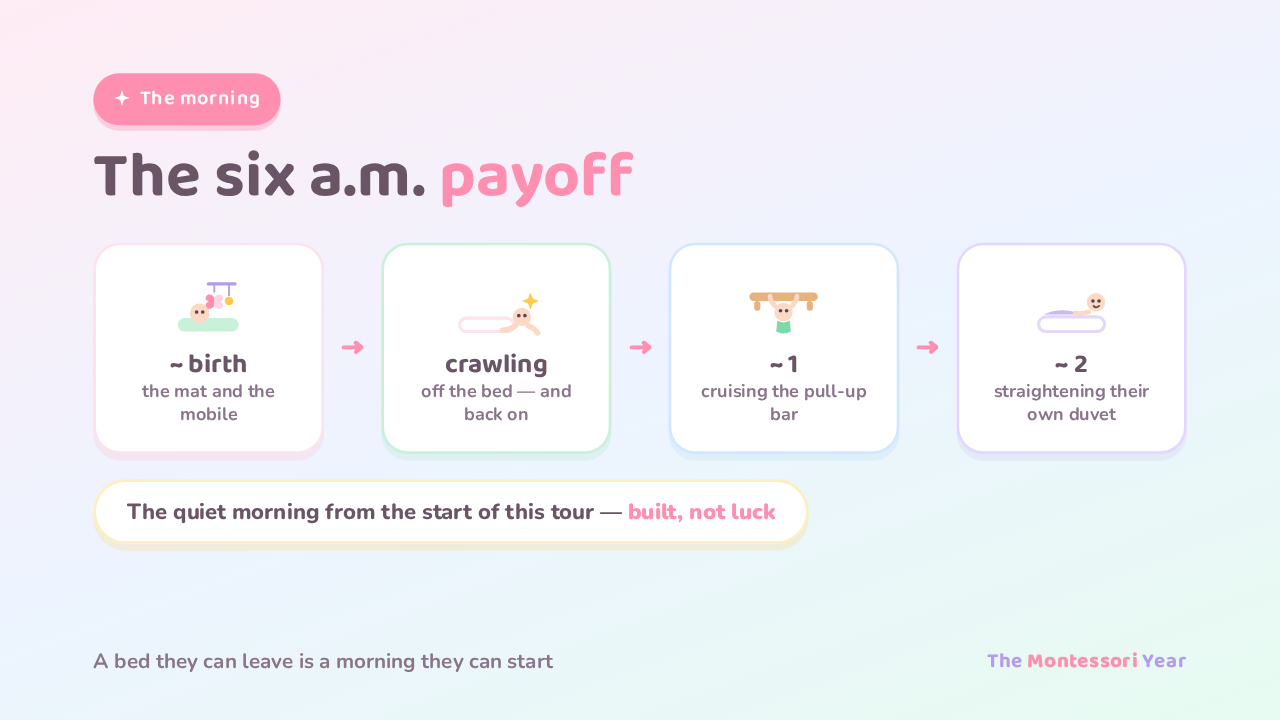
The six a.m. payoff
~ birth
the mat and the mobile
crawling
off the bed — and back on
~ 1
cruising the pull-up bar
~ 2
straightening their own duvet
Which brings us back to six in the morning. A baby who wakes on a floor bed opens their eyes to their room, not to bars and a ceiling. So they roll off, pad over to the shelf, and start the day with the book basket. The crying that's really a request to be rescued from a cage simply has less reason to happen; you heard that quiet morning at the start of this tour. And it compounds. Around two, many children are straightening their own duvet and tidying their own bed, because a bed at floor height is a bed they can care for. You built a room that works the early shift for you.
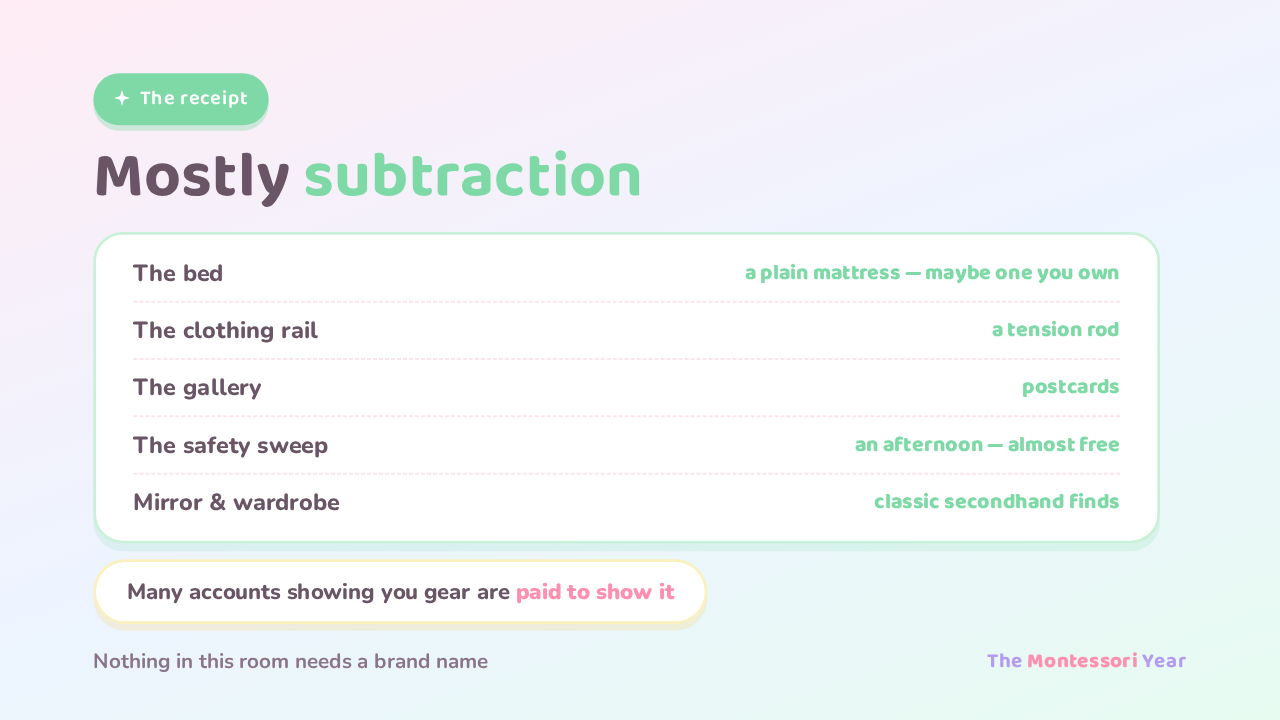
Mostly subtraction
- The beda plain mattress — maybe one you own
- The clothing raila tension rod
- The gallerypostcards
- The safety sweepan afternoon — almost free
- Mirror & wardrobeclassic secondhand finds
Let's total the tour. The bed is a plain mattress, quite possibly one you already own. The clothing rail is a tension rod. The gallery is postcards. The single biggest project, the safety sweep, costs an afternoon and almost nothing else. The mirror and the wardrobe are classic secondhand finds, and the fancy versions sold under a Montessori label do the same job as the plain ones. One caution from inside the parenting world itself: many accounts showing you gear are paid or gifted to show it. Let that soften its grip on you. Nothing in this room needs a brand name.
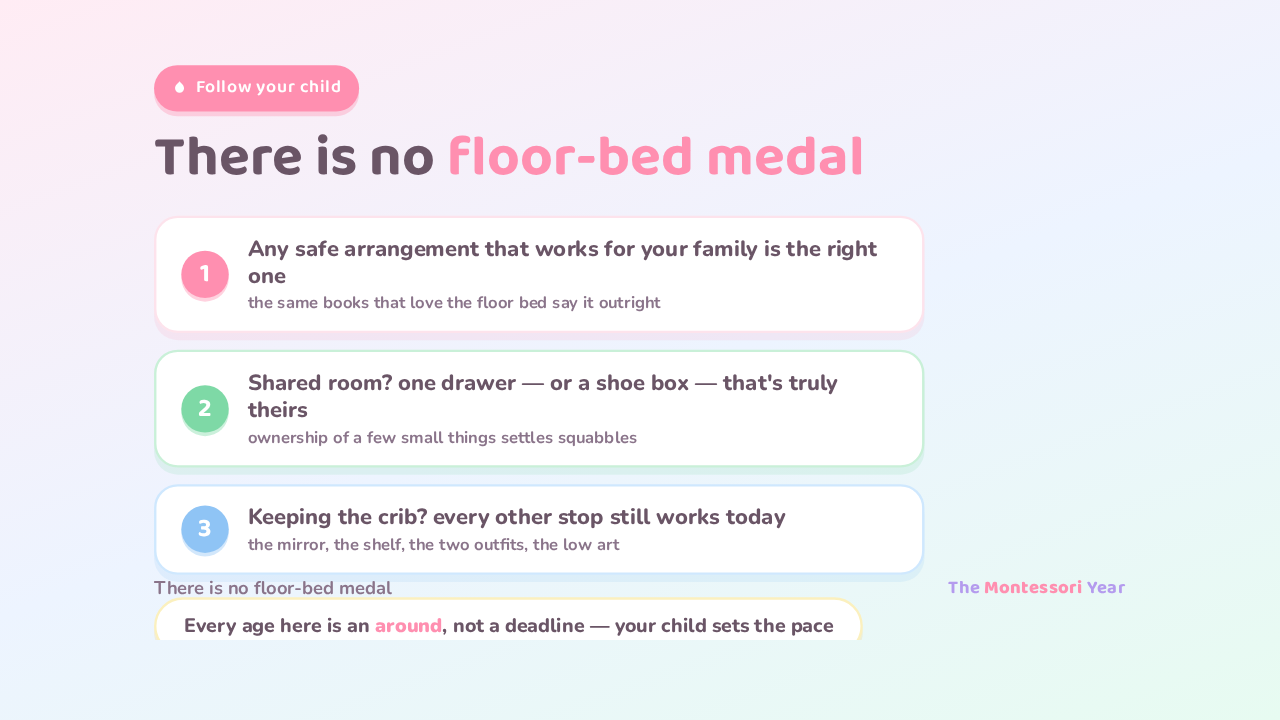
There is no floor-bed medal
Any safe arrangement that works for your family is the right onethe same books that love the floor bed say it outright
Shared room? one drawer — or a shoe box — that's truly theirsownership of a few small things settles squabbles
Keeping the crib? every other stop still works todaythe mirror, the shelf, the two outfits, the low art
And now the permission slip, because Montessori parenting has no medals for furniture. The same books that love the floor bed say it outright: however your family's safe sleeping arrangement works, that is what's perfect for your family. Sharing a bedroom, or sharing with a sibling? Give the child one drawer or a simple shoe box that is truly, privately theirs; ownership of a few small things settles more squabbles than referees do. Keeping the crib for now? Every other stop still works today: the mirror, the shelf, the two outfits, the low art. Every age in this tour is an around, not a deadline. Your child sets the pace.
Guard less.Prepare more.
This weekend: one nap-time on your knees in that room · anchor the dresser · cover the outlets · lower one basket of books.
So here's the whole room in one sentence: stop guarding your child from the bedroom, and prepare the bedroom until there's nothing left to guard. The mattress is the least of it. This weekend, spend one nap-time on your knees on that floor, seeing what they'll see. Anchor the dresser. Cover the outlets. Take the blind cords away. Then lower one basket of books to the floor and see what happens at six a.m. The Prepared Home continues, room by room, because every room in your house is hiding a smaller room your child can run. This one just happens to hold the sunrise. I'll see you in the next one.