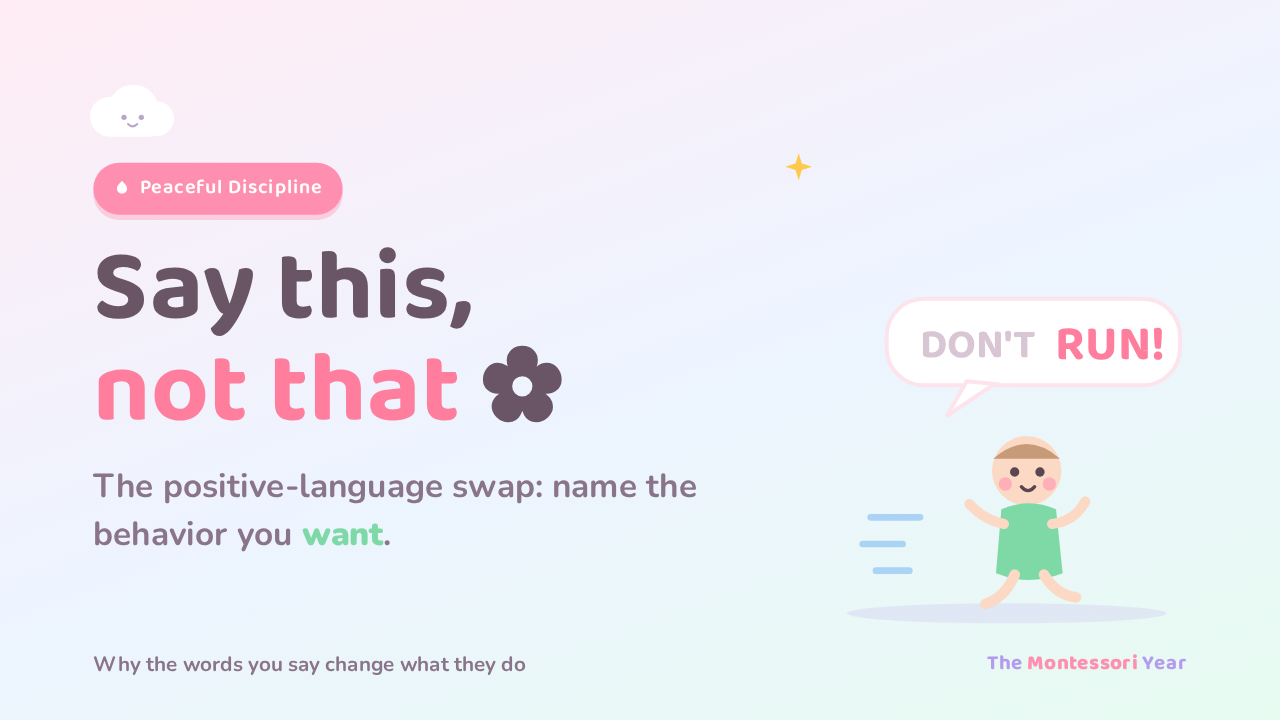
Say this,not that ✿
The positive-language swap: name the behavior you want.
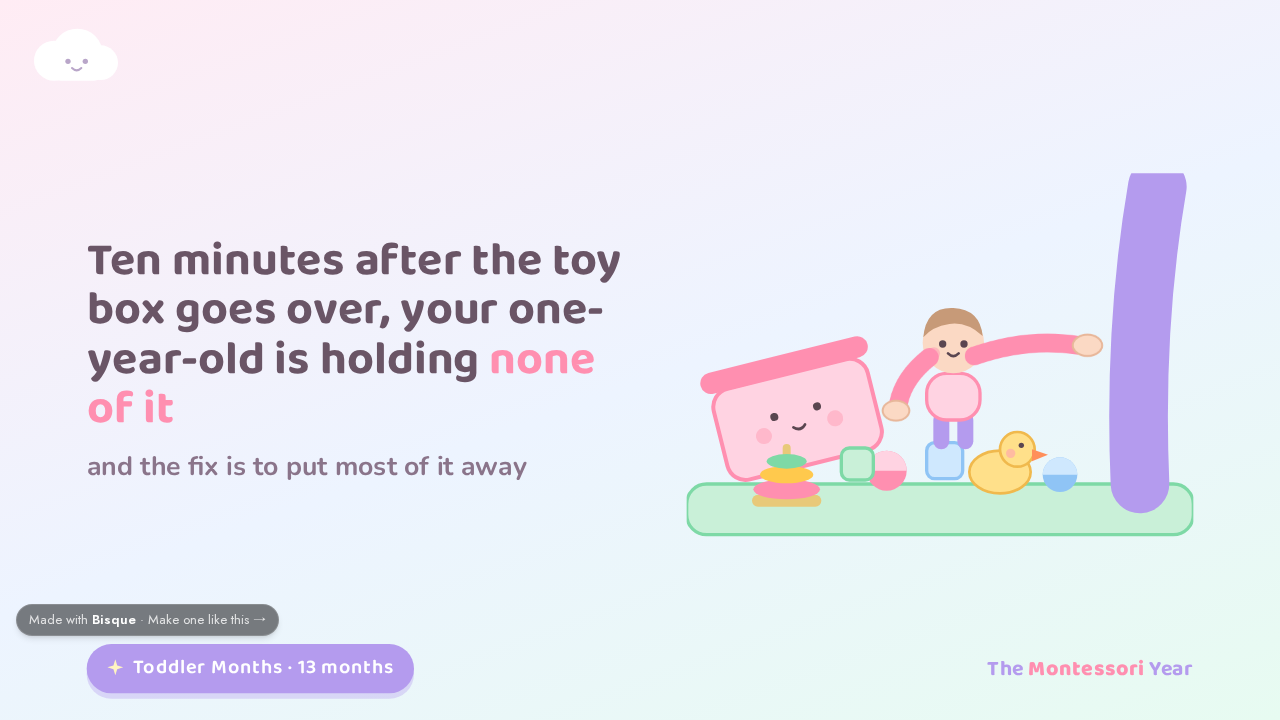
You call out, don't run! And your toddler runs faster. That's not defiance. In a very real way, they heard one word, and that word was run. The fix is a small flip in the sentences you already say: name the behavior you want, instead of the one you don't. I'll show you why young brains hear this way, hand you a stack of ready-made swaps to steal, and save one thing for the end, what to do on the days when no words land at all. The rule you're holding doesn't change. Only the words do.
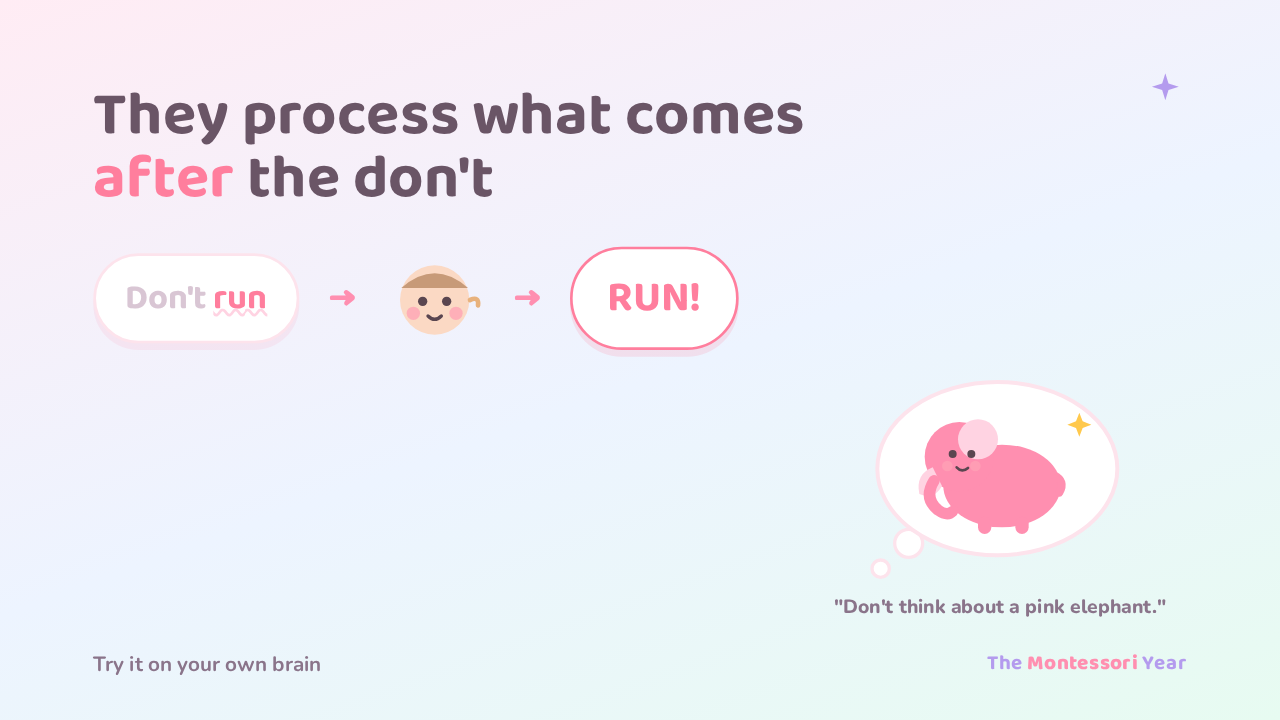
They process what comesafter the don't
"Don't think about a pink elephant."
Here's what's happening. A young mind takes a sentence in pieces, and the piece that lands first is whatever comes after the no or the stop. Say no throwing your toys, and the part that arrives first is throw your toys. You can feel this in your own head. Don't think about a pink elephant. No pink elephants at all. What are you picturing right now? Exactly. And attention isn't neutral. Whatever a brain attends to, it strengthens. So every time we shout the thing we don't want, we hand that exact thing a spotlight. The sentence points at the wrong picture.
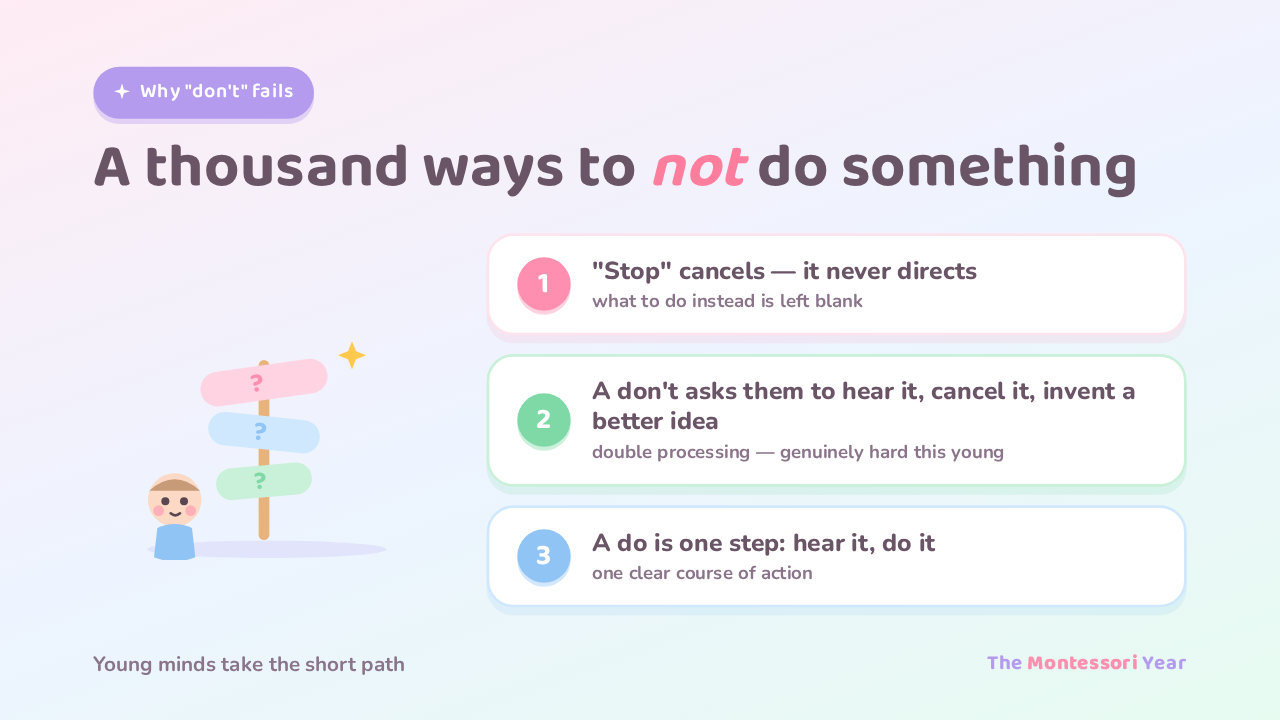
A thousand ways to not do something
"Stop" cancels — it never directswhat to do instead is left blank
A don't asks them to hear it, cancel it, invent a better ideadouble processing — genuinely hard this young
A do is one step: hear it, do itone clear course of action
There's a second problem with stop and no and don't. They give a child nowhere to go. Stop tells them what to cancel and nothing about what to do instead, and we can't assume they know. Think about it from their side. There are about a thousand ways to not do something. There's exactly one way to follow walking feet. A don't sentence asks a toddler to hear the action, cancel it, imagine a better option, and choose it. That's double processing, and it's genuinely hard for a mind this young. A do sentence is one step. Hear it, do it.
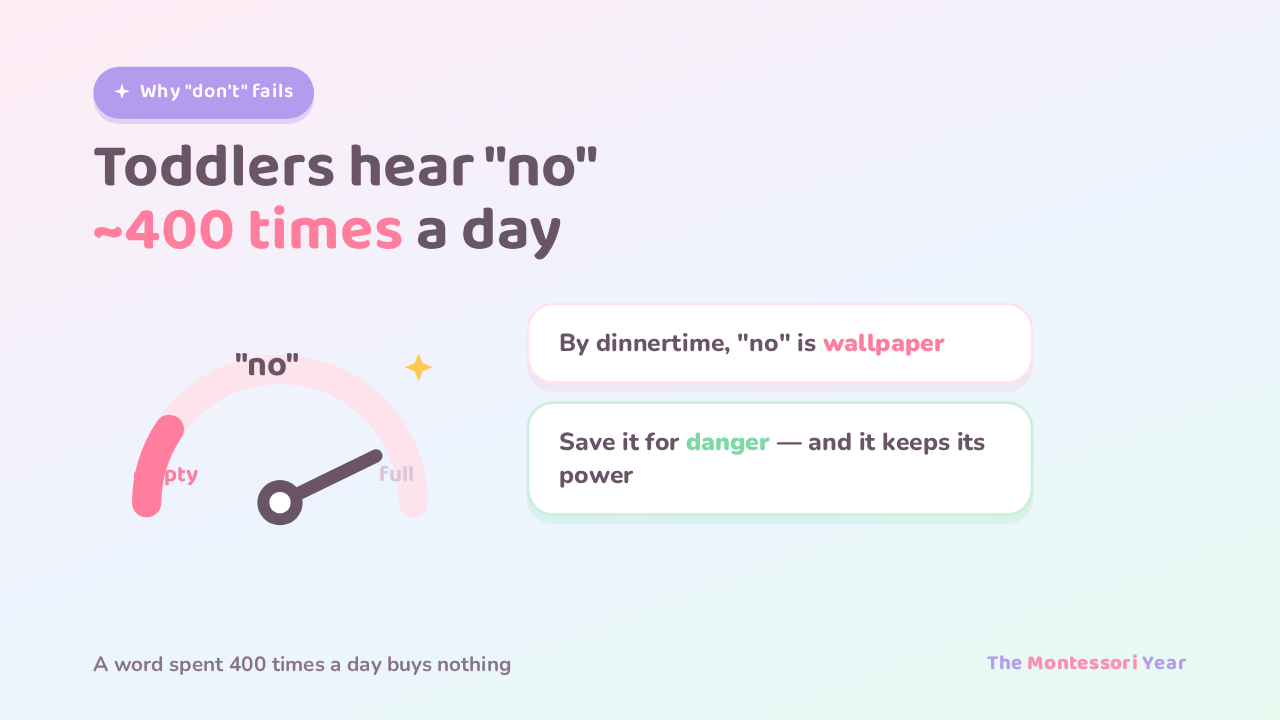
Toddlers hear "no"~400 times a day
And we say these words a lot. Haley Turner cites a study that counted how often toddlers hear the word no. The average came out around four hundred times a day. Four hundred. No word survives that. By dinnertime, no is wallpaper. So this isn't about never saying no. It's about spending no like it's rare. Save it for the street, the stove, the true dangers, and the word keeps its power. When your no is one of four instead of one of four hundred, your child stops and looks up.
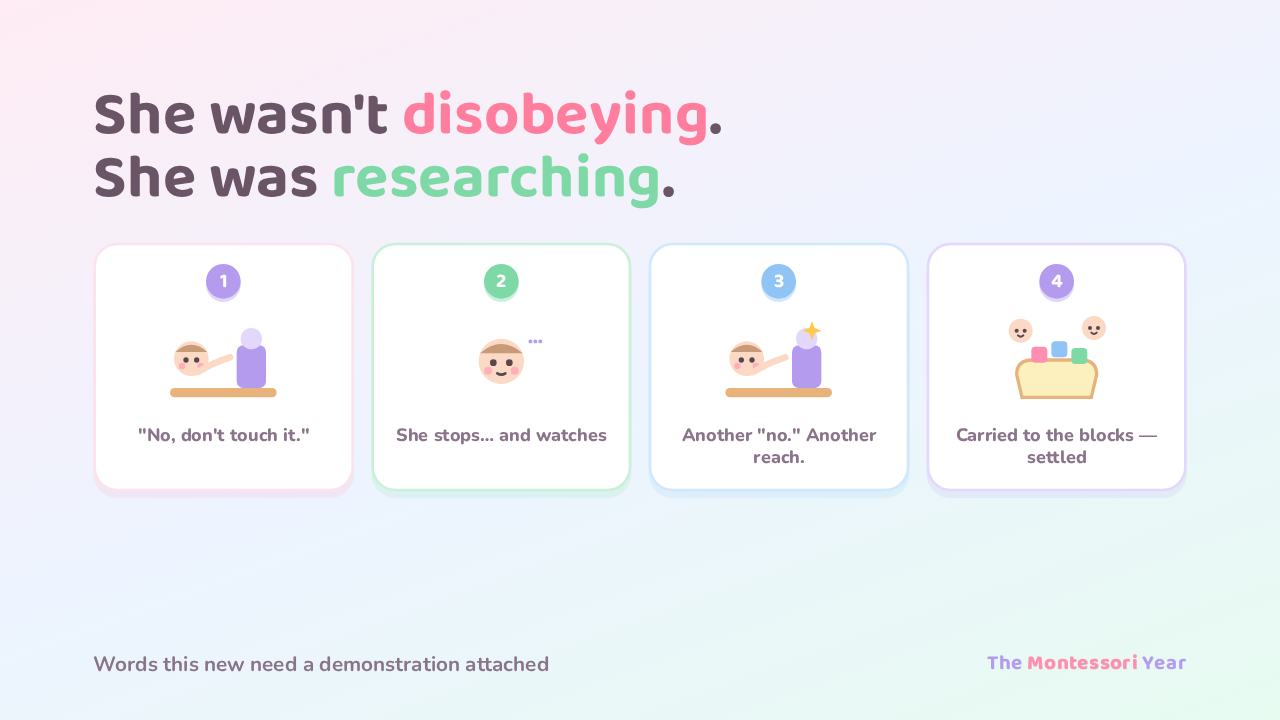
She wasn't disobeying.She was researching.
"No, don't touch it."
She stops… and watches
Another "no." Another reach.
Carried to the blocks — settled
One more piece, because it explains so much. Picture a two year old up on the piano bench, reaching for a little statue just inside her reach. Her mother says no, don't touch it. She stops, lowers her arm, watches her mother, and reaches again. Another no, a little louder. Another reach. Round after round, no resolution. She wasn't being naughty. She was running an experiment to find out what no actually means. What ended it was gentle. Her mother said no once more, and while she said it, she picked her up and carried her over to the blocks. Both of them relaxed. At this age, reasoning hasn't arrived yet. A word alone is just a sound. A word plus a demonstration is a lesson.
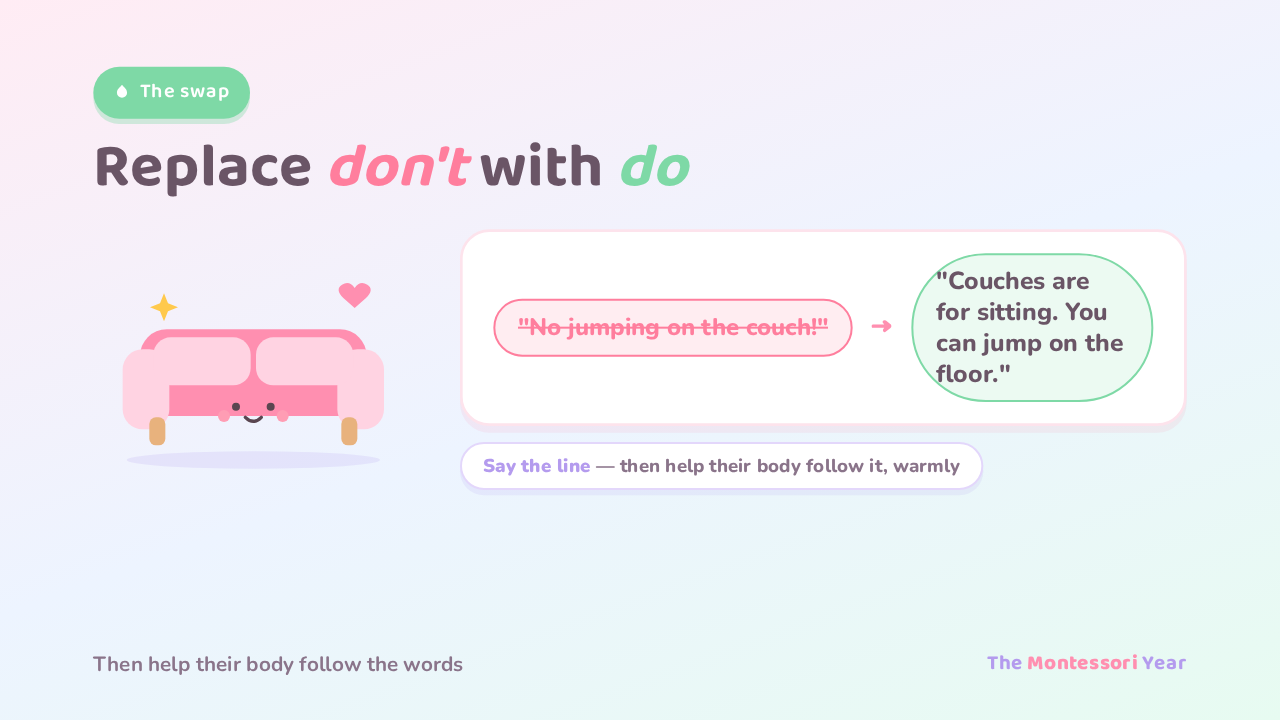
Replace don't with do
So here's the whole technique. Replace don't with do. Say what you want to see. Your child is bouncing on the couch. Instead of no jumping on the couch, try this. Couches are for sitting. You can jump on the floor. Feel the difference? The first sentence hands them a picture of jumping on the couch. The second hands them somewhere to land. One honest note. Mid bounce, words alone may not win, because jumping is delightful. So say the line and help their body follow it. Lift them down to the floor, warmly. The words teach. Your hands hold the boundary while the words sink in.
Slide 7
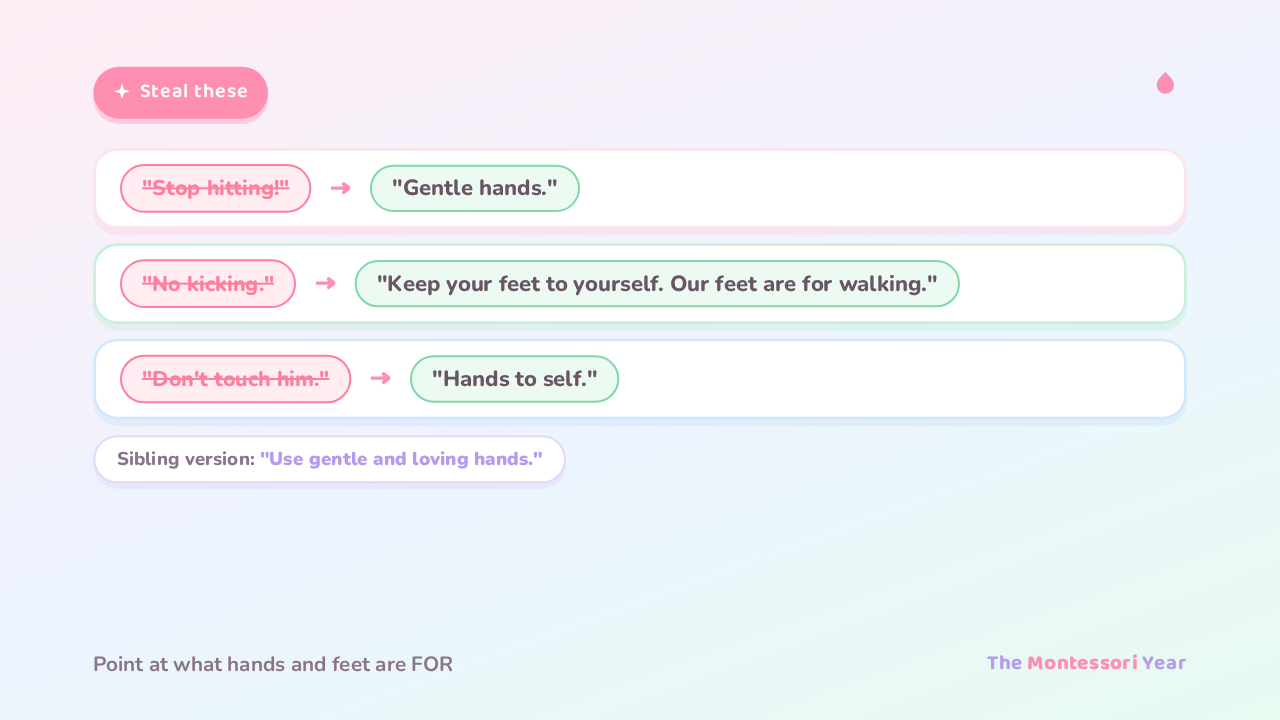
Start with the big three, the body ones. Instead of stop hitting, gentle hands. Instead of no kicking, keep your feet to yourself, our feet are for walking. Instead of don't touch him, hands to self. And when it's a sibling on the receiving end, use gentle and loving hands. Short, warm, and aimed at the behavior you want. Notice what these little phrases share. No lecture. No verdict on who they are. Just a clear picture of what hands and feet are for.
Slide 8
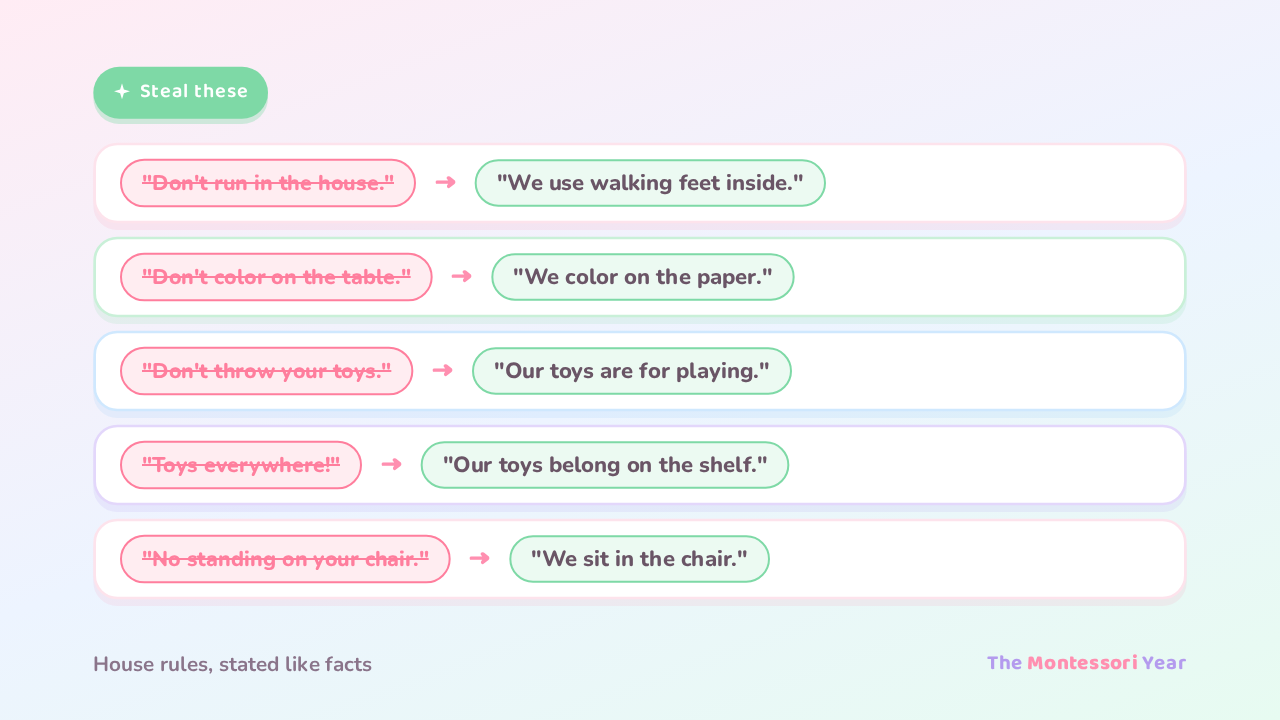
Now the household set. Don't run in the house becomes we use walking feet inside. Don't color on the table, we color on the paper. Don't throw your toys, our toys are for playing. Toys all over the floor? Our toys belong on the shelf. Standing on the chair again? We sit in the chair. Hear the pattern in the we. These aren't commands barked down at a small person. They're house rules, said the way you'd state a plain fact about your family. This is how we do things here. A toddler can't win against a command. But a toddler can join a we.
Slide 9
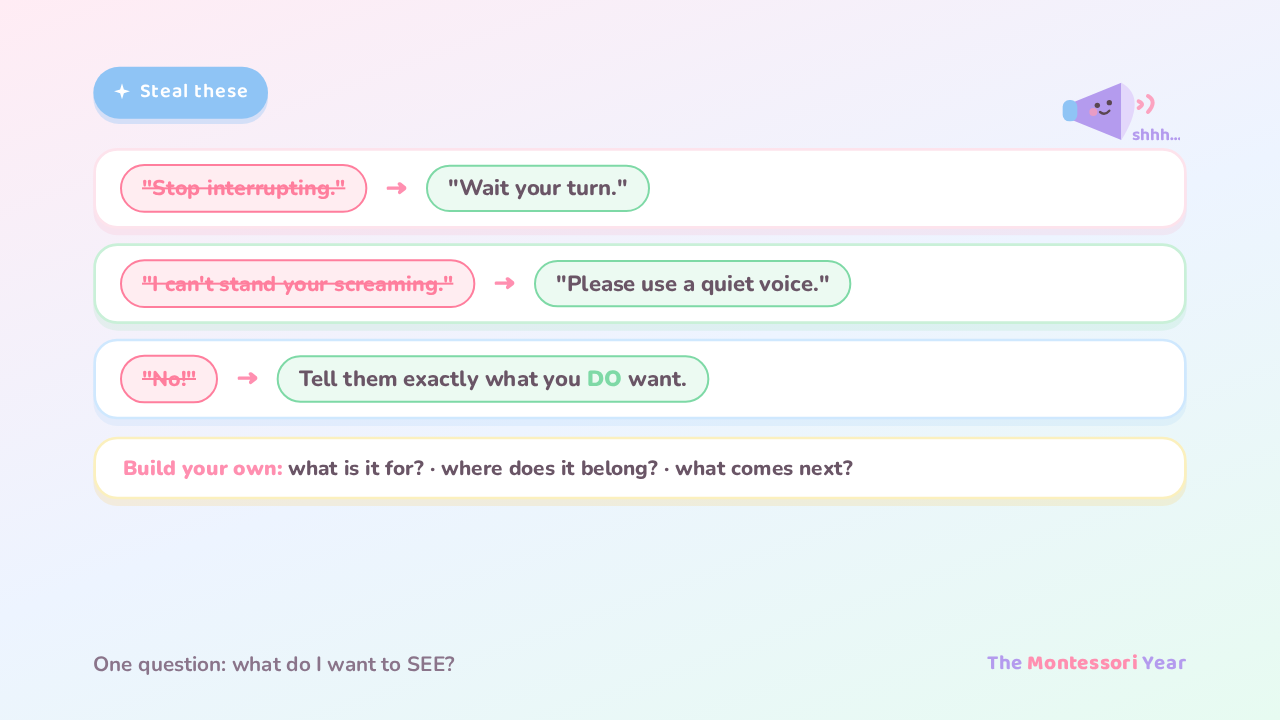
A few more for the loud moments. Stop interrupting becomes wait your turn. And on the days the screaming is fraying your last nerve, trade I can't stand your screaming for please use a quiet voice. Even the bare no has a swap. Tell them exactly what you do want. And that right there is how you build your own. You don't memorize a list. When a don't is on your lips, ask one question. What do I want to see instead? Then say that. What the thing is for. Where it belongs. What comes next. Couches are for sitting. Toys live on the shelf. First shoes, then outside.
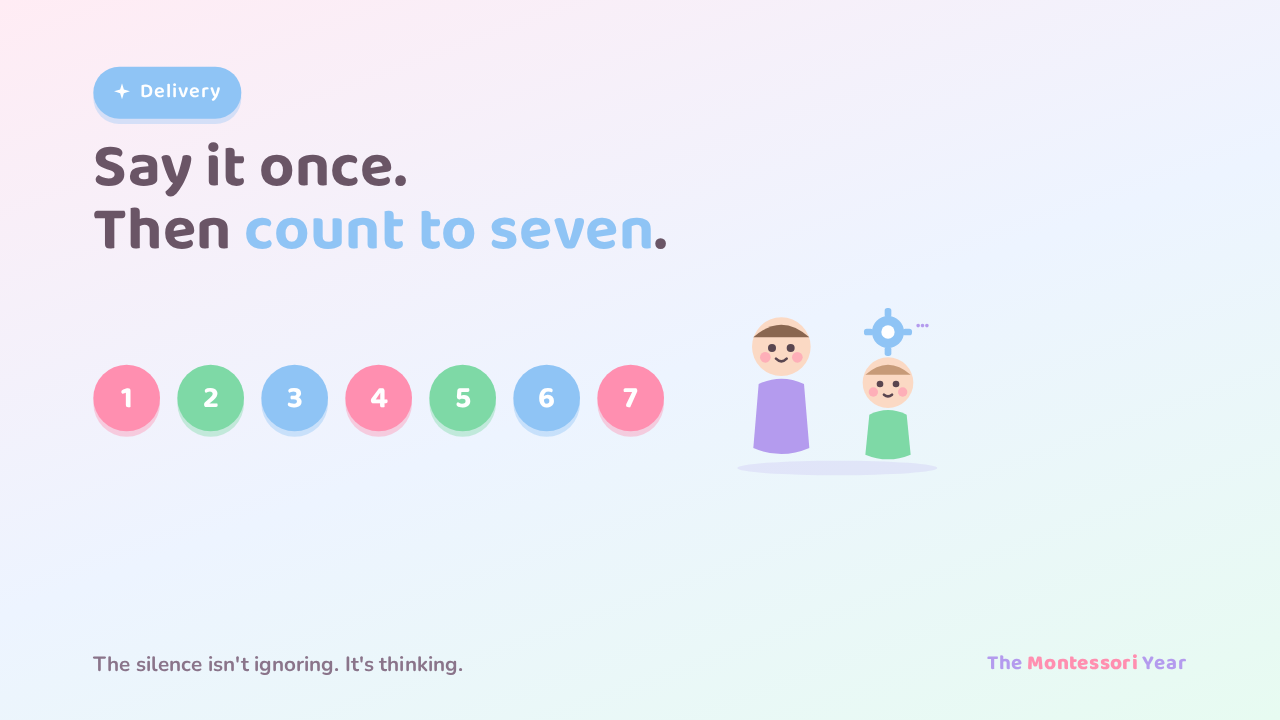
Say it once.Then count to seven.
Now, the part nobody tells you. You'll deliver the perfect line, walking feet, gentle hands, and your child will just stand there, staring at you. Don't panic, and don't reload. Nothing is wrong. They're processing. A young child is still decoding language, and they can need seconds longer than you do, sometimes minutes, to take a sentence in and choose what to do with it. So here's a habit worth stealing. Count seven full seconds before you repeat yourself. Seven feels like forever. Count them anyway. Calm, patient repetition gets you fewer blowups than rapid fire ever will. That silence isn't ignoring. It's thinking.
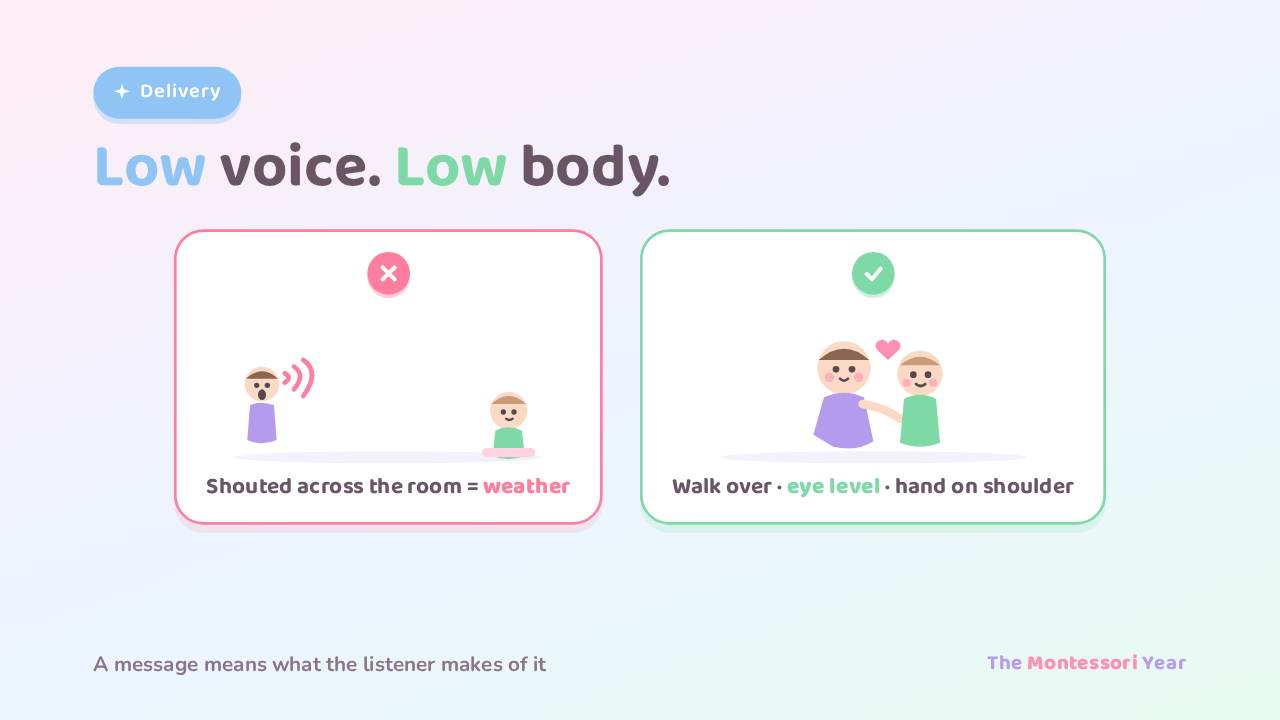
Low voice. Low body.
Where you say it matters as much as what you say. Shouted across a room, even the perfect words don't land. Small children get so absorbed in their world that a far-away voice is weather, not language. So walk over. Get down low, to eye level. A hand on the shoulder. Connect first, then say the line. And keep your voice under the moment, not over it. Yelling flips a young brain into alarm mode, and an alarmed brain stops hearing words entirely. You'd be louder, and less heard. A sentence ends up meaning whatever the listener makes of it. Calm, close, and low is how you make it mean what you meant. Raise your words, not your voice.
Slide 12
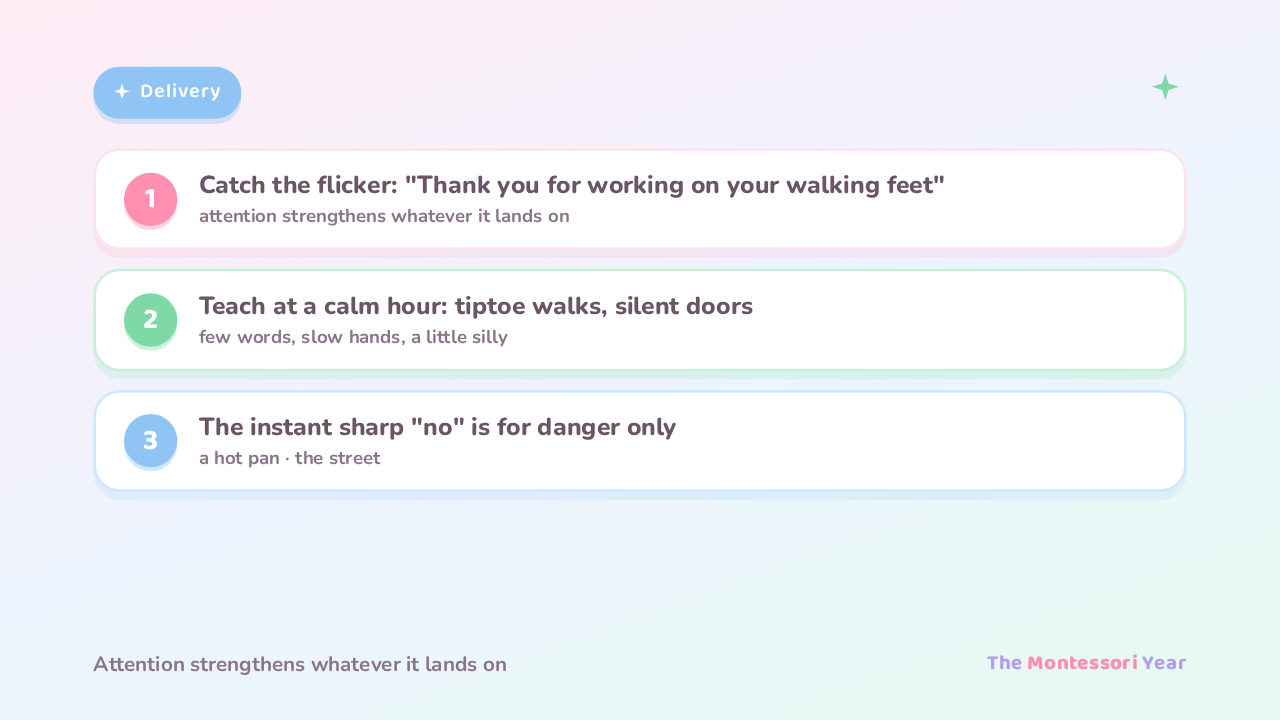
Catch the flicker: "Thank you for working on your walking feet"attention strengthens whatever it lands on
Teach at a calm hour: tiptoe walks, silent doorsfew words, slow hands, a little silly
The instant sharp "no" is for danger onlya hot pan · the street
Two habits finish the job. First, catch it going right. You said we walk in the house, and those little legs slow down even slightly. Mark it. Eye contact, a smile, thank you for working on your walking feet. Attention strengthens whatever it lands on, so shine yours on the behavior you want more of. Second, teach the repeat offenses outside the moment. Pick a calm hour and make a tiny lesson of it. Cross the room together on exaggerated tiptoe. Practice closing a door so slowly it makes no sound at all. Few words, slow hands, a little silly. Children rehearse whatever we make delightful. And keep one sharp, instant no in your pocket for real danger. A hot pan. A street.
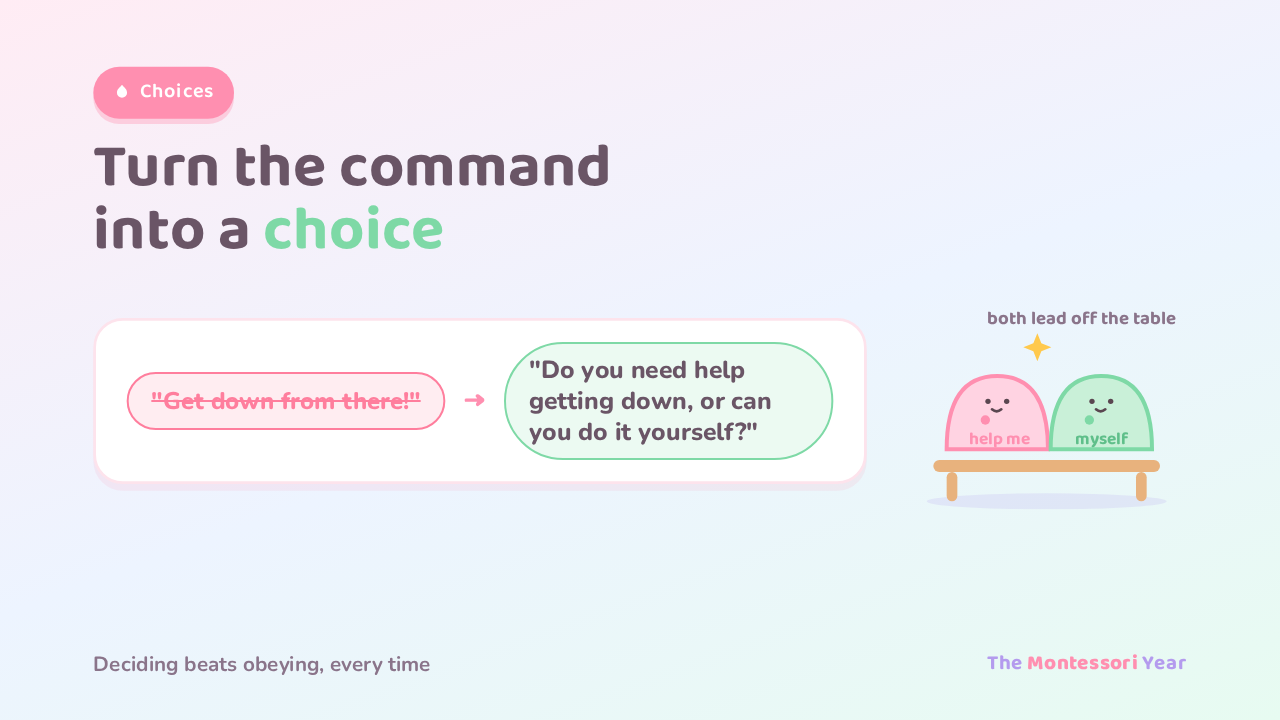
Turn the commandinto a choice
There's a second flip that works just as well. Turn the command into a choice. Commands trip a little alarm in every human brain, a voice that says, I control my own life. Adults can override that voice. Toddlers mostly can't yet. So the child up on the table who hears get down from there often refuses just to save face. Try instead, do you need help getting down, or can you do it yourself? Same table. Same rule. But now they're deciding instead of obeying, and children almost always take the dignified exit. Susan Stephenson, the author of The Joyful Child, writes that she knows of nothing more certain to create a peaceful home with a two year old than offering choices.
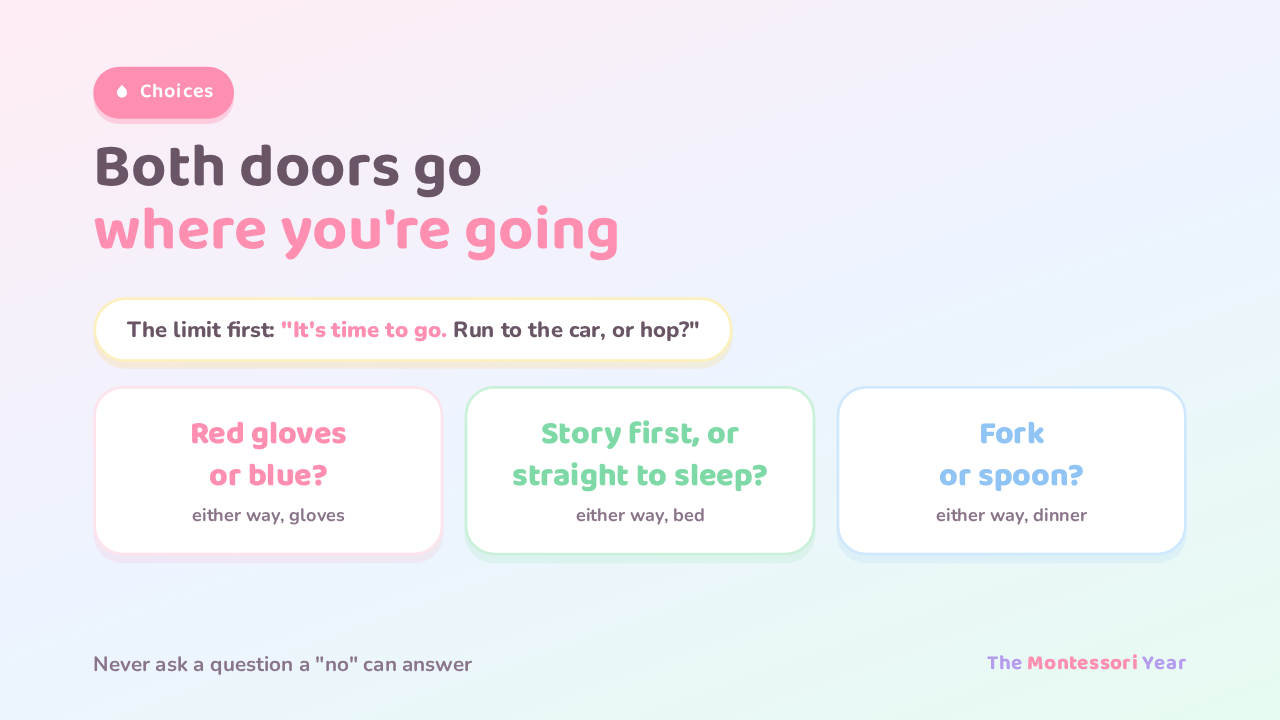
Both doors gowhere you're going
or blue?either way, gloves
straight to sleep?either way, bed
or spoon?either way, dinner
The craft of a good choice is simple. Both doors lead where you're going. Red gloves or blue gloves. Either way, gloves. A story first or straight to sleep. Either way, bed. Fork or spoon. Either way, dinner. Set the limit first, then hang the choice inside it. It's time to go. Should we run to the car, or hop? And watch your phrasing, because a question can hand your no right back to you. Ready to leave the playground? That's an invitation to scream no. Time to go, car or hop, is a plan with a steering wheel in it.
Slide 15
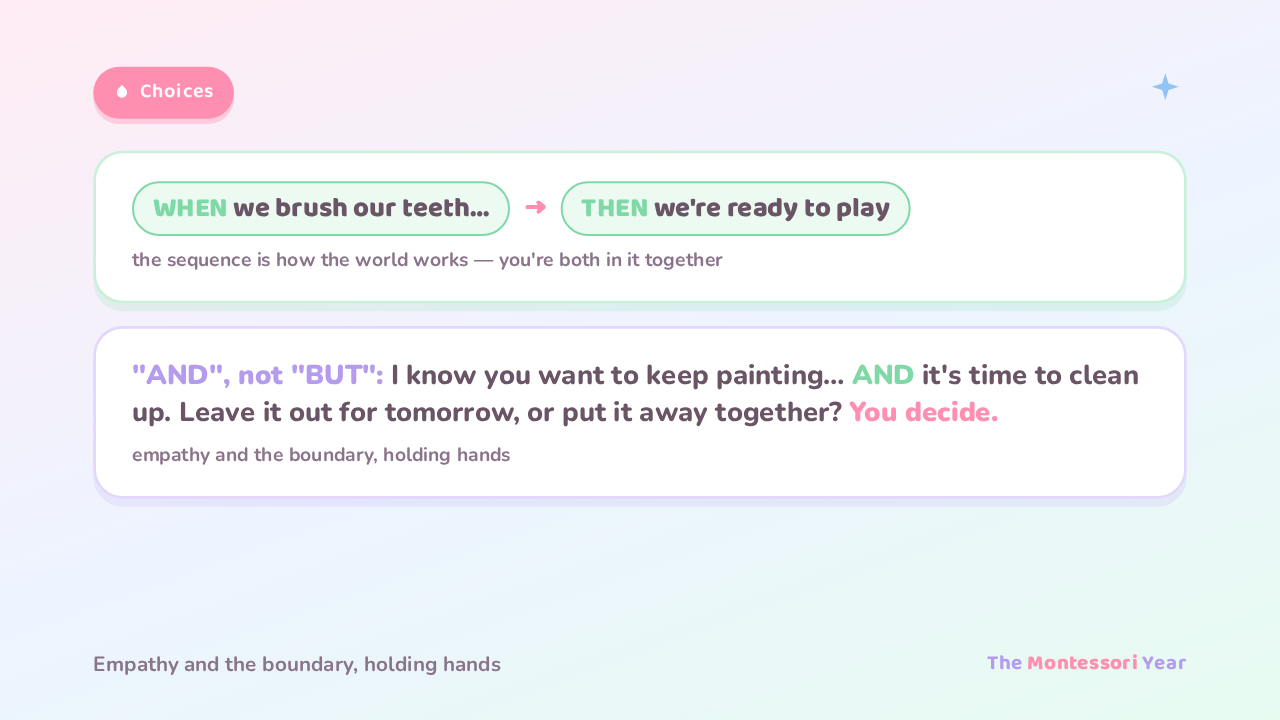
Two little connectors round out the kit. The first is when, then. When we brush our teeth, then we're ready to play. When shoes are on, then we head outside. It turns you from enforcer into narrator. The sequence is just how the world works, and you're both in it together. The second is and instead of but. But erases everything you said before it. And lets two true things stand side by side. I know you want to keep painting. I get it, you love art. And it's time to clean up. Would you like to leave your supplies out for tomorrow, or put them away together? You decide. That's empathy and the boundary, holding hands.
Freedom within limits
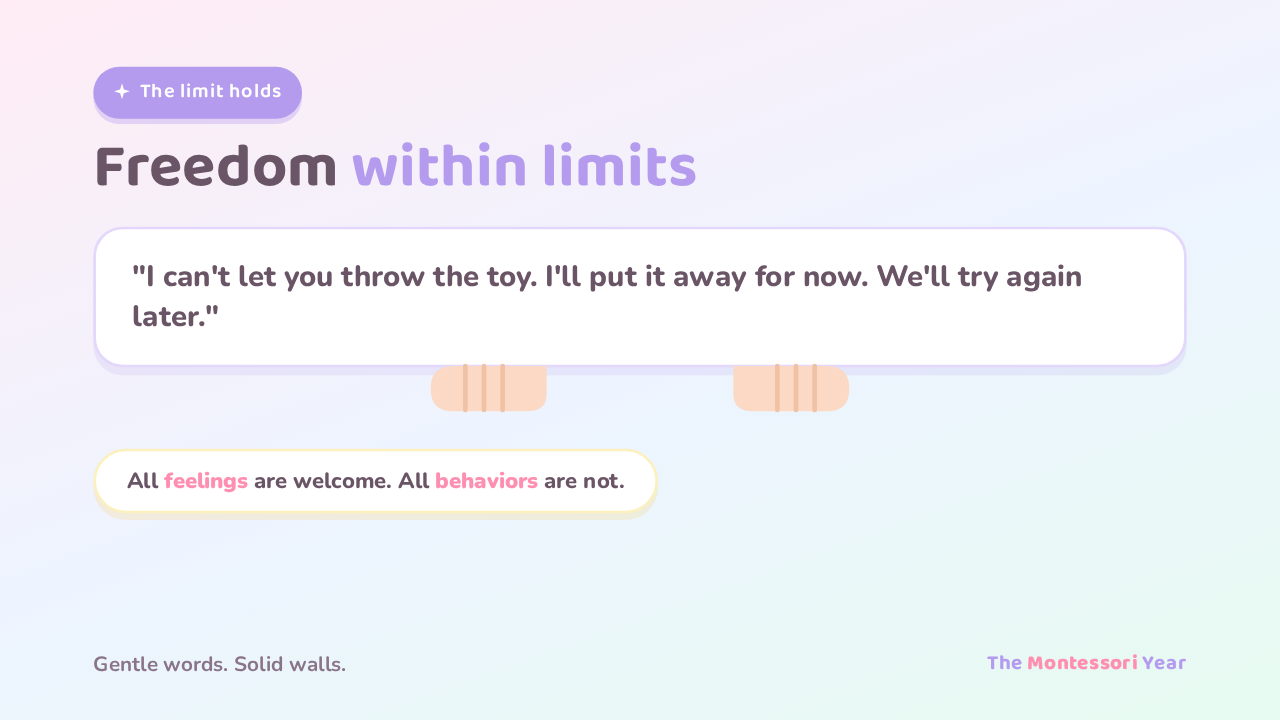
Now the important part, said plainly, because gentle words get mistaken for weak rules. This is not permissiveness. Maria Montessori called it freedom within limits, and the limits are real. Hitting still stops. The couch is still not a trampoline. What changes is only the signpost. And when words aren't enough, remember that a boundary is something you do, not something you request. Don't throw that toy, I've told you a hundred times. That's a request, and enforcing requests is not a toddler skill. Instead, I can't let you throw the toy. I'll put it away for now, and we'll try again later. Then do exactly that. Kindly, and every time. They're allowed to hate it. All feelings are welcome. All behaviors are not.
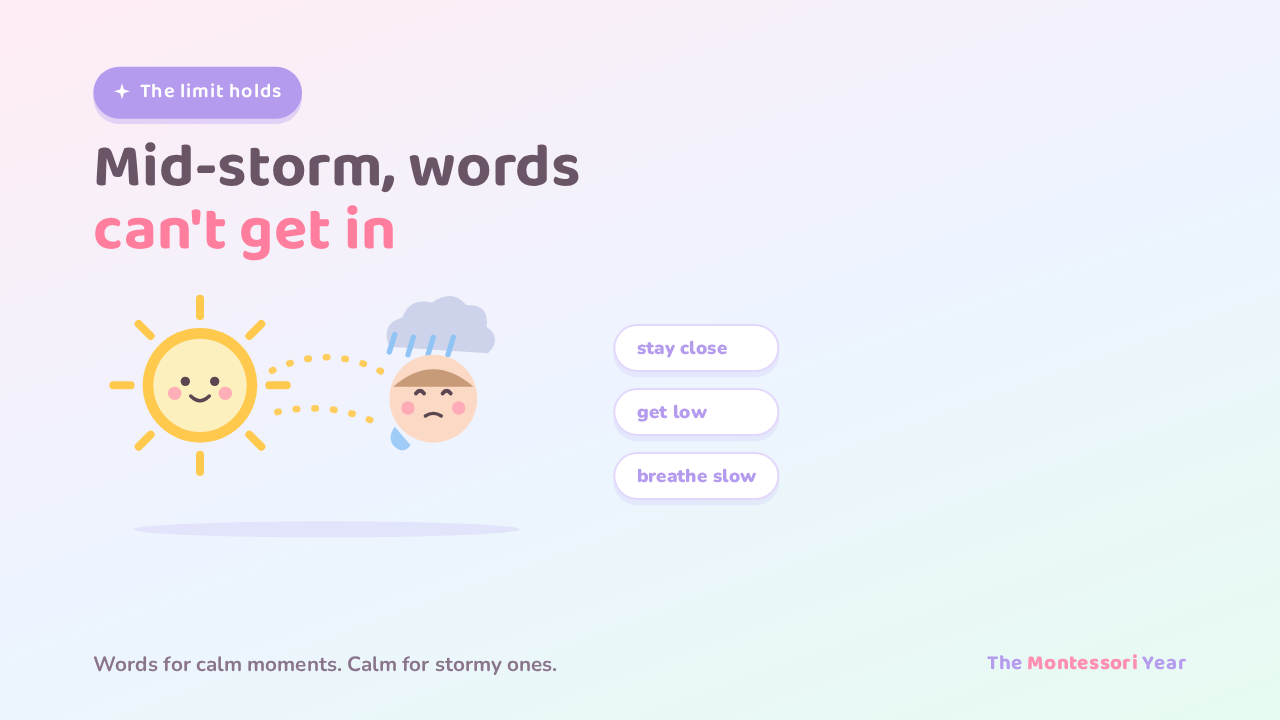
Mid-storm, wordscan't get in
Which brings us to the promise from the beginning. Some days, no words work. Your beautiful swap bounces straight off a screaming child, and you wonder what you did wrong. Nothing. Here's the honest limit of every tool in this kit. Language needs a working brain to land in, and a child in a full storm doesn't have one available. The thinking part of the brain goes offline in a meltdown. Words literally can't get in, so stop producing them. Stay close. Get low. Breathe slow, and let them borrow your calm, because a small nervous system settles by syncing with a settled one nearby. Words are for the calm moments. Calm is for the stormy ones. That's the whole division of labor.
You're planting,not programming
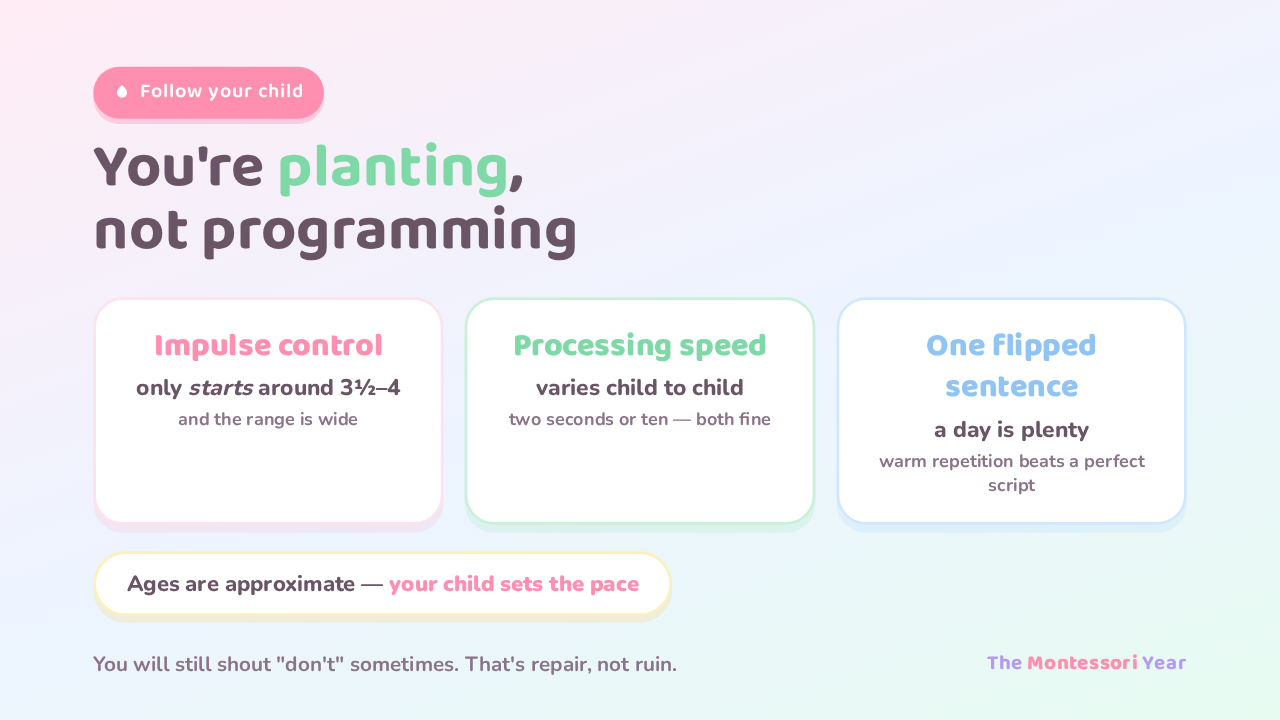
And a word about ages, because your child hasn't read any of these books. Impulse control only starts developing somewhere around three and a half to four, and the range is wide. A one year old who hears walking feet will not walk every time. You're not doing it wrong. You're planting. Processing speed varies just as much, so one child answers in two seconds and another needs ten, and both are fine. Release yourself from the script, too. You will still shout don't sometimes, because you're a human being at five thirty in the evening. One flipped sentence, repeated warmly, beats a perfect script you can't sustain. Aim for one swap a day. That's plenty.
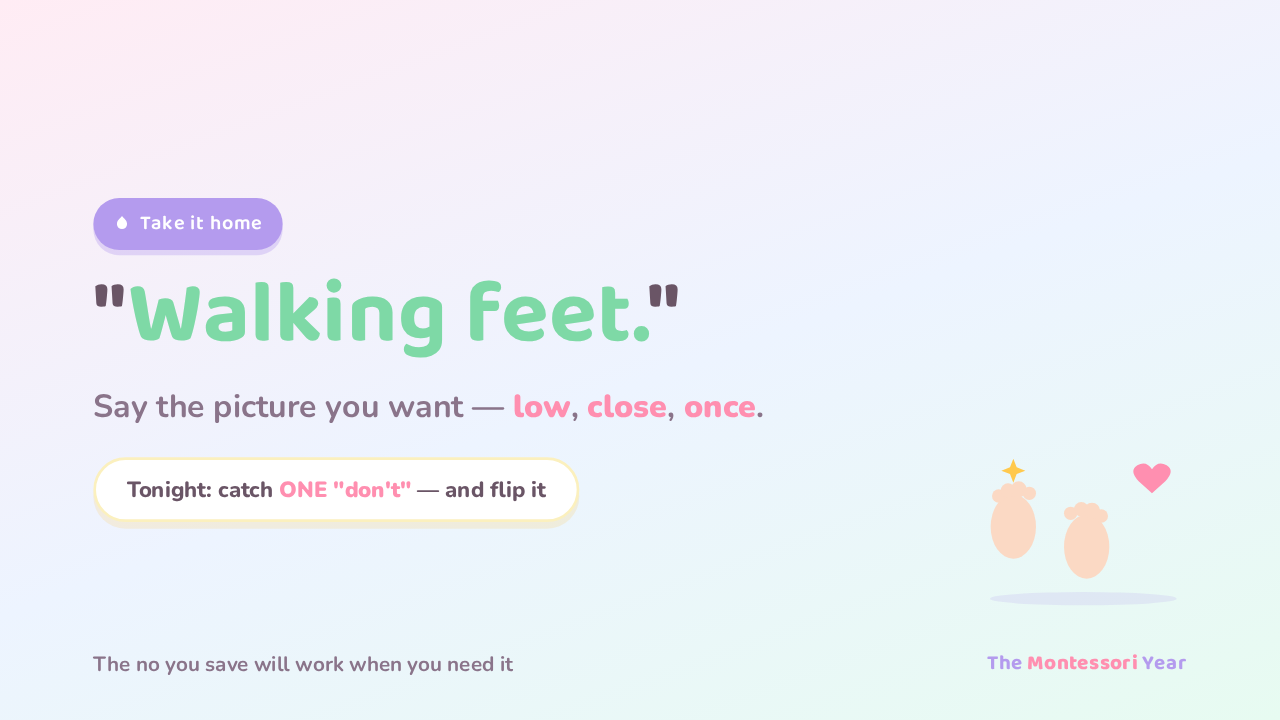
"Walking feet."
Say the picture you want — low, close, once.
So, back to the hallway. The next time your little one takes off running, you'll hear the sentence the way they hear it, and you'll know what to say. Walking feet. Two words. A picture of exactly what you want, said low and close and once. Tonight, just catch one don't as it leaves your mouth, and flip it. What do I want to see instead? Say that. The no you save will still be there when you truly need it. And now it will work.
Tell them what to do —and they can do it
One line to keep. Tell them what to do, and they can finally do it. Next time in Peaceful Discipline, the difference between a tantrum and a meltdown, and why knowing which one you're looking at changes everything about your next move. I'll see you there.