First words ✿
The payoff of months of listening.
You're changing a diaper, narrating the way you always do, and your baby looks up and says it back: da-da. The first word feels like magic. Really, it is the payoff of months of listening, and around eleven months you are deep in prime listening season. So today, how first words actually arrive, and three Montessori habits that cost nothing and feed everything.
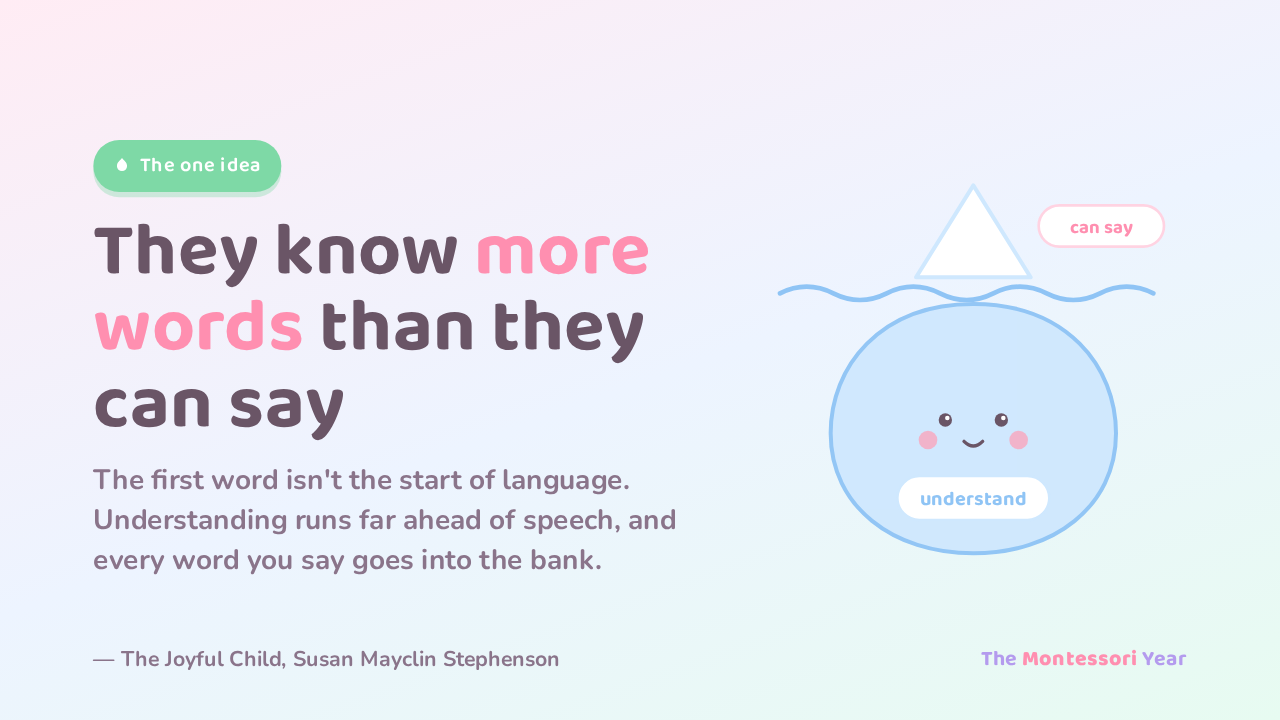
They know more words than they can say
The first word isn't the start of language. Understanding runs far ahead of speech, and every word you say goes into the bank.
Here is the part most of us get backwards. We treat the first word as the start of language. It is not the start. It is the tip of the iceberg. In The Joyful Child, Susan Mayclin Stephenson puts it plainly: long before a child speaks clearly, he has been listening and absorbing everything he hears. Understanding runs far ahead of speech. In fact, children soon understand many, many words that they simply cannot say yet. Your baby already knows more words than they can show you, and every word you speak today goes into that bank.
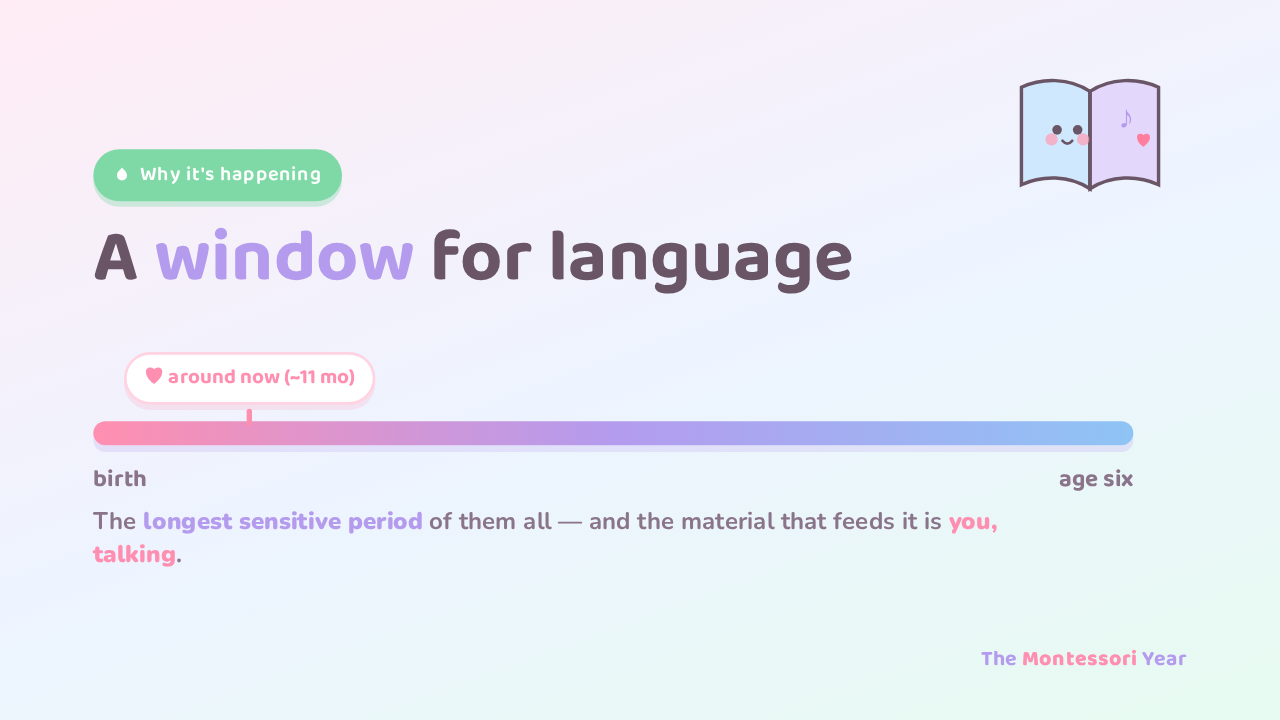
A window for language
The longest sensitive period of them all — and the material that feeds it is you, talking.
Montessori called this a sensitive period: a stretch of childhood when one ability is absorbed almost without effort. The sensitive period for language is the longest of them all. It begins at birth and runs to about age six. Truthfully, it starts even earlier, because babies begin absorbing the rhythms of their mother's language in the womb. And the language material your baby needs most is not a toy or an app. It is you. As one Montessori trainer puts it, we are the most important language material in the environment.
Slide 4
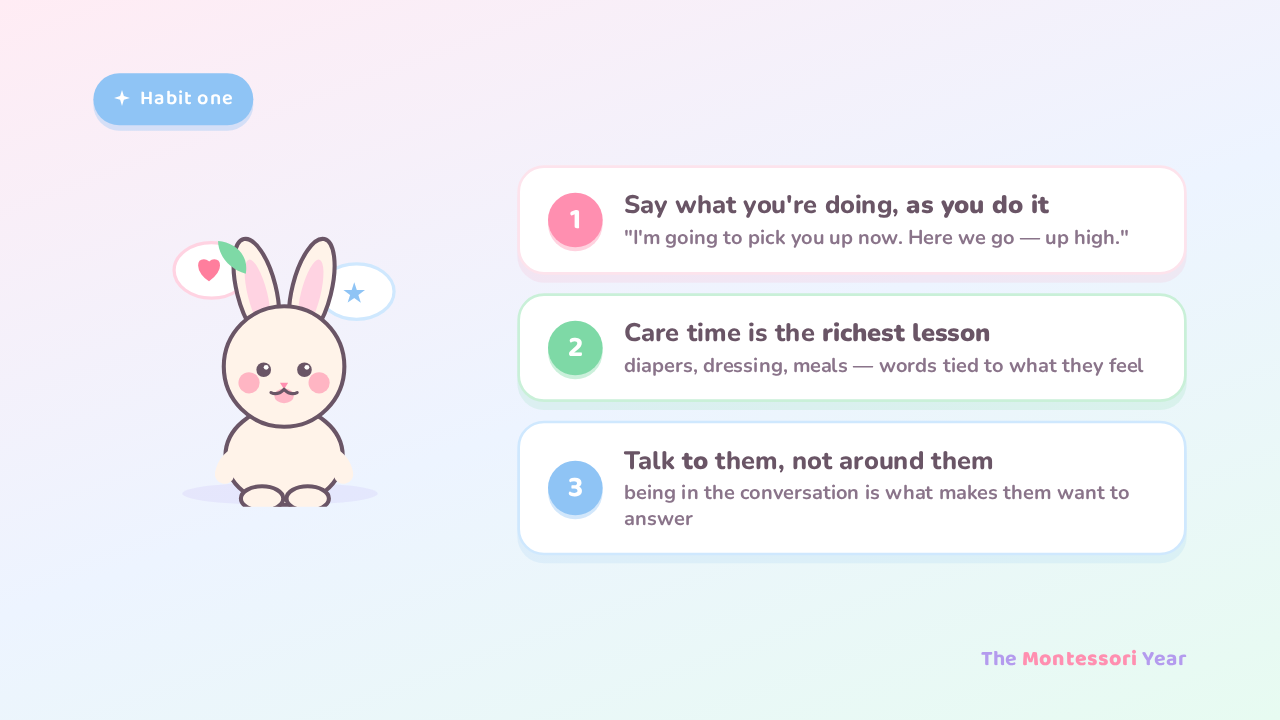
Say what you're doing, as you do it"I'm going to pick you up now. Here we go — up high."
Care time is the richest lessondiapers, dressing, meals — words tied to what they feel
Talk to them, not around thembeing in the conversation is what makes them want to answer
So, habit one: narrate your day. As you care for your baby, say what you are doing while you do it. I'm going to pick you up now. Here we go, up high. Now I'm washing your feet, one toe at a time. Care moments like diapers, dressing, and meals are the richest language lessons of the whole day, because the words are tied to real things your baby can feel. And talk to them, not just around them. Being included in the conversation is exactly what makes a baby want to answer.
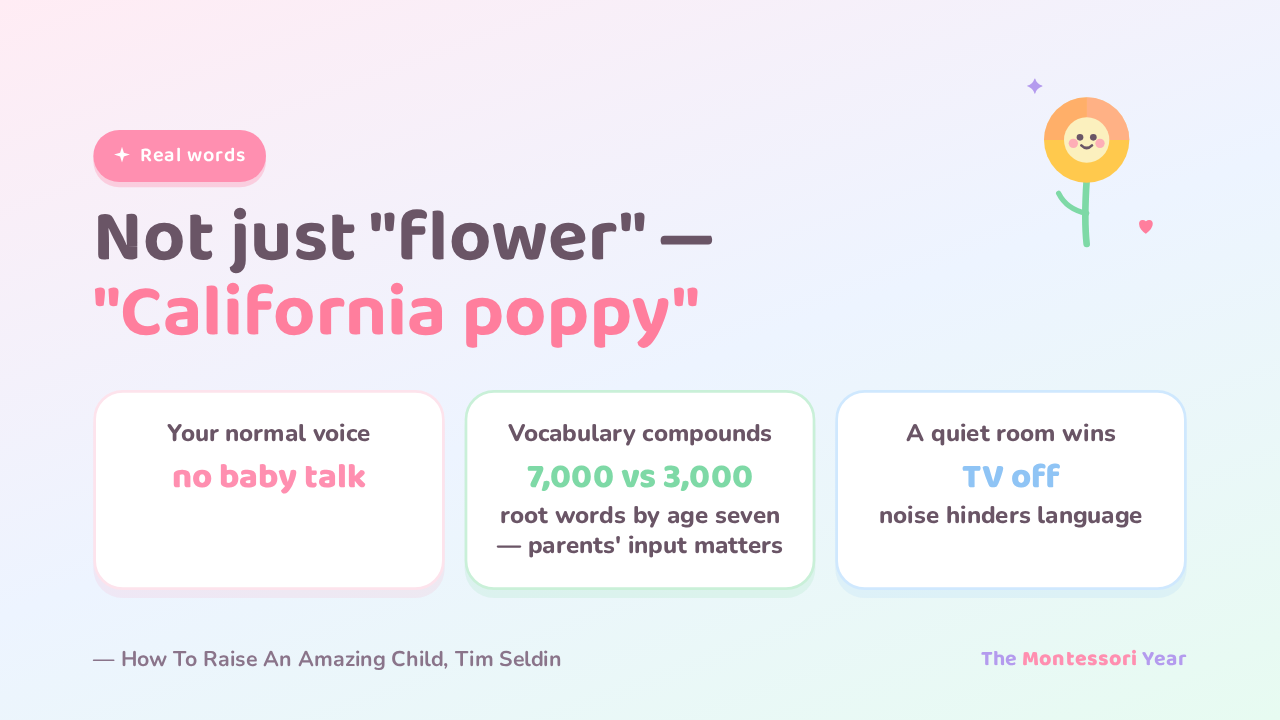
Not just "flower" —"California poppy"
And use real words, rich ones. Stephenson suggests giving the exact name: not just flower, but California poppy, along with describing words like orange, small, and soft. There is no need for baby talk. Speak clearly, in your normal voice, and let the vocabulary stretch. It adds up more than you would think. Tim Seldin, in How To Raise An Amazing Child, cites a study of seven-year-olds where the strongest quarter knew around seven thousand root words, the weakest about three thousand, and parents' input was a major factor either way. One more tip from the same book: turn the television off. A noisy room hinders language.
Slide 6
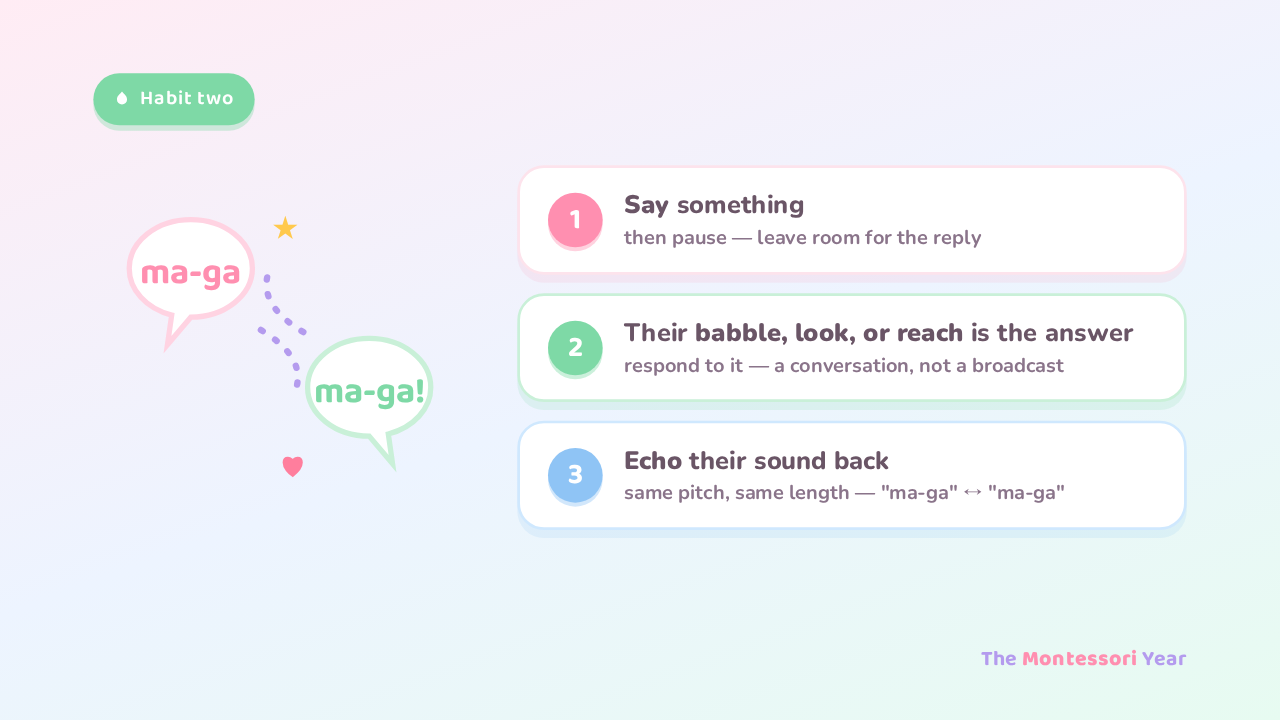
Say somethingthen pause — leave room for the reply
Their babble, look, or reach is the answerrespond to it — a conversation, not a broadcast
Echo their sound backsame pitch, same length — "ma-ga" ↔ "ma-ga"
Habit two: serve and return. Talk with your baby, not at them. Say something, then pause, and let the babble, the look, or the reach be their answer. Then answer back. Stephenson describes an even simpler version: when your baby makes a sound, imitate it exactly, matching the pitch and the length. Ma-ga. Ma-ga. Babies often light up, as if to say, at last, someone speaks my language. After a few rounds, many will start offering sounds just for you to copy. That is not baby talk. That is a first real conversation.
Slide 7
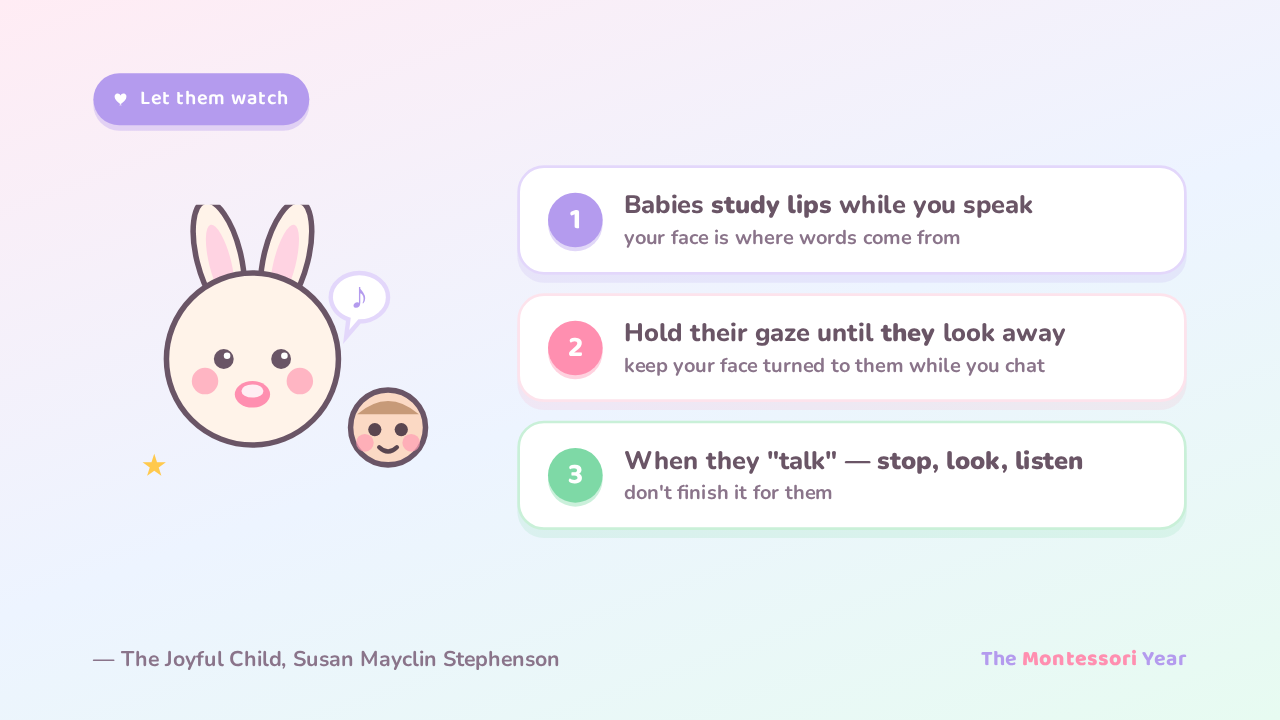
Babies study lips while you speakyour face is where words come from
Hold their gaze until they look awaykeep your face turned to them while you chat
When they "talk" — stop, look, listendon't finish it for them
While you talk, let them watch your face. From their first days, babies study the face and lips of whoever is speaking. Stephenson tells of holding a friend's baby in Rome who watched her mouth intently as she spoke, and her mentor's advice was to keep her face turned toward him until he was finished watching. So hold their gaze while you chat. And when the answering babble comes, stop, look, and listen. Do not jump in to finish it for them. A baby who is sure of being heard keeps talking.
Slide 8
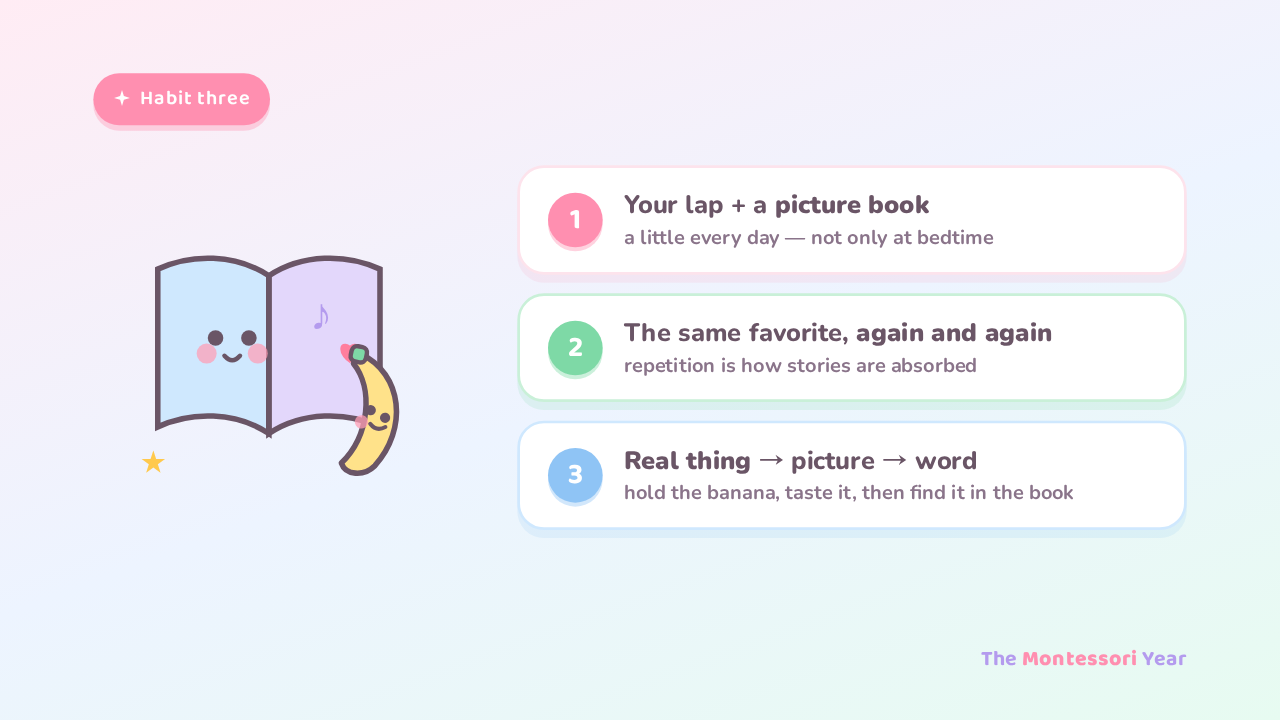
Your lap + a picture booka little every day — not only at bedtime
The same favorite, again and againrepetition is how stories are absorbed
Real thing → picture → wordhold the banana, taste it, then find it in the book
Habit three: books, and the naming game. As soon as your baby can sit and focus, they will enjoy short stretches on your lap with a picture book, hearing you talk about what is on the page. Read a little every day, not only at bedtime, and surrender to the repetition, because children absorb stories by hearing them again and again. When you can, give the real thing before the picture: handle a banana, smell it, taste it, then find it in the book. At this age children are hungry for the name of every single object. Feed that hunger.
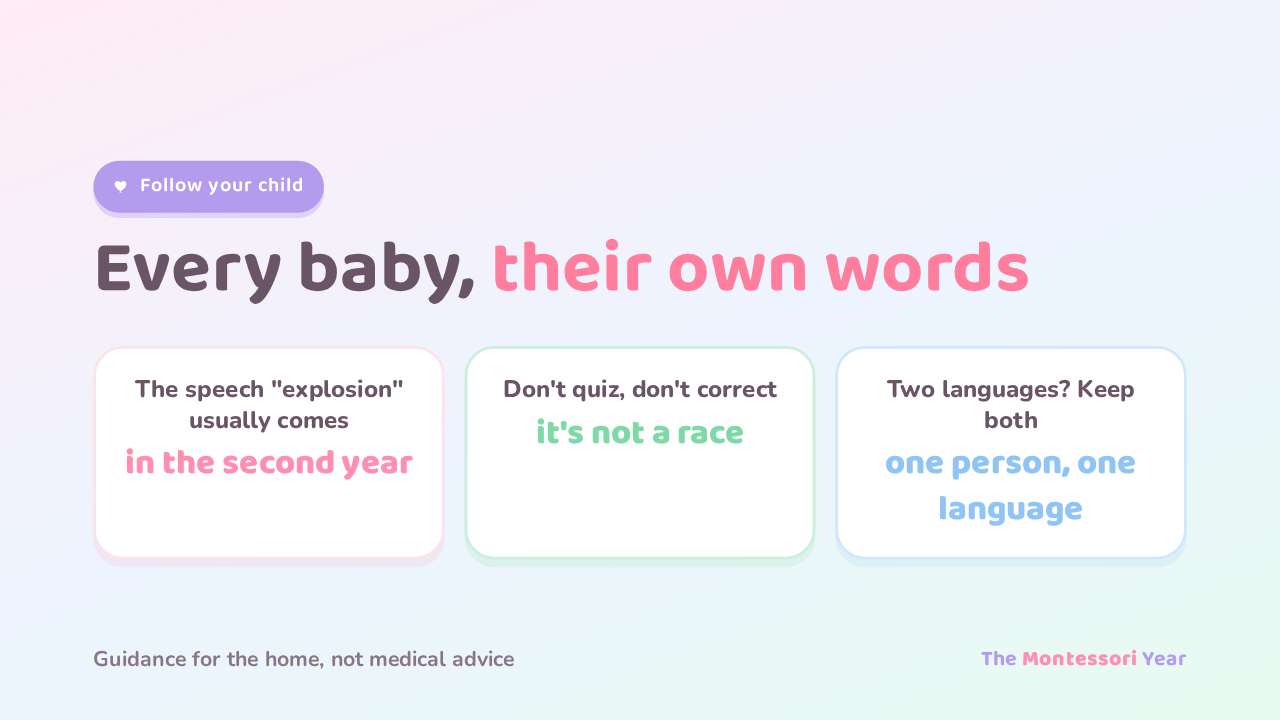
Every baby, their own words
Now the calibration, because every baby has their own timeline. The explosion into speech usually comes sometime in the second year, so whether the first word arrives before the first birthday or months after it, your baby is right on schedule, their own schedule. This is parenting practice, not medical advice; bring any worry about speech or hearing to your pediatrician. In the meantime, do not quiz, and do not correct. Learning language is not a race, and the more parents push, the more children resist. And if your family speaks two languages, keep both. Young children absorb several at once, most easily when each person always speaks their own language to the child.
Talk with them.Listen back. ♥
Real words, a pause for their reply, and a name for everything.
So this week: narrate in real words, serve and return, and name the world with a book in your lap. Your baby is listening, and understanding, far more than they can show you yet. Talk with them, and listen back. The words will come. Today leaned on The Joyful Child by Susan Mayclin Stephenson and How To Raise An Amazing Child by Tim Seldin, both worth a spot on your shelf. I'm so glad you're here. I'll see you next week.