
The preparedenvironment ✿
Montessori's real invention — and the fix for a house that fights your child.
It's seven in the morning, and you hear it. The scrape of a kitchen chair being dragged across the floor. Your toddler is moving furniture again, because everything they want sits about three feet out of reach. That daily battle has a fix, and it was invented more than a hundred years ago, in one of the poorest quarters of Rome, by Maria Montessori. It became the most copied idea in early education. And in the book that made her famous, she never even gave it its name. So here's where the prepared environment really came from, why it works, and at the end, a walkthrough of your own home, on your knees, that can change your week.
Her invention was a room,not a lesson
Her famous book describes the room for pages — and the phrase "prepared environment" appears exactly 0 times. The Montessori Method, 1912 — the name only came later
Let me name the idea, then tell you the story, because the story is better than any definition. Montessori teachers call it the prepared environment: a space arranged so carefully around the child that the room itself does much of the teaching. And here is my favorite fact about it. Her famous book, The Montessori Method, published in 1912, describes that room for page after page. But the phrase "prepared environment" never appears in it. Not once. She wasn't naming a concept. She was building something that didn't exist yet, and the name only came later. To see what she built, you first have to see the world she built it against.
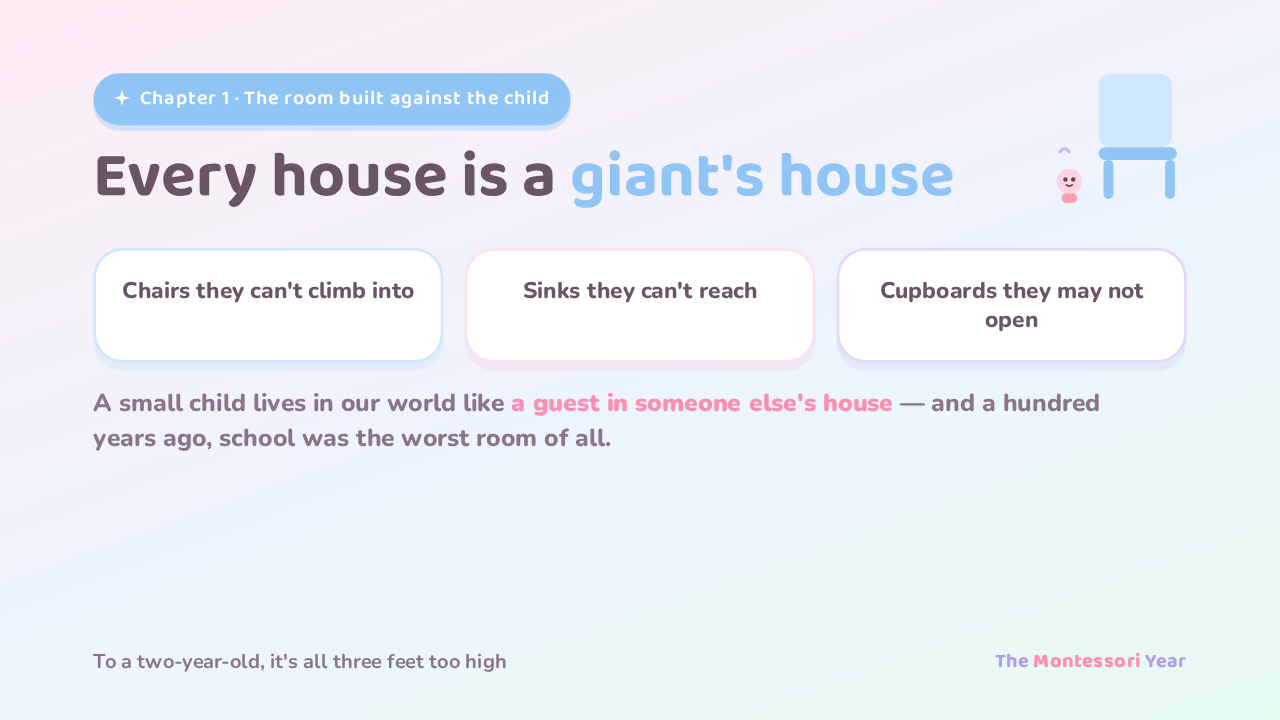
Every house is a giant's house
A small child lives in our world like a guest in someone else's house — and a hundred years ago, school was the worst room of all.
Start at your child's altitude. To a two-year-old, an ordinary home is a giant's house. The chairs need climbing gear. The sink might as well be on the roof. The tools of daily life, the cups, the spoons, the coats, all hover somewhere overhead, and touching them usually earns a "no." A small child lives in our world like a guest in someone else's house, and then we wonder why they whine, cling, and climb. A hundred years ago it was worse, and school was the worst room of all. Because back then, science had just gotten involved in classroom furniture.
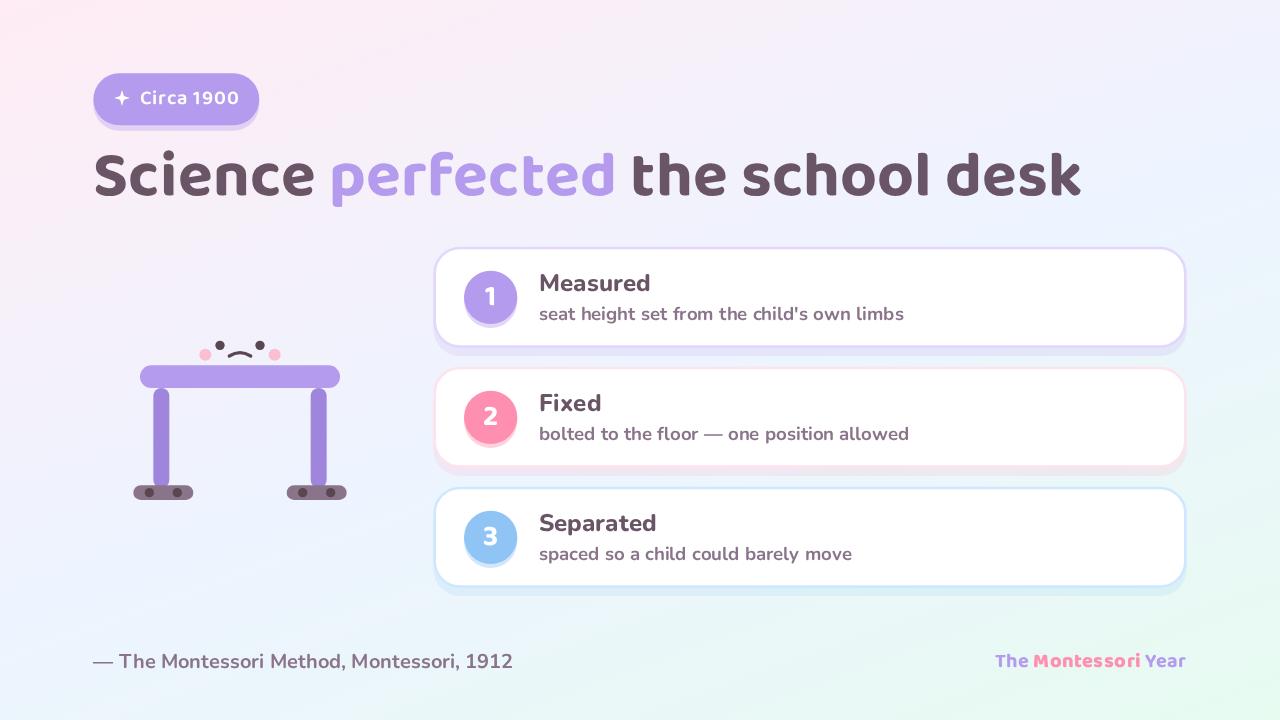
Science perfected the school desk
Measuredseat height set from the child's own limbs
Fixedbolted to the floor — one position allowed
Separatedspaced so a child could barely move
In Montessori's day, the school desk was a point of scientific pride. Anthropologists measured children's bodies and set the seat at exactly the right height. The desk and chair were built as one machine and fastened to the floor. Seats were separated, and spaced so precisely that a child could just barely sit down, and could not lean, stretch, or stand. Montessori writes that these desks were designed to render the child, in her words, visible in all his immobility. Nations even patented their national desk designs. The child was studied with real rigor, and then the results were used to hold the child perfectly still.
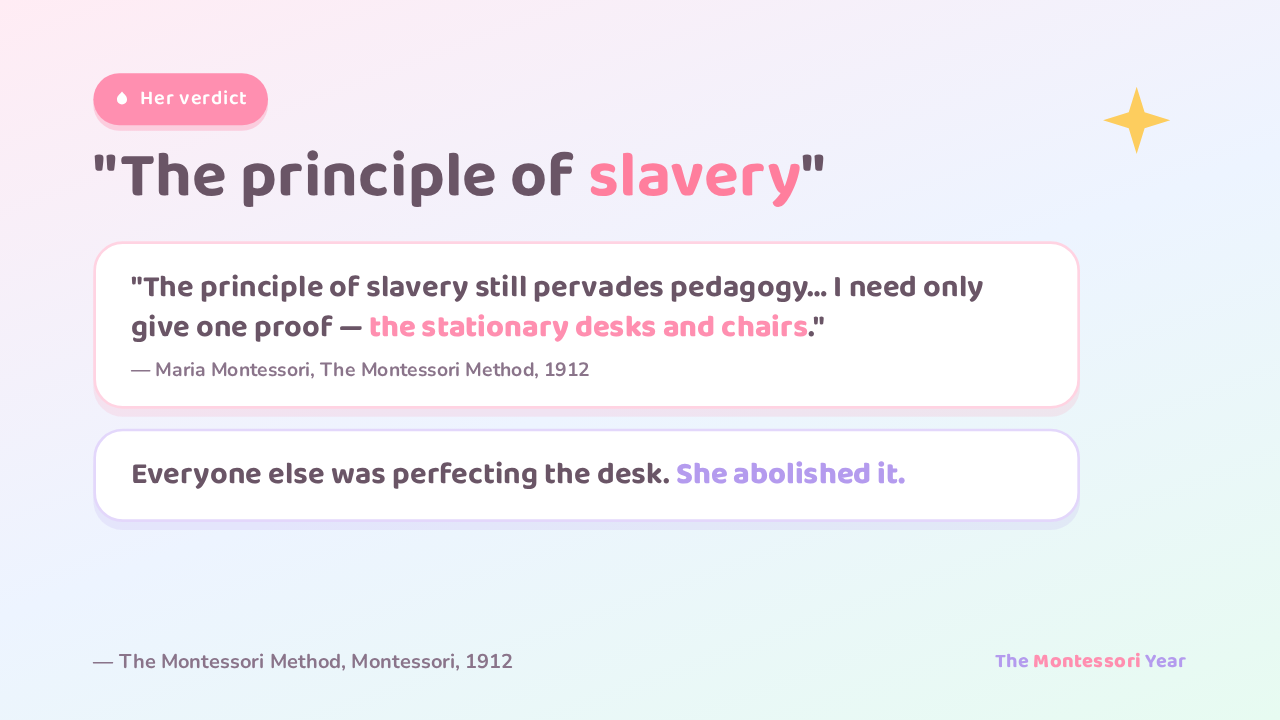
"The principle of slavery"
"The principle of slavery still pervades pedagogy… I need only give one proof — the stationary desks and chairs." — Maria Montessori, The Montessori Method, 1912
Everyone else was perfecting the desk. She abolished it.
Montessori's verdict on all that engineering is one of the most famous lines she ever wrote: "The principle of slavery still pervades pedagogy. I need only give one proof, the stationary desks and chairs." She had a dark sense of humor about it, too. Those seats were marketed as preventing curvature of the spine, and she predicted that people would one day touch them with wondering hands, amazed that anyone treated a bent spine with better bolts instead of asking why school was bending children in the first place. While everyone else perfected the desk, she threw it out. And in 1907, she got a room to prove it in.
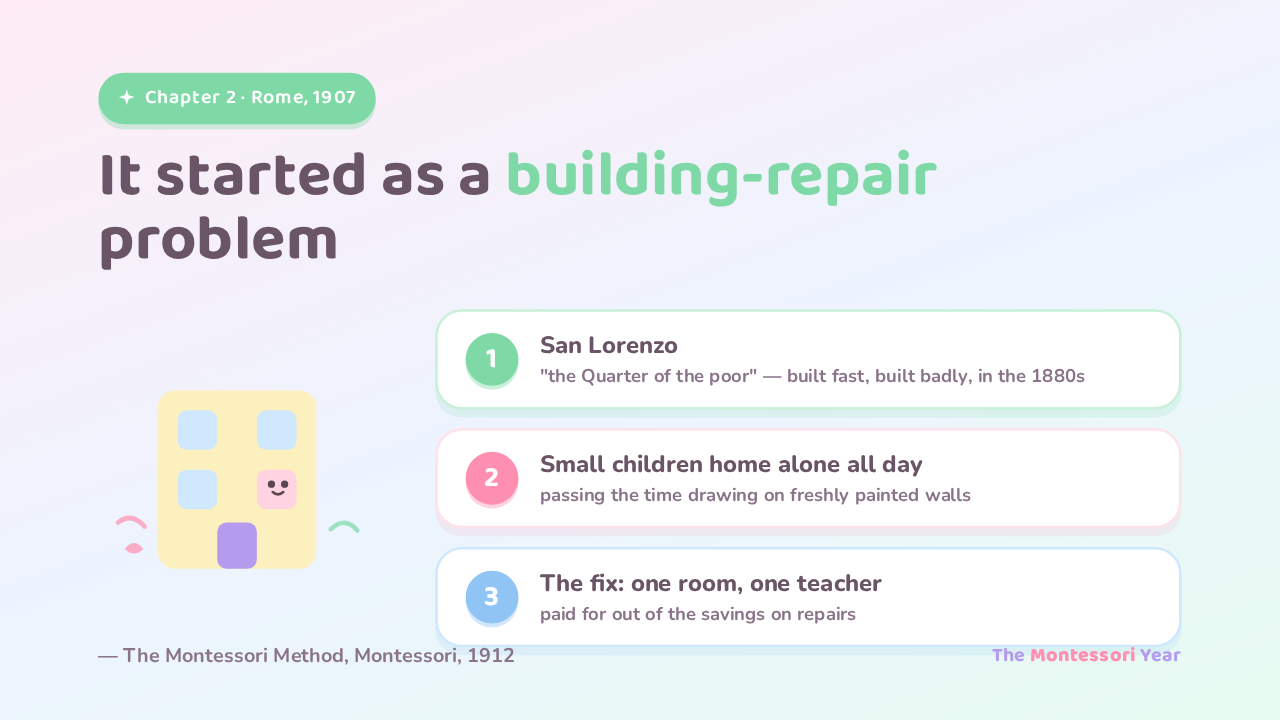
It started as a building-repair problem
San Lorenzo"the Quarter of the poor" — built fast, built badly, in the 1880s
Small children home alone all daypassing the time drawing on freshly painted walls
The fix: one room, one teacherpaid for out of the savings on repairs
The prepared environment was not born in a lab. It was born as a building-maintenance problem. San Lorenzo was a poor quarter of Rome, thrown up fast in the building fever of the 1880s. A housing association was renovating its tenements, and it had one stubborn issue. Children too young for school were left alone all day while their parents worked, and they passed the time scribbling on the freshly painted walls and stairs. So the association tried something new. Gather the little ones in one big room, with a teacher, and pay for it out of the money saved on repairs. To run it, they invited a young doctor named Maria Montessori.
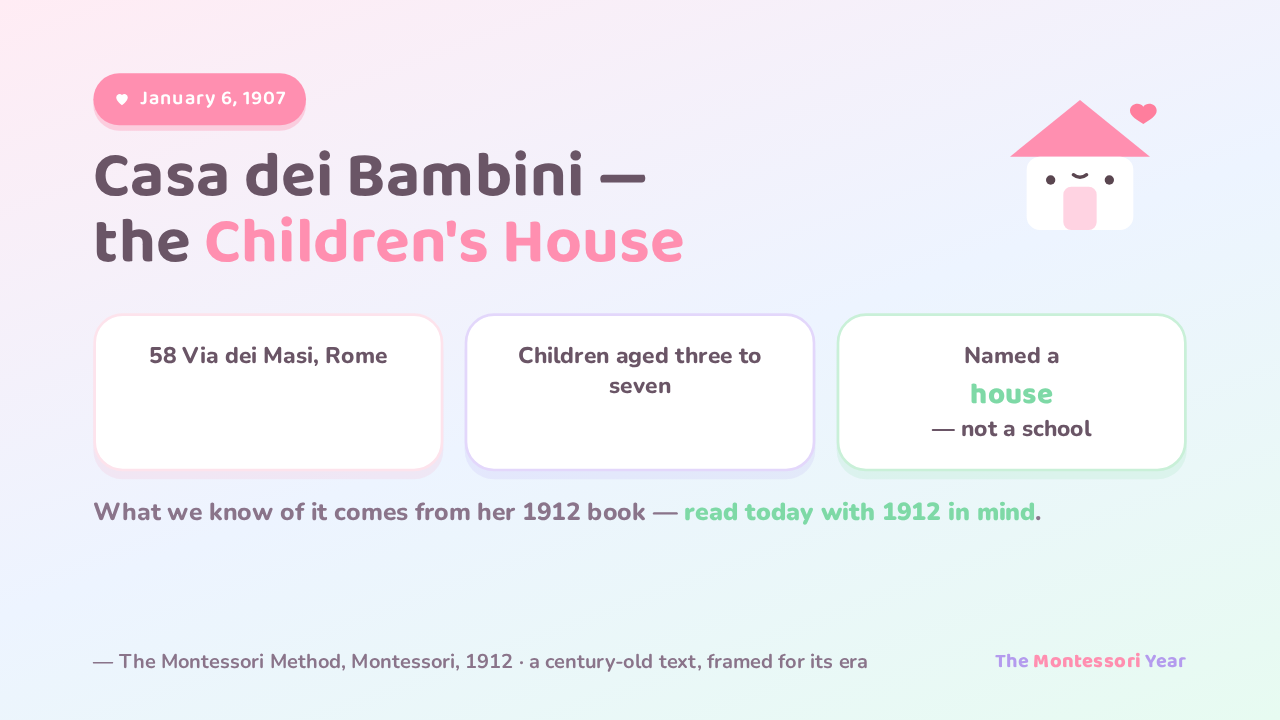
Casa dei Bambini —the Children's House
What we know of it comes from her 1912 book — read today with 1912 in mind.
It opened on the sixth of January, 1907, at 58 Via dei Masi, and a friend gave it the name that stuck: Casa dei Bambini, the Children's House. Not a school. A house. One honest note before we go inside. Almost everything we know about that room comes from the book Montessori published five years later, and it is very much a text of its time. Some of its language, especially around disability, lands badly today, and it should. I'll quote the parts that made history, and we can read the rest with clear, modern eyes. Because what she did inside that room really was new. She started with the furniture.
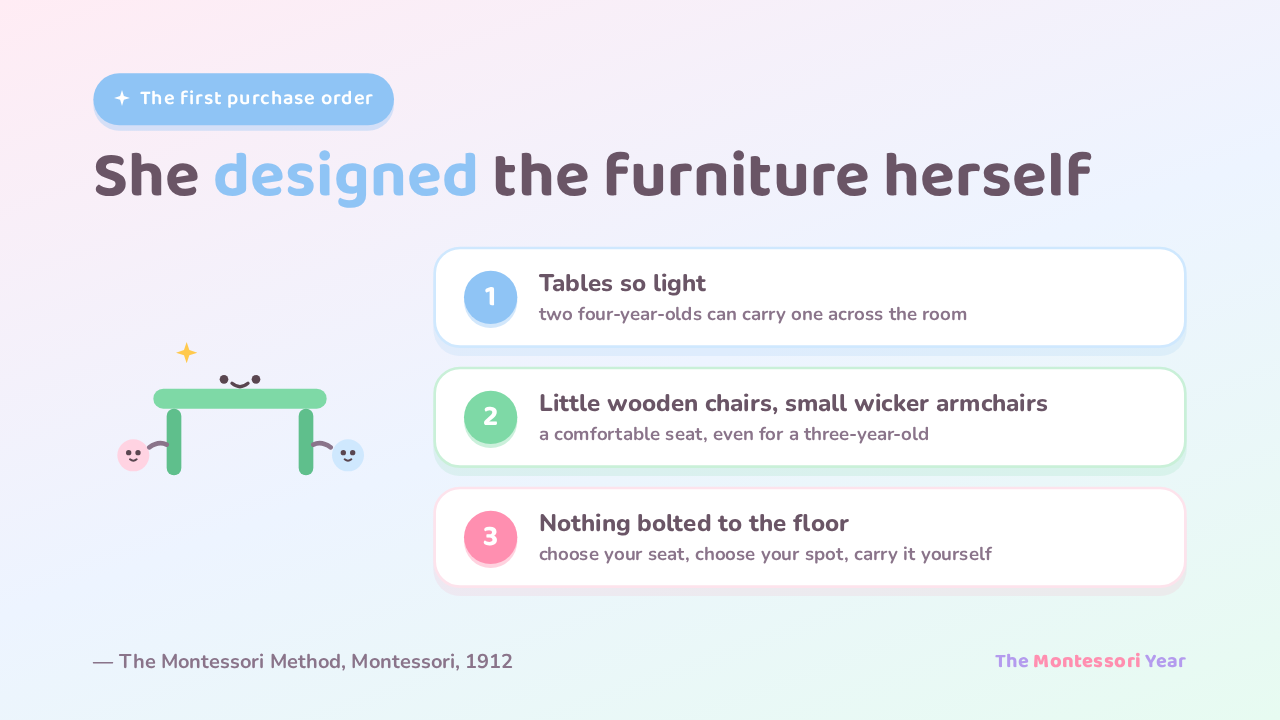
She designed the furniture herself
Tables so lighttwo four-year-olds can carry one across the room
Little wooden chairs, small wicker armchairsa comfortable seat, even for a three-year-old
Nothing bolted to the floorchoose your seat, choose your spot, carry it yourself
Child-sized school furniture wasn't a thing you ordered in 1907. School furniture meant desks, and desks meant bolts. So Montessori designed her own and had it manufactured. Tables with wide, sturdy legs, but so light, she writes, that two four-year-olds could pick one up and carry it across the room. Little chairs, first woven, then all wood when the weaving wore out. A few small armchairs of wood and wicker, because even a three-year-old deserves a comfortable seat. Notice what's happening. Every design choice hands something back to the child: choose your seat, choose your spot, carry your own table there yourself.
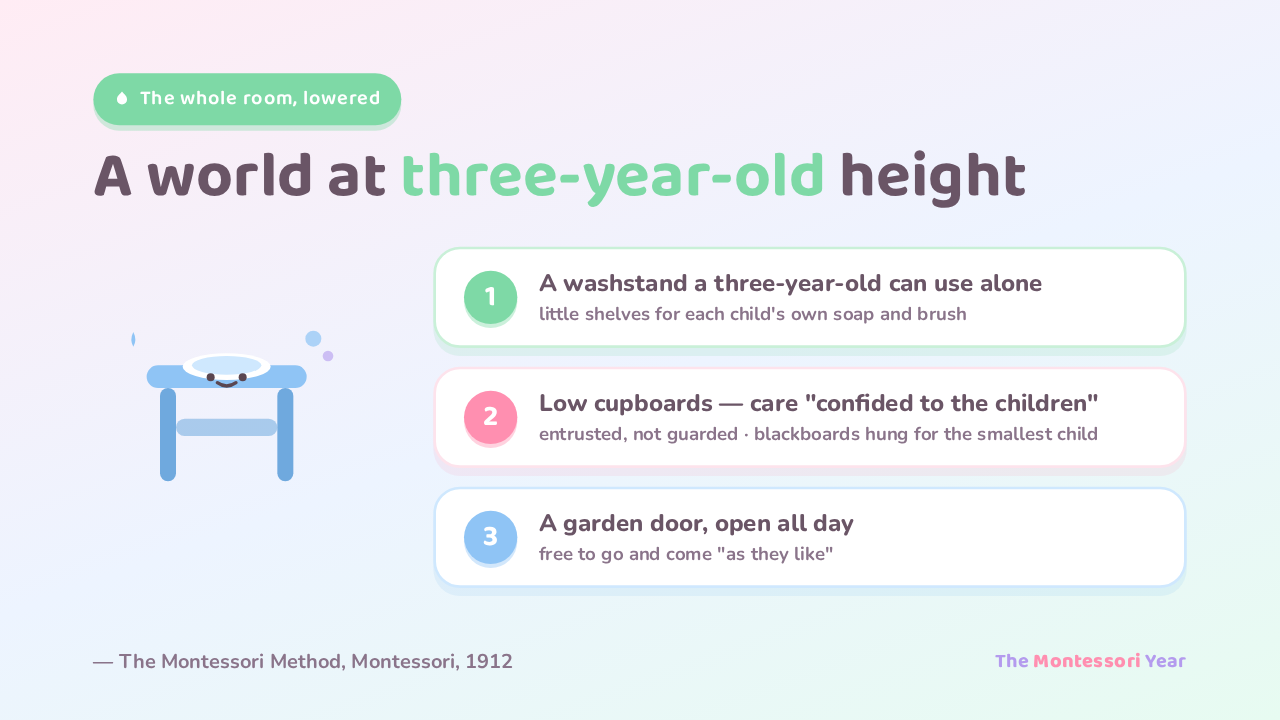
A world at three-year-old height
A washstand a three-year-old can use alonelittle shelves for each child's own soap and brush
Low cupboards — care "confided to the children"entrusted, not guarded · blackboards hung for the smallest child
A garden door, open all dayfree to go and come "as they like"
Then she lowered the entire room. A little washstand, low enough for a three-year-old, with small shelves for each child's own soap and nail brush. Long, low cupboards for the learning materials, with doors that open easily, and here is the detail I love: the care of those cupboards was confided to the children. Not guarded from them. Entrusted to them. Blackboards hung where the smallest child could reach and write. And the schoolroom opened straight onto a garden, with the door open, so children could go and come, in her words, as they liked, throughout the entire day.
No teaching machine.A house that said yes.
"This, then, is the environment which I have selected for the children we wish to educate." — Maria Montessori, The Montessori Method, 1912
When she finishes describing the room, she closes with a quiet little sentence: "This, then, is the environment which I have selected for the children we wish to educate." Read that again. Not the curriculum I have written. Not the machine I have perfected. The environment I have selected. Her first act of education was a shopping list and a carpenter. And notice there is nothing expensive in it, no gadgets, nothing you couldn't recreate in any home. Which raises the obvious question: if the room is that simple, what is actually doing the teaching? That's where this story gets genuinely surprising.
She made it easy toknock over. On purpose.
Critics predicted chaos. She called that "a prejudice… with no real foundation."
Now the part almost everyone gets wrong, including plenty of Montessori fans. The tiny furniture is not about being adorable. It is engineered, and the engineering is counterintuitive. She made it light on purpose. Light enough to knock over. Her critics saw children free among lightweight tables and predicted exactly what you'd predict: noise, crashes, chaos. She answered that this fear was a prejudice with no real foundation. Because the tipping wasn't a flaw in her design. The tipping was the design.
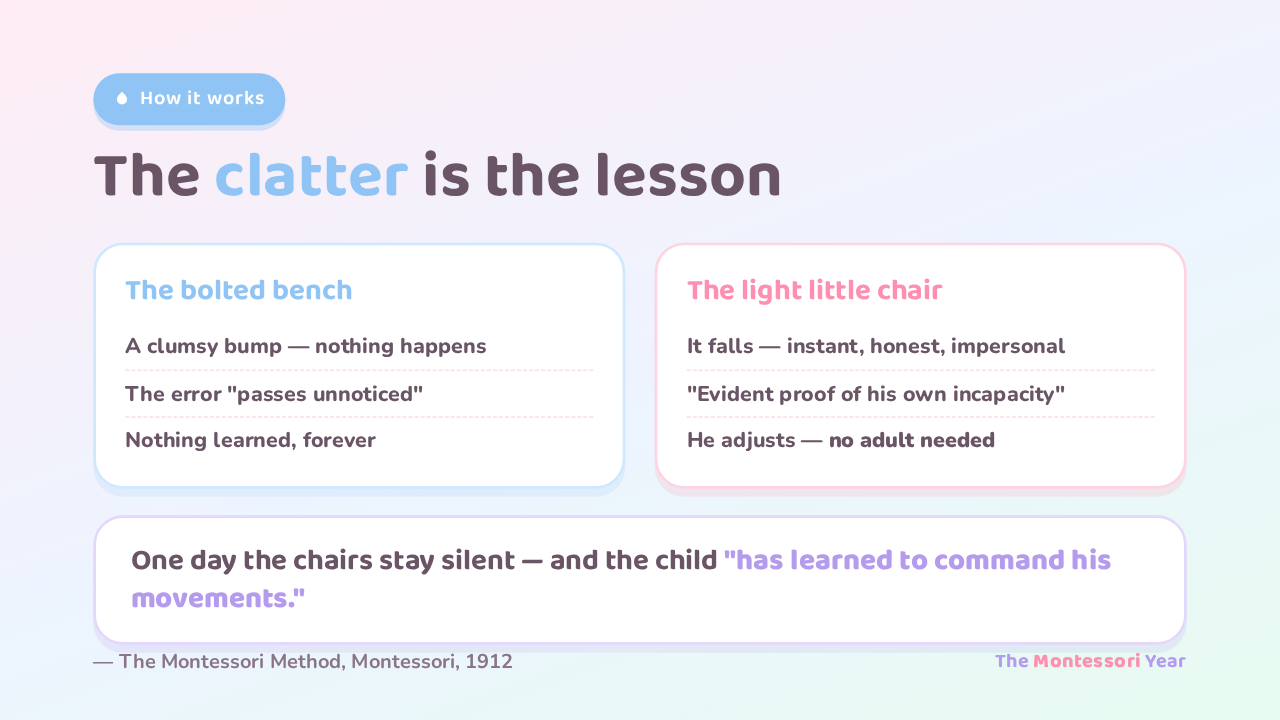
The clatter is the lesson
The bolted bench
- A clumsy bump — nothing happens
- The error "passes unnoticed"
- Nothing learned, forever
The light little chair
- It falls — instant, honest, impersonal
- "Evident proof of his own incapacity"
- He adjusts — no adult needed
One day the chairs stay silent — and the child "has learned to command his movements."
Here's her logic. A child bumps a bolted bench, and nothing happens. The error vanishes. It passes unnoticed, she writes, and so it repeats forever. But bump a light little chair and it falls, loudly. The child gets, in her words, evident proof of his own incapacity. That sounds harsh until you notice what kind of feedback it is. Instant. Honest. And completely impersonal. No scolding voice, no disappointed face, just physics, quietly reporting the facts. So the child adjusts, moves more carefully, and one day the chairs stay silent, and that silence is his own achievement. The child, she says, has learned to command his movements.
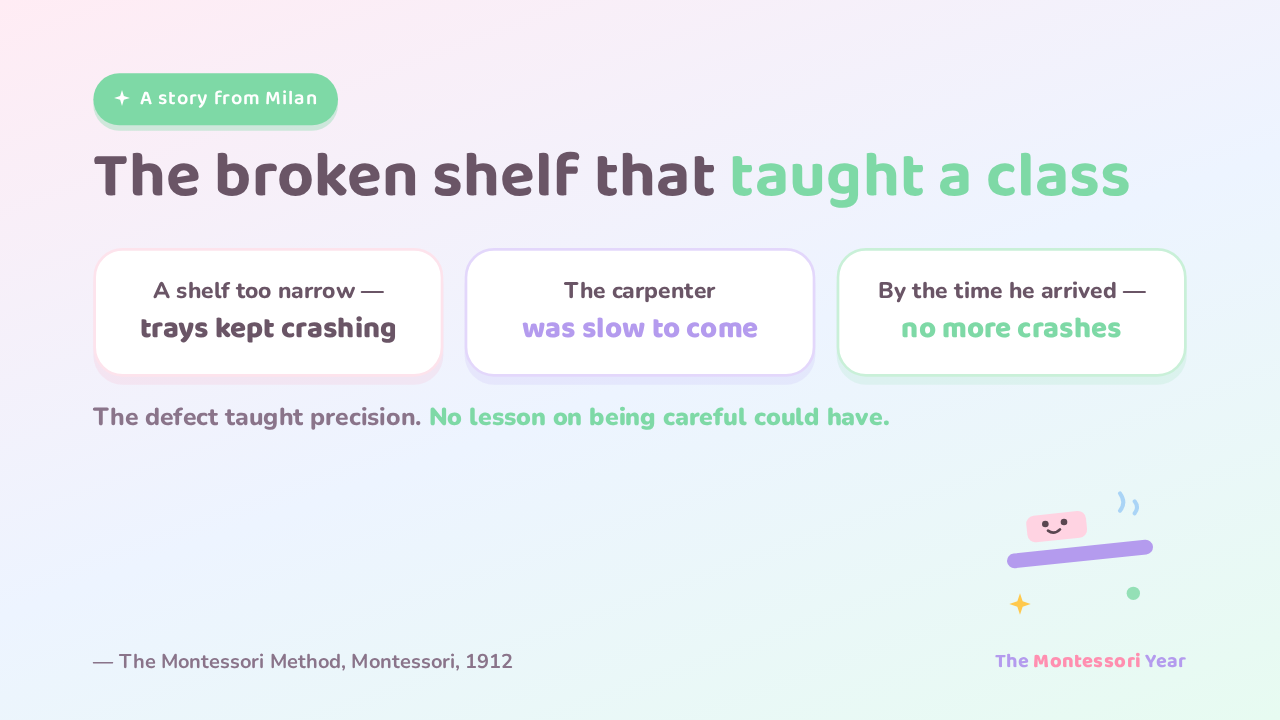
The broken shelf that taught a class
The defect taught precision. No lesson on being careful could have.
She tells a story from the Children's House in Milan that makes the point perfectly. A teacher set the metal drawing materials on a shelf under a window, and the shelf was too narrow and sloped, so when children reached for a tray, the whole thing would crash to the floor, pieces everywhere. The teacher intended to have it fixed, but the carpenter was slow in coming. And while everyone waited, something happened. The children learned to reach so carefully that the trays stopped falling, faulty shelf and all. The defect taught precision. No lesson on being careful ever could have done that.
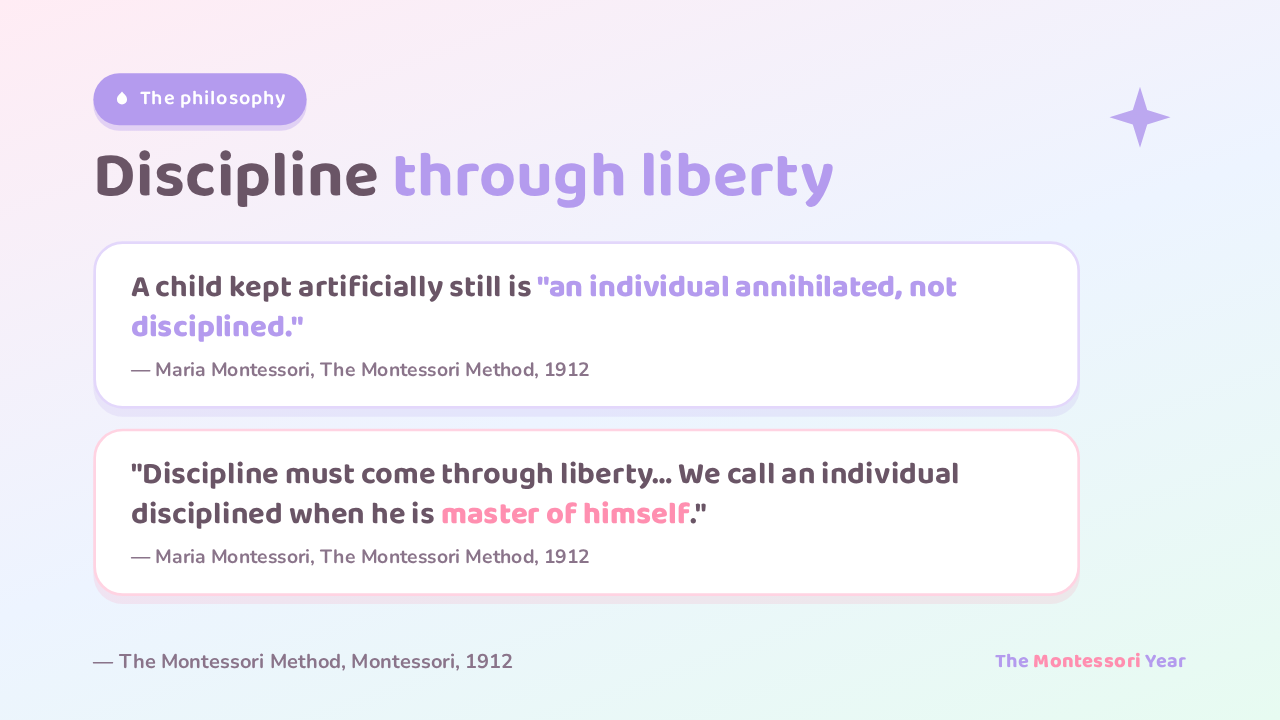
Discipline through liberty
A child kept artificially still is "an individual annihilated, not disciplined." — Maria Montessori, The Montessori Method, 1912
"Discipline must come through liberty… We call an individual disciplined when he is master of himself." — Maria Montessori, The Montessori Method, 1912
This is where the room turns into a philosophy. In her day, a disciplined class was a motionless one. Montessori called that child, and this quote still stings a century later, "artificially silent as a mute and immovable as a paralytic... an individual annihilated, not disciplined." Strong words, from a book that is over a hundred years old. Her alternative: "Discipline must come through liberty." A disciplined person, she wrote, is one who is master of himself. And you cannot become master of yourself sitting bolted to a bench. You need a room where your choices have real, visible consequences, small ones, safe ones, every single day.
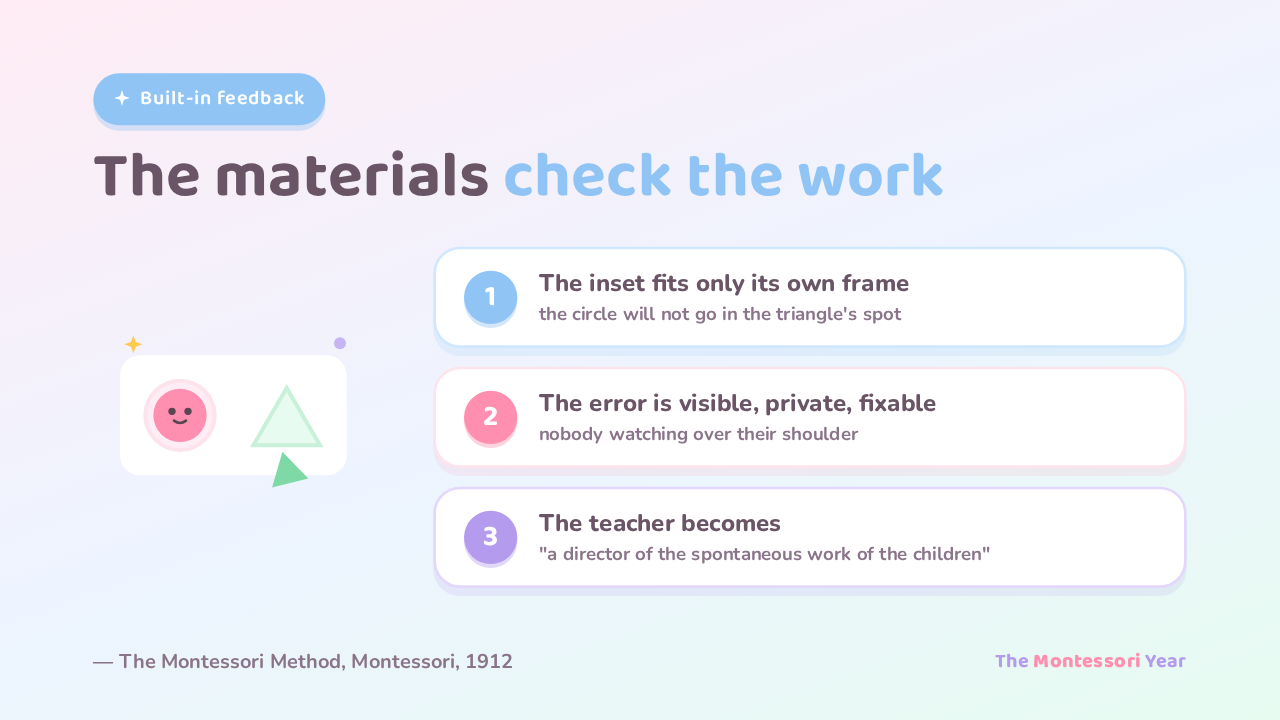
The materials check the work
The inset fits only its own framethe circle will not go in the triangle's spot
The error is visible, private, fixablenobody watching over their shoulder
The teacher becomes"a director of the spontaneous work of the children"
She then built the same trick into the learning materials. Take her classic wooden shapes: each piece fits into exactly one frame. Put the circle in the triangle's spot and it simply will not go. The material announces the error, privately, to the child alone, and the child can try again with nobody watching over their shoulder. She called the effect auto-education, teaching yourself. And it quietly redefines the adult's job. In her words, the teacher becomes a director of the spontaneous work of the children. Not the source of every correction. The person who prepares the room, and then watches it work.
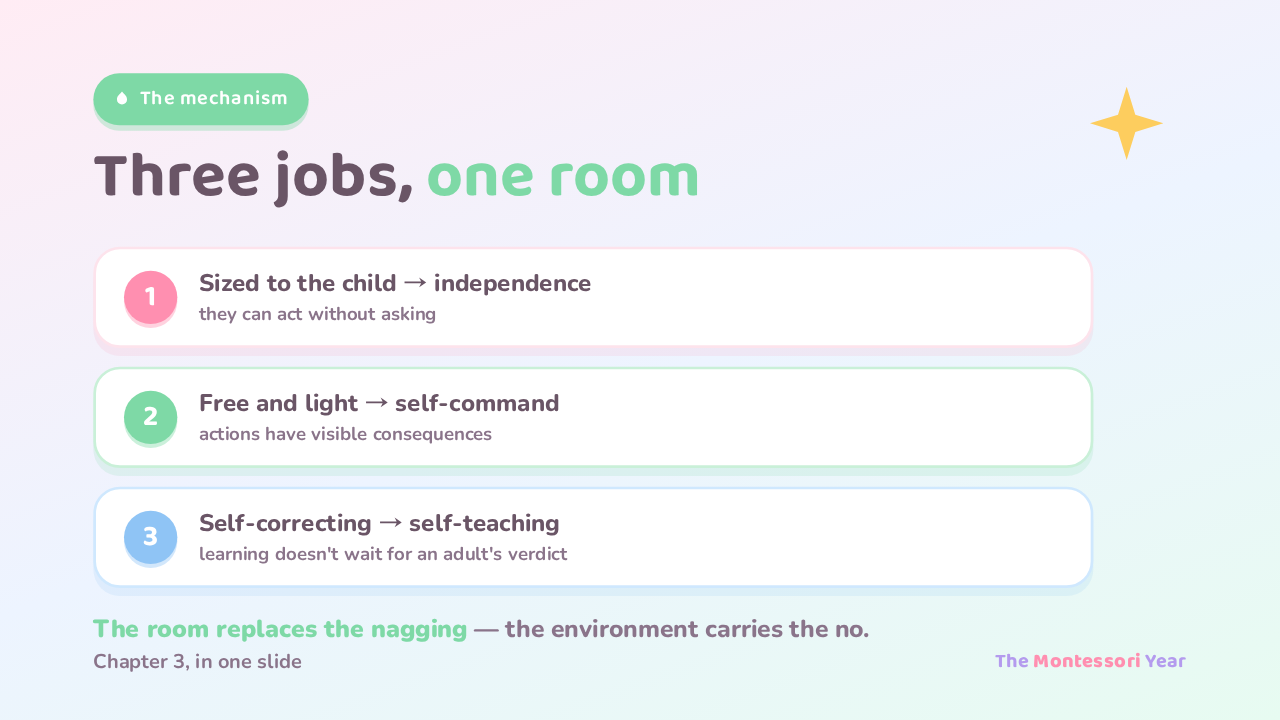
Three jobs, one room
Sized to the child → independencethey can act without asking
Free and light → self-commandactions have visible consequences
Self-correcting → self-teachinglearning doesn't wait for an adult's verdict
The room replaces the nagging — the environment carries the no.
So that's the machinery under all the cuteness, and it comes down to three jobs. First, the room is sized to the child, so they can act without asking. That builds independence. Second, the room is free and light, so actions have visible consequences. That builds self-command. Third, the materials correct themselves, so learning doesn't wait for an adult's verdict. That builds self-teaching. Put the three together and something wonderful happens for you, the parent: the room absorbs a hundred daily corrections, so you don't have to say them. The environment carries the no, and you get to just be the mother, or the father.
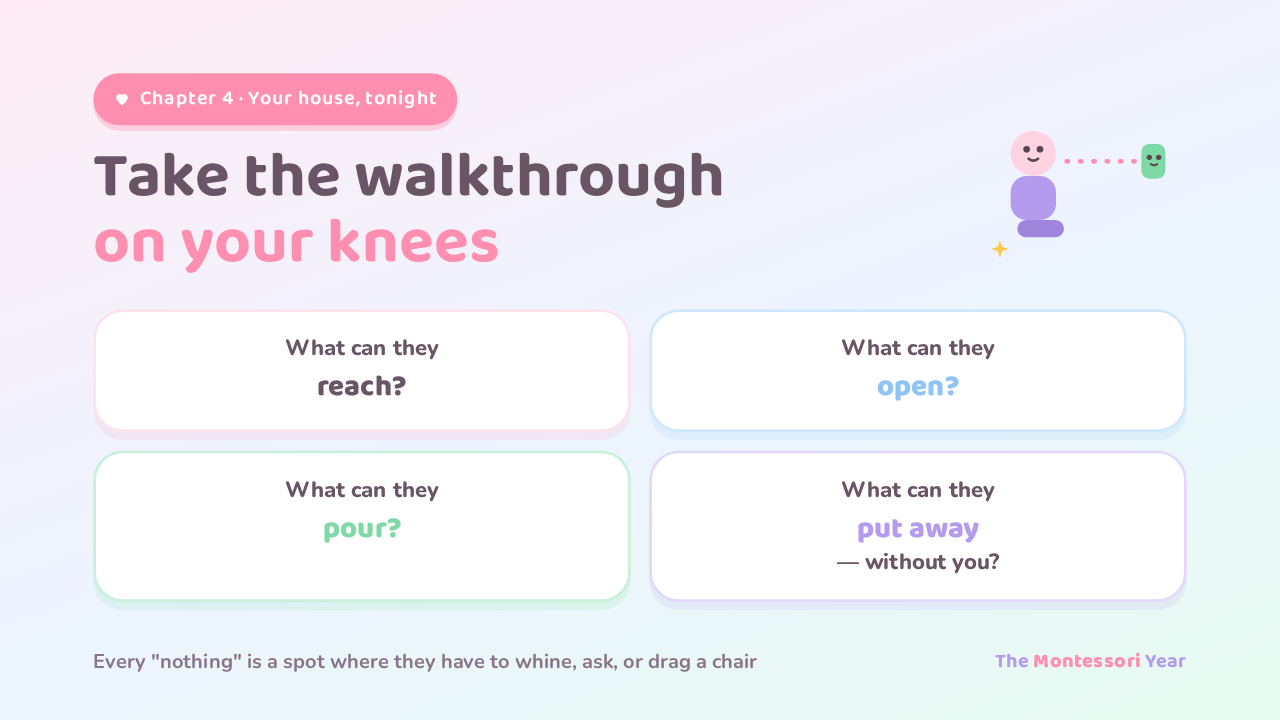
Take the walkthroughon your knees
Which brings us to the payoff I promised, and it costs nothing. Tonight, after bedtime, get down on your knees, so your eyes are about at your child's height, and take a slow tour of your own home. Kitchen, bathroom, their bedroom, the front door. At every stop, ask four questions. What can they reach from here? What can they open? What can they pour? What can they put away, without me? Every answer that comes back "nothing" is a spot where your child has to whine, ask, or drag a chair. You don't need to fix it all. Pick the two or three that cause the most friction.
Lower it. Lighten it.
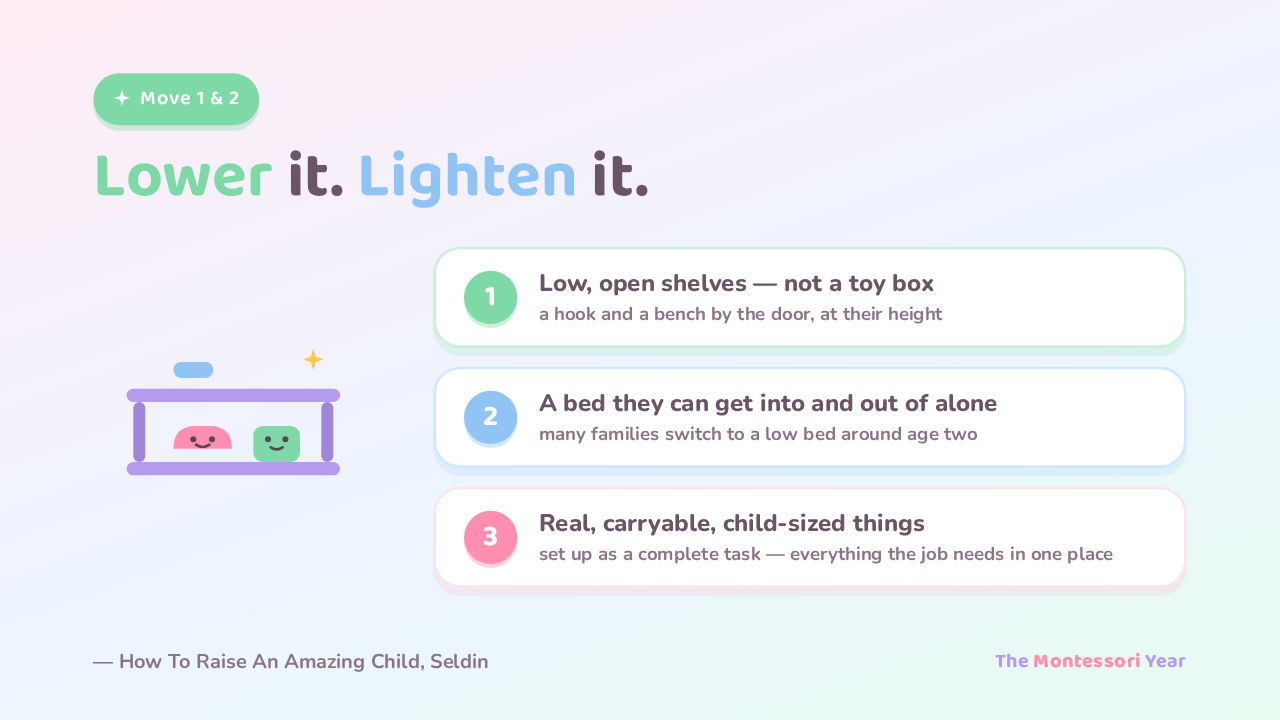
Low, open shelves — not a toy boxa hook and a bench by the door, at their height
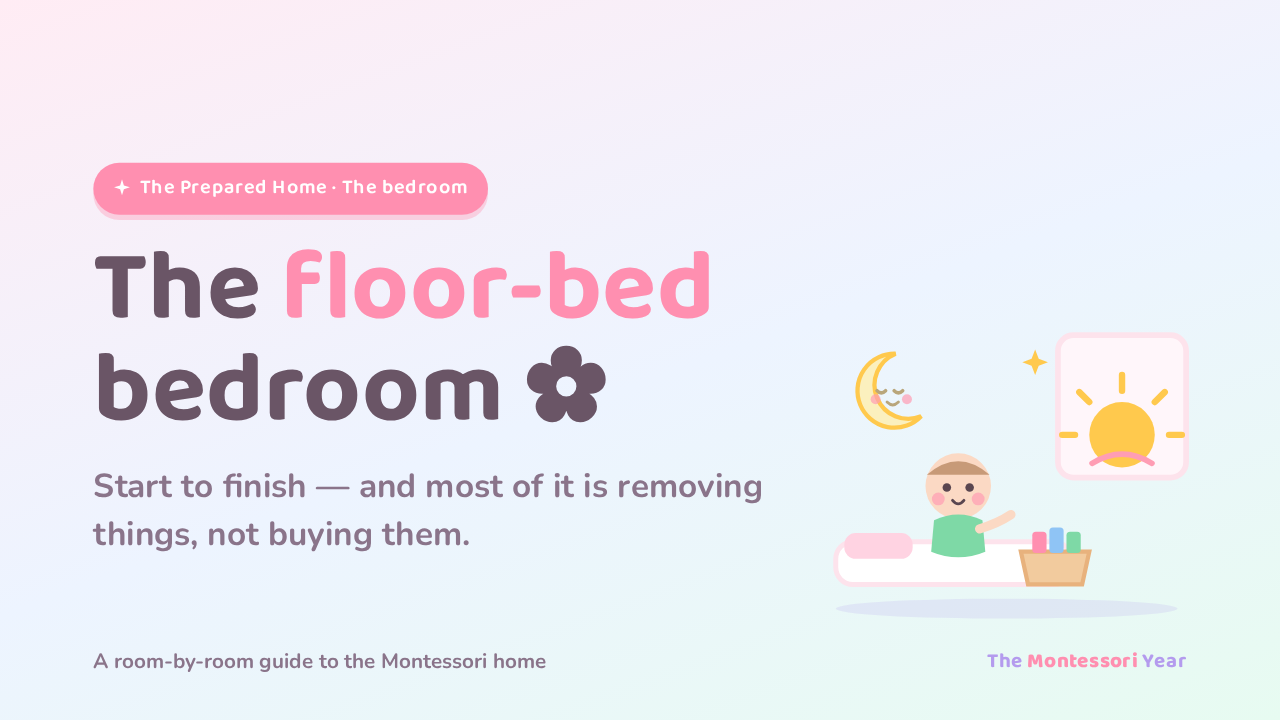
A bed they can get into and out of alonemany families switch to a low bed around age two
Real, carryable, child-sized thingsset up as a complete task — everything the job needs in one place
The first two moves come straight from that 1907 room. Lower it: toys on low, open shelves instead of buried in a toy box. A hook and a little bench by the door, at their height, so coats and shoes become their job. A bed low enough to climb into and out of alone; many families switch to a low bed or floor mattress around age two. Then lighten it: real things, sized for small hands, light enough to carry. Tim Seldin adds a lovely rule: set things up as complete tasks, everything the job needs in one place, so your child gets the satisfaction of finishing.
Kitchen & bathroom, at their scale
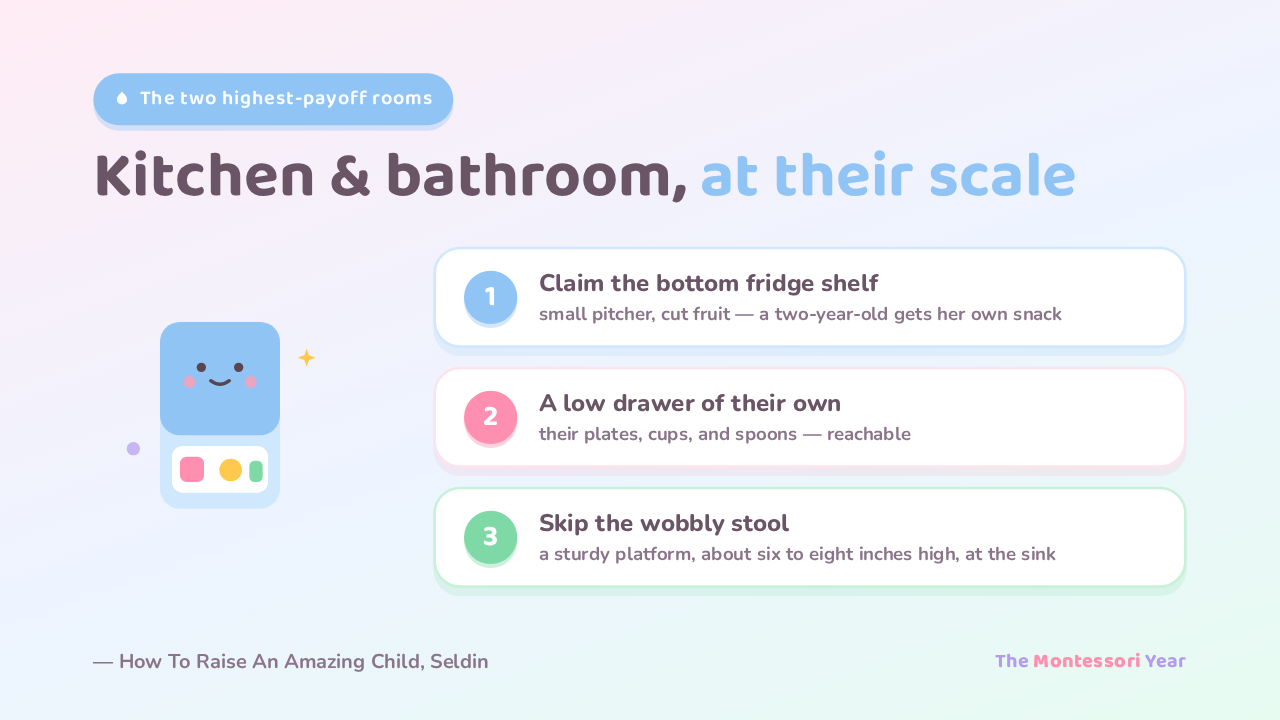
Claim the bottom fridge shelfsmall pitcher, cut fruit — a two-year-old gets her own snack
A low drawer of their owntheir plates, cups, and spoons — reachable
Skip the wobbly stoola sturdy platform, about six to eight inches high, at the sink
The two highest-payoff rooms are the kitchen and the bathroom. In the kitchen, claim the bottom shelf of the fridge for your child: a small pitcher of water or milk, cut fruit, the makings of a simple snack. Seldin points out that around age two, a child can open the fridge and get their own prepared snack, and that one change alone retires a whole category of whining. Give them a low drawer with their own plates, cups, and spoons. In the bathroom, skip the wobbly stool. A sturdy platform, roughly six to eight inches high, puts the sink, the soap, and the toothbrush within reach, and washing hands stops being a lift-and-hold operation.
Fewer things, each with a home
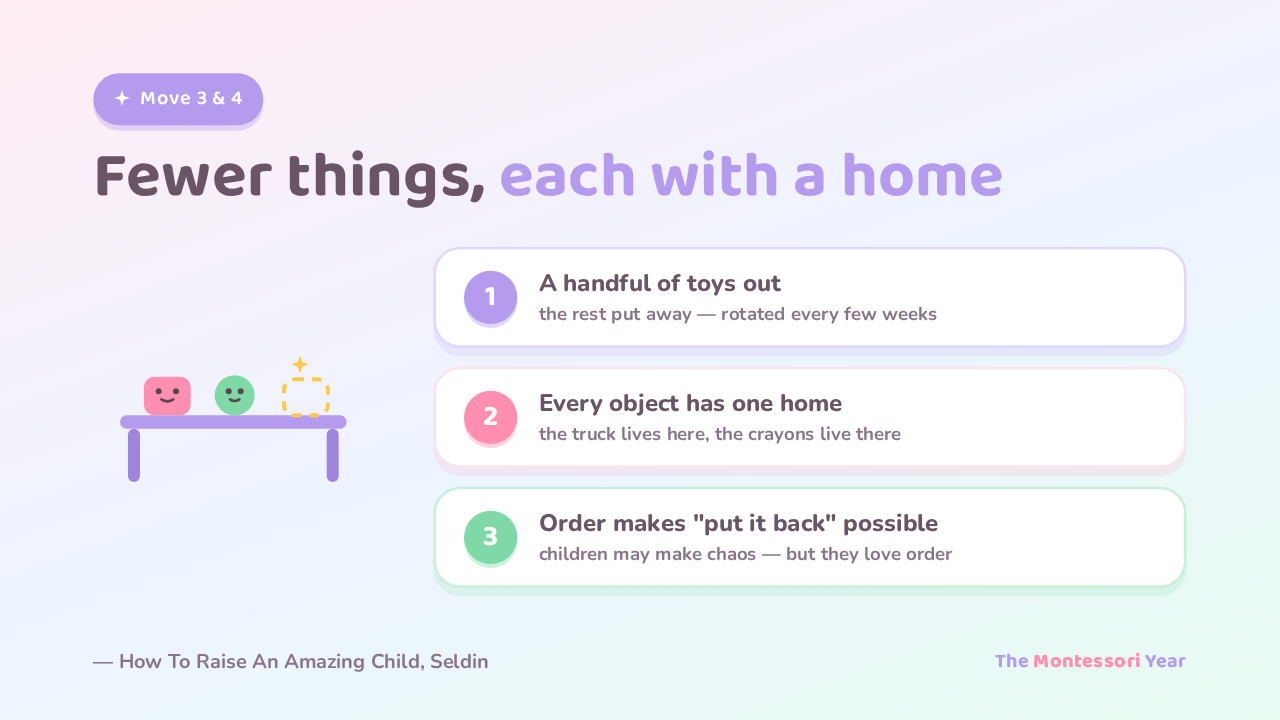
A handful of toys outthe rest put away — rotated every few weeks
Every object has one homethe truck lives here, the crayons live there
Order makes "put it back" possiblechildren may make chaos — but they love order
Now the two moves people skip, and they matter just as much. Limit it: only a handful of toys out at a time, on those low shelves, and the rest put away, rotated every few weeks so old things come back like new. A child facing thirty choices plays shallowly with all of them; a child facing six goes deep. And order it: every object gets one home, the truck lives here, the crayons live there. Young children may generate chaos, but they have a deep love of order, and it shows in their behavior when the room holds steady. Order is also what makes "put it back" a job a two-year-old can actually do.
Change the room,not the child
And now the calibration, because this is not a decorating standard to fail. A prepared environment works in a studio apartment, an RV, any rental. It is not the beautiful photo; it is whether your child can act for themselves in the space they actually live in. So follow your child. Watch where the friction happens this week, and when it repeats, change the room before you try to change the child. Climbing the counter? Give the climbing somewhere legal to live. Emptying that one cupboard daily? Maybe that cupboard becomes theirs. And moving something out of reach for a season is not a punishment. It is the room, doing the disciplining, kindly.
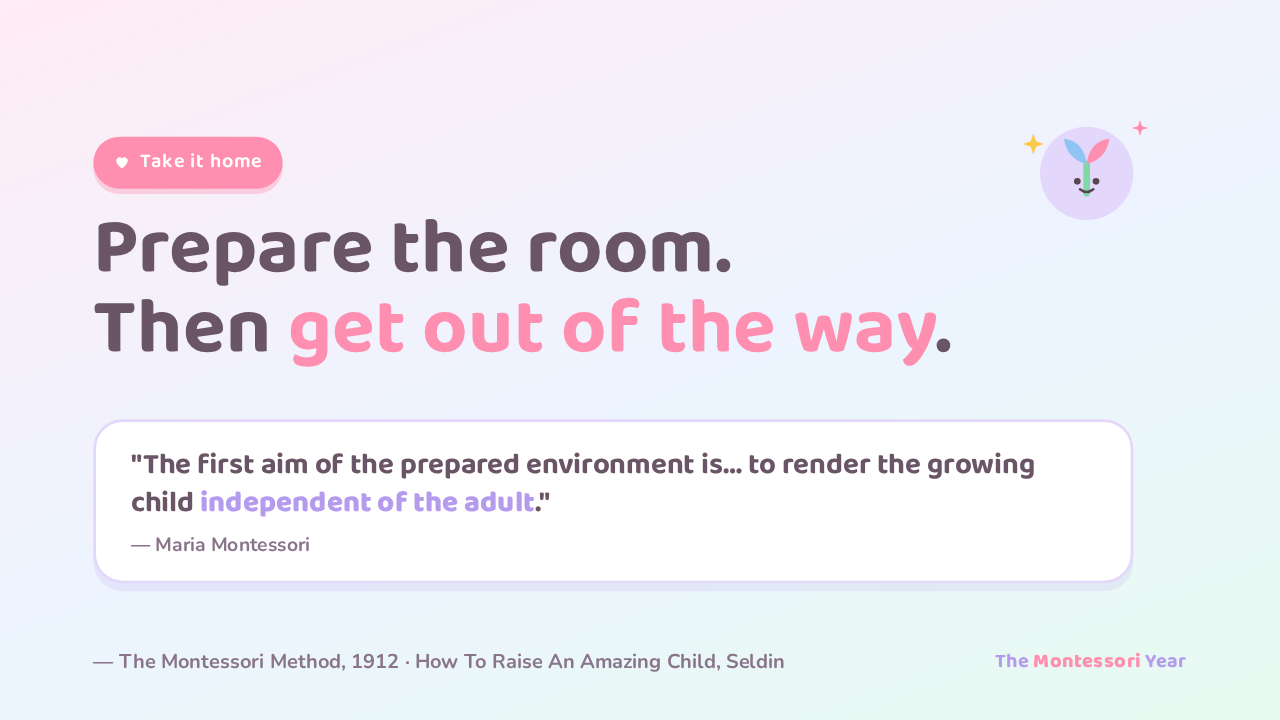
Prepare the room.Then get out of the way.
"The first aim of the prepared environment is… to render the growing child independent of the adult." — Maria Montessori
Years after that first Children's House, Montessori finally gave her invention its name, and its mission statement: the first aim of the prepared environment is, as far as possible, to render the growing child independent of the adult. Not independent of your love, or your lap. Independent of your hands, for the small things, so your hands are free for the big ones. So tomorrow morning, when you hear that chair start its journey across the kitchen floor, smile. That's not mischief. That's a work order. Your child is telling you exactly where the house still fights them. Prepare the room. Then get out of the way. I'll see you next time.