
The Montessorikitchen ✿
A learning tower, an open cup, real tools — and almost nothing to buy.
It's five thirty. Dinner is half cooked, and a small person is standing on your feet, crying to be picked up. Most advice says get them out of the kitchen. A gate, a screen, a basket of toys. Montessori advice says the opposite: bring them up to the counter. This is the first tour in our Prepared Home series, and we're starting in the kitchen, because if you only ever change one room, this is the one. Five stops: a place to stand, a cabinet of their own, a water station, a table that fits, and real tools. And here's my promise. By the end of this tour, there will be almost nothing left to buy.
A guest is served.Family cooks together.
Picture two dinner guests: one waited on, one welcomed into the kitchen while the meal is made. The first is politeness; the second is friendship. A young child lives like the first guest in rooms built for adults — so the plan isn't to childproof them out of the kitchen. It's to lower the room until it welcomes them in.
Here's the idea underneath the whole room. In The Joyful Child, Susan Stephenson asks you to picture two dinner guests. One is seated, served, and waited on. The other is welcomed into your kitchen to talk and laugh while you cook together. The first relationship is polite. The second one is a friendship. A young child in most homes lives like the first guest, fed, carried, and managed, in rooms built for adults. Haley Turner tells parents that if you do nothing else Montessori, bring your child into the kitchen. So the plan is not to childproof them out of it. The plan is to lower the room until it welcomes them in.
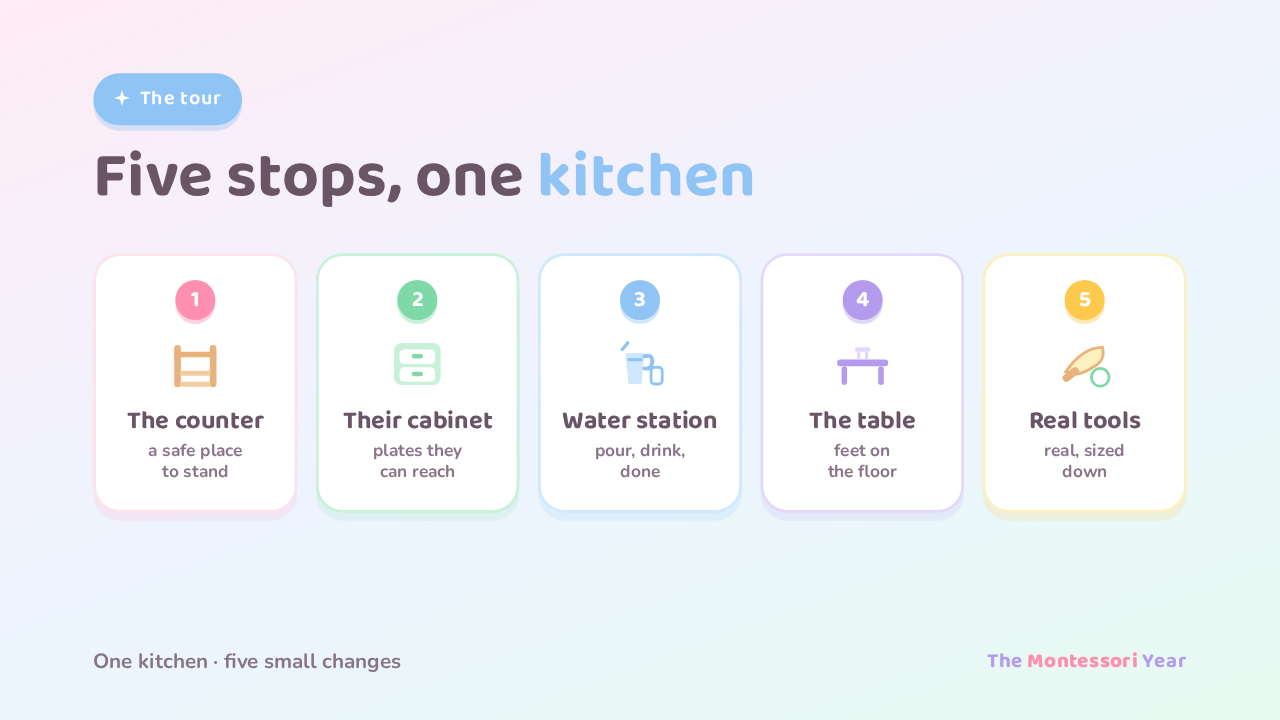
Five stops, one kitchen
The counter
a safe place
to stand
Their cabinet
plates they
can reach
Water station
pour, drink,
done
The table
feet on
the floor
Real tools
real, sized
down
So here's the map. Stop one, the counter, and the tower that gets them up to it. Stop two, one low cabinet that belongs to them. Stop three, a water station they can work without you. Stop four, a table where their feet touch the floor. And stop five, the tools, real ones, sized for small hands. None of these is a renovation. Every one of them is an afternoon, or less. First stop: the counter.
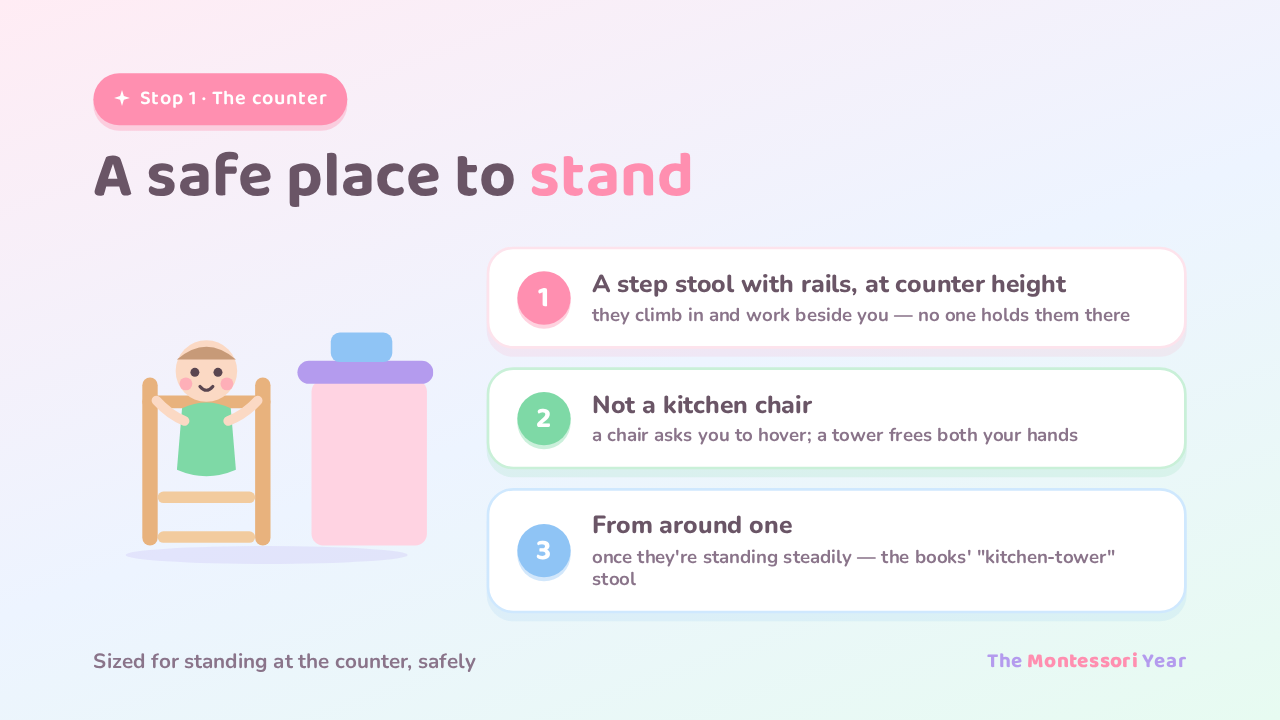
A safe place to stand
A step stool with rails, at counter heightthey climb in and work beside you — no one holds them there
Not a kitchen chaira chair asks you to hover; a tower frees both your hands
From around oneonce they're standing steadily — the books' "kitchen-tower" stool
The single most useful object in a Montessori kitchen is a stool. Turner calls stools our best friend, because they hand the grown-up world to a child. For the youngest cooks, roughly from the time they're standing well, you want the one people call a learning tower: a step stool with rails, so your child can climb up, stand at counter height, and work beside you without being held there. That's the difference from a kitchen chair. A chair asks you to hover. A tower lets you cook with two hands while they watch the onions hit the pan from the best seat in the house.
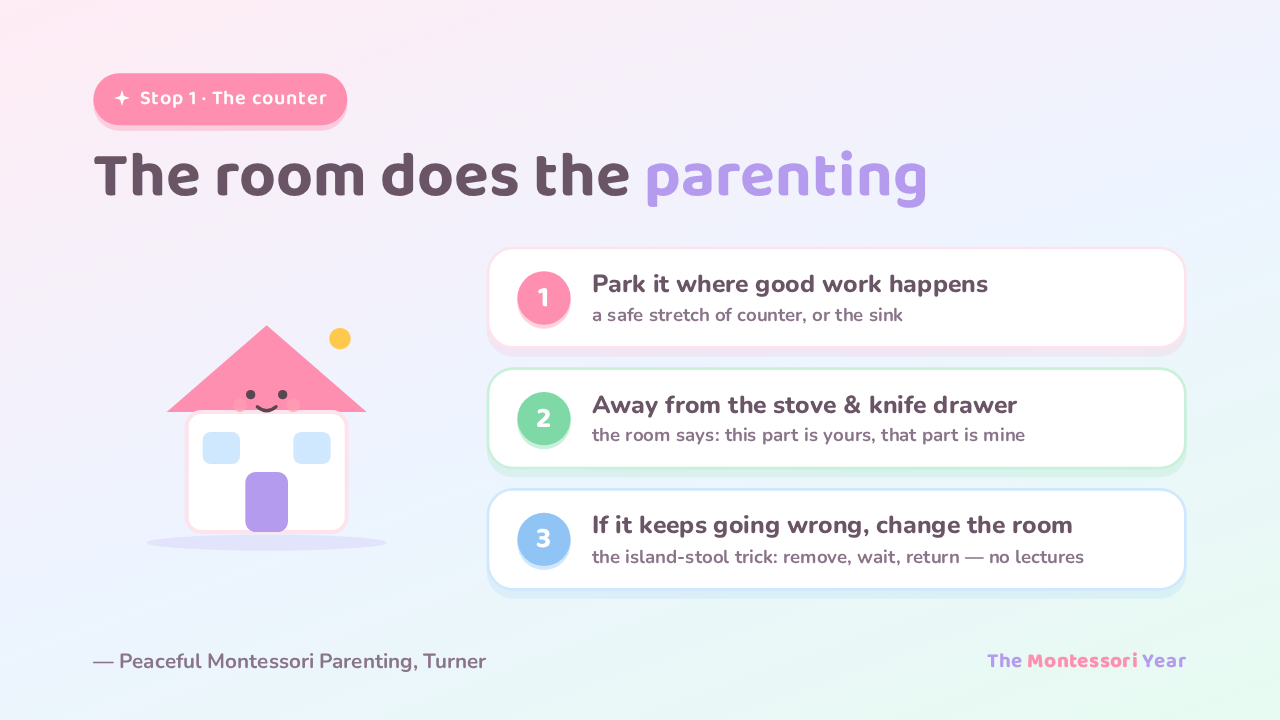
The room does the parenting
Park it where good work happensa safe stretch of counter, or the sink
Away from the stove & knife drawerthe room says: this part is yours, that part is mine
If it keeps going wrong, change the roomthe island-stool trick: remove, wait, return — no lectures
Where you park the tower matters as much as owning one. Set it at a safe stretch of counter, or by the sink, away from the stove, so the room itself says: this part is yours, that part is mine. Turner thinks of the home as a kind of third parent, quietly steering a child toward what they're ready for. When her toddler kept climbing onto the kitchen island, the stools simply went to the garage for a few months, then came back, no lectures required. That's the move to remember. When something keeps going wrong in the kitchen, don't work on the child. Rearrange the room.
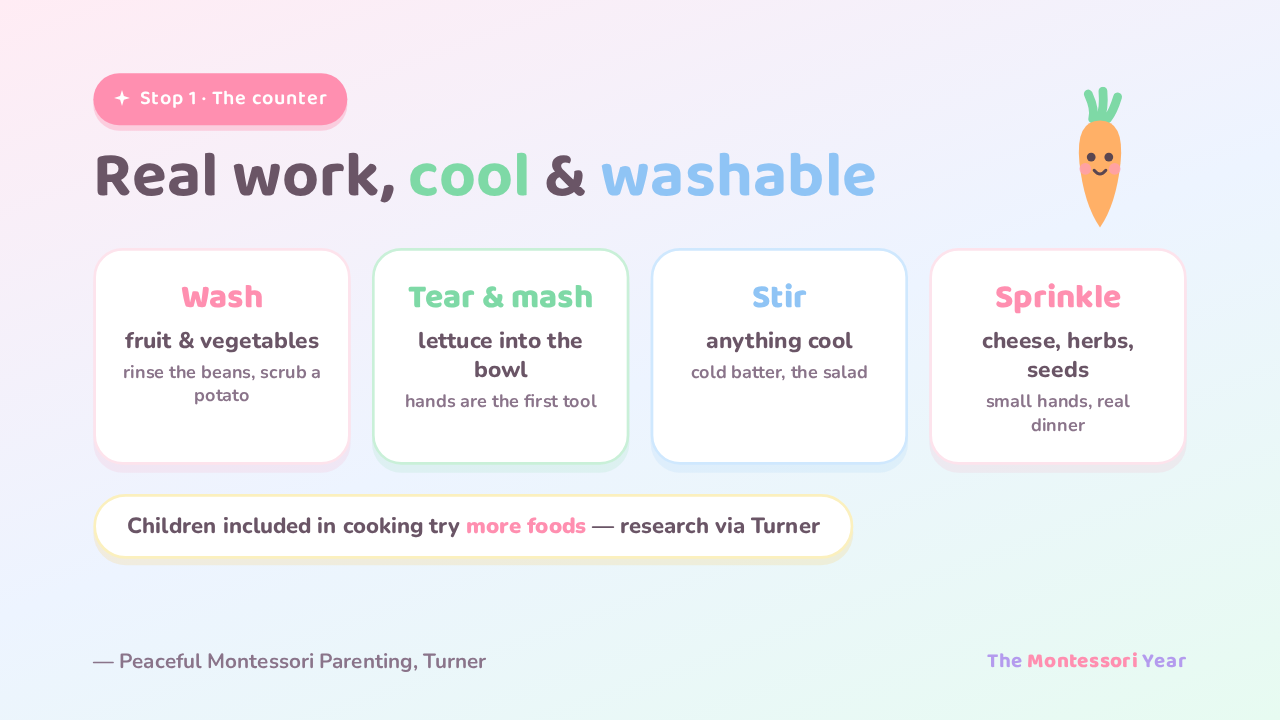
Real work, cool & washable
So what does a one- or two-year-old actually do up there? Real jobs, chosen for being cool and washable. They rinse the green beans, tear lettuce into the salad bowl, scrub a potato, stir the cold pancake batter, sprinkle the cheese. This isn't pretend cooking, and children can feel the difference. Stephenson counts washing vegetables among a child's truest work, the kind that builds concentration and a child who feels needed. And Turner points to research that children included in cooking are more likely to eat a variety of foods. The picky-eating battle often softens right here, on the tower.
One drawer, one shelf, theirs
One low drawertheir forks & spoons
One low shelfplates, bowls, glasses, napkins
Theirs to fetch — and put backevery snack starts with them, not with begging you
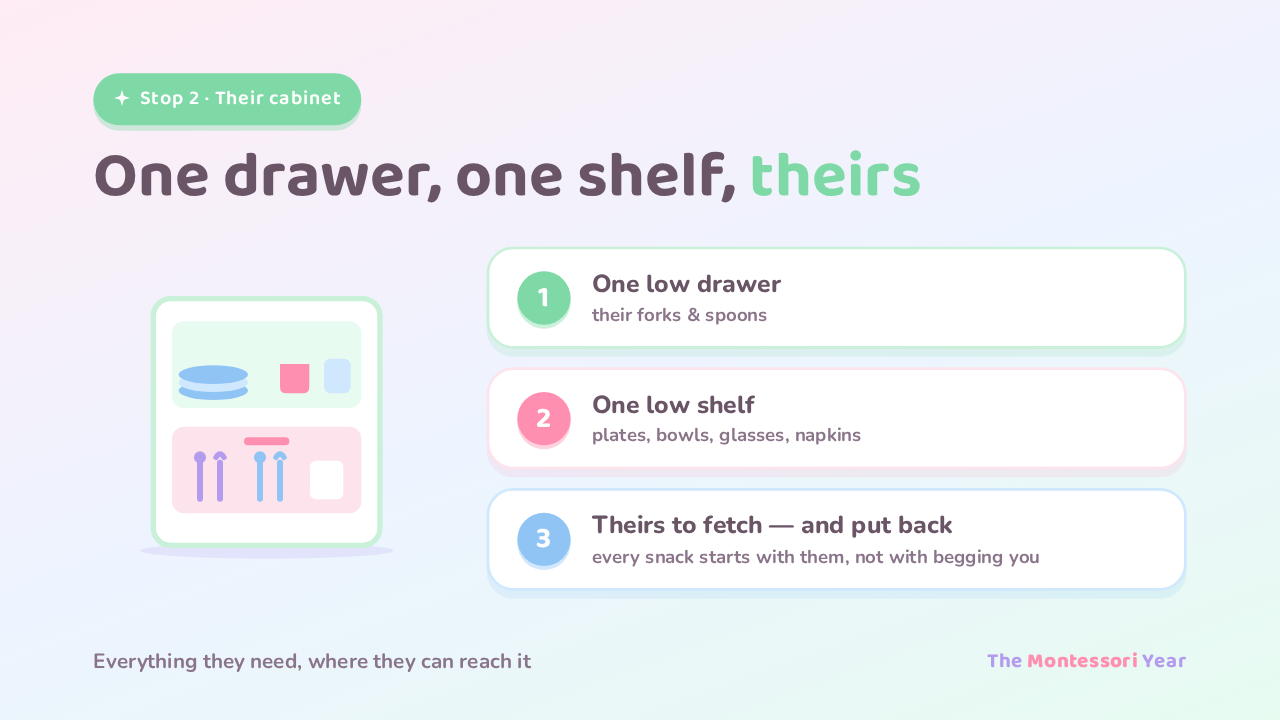
Stop two costs nothing at all. Pick one low drawer and one low shelf, and hand them over. Into the drawer go their forks and spoons. Onto the shelf, their plates, bowls, glasses, and napkins. That's the whole job, and it quietly changes everything, because now your child can fetch their own bowl, carry it to their table, and put it back after. In a kitchen where everything lives above their head, every snack begins with begging an adult. In a kitchen with one low cabinet, it begins with them.
The bottom shelf of the fridge
The bottom shelf is theirsa small pitcher, fruit, snack makings
Containers little hands can openaround two: open the fridge, fetch a snack, alone
You're still the editoryou stock the shelf; they serve themselves from it
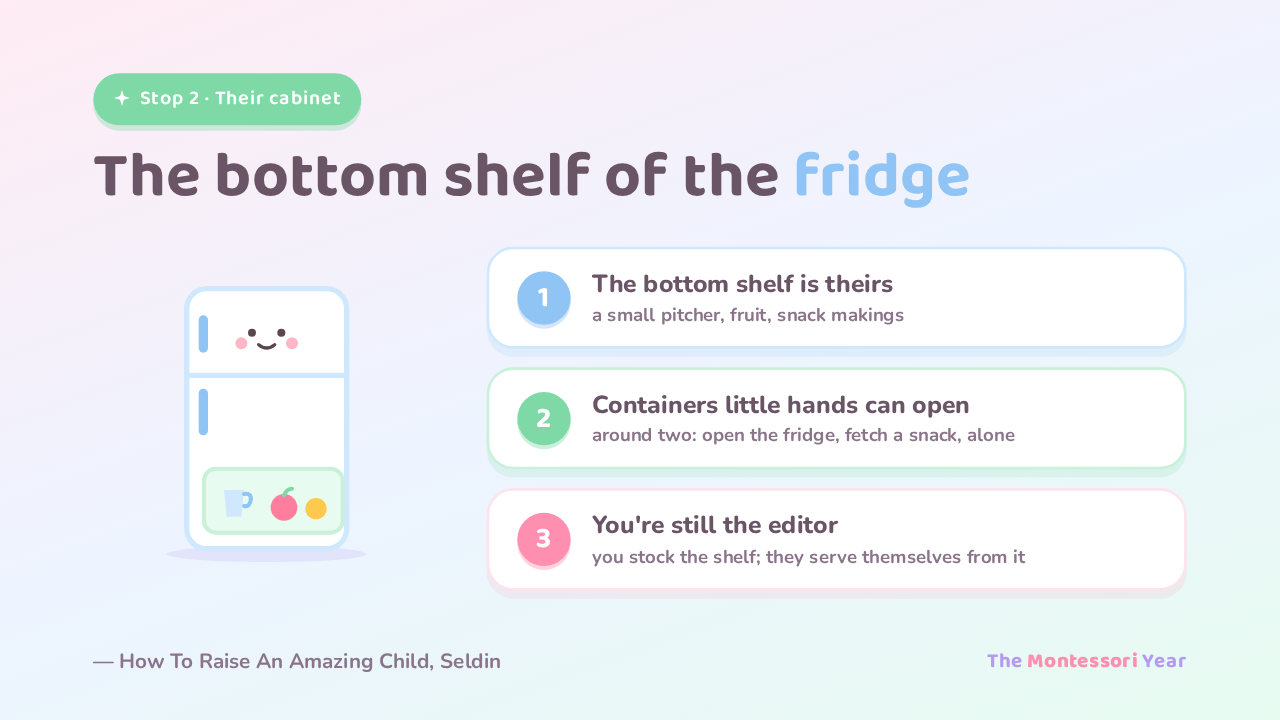
The cabinet has a cold cousin: the bottom shelf of the refrigerator. Tim Seldin suggests setting it aside for your child, with a small pitcher of drink, some fruit, and snack makings in containers little hands can open. A child of around two, he writes, can open the fridge and take out her own snack; an older child pours her own juice and builds the snack herself. If that makes you nervous, remember you're still the editor. You decide what's on the shelf. They just get the dignity of serving themselves from it.
The open cup. Yes, a real glass.
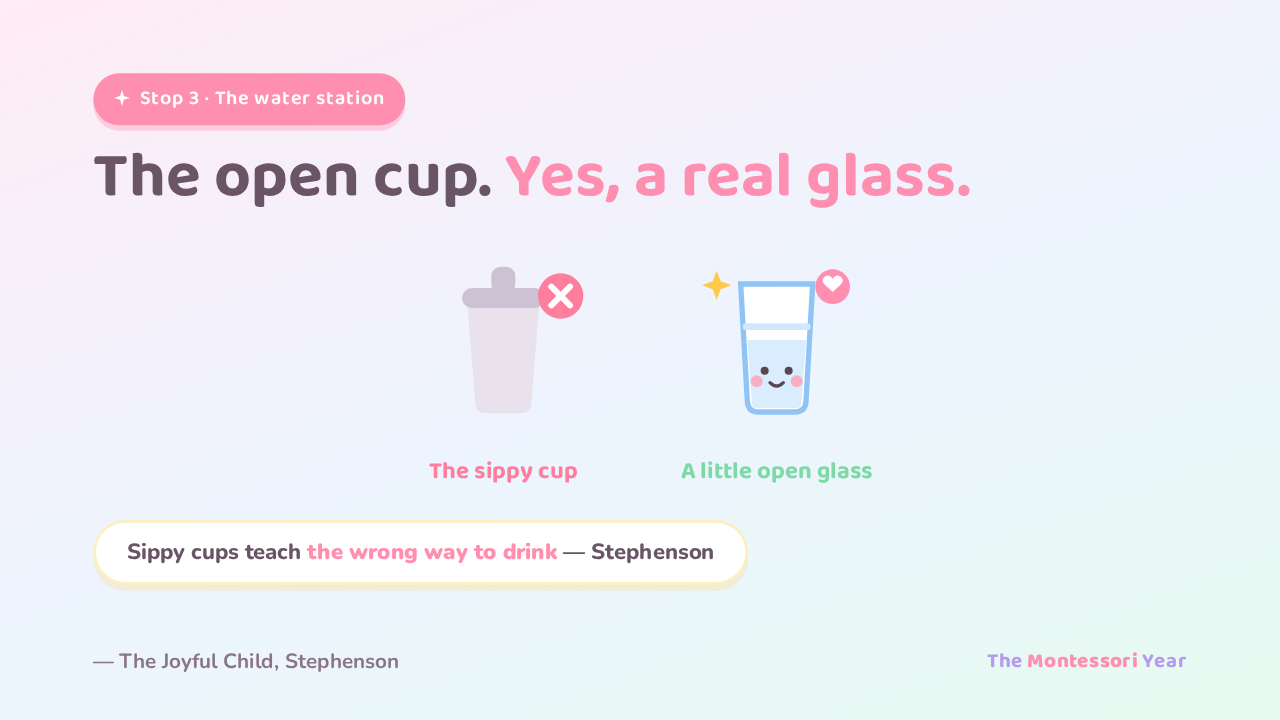
Now the stop that makes every visitor's eyebrows go up: in a Montessori kitchen, even a baby drinks from an open cup, and it's usually glass. This sounds reckless until you hear the reasoning. Stephenson is blunt: sippy cups and bottles teach the wrong way to drink, a false experience of how liquid actually moves, and a child who lives on them has to relearn drinking later. A small open cup, offered with help from the first meals, teaches the real physics from day one. Many children manage a little glass around the end of the first year. Not because they're rushed. Because nobody taught them the wrong way first.
Trust reads as pride
Say it"It's glass, just like mine. We take great care of it."
Model itthe slow sip, two hands, the gentle landing
If it's thrown, stay calm"Cups are for drinking. We'll try again later."
Why glass, though? Because the material is the message. Turner describes handing a child a glass cup with the words: this is a fragile cup that we take great care of, it's glass, just like I use. Then you model it, the careful sip, the two hands, the gentle landing on the table. Children rise to that trust; parents are usually surprised how fast. Plastic is a quiet vote of no confidence, and it teaches nothing when it's dropped. And when the cup does get flung, and someday it will, the answer is calm: it looks like you're done drinking, cups are only for drinking, we'll try again later. No shame. Just a boundary.
Water, on tap, at their height
A tray, set lowa small pitcher + one little glass
Always availableonce they're walking — until they can work the tap
A folded cloth beside itfor the inevitable — they wipe, too
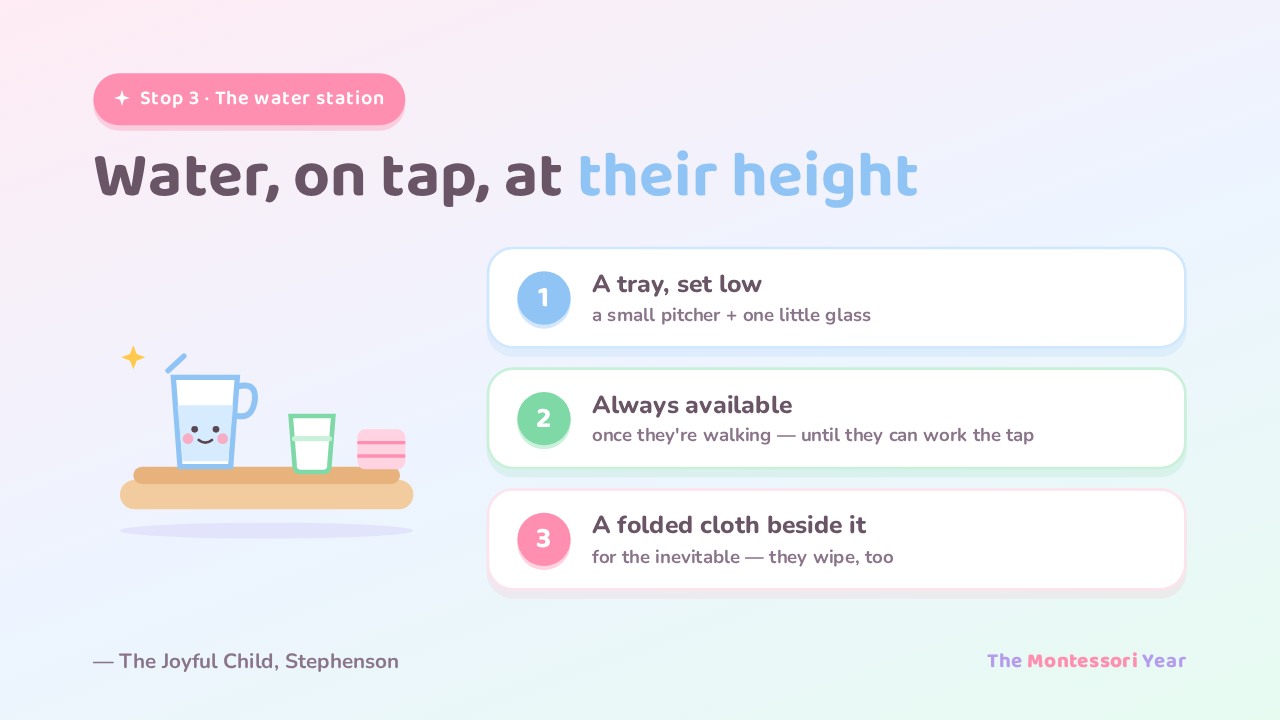
Put it together and you get the water station: a little tray on a low shelf, holding a small pitcher of water and one little glass, with a folded cloth beside it for the inevitable. Once your child is walking, Stephenson says water should simply always be available like this, until the day they can work the tap themselves. The Joyful Child describes a fifteen-month-old with a tray like this in the kitchen, pouring herself a drink whenever she likes. Thirsty, walk over, pour, drink, done. No whining at your knee, no adult required. A two-dollar setup doing the work of a thousand requests.
Teaching the pour: dry first
1 · Lentils first
tiny pitcher to pitcher — a tray catches every grain
2 · Into a glass
one hand on the handle, one under the spout
3 · Then water
months of happy practice — that's the point
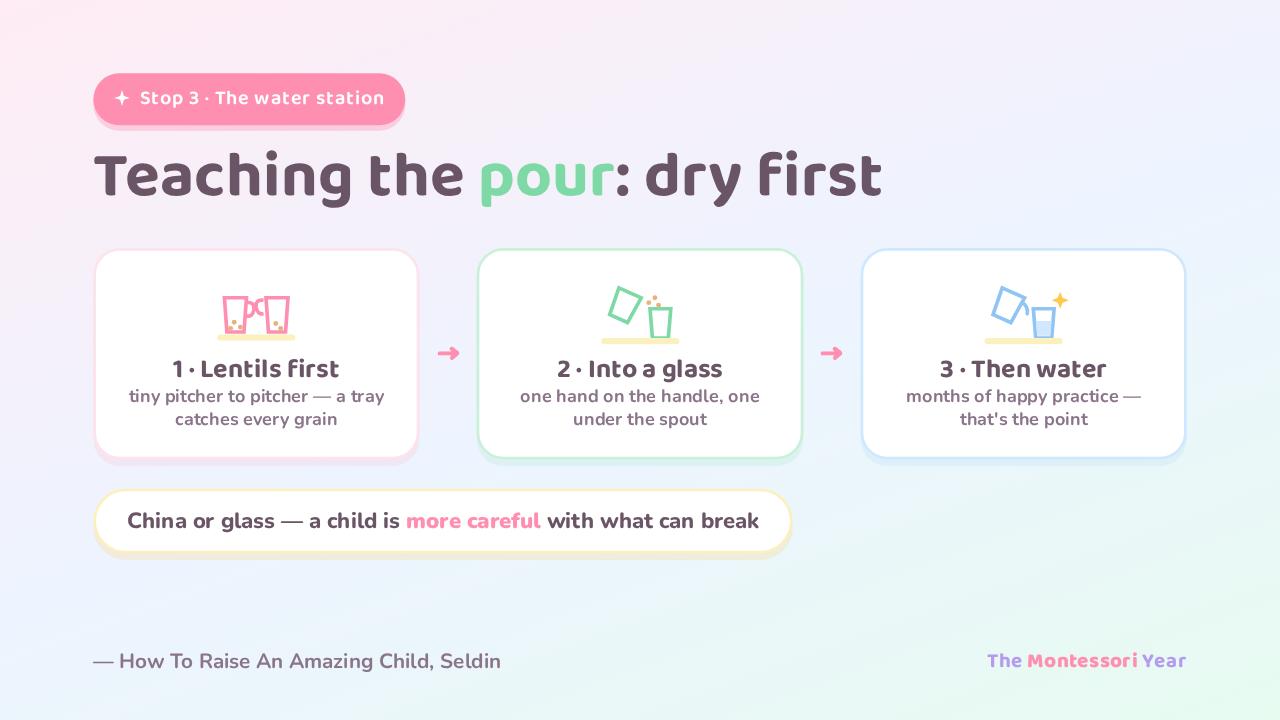
Pouring itself is taught, and Seldin's little course is worth following exactly. Start dry: two tiny cream-sized pitchers and some rice or lentils, on a tray that catches every stray grain. Show it slowly, one hand on the handle, the other under the spout, then let them repeat it as long as they like. When that's smooth, pour the lentils into a glass. Only then, water. One more detail: use china or glass pitchers, because a child is more careful with things that can break. And be patient. Mastering the pour takes months of happy practice, which is exactly the point. It's not a chore. It's the work.
Three good seats
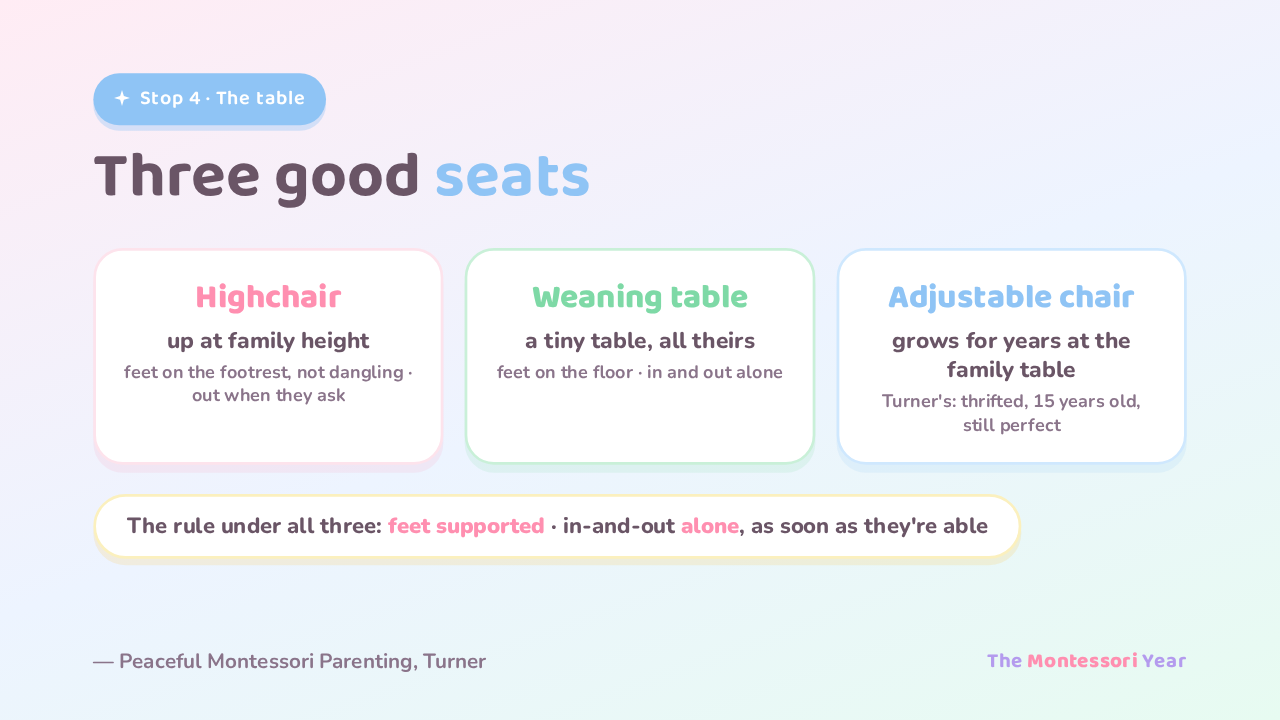
Stop four: where they eat. Here the books are refreshingly unfussy. Turner walks through all three seats and says, you decide, use what works for your family. A highchair puts them at family height and holds them safely; just look for feet resting on a footrest, not dangling, and lift them out when they ask to be done. A weaning table is a tiny table and chair that are entirely theirs. And an adjustable chair grows with the child for years at the family table; Turner's was thrifted, fifteen years old and still perfect. The rule under all three: feet supported, and a seat they can get into and out of alone, as soon as they're able.
Feet flat on the floor
Seat: about 6–8 inchesfeet flat on the floor
Table: about 12–14 inchesnatural wood, a finish they can wipe clean
From around six monthsfirst tastes at their own table · by 10–12 months, family food
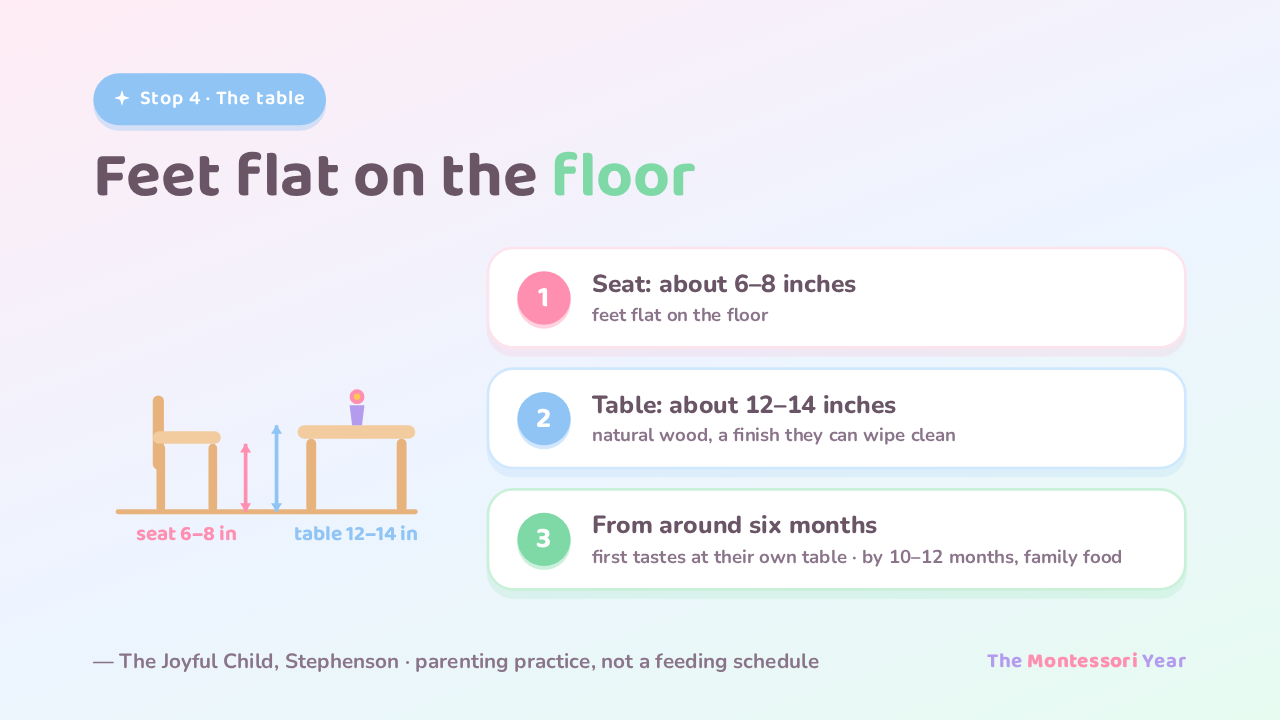
The weaning table deserves its own stop, because it's the most Montessori object in the house, and The Joyful Child gives you the actual measurements. A chair with a seat about six to eight inches high. A table about twelve to fourteen inches. Natural wood, with a finish a child can wipe clean. That's low enough that a baby who has just learned to sit, around six months for many children, eats at their own table with feet flat on the floor, from the very first tastes of food. Find one second-hand, or cut down a thrifted coffee table. By ten to twelve months, many children eat what the family eats, sometimes here, sometimes at the big table.
The placemat trick
Draw the outlinesplate here, glass here, spoon here
Setting the table = a matching gamethey can win it from their earliest walking days
Fetch, set, eat, carry backthe whole meal becomes practical life
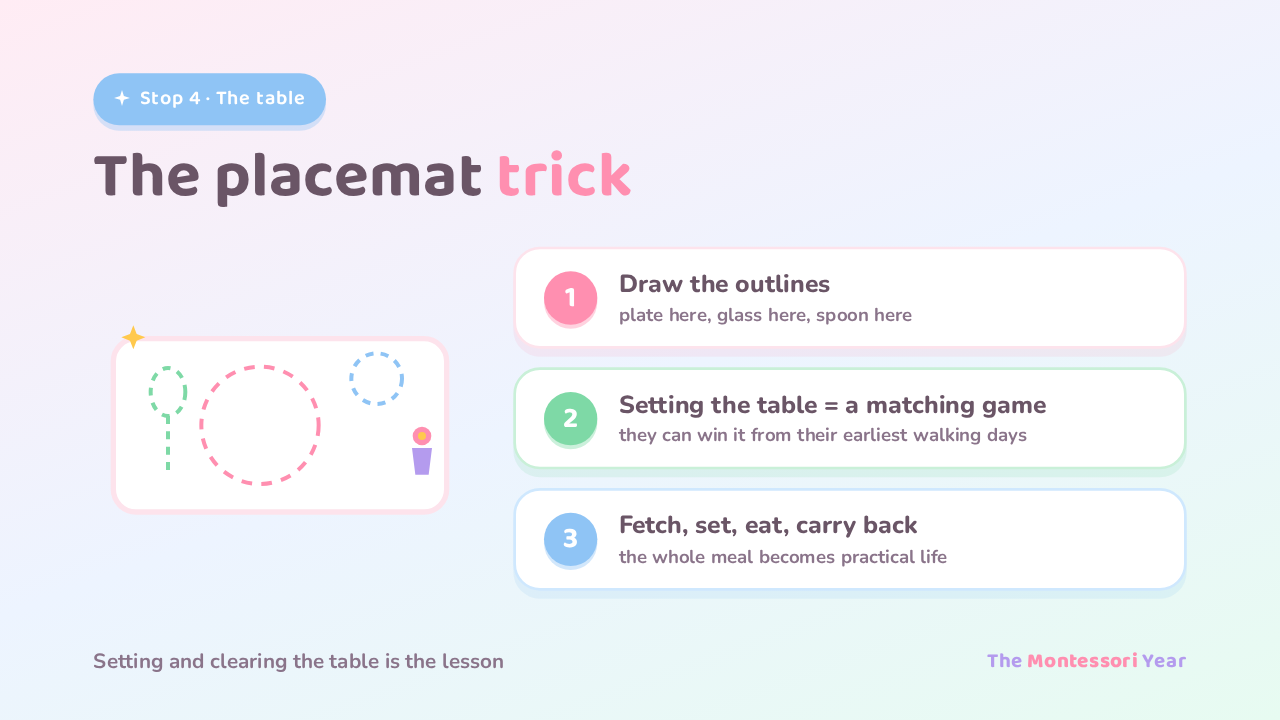
Here's a detail I love, straight from the books: the placemat with outlines. You draw or stitch the shapes onto a mat, here's where the plate lives, here the glass, here the spoon, and setting the table becomes a matching game your child can win from their earliest walking days. It turns the whole meal into practical life: fetch your bowl from your shelf, set it on its outline, eat, carry it back. Stephenson even suggests a little vase of flowers on the weaning table, because dignity is part of the lesson. This is breakfast when the room is on the child's side.
Joining the family table
Their meal firstwith your full attention
Then join the family — bread & a platealready fed; there for the company
They're there for the conversationmanners, turn-taking, the music of family talk
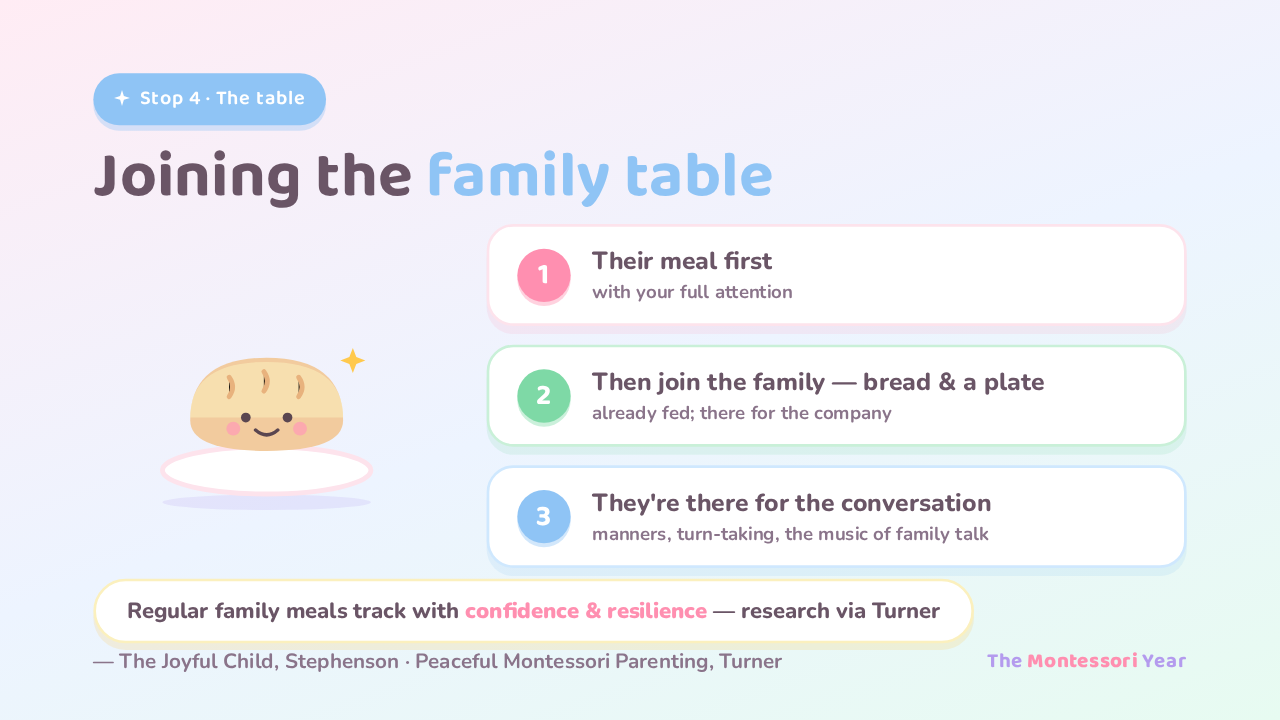
The little table doesn't replace the family table; it's the on-ramp to it. Early on, Stephenson advises feeding your child their own meal first, with your full attention, because managing their dinner and yours at once is too much for everyone. Then they join the family meal as company: already fed, with a piece of bread to nibble and a plate of their own, there to soak up the turn-taking and the music of family talk. Protect that table time as they grow. Turner points to research that children who share regular family meals, around four a week or more, tend toward better self-esteem and resilience. Dinner is part of the prepared environment too.
Real tools, small hands
"…a great increase in the self-respect of the child when he is allowed to use our things, instead of being given plastic substitutes."— Stephenson, The Joyful Child
The tray, not a toy seta little apron · a broom that sweeps · a pitcher that pours
Why the play kitchen gathers dust"Why buy a play kitchen when what she really wants is to help in the real one?" — Seldin
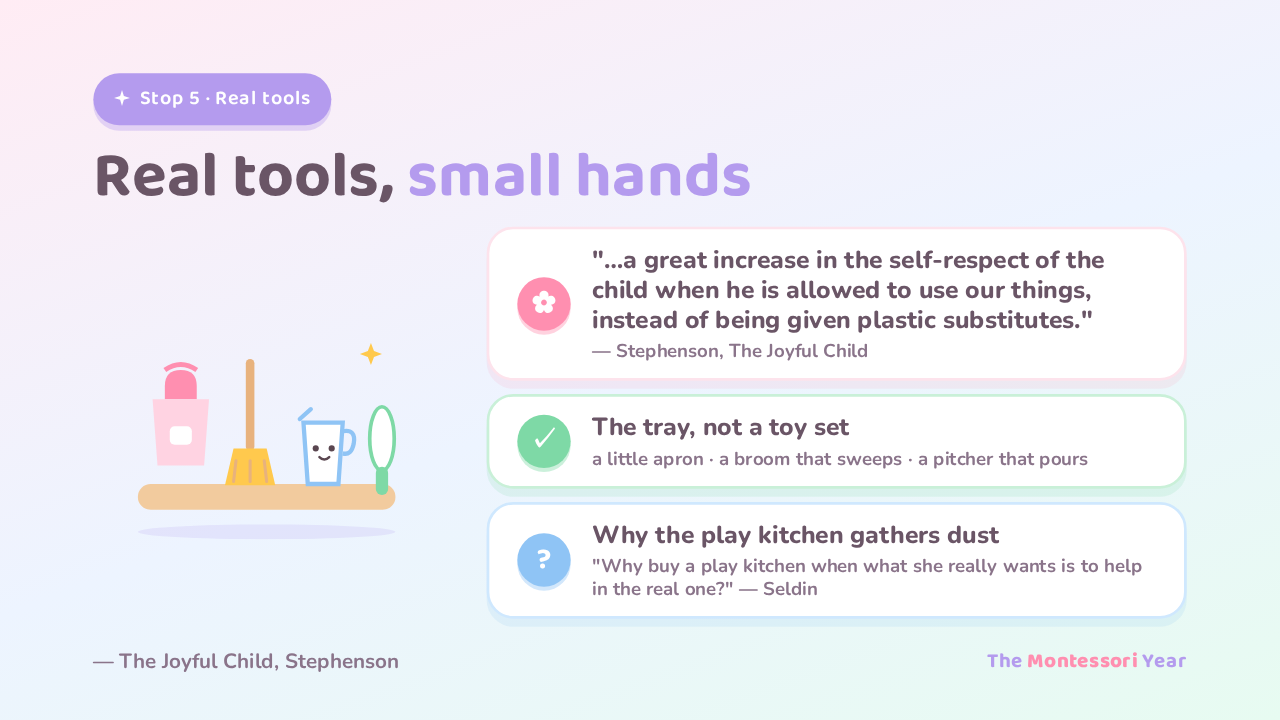
Last stop: the tools, and the rule that sorts every purchase. Real, but sized down. Stephenson writes that there's a great increase in a child's self-respect when he's allowed to use our things, real pottery, glass, and metal, instead of being given plastic substitutes. And with beautiful, breakable things comes a matching care for them. So the tool tray isn't a toy set. It's a little apron. A child-sized broom that actually sweeps. A small pitcher that actually pours. And this is why the play kitchen gathers dust. Why would you buy your child a play kitchen, Seldin asks, when what she really wants is to help in the real one, with you?
The knife ladder
1 · Spread
a rounded cheese knife · butter or jam on a cracker
2 · Slice soft
the banana is the classic first cut
3 · Slice firm
apple, carrot, celery — real dinner prep
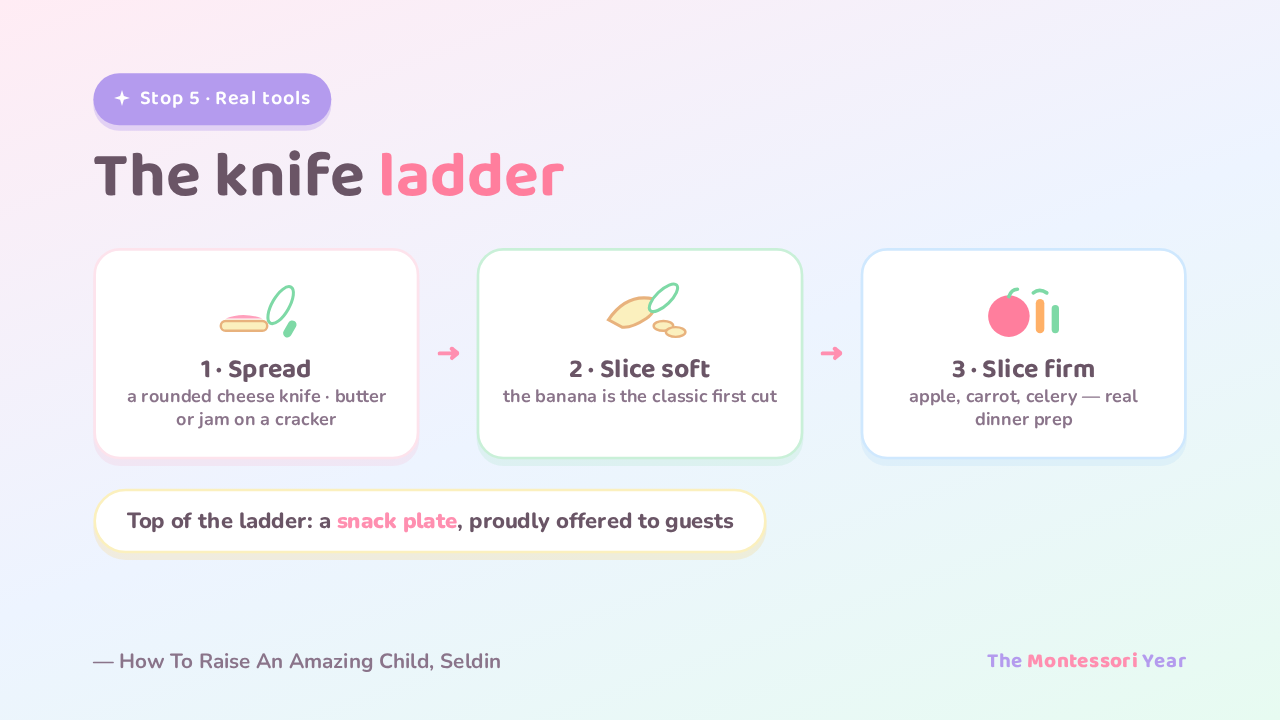
Even the knife has a ladder, and it starts gentler than you'd think. Rung one is spreading: a small cheese knife with a rounded point, butter or jam, and a cracker. Rung two is slicing soft things, and the banana is the classic first cut. Rung three, as hands grow stronger, is apple, carrot, celery, real prep for the family dinner. Seldin's method carries the whole climb: show each step slowly, with almost no words, then step back and let them repeat it for weeks if they want to. The top of the ladder is lovely: a child who builds a snack plate, banana slices, crackers, toothpicks, and proudly hands it around to guests.
Freedom has a fence
Stay close & modelevery tool, every time
Teach slow & theatricalthey copy what they see, not what they're told
The room draws the linestove, sharp knives, hot things: up high, adult-only
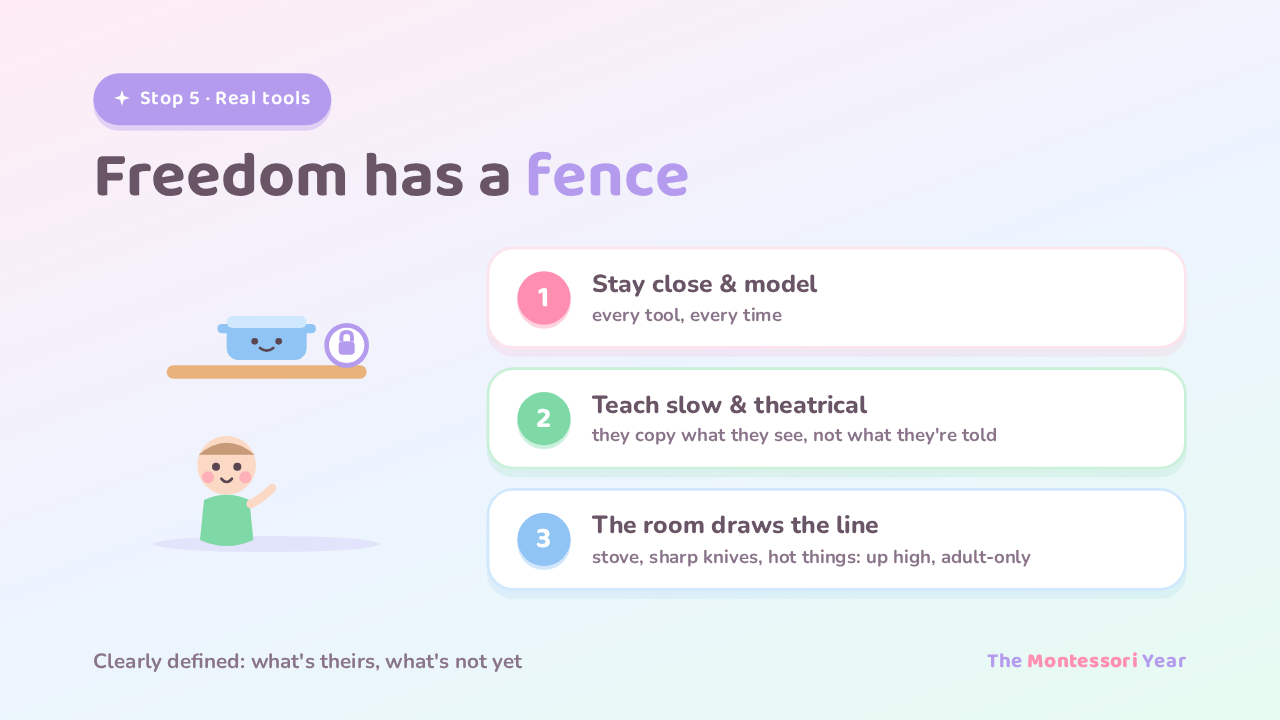
Let's say the safety part once, clearly, because all this freedom works only inside a fence. The books are unanimous: stay close, and model the proper use of every tool you hand over. Teach with a slow, exaggerated, almost theatrical demonstration, because children copy what they see far better than what they're told. Save the sharp no for actual danger, a hand reaching for a hot pot handle. And let the room hold the rest of the line: the stove, the real knives, the hot kettle live up high or behind a latch, clearly not theirs yet. A prepared kitchen isn't a permissive one. The yes-es and the no-s are built into the furniture.
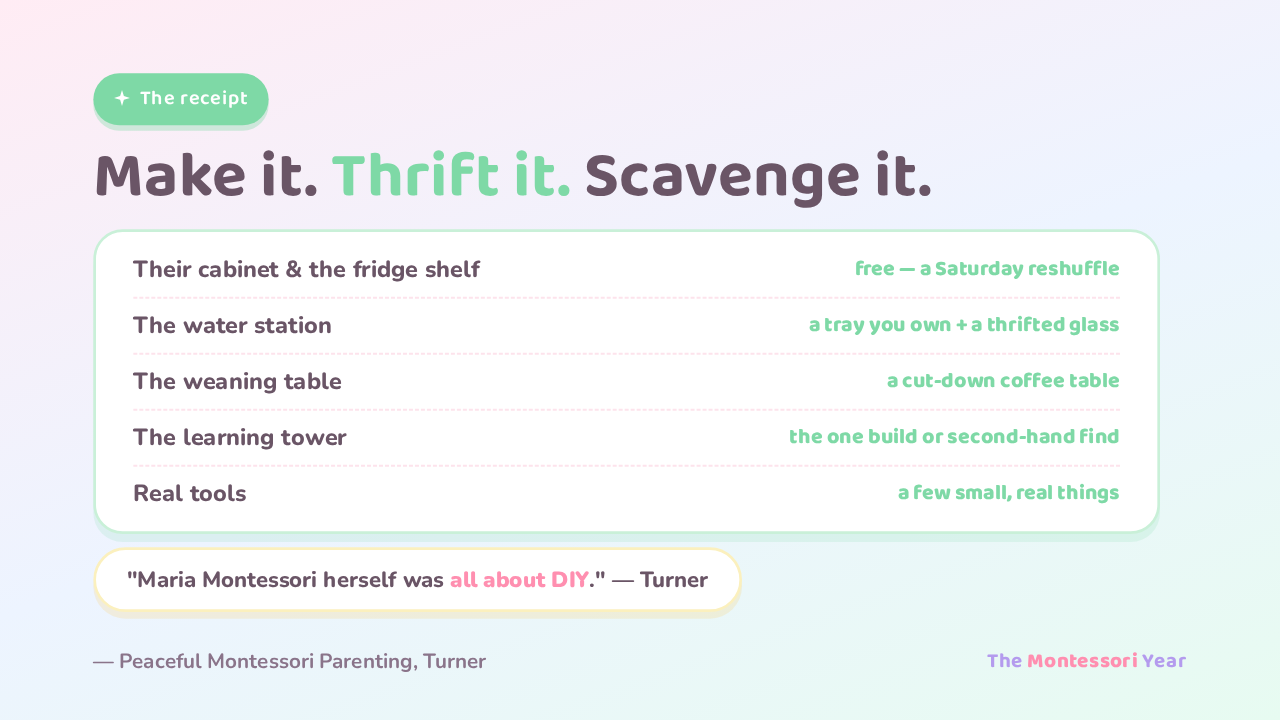
Make it. Thrift it. Scavenge it.
- Their cabinet & the fridge shelffree — a Saturday reshuffle
- The water stationa tray you own + a thrifted glass
- The weaning tablea cut-down coffee table
- The learning towerthe one build or second-hand find
- Real toolsa few small, real things
Now, the promise from the start of the tour. Add it up. The cabinet and the fridge shelf cost nothing; they're a Saturday-morning reshuffle. The water station is a tray you own and a tiny glass from the thrift shop. The weaning table can be a cut-down coffee table; the tower is the one worthwhile build or second-hand find. Turner devotes a whole section to this: make it, thrift it, scavenge it, through Buy Nothing groups, marketplaces, and hand-me-downs. She's honest that many accounts showing you Montessori gear are paid to make you want it. Her line is the keeper: Maria Montessori herself was all about DIY. The method was never in the products. It's in the preparation.
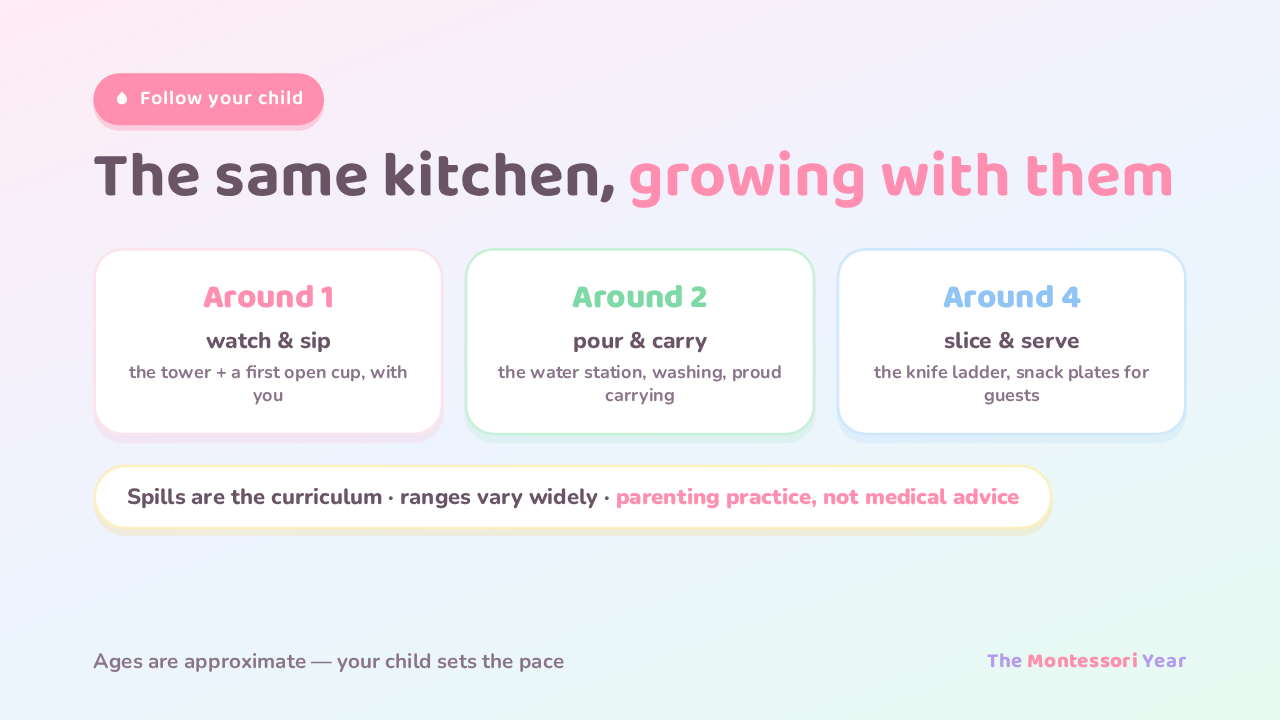
The same kitchen, growing with them
As always, your child hasn't read the books, and doesn't need to. These ages are approximations, not deadlines. Around one, the kitchen might just be the tower, watching, plus a first open cup with your help. Around two, it's pouring and washing and proudly carrying things. Around four, it's the knife ladder and snack plates for guests. Some children run ahead in one lane and wait in another, and all of it is fine. Expect spills, and try to love them, because here the spill is the curriculum; in The Joyful Child, even the toddlers run for the cloth themselves. And Turner's grace note: if a sippy cup in the car saves your sanity some days, go ahead, my friend. On feeding questions, this is parenting practice, not medical advice.
Stop serving.Start welcoming.
This weekend: one low drawer · one sturdy stool · one little glass.
Next tour in The Prepared Home: the entryway.
Remember the two dinner guests, the one who's served, and the one who's welcomed into the kitchen? Your child would rather be the second one. Dinner gets made every day, and that's the beauty of this room: the curriculum is already happening, at five thirty, whether you planned it or not. You're just lowering it within reach. So here's your weekend, in three small moves. Clear one low drawer. Park one sturdy stool at the counter. And set out one small glass, with a little pitcher beside it. This tour leaned on The Joyful Child, How To Raise An Amazing Child, and Peaceful Montessori Parenting, all worth a place on your shelf. Next time in The Prepared Home: the entryway, where coats live at knee height and children flip them on like magicians. I'll see you there.