The absorbentmind ✿
Why children under six don't learn the world — they become it.
Somewhere in your house there is a person who learned an entire language without a single lesson. Nobody taught them. By around age two they had your vocabulary, your grammar, and, this is the part that gets me, your exact accent. Maybe you've tried to learn a language as an adult. You know what it costs. So how did someone who can't buckle their own shoes do it for free? Maria Montessori built her whole method on the answer. From birth to around six, your child's mind doesn't learn the way yours does. It absorbs. In the next ten minutes I'll show you what that mind is doing, the quiet switch that happens around age three, and what to do differently on each side of it.
The absorbent mind
For roughly the first six years — Montessori's first plane of development — a child's mind soaks up everything around it: language, movement, habits, attitudes, the whole feel of the home they live in. Without effort, without choosing — the way a sponge takes water.
Montessori spent her life watching young children, and she noticed that before the age of six or so, they take in the world in a way adults simply can't. She called it the absorbent mind. For roughly the first six years, the stretch she called the first plane of development, a child's mind soaks up everything around it. Language, movement, habits, attitudes, the whole feel of the home they live in. And it does this without trying, the way a sponge takes water. Your child isn't studying the world. At this age, taking in the world is simply what the mind is built to do.
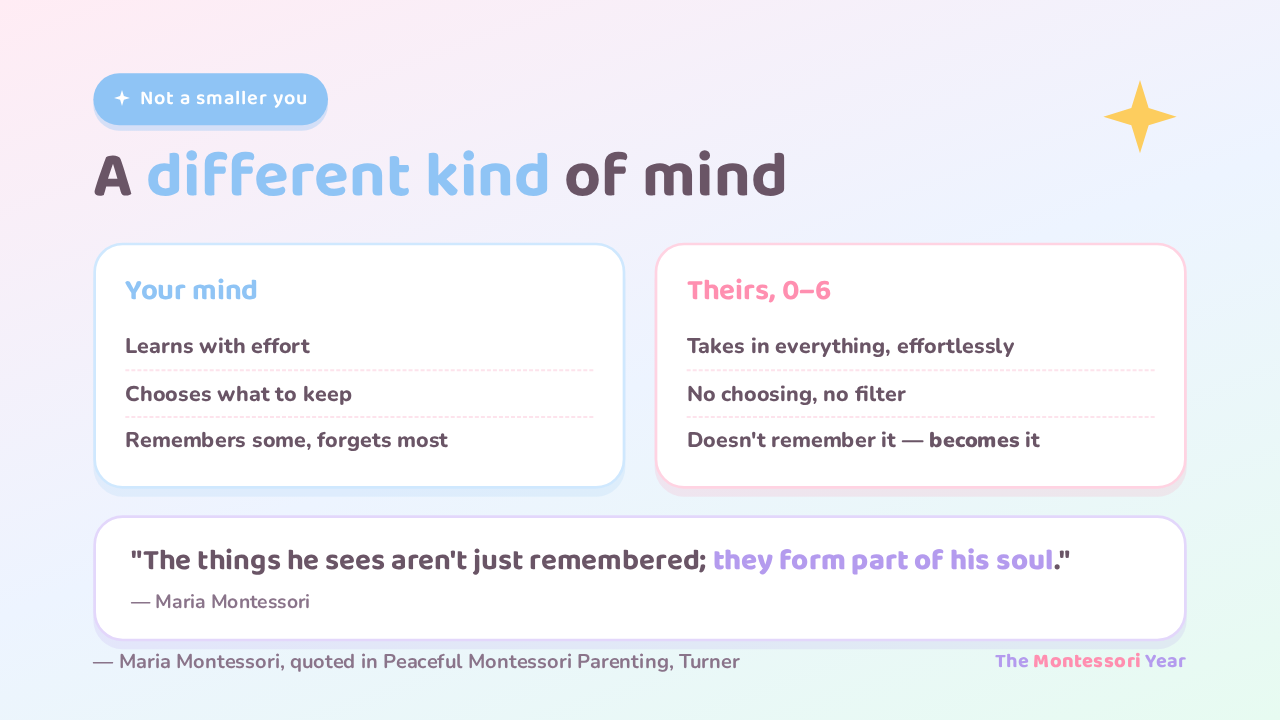
A different kind of mind
Your mind
- Learns with effort
- Chooses what to keep
- Remembers some, forgets most
Theirs, 0–6
- Takes in everything, effortlessly
- No choosing, no filter
- Doesn't remember it — becomes it
"The things he sees aren't just remembered; they form part of his soul." — Maria Montessori
Here's the difference. When you learn something new, you work at it. You pay attention, you repeat it, and you still forget most of it, because your mind chooses what to keep. A young child's mind doesn't choose. It takes in everything, effortlessly, and what goes in doesn't sit in memory like a fact. Montessori put it like this. The things he sees aren't just remembered; they form part of his soul. He incarnates in himself all in the world about him that his eyes see and his ears hear. Notice she didn't say the child remembers his world. She said he becomes it.
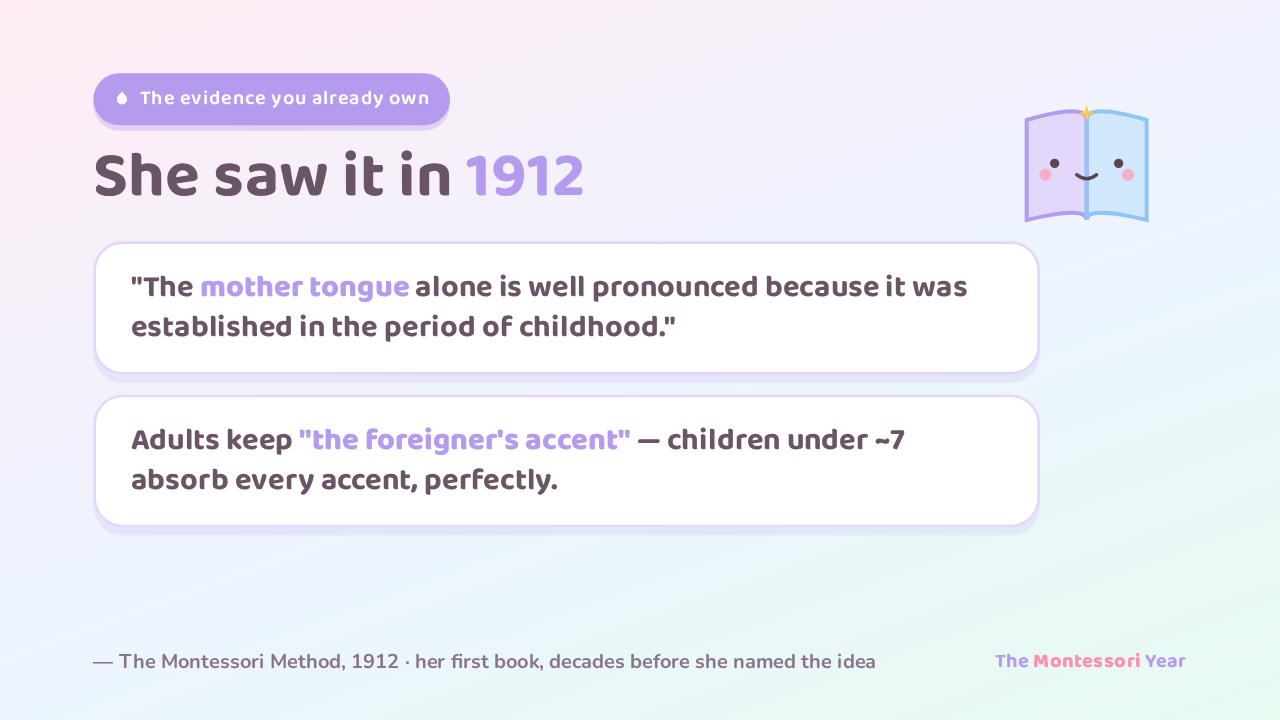
She saw it in 1912
"The mother tongue alone is well pronounced because it was established in the period of childhood."
Adults keep "the foreigner's accent" — children under ~7 absorb every accent, perfectly.
She saw all this long before she had a name for it. Back in 1912, in her very first book, she pointed at evidence every family already owns. Your mother tongue is the only language you pronounce perfectly, she observed, because it was established in childhood. An adult who learns a new language carries the foreigner's accent forever. But a child under about seven who grows up around several languages picks up every accent, perfectly, all at once. She even wrote that if adults learned as easily as children under six, ending illiteracy would be easy. A mind that powerful deserved its own name. Years later, she gave it one.
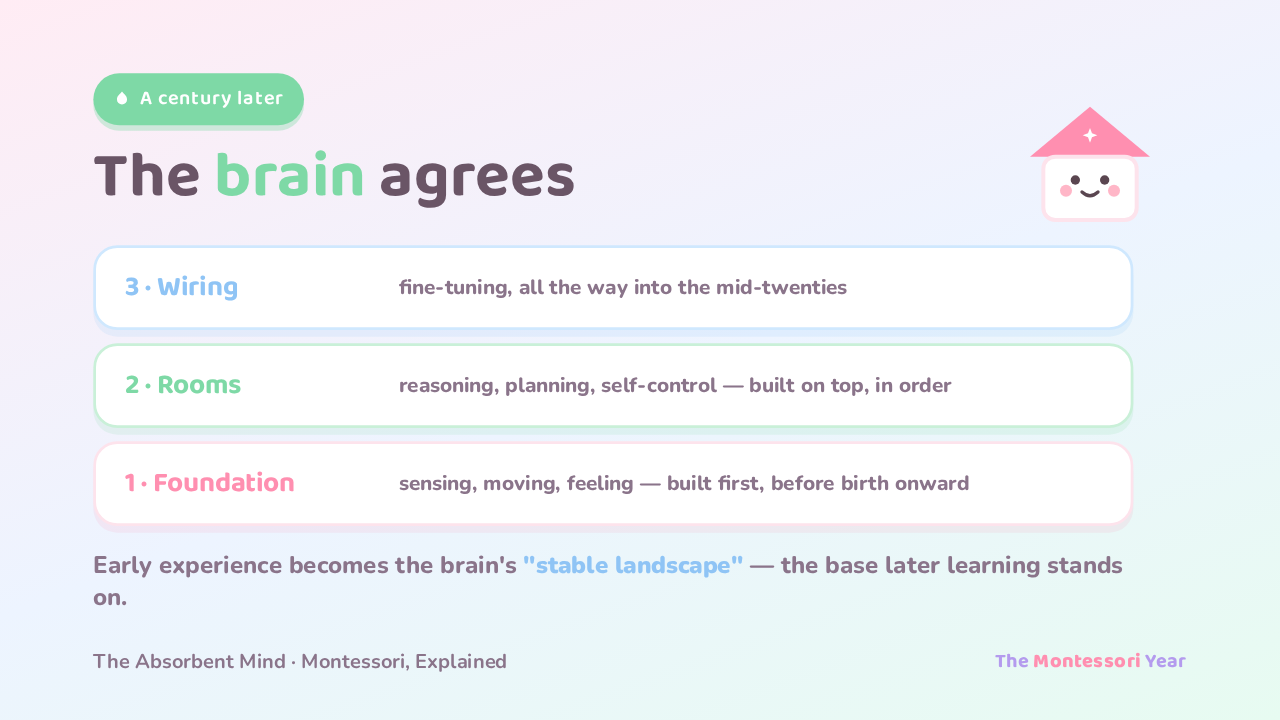
The brain agrees
1 · Foundation
sensing, moving, feeling — built first, before birth onward
2 · Rooms
reasoning, planning, self-control — built on top, in order
3 · Wiring
fine-tuning, all the way into the mid-twenties
Early experience becomes the brain's "stable landscape" — the base later learning stands on.
A century later, the science tells the same story from the inside. In the early years the brain builds itself from the bottom up, like a house. Foundation first, then the rooms, then the wiring, in a set order. And early experiences shape that circuitry directly. Scientists describe the connection patterns laid down in these years as the brain's stable landscape, the base that future learning and behavior stand on. Given the right experience at the right time, a young child learns almost unconsciously. Which is exactly what Montessori was describing a hundred years earlier, with nothing but a notebook and very patient eyes.
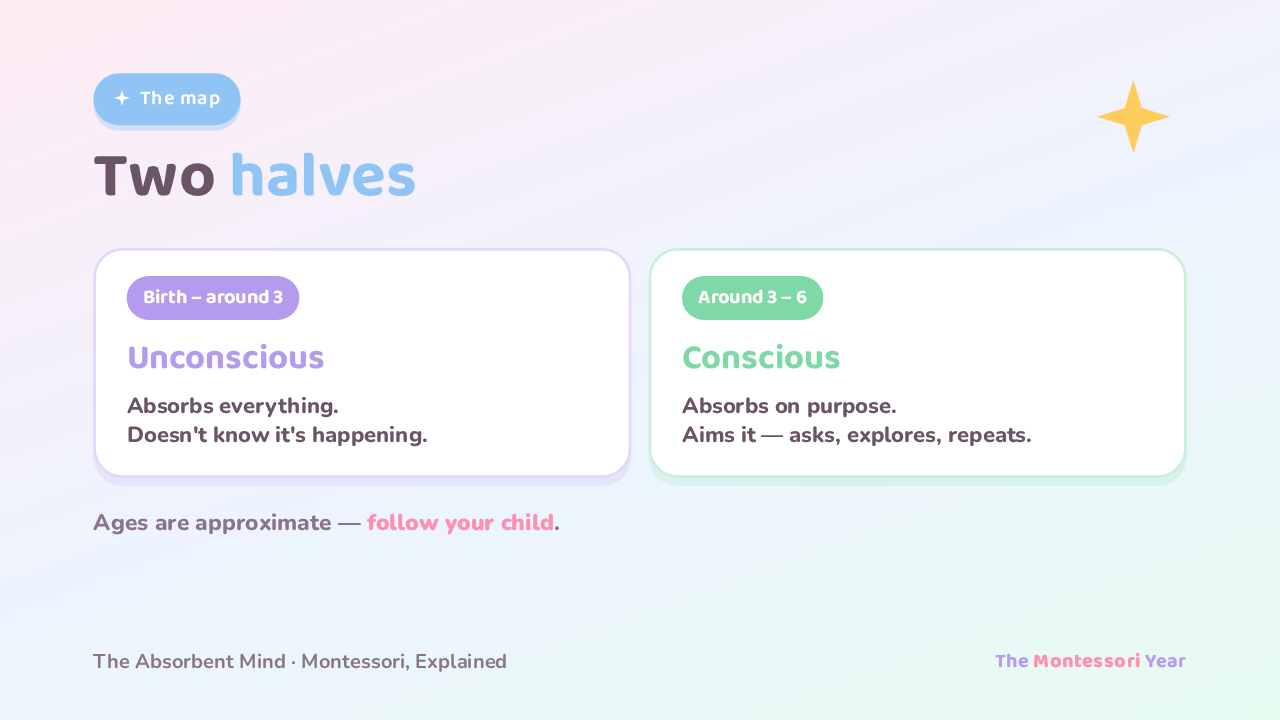
Two halves
Unconscious
Absorbs everything.
Doesn't know it's happening.
Conscious
Absorbs on purpose.
Aims it — asks, explores, repeats.
Ages are approximate — follow your child.
Now, the part most explanations skip, and the reason this video has two halves. The absorbent mind itself has two halves. From birth to around three, the absorbing is unconscious. Your child takes in everything and has no idea they're doing it. Then from around three to six, it turns conscious. The intake is just as astonishing, but now the child aims it, deliberately. Same mind, two seasons, and your role in each one is different. So let's walk through them, birth to three first.
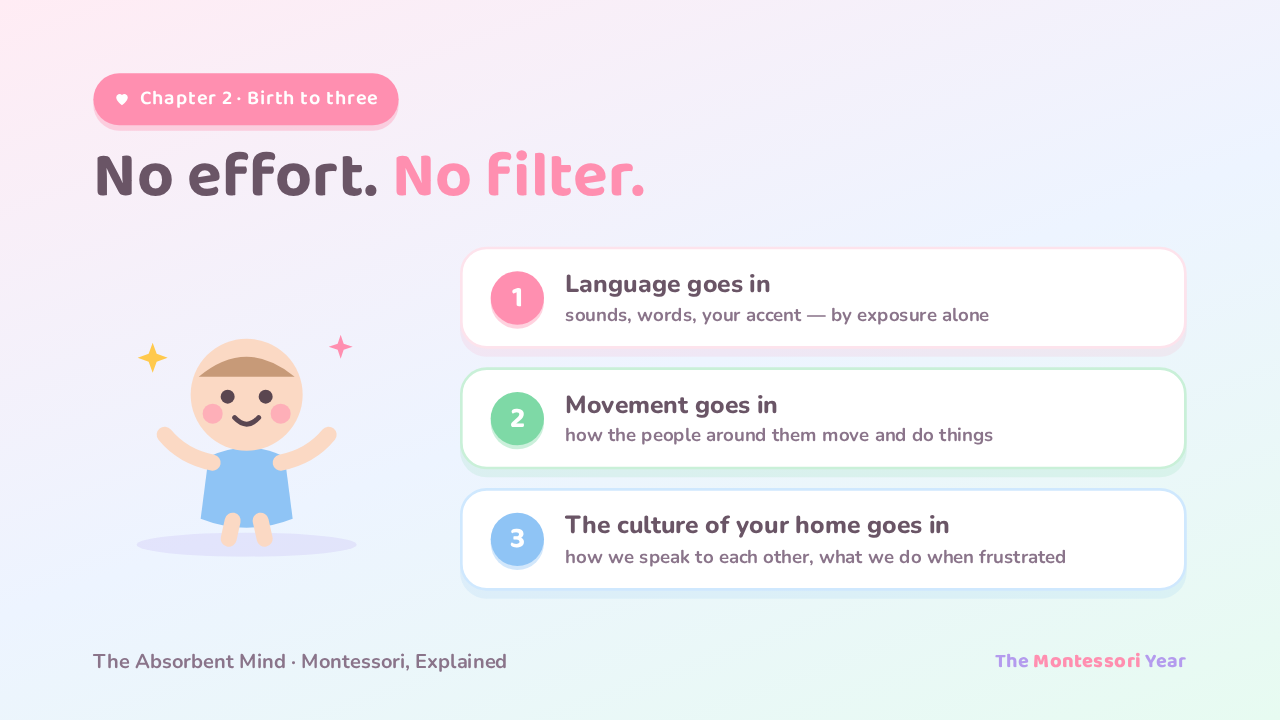
No effort. No filter.
Language goes insounds, words, your accent — by exposure alone
Movement goes inhow the people around them move and do things
The culture of your home goes inhow we speak to each other, what we do when frustrated
In the first three years or so, your child absorbs without choosing. There is no effort involved, and there is no filter. Nobody sits a baby down to teach the sounds of the family language, or how faces work, or what dinnertime feels like in this particular house. They're simply exposed to it, and it goes in. The way people move goes in. The way we speak to each other goes in. What we do when we're frustrated goes in. And here's the remarkable part. Your child will never remember absorbing any of it. It will simply feel to them like the normal way life is.
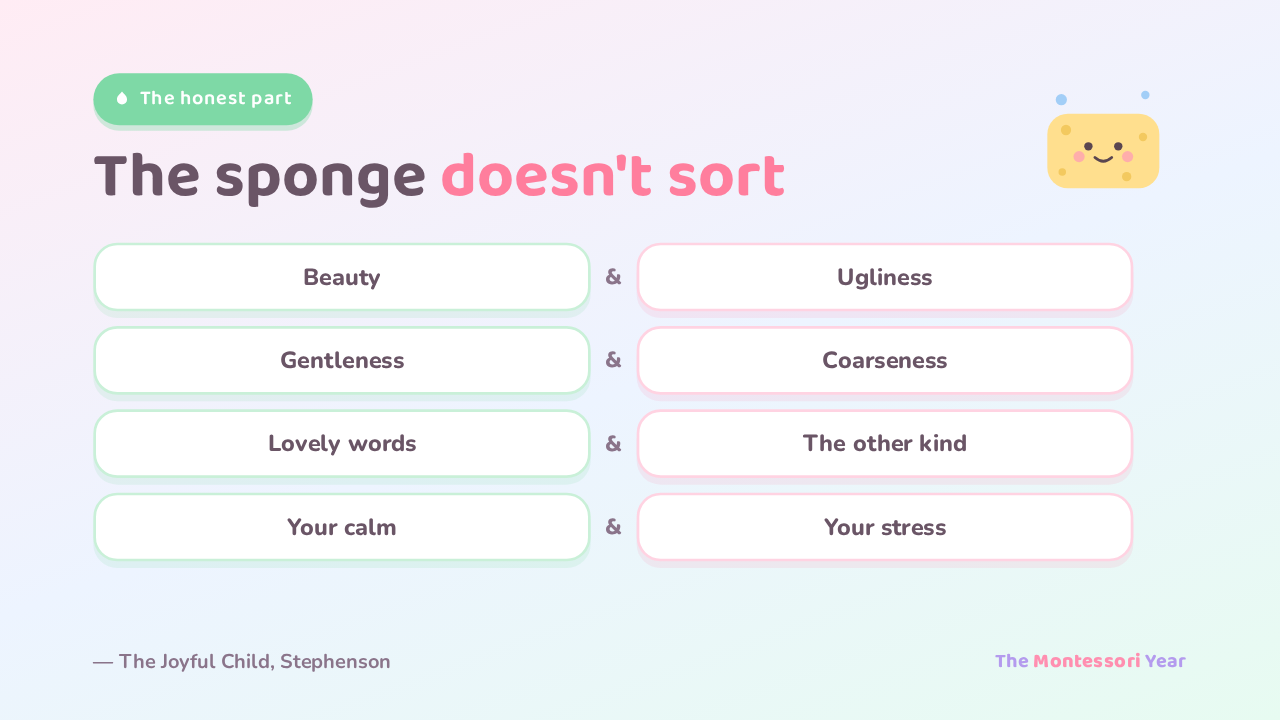
The sponge doesn't sort
And here's the honest part. The sponge doesn't sort. Stephenson says it plainly in The Joyful Child. In these years a child absorbs, like a sponge, whatever is in the environment. Ugliness or beauty. Coarse behavior or gentleness. Good or bad language. It all soaks in with the same ease. And that includes things you can't put on a shelf. Your child reads your nervous system all day long. They pick up your breathing, your tone, the set of your shoulders, and tune their own little system to match. Children this age don't absorb what we explain to them. They absorb how it feels to be near us.
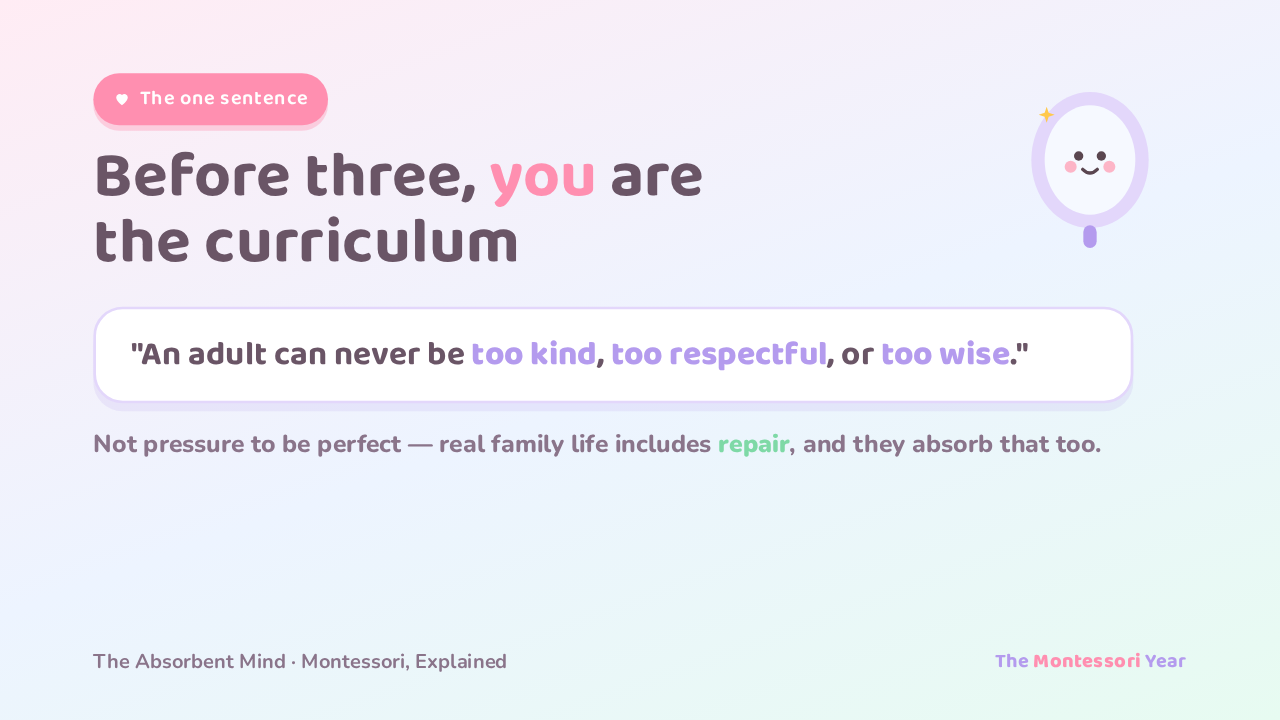
Before three, you arethe curriculum
"An adult can never be too kind, too respectful, or too wise."
Not pressure to be perfect — real family life includes repair, and they absorb that too.
Which brings us to the one sentence that changes how you see this whole stage. Before age three, you are the curriculum. Not the toys, not the classes. You. Your child is building their picture of what a human being is, and you are the model they study most. Stephenson writes that with children this age, an adult can never be too kind, too respectful, or too wise. Now, that is not pressure to be perfect. Real family life includes losing your patience, and it also includes coming back and repairing. Your child absorbs that too, and honestly, watching you recover kindly might be the best lesson in the house.
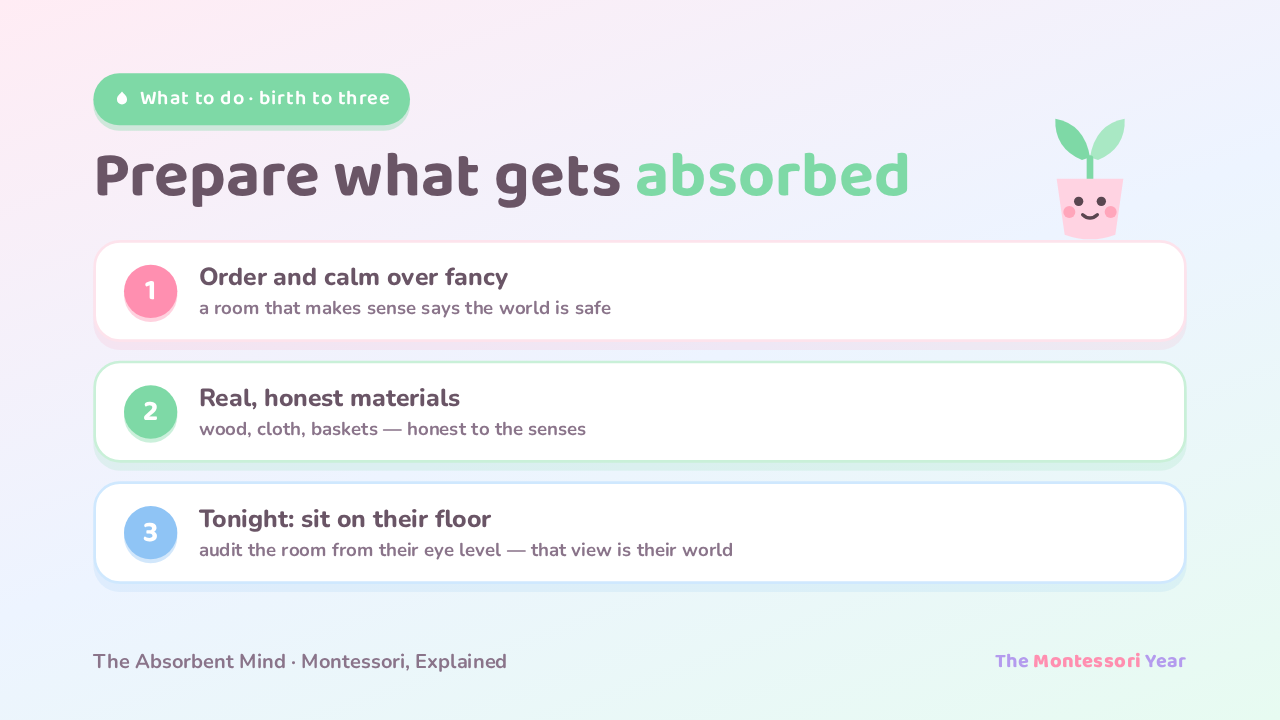
Prepare what gets absorbed
Order and calm over fancya room that makes sense says the world is safe
Real, honest materialswood, cloth, baskets — honest to the senses
Tonight: sit on their flooraudit the room from their eye level — that view is their world
For the first three years, your job is mostly to prepare what gets absorbed. Montessori's advice for this stage was a rich and orderly environment, and orderly matters far more than fancy. A calm room, with a place for things, tells a very young child that the world is safe and makes sense. Choose real materials where you can, wood and cloth and baskets, things that are honest to the senses. And try this tonight. Sit down on the floor where your child plays, at their height, and just look. Whatever you can see and hear from down there is what's soaking in. That view is their whole world right now.
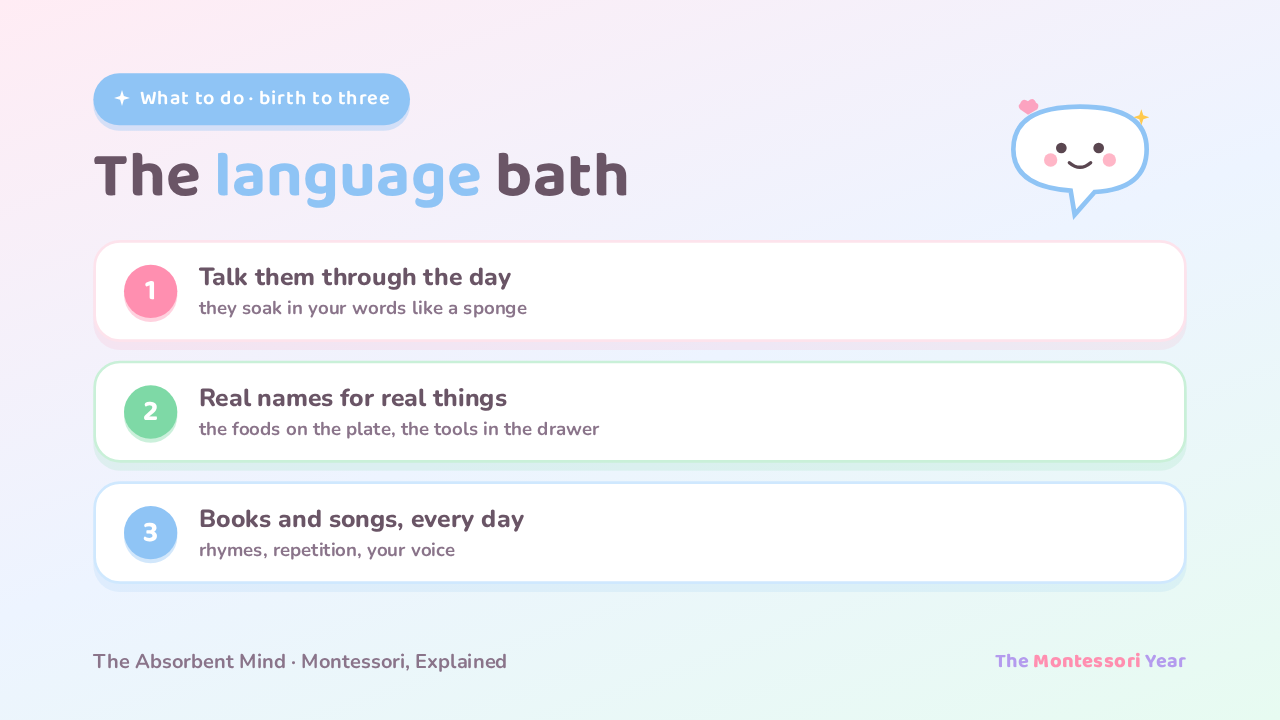
The language bath
Talk them through the daythey soak in your words like a sponge
Real names for real thingsthe foods on the plate, the tools in the drawer
Books and songs, every dayrhymes, repetition, your voice
The second job is words, because language is the longest window of all. It runs from birth straight through age six, and in these first years your child is drawn to your voice and soaks in words, quite literally, like a sponge. So talk them through the day. Tell them what you're doing while you change them, cook, shop. Use the real names of things, the actual words for the foods on the plate and the tools in the drawer. Read together every day, and sing, and rhyme. None of it needs to look like teaching. A child who is spoken with all day is receiving the richest curriculum there is, for free.
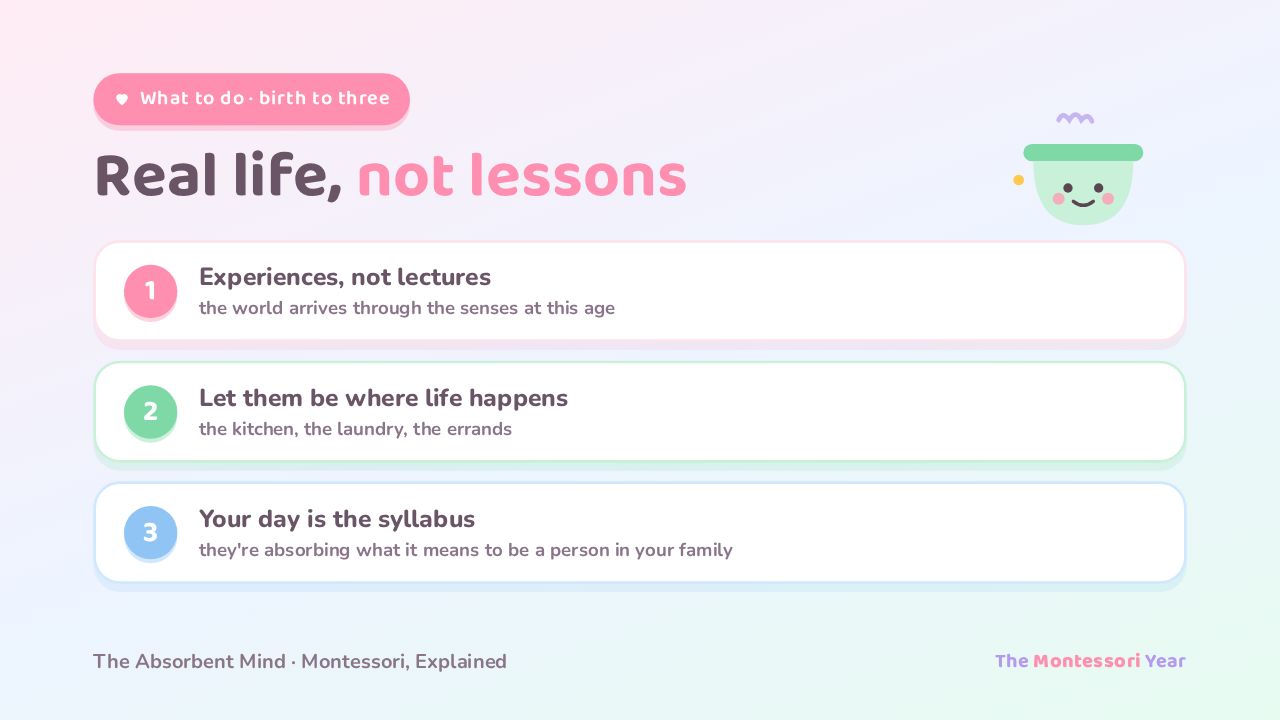
Real life, not lessons
Experiences, not lecturesthe world arrives through the senses at this age
Let them be where life happensthe kitchen, the laundry, the errands
Your day is the syllabusthey're absorbing what it means to be a person in your family
And the third job is the easiest to say and the hardest to believe. This stage needs experiences, not lessons. Stephenson's advice is to introduce the world experientially, through the senses, not with lectures. So let your child be where life actually happens. In the kitchen while you cook. Next to the laundry basket. Along for the errands. To us that's just Tuesday. To an absorbent mind it is the entire syllabus of being human, and they are drinking it in. You don't need to add a curriculum to your day. For a child under three, your day already is one.
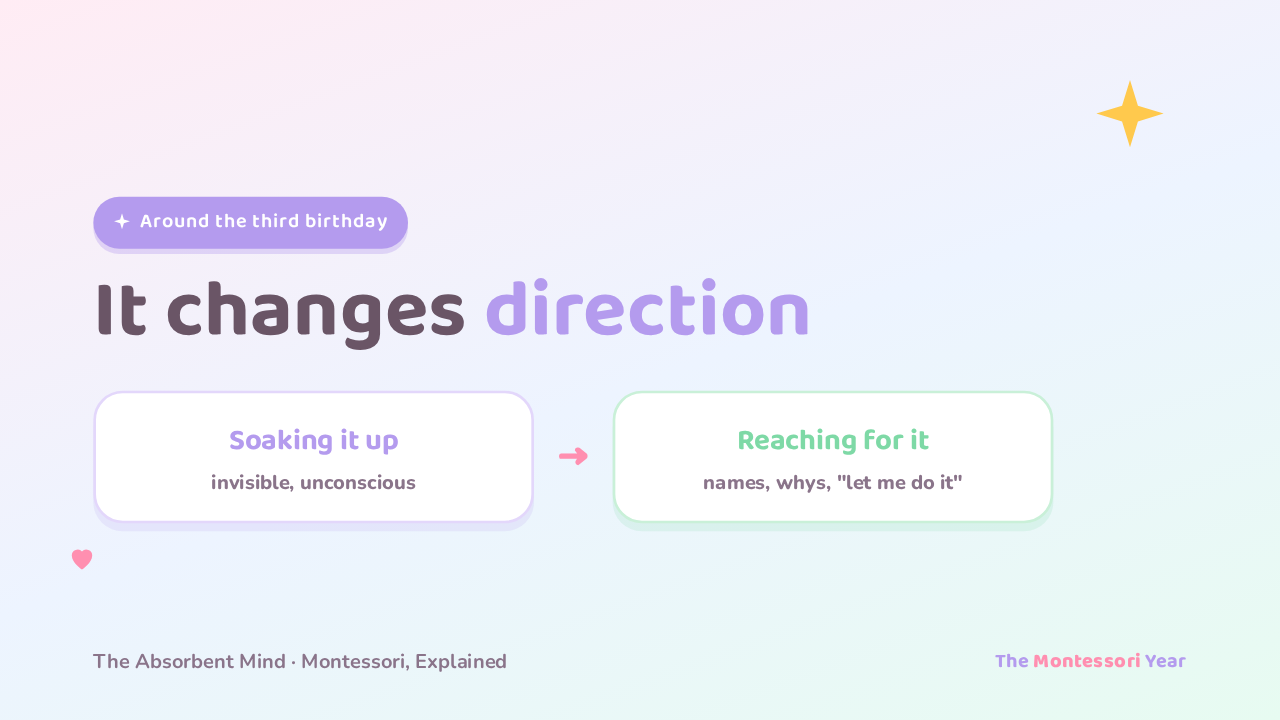
It changes direction
Soaking it up
invisible, unconscious
Reaching for it
names, whys, "let me do it"
Then, somewhere around the third birthday, something quietly flips. The absorbing doesn't stop. It changes direction. The child who was soaking up the world invisibly starts reaching for it on purpose. They ask the names of things. They ask why, and then why again. They want to do it themselves, and then do it again and again until it's theirs. Montessori called this the conscious absorbent mind. And here's why it's worth knowing about, because most of us keep parenting the first half long after our child has moved into the second.
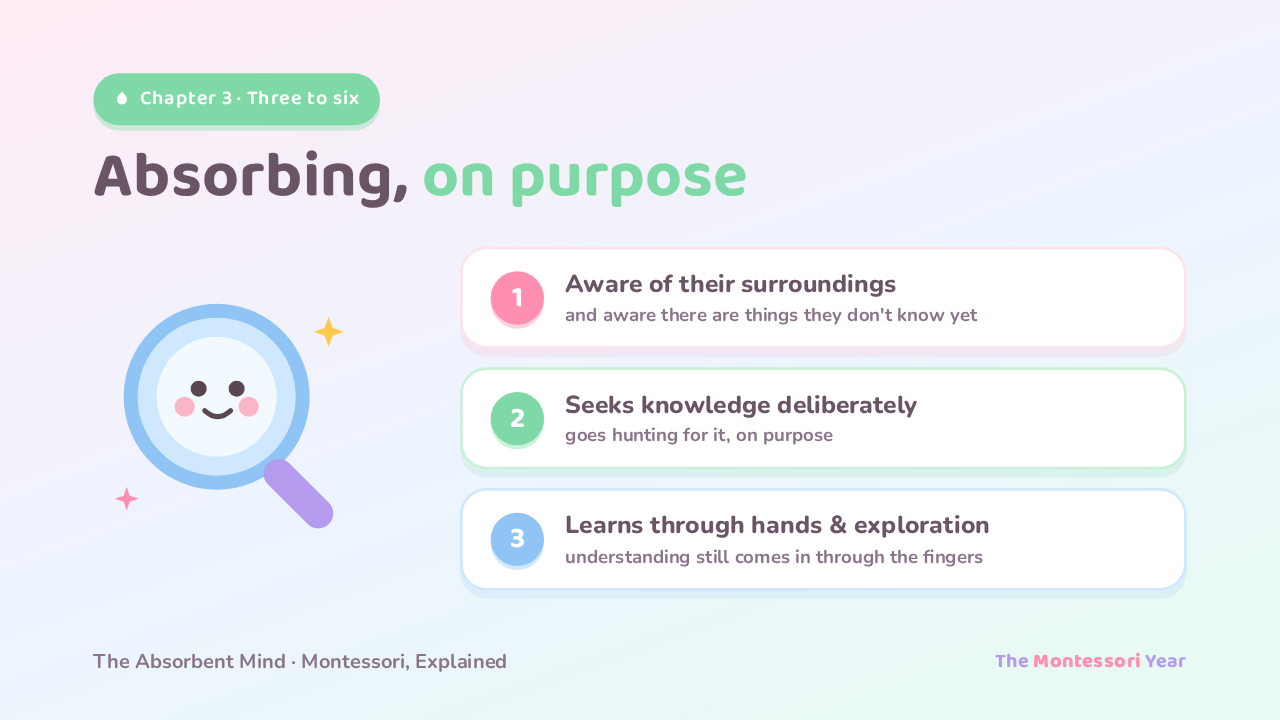
Absorbing, on purpose
Aware of their surroundingsand aware there are things they don't know yet
Seeks knowledge deliberatelygoes hunting for it, on purpose
Learns through hands & explorationunderstanding still comes in through the fingers
From around three to six, the child becomes a deliberate learner. Where the baby absorbed whatever happened to be nearby, the three to six year old goes hunting. They are aware of their surroundings now, aware that there are things they don't know yet, and they seek knowledge out on purpose, through exploration and through their hands. This is why a four-year-old's questions can outlast your entire supply of answers before breakfast. The mind is still absorbing at full power. What's new is that your child is holding the steering wheel.
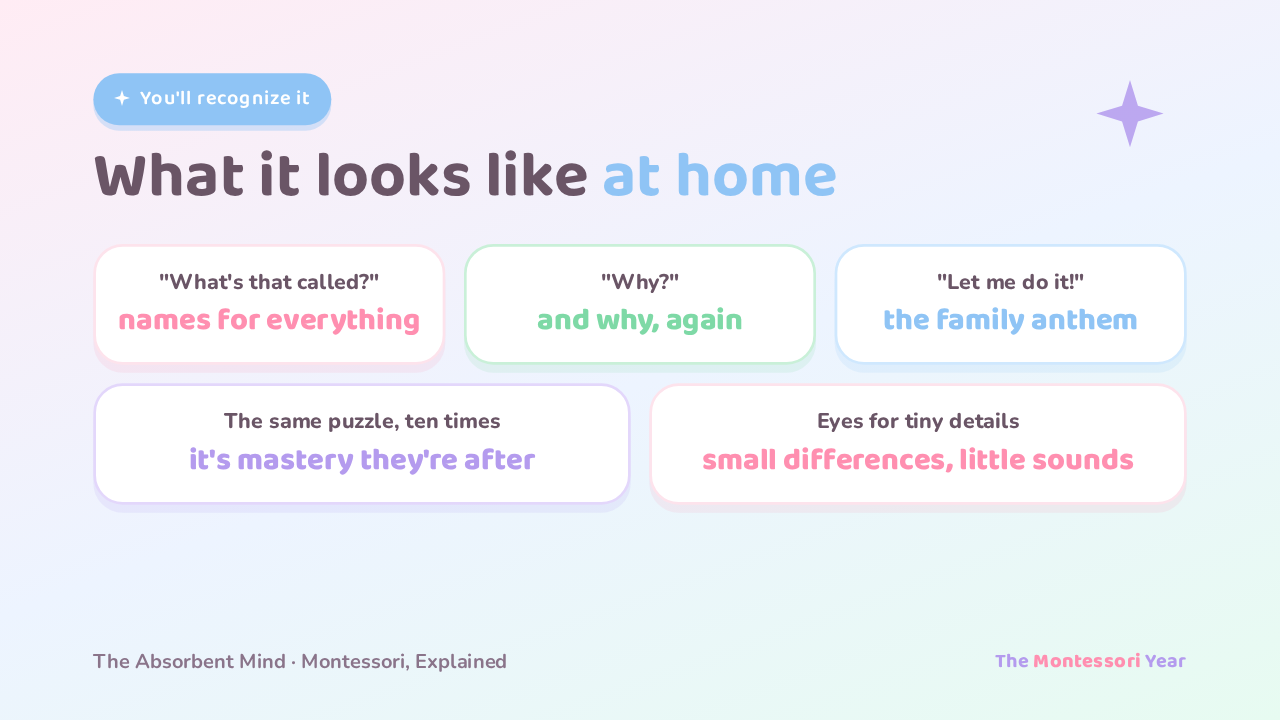
What it looks like at home
You'll recognize this season when you see it. They want the names of everything, real names, the more precise the better, shapes and plants and animals. The why questions arrive, in bulk. Let me do it becomes the family anthem. They repeat things that look finished to us, the same puzzle ten times, because they're not after the result, they're after mastery. And they start noticing tiny differences, small details, little sounds. None of this is your child being difficult. This is what deliberate absorption looks like from the outside.
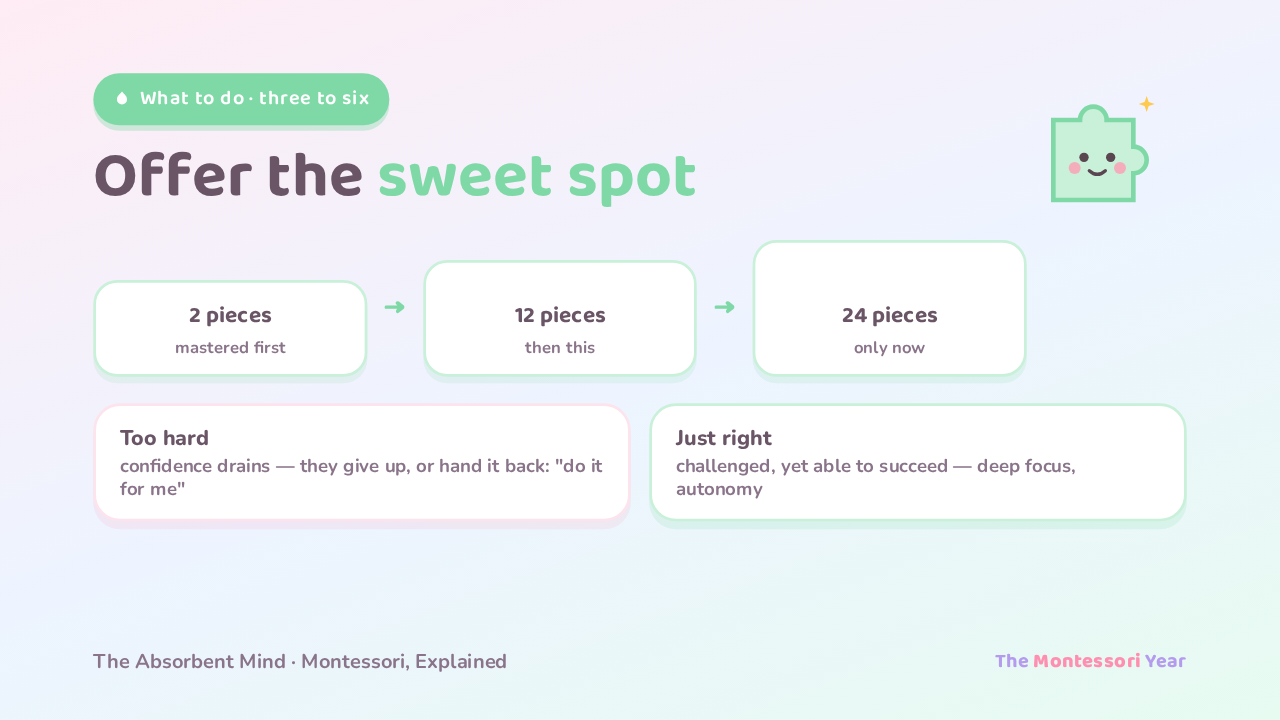
Offer the sweet spot
Too hardconfidence drains — they give up, or hand it back: "do it for me"
Just rightchallenged, yet able to succeed — deep focus, autonomy
With a deliberate learner, your first job is to offer work at the sweet spot, challenging enough to be interesting, doable enough to succeed. Turner gives a lovely rule of thumb with puzzles. You wouldn't hand a child a twenty-four piece puzzle before they've mastered a twelve, and a four or six piece before that, and a two piece before that. Offer something far above their ability and you can watch the confidence drain. They give up quickly, or hand it back to you to do. Offer the just-right challenge and something magic happens instead. Long, deep stretches of concentration, and a child who walks away taller.
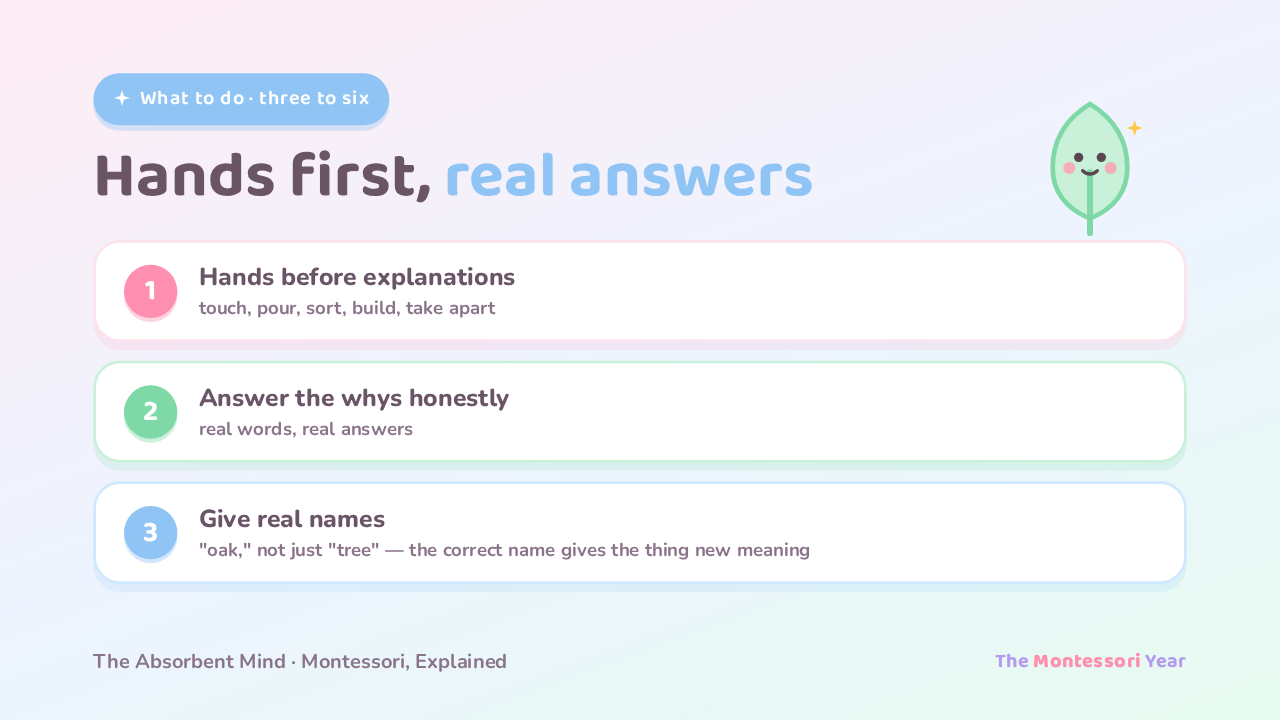
Hands first, real answers
Hands before explanationstouch, pour, sort, build, take apart
Answer the whys honestlyreal words, real answers
Give real names"oak," not just "tree" — the correct name gives the thing new meaning
The second job is to feed the hunt honestly. Hands before explanations. At this age understanding still comes in through the fingers, so let them touch, pour, sort, build, take apart. Real experiences still beat lectures, just as they did at two. And when the questions come, answer them honestly, with real words. When a child learns the correct name for a thing, the thing itself takes on new meaning. So give them oak instead of just tree, and triangle instead of just shape, whenever they're reaching for it. You're not showing off vocabulary. You're handing a hungry mind exactly what it came for.
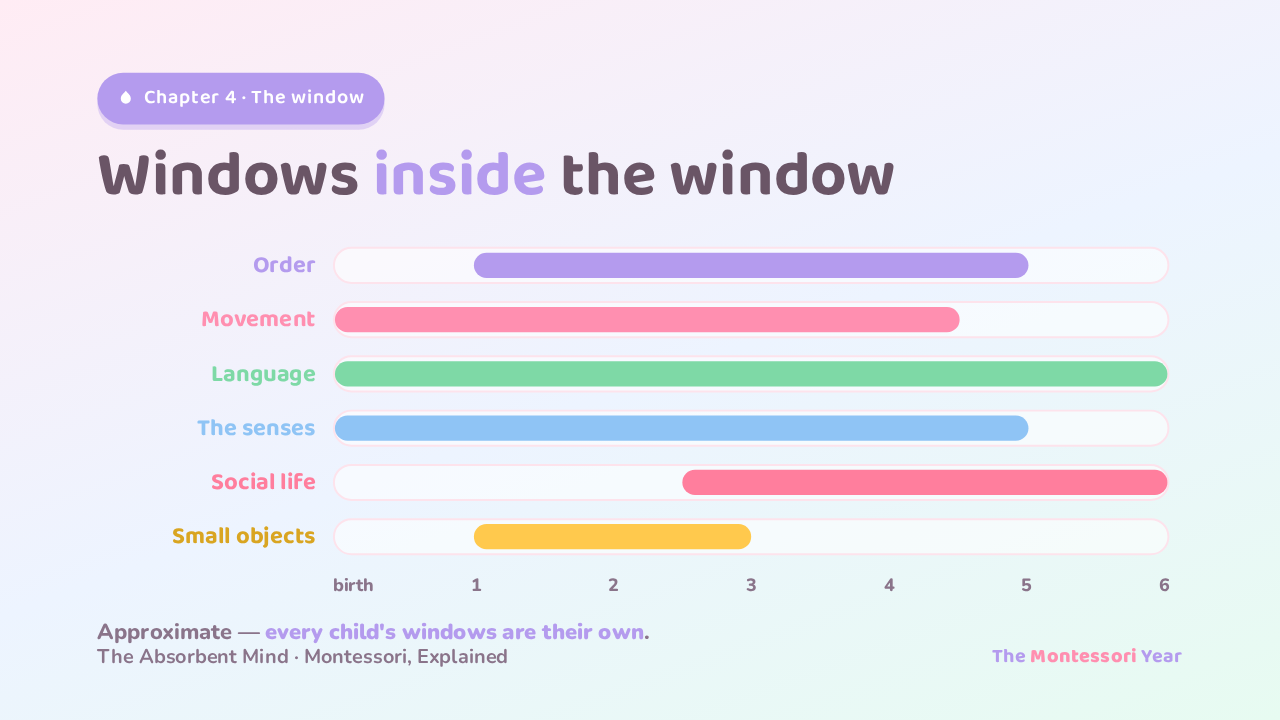
Windows inside the window
Approximate — every child's windows are their own.
One more layer, and the whole picture snaps into focus. Inside these six years, Montessori observed tighter windows she called sensitive periods, stretches when one particular skill becomes almost magnetic. A window for order, strongest somewhere around one to five, when routines matter enormously. Movement, from birth to around four and a half. Language, the whole six years. The senses. Social life, from around two and a half, when other children suddenly matter. Even a window for tiny objects and tiny details. During its window, a skill gets absorbed almost for free. Your child can't get enough of it. And the ages are approximate, always. Every child opens their own windows on their own calendar.
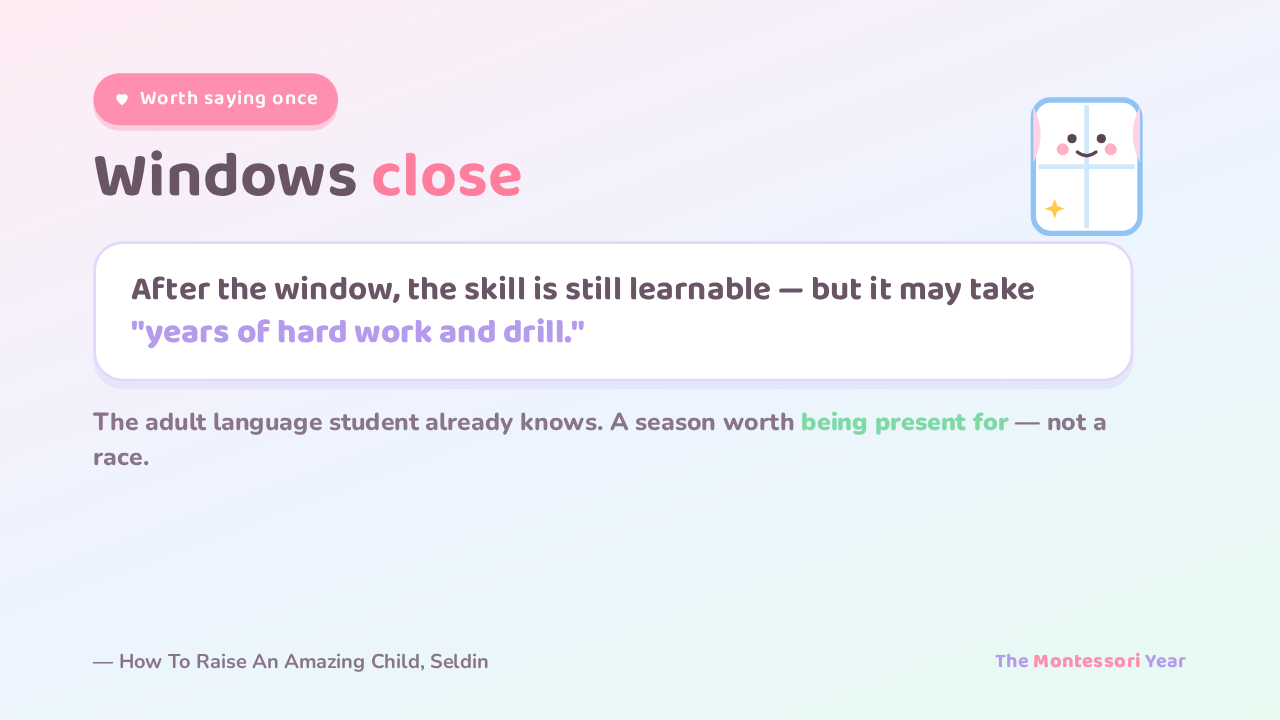
Windows close
After the window, the skill is still learnable — but it may take "years of hard work and drill."
The adult language student already knows. A season worth being present for — not a race.
Here's the one thing worth saying plainly, once. Windows close. When a sensitive period passes, the intense pull fades, and it doesn't come back. The skill can absolutely still be learned later. But as Seldin puts it, it may take years of hard work and drill, where the young child would have absorbed it almost without noticing. You already know this is true, because you've met it. It's the difference between how you'd learn Spanish tonight and how your toddler would. That difference is the entire reason the early years deserve their reputation. Not as a race, but as a season worth being present for.
The good news
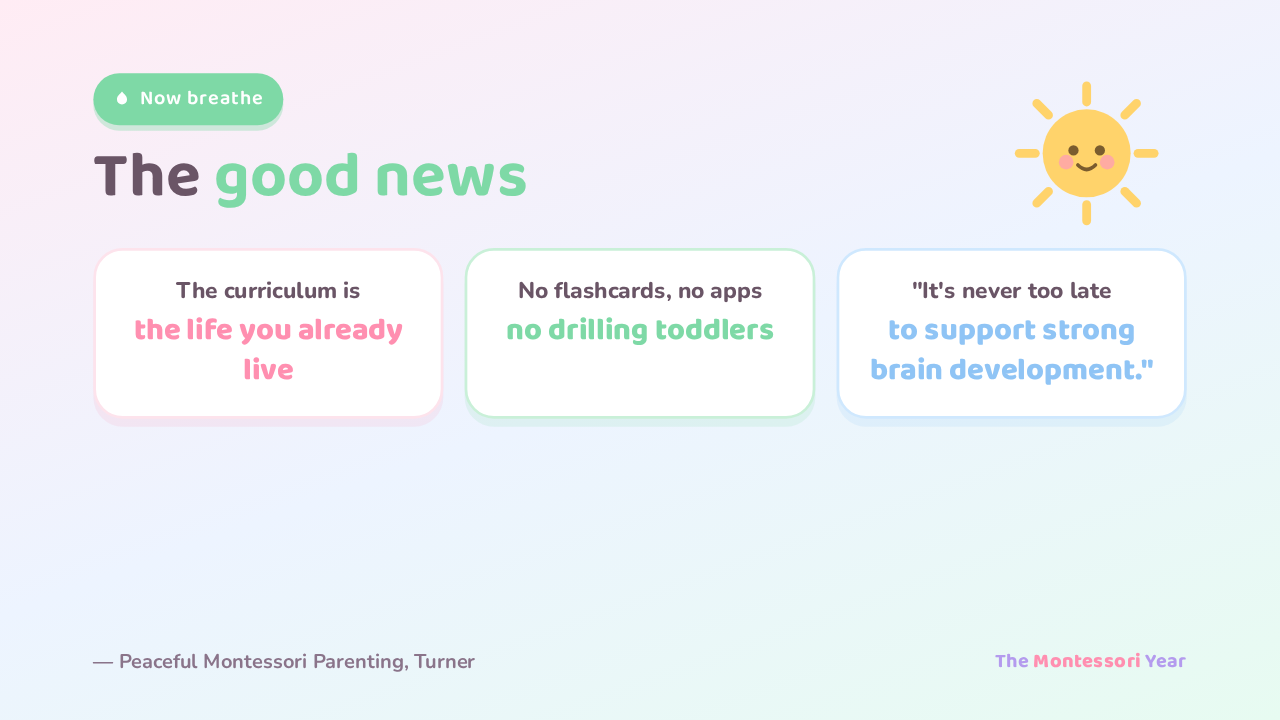
Now breathe, because the good news here is genuinely good. Nothing in this video asked you to buy anything, drill anything, or add a single flashcard. The absorbent mind's curriculum is the life you are already living. A calm, ordered home. Real words, real things, real work, and you, being an ordinary decent human where they can watch. That's the whole program. And if your child is past three, or past six, and you're doing the math with a sinking feeling, don't. Turner says it directly. It's never too late to support strong brain development. The brain keeps building well into the twenties. The window years are a gift, not a verdict.
Your child sets the pace
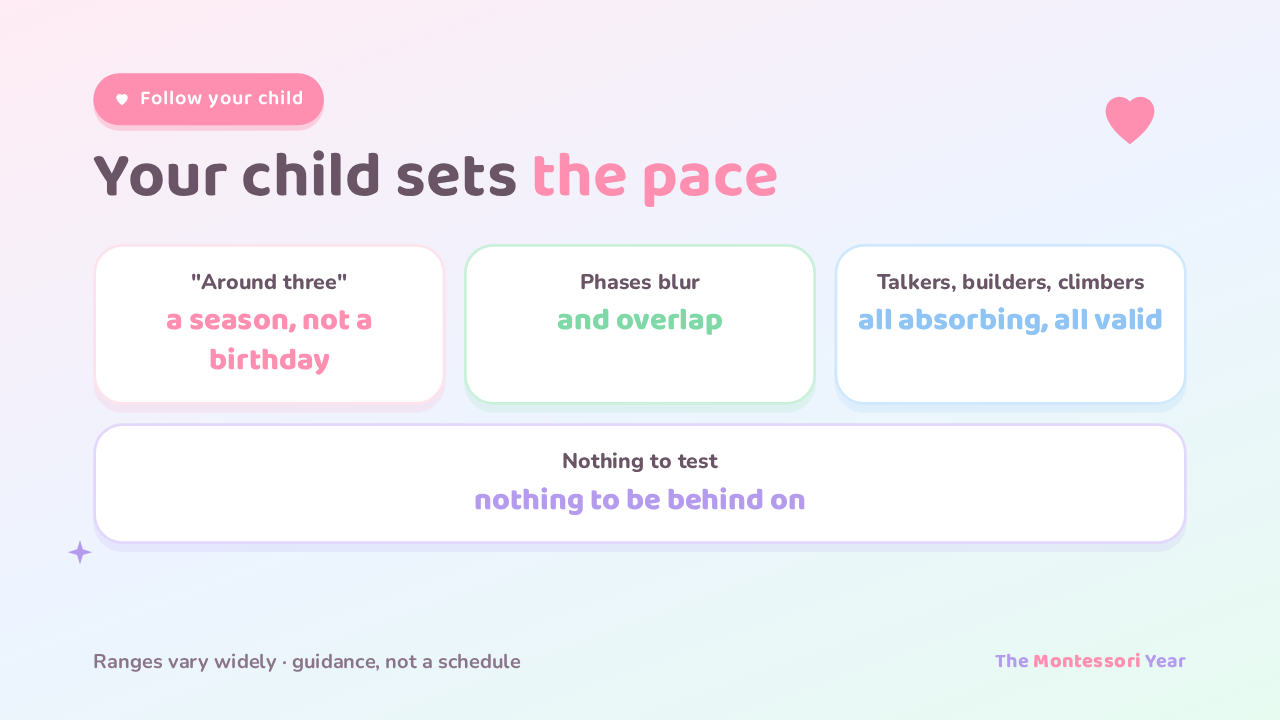
And the calibration, because your child hasn't read this video. Around three is a season, not a birthday. The unconscious and conscious phases blur into each other, and children cross that bridge at their own pace, in their own style. One three-year-old is drowning you in words while another is quietly building towers and absorbing just as much. Windows open early for some children and later for others, and the ranges are wide. So there is nothing here to test your child against, and nothing to be behind on. Watch what they're drawn to this month. That's your syllabus. Follow the child was Montessori's instruction, and it outranks every chart in this video, including mine.
You can't teach it.You can only live it.
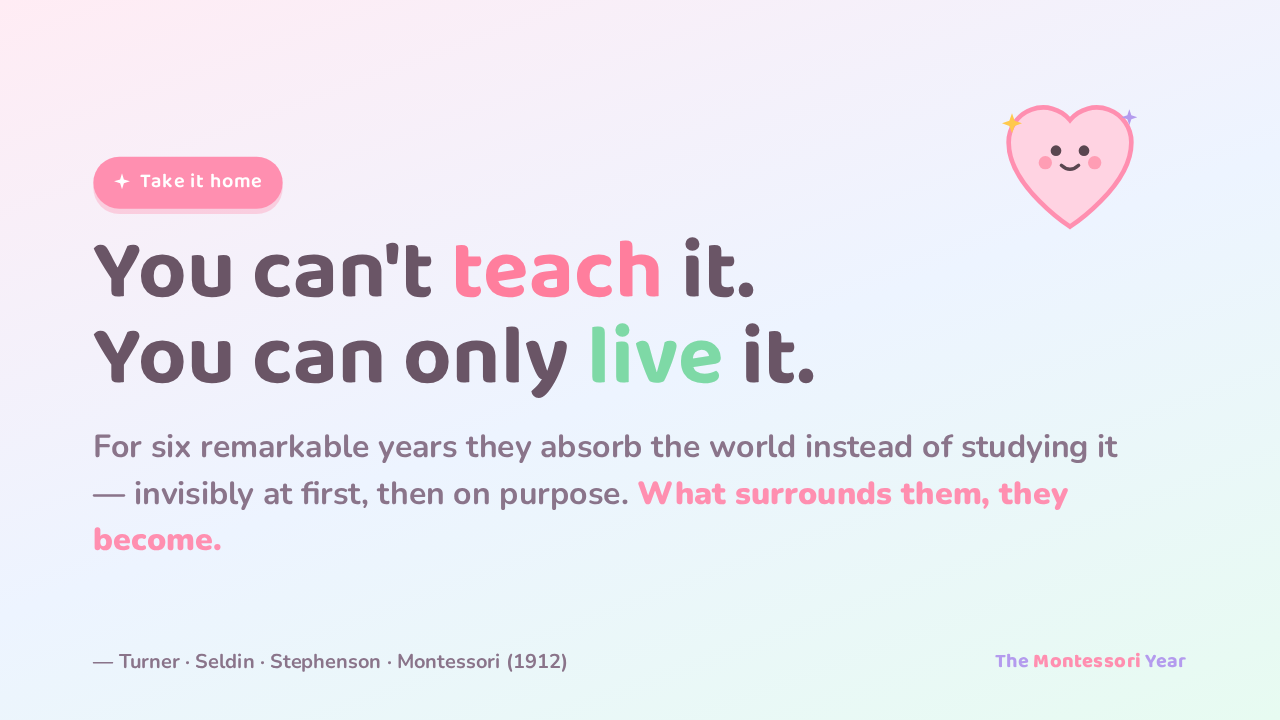
For six remarkable years they absorb the world instead of studying it — invisibly at first, then on purpose. What surrounds them, they become.
So here's the whole idea in one breath. For six remarkable years your child absorbs the world instead of studying it. Invisibly at first, then on purpose. And what they absorb, they become. Which means you can't really teach the absorbent mind anything. You can only hand it a world worth becoming, and then get out of its way. Today leaned on Peaceful Montessori Parenting by Haley Turner, How To Raise An Amazing Child by Tim Seldin, The Joyful Child by Susan Mayclin Stephenson, and Montessori's own first book. All worth your shelf. Thank you for spending this time with me. I'll see you next time.