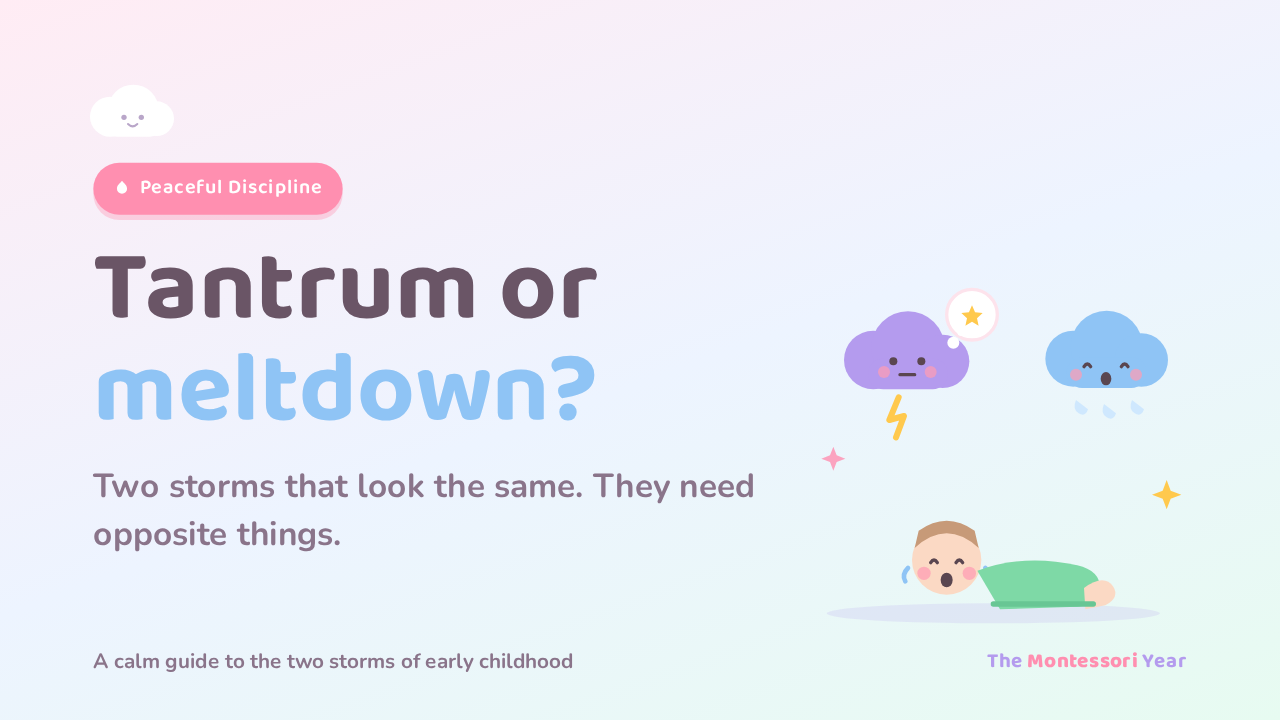
Tantrum ormeltdown?
Two storms that look the same. They need opposite things.
Your toddler is face down on the grocery store floor, screaming. And everything you try, the snack, the hug, the firm voice, makes it louder. Here's what nobody tells you in that aisle. Two completely different storms look exactly like this, and they need opposite things from you. Guess wrong, and the storm grows. That's why it feels like nothing works. By the end, you'll have one question that tells you which storm you're in, usually in one look, and a simple playbook for each.
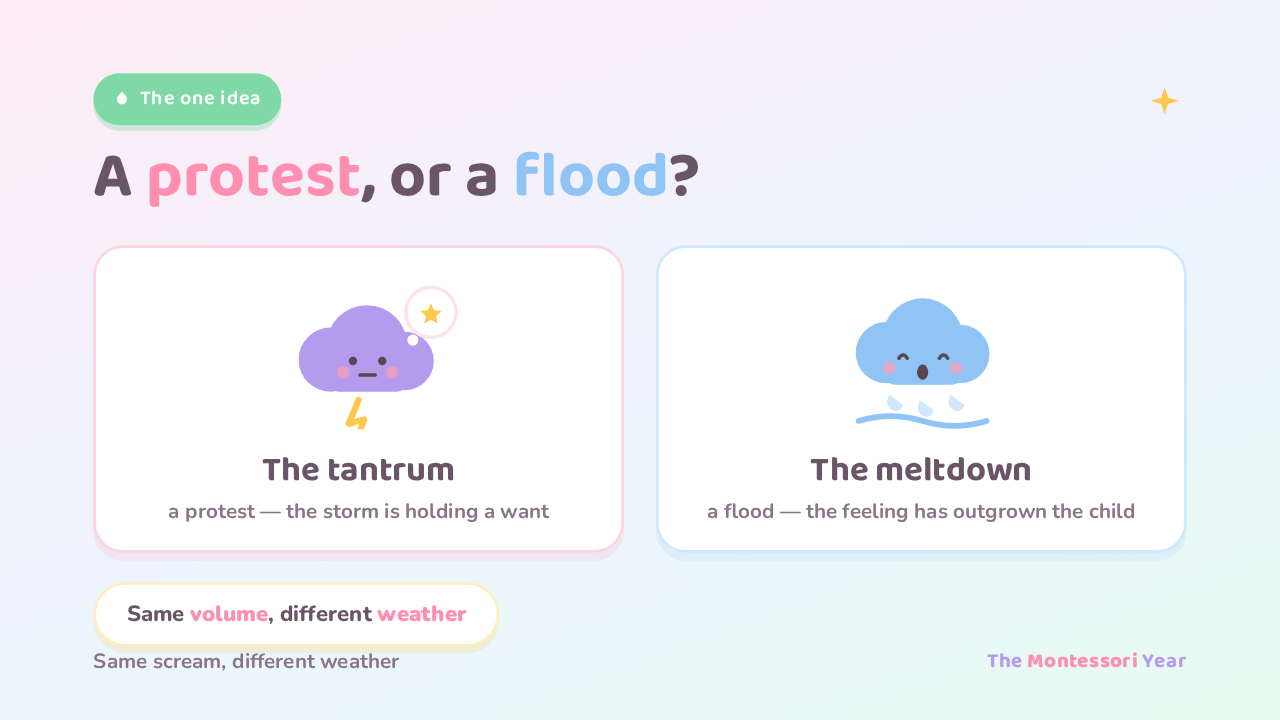
A protest, or a flood?
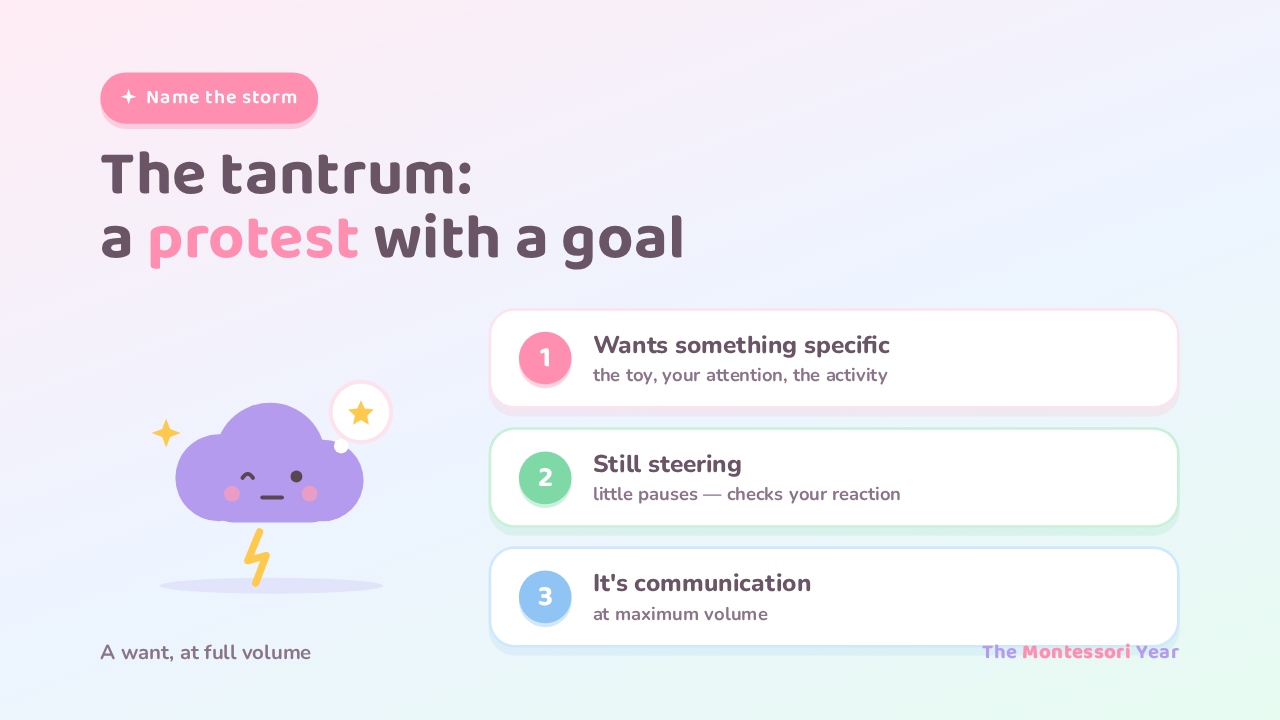
The tantrum
a protest — the storm is holding a want
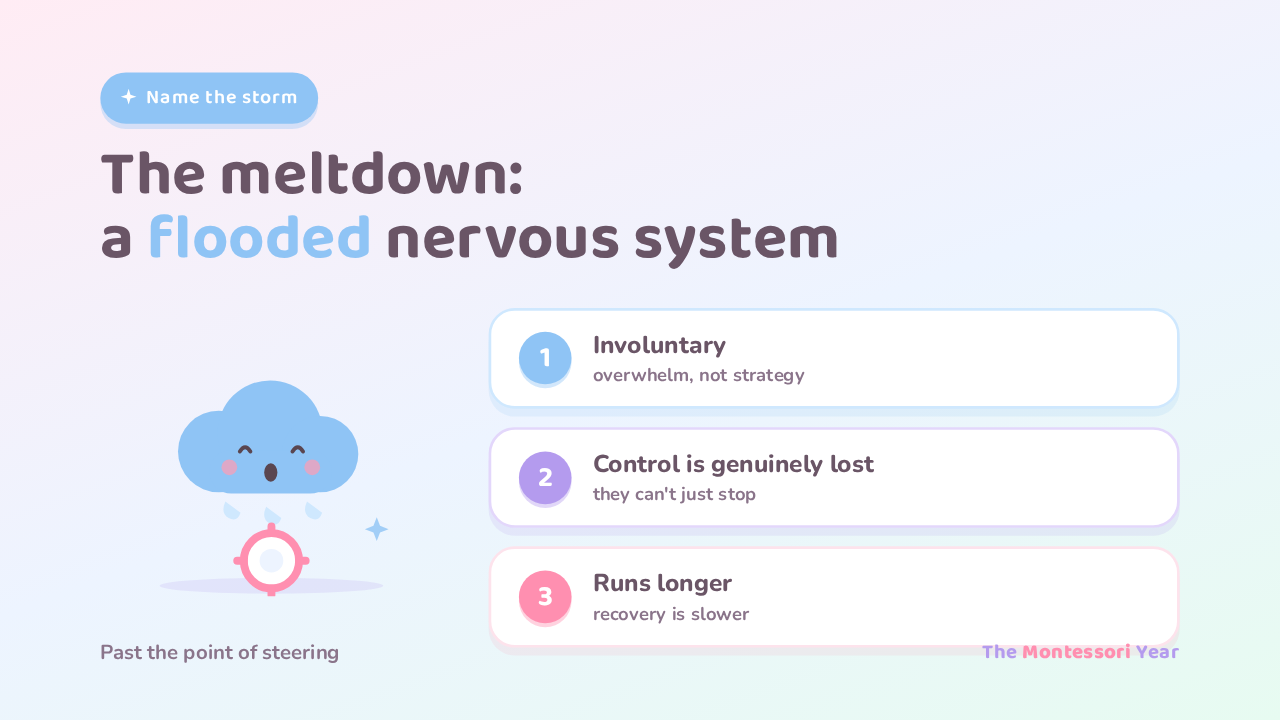
The meltdown
a flood — the feeling has outgrown the child
A screaming child is not one thing. Sometimes the scream is a protest. Your child wants something, the cereal, your phone, five more minutes, and the storm is aimed at getting it. And sometimes the scream is a flood. Nothing is being asked for anymore, because the feeling has simply outgrown the child. The protest and the flood sound identical at full volume. But they come from different places in a young brain, and they call for opposite responses from you. Pick the right label, and your next move becomes almost obvious. Pick the wrong one, and you'll be pouring water on a grease fire.
The tantrum:a protest with a goal
Wants something specificthe toy, your attention, the activity
Still steeringlittle pauses — checks your reaction
It's communicationat maximum volume
Take the protest first. A tantrum has a goal. It's usually set off by wanting something specific, a toy, your attention, a certain activity, and somewhere under all that noise, your child is still steering. You can often see it. There are little pauses. One eye cracks open to check whether this is working on you. As children get older and more knowing, a tantrum can even be a small experiment: what happens to this limit if I push? None of that makes your child manipulative. It makes them a person with a real want and not many words yet. A tantrum is communication, at maximum volume.
The meltdown:a flooded nervous system
Involuntaryoverwhelm, not strategy
Control is genuinely lostthey can't just stop
Runs longerrecovery is slower
The flood is different. In Peaceful Montessori Parenting, Haley Turner describes a meltdown as an intense and involuntary emotional response, one that overwhelms the child, often set off by sensory overload, distress, or frustration piled too high. Involuntary is the key word. In a meltdown, your child is not steering anymore. They've lost hold of their own emotions and behavior, and they cannot simply stop, because right now they can't regulate themselves at all. Meltdowns also run longer, and recovery comes slower. Here's the difference in one line. A tantrum is a storm your child is having. A meltdown is a storm that's having your child.
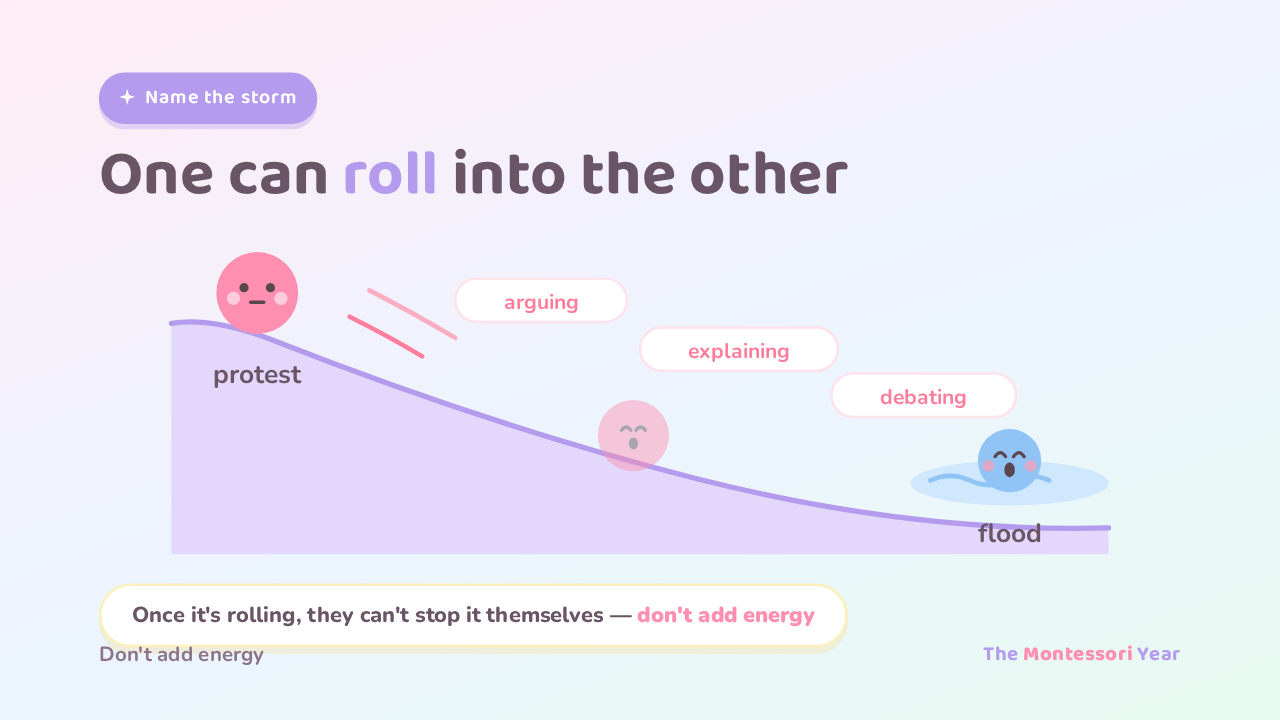
One can roll into the other
And here's the tricky part. One can turn into the other. A tantrum that starts as a protest can roll downhill into a real flood, because once genuine emotion gets moving, a small child can't stop the ball themselves. That's worth knowing, because our favorite tools push the ball faster. Arguing. Explaining. Debating the cereal at rising volume. You can't win a debate with someone who is past being rational, and every round adds fuel. So whatever else you do, the first rule is the same for both storms. Don't add energy. Be the still thing in the aisle.
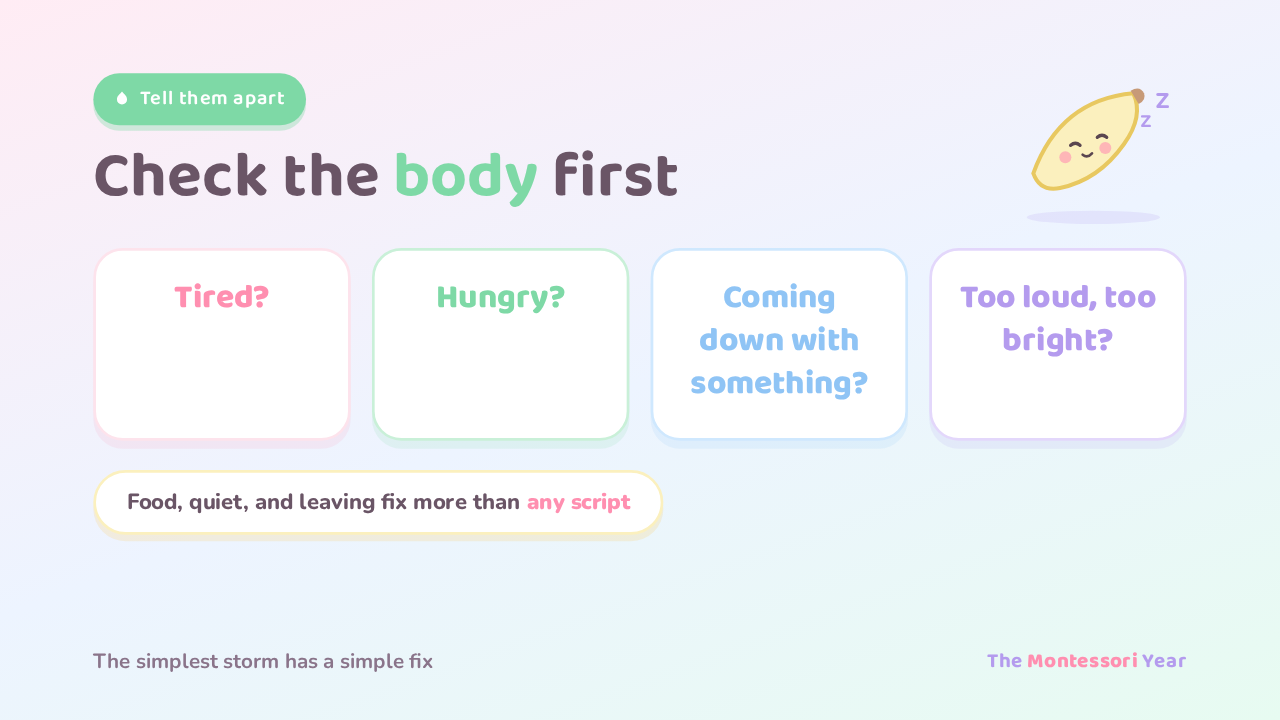
Check the body first
Now, telling them apart. Before anything clever, check the body. The most common storms are physical: a child who is extremely tired, irritably hungry, getting sick, or simply overstimulated by a loud, bright, busy place. This kind needs no philosophy. Food helps. Quiet helps. Leaving helps. A snack in your bag has ended more storms than any parenting script ever written. So run the body checklist first. When did they last eat? How did they sleep? How loud is this room? If the body is the problem, meet the body's need, and watch the storm dissolve on its own.
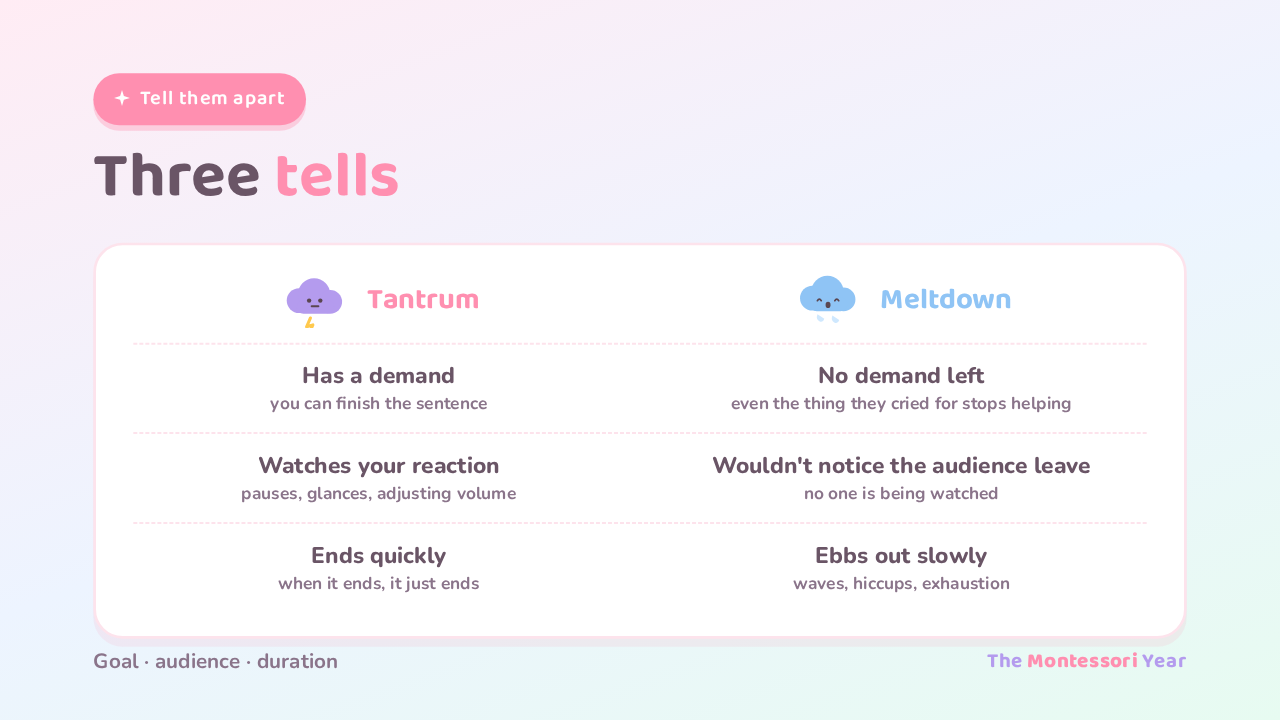
Three tells
If the body checks out, look for the tells. A tantrum has a demand attached, and you can usually finish the sentence: they want the toy, the turn, the not-leaving-yet. A meltdown has no demand left. Even the thing they were crying for stops helping. A tantrum watches you. There are pauses, glances, volume that adjusts to your reaction. A meltdown wouldn't notice if the audience left the building. And a tantrum is short. When it ends, it just ends. A meltdown runs long and ebbs out slowly, in waves, with hiccups and exhaustion. Goal, audience, duration. Three tells, one look.
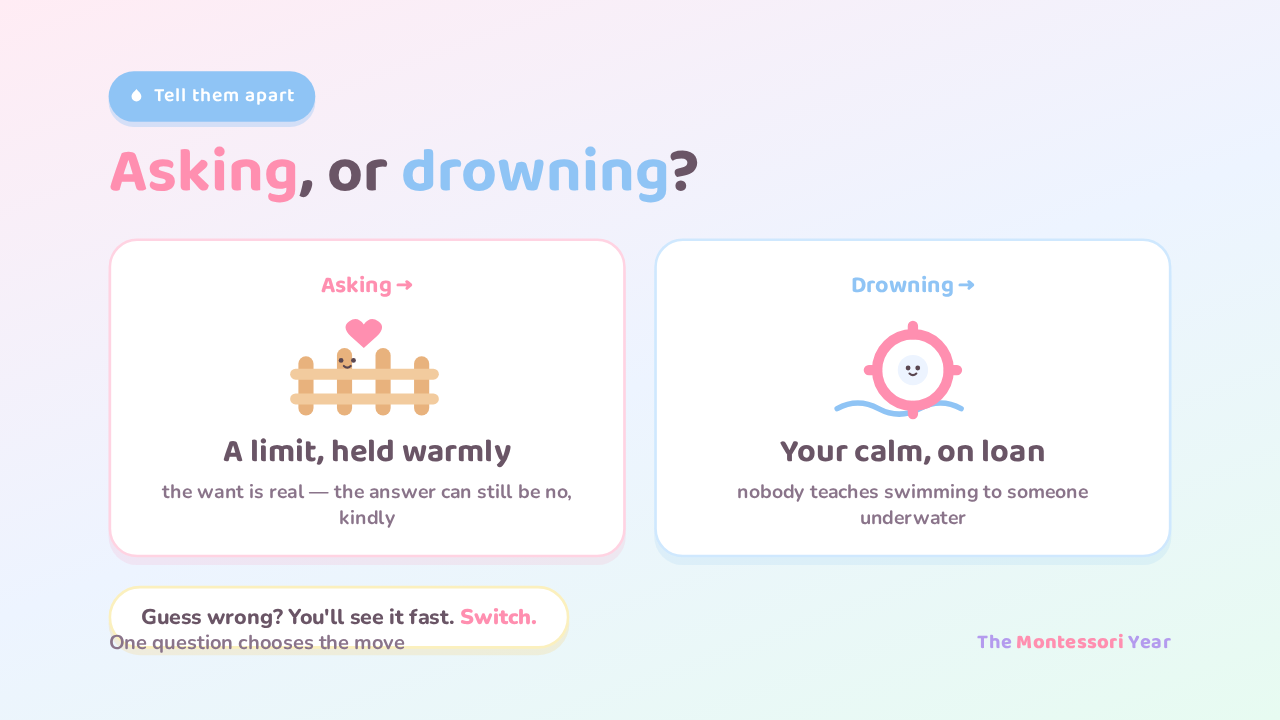
Asking, or drowning?
A limit, held warmly
the want is real — the answer can still be no, kindly
Your calm, on loan
nobody teaches swimming to someone underwater
All of it folds into one question you can ask right in the moment. Is my child asking for something, or drowning in something? Asking calls for a boundary, held kindly. The want is real, the answer is still no, and you can be warm about both. Drowning calls for a lifeguard. Nobody teaches swimming to someone underwater, and nobody holds a boundary against a wave. Ask the question, take your best guess, and let the answer choose your next move. And if you guess wrong? You'll see it quickly, and you can switch. Even a rough guess beats a coin flip made in panic.
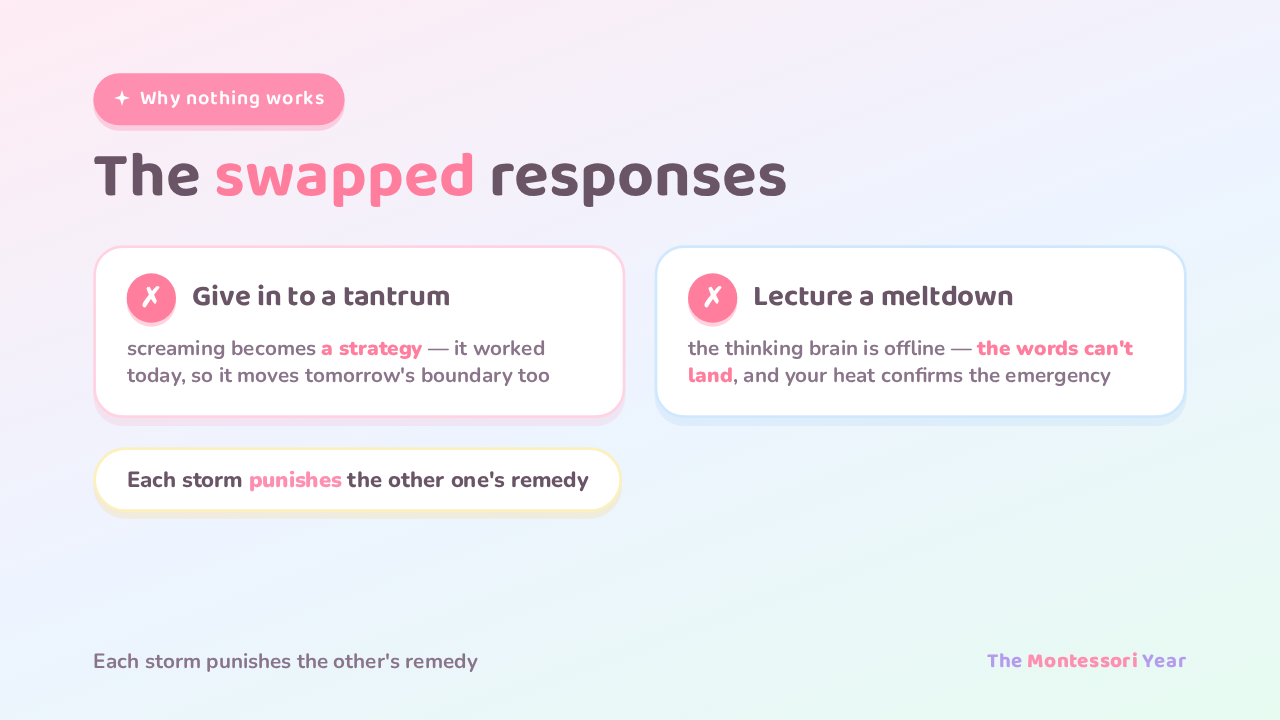
The swapped responses
Give in to a tantrum
screaming becomes a strategy — it worked today, so it moves tomorrow's boundary too
Lecture a meltdown
the thinking brain is offline — the words can't land, and your heat confirms the emergency
Which brings us to why nothing works: each storm punishes the other storm's remedy. Mistake one is treating a tantrum like a flood and giving in, just to make the crying stop. It works today. And your child learns that screaming moves boundaries. Tim Seldin warns that tantrums are typical for toddlers, but some children carry them on for years, because tantrums keep getting them what they want. Mistake two is treating a meltdown like a protest, with lectures and consequences. But the thinking part of that little brain is offline. Your words can't land, and your rising heat only confirms the emergency. Swap the responses, and both storms get worse.
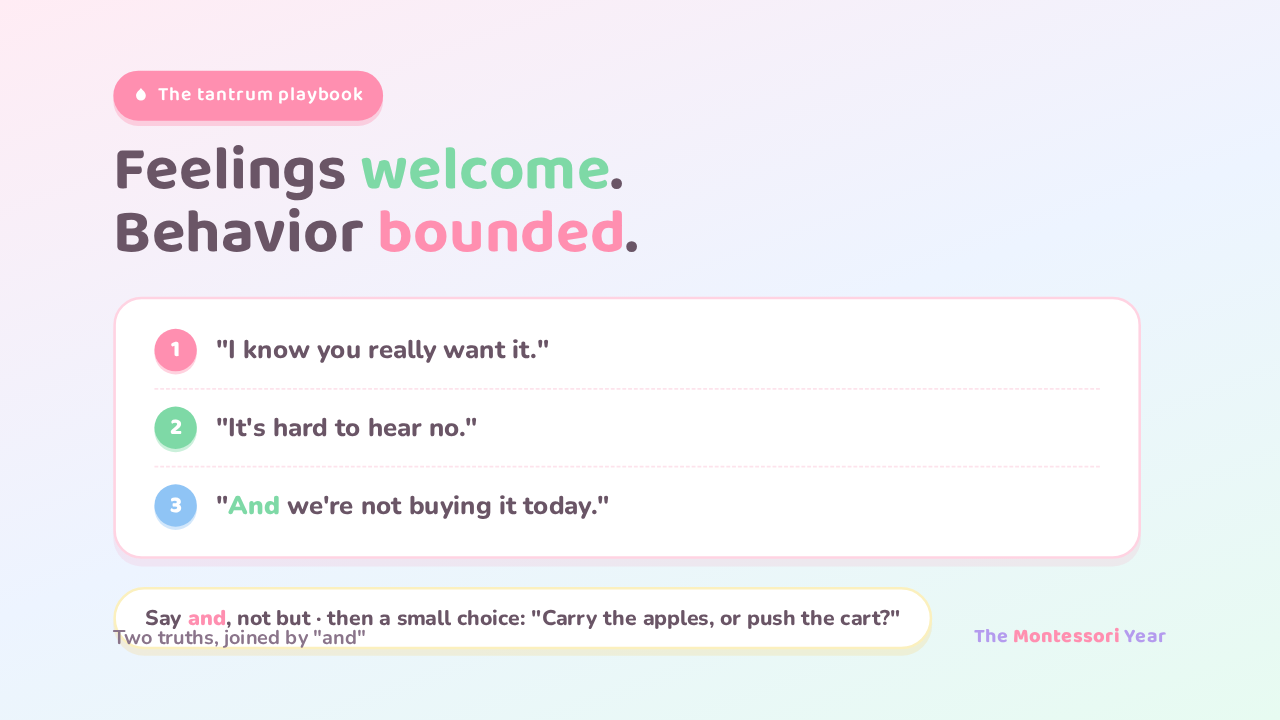
Feelings welcome.Behavior bounded.
- 1"I know you really want it."
- 2"It's hard to hear no."
- 3"And we're not buying it today."
So here's the tantrum playbook. The rule is simple to say and hard to do. All feelings are welcome, and all behaviors are not. Wanting the cereal is completely fine. Screaming for it doesn't change the answer. Come close, get down, connect first, and then say both truths, joined by and. I know you really want it. It's hard to hear no. And we're not buying it today. That little and matters, because but erases the empathy that came before it. Then, where you can, hand back some real control with a small choice. You can carry the apples, or push the little cart. You decide.
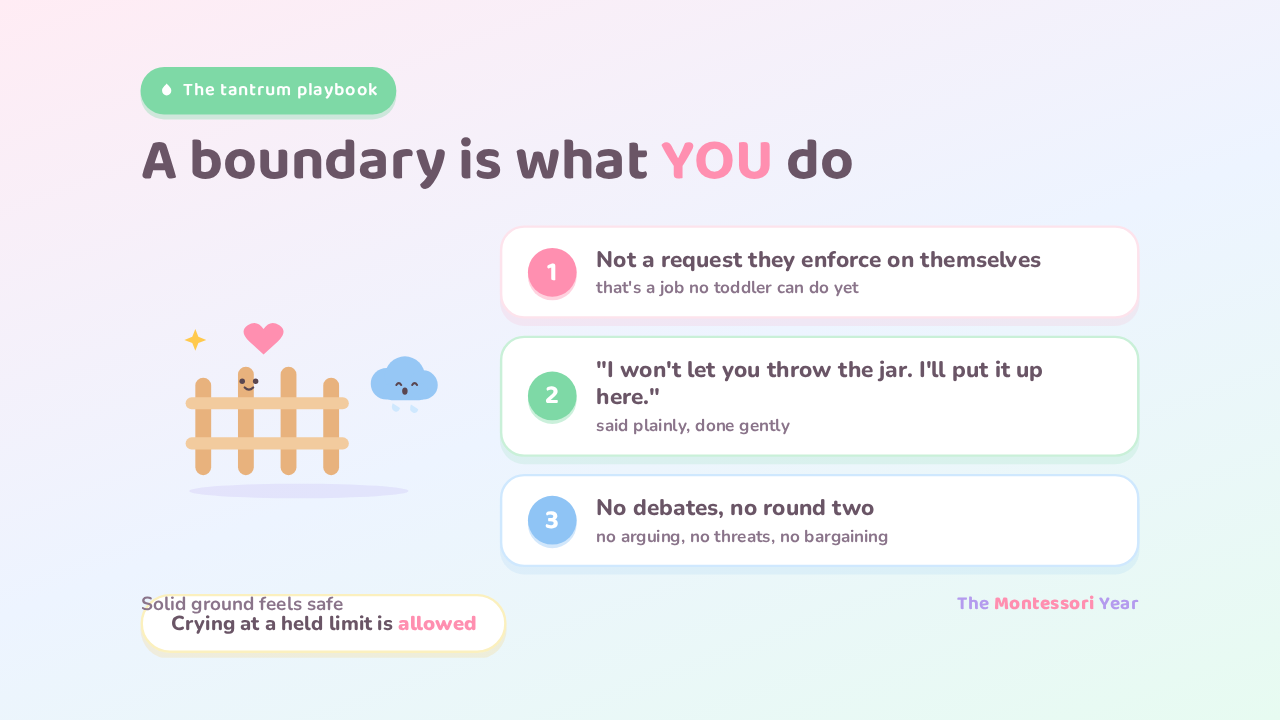
A boundary is what YOU do
Not a request they enforce on themselvesthat's a job no toddler can do yet
"I won't let you throw the jar. I'll put it up here."said plainly, done gently
No debates, no round twono arguing, no threats, no bargaining
Then hold. And notice what holding actually means. A boundary is not a request you shout across the aisle and hope a two-year-old enforces on themselves. That's a job no toddler can do yet. A boundary is what you will do, said plainly and done gently. I won't let you throw the jar. I'll put it up here. No arguing, no threats, no bargaining round two. Your child may cry the whole way to the car, and that is allowed. Feelings welcome, remember. A held limit isn't harshness. To a small child, a parent who means what they say feels like solid ground.
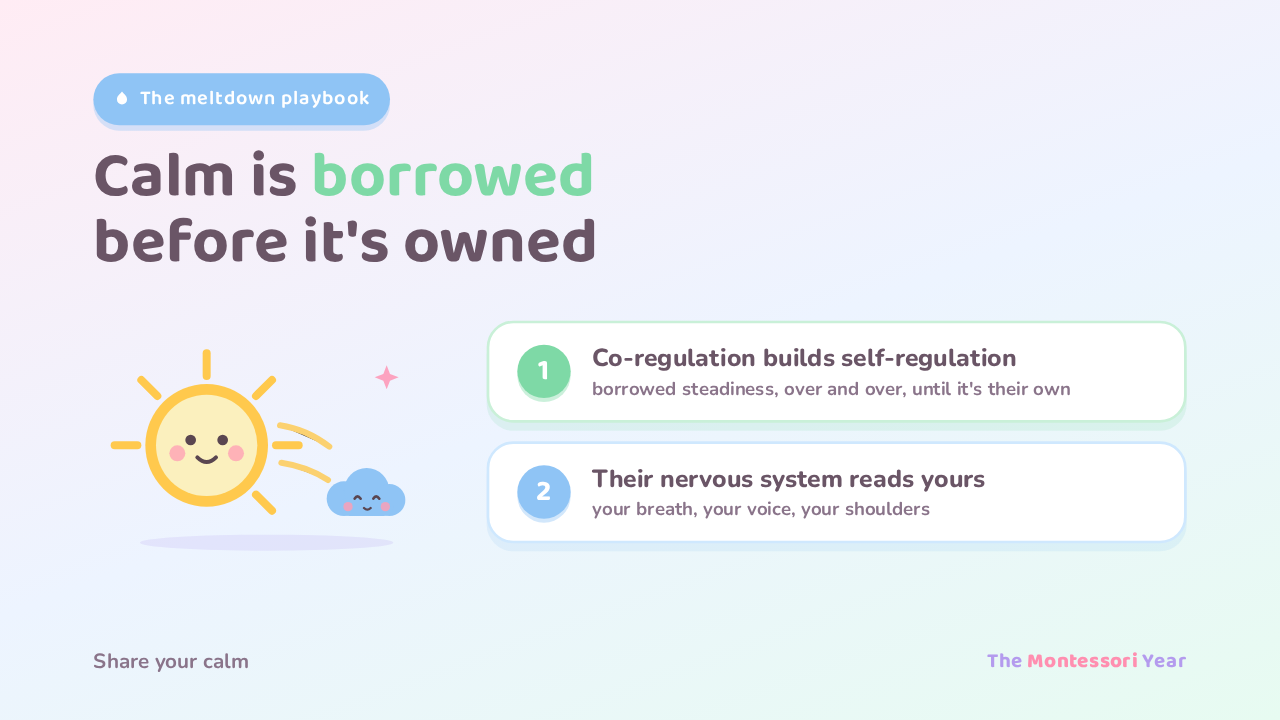
Calm is borrowedbefore it's owned
Co-regulation builds self-regulationborrowed steadiness, over and over, until it's their own
Their nervous system reads yoursyour breath, your voice, your shoulders
Now the meltdown playbook, and it starts with a truth about how calm is learned. Calm can't be installed with instructions. Children build self-regulation through co-regulation, which means borrowing a grown-up's steady nervous system, over and over, until the wiring becomes their own. You already know this feeling. On your worst days, you call a friend or lean into a hug, because another person's calm settles you. Your child's nervous system reads yours the same way. Your slow breathing. Your low voice. Your soft shoulders. In a meltdown, you're not the referee, and you're not the fixer. You are the calm they can't make yet.
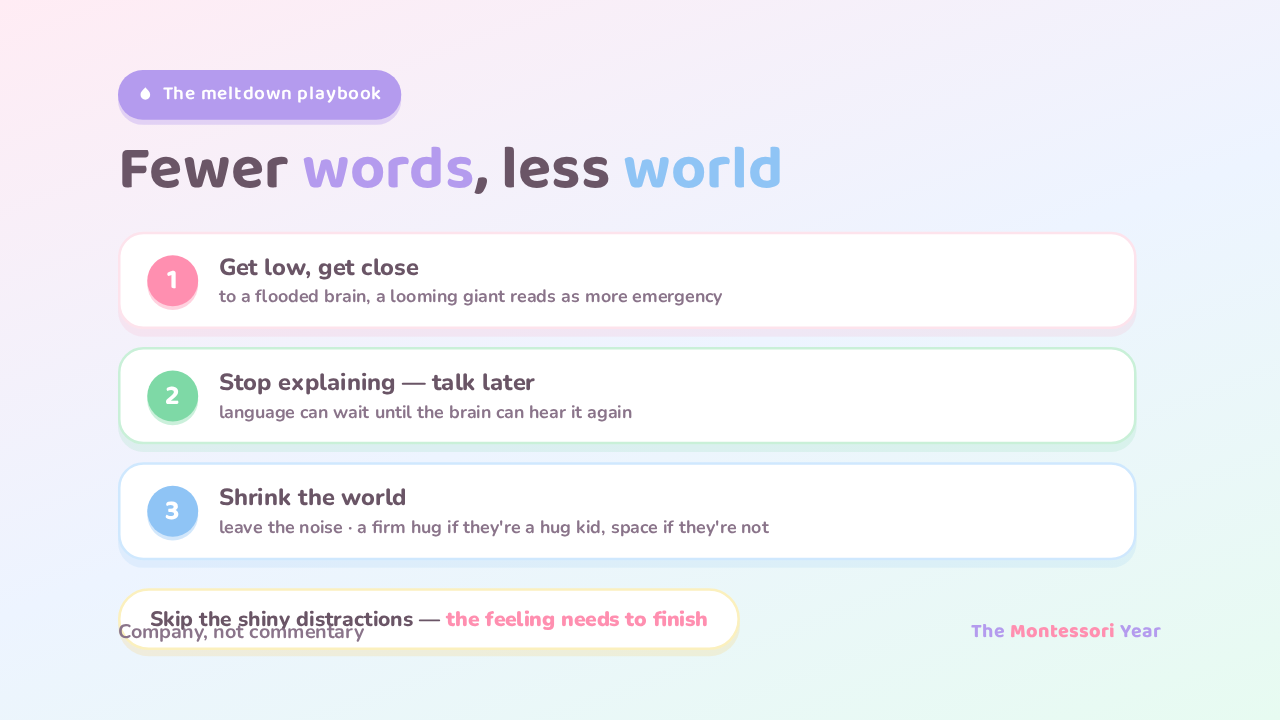
Fewer words, less world
Get low, get closeto a flooded brain, a looming giant reads as more emergency
Stop explaining — talk laterlanguage can wait until the brain can hear it again
Shrink the worldleave the noise · a firm hug if they're a hug kid, space if they're not
In practice, lend your calm like this. Fewer words, less world. Get down on their level, because to a flooded brain, a looming giant reads as more emergency. Get close, and stop explaining. Language can wait until the brain can hear it again. Then shrink the world. Carry them out of the loud, bright store if you can. Some children settle with a firm bear hug. Others can't bear touch until the wave has passed, and both are normal, so follow your child. Skip the shiny distractions too. The feeling needs to finish. You're not fixing the storm. You're keeping them company inside it.
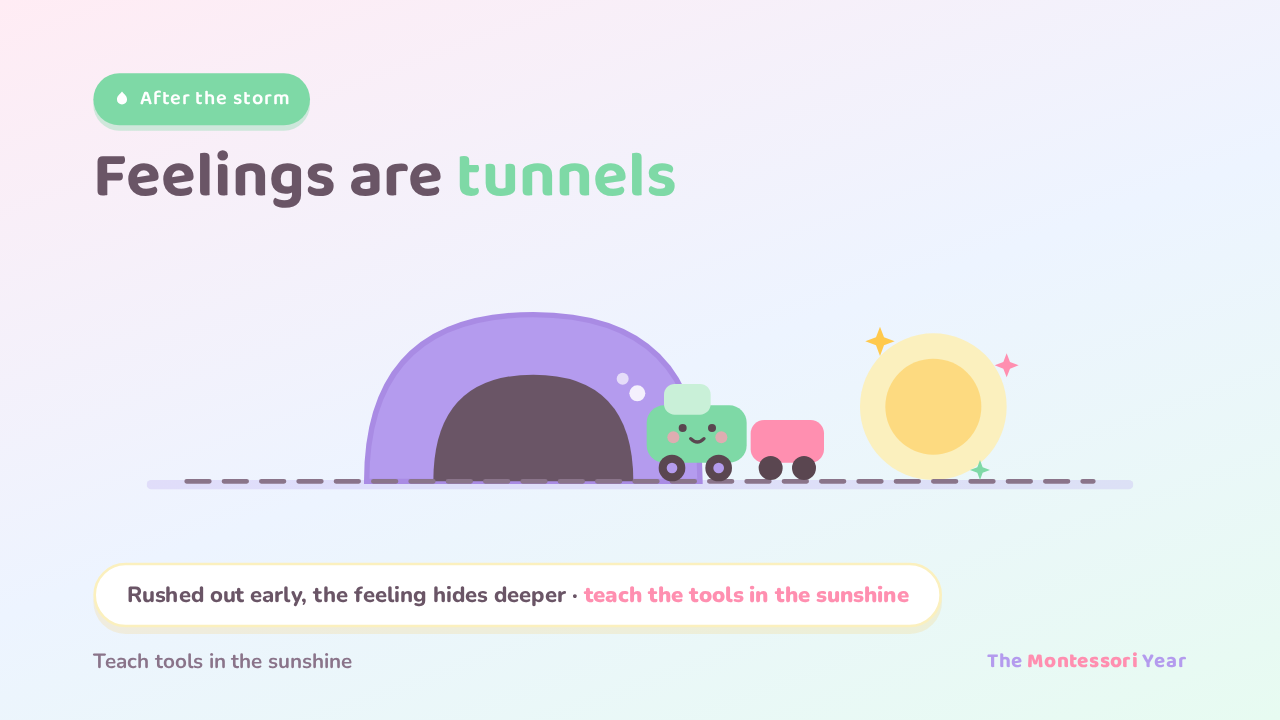
Feelings are tunnels
And storms do end. Here's an image worth keeping: a feeling is a tunnel, and your child is a little train riding through it. The only way out is through, all the way, to the light at the far end. Rushed out early, the feeling doesn't disappear. It just hides deeper. Ridden through with company, it empties, and a child often comes out the other side strangely peaceful, calmer than they've been all day. That is when words work again. That's the moment to name the feeling, and to practice the deep breath or the stomp-it-out dance. Teach the tools in the sunshine, and they'll be reachable in the rain.
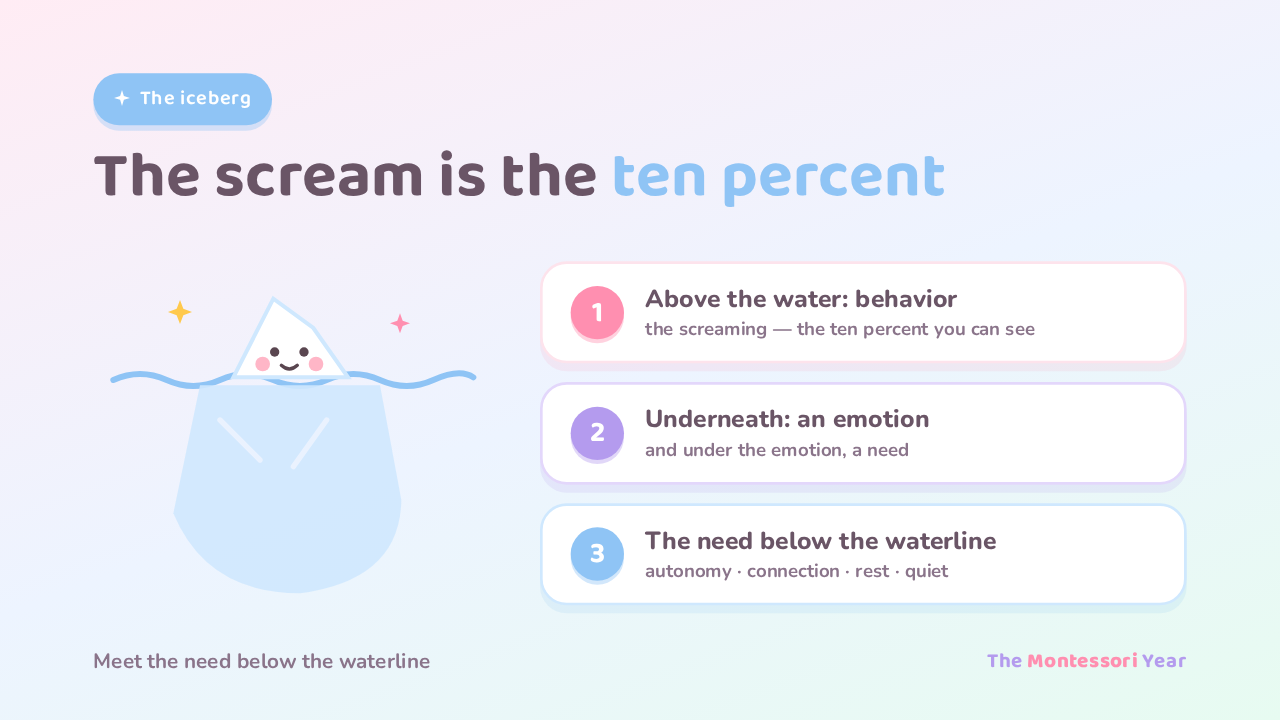
The scream is the ten percent
Above the water: behaviorthe screaming — the ten percent you can see
Underneath: an emotionand under the emotion, a need
The need below the waterlineautonomy · connection · rest · quiet
Zoom out once, because a bigger idea sits under both storms. Behavior is an iceberg. The screaming is the ten percent above the water. Underneath sits an emotion, and under the emotion sits a need. More say over their own little life. Connection. Rest. Relief from a noisy world. A child in a storm is asking for help in the hardest possible way. That's why punishing the tip of the iceberg changes so little. Meet the need below the waterline, and the behavior above it quiets on its own. This idea also softens you. It's very hard to stay angry at someone who is drowning and can't say so.
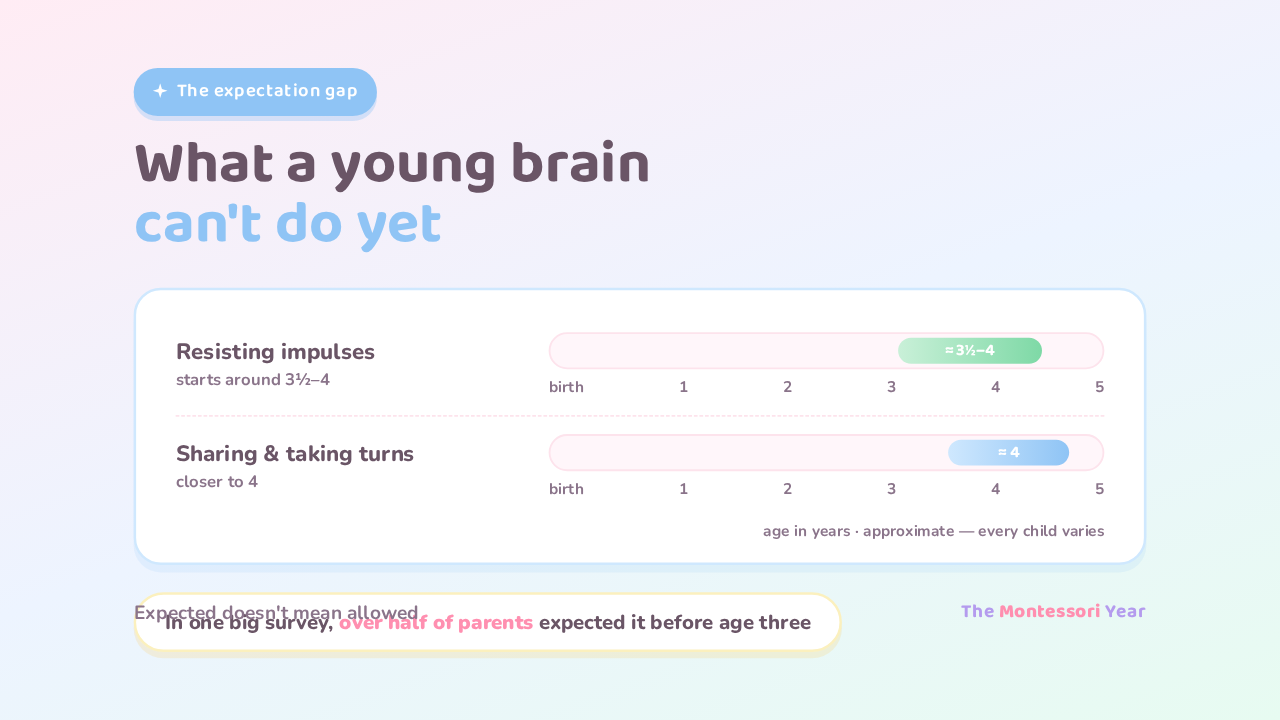
What a young braincan't do yet
There's one more reason storms feel constant at this age, and it isn't your child, and it isn't you. It's the gap between what we expect and what a young brain can do. In one big survey, more than half of parents believed children under three can resist a forbidden impulse. Over a third believed children under two can. The research on little brains says that skill only starts developing around three and a half to four. Sharing and turn-taking arrive closer to four. So much of what gets called bad behavior is a brain doing exactly what brains do at that age. Expected doesn't mean allowed. It means the limit comes without the anger.
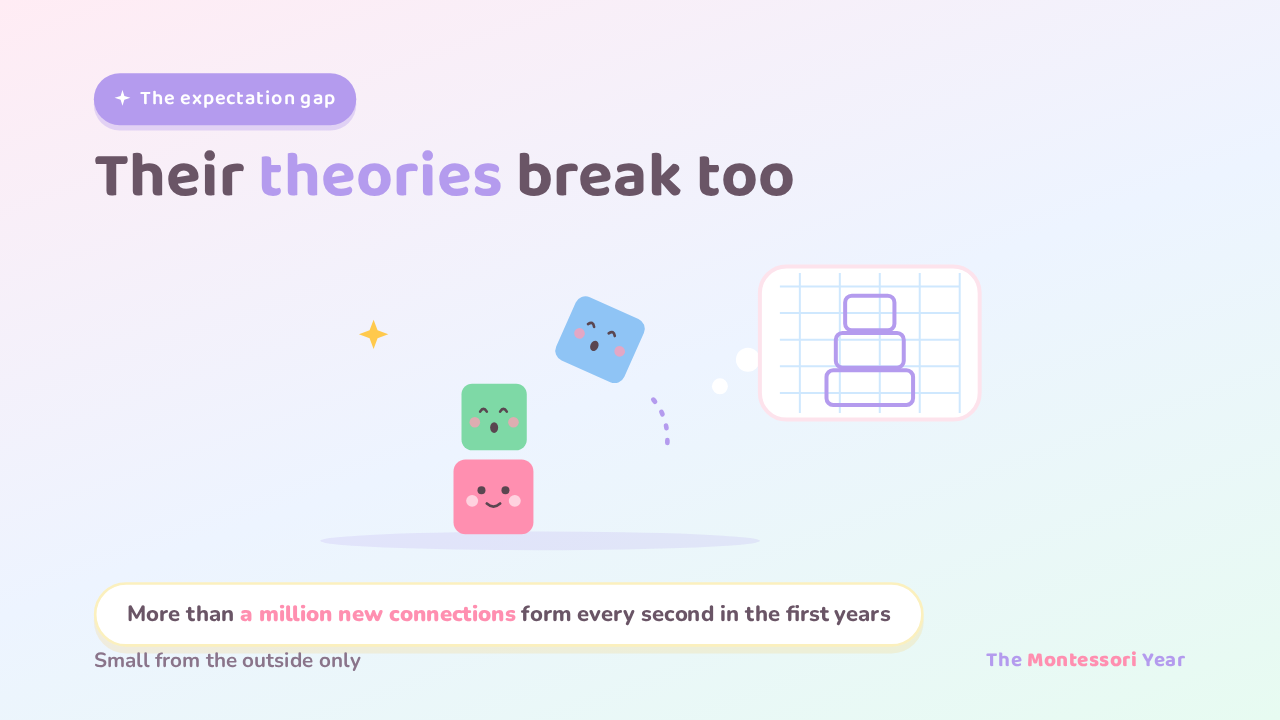
Their theories break too
Children carry expectations too, and theirs break constantly. The tower falls just as the last block goes on. The big sibling says no to sharing the puzzle. The morning goes differently from every other morning. In the first few years of life, a brain forms more than a million new connections every second, and each one is a little theory about how the world works. When a theory shatters, the feeling is real grief, small only from the outside. You didn't expect that, did you, love. That one sentence, said kneeling, is half the comfort. Predictable days and honest warnings about what's coming bridge these gaps before they become storms.
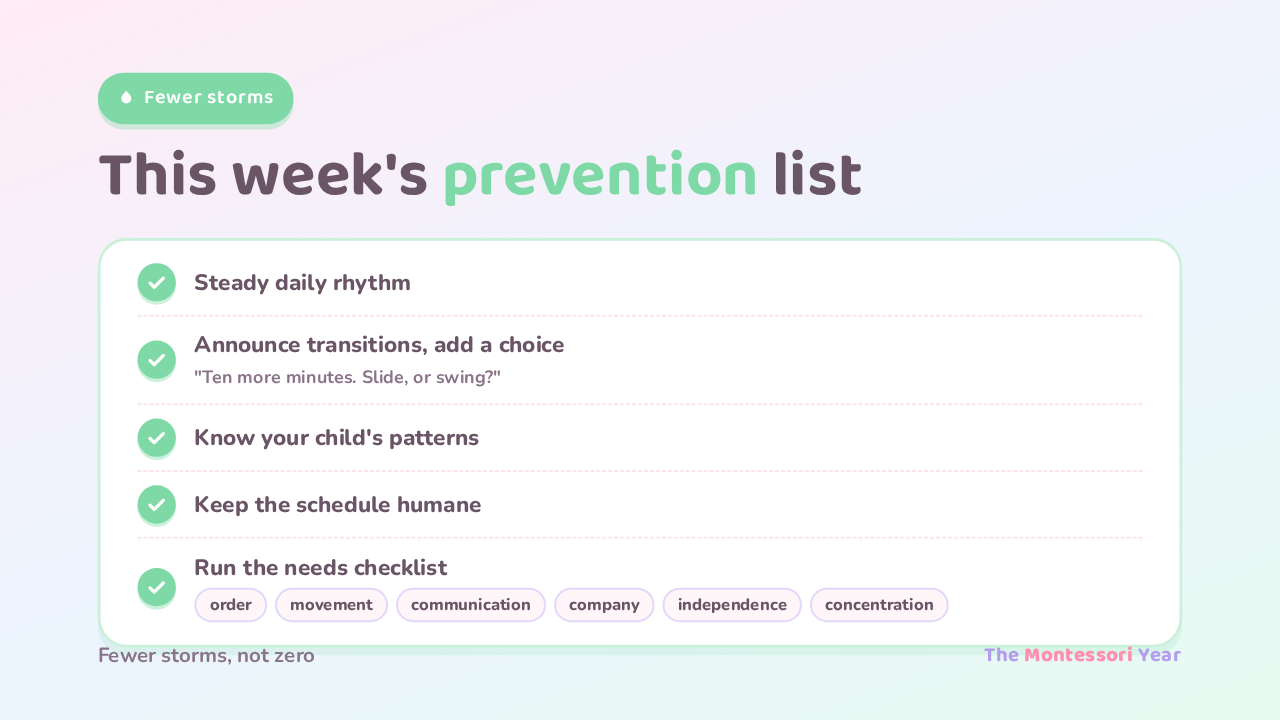
This week's prevention list
- Steady daily rhythm
- Announce transitions, add a choice"Ten more minutes. Slide, or swing?"
- Know your child's patterns
- Keep the schedule humane
- Run the needs checklistordermovementcommunicationcompanyindependenceconcentration
Which brings us to prevention. A steady daily rhythm, so the day itself feels like solid ground. Transitions announced ahead of time, with a small choice tucked inside. Ten more minutes. Slide, or swing? Watch for your child's patterns, the witching hour, the errand that always ends in tears, and plan around them. Keep the schedule humane, because racing between activities sets the stage for storms. And when trouble keeps repeating, check their needs like a list. Susan Stephenson shares the one Montessori teachers learn by heart in training: order, movement, communication, company, independence, uninterrupted concentration. When one of those runs empty, it often refills as a storm.
Same house,different storms
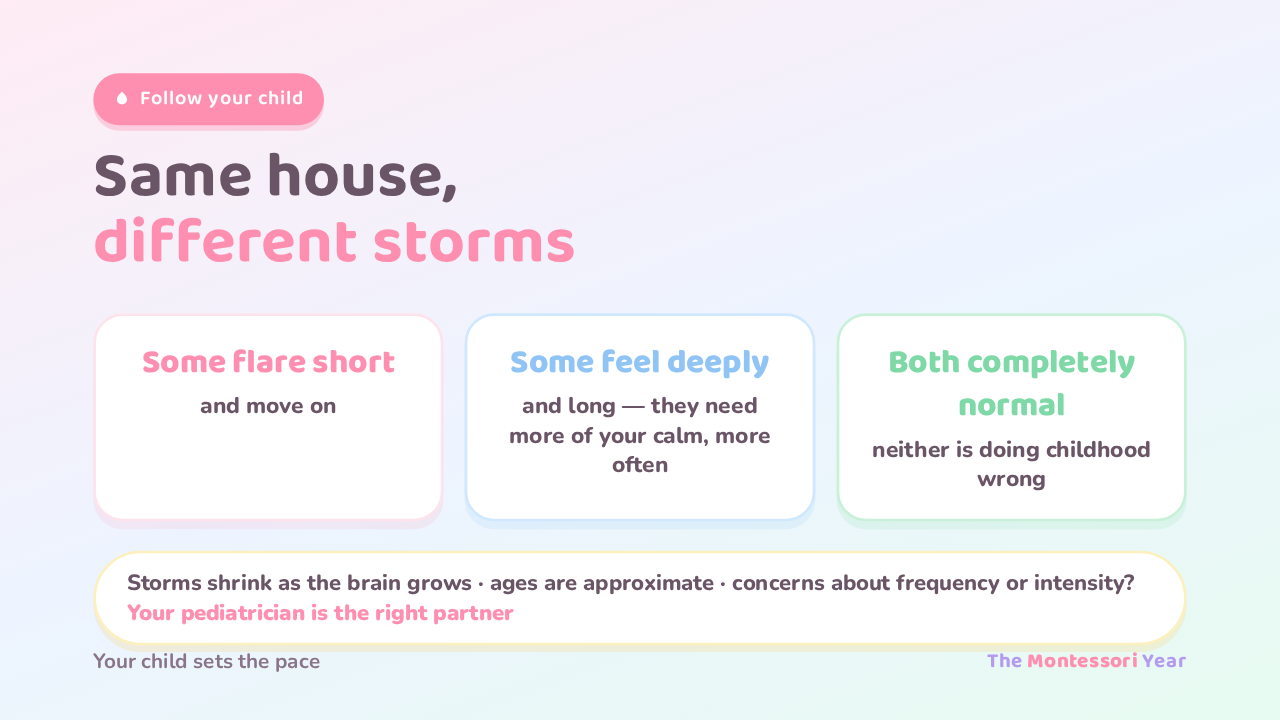
And as always, follow your child, because temperament is real. Two children in the same home can storm in profoundly different ways. One flares short and moves on. Another feels everything deeply, intensely, and for a long time, and simply needs more of your calm, more often. Neither one is doing childhood wrong. Storms also shrink on their own as the brain matures and language arrives, so this season is not forever, and the ages here are approximate. One honest note before we finish. If the frequency or intensity of your child's meltdowns ever worries you, your pediatrician is the right partner for that conversation.
Asking, or drowning?
Asking → the kind wall · drowning → the lifeguard.
Next in Peaceful Discipline: Say this, not that.
So, back to that grocery store floor. Next time, you'll kneel down with one question. Asking, or drowning? If they're asking, you'll be the kind wall. Feelings welcome, boundary held. If they're drowning, you'll be the lifeguard. Fewer words, less world, your calm on loan. Either way, you're no longer guessing, and you're no longer the enemy in the aisle. You're the adult who knows what this storm is. Your child isn't giving you a hard time. They're asking for help in the hardest way they know. You're not failing, and neither are they. Next time in Peaceful Discipline: what to say instead of no, stop, and don't. I'll see you there.