A day with your11-month-old ✿
Morning to bedtime — a rhythm you can actually live.
It's six in the morning, and someone in the next room is already awake — standing up in bed, holding on to the wall, announcing it to the whole house. Around eleven months, a lot of parents look up and realize the baby routine they knew has quietly expired. Two naps are fighting to become one. Purées have turned into demands for real food. And a baby who used to stay where you put them is now cruising the furniture like a tiny commuter. So today, let's walk through one whole day together, morning to bedtime — the Montessori way. Not a schedule to obey. A rhythm to lean on. Everything here comes from the books — mainly The Joyful Child, by Susan Mayclin Stephenson — and I'll tell you which one, as we go.
A rhythm, not a schedule
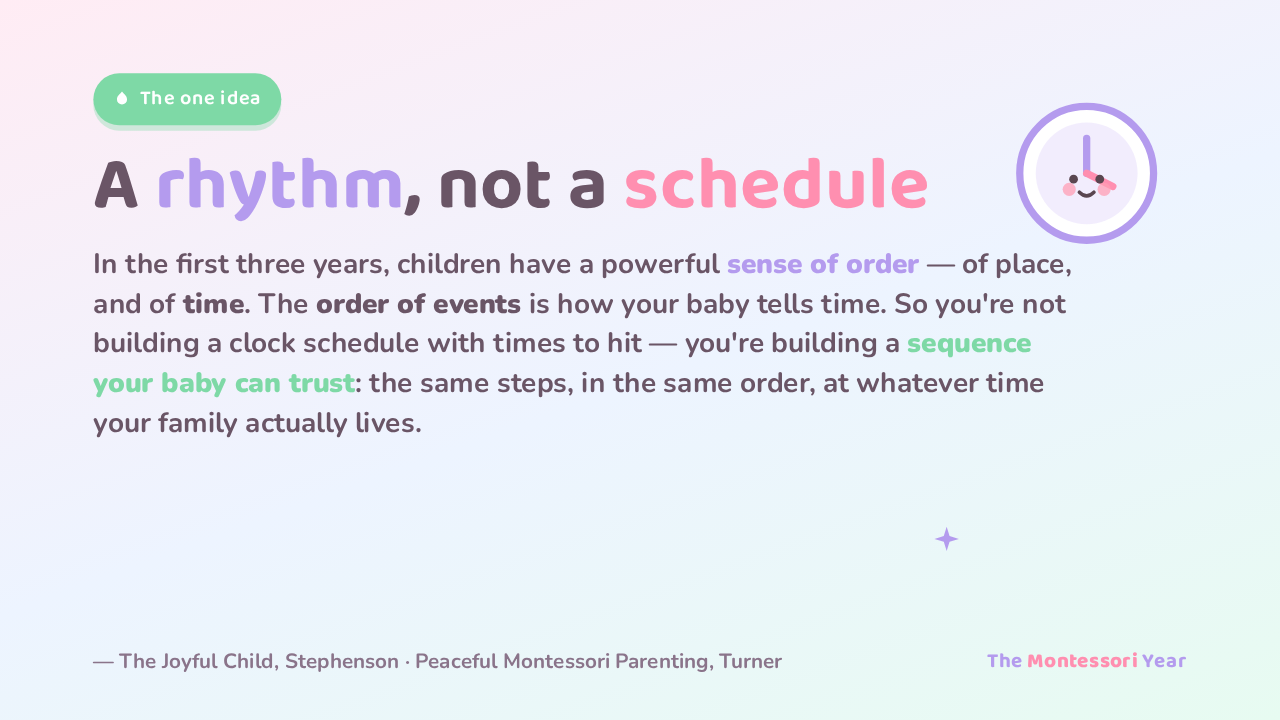
In the first three years, children have a powerful sense of order — of place, and of time. The order of events is how your baby tells time. So you're not building a clock schedule with times to hit — you're building a sequence your baby can trust: the same steps, in the same order, at whatever time your family actually lives.
Here's the one idea that holds the whole day together. Montessori observed that in the first three years, children have a very strong sense of order — of place, and of time. In The Joyful Child, Stephenson describes a baby who became upset simply because he was bathed after a meal, when he was used to being bathed before it. The order of events is how your baby tells time. And in Peaceful Montessori Parenting, Haley Turner puts it simply: go with the flow, while maintaining a rhythm. She points out that the predictability of a daily rhythm measurably reduces stress for children — it tells them what's coming, so they can relax into it. So we're not building a clock schedule with times to hit. We're building a sequence your baby can trust: the same steps, in the same order, at whatever time your family actually lives.
The shape of the day
☀ Morning
- Wake & unhurried carediaper, clothes made for moving
- Breakfast at the little table
- The real workfree movement, independent play
- Outside, every day
☁ Midday
- Lunchtheirs first, then the family table
- The napby need, not by clock
- Quiet waking upno rush back into the day
☾ Afternoon & evening
- Books & the treasure basket
- Tag alongerrands, laundry, "helping"
- Dinner alongside the family
- Bath & the same goodnight steps
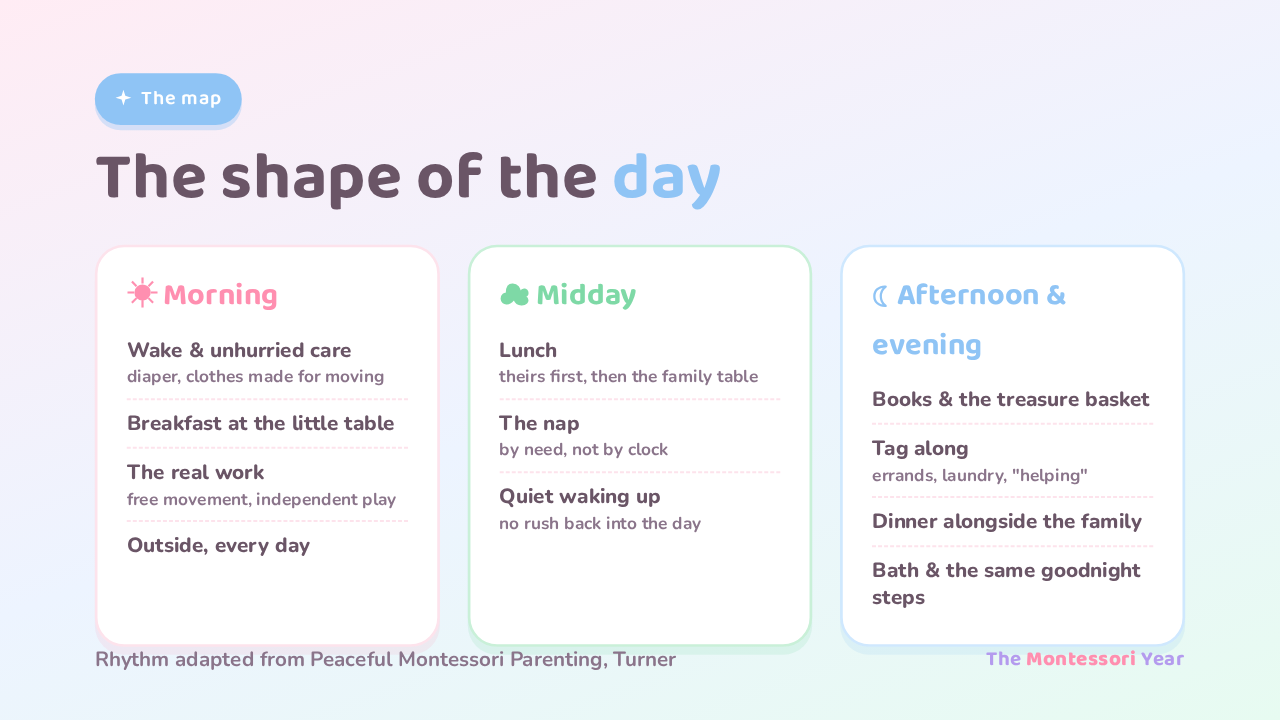
So here's the shape of a Montessori day at around eleven months. The morning: wake, and unhurried care — a fresh diaper, clothes made for moving. Breakfast at the little table. Then the morning's real work: free movement, independent play, and some time outside. Midday: lunch, and then a nap — according to need, not the clock. And the rest: an afternoon of books, the treasure basket, errands together, and time just being near you while you work. Dinner alongside the family. Then a bath, and the same few steps to bed, in the same order, every single night. If the times drift — and with an eleven-month-old, they will — the sequence holds. That's adapted from the daily rhythm Haley Turner shares in Peaceful Montessori Parenting, shaped by The Joyful Child's first-year chapters. Now let's take it one moment at a time.
Care, done together
Narrate everything"I'm going to change you now — here we go, lifting you up."
Your face is their mirrorthey can't separate your reaction to the mess from your reaction to them
Dress for movementhands free, knees free — nothing that pins the crawl or the cruise
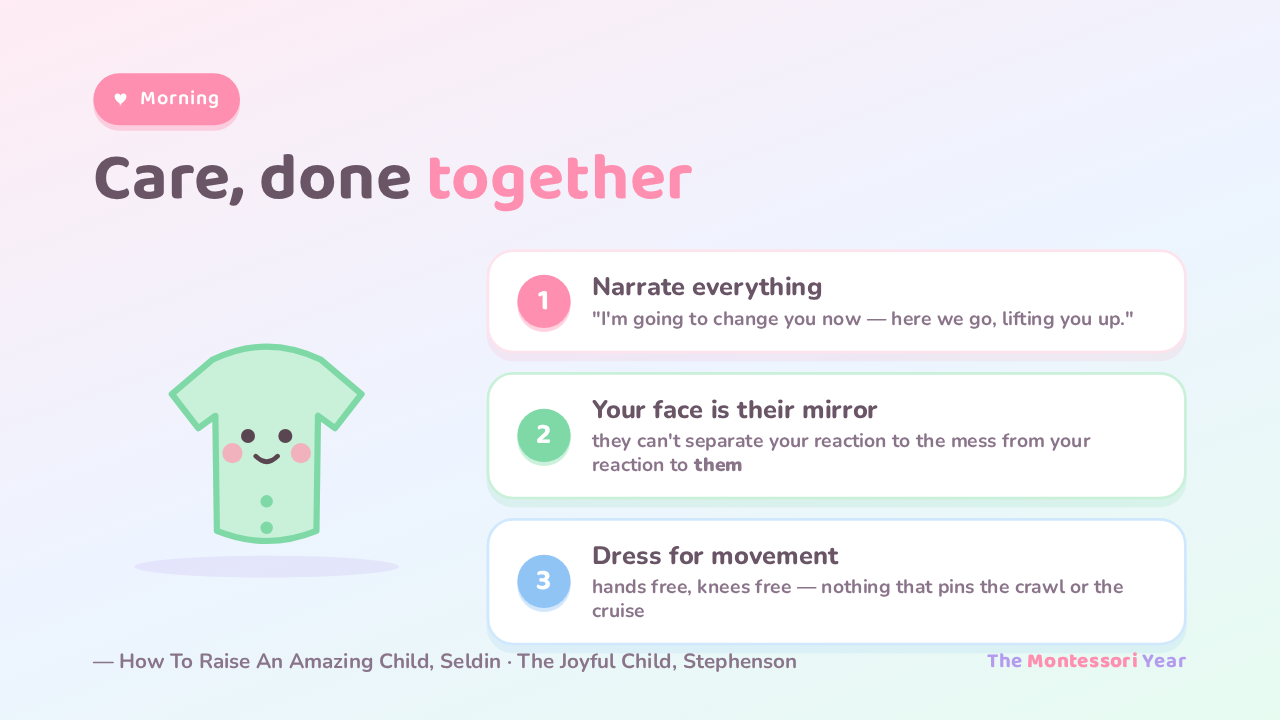
The day starts with care — diaper, clothes, faces washed. It's tempting to rush through it. But in a Montessori home, care time is the first connection of the day. Tim Seldin, in How To Raise An Amazing Child, suggests narrating all of it: "I'm going to change you now. Here we go — lifting you up." You're tying actions to language, all day long. And Stephenson tells a story that changed how I think about diapers: a nurse who wrinkled her nose at a baby's messy diaper — and the baby's face fell. Because from his side, she was reacting to him. Your baby can't yet separate your reaction to the mess from your reaction to them. So keep your face warm, and include them in the job — let them lift their legs, push an arm through a sleeve. Then dress them for movement: nothing that covers their hands, nothing that pins their knees.
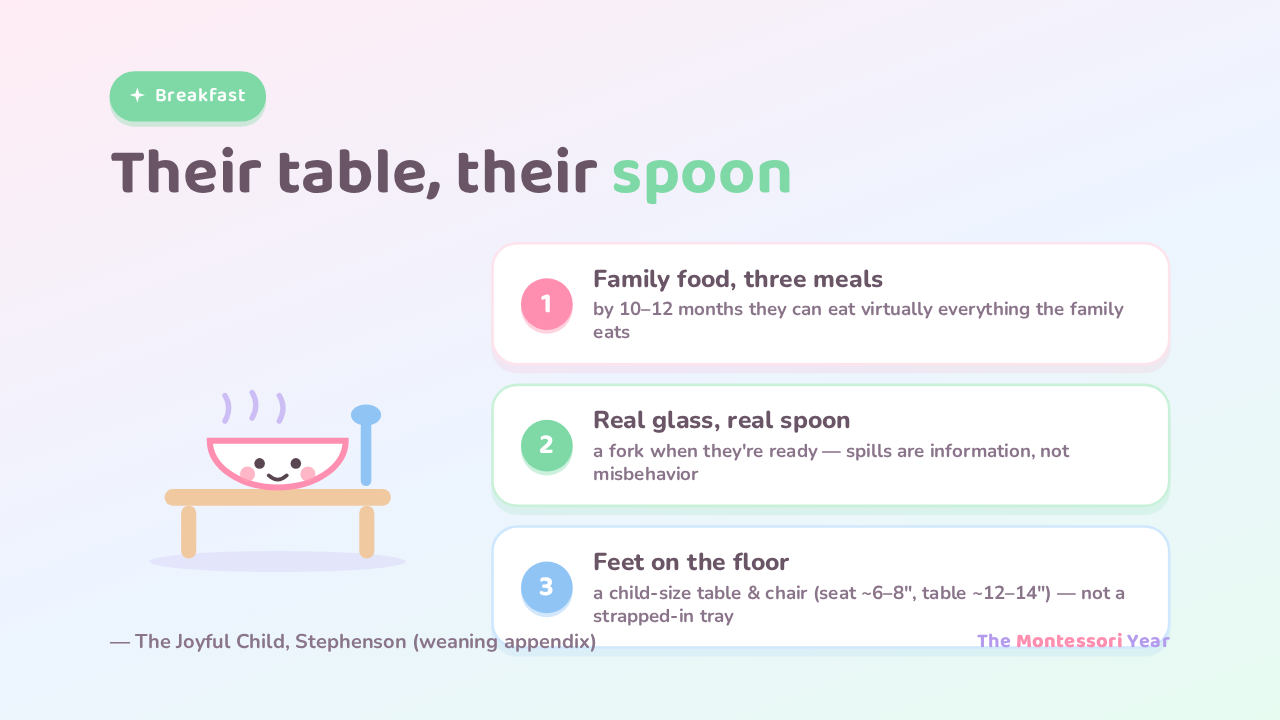
Their table, their spoon
Family food, three mealsby 10–12 months they can eat virtually everything the family eats
Real glass, real spoona fork when they're ready — spills are information, not misbehavior
Feet on the floora child-size table & chair (seat ~6–8", table ~12–14") — not a strapped-in tray
By ten to twelve months, Stephenson writes, your child can be eating virtually everything the rest of the family eats — three meals a day, sometimes at their own little table, sometimes at the family's. So breakfast looks like this: food they can feed themselves, from the family's own menu. A real glass — small, and yes, breakable. A real spoon, and a fork when they're ready. Sit with them; expect spills — a spill is information, not misbehavior. And a child-sized table and chair, low enough that their feet reach the floor. Notice what's missing: no bottle propped on a pillow, no pouch eaten on the go. The Joyful Child has a lovely detail here — a placemat with the outlines of the dish, the glass, and the spoon, so that one day soon, they can set their own place. Breakfast isn't just calories. It's the first independent work of the day.
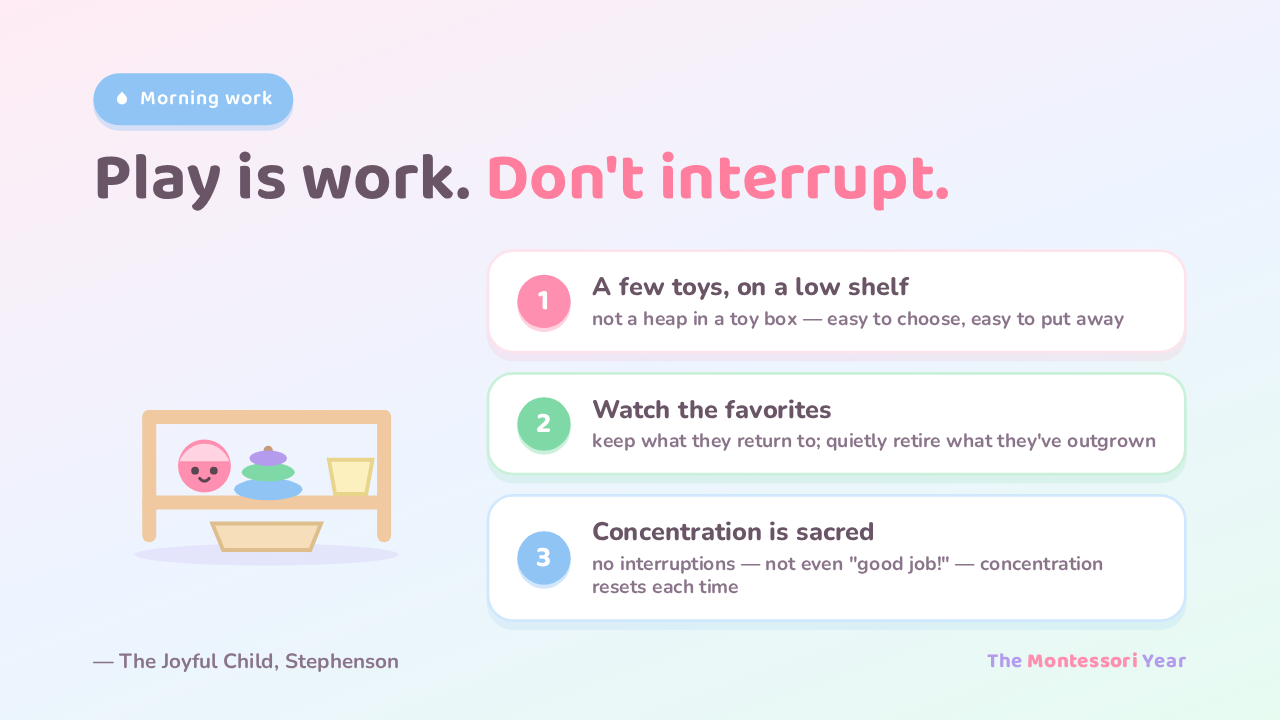
Play is work. Don't interrupt.
A few toys, on a low shelfnot a heap in a toy box — easy to choose, easy to put away
Watch the favoriteskeep what they return to; quietly retire what they've outgrown
Concentration is sacredno interruptions — not even "good job!" — concentration resets each time
Now the part of the morning that matters most, and costs nothing: uninterrupted play. Montessori called a child's activity work — something that involves the mind and the body, with a purpose that fulfills them. At eleven months, pulling every scarf out of a basket, over and over, is real work. Stephenson tells of a baby in a stroller who studied a poster on a building for twenty-two minutes — then sighed, happily, and looked away. Whatever he was doing, it was important. So: a few toys on a low shelf, not a heap in a toy box. Watch which ones they return to, and quietly retire what they've outgrown. And when they're concentrating — don't interrupt. Not even with praise. The urge to cheer every thirty seconds is real, but concentration is a muscle, and every interruption resets it. Your job this hour is nearby, quiet, and gloriously unnecessary.
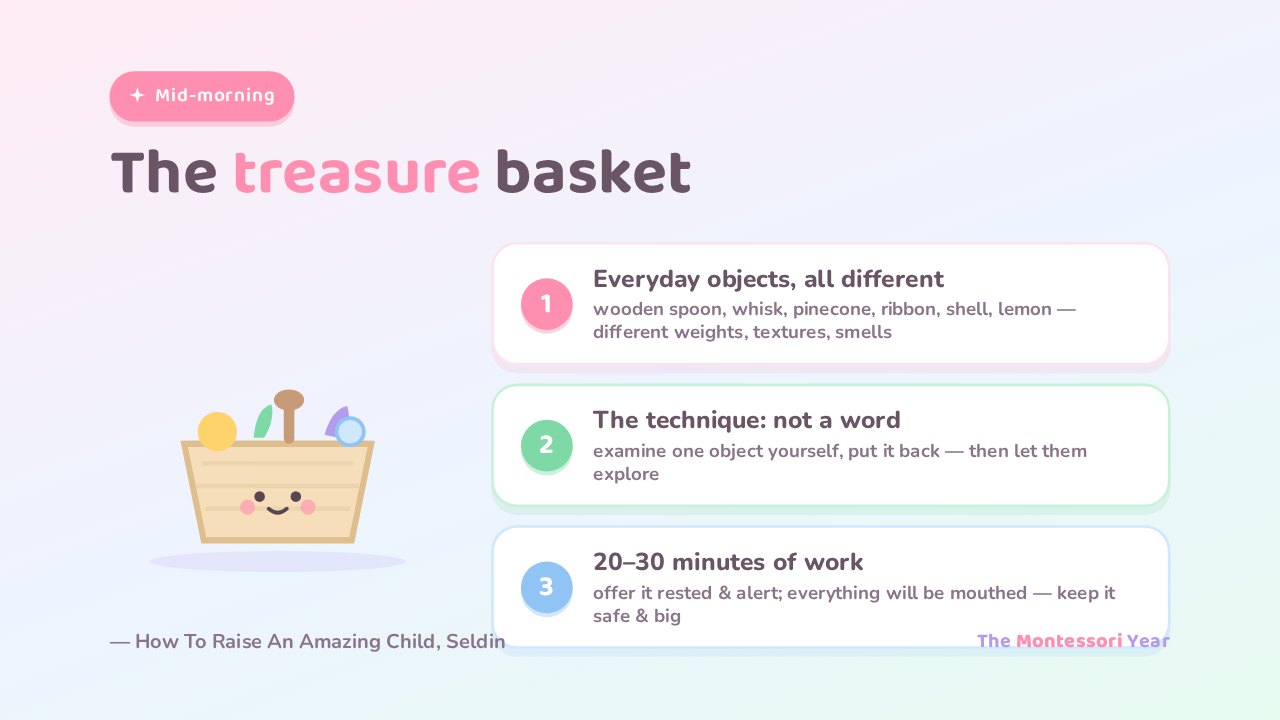
The treasure basket
Everyday objects, all differentwooden spoon, whisk, pinecone, ribbon, shell, lemon — different weights, textures, smells
The technique: not a wordexamine one object yourself, put it back — then let them explore
20–30 minutes of workoffer it rested & alert; everything will be mouthed — keep it safe & big
Mid-morning, when your baby is rested and alert, bring out the treasure basket. Tim Seldin describes it beautifully: a low basket of everyday objects — dozens of them, each distinctly different in shape, weight, texture, and smell. A wooden spoon. A metal whisk. A pinecone, a silk ribbon, a big shell, a lemon. Everything large enough not to be swallowed, and safe to mouth — because it will all be mouthed; that's how babies study things. Here's the technique, straight from the book: put the basket down, and don't say a word. Pick up one object yourself, examine it slowly, put it back. Then let them explore. An engaged baby, Seldin notes, may work at that basket for twenty or thirty minutes. Stay close, but don't direct. Real things beat plastic, because real things are honest — cold, heavy, rough, fragrant — and plastic all feels the same.
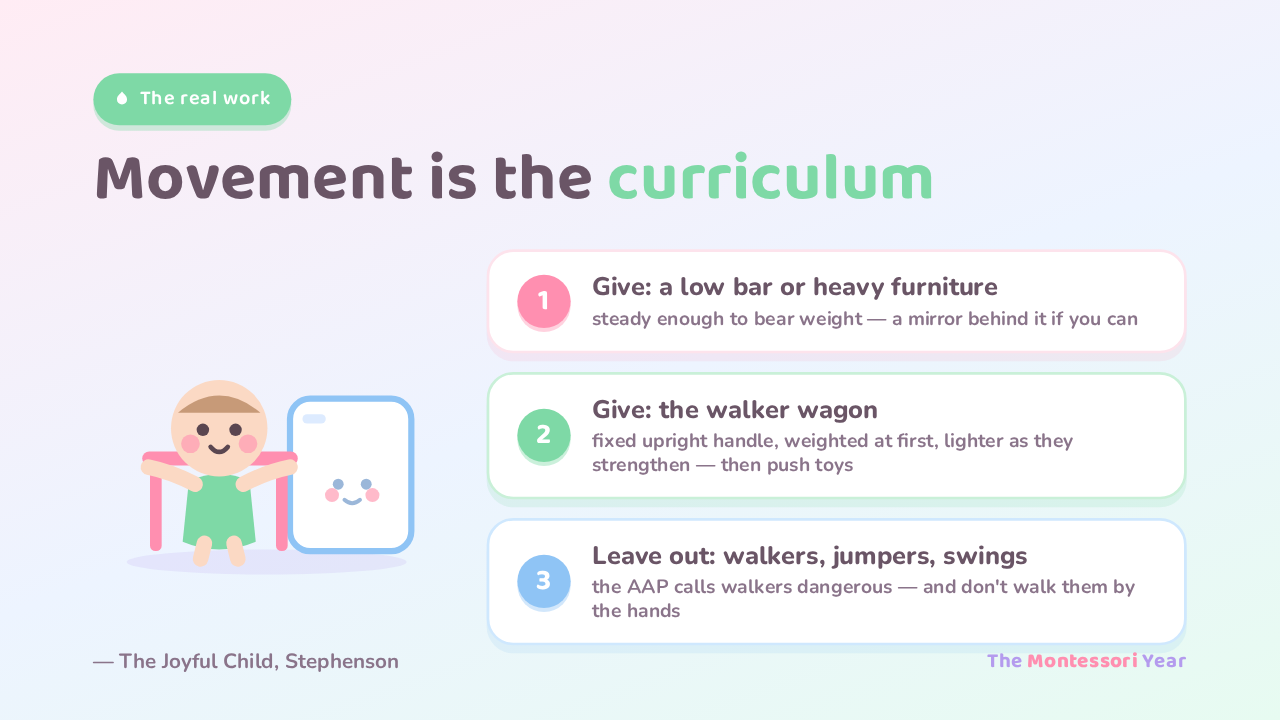
Movement is the curriculum
Give: a low bar or heavy furnituresteady enough to bear weight — a mirror behind it if you can
Give: the walker wagonfixed upright handle, weighted at first, lighter as they strengthen — then push toys
Leave out: walkers, jumpers, swingsthe AAP calls walkers dangerous — and don't walk them by the hands
At eleven months, movement is the curriculum. Pulling up, cruising along the couch, maybe first steps — each child has an internal timetable, Stephenson writes, and it needs no hurrying from us. What helps: a low bar, or a heavy, stable piece of furniture to pull up on — with a mirror behind it if you can manage one. A walker wagon — that little cart with the fixed, upright handle — weighted at first so it can't scoot away, then lighter as they grow stronger. Push toys, once they're steady. And what hinders — this list is straight from The Joyful Child: baby walkers, jumpers, swings, long stretches parked in containers. Walkers teach the legs the wrong lessons, and she quotes the American Academy of Pediatrics calling them dangerous enough to ban from day care centers. And walking them around by the hands? It feels like helping. Mostly it tells them their own timetable isn't good enough.
Outside, every day
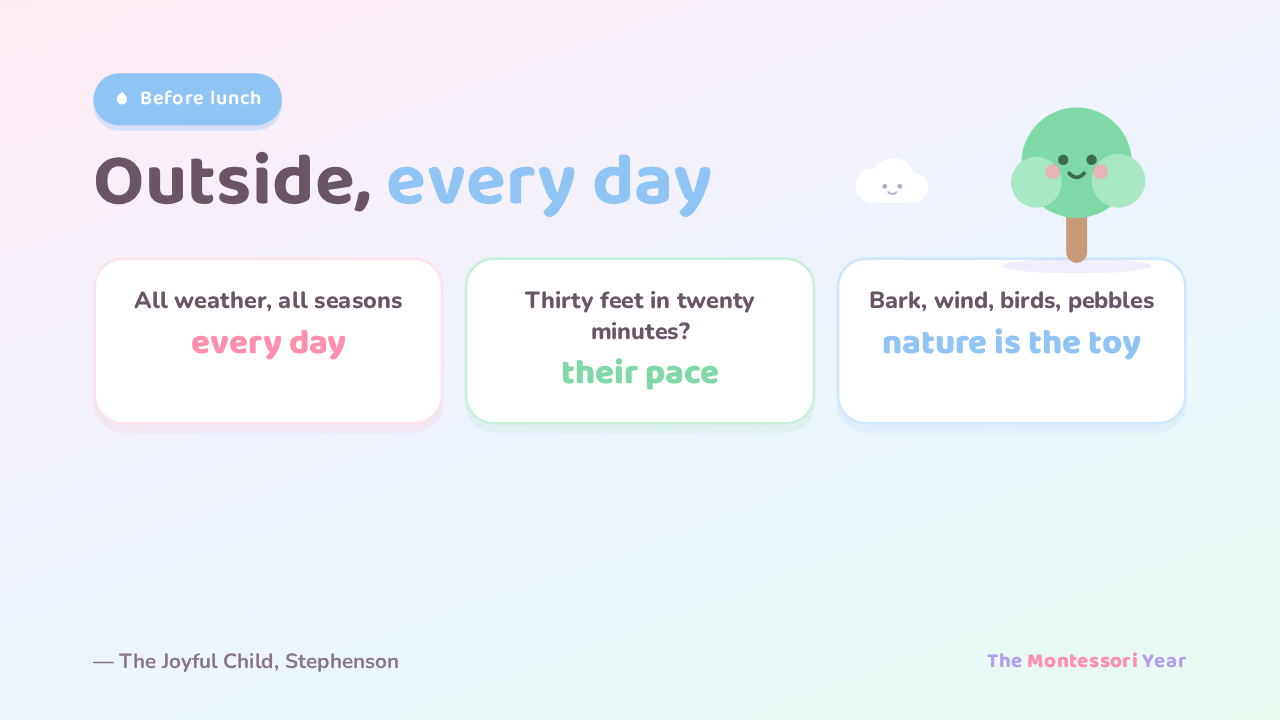
Sometime before lunch, go outside — every day if possible, in all kinds of weather, through every season. That's not me being romantic; that's Stephenson: nothing can substitute for walking in nature, hearing birds, watching the daily growth of a flower. For an eleven-month-old, outside is a full sensory meal — bark under the fingers, wind on the face, the smell of the ground after rain. Let them cruise along a park bench. Let the walk belong to them, even if it covers thirty feet in twenty minutes — a child moving at their own pace, stopping for every pebble, is doing exactly the work of this age. Grass is a fine gymnasium, and a gentle slope is a better teacher than any climbing toy. There's no bad weather for it — just clothes that let them move, and a grown-up who isn't in a hurry.
Two tables, one family
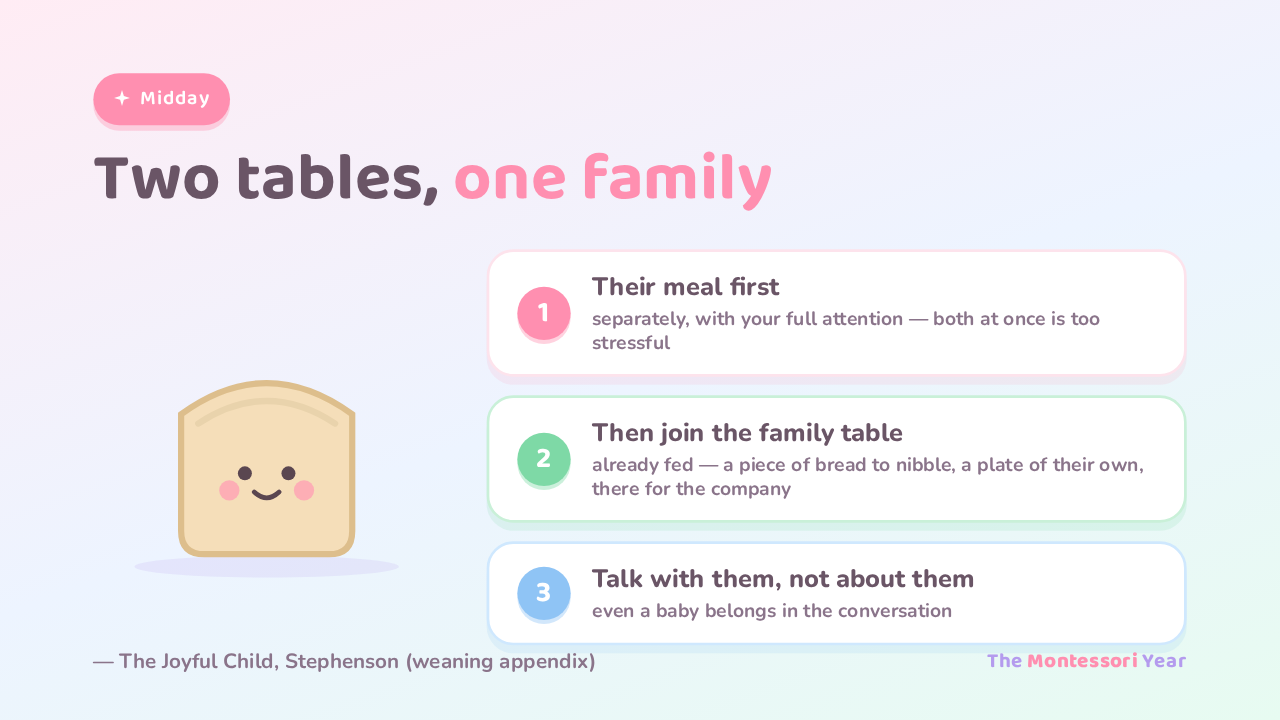
Their meal firstseparately, with your full attention — both at once is too stressful
Then join the family tablealready fed — a piece of bread to nibble, a plate of their own, there for the company
Talk with them, not about themeven a baby belongs in the conversation
Lunch works like breakfast: real food, real dishes, their own table. But here's a distinction from The Joyful Child worth keeping. Early in weaning, your child eats their own meal separately, when you can give them your full attention — managing their meal and yours at once is too stressful for everyone. But they should be present at the family's meal whenever they're interested: already fed, with a piece of bread to nibble and a plate of their own, there for the company. That's how they learn what meals actually are — not just eating, but eating together: manners, turn-taking, the music of family talk. And through all of it, include them in the conversation. Stephenson once watched doctors discuss an infant as if he weren't in the room — until a nurse reminded them to talk to him. Even a baby deserves to be spoken with, not about.
Sleep is work too
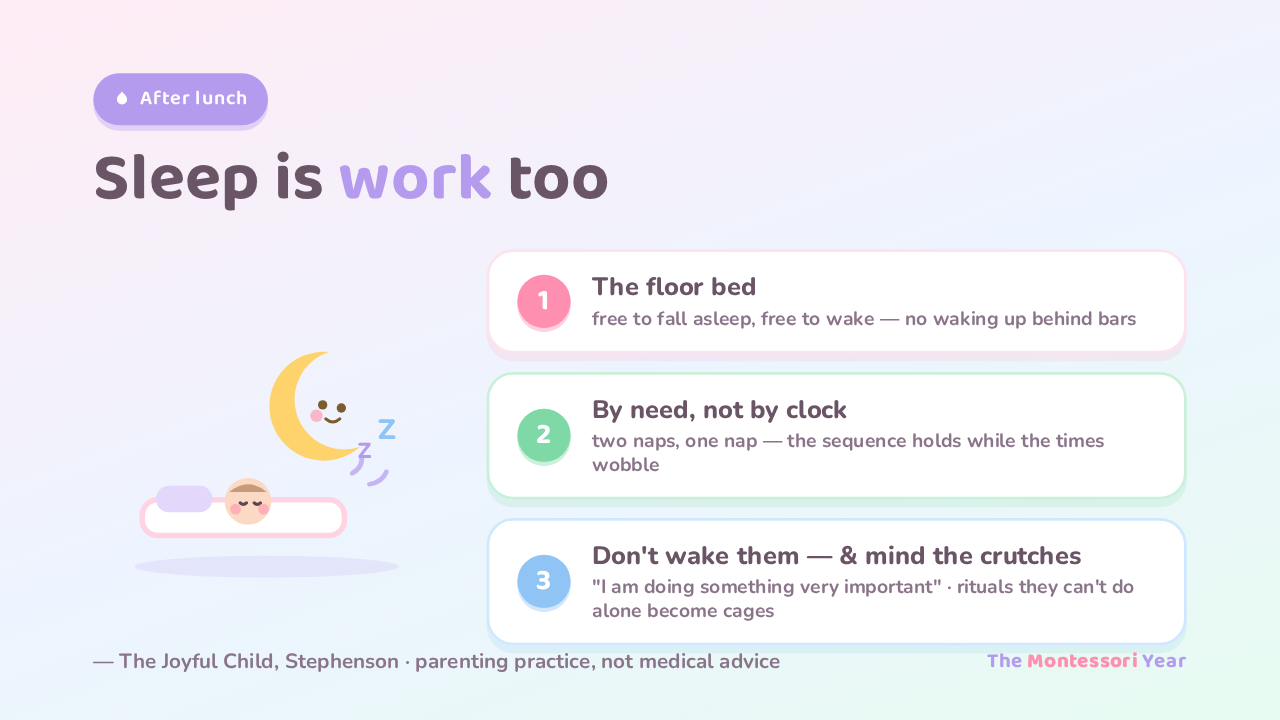
The floor bedfree to fall asleep, free to wake — no waking up behind bars
By need, not by clocktwo naps, one nap — the sequence holds while the times wobble
Don't wake them — & mind the crutches"I am doing something very important" · rituals they can't do alone become cages
After lunch: sleep. In a Montessori home that usually means a floor bed — a mattress low to the ground in a fully baby-proofed room — so your child can feel sleepy, crawl to bed, and wake up free, instead of waking behind bars and crying to be released. Let sleep follow need, not the clock. At this age naps are consolidating — many babies hover between two naps and one for a while — and the rhythm holds even when the times wobble. Two cautions from The Joyful Child. First: try not to wake a sleeping baby. As Stephenson has the baby say — "I am doing something very important." And second, from Clare's parents in the weaning appendix: be careful about nursing or rocking your baby to sleep every single time, because they can lose touch with their own ability to fall asleep. A good attachment, Doctor Montanaro says there, is the best preparation for a good detachment. And as always with sleep: this is parenting practice, not medical advice.
Books, words, more words
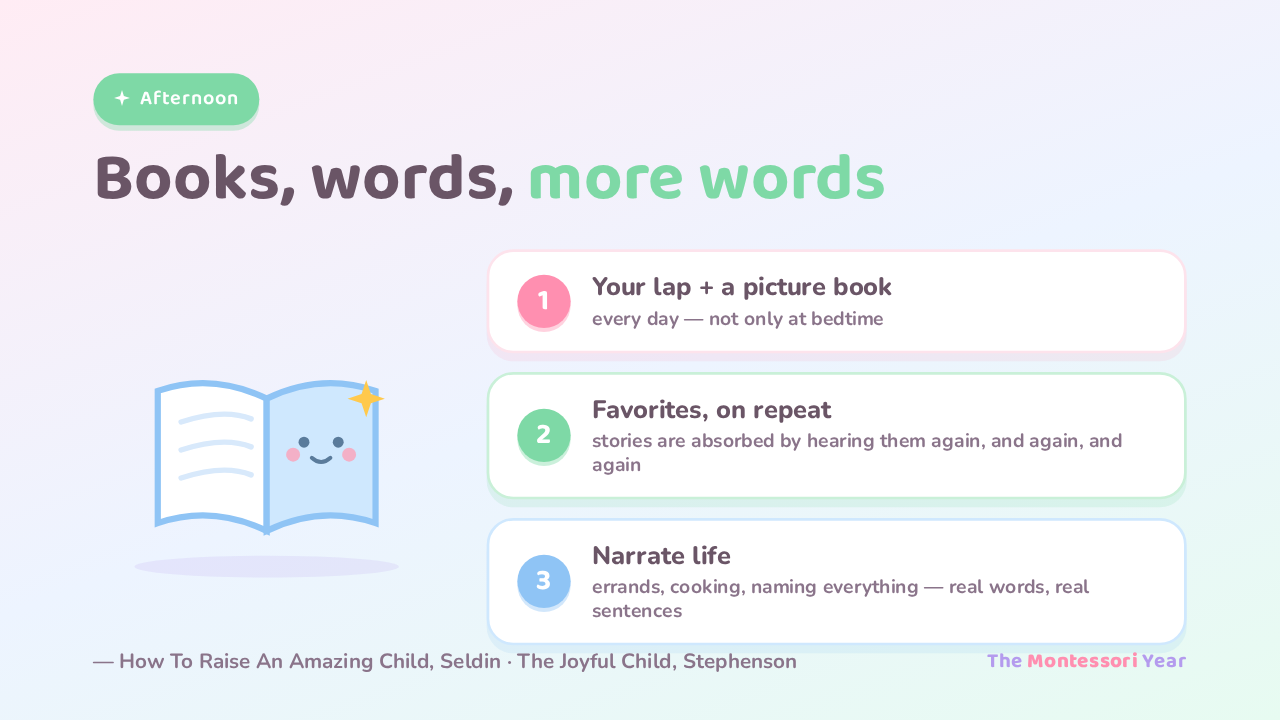
Your lap + a picture bookevery day — not only at bedtime
Favorites, on repeatstories are absorbed by hearing them again, and again, and again
Narrate lifeerrands, cooking, naming everything — real words, real sentences
The afternoon is for the quieter work: language. Around eleven months your baby understands far more than they can say — first words are close, or maybe already here. Two habits feed them. First, books. Seldin writes that as soon as a baby can sit and focus, she'll enjoy short stretches on your lap with a picture book — every day, and not only at bedtime. Watch for favorites, and surrender to the repetition: children absorb stories by hearing them again, and again, and again. Second, keep talking. Narrate the errands. Name things at the grocery store. Describe what your hands are doing while you cook. Real words, real sentences — your baby is taking in a huge amount of language right now that they'll use later, as Stephenson puts it. The language explosion of the second year is built from the ordinary sentences of this one.
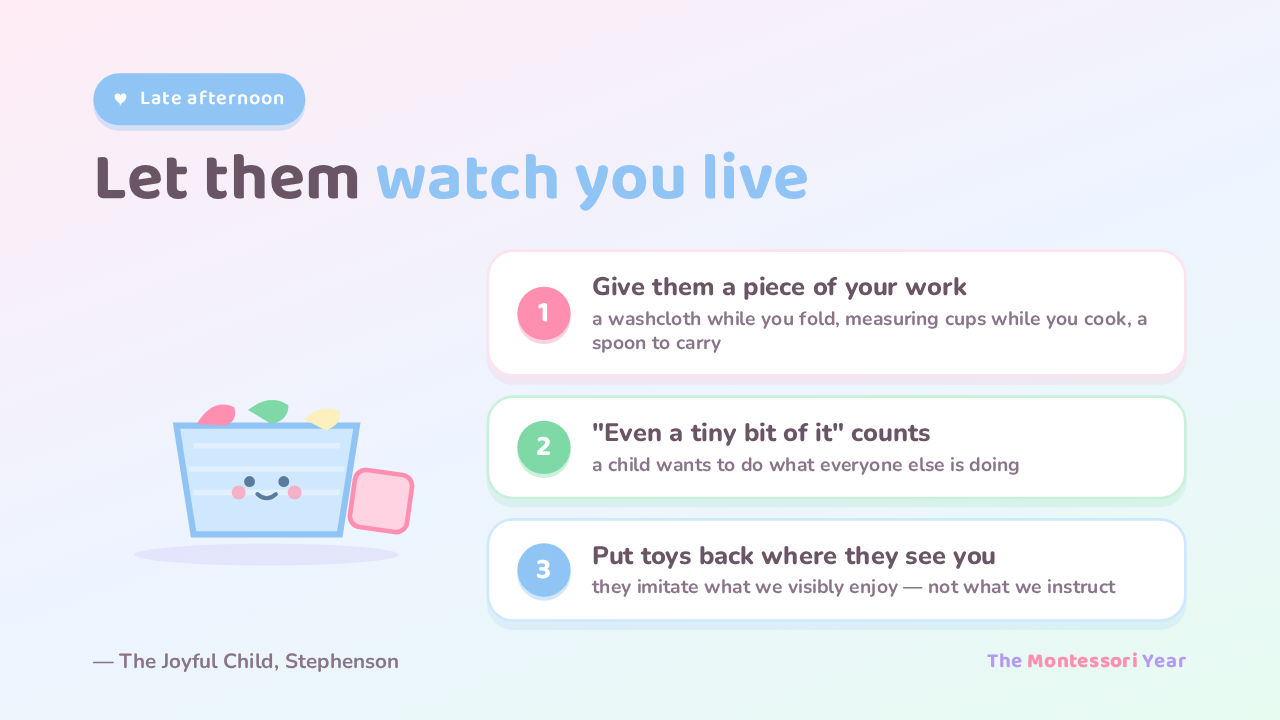
Let them watch you live
Give them a piece of your worka washcloth while you fold, measuring cups while you cook, a spoon to carry
"Even a tiny bit of it" countsa child wants to do what everyone else is doing
Put toys back where they see youthey imitate what we visibly enjoy — not what we instruct
Late afternoon — you have things to do. Good news: at this age, you don't need to entertain your baby. You need to let them watch you live. Stephenson writes that a child wants to do the things everyone else is doing — even if just a tiny bit of it. So fold the laundry with them beside you, and give them a washcloth of their own. Let them bang the measuring cups while you cook. Hand them the spoon to carry, so proudly, to their little table. And when play winds down, put the toys back on the shelf yourself, cheerfully, where they can see you do it. Children this age love order — they want to know where everything belongs — and Stephenson's rule is that they imitate what we visibly enjoy, not what we instruct. You're not teaching chores. You're letting them apprentice in the family.
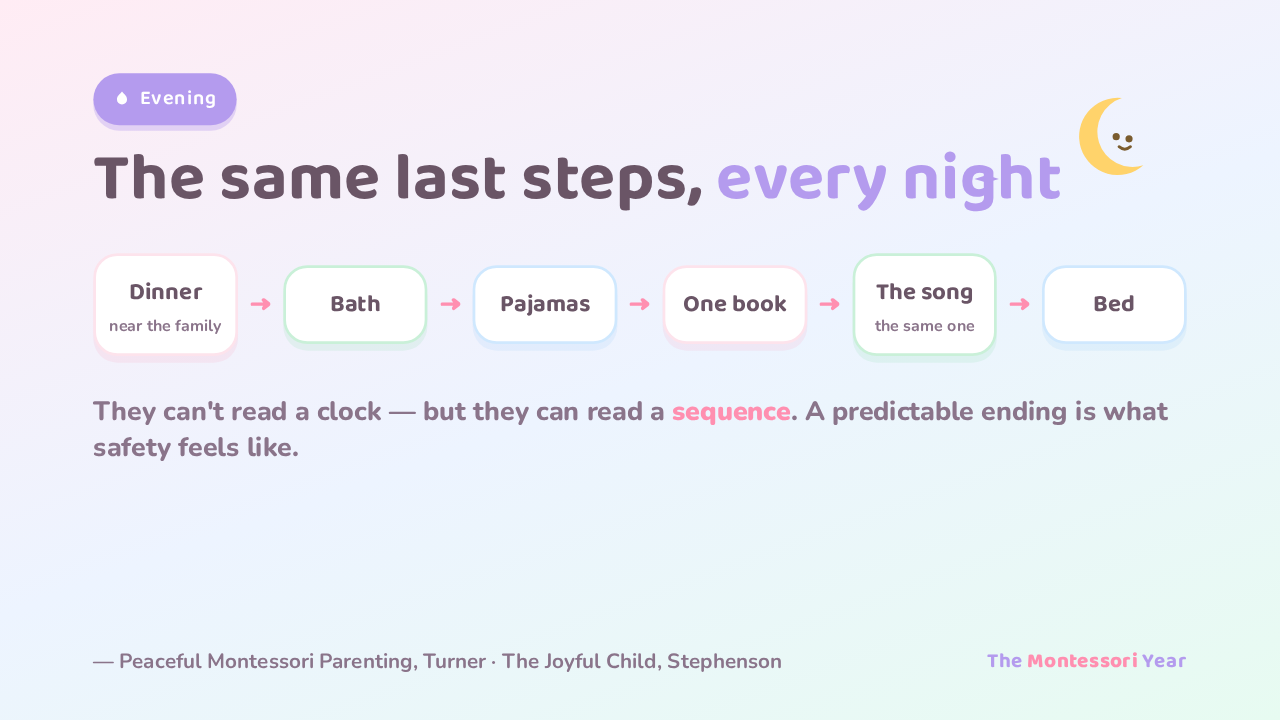
The same last steps, every night
They can't read a clock — but they can read a sequence. A predictable ending is what safety feels like.
Evening. Your baby joins dinner — at their little table pulled near, or at the family's. Then the wind-down, and here, the sequence is everything: the same few steps, in the same order, every night. Maybe it's bath, pajamas, one book, a song, bed. Which steps you choose matters far less than that they're yours, and that they repeat. Haley Turner suggests a bedtime song you've used since they were born — a familiar tune, she writes, actually signals the brain that it's time to shift into sleep. And that's the sense of order again. Your baby can't read a clock, but they can read a sequence, and a predictable ending to the day is what safety feels like at this age. Remember Stephenson's baby, undone because an umbrella he'd only ever seen closed was suddenly opened? To a baby, order isn't fussiness. Order is love.
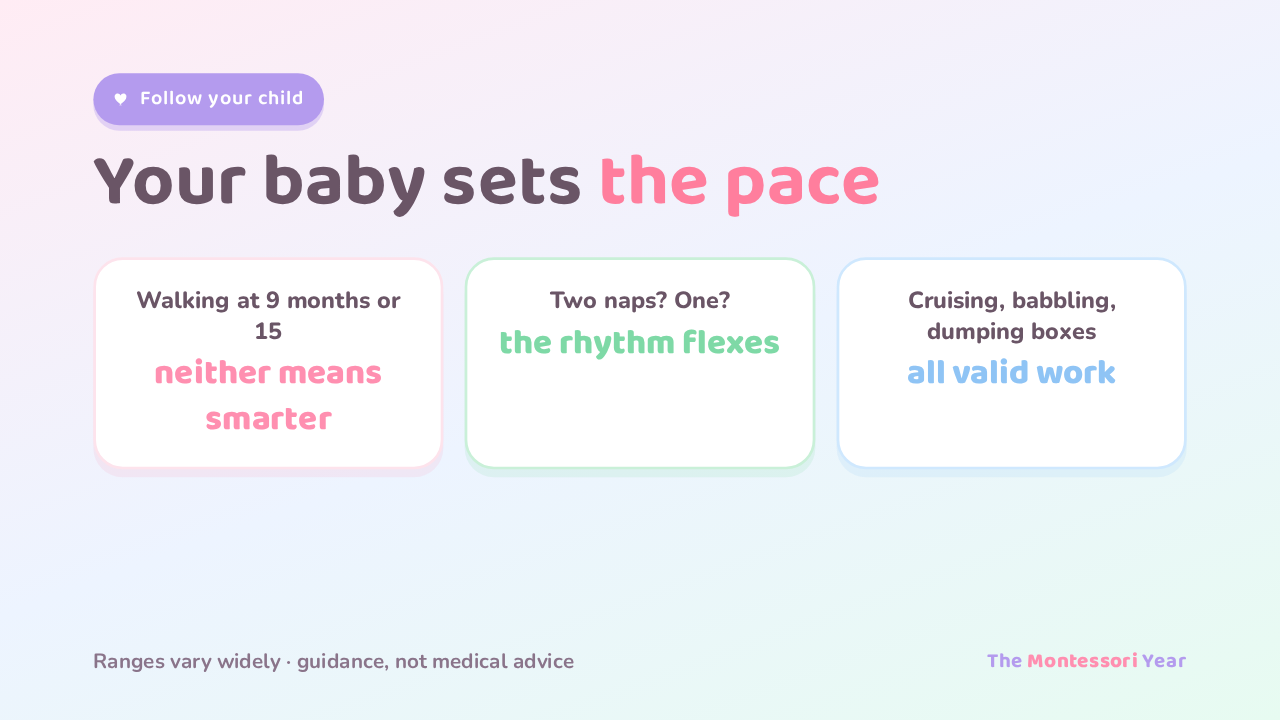
Your baby sets the pace
Now, the calibration — because your baby hasn't read this rhythm, and doesn't need to. Some eleven-month-olds are walking; plenty won't for months. And walking early or late, Stephenson says plainly, does not signify more or less intelligence. Some babies still need two naps; some are down to one. One baby is obsessed with cruising, another with babbling, another with putting things into a box and taking them out again — at the very same age, different children work on completely different things, and all of it is valid work. The best summary in the whole book goes like this: support free movement, provide the best language model — and then watch, listen, respect, offer, and get out of the way. And if today's rhythm collapsed by nine a.m. — teeth, a cold, a growth spurt — that's not failure. That's the follow-your-child part.
Prepare the day.Then get out of the way. ♥
Care together · meals they feed themselves · long unbroken play · outside daily · sleep by need · words everywhere — and the same gentle order, morning and night.
So that's the day. Care done together. Meals they feed themselves. Long, unbroken stretches of play. The outdoors, daily. Sleep by need. Language, everywhere. And the same gentle order holding it all, morning and night. Notice what you didn't need: flashcards, apps, or a single scheduled activity. Prepare the day — then get out of the way. Today leaned on The Joyful Child by Susan Mayclin Stephenson, How To Raise An Amazing Child by Tim Seldin, and Peaceful Montessori Parenting by Haley Turner — all three worth a place on your shelf. Thank you for spending this day with me. I'll see you next time.