Run a real LLM on your desk, starting at $899
3 months ago
A Mac mini with 16 gigabytes of memory now costs 899 dollars, and it ships a chip with Neural Accelerators in every graphics core. That is the first time the cheapest Mac has been a genuinely capable machine for running language models on hardware you own. So the useful question is which models actually fit, at each price.
Ask about this presentation
Chapters





Show transcriptHide transcript
A Mac mini with 16 gigabytes of memory now costs 899 dollars, and it ships a chip with Neural Accelerators in every graphics core. That is the first time the cheapest Mac has been a genuinely capable machine for running language models on hardware you own. So the useful question is which models actually fit, at each price.
Slide text
LOCAL LLM / APPLE 2026 01Run a real LLM on your desk, starting at $899.
The cheapest Mac now ships Neural Accelerators in every graphics core. What fits at each price is the useful question.
 Hardware image: Apple Newsroom, Aug 25 2026
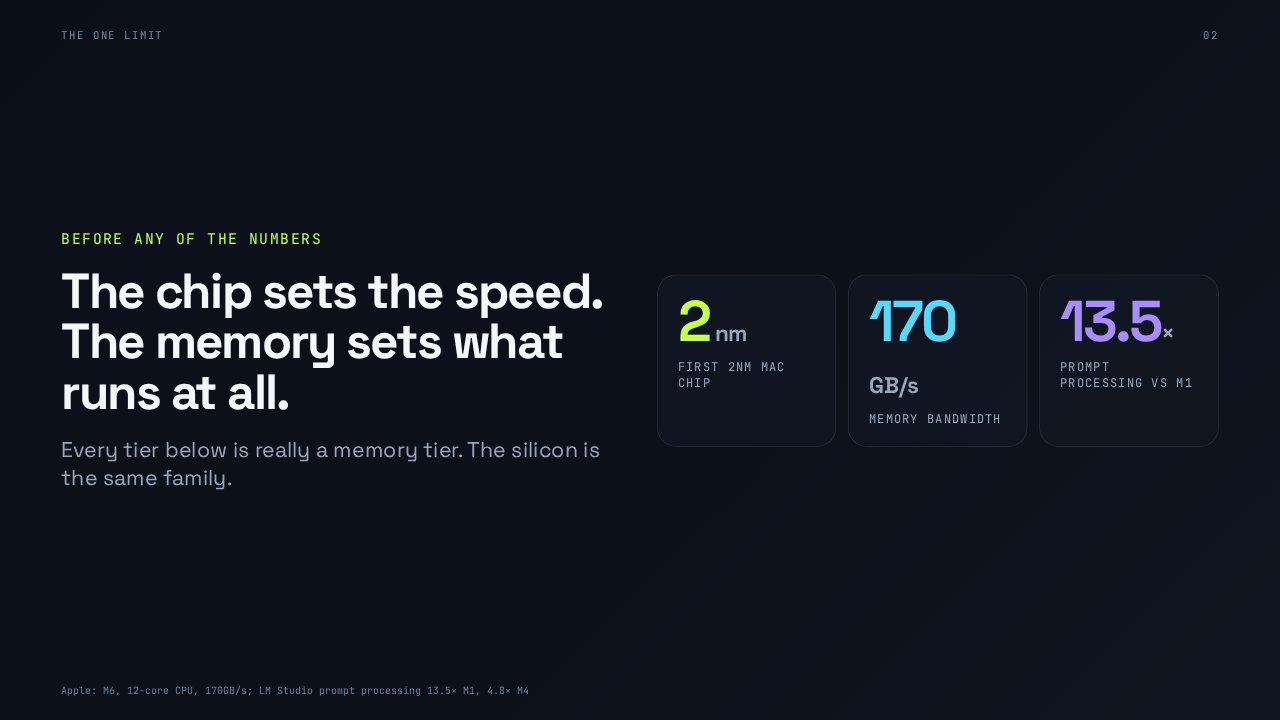
Before any of the numbers, one limit worth stating. The chip decides how fast a model runs. The memory decides whether it runs at all. The M6 is Apple's first 2-nanometer chip, with 170 gigabytes per second of memory bandwidth. Apple measured prompt processing in LM Studio at 13.5 times the M1, and 4.8 times the M4.
Start at the bottom of the lineup.
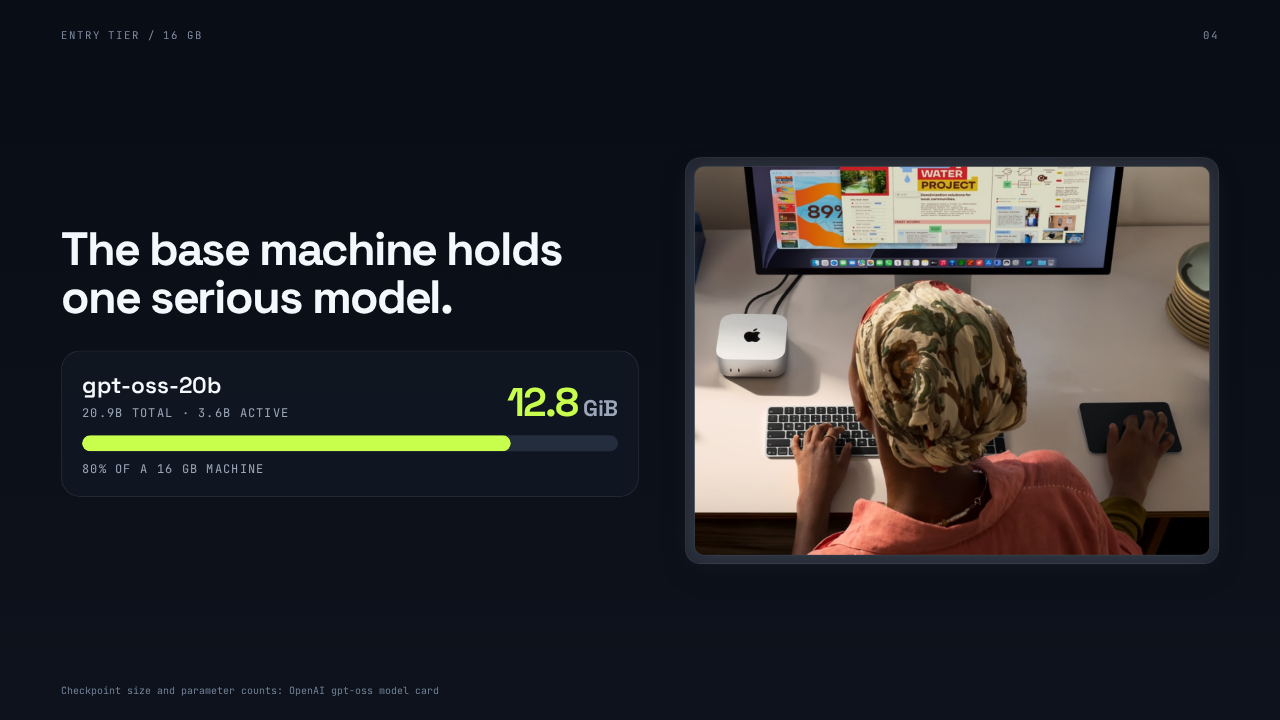
16 gigabytes is the base configuration, and it sets a hard ceiling. OpenAI's gpt-oss-20b checkpoint is 12.8 gibibytes, so it fits with room left for context. It carries 20.9 billion parameters in total but activates only 3.6 billion for each token, which is why a machine this size can keep up with it.
Slide text
ENTRY TIER / 16 GB 04The base machine holds one serious model.
gpt-oss-20b20.9B total · 3.6B active12.8 GiB80% of a 16 GB machine Checkpoint size and parameter counts: OpenAI gpt-oss model card
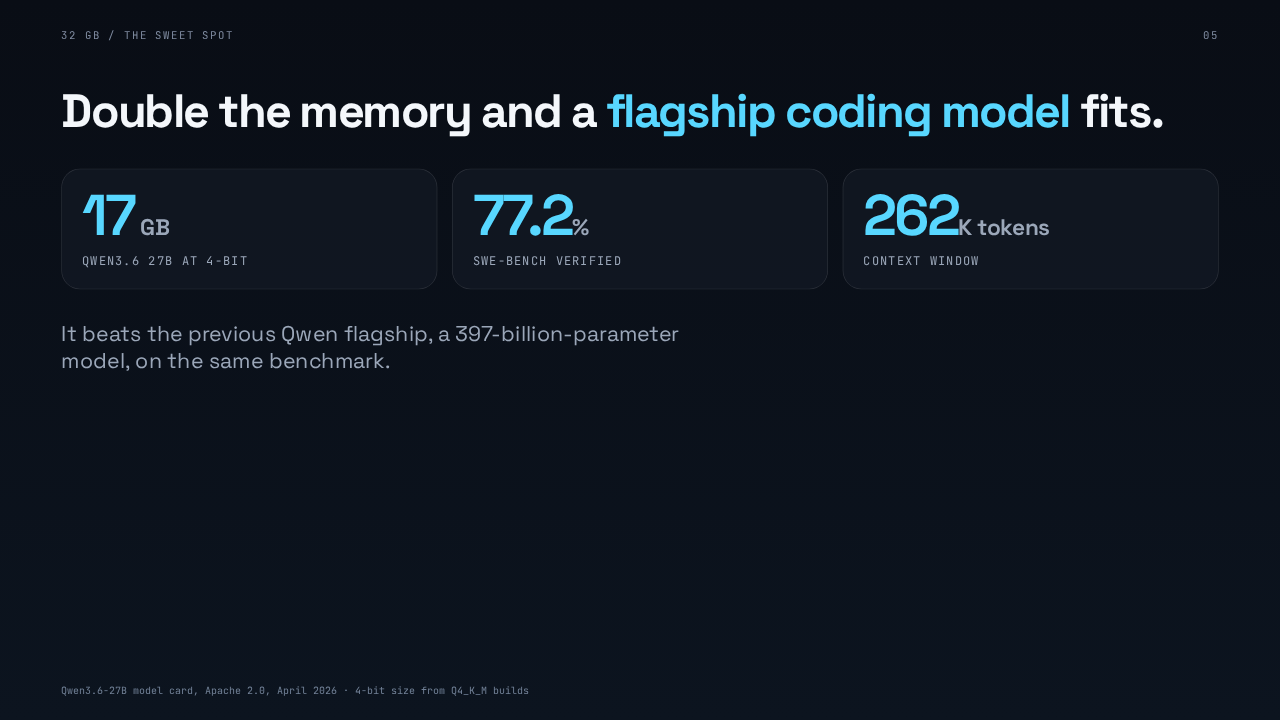
Move up to 32 gigabytes and the answer changes. Qwen3.6 27B is a dense model that runs in about 17 gigabytes at 4-bit, and it scores 77.2 percent on SWE-bench Verified. That beats the previous Qwen flagship, which carried 397 billion parameters. A coding model at that level, sitting on a desk, is genuinely new this year.
Now the other end of the lineup.
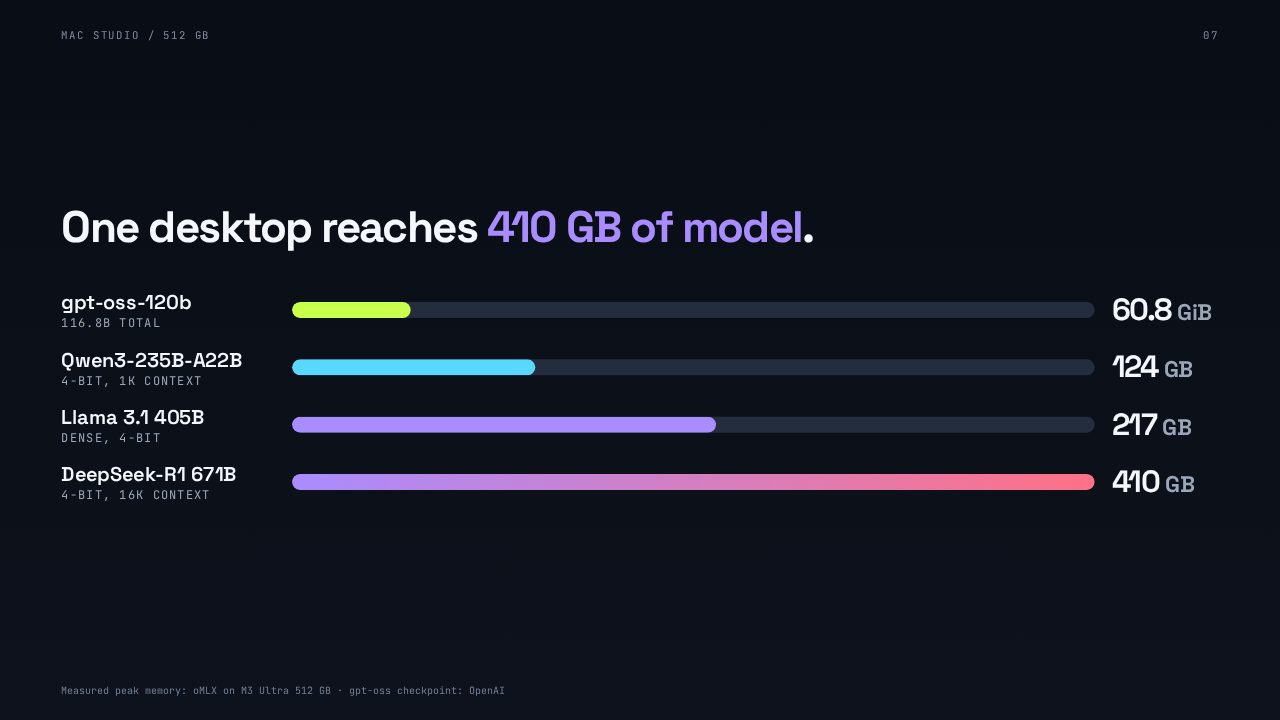
At the top of the lineup the Mac Studio takes 512 gigabytes of unified memory at 1.2 terabytes per second. That fits gpt-oss-120b at about 61 gibibytes, Qwen3 235B at about 124 gigabytes, dense Llama 405B at about 217, and DeepSeek R1 reaching about 410 gigabytes with 16,000 tokens of context.
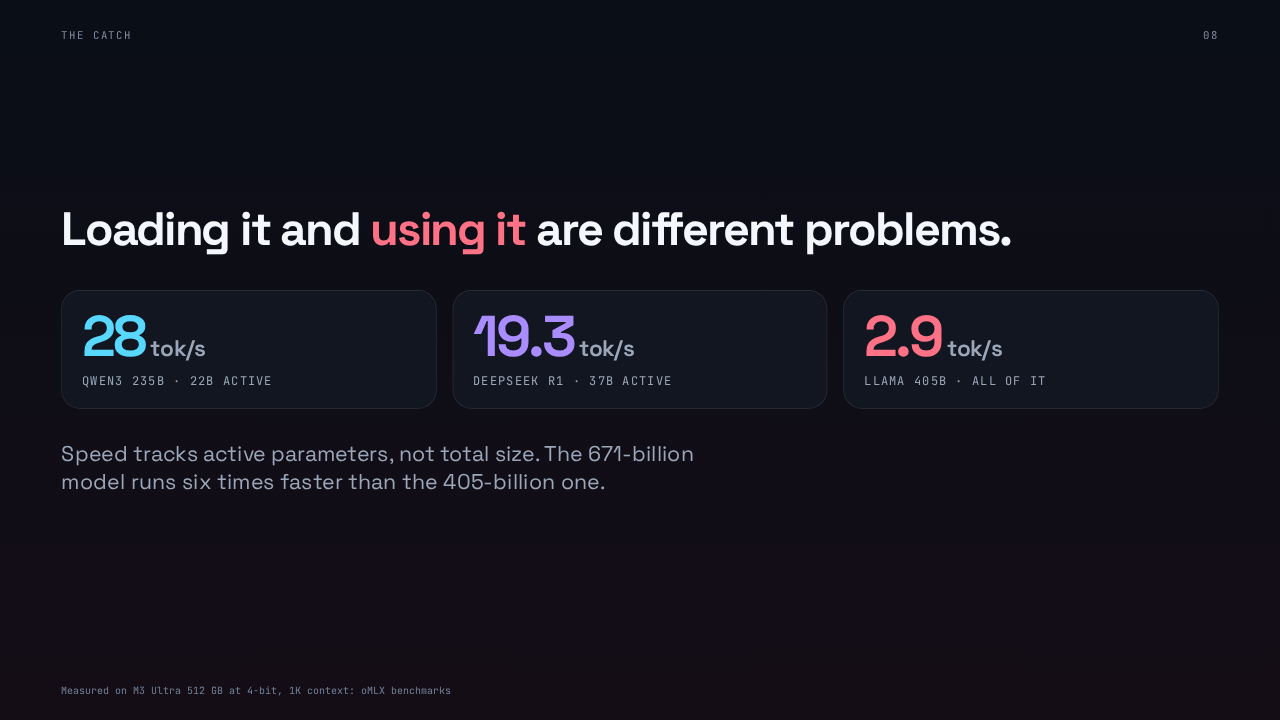
Fitting a model and using it are separate problems. On an M3 Ultra with the same 512 gigabytes, Qwen3 235B generated about 28 tokens per second, because it activates only a fraction of its weights for each token. DeepSeek R1 reached 19.3. Dense Llama 405B managed about 2.9. Memory buys the load. Architecture decides whether you can work with it.
Now, past a single machine.
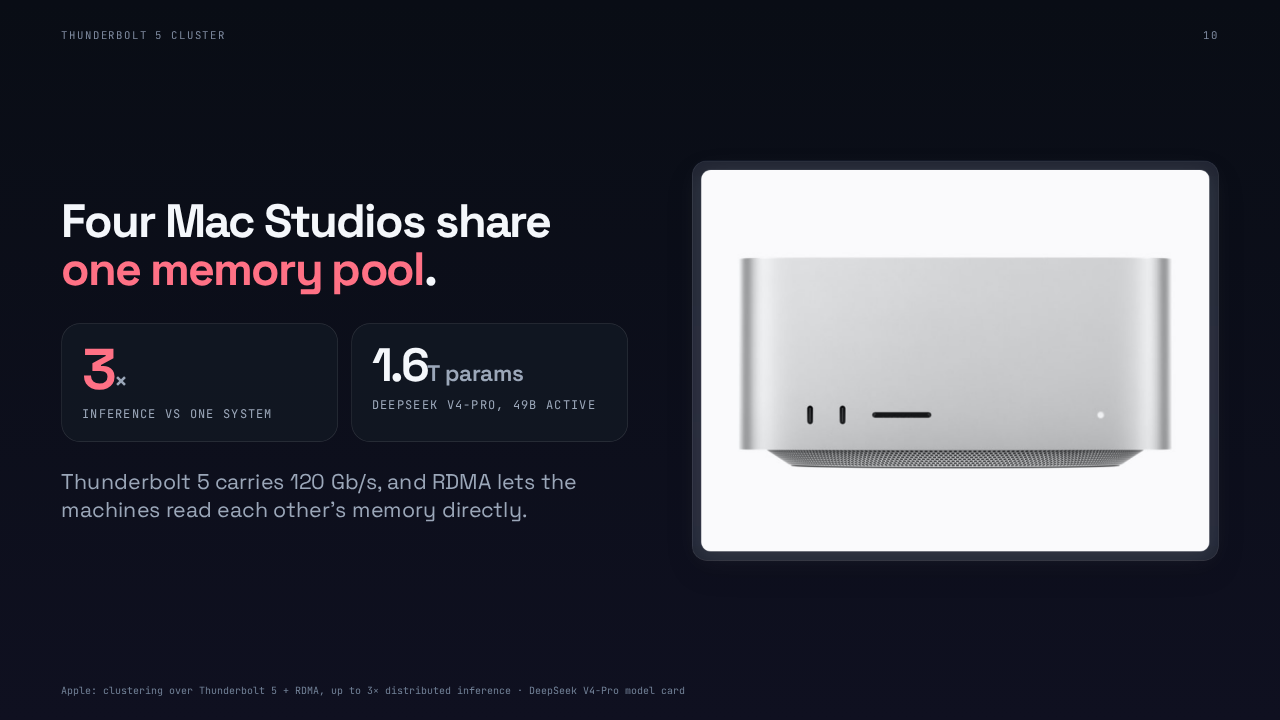
Apple designed for the case where one machine runs out. It says Thunderbolt 5 and RDMA let several Mac Studios pool their memory, and that a cluster of four delivers up to 3 times the AI inference performance of a single system. That is the range where something like DeepSeek V4-Pro, 1.6 trillion parameters with 49 billion active per token, stops needing a data center.
Slide text
THUNDERBOLT 5 CLUSTER 10Four Mac Studios share one memory pool.
3×Inference vs one system1.6T paramsDeepSeek V4-Pro, 49B activeThunderbolt 5 carries 120 Gb/s, and RDMA lets the machines read each other's memory directly.
 Apple: clustering over Thunderbolt 5 + RDMA, up to 3× distributed inference · DeepSeek V4-Pro model card
The limit is worth restating at the end. Memory decides what loads, and architecture decides whether it is fast enough to work with, so the largest dense model on this list still crawls. But the floor moved a long way this year. Apple's Mac revenue grew 29 percent last quarter to 10.4 billion dollars. You can run a real LLM on your desk now, starting at 899 dollars.
Up next
 3:17
Anime.js, the all-in-one JavaScript animation engine
@siderakis
1 month ago
 2:22
Put a 3D model on a slide, declared in HTML: three.js and anime.js in Bisque presentations
@siderakis
1 month ago
 3:51
Explain every GitHub release to the people deciding whether to upgrade
@siderakis
1 month ago
 8:14
Inside mattpocock/skills, the 25 agent skills 270,000 GitHub users starred
@siderakis
2 months ago
 3:00
Your coding agent can present its work: /present, the open-source skill
@siderakis
2 months ago
 1:43
Your agents have a lot to tell you
@siderakis
3 months ago
 2:23
This Week in Bun
@siderakis
3 months ago
 3:14
The Claude system card, in 3 minutes
@siderakis
3 months ago
 2:19
Week in review, from git
@siderakis
3 months ago
 3:06
Research → briefing: the launch playbook
@siderakis
3 months ago
 2:41
PR walkthrough: the heteronym fix
@siderakis
3 months ago
 2:00
Office hours → team briefing
@siderakis
3 months ago