Research that talksgets watched.
Yesterday's research session on launching a dev tool, turned into the briefing you are watching.
Yesterday I spent a session reading primary sources on one question. How does a solo founder launch a developer tool. What you are watching is that session's findings, turned into something you can share. The findings first. Then the one line that made this.
Launch againand again.
The canonical essay is by YC partner
Kat Mañalac
"How to Launch (Again and Again)" — commonly misattributed to Michael Seibel; Seibel presents the adjacent Startup School material. ycombinator.com/library/6i-how-to-launch-again-and-again
"Launch and iterate, launch and iterate, until you have a core of users who really love you."
The central finding comes from Y Combinator's own library. The canonical essay is by partner Kat Manalac, and its title is the whole doctrine. Launch again and again. Launching is not an event you polish toward for months. It is something you do continually, to refine the pitch and find the channel where your real users live. Launch and iterate, until you have a core of users who really love you.
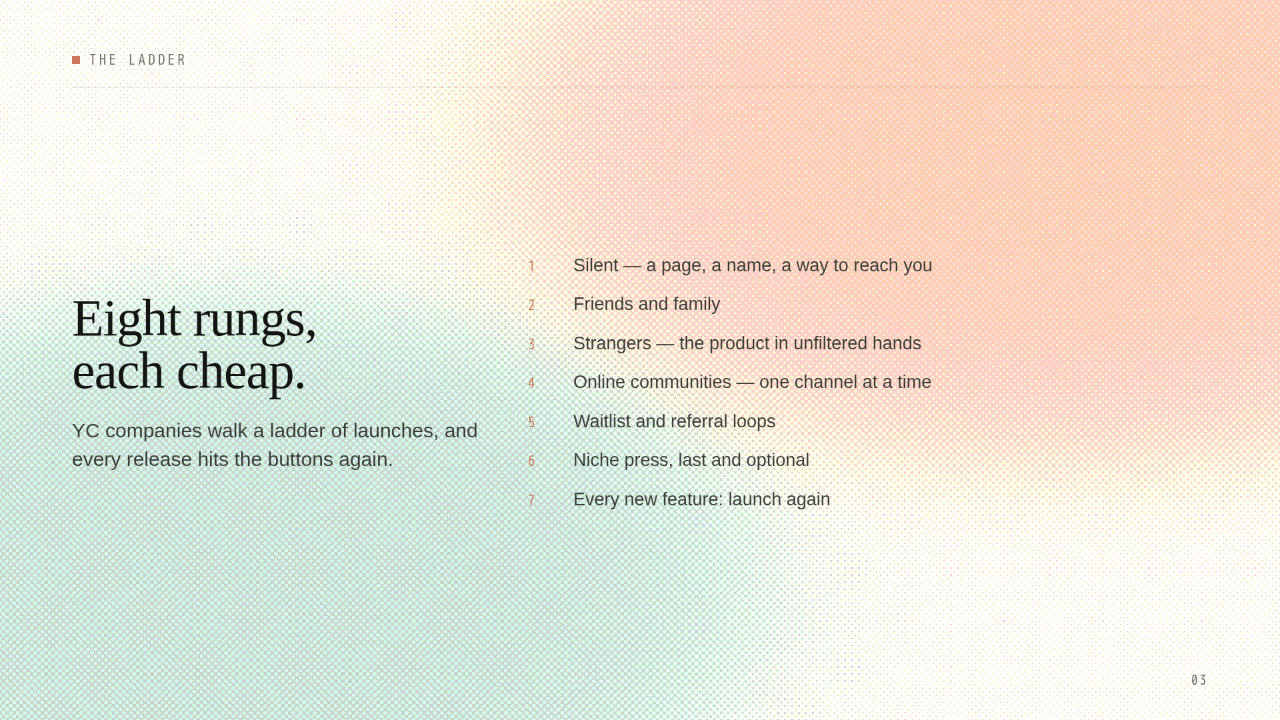
Eight rungs,each cheap.
YC companies walk a ladder of launches, and every release hits the buttons again.
Silent — a page, a name, a way to reach you
Friends and family
Strangers — the product in unfiltered hands
Online communities — one channel at a time
Waitlist and referral loops
Niche press, last and optional
Every new feature: launch again
The essay lays out the ladder these companies climb. A silent launch, only a page and a name. Friends and family next. Then strangers, the product in unfiltered hands. Then online communities, one channel at a time. A waitlist if scarcity helps you. Press comes last, and stays optional. And every meaningful release climbs the ladder again. None of these rungs costs much, which is the point.
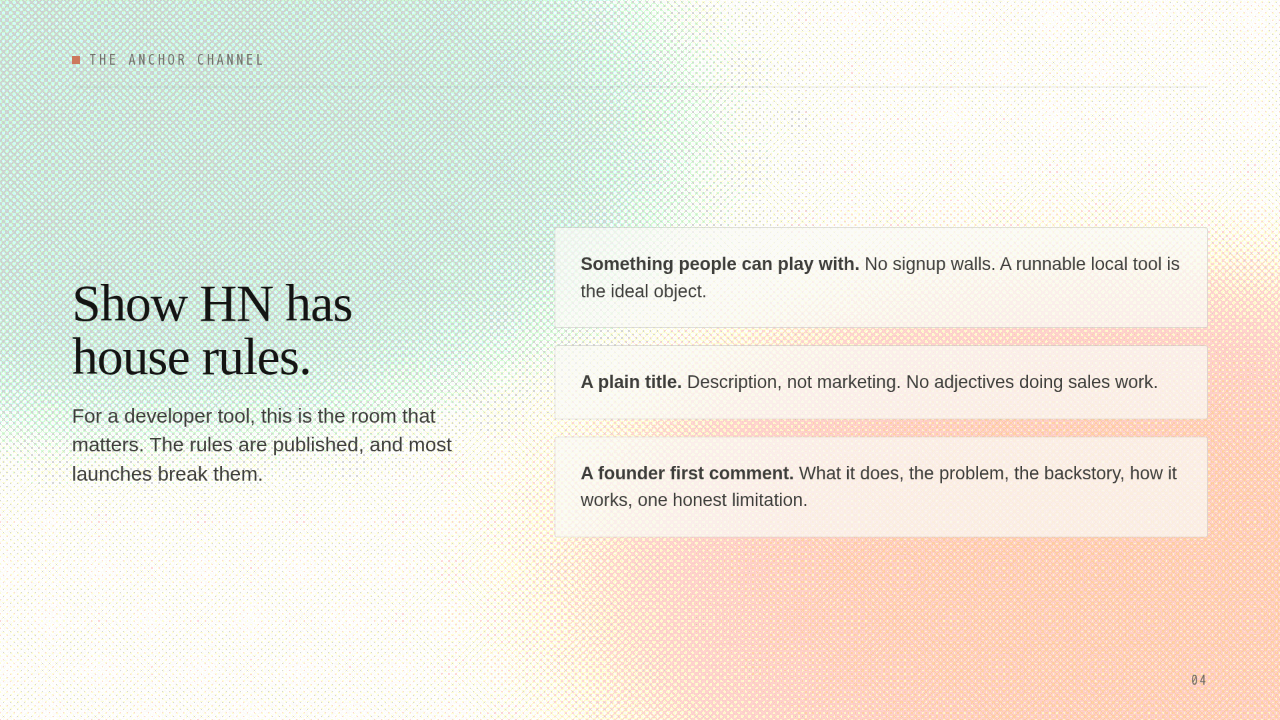
Show HN hashouse rules.
For a developer tool, this is the room that matters. The rules are published, and most launches break them.
Something people can play with. No signup walls. A runnable local tool is the ideal object.
A plain title. Description, not marketing. No adjectives doing sales work.
A founder first comment. What it does, the problem, the backstory, how it works, one honest limitation.
For a developer tool the anchor channel is Show HN, and its rules are published. It must be something people can play with, without a signup. The title is plain description. No adjectives doing sales work. And the founder writes the first comment. What it does, in the first sentence. The problem. The backstory. How it works, with real technical detail. And one honest limitation, offered before anyone asks.
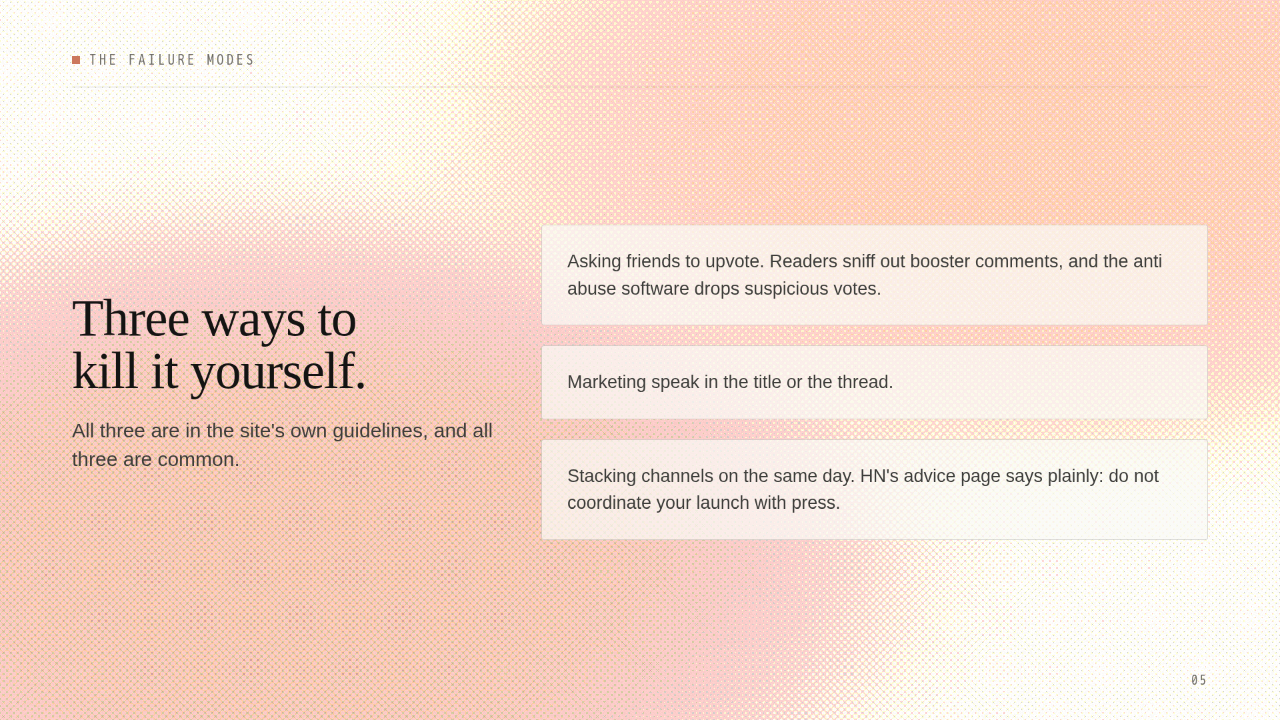
Three ways tokill it yourself.
All three are in the site's own guidelines, and all three are common.
Asking friends to upvote. Readers sniff out booster comments, and the anti abuse software drops suspicious votes.
Marketing speak in the title or the thread.
Stacking channels on the same day. HN's advice page says plainly: do not coordinate your launch with press.
The same pages spell out what kills a launch, and all three failures are self inflicted. Asking friends to upvote. Readers have a nose for booster comments, and the anti abuse software silently drops suspicious votes. Marketing speak. And stacking channels on the same day. The site's own advice page says do not coordinate your launch with press. One channel per day, so each gets its own push and you can tell where the traffic came from.
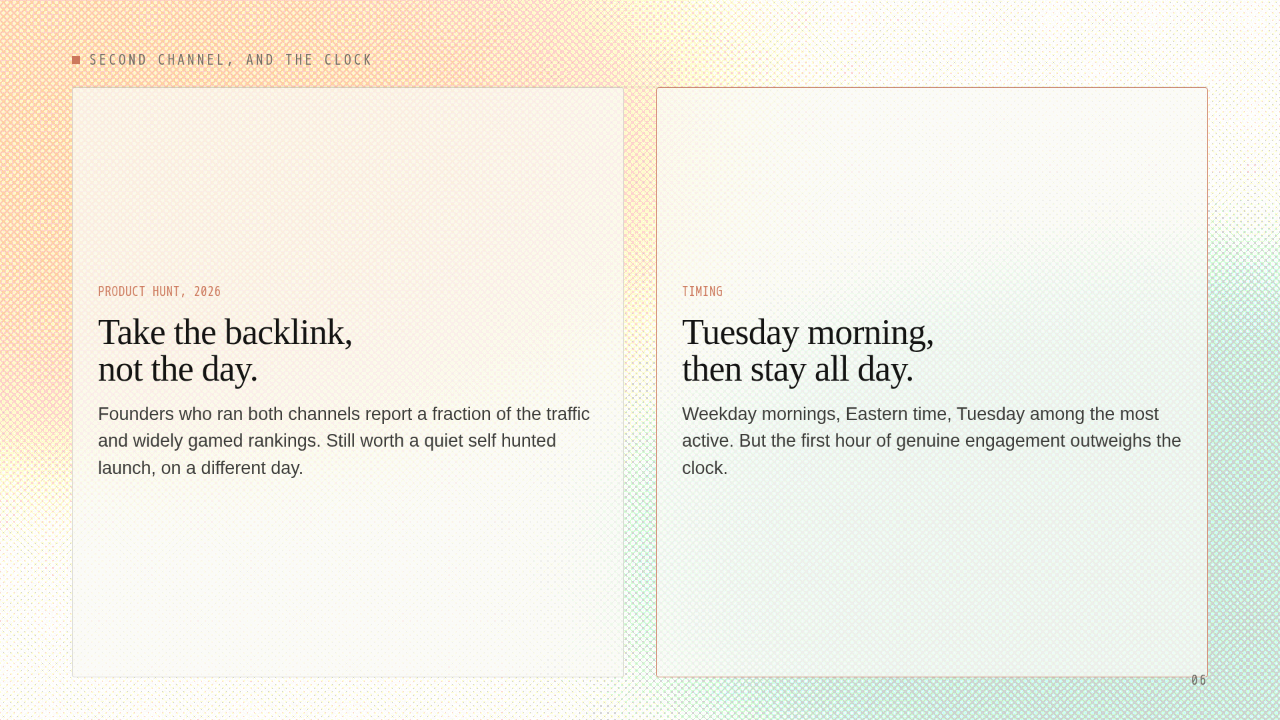
Take the backlink,not the day.
Founders who ran both channels report
a fraction of the traffic
Sept 2025 HN thread "Product Hunt is dead": ~50 visitors for a #7 finish in 2024 vs 250 for #14 in 2022; Show HN cited at 3–10× the traffic. news.ycombinator.com/item?id=45362569
Tuesday morning,
then stay all day.
Weekday mornings, Eastern time, Tuesday among the most active. But the first hour of genuine engagement outweighs the clock.
Two smaller findings. Product Hunt still exists, and the community verdict on it is blunt. Traffic has collapsed and the rankings are widely gamed. Founders who ran both channels saw several times the visitors from Show HN. It is still worth a quiet secondary launch on a different day, for the backlink and the badge. And timing is the smallest lever. A weekday morning, Eastern time, Tuesday among the most active days. Every analysis agrees the first hour of genuine engagement matters more than the clock. Post in the morning, then stay in the thread and answer as a builder.
Slide 7
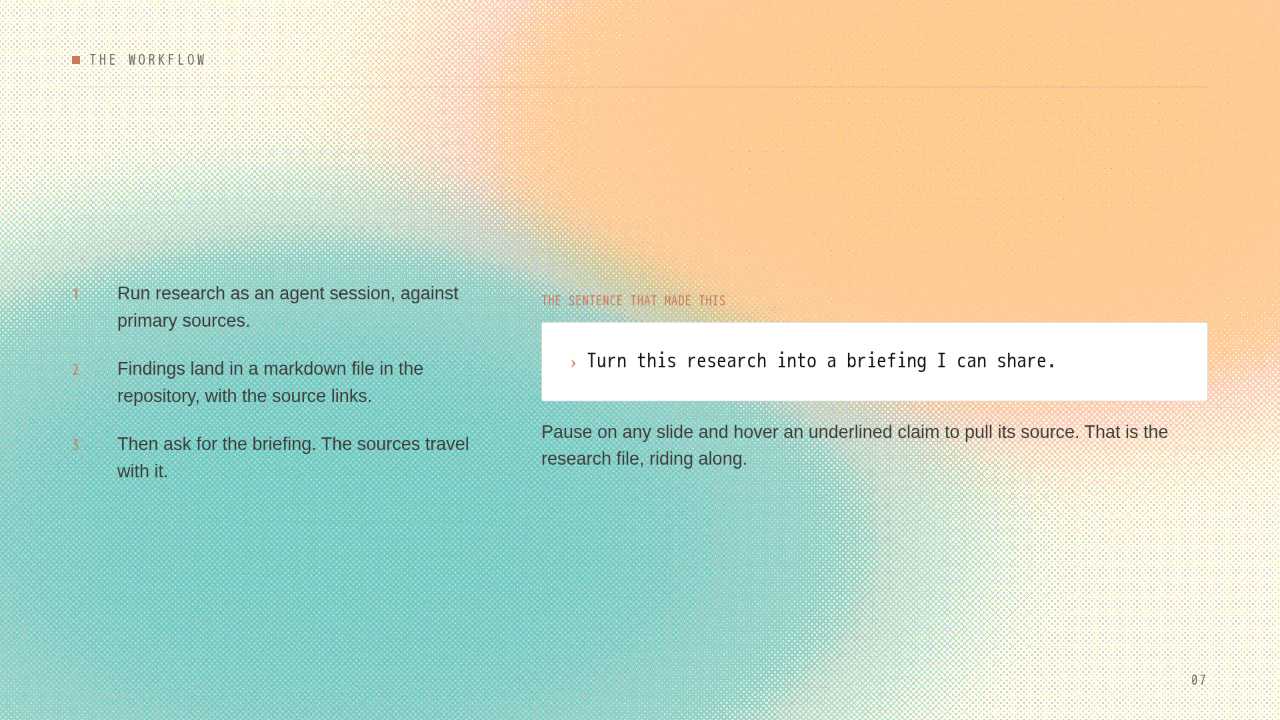
Run research as an agent session, against primary sources.
Findings land in a markdown file in the repository, with the source links.
Then ask for the briefing. The sources travel with it.
Pause on any slide and hover an underlined claim to pull its source. That is the research file, riding along.
The recipe. Run the research as a session. The agent reads the primary sources and writes the findings into a file in your repository, links included. Then one line. Turn this research into a briefing I can share. The sources travel with it. Pause this presentation on any slide and hover an underlined claim, and the source comes up. That is the research file, riding along with the briefing.
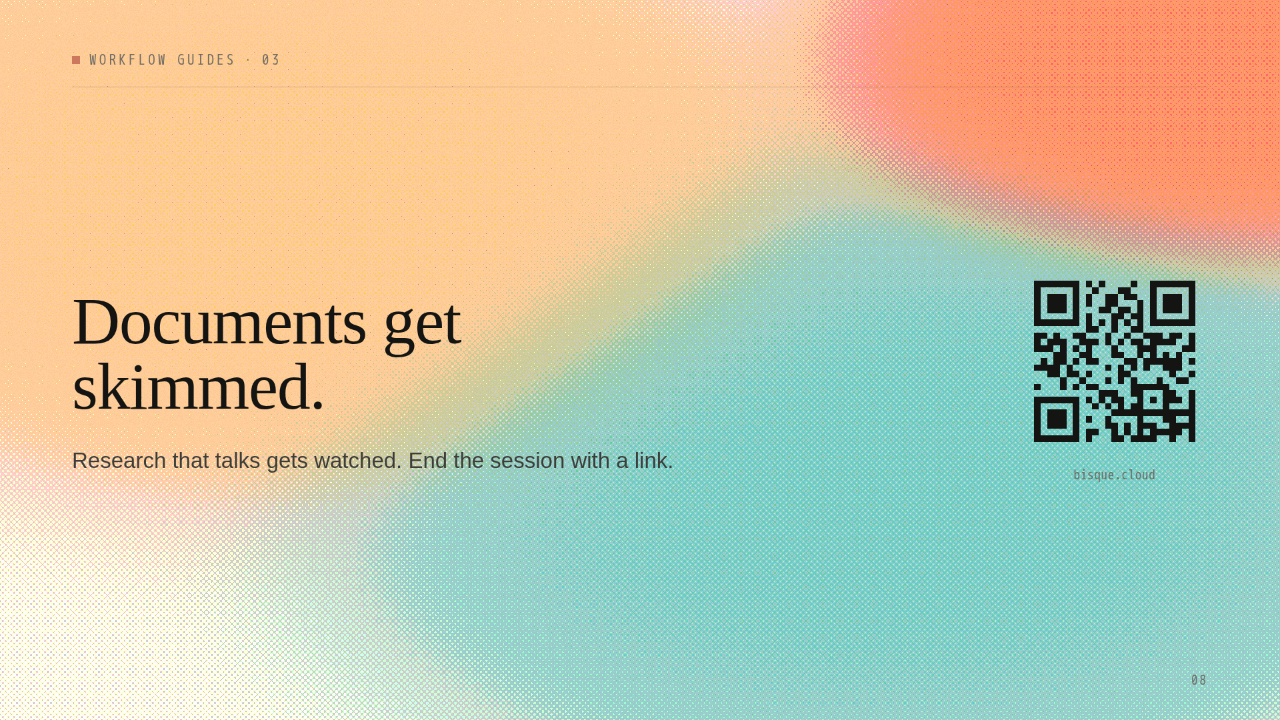
Documents getskimmed.
Research that talks gets watched. End the session with a link.
bisque.cloud
Research you share as a document gets skimmed. Research that talks gets watched, and the sources ride along for anyone who wants to check. End the session with a link.