
One repository, seven days
One repo, one week,
155 commits.
gbrain is an open source agent brain. This is its last seven days, a week in review read straight from git.
github.com/garrytan/gbrain
This is a week in review built from nothing but git history. The repository is G brain, an open source agent brain. One hundred fifty five commits from thirty seven contributors landed there in seven days. Here is the story they tell.
The shape of the week
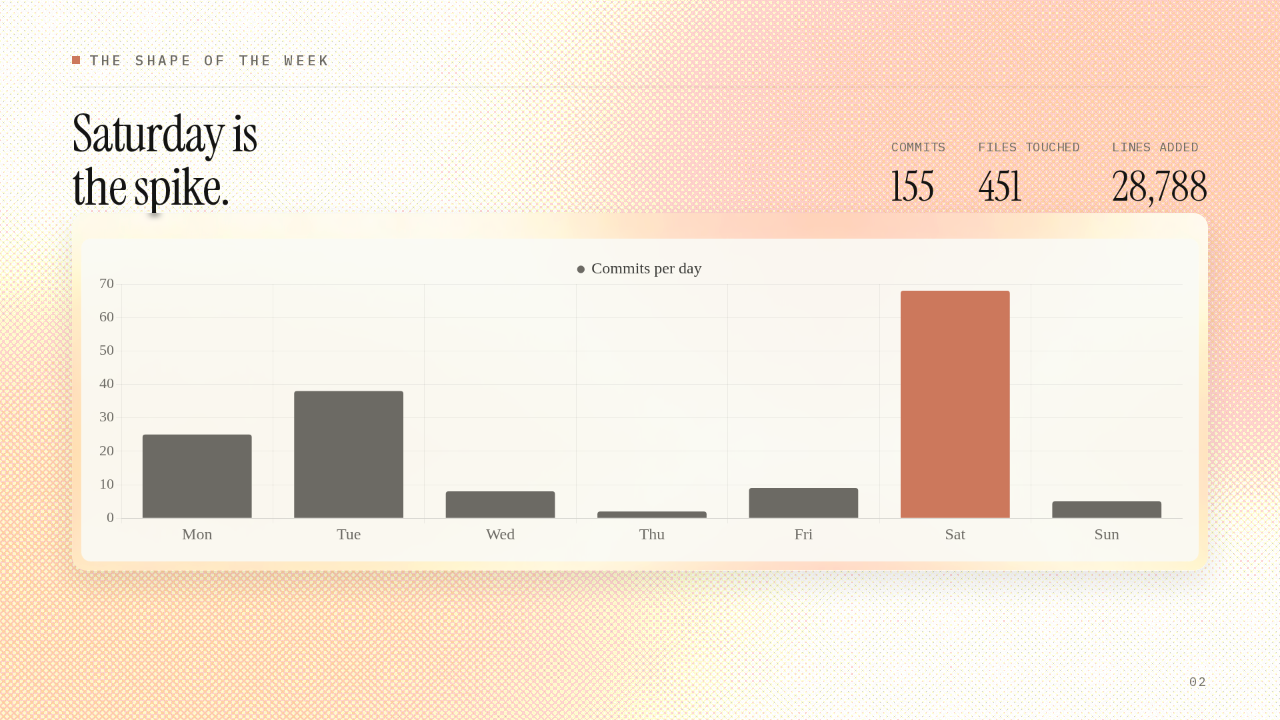
Saturday is
the spike.
First, the shape of the week. It opens busy, twenty five commits Monday, thirty eight Tuesday. Midweek drops to a trickle, two commits on Thursday. Then Saturday explodes, sixty eight commits in a single day. Across the week, four hundred fifty one files changed and nearly twenty nine thousand lines arrived. Something happened on Saturday, and the log says exactly what.
Forty fixes, one Saturday
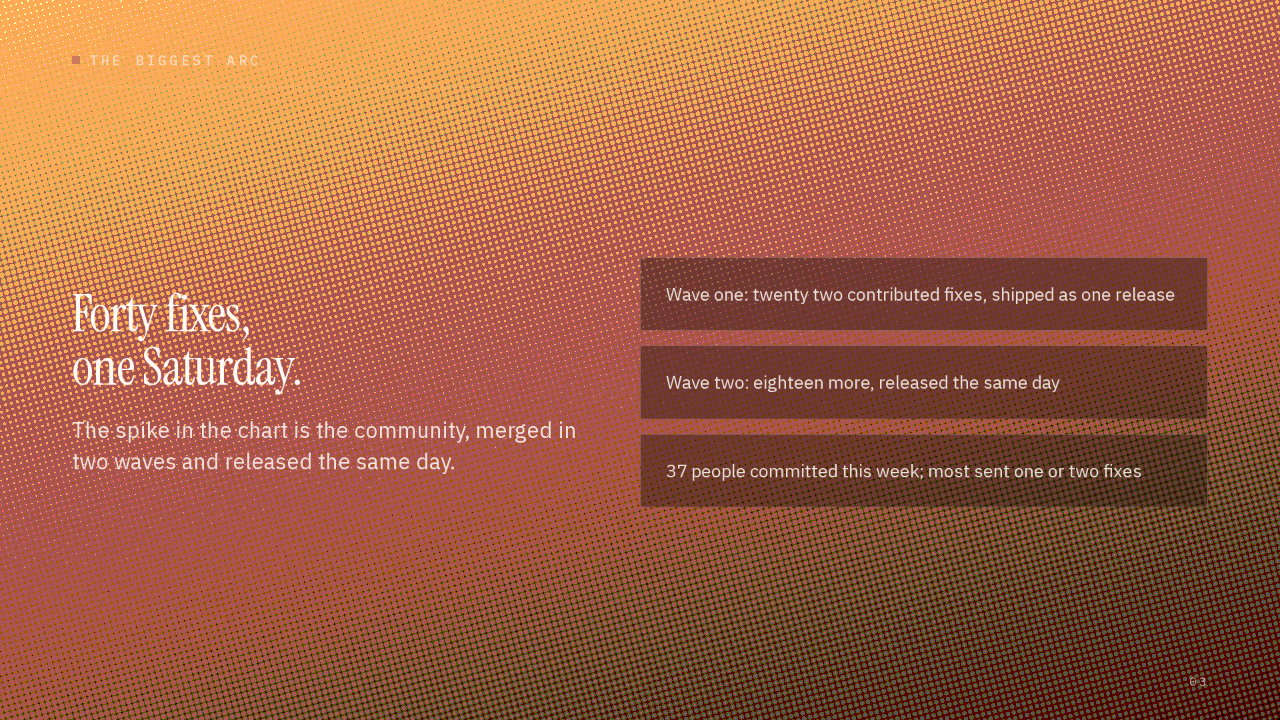
Forty fixes,
one Saturday.
The spike in the chart is the community, merged in two waves and released the same day.
Wave one: twenty two contributed fixes, shipped as one release
Wave two: eighteen more, released the same day
37 people committed this week; most sent one or two fixes
The Saturday spike has a name, community fix waves. G brain is open source, and the fixes come from everywhere. The first wave carried twenty two contributed fixes and shipped as a single release. The second added eighteen more, released the same day. Thirty seven people committed during the week, most sending just one or two fixes each, dead flags, dry run safety, link resolution, Windows support. Merged, released, done.
Silent failures made loud
Silent failures
now speak up.
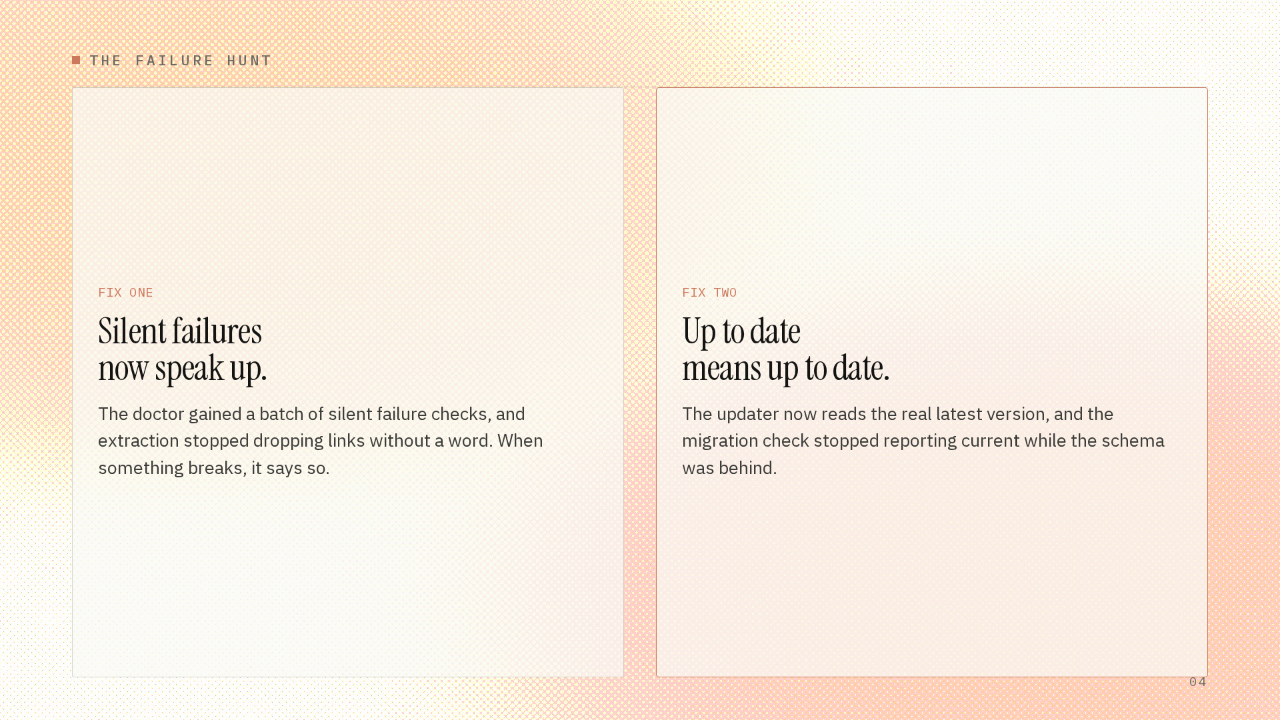
The doctor gained a batch of silent failure checks, and extraction stopped dropping links without a word. When something breaks, it says so.
Up to date
means up to date.
The updater now reads the real latest version, and the migration check stopped reporting current while the schema was behind.
A second thread runs through the whole week, hunting failures that used to be silent. The built in doctor gained a batch of silent failure checks, and extraction stopped dropping links without a word. When something breaks now, it says so. The updater stopped guessing too. It reads the real latest version, and the migration check no longer reports current while the schema is behind. Up to date now means exactly that.
It learned to read more of the world
It learned to read
more of the world.
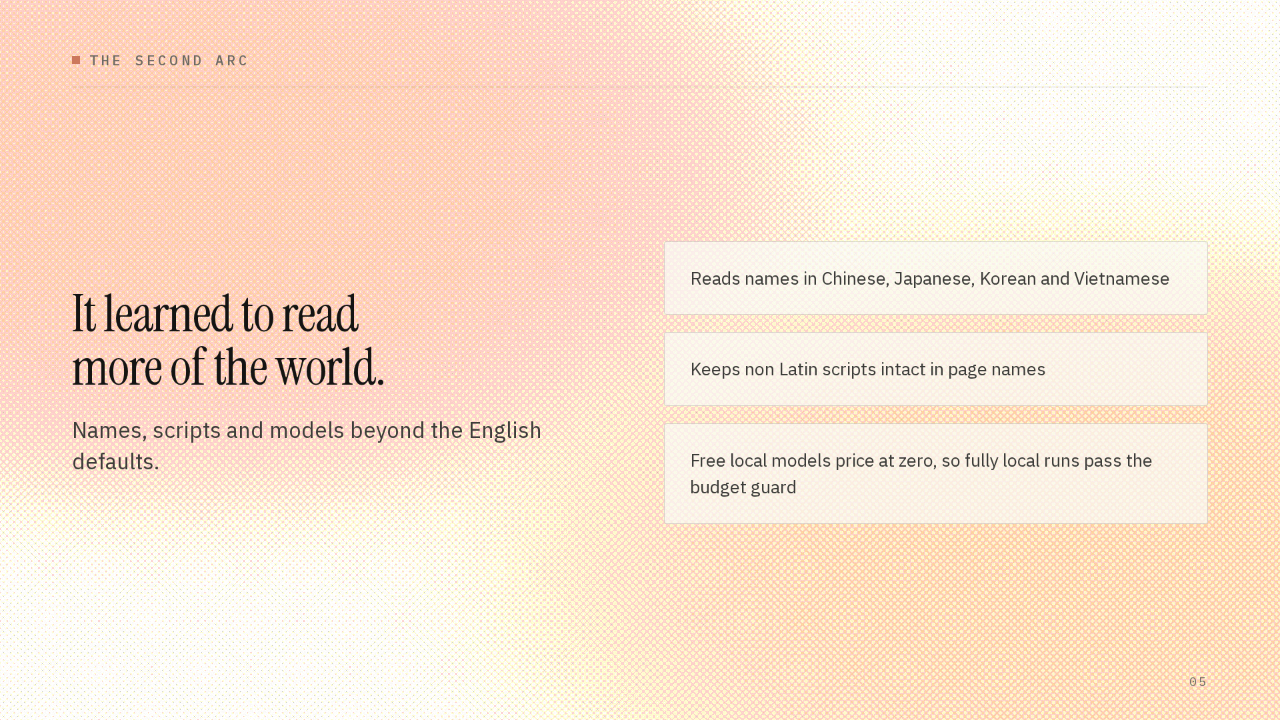
Names, scripts and models beyond the English defaults.
Reads names in Chinese, Japanese, Korean and Vietnamese
Keeps non Latin scripts intact in page names
Free local models price at zero, so fully local runs pass the budget guard
The second arc is reach. The extractor learned to read names in Chinese, Japanese and Korean, and a new tokenizer keeps Vietnamese names and their accents intact. Page names stopped mangling non Latin scripts. And free local models are now priced at zero, so a fully local setup passes the budget guard instead of tripping it. Less tied to English defaults, more of the world.
Releases ship themselves
Releases now
ship themselves.
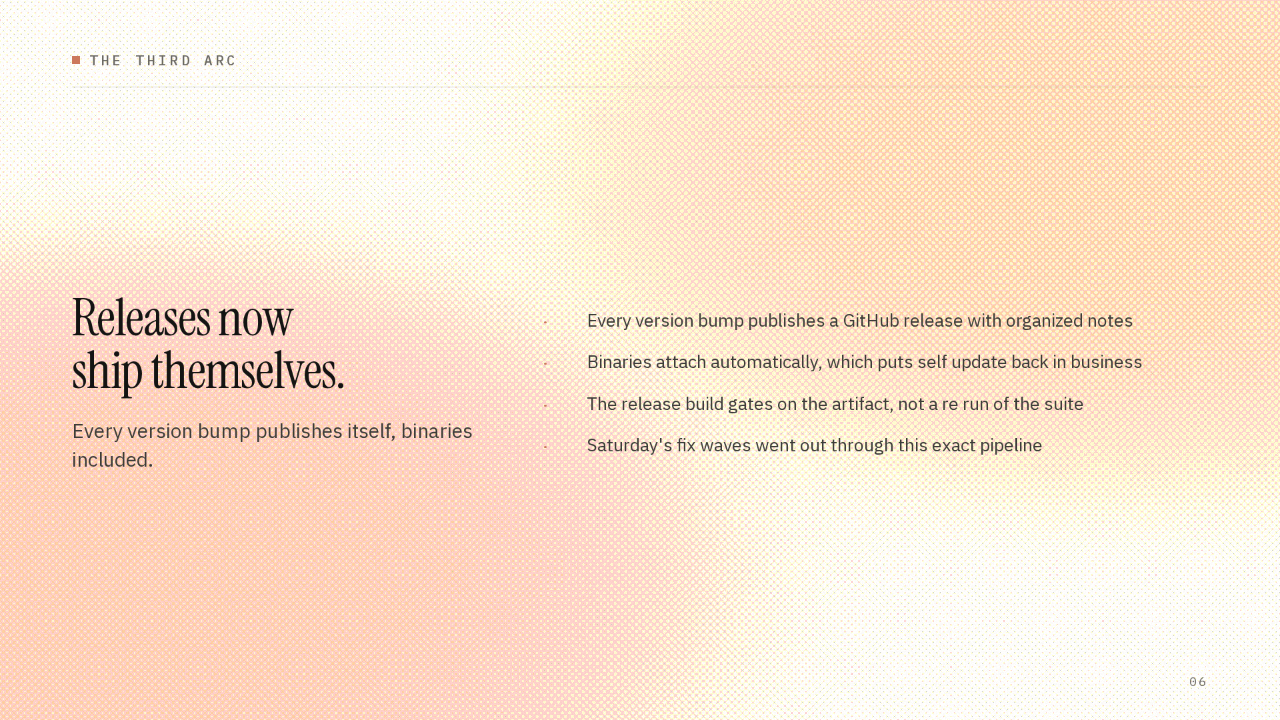
Every version bump publishes itself, binaries included.
Every version bump publishes a GitHub release with organized notes
Binaries attach automatically, which puts self update back in business
The release build gates on the artifact, not a re run of the suite
Saturday's fix waves went out through this exact pipeline
The third arc closes a loop, releasing stopped being manual work. Every version bump now publishes a GitHub release, with organized notes and the binaries attached, which puts self update back in business. The release build gates on the artifact itself instead of re running the whole test suite. And Saturday's fix waves went out through this exact pipeline. Ship the bump, and the release follows on its own.
The cheapest guide in the series
The source material
writes itself.
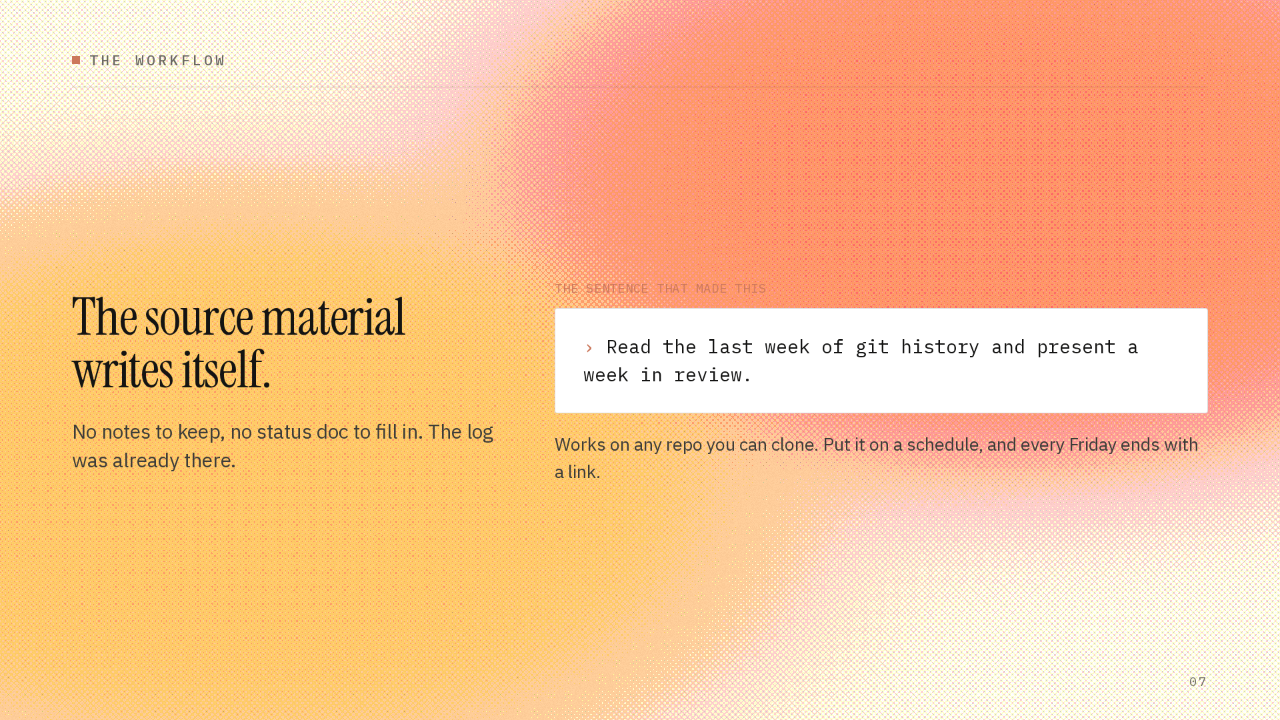
No notes to keep, no status doc to fill in. The log was already there.
Works on any repo you can clone. Put it on a schedule, and every Friday ends with a link.
This is the cheapest guide in the series, because the source material writes itself. At the end of the week, one line. Read the last week of git history and present a week in review. The agent reads the log, finds the arcs, and narrates them, with the numbers pulled straight from the commits. This one came from a public repository, and it works on any repo you can clone. Put it on a schedule, and every Friday ends with a link.
Let the log present
The log already
knows the story.
Let it present.
bisque.cloud
That is the week, and that is the workflow. The log already knows what happened. So let it present.