Hacker News, September 26
 Hacker NewsSaturday, September 26, 2026
Amit Sahai says understanding AI's new mathematics will take more mathematicians, not fewer — Hacker News, September 26
- Conversations leaves Google Play
- The end of plan mode
- How Apple Cards got printed
- Floci, four clouds on a laptop
The Hacker News front page for Saturday, September twenty sixth, two thousand twenty six. At the top, with about three hundred sixty points: a guest post on Terence Tao's blog, where Amit Sahai argues that the machines will leave humanity needing more mathematicians.
A time for humility in research mathematics
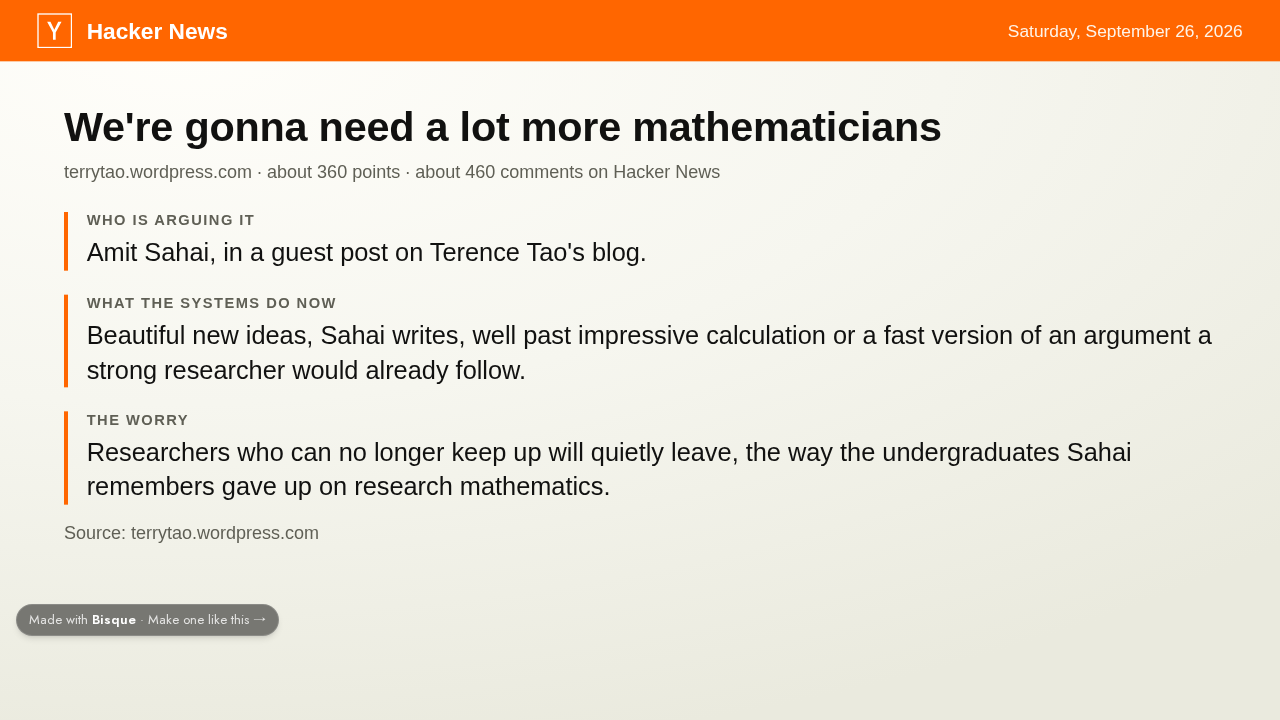
Hacker NewsSaturday, September 26, 2026We're gonna need a lot more mathematicians
Amit Sahai is writing as a guest on Terence Tao's blog. The systems he works with already produce genuinely new ideas, he says, not just fast arguments. So every mathematician is about to learn what it feels like to be unable to keep up.
A fusion design built on principles no human conceived
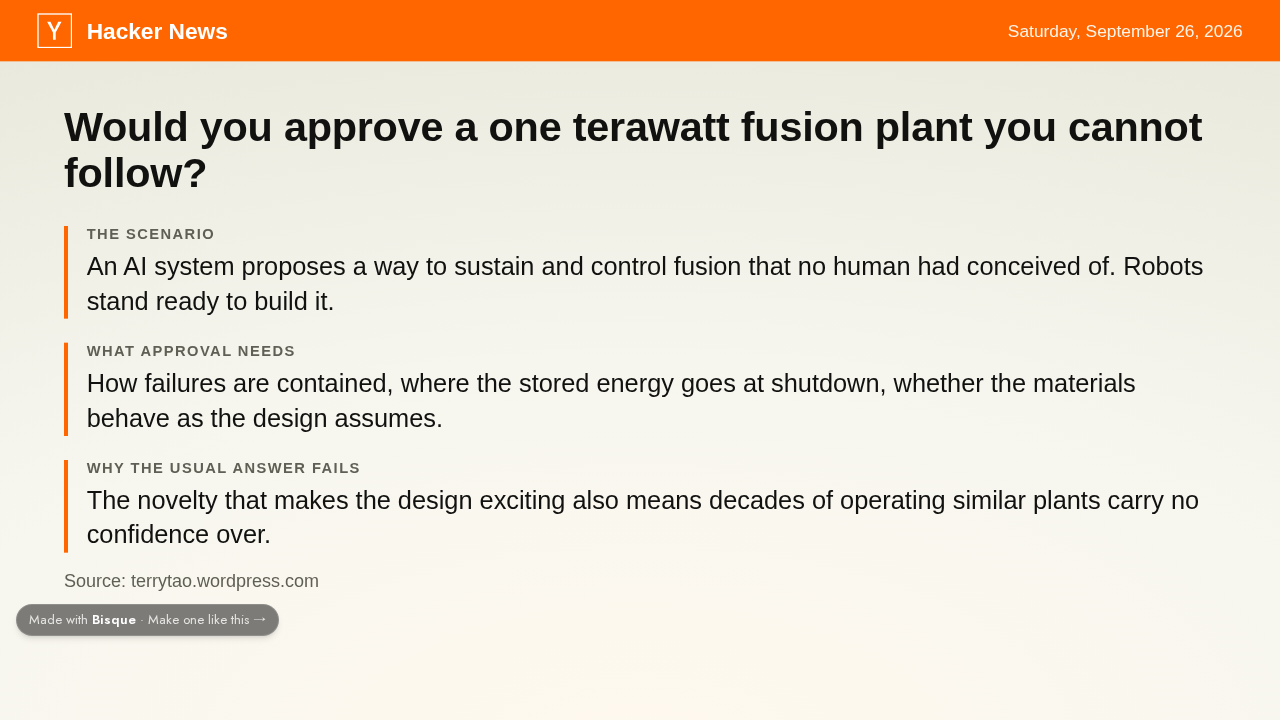
Hacker NewsSaturday, September 26, 2026Would you approve a one terawatt fusion plant you cannot follow?
His example is a one terawatt fusion plant, designed by an AI on principles people have never put into practice. Approving it means understanding containment, shutdown and materials. And because the design is new, experience with earlier plants can't answer them.
A deployable intellectual reserve
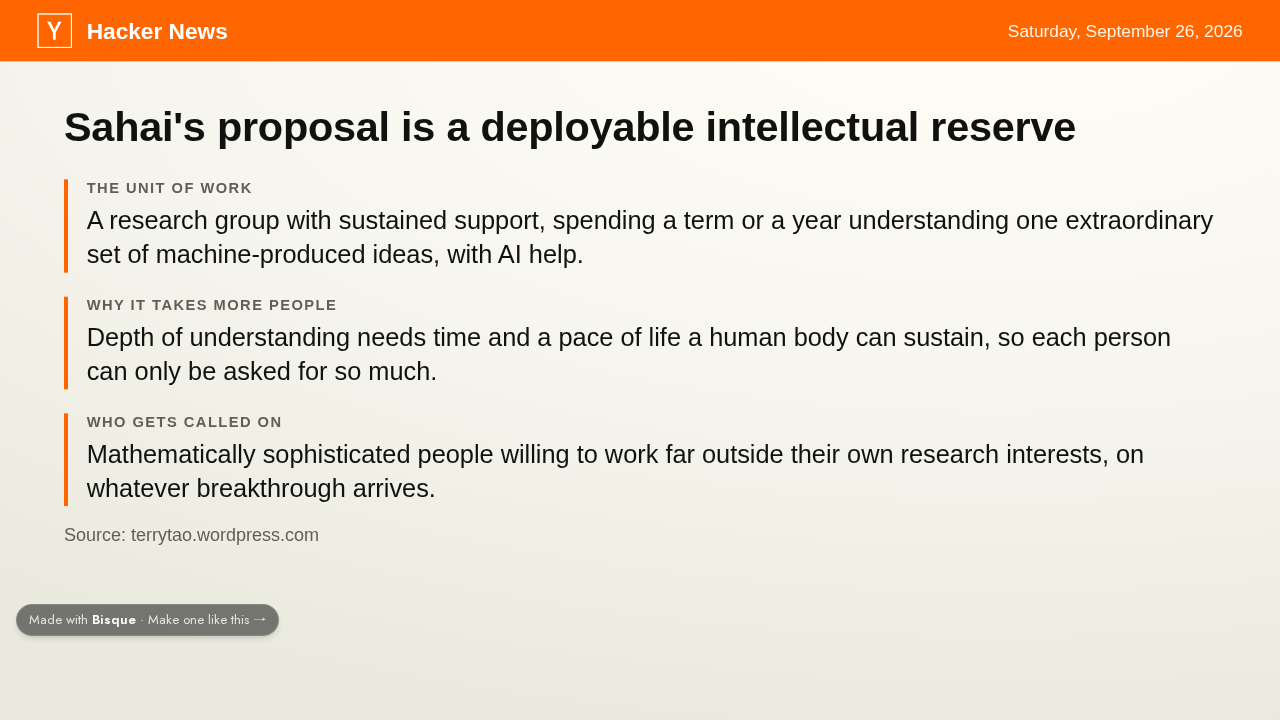
Hacker NewsSaturday, September 26, 2026Sahai's proposal is a deployable intellectual reserve
What he wants funded is research groups, each spending a term or a year understanding one set of machine-made ideas. Human understanding runs at a human pace, which is why it takes more people rather than fewer. He calls it a deployable intellectual reserve.
A commenter watching their own scrutiny slip
Hacker NewsSaturday, September 26, 2026In the thread
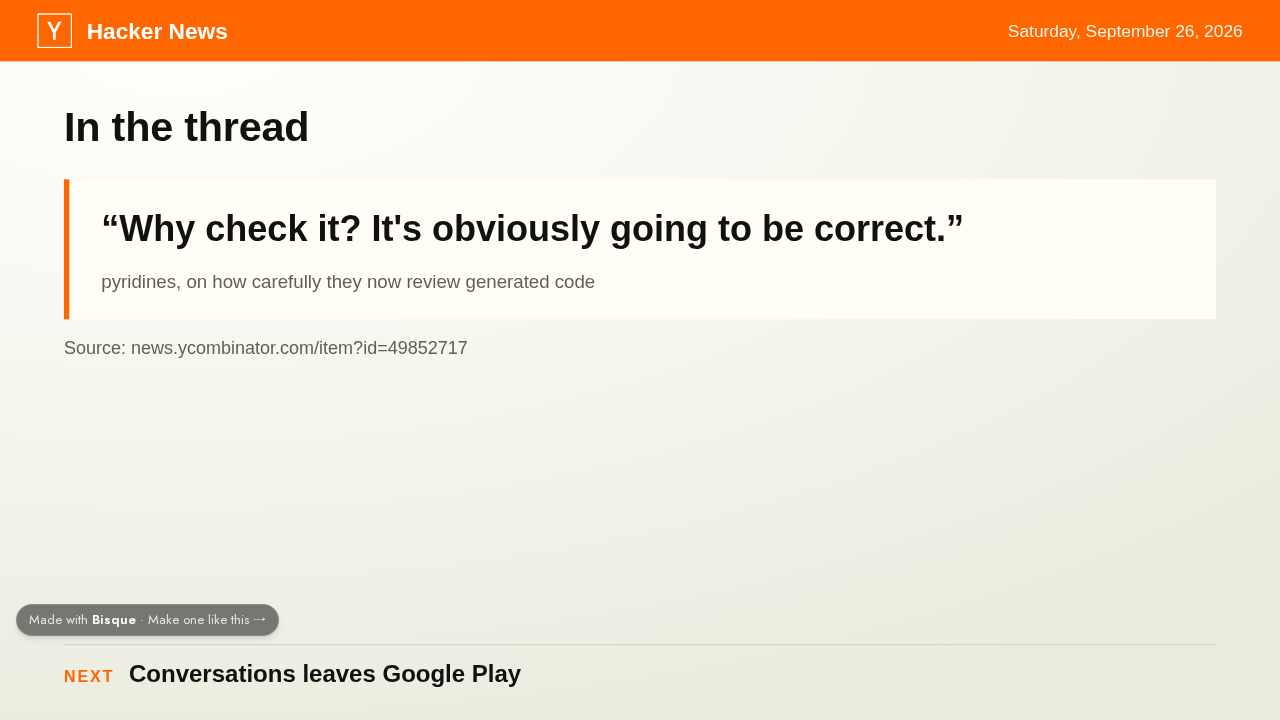
“Why check it? It's obviously going to be correct.”
Commenter pyridines takes the fusion plant down to the desk. They used to read every line the model wrote and usually found something; they catch fewer problems now, and they ask whether the ten thousandth fusion plant gets the same trust. Next: Conversations leaves Google Play.
What Google Play costs one Android developer
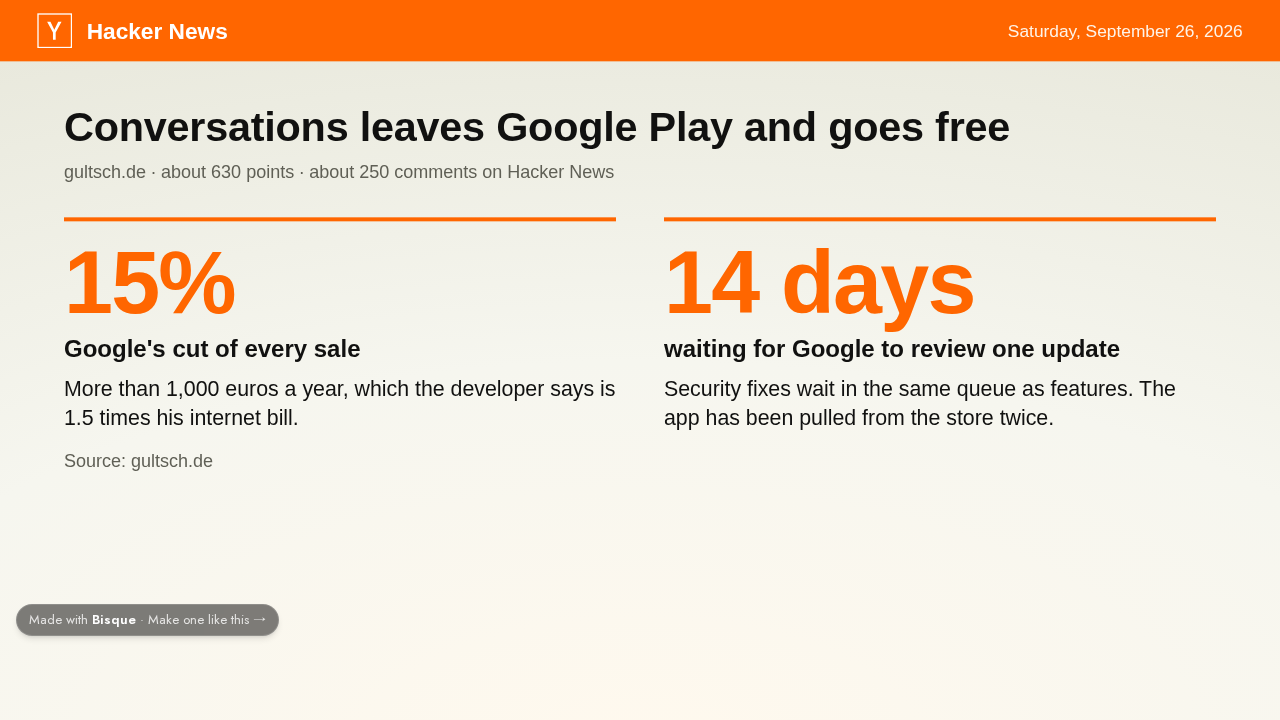
Hacker NewsSaturday, September 26, 2026Conversations leaves Google Play and goes free
Conversations is an XMPP messenger for Android, and since 2014 its Play Store sales have paid Daniel Gultsch's rent. Google's fifteen percent cut comes to more than a thousand euros a year. One update has waited fourteen days for review. Grants now fund the work through 2029, so the app is free.
A support number that cannot pass verification
Hacker NewsSaturday, September 26, 2026In the thread
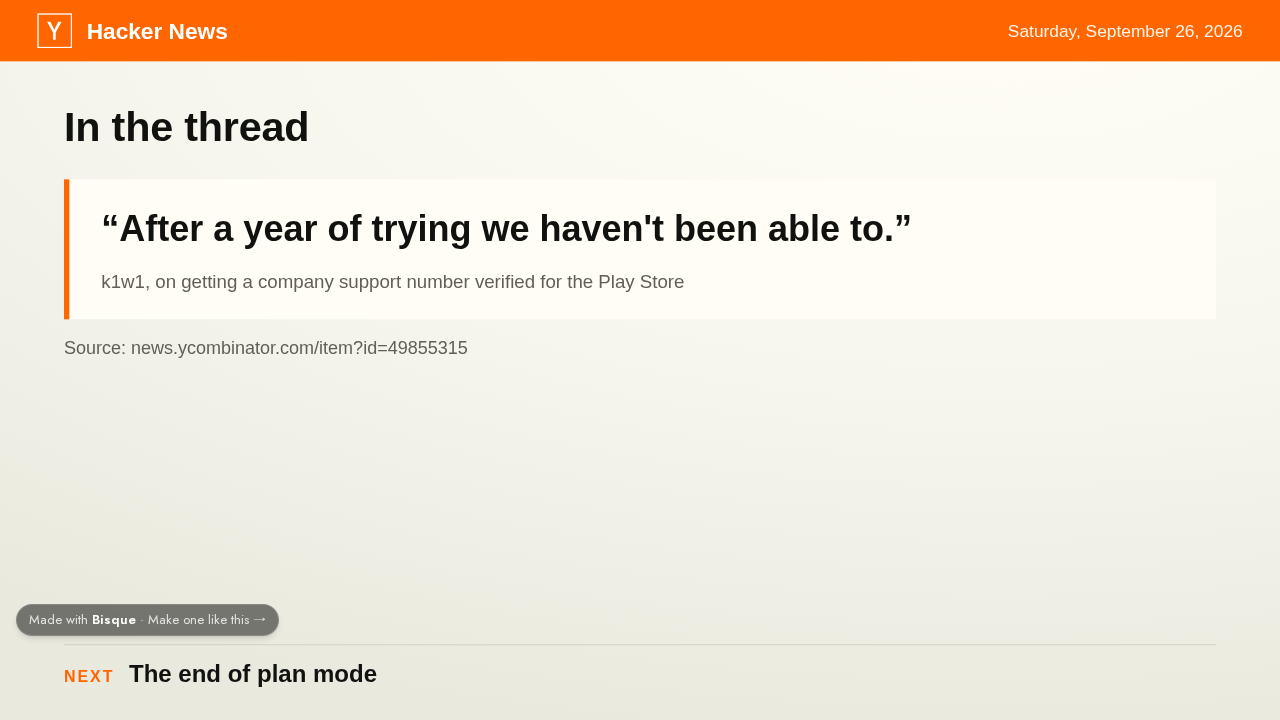
“After a year of trying we haven't been able to.”
Other developers describe the same queue from the other side. Commenter k1w1 says their company has spent a year failing Google's support-number check, because verification wants a text or a human and their line answers with a menu. Next: The end of plan mode.
The founder of a planning app says planning moved
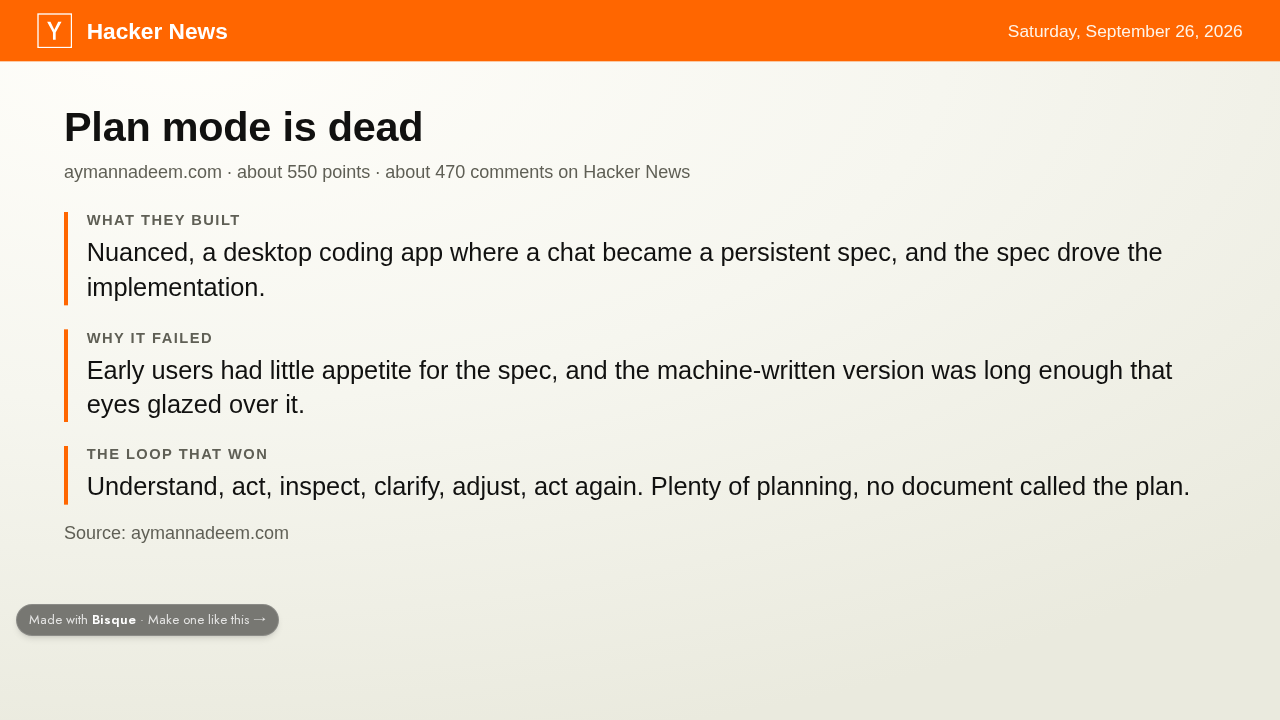
Hacker NewsSaturday, September 26, 2026Plan mode is dead
Ayman Nadeem built a coding app around planning, where a conversation hardened into a spec. Users had little appetite for that spec, and machine-written prose is punishing to read. Planning has moved inside the build loop instead.
Plan mode was only ever a prompt
Hacker NewsSaturday, September 26, 2026In the thread
“Plan mode has always been a prompt.”
Commenter bcherny, who works on Claude Code, says plan mode there is a reminder appended to each message. Switching the tools instead would break the prompt cache, and cost users money. Next: How Apple Cards got printed.
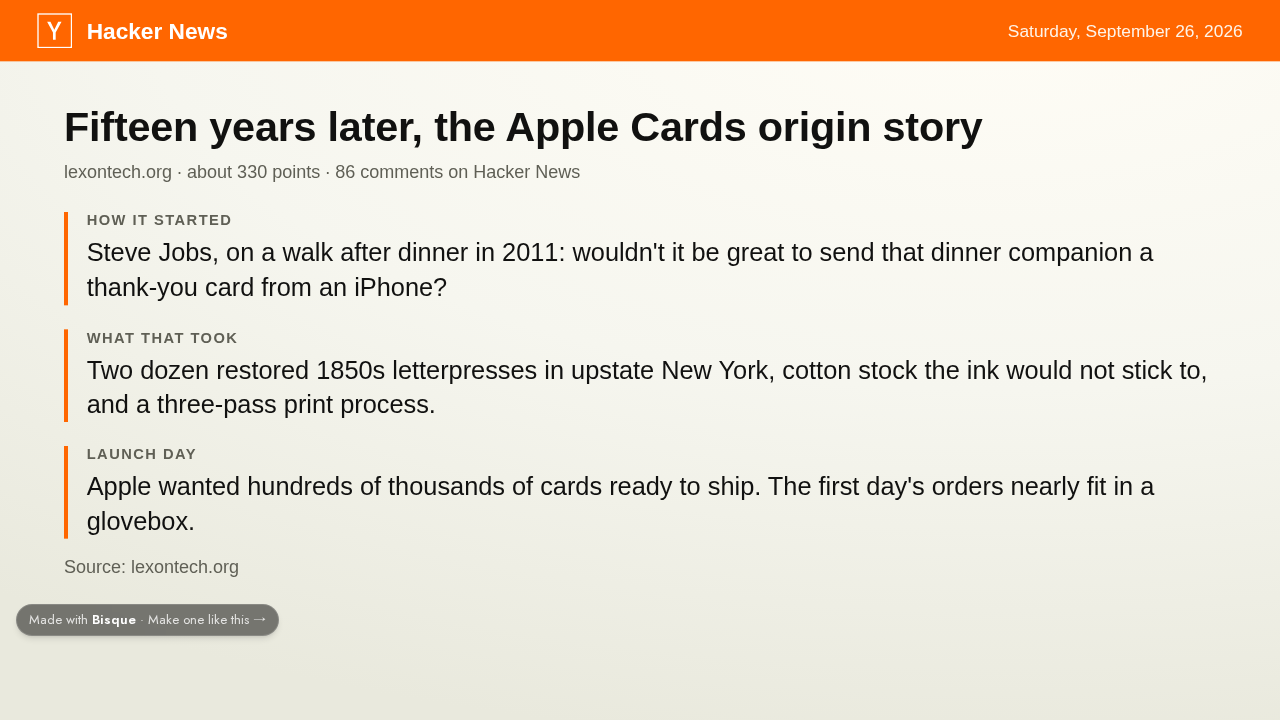
Steve Jobs asks for a thank-you card from his iPhone
Hacker NewsSaturday, September 26, 2026Fifteen years later, the Apple Cards origin story
Lex Friedman of Lex on Tech heard it from the man who ran the printing: it began with Steve Jobs on a walk after dinner. It took restored eighteen-fifties letterpresses, and cotton paper the ink refused. Apple wanted hundreds of thousands of cards ready. The first day's orders nearly fit in a glovebox.
The startup Apple landed on
Hacker NewsSaturday, September 26, 2026In the thread
“It felt like we'd been Sherlocked.”
Commenter solfox co-founded Sincerely, which was mailing printed cards from an iPhone before Apple was. Their account is that the keynote mostly brought them awareness, and that when Apple retired Cards, it came as no shock. Next: Floci, four clouds on a laptop.
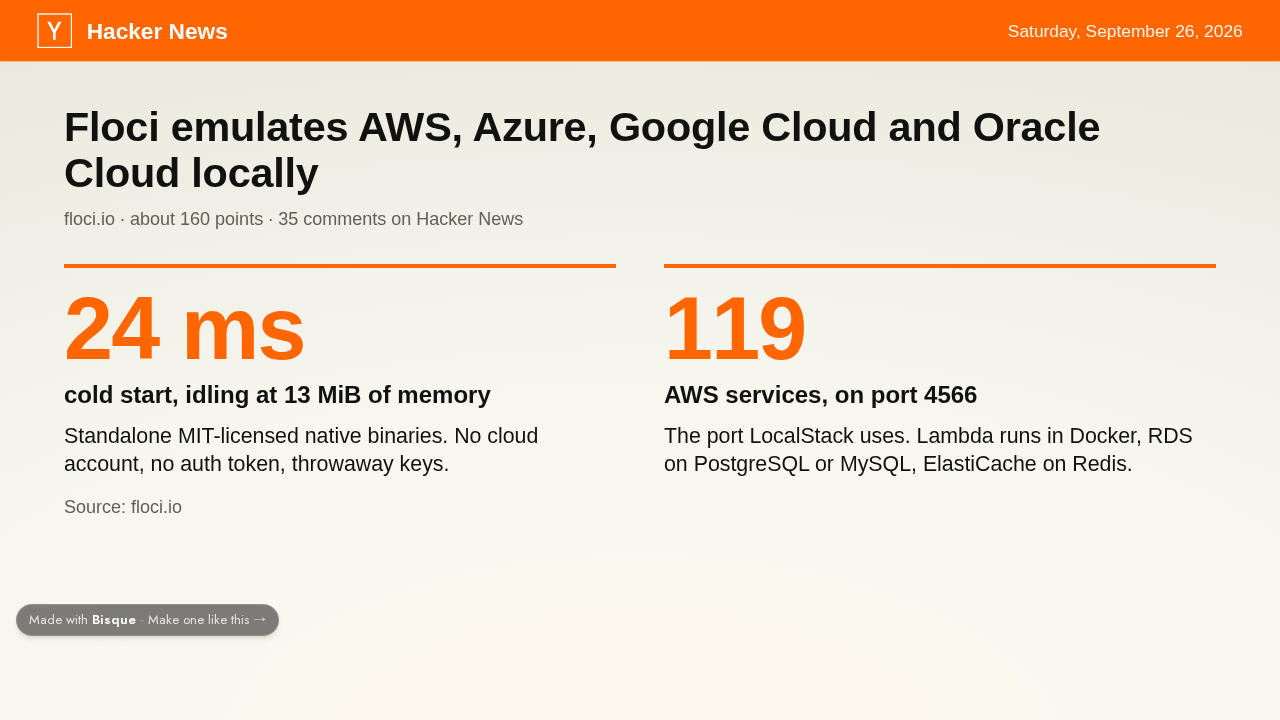
Four clouds, emulated on localhost
Hacker NewsSaturday, September 26, 2026Floci emulates AWS, Azure, Google Cloud and Oracle Cloud locally
Floci emulates four clouds on your laptop, as MIT-licensed binaries that start in about twenty four milliseconds and need no cloud account. Its AWS emulator answers on the port LocalStack uses, with about a hundred twenty services, and Lambda, RDS and Redis run for real underneath.
A reader already running it in CI
Hacker NewsSaturday, September 26, 2026In the thread
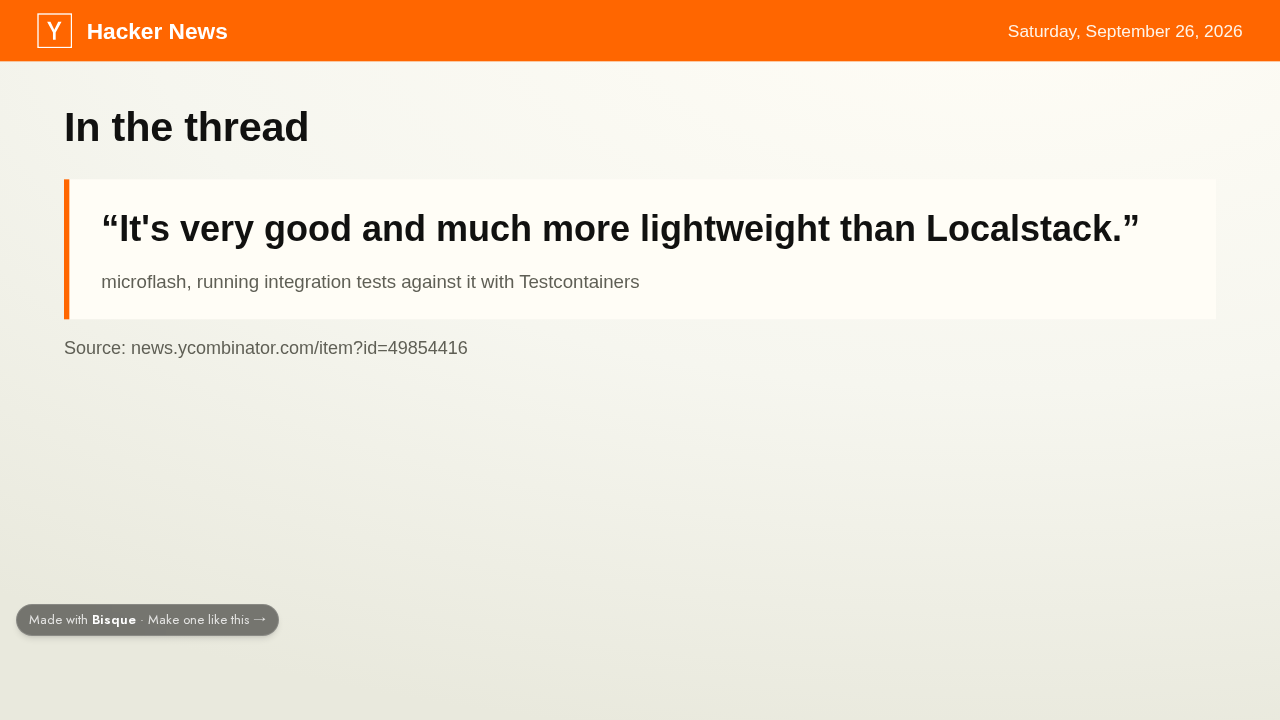
“It's very good and much more lightweight than Localstack.”
Commenter microflash has been running integration tests against it with Testcontainers for a while, and calls it much more lightweight than LocalStack.