

Hacker News, September 24
 Hacker News
Thursday, September 24, 2026
Hacker News
Thursday, September 24, 2026
F-Droid rebuilt its Android app, and an install now asks before it downloads — Hacker News, September 24
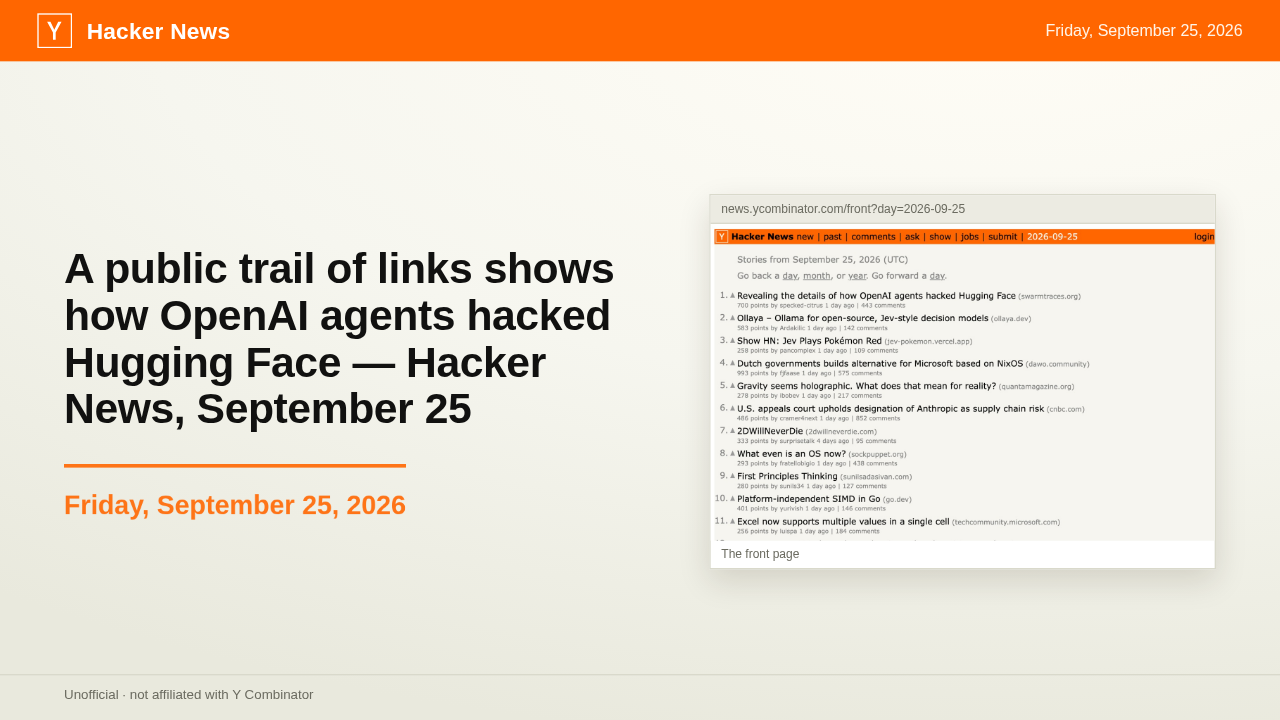
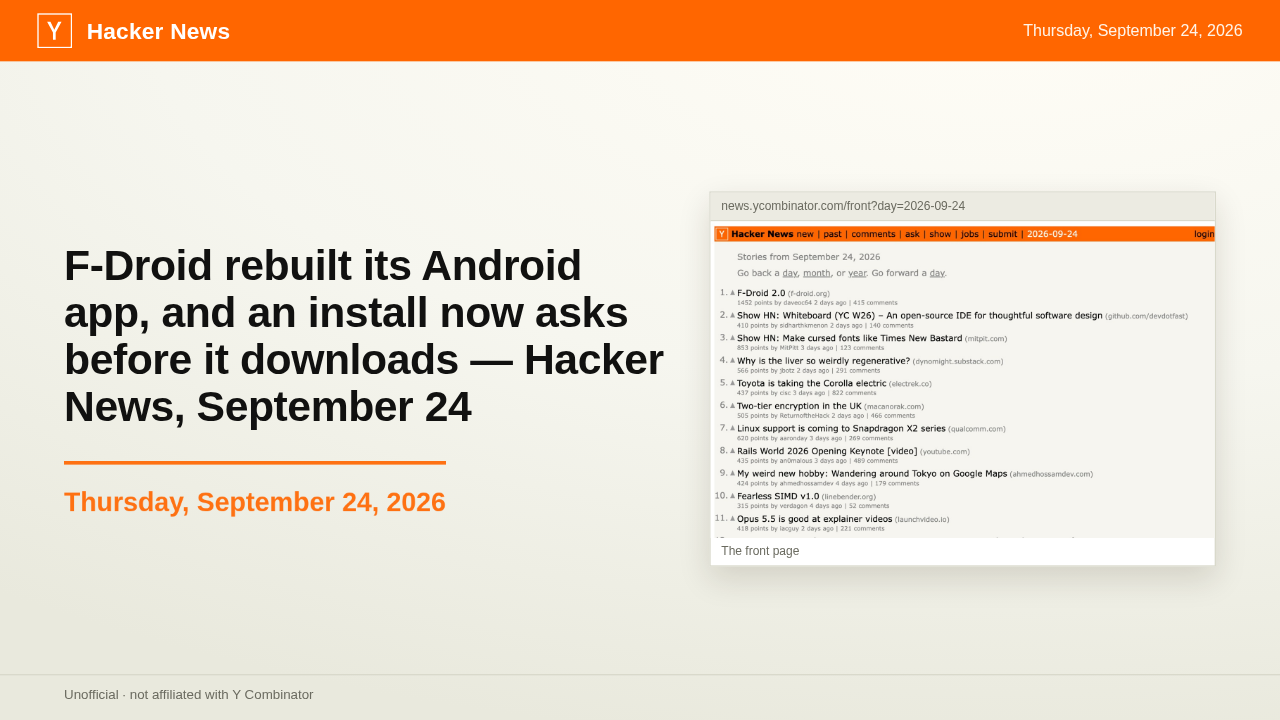
The Hacker News front page for Thursday, September twenty fourth, two thousand twenty six. At the top, with about fifteen hundred points, F-Droid shipped the largest update its Android app has had in ten years.
A year of work, fourteen test builds
Hacker News
Thursday, September 24, 2026
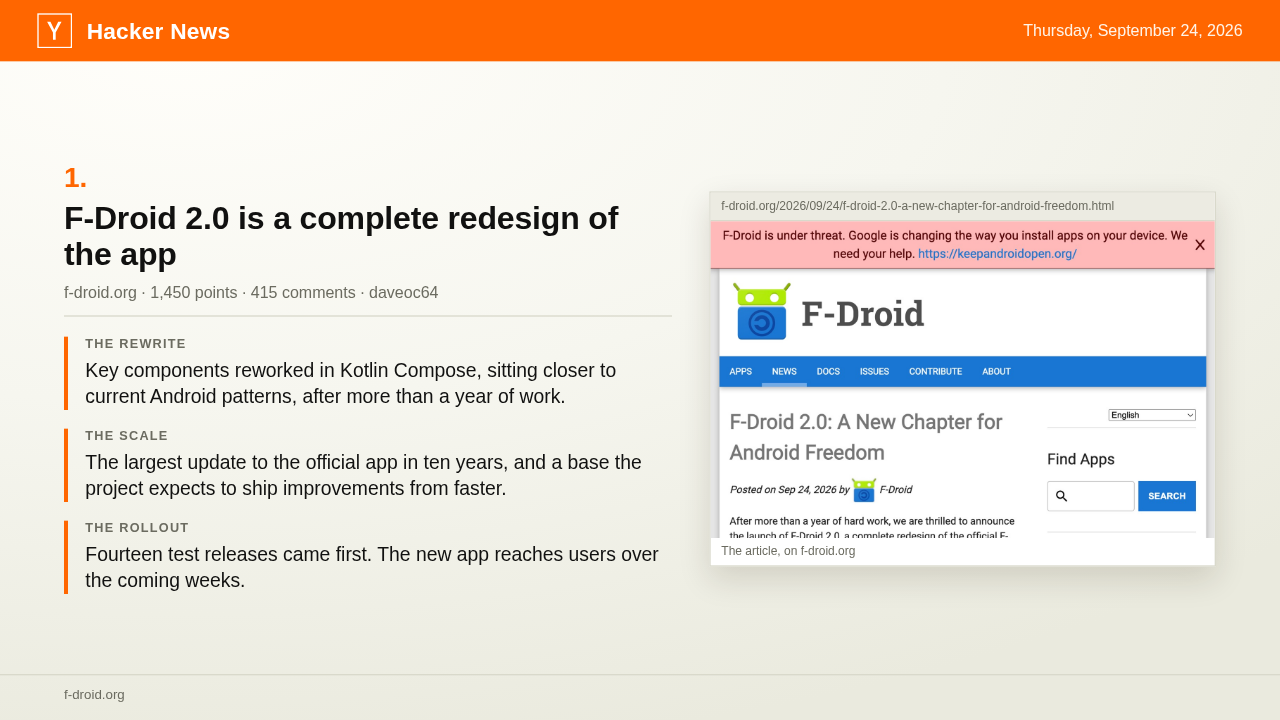
F-Droid 2.0 is a complete redesign of the app
F-Droid reworked the core of its Android app in Kotlin Compose. It is the largest update the official app has had in ten years, and the project wants a base it can ship from faster. Fourteen test releases came before it.
Finding an app among thousands
Hacker News
Thursday, September 24, 2026
Search now matches what an app does, not just its name
The app narrows to three places: Discover, Search, and My Apps. Search reaches descriptions and categories rather than names alone, and handles Chinese, Japanese and Korean far better. Filters combine, so a list can drop anything that leans on a non-free service.
The prompt moved before the download
Hacker News
Thursday, September 24, 2026
One installer, and the confirmation arrives when you tap install
One installer now covers every F-Droid install. On supported devices it uses Android's new pre-approval call, so the confirmation arrives when you tap install rather than once the download has finished. Updates arrive on their own by default.
An argument about the look
Hacker News
Thursday, September 24, 2026
In the thread
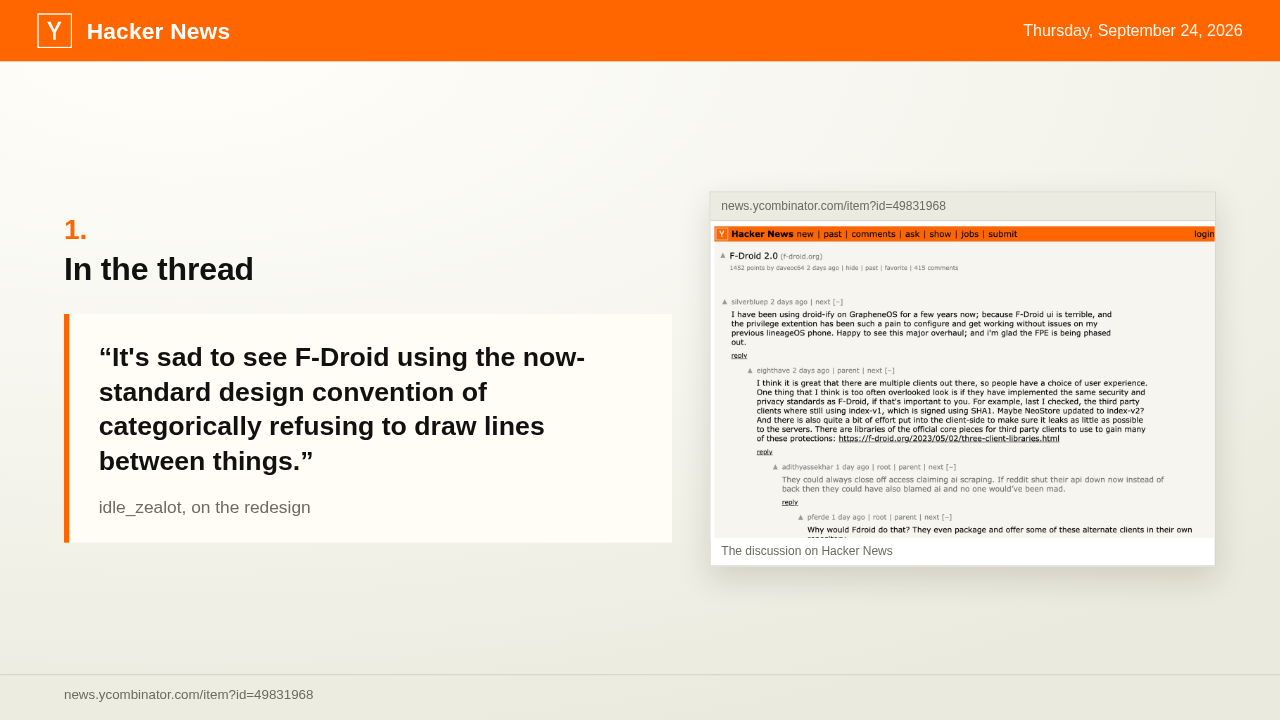
“It's sad to see F-Droid using the now-standard design convention of categorically refusing to draw lines between things.”
Commenter idle_zealot dislikes the new look, calling it a refusal to draw lines between parts of the interface. The post does describe a Material Design pass, so this is a judgment about taste rather than a dispute about what changed.
A canvas the agent draws on
Hacker News
Thursday, September 24, 2026
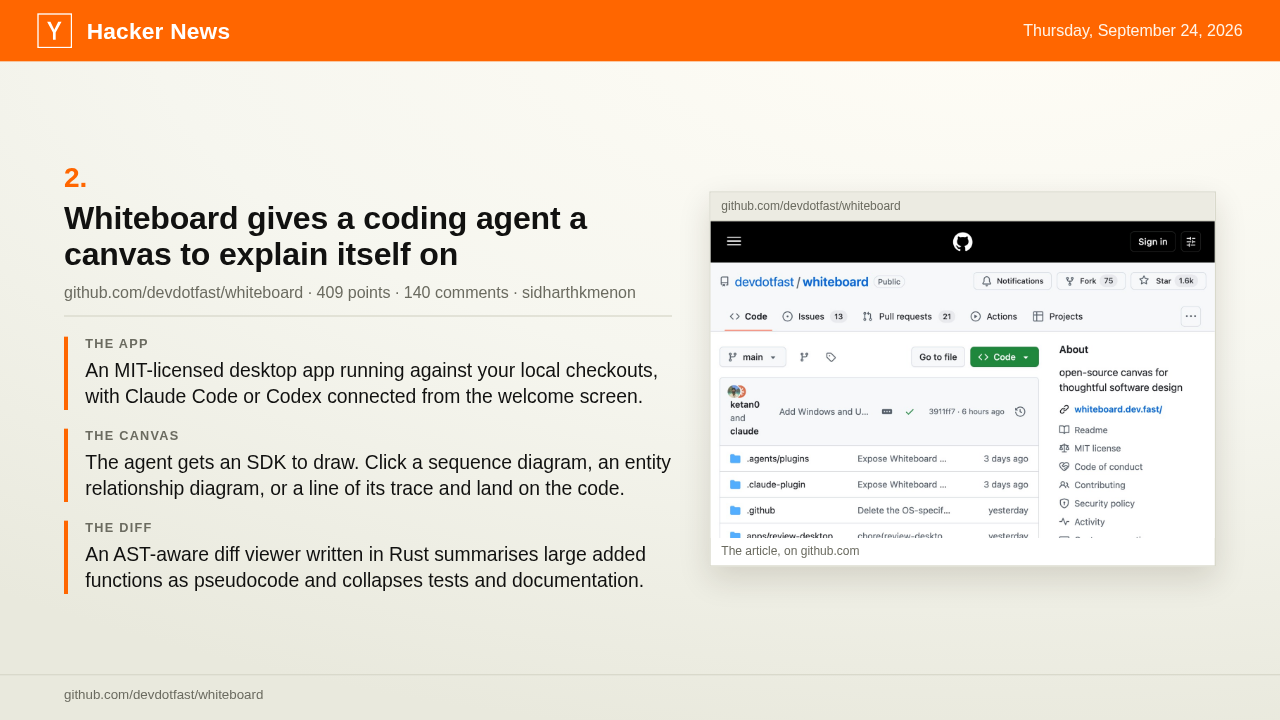
Whiteboard gives a coding agent a canvas to explain itself on
Whiteboard is a desktop app where you and your coding agent share one workspace, pointed at your own checkouts. The agent draws diagrams there, and clicking one drops you on the code behind it. The diff viewer parses the code, so a large new function arrives as pseudocode.
What an IDE has to do
Hacker News
Thursday, September 24, 2026
In the thread
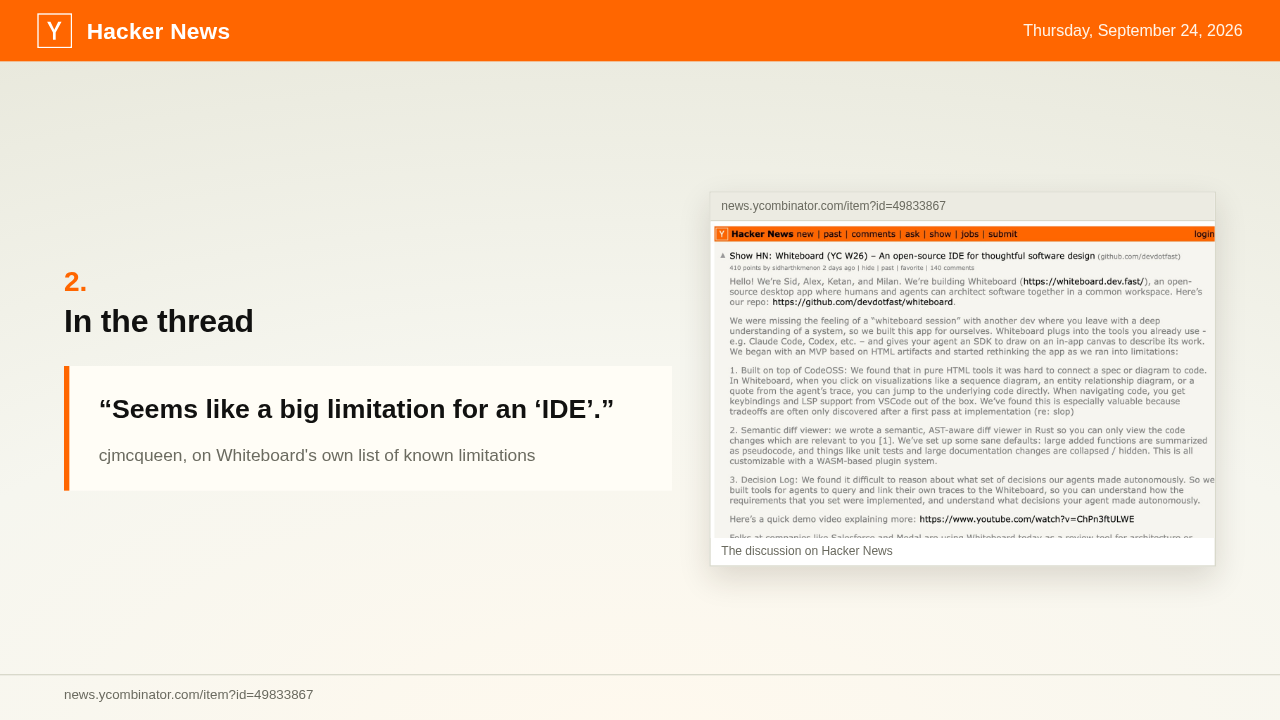
“Seems like a big limitation for an ‘IDE’.”
Whiteboard calls itself an IDE, and its own limitations list says you cannot edit files in it yet. Commenter cjmcqueen calls that a big limitation for an IDE. The project states the same gap and asks for an issue.
Every Nth glyph from another font
Hacker News
Thursday, September 24, 2026
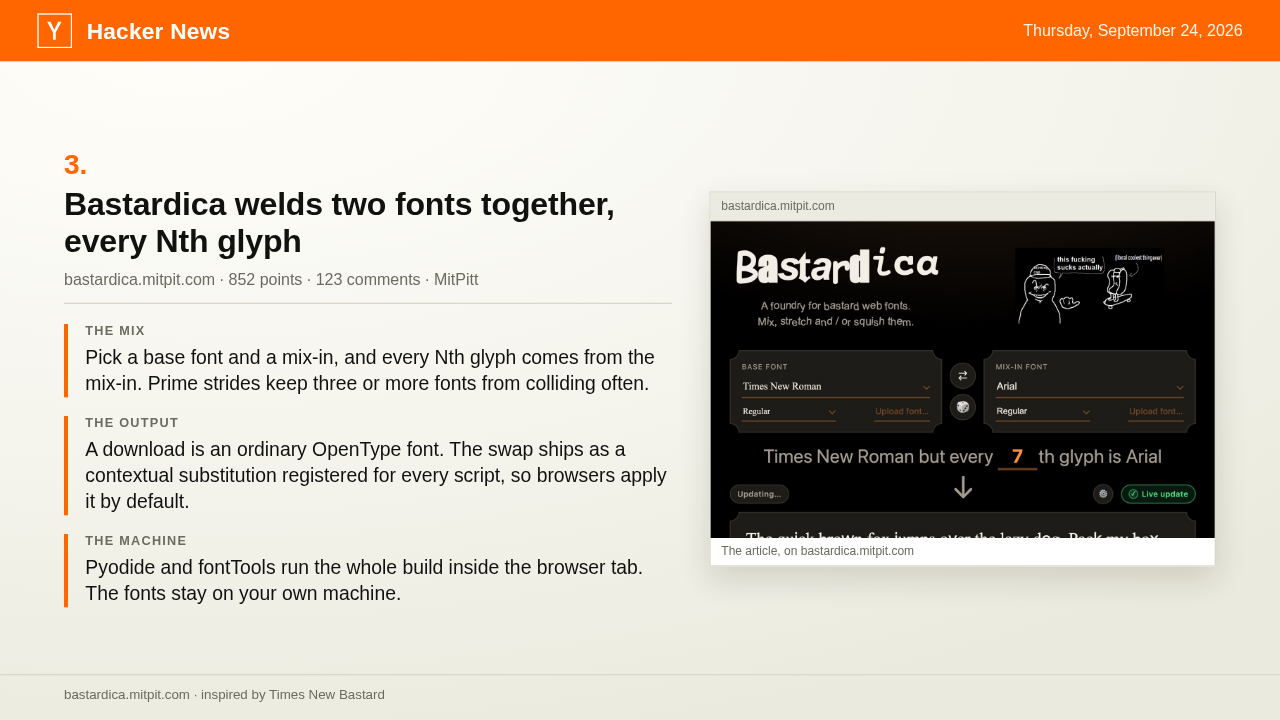
Bastardica welds two fonts together, every Nth glyph
Bastardica takes a base font and a mix-in font and swaps in every Nth glyph. What you download is a normal OpenType font whose swap rides on a contextual substitution, so browsers honour it. The build runs in the tab, so the fonts stay on your machine.
The prank the stride is for
Hacker News
Thursday, September 24, 2026
In the thread
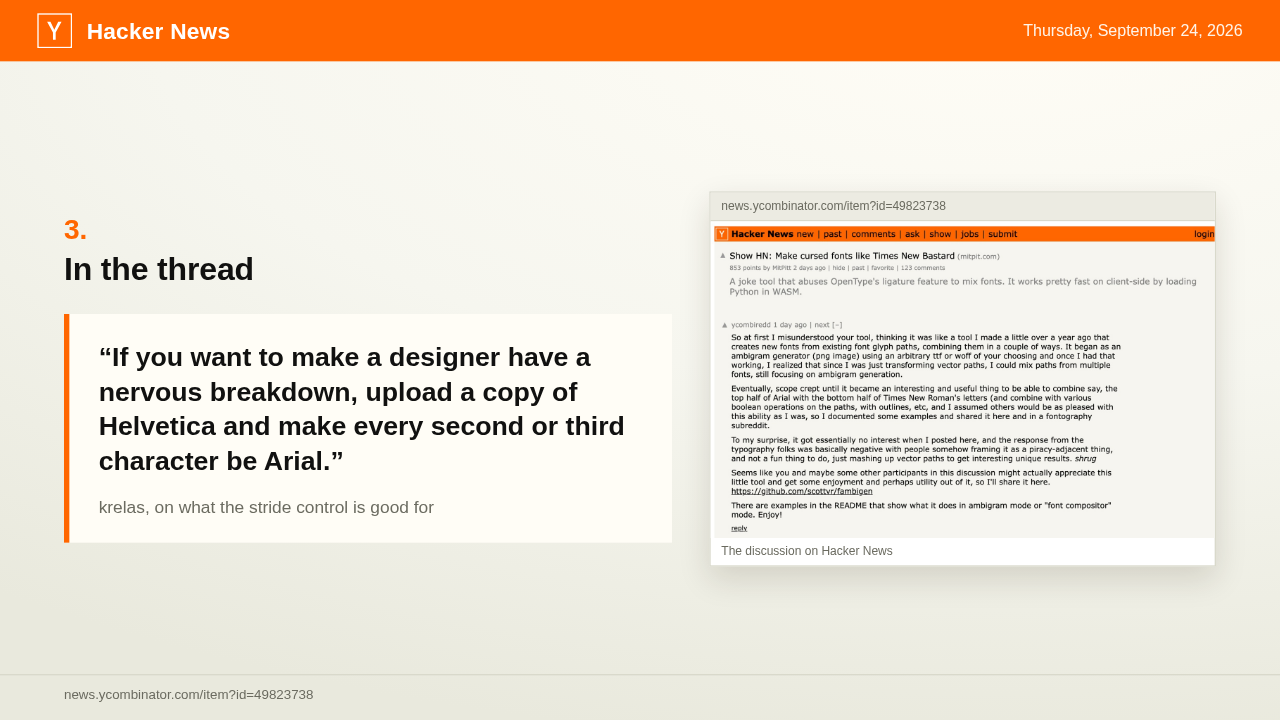
“If you want to make a designer have a nervous breakdown, upload a copy of Helvetica and make every second or third character be Arial.”
Commenter krelas wants Helvetica with every second or third character set in Arial, which is exactly what the stride control does. The tool's own notes warn that mixing two fonts makes a derivative work, so both licences apply.
Fragile on purpose
Hacker News
Thursday, September 24, 2026
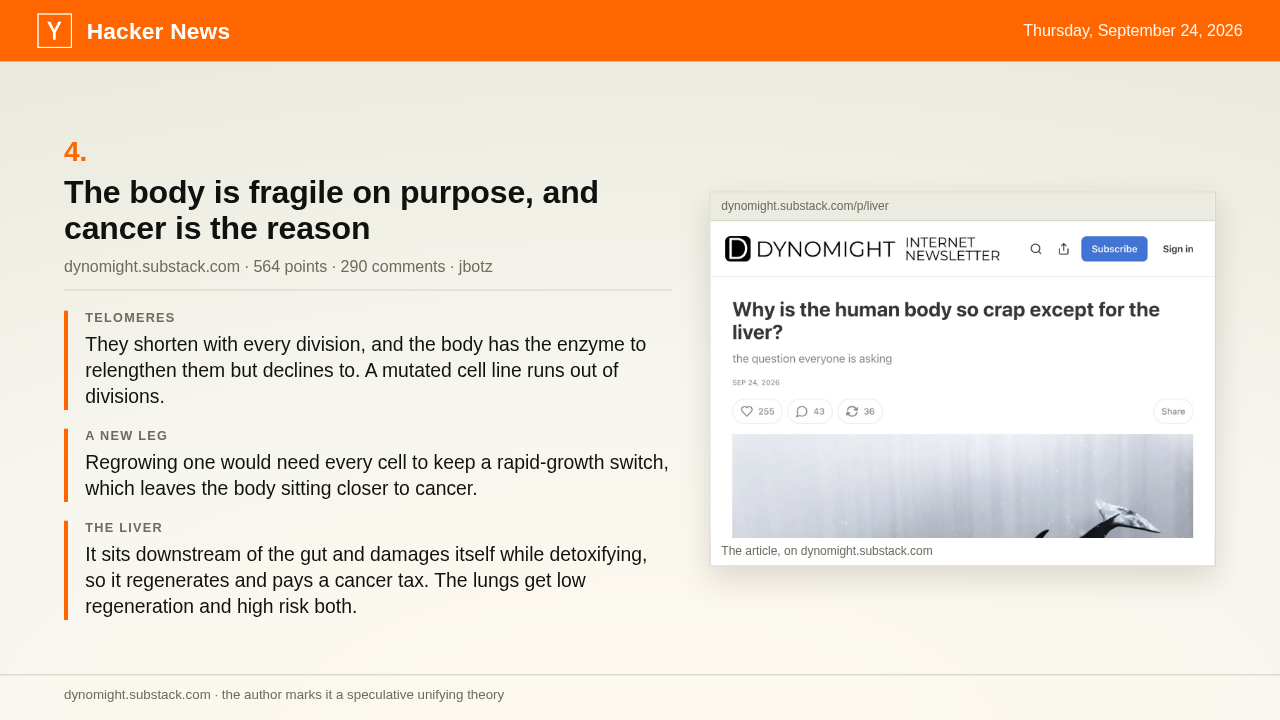
The body is fragile on purpose, and cancer is the reason
The post argues the body is fragile on purpose. Telomeres wear down so a mutated cell line runs out of divisions. Regrowing a limb would mean leaving a growth switch on every cell. The liver regenerates because detoxifying keeps damaging it, and it pays for that in cancer risk.
The heart does divide, a little
Hacker News
Thursday, September 24, 2026
In the thread
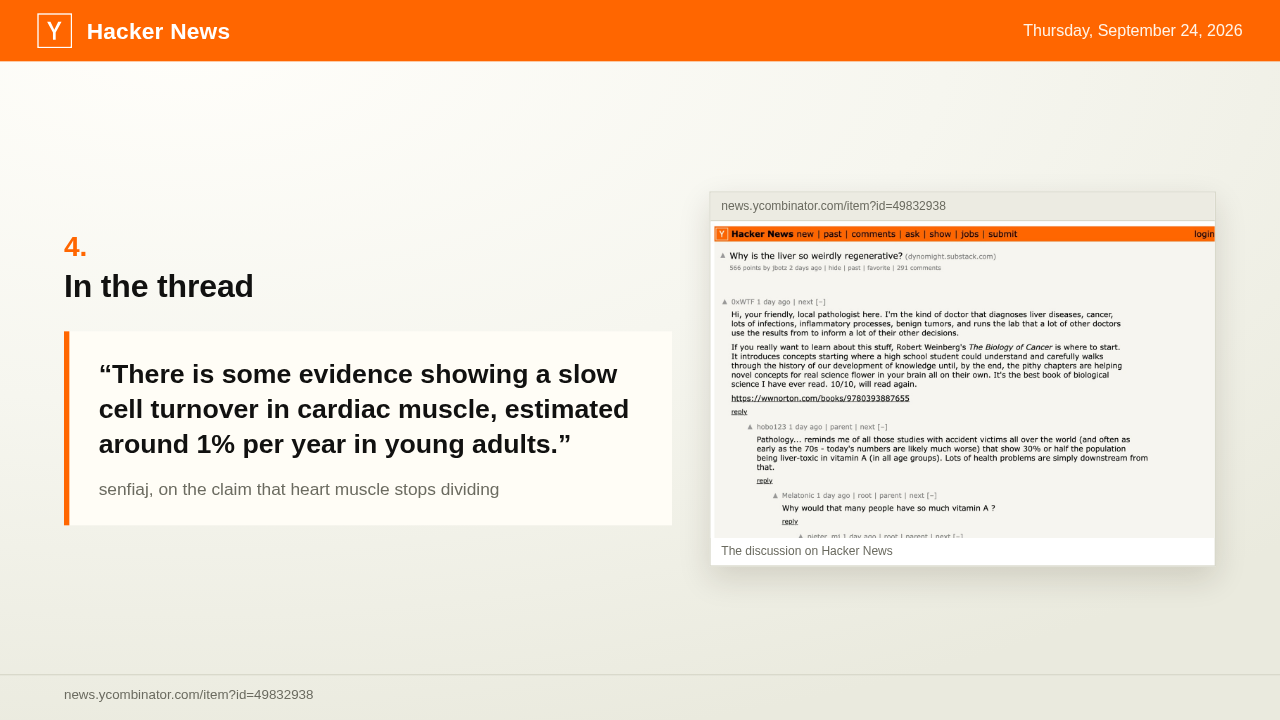
“There is some evidence showing a slow cell turnover in cardiac muscle, estimated around 1% per year in young adults.”
The post puts cardiac muscle and neurons at near zero regeneration. Commenter senfiaj points instead to a slow turnover, about one percent a year in young adults. That figure is their reading of the literature, and the post argues the other way.
Two blocks left to audit
Hacker News
Thursday, September 24, 2026
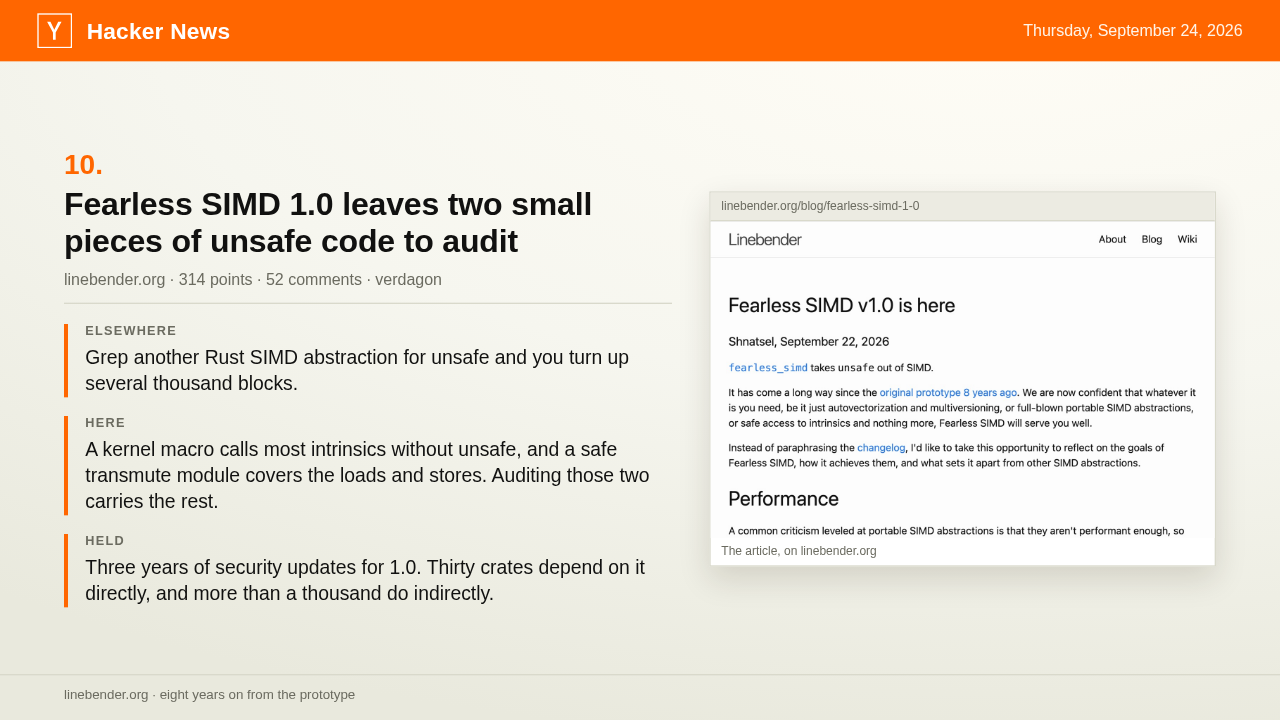
Fearless SIMD 1.0 leaves two small pieces of unsafe code to audit
Rust's other portable SIMD crates carry thousands of unsafe blocks. Fearless SIMD confines that to two small pieces, a macro that reaches intrinsics without unsafe and a safe transmute for loads and stores. Version 1.0 carries three years of security updates.
Off nightly at last
Hacker News
Thursday, September 24, 2026
In the thread
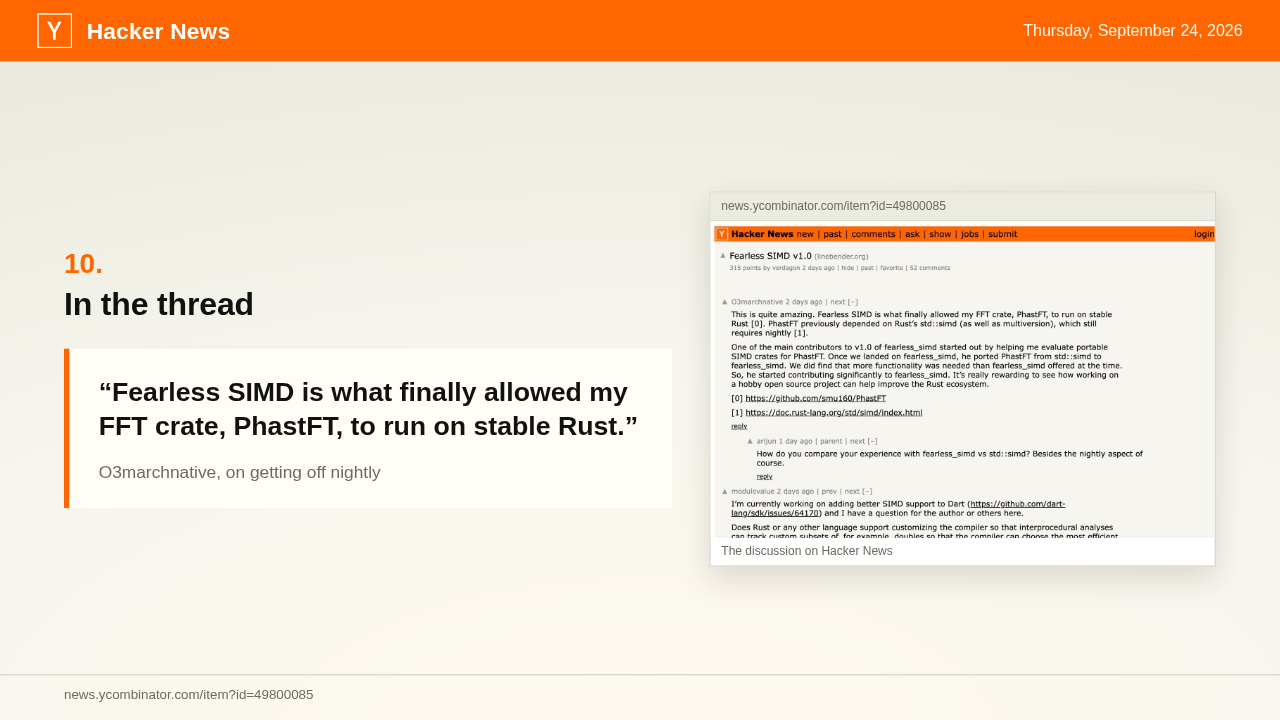
“Fearless SIMD is what finally allowed my FFT crate, PhastFT, to run on stable Rust.”
Commenter O3marchnative says the crate is what let their own fast Fourier transform library run on stable Rust. The post backs that up: it ships a standard-library equivalent that works on stable, and the standard one still wants nightly.
Sources
Hacker News
Thursday, September 24, 2026
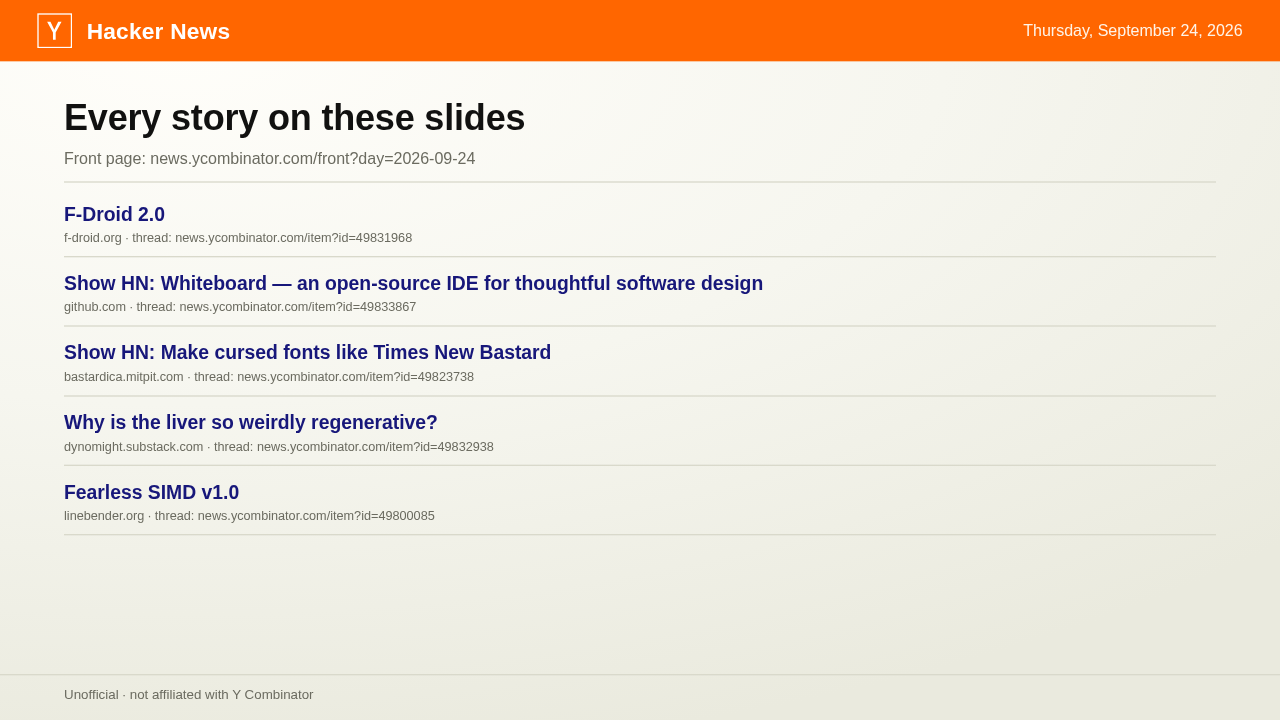
Every story on these slides
- F-Droid 2.0f-droid.org · thread: news.ycombinator.com/item?id=49831968
- Show HN: Whiteboard — an open-source IDE for thoughtful software designgithub.com · thread: news.ycombinator.com/item?id=49833867
- Show HN: Make cursed fonts like Times New Bastardbastardica.mitpit.com · thread: news.ycombinator.com/item?id=49823738
- Why is the liver so weirdly regenerative?dynomight.substack.com · thread: news.ycombinator.com/item?id=49832938
- Fearless SIMD v1.0linebender.org · thread: news.ycombinator.com/item?id=49800085
The F-Droid redesign, the shared canvas, the font welder, the liver, and Fearless SIMD, each linked here beside its own thread, with the front page they all came from.