

Hacker News, September 22
 Hacker News
Tuesday, September 22, 2026
Hacker News
Tuesday, September 22, 2026
Claude Opus 5.5 costs 40% less to run than the model it replaces — Hacker News, September 22
The front page for Tuesday, September twenty second, two thousand twenty six. At about eighteen hundred points, Anthropic shipped Claude Opus five point five, and says the same work now costs forty percent less to run than it did on the model this one replaces.
A new Claude family opens
Hacker News
Tuesday, September 22, 2026
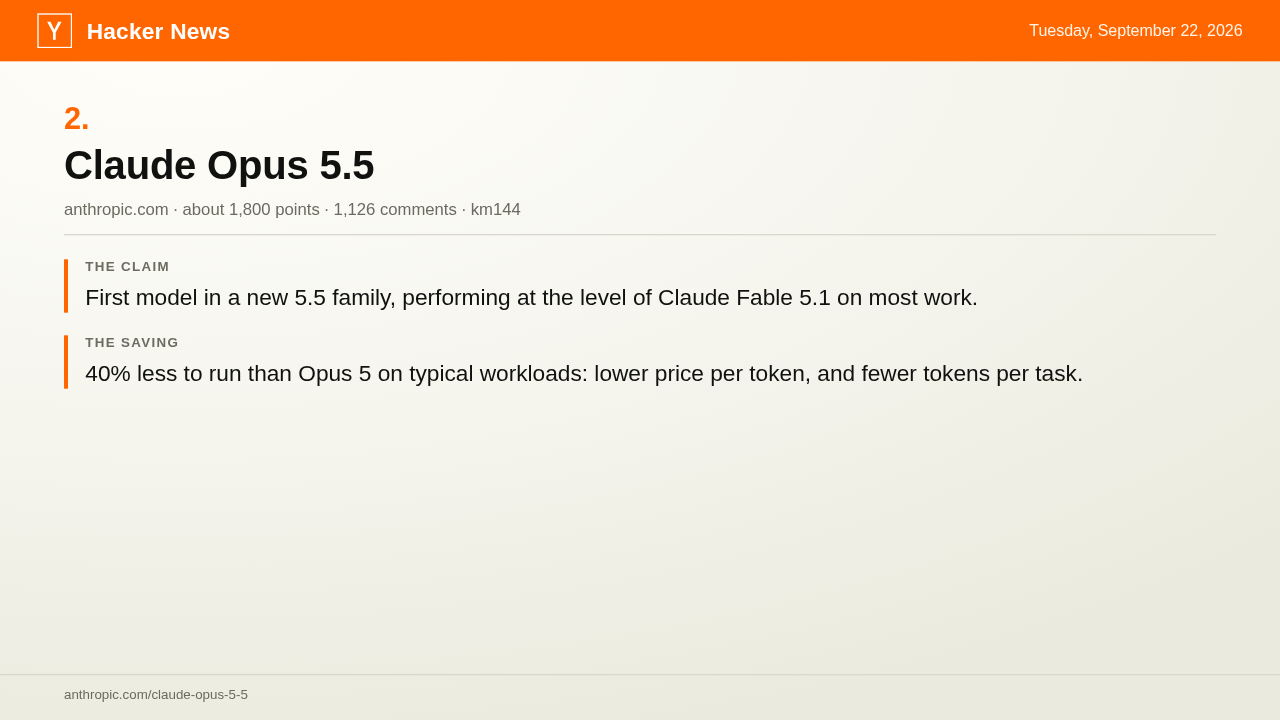
Claude Opus 5.5
It opens a new Claude family, and Anthropic says it works at the level of Fable five point one on most jobs. The forty percent saving is two things at once: a lower price per token, and fewer tokens per task.
The price per million tokens
Hacker News
Tuesday, September 22, 2026
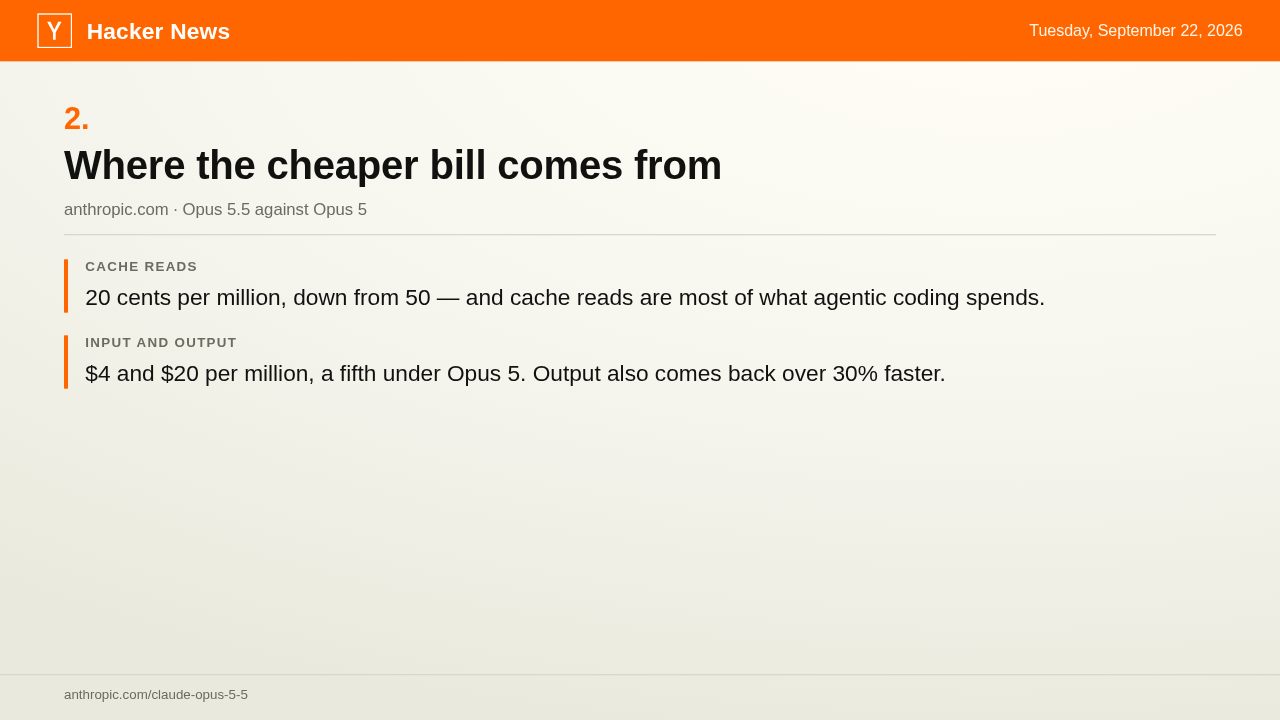
Where the cheaper bill comes from
Cache reads fall from fifty cents a million to twenty, and cache reads are where most of the cost of agentic coding sits. Input and output come down a fifth, to four dollars and twenty, and output comes back over thirty percent faster.
What early testers finished
Hacker News
Tuesday, September 22, 2026
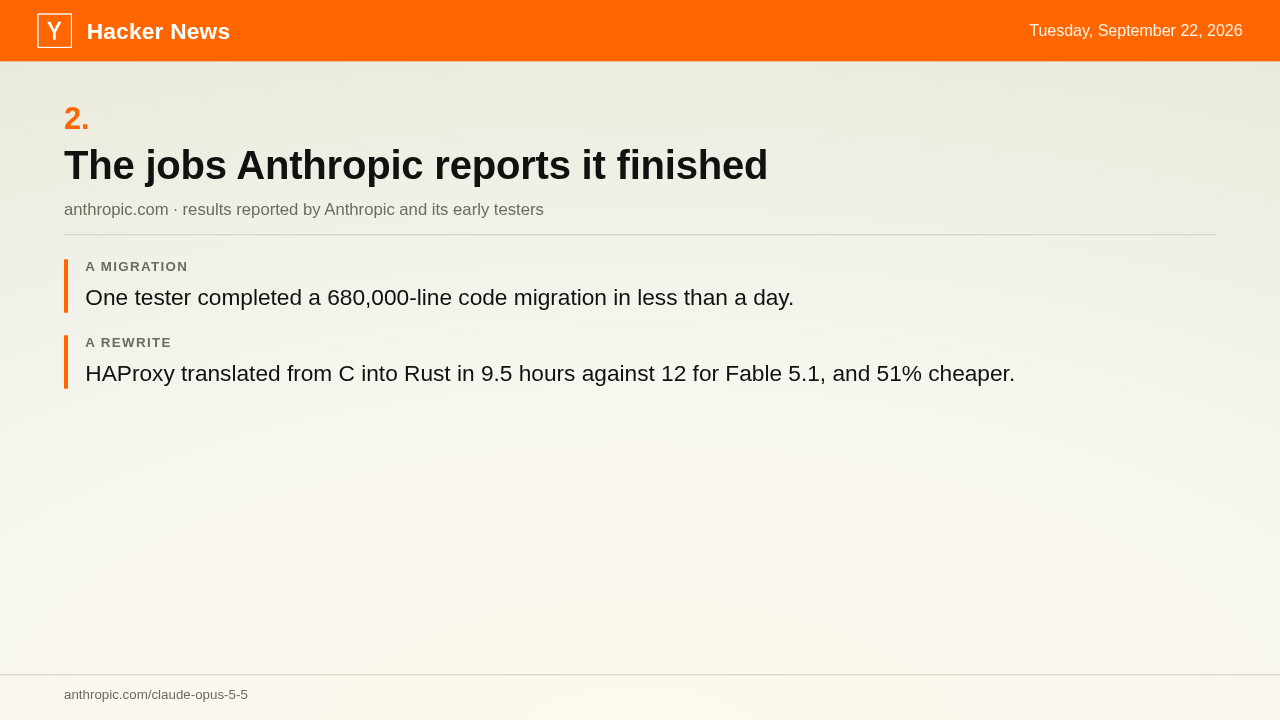
The jobs Anthropic reports it finished
An early tester finished a six hundred and eighty thousand line migration in under a day. Anthropic also had it translate HAProxy from C into Rust, nine and a half hours against twelve for Fable five point one, at half the cost.
Pacing, and the numbers under it
Hacker News
Tuesday, September 22, 2026
In the thread
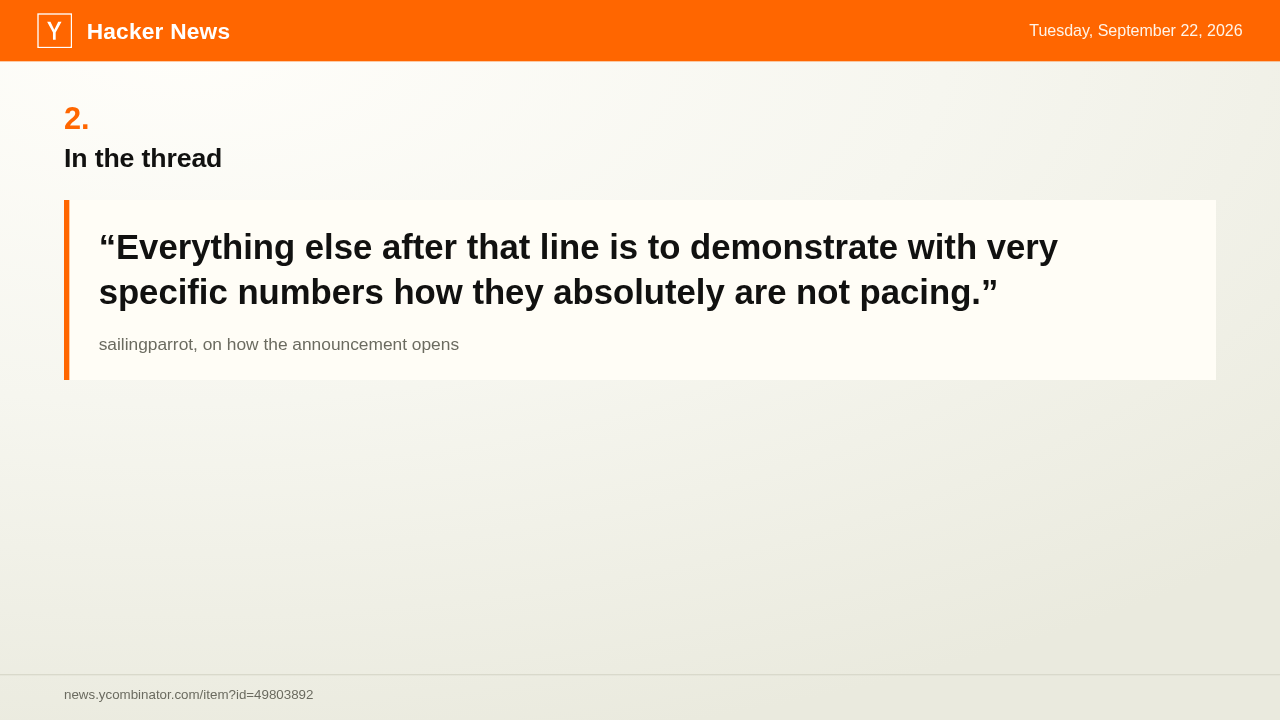
“Everything else after that line is to demonstrate with very specific numbers how they absolutely are not pacing.”
Commenter sailingparrot notices what the announcement opens with: Anthropic's own recent call to pace the frontier. Everything after that line, they argue, is specific numbers showing the opposite, and the post does open exactly that way, calling this its first release since that call.
An Enigma message finally opens
Hacker News
Tuesday, September 22, 2026
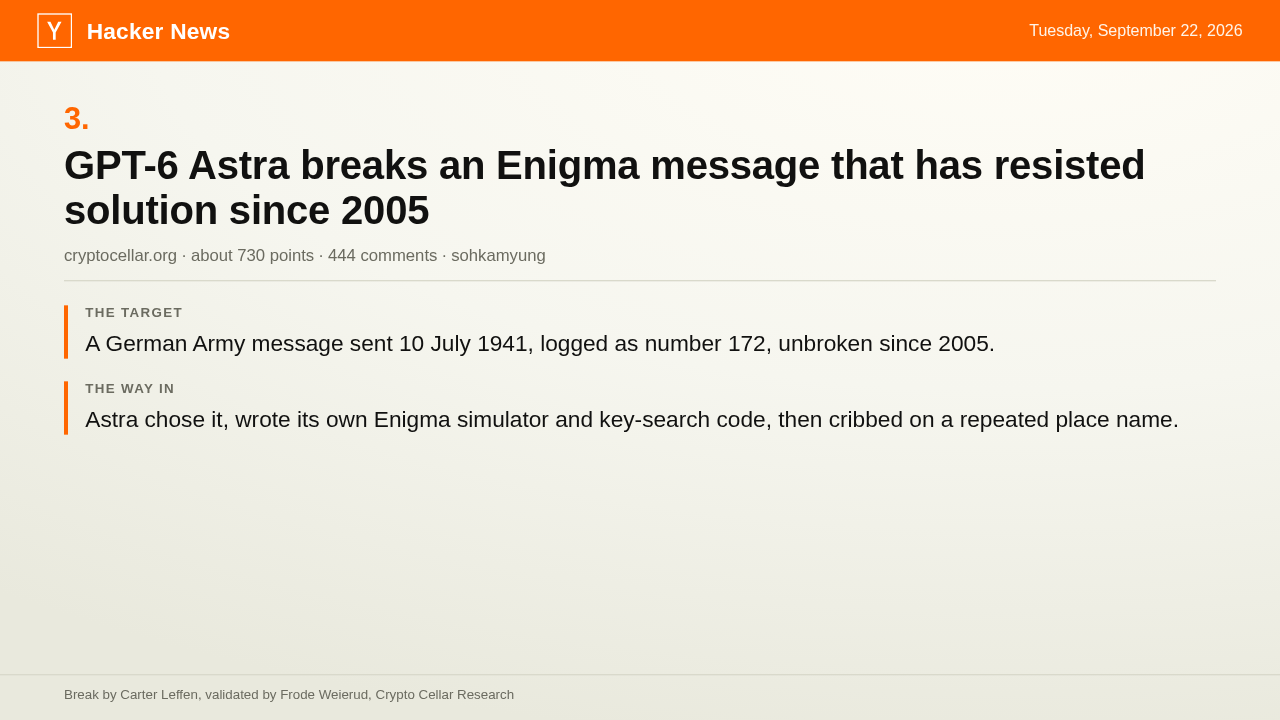
GPT-6 Astra breaks an Enigma message that has resisted solution since 2005
The message went out on the tenth of July, nineteen forty one, and had held out since two thousand five. Astra picked that target itself, wrote its own Enigma simulator and key search code, and cribbed on a repeated place name.
How much credit the model earns
Hacker News
Tuesday, September 22, 2026
In the thread
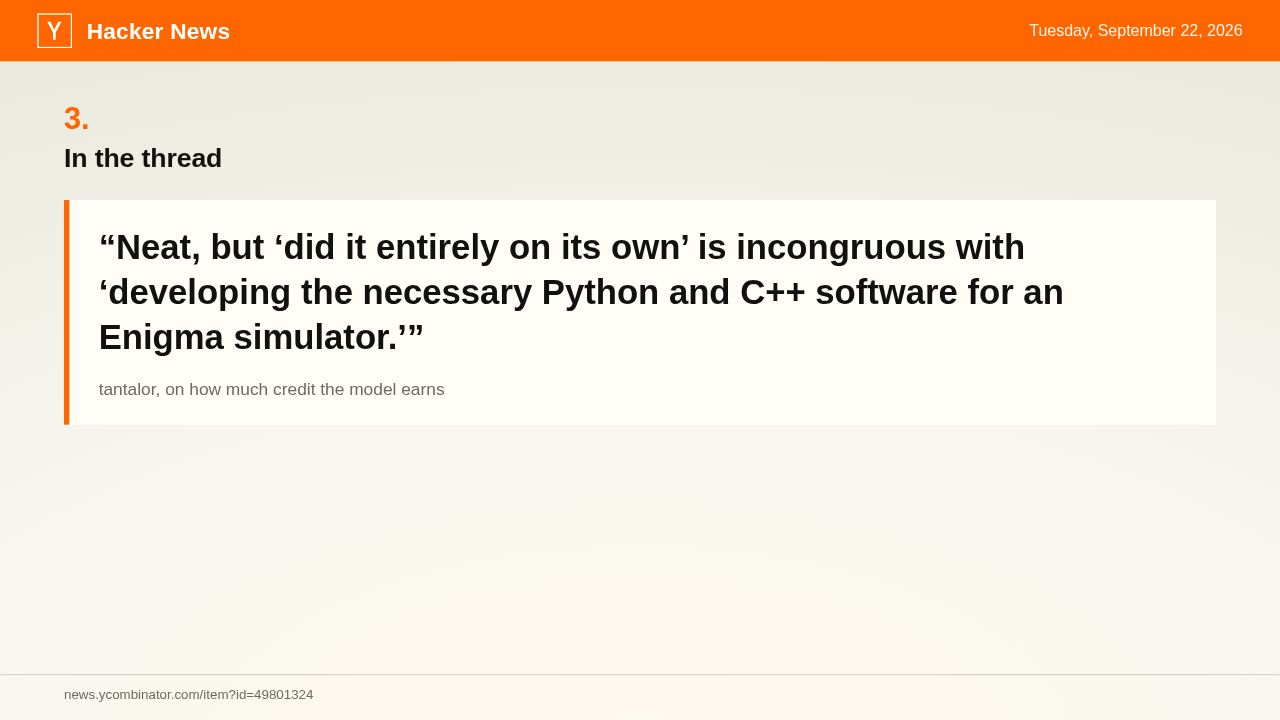
“Neat, but ‘did it entirely on its own’ is incongruous with ‘developing the necessary Python and C++ software for an Enigma simulator.’”
Commenter tantalor pushes on the framing. The write up says the model did it entirely on its own, and in the same breath says it wrote the simulator and the search code, which is where the work went.
The context you have and they don't
Hacker News
Tuesday, September 22, 2026
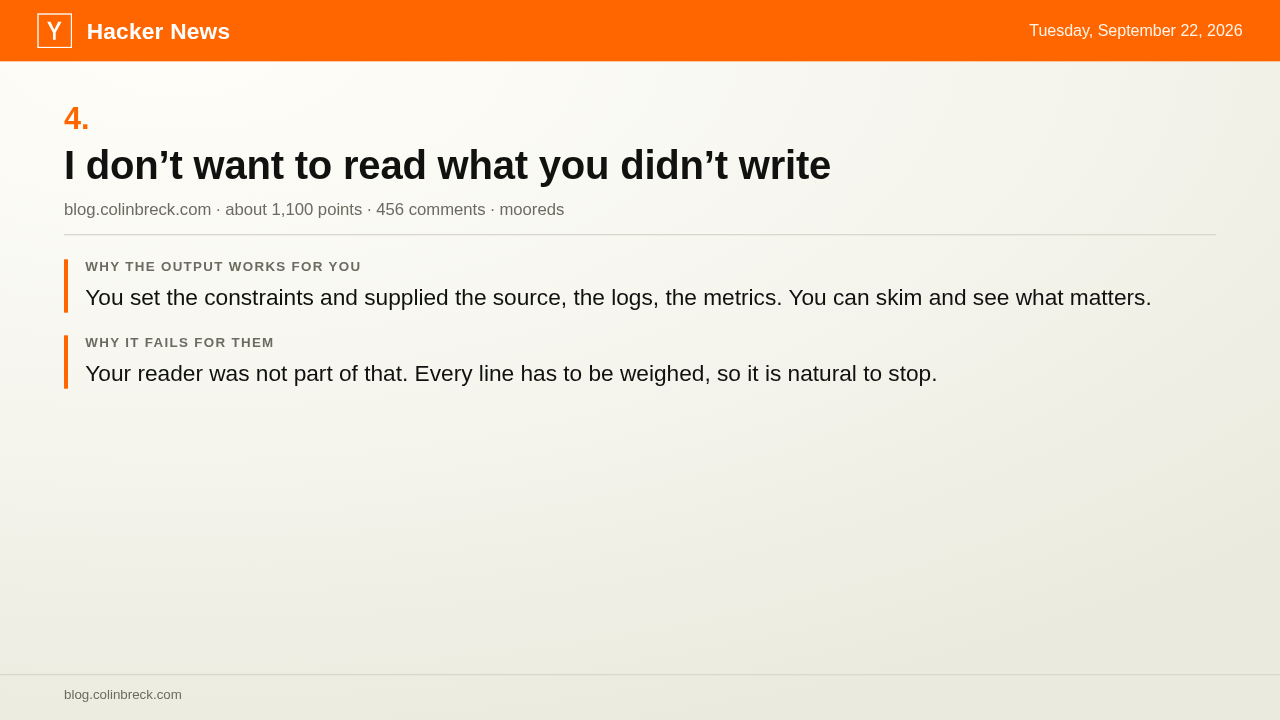
I don’t want to read what you didn’t write
Colin Breck's argument turns on context. You set the constraints and handed over the source and the logs, so you can skim your own output. Your reader has none of that, and has to weigh every line, so they stop.
Too much description to approve
Hacker News
Tuesday, September 22, 2026
In the thread
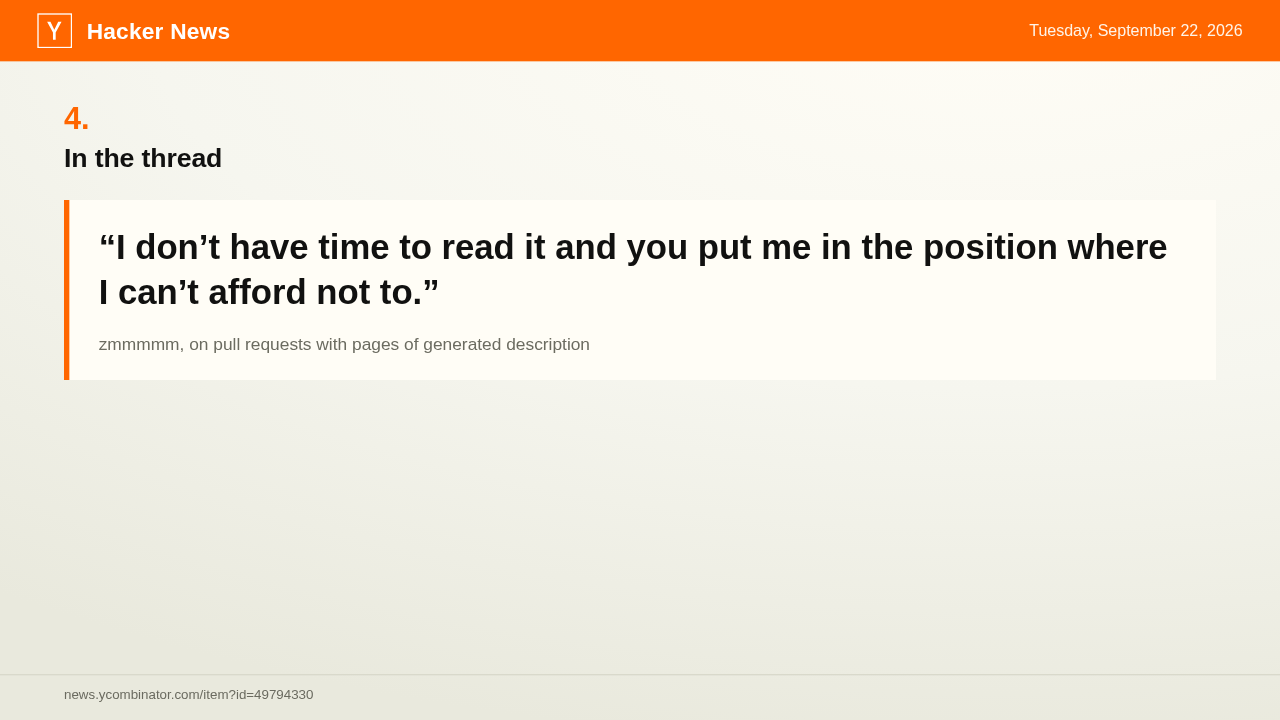
“I don’t have time to read it and you put me in the position where I can’t afford not to.”
Commenter zmmmmm reports sending pull requests back for too much description: pages of generated rationale and risk analysis on a twenty line change. Approving it would imply they had read all of it, and there is not time.
FoxPro on a WebAssembly runtime
Hacker News
Tuesday, September 22, 2026
Microsoft killed FoxPro in 2007. Anyway, here’s FoxPro revived
FoxDev Studio rebuilds the Visual FoxPro nine language: a compiler and bytecode machine in Rust, compiled to WebAssembly, forms drawn by React. Most of the seventeen hundred language reference entries are compared against the original product's own answer.
The database container has no lock
Hacker News
Tuesday, September 22, 2026
In the thread
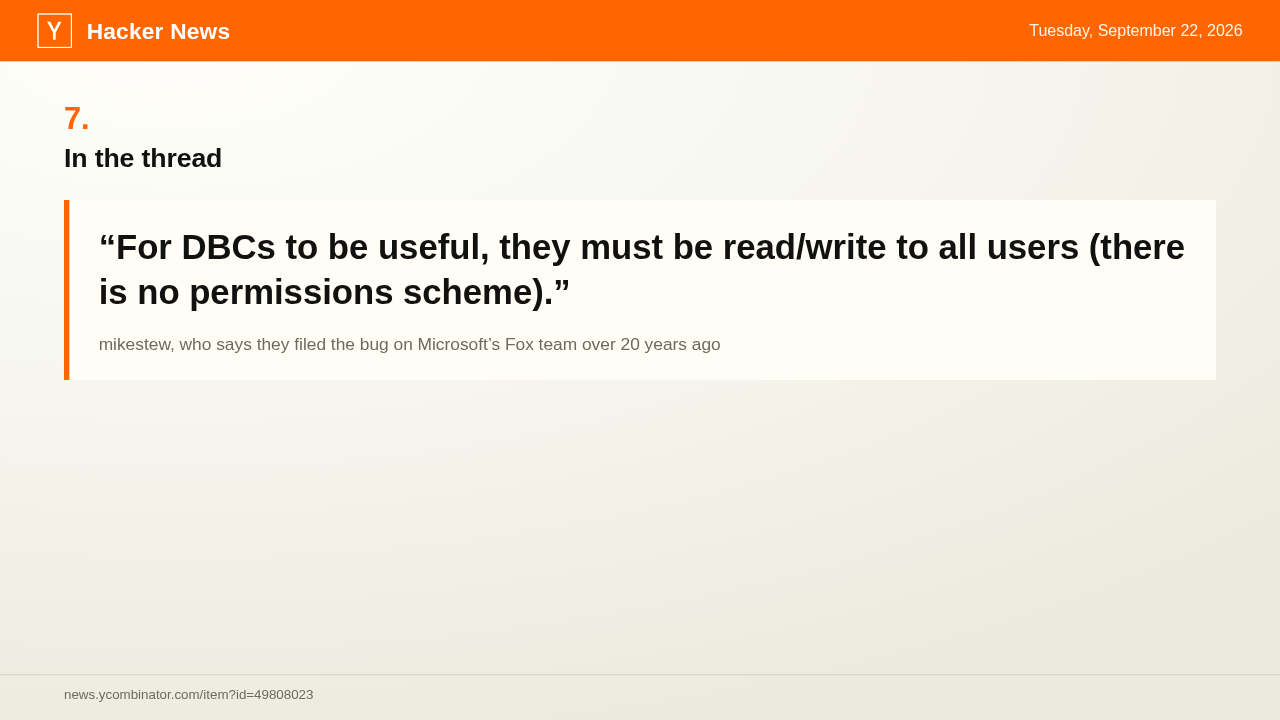
“For DBCs to be useful, they must be read/write to all users (there is no permissions scheme).”
Commenter mikestew, who says they worked on the Fox team, raises a caveat the site does not cover. A FoxPro database container has no permissions scheme, so it is writable by everyone, and its stored procedures sit in a plain text field.
A second word for a hidden mark
Hacker News
Tuesday, September 22, 2026
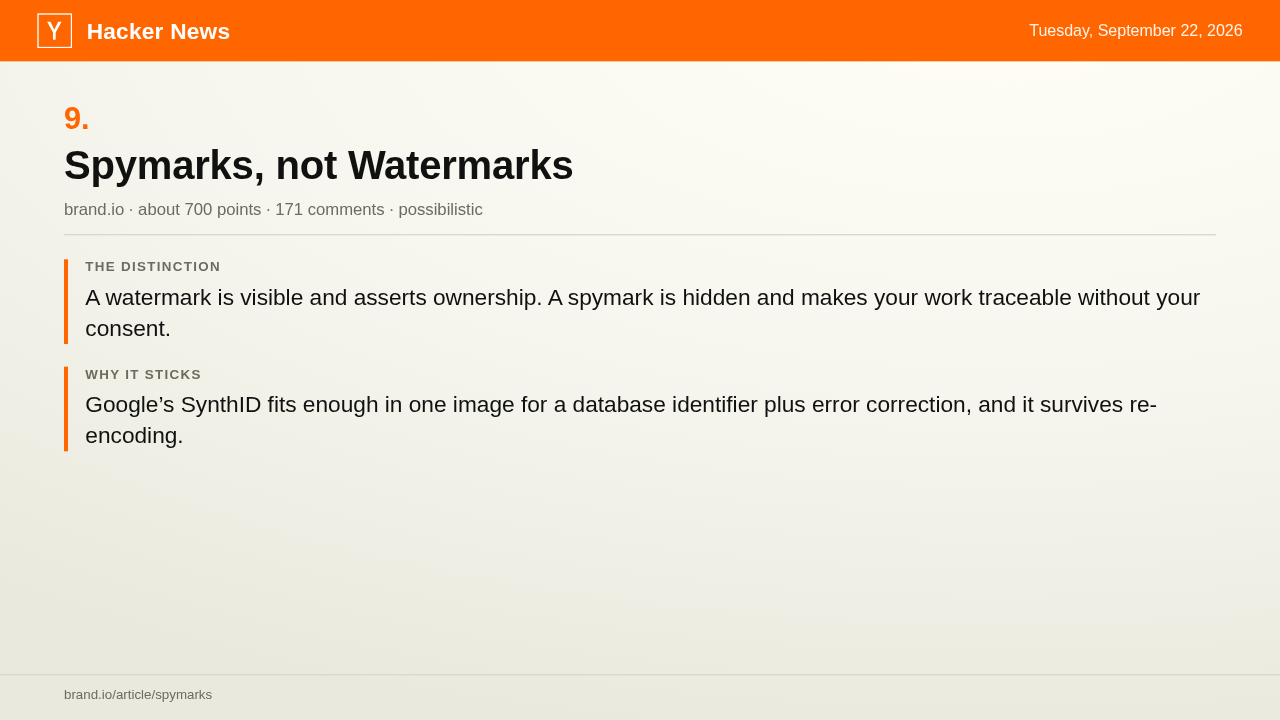
Spymarks, not Watermarks
Brandon Thomas wants a second word. A watermark is visible and claims ownership; a spymark is hidden, and traces your work without your consent. Google's SynthID fits enough in one image for a database identifier plus error correction, and survives re-encoding.
Steganography under a new name
Hacker News
Tuesday, September 22, 2026
In the thread
“Spymarks just seem like another word for steganography.”
Commenter re-compresses it steganography under a new name, and offers a defense: assert that what you publish is byte for byte what you made. The open door, they say, is any platform that re compresses your upload.
Sources
Hacker News
Tuesday, September 22, 2026
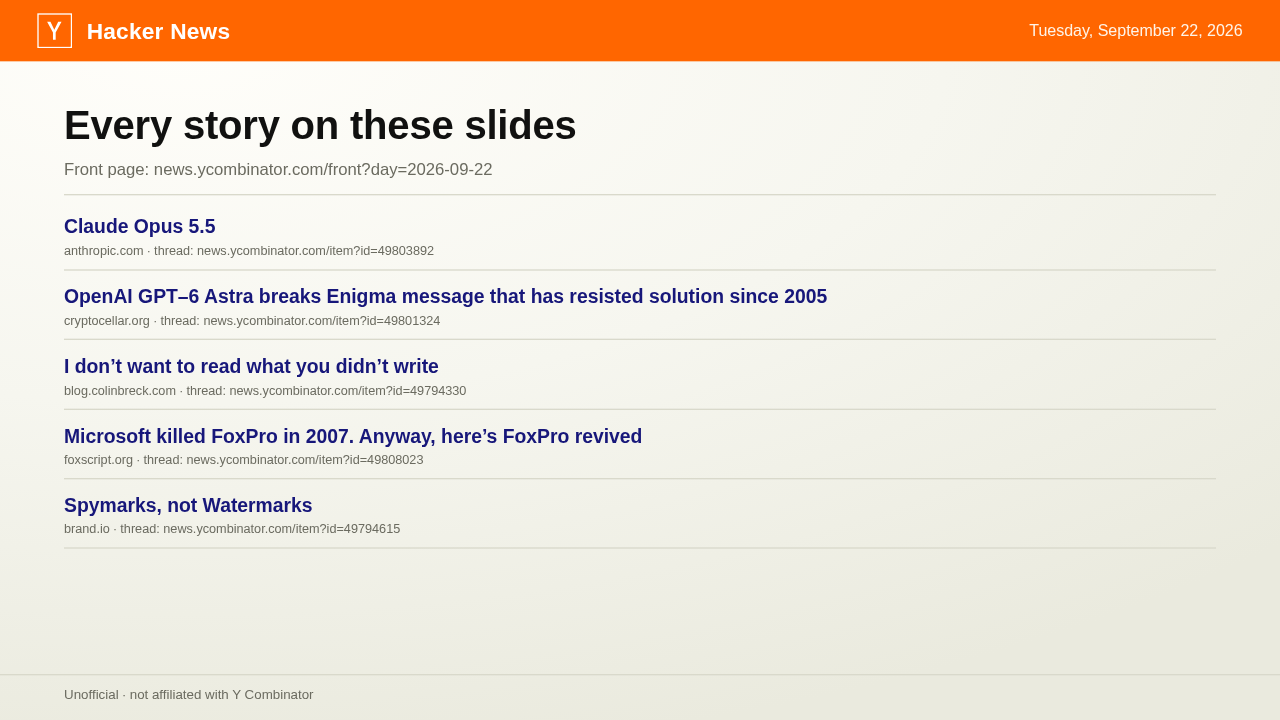
Every story on these slides
- Claude Opus 5.5anthropic.com · thread: news.ycombinator.com/item?id=49803892
- OpenAI GPT–6 Astra breaks Enigma message that has resisted solution since 2005cryptocellar.org · thread: news.ycombinator.com/item?id=49801324
- I don’t want to read what you didn’t writeblog.colinbreck.com · thread: news.ycombinator.com/item?id=49794330
- Microsoft killed FoxPro in 2007. Anyway, here’s FoxPro revivedfoxscript.org · thread: news.ycombinator.com/item?id=49808023
- Spymarks, not Watermarksbrand.io · thread: news.ycombinator.com/item?id=49794615
Claude Opus five point five, the Enigma break, Colin Breck on writing, FoxPro revived, and spymarks. Each one is linked here beside its thread, together with the Hacker News front page they all came from, if you want the originals.