OpenVLHarness gives vision models tools and a memory, and seven models each gain about 10 points
3 weeks ago
OpenVLHarness is a training-free harness for vision-language models: nine tools for finding objects, reading text, depth, camera motion, web search and Python code, with a memory that keeps every image, mask, depth map and link reusable for the whole question. Seven models score 9.7 to 12.6 points higher on the average over 22 benchmarks, and GPT-6 Luna at medium effort beats itself, Codex and Visual Sketchpad at maximum effort for at most 37% of their model-token cost. Crowded scenes with more than 25 objects remain hard, and tool costs are not counted. Paper (arXiv 2610.26860v1, 19 Oct 2026, UCLA and Apple): https://arxiv.org/abs/2610.26860 Code (MIT): https://github.com/uclanlp/OpenVLHarness
Ask about this presentation
Chapters
Show transcriptHide transcript
OpenVLHarness wraps a vision model in tools for finding objects, reading text, measuring depth, searching the web and running code, and keeps every result on hand. With no retraining, seven models scored ten to thirteen points higher. It comes from UCLA and Apple.
Slide text

OpenVLHarness gives vision models tools and a memory, and seven models each gain about 10 points
Yu Zhou, Cheng-Fu Yang, Rui Sun, Di Wu and colleagues · University of California, Los Angeles and Apple
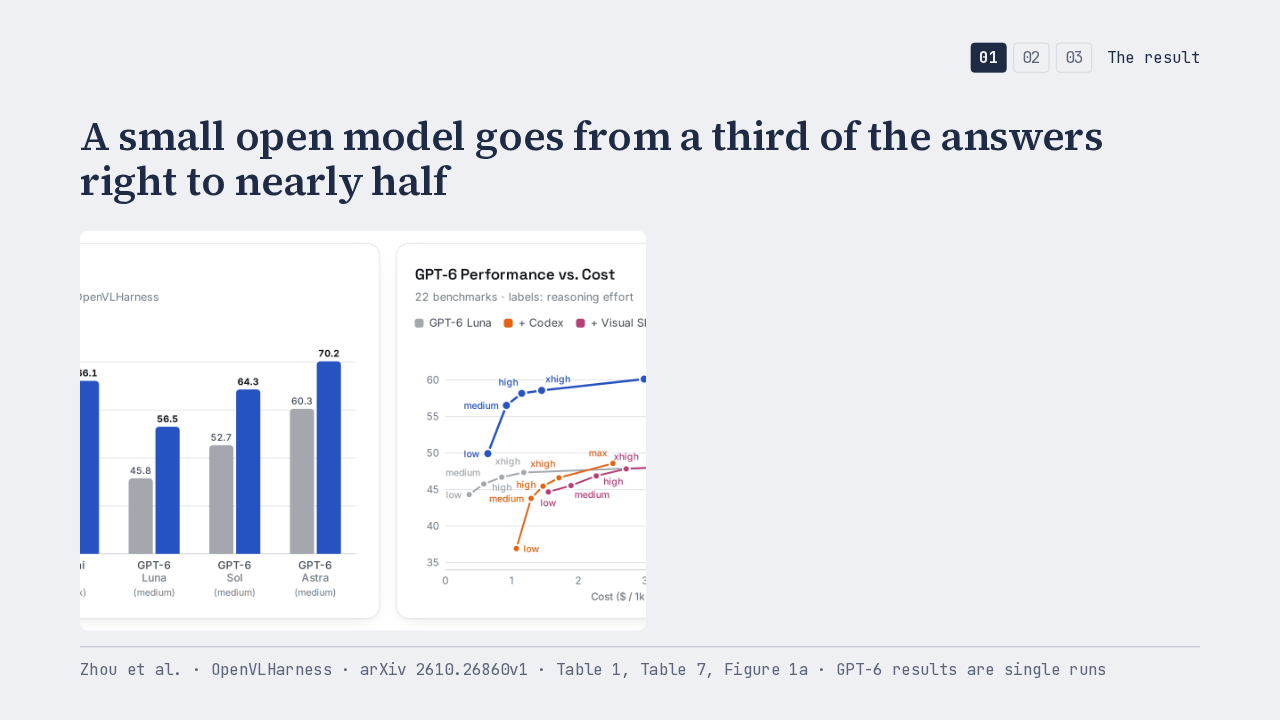
Zhou et al. · OpenVLHarness · arXiv 2610.26860v1 · submitted 19 Oct 2026On Qwen3-VL-8B, the smallest model, the average across 22 benchmarks rises from about 34 to 45 out of 100. GPT-6 Astra goes from 60 to 70, and improves on all 22.
Slide text
01 02 03 The resultA small open model goes from a third of the answers right to nearly half
 Zhou et al. · OpenVLHarness · arXiv 2610.26860v1 · Table 1, Table 7, Figure 1a · GPT-6 results are single runs
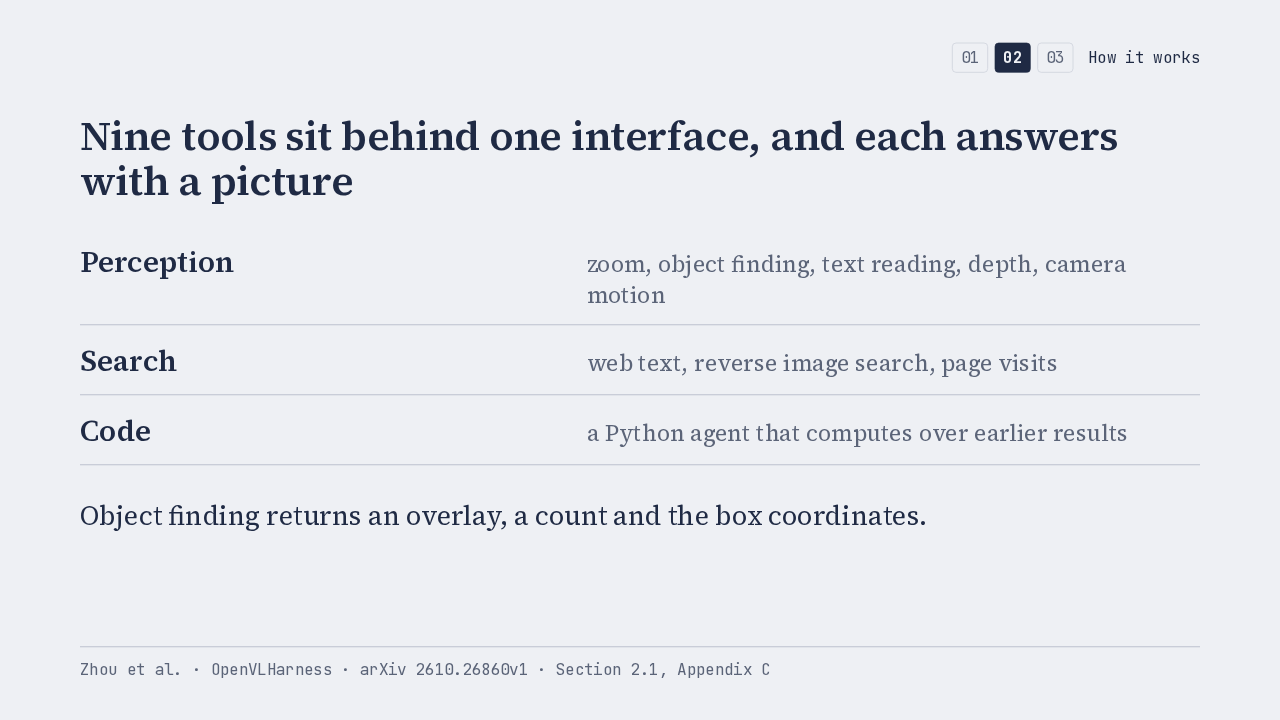
Every tool is called the same way, so a backend such as SAM 3 can be swapped without changing the prompts. The tools cover perception, search and code. Results come back as something the model can look at, like a labelled overlay with box coordinates.
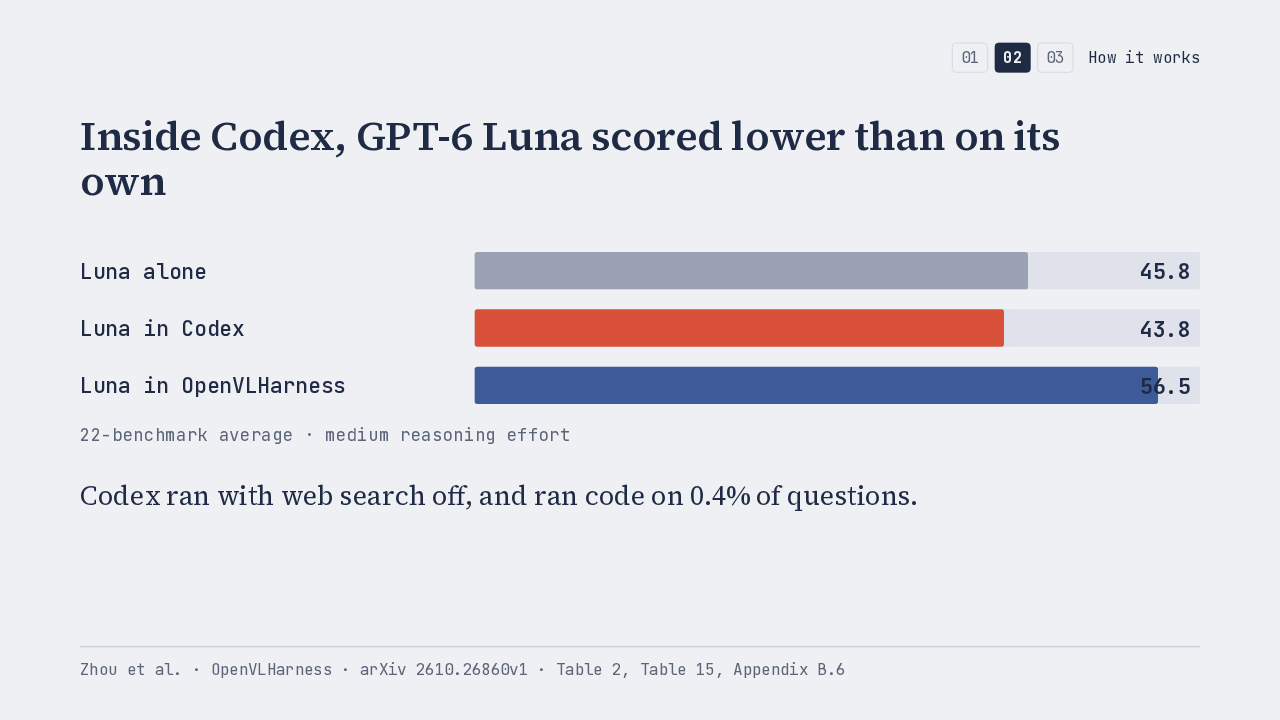
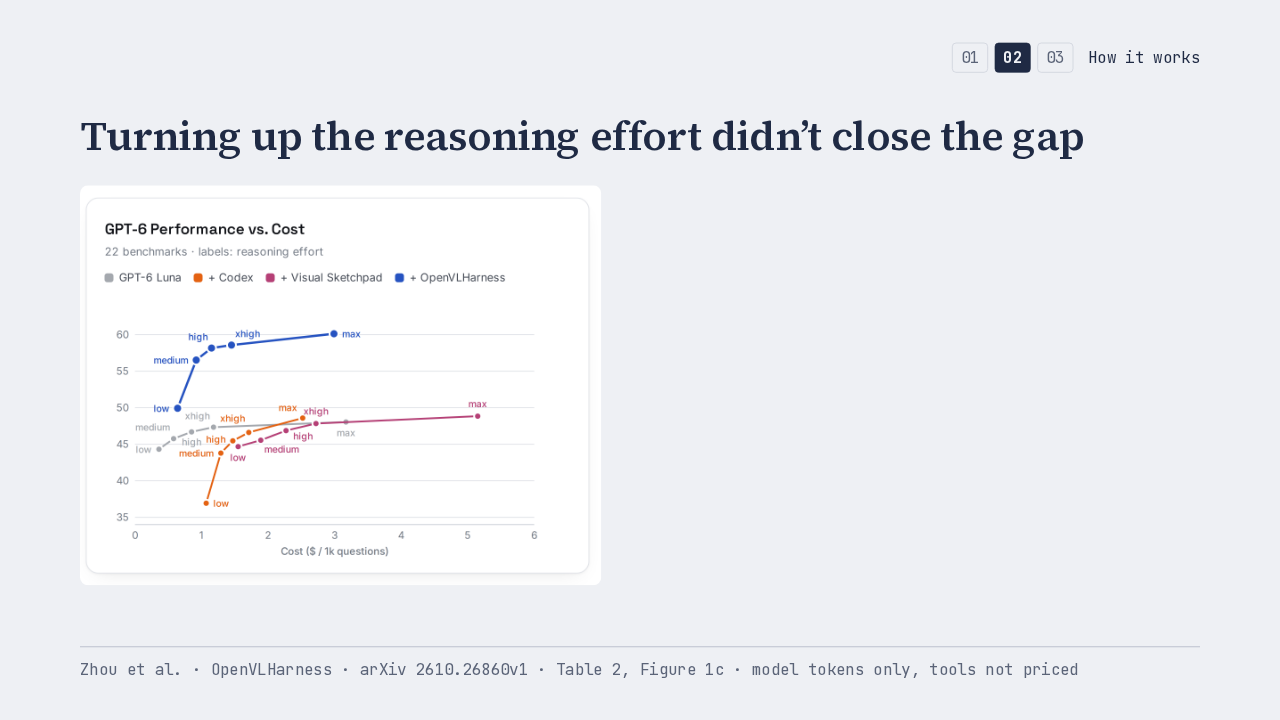
Codex is OpenAI's coding agent. With GPT-6 Luna at medium effort, Codex averaged two points below the bare model, and OpenVLHarness added about eleven. Codex ran with web search off, and ran code on fewer than one question in two hundred.
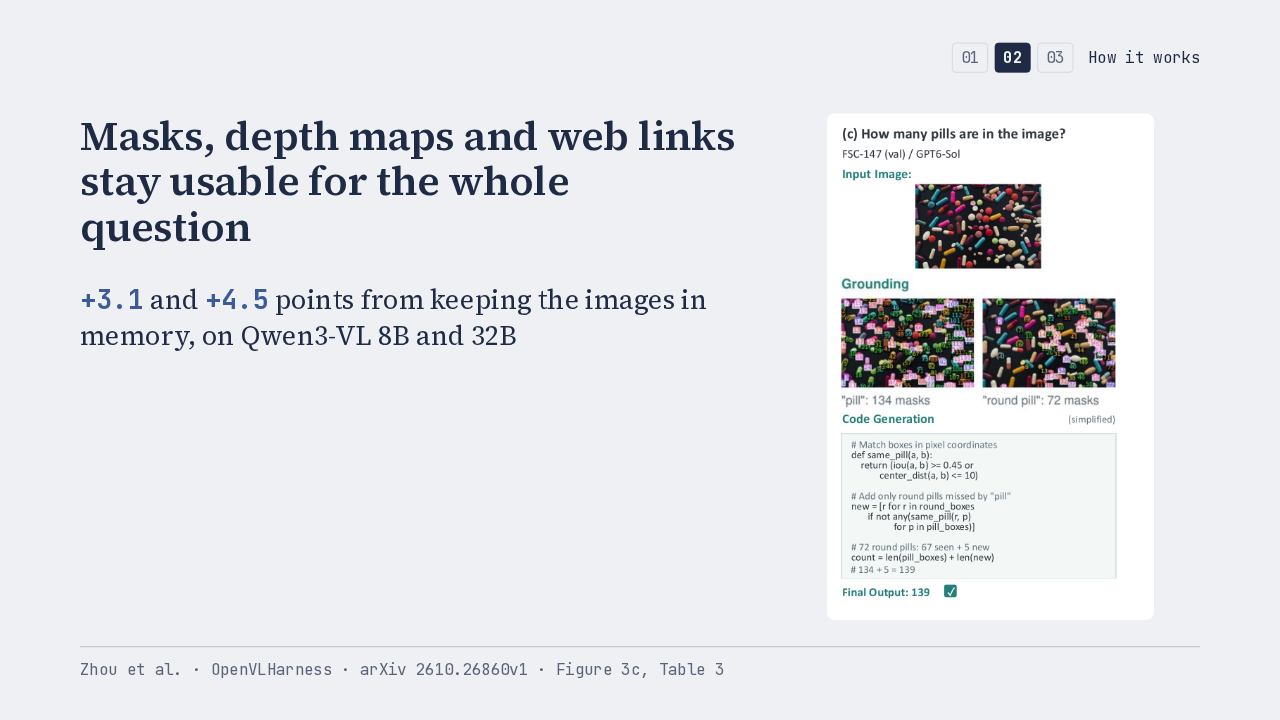
Every result is stored under a name that later steps can reuse. To count pills, the model searched for pills and for round pills, then merged the two sets of masks in code and got the exact count, 139. Keeping the images in memory, instead of text about them, added three to four and a half points.
Slide text
01 02 03 How it worksMasks, depth maps and web links stay usable for the whole question
+3.1 and +4.5 points from keeping the images in memory, on Qwen3-VL 8B and 32B
 Zhou et al. · OpenVLHarness · arXiv 2610.26860v1 · Figure 3c, Table 3
More reasoning helps the bare model far less. At medium effort, OpenVLHarness beats Luna alone, Codex and Visual Sketchpad at their maximum effort by about eight points, for at most 37 percent of their token spend. Tool costs aren't included.
Slide text
01 02 03 How it worksTurning up the reasoning effort didn’t close the gap
 Zhou et al. · OpenVLHarness · arXiv 2610.26860v1 · Table 2, Figure 1c · model tokens only, tools not priced
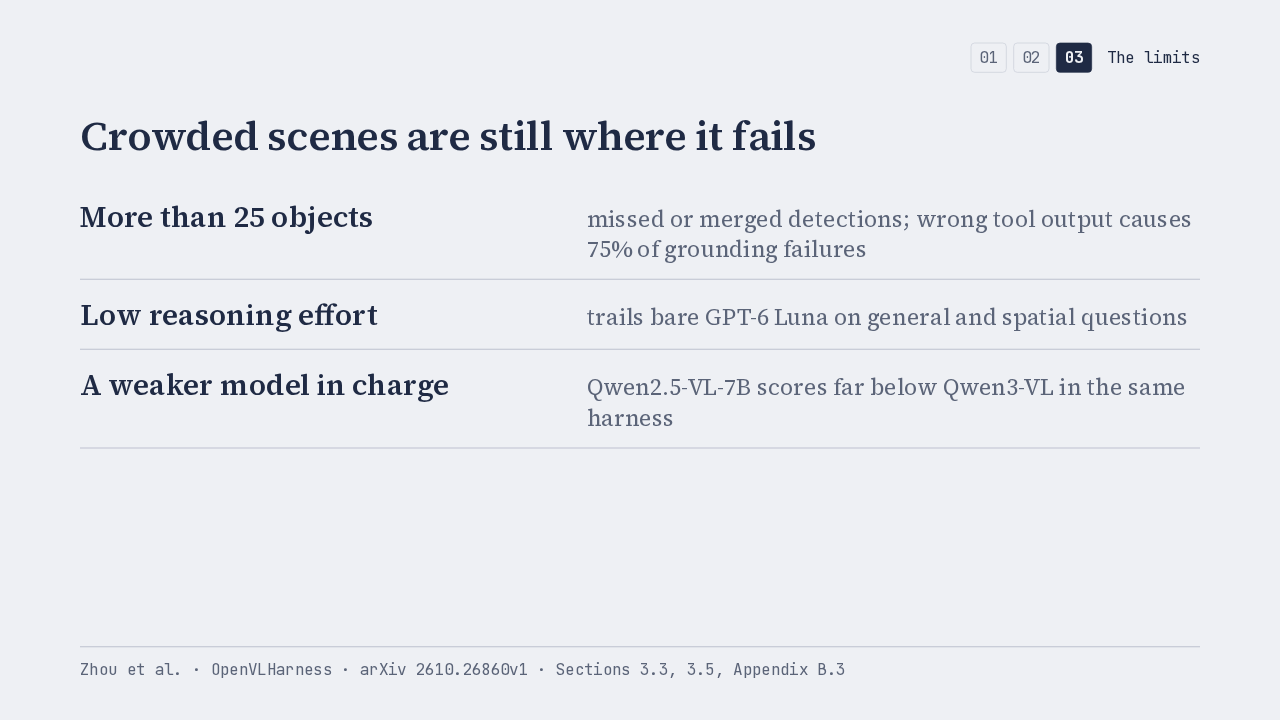
Past about 25 objects, the detector misses or merges them, and three quarters of the grounding failures are wrong tool results. At low effort, the harness trails the bare model on general and spatial questions. And an older, smaller Qwen gains much less.
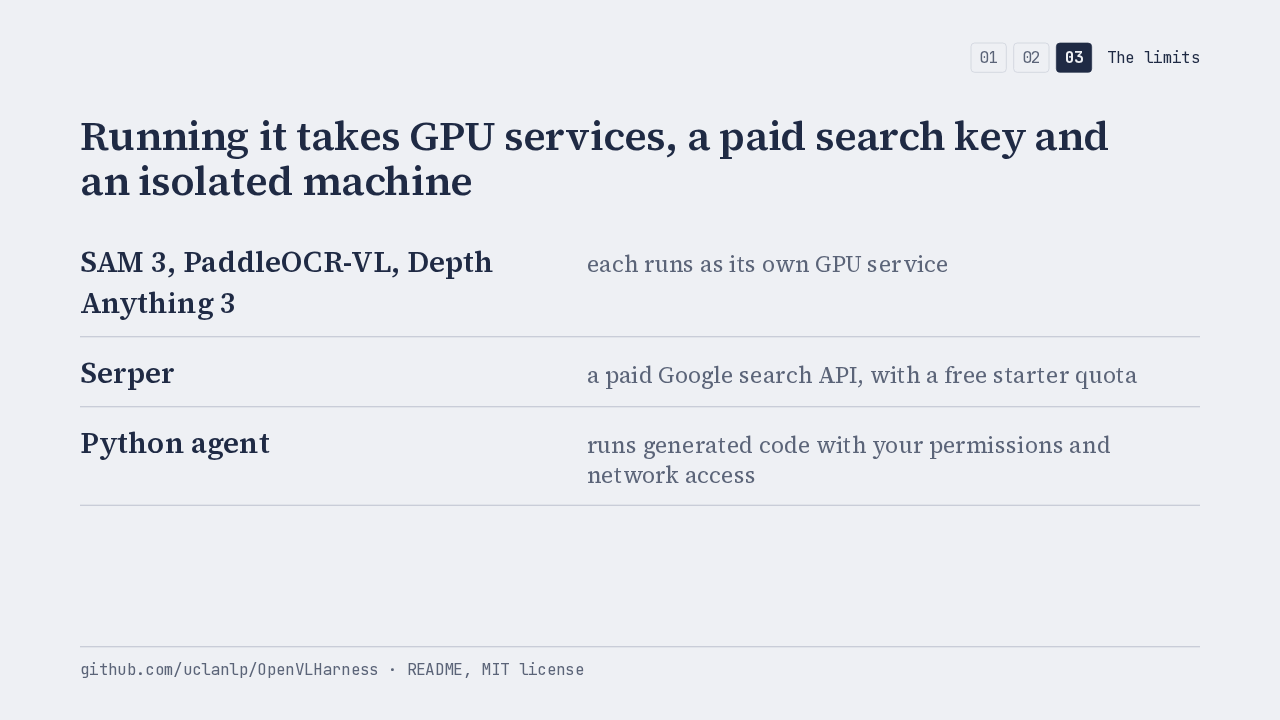
The code is MIT licensed, with presets for the seven models tested. Object finding, text reading and depth each need their own GPU service, and search runs through Serper, a paid API. The Python agent runs generated code with your permissions, so give it an isolated machine.
The harness, its tools and the evaluation scripts are on GitHub. Which vision model would you put inside it?
Up next
 2:49
NestOne cuts a Qwen3.5 decision model to 24 layers at nearly full accuracy
@ai-papers
1 day ago
 2:33
MME-VLA robot memory counts a pause as work done and stops early
@ai-papers
3 days ago
 2:16
GPT-6 Astra fixed a small Qwen’s math by editing 1,023 of its weights
@ai-papers
5 days ago
 2:42
LoopVQ cuts looped models’ KV cache to half a bit and lifts Ouro’s throughput up to 6×
@ai-papers
1 week ago
 2:35
CUA-Master-27B is an open computer-use agent that trails only Claude Opus 5 and GPT-5.6-Sol on Agents' Last Exam
@ai-papers
1 week ago
 2:37
CaPtain trains Qwen3.5-4B to control a robot in code and beats several frontier-model agents
@ai-papers
1 week ago
 2:45
Trajectory2Gym data lifts a 4B Qwen3 agent past the stock 30B model on Tau2
@ai-papers
2 weeks ago
 2:46
“Wait” in reasoning models comes from training data, and RL almost never invents it
@ai-papers
3 weeks ago
 2:08
Looking Ahead makes Wan video models more physically plausible, with generation unchanged
@ai-papers
3 weeks ago
 2:41
3DCodeVerse makes the same model write better 3D code than Claude Code, Codex or Gemini CLI
@ai-papers
4 weeks ago
 2:53
Agent-Reflex trains an 8B agent to recover when its MCP tools fail, and it gets derailed half as often
@ai-papers
1 month ago
 2:45
EmbodiedCLBench: one practice task gives AI agents most of their gain, and more practice doesn’t add to it
@ai-papers
1 month ago