MME-VLA robot memory counts a pause as work done and stops early
3 days ago
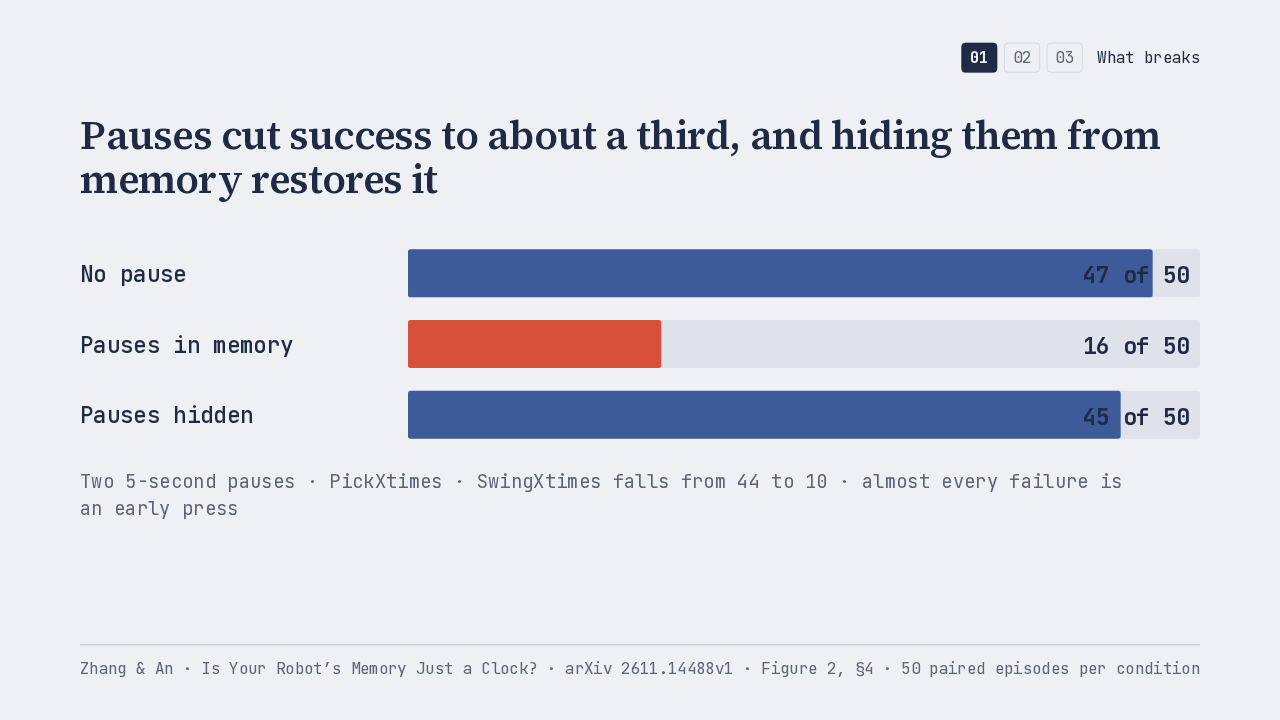
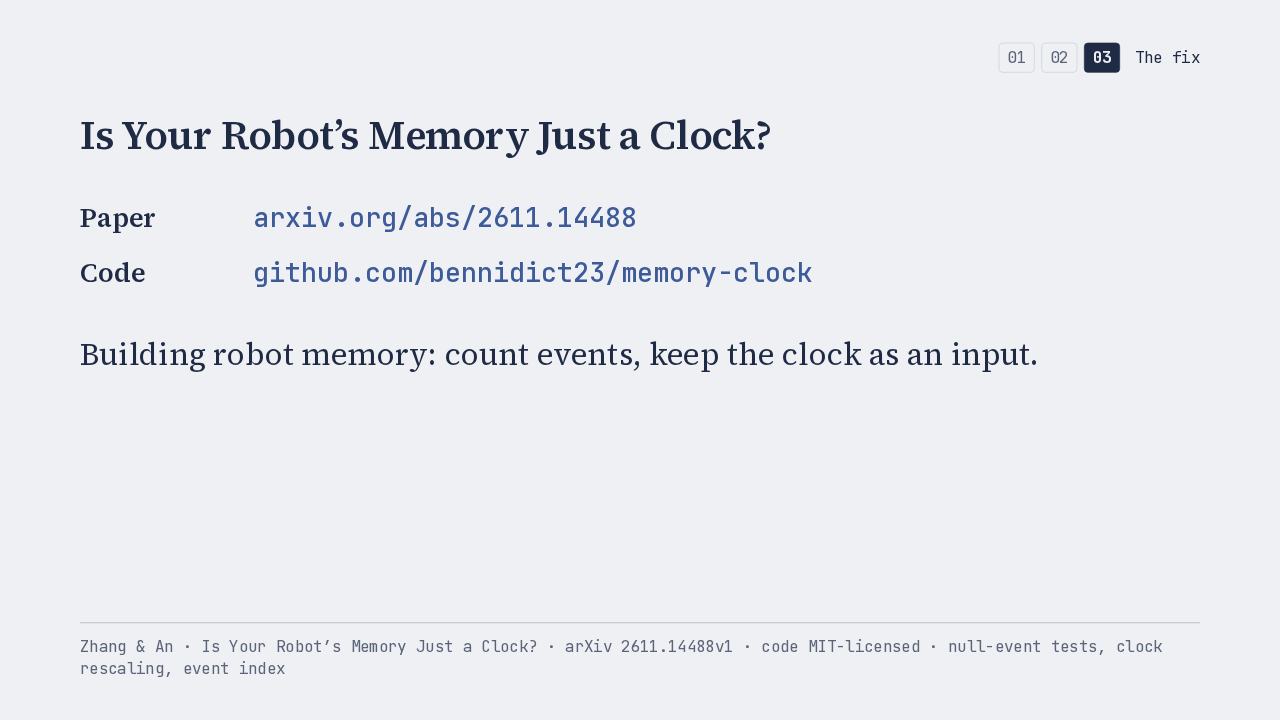
MME-VLA, a memory-augmented robot policy on RoboMME, counts a pause as work done: two 5-second pauses cut its success on a counting task from 47 to 16 of 50, because its memory is filled by time. Indexing memory by events at test time wins back half or more of the loss. Paper: https://arxiv.org/abs/2611.14488 Code: https://github.com/bennidict23/memory-clock
Ask about this presentation
Chapters
Show transcriptHide transcript
Pause MME-VLA, a robot policy with memory, for five seconds, twice, and it decides the job is further along than it is. It presses the finish button early. That failure is phantom progress, found by a Nanyang Technological University team.
Slide text

MME-VLA robot memory counts a pause as work done and stops early
Chubin Zhang and Bo An · Nanyang Technological University
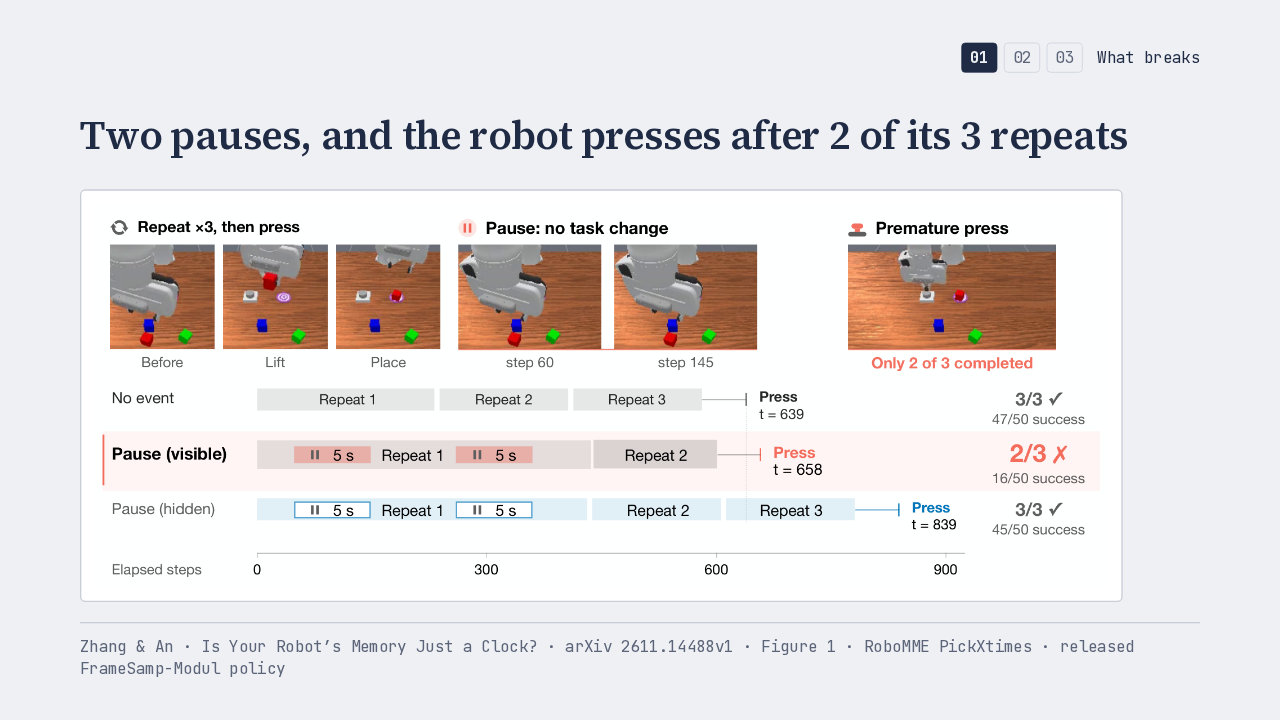
Zhang & An · Is Your Robot’s Memory Just a Clock? · arXiv 2611.14488v1 · submitted 10 Nov 2026The task: pick up a cube and place it three times, then press a button. With two pauses, the robot presses after two repeats, at about the moment it would have pressed with no pauses.
Slide text
01 02 03 What breaksTwo pauses, and the robot presses after 2 of its 3 repeats
 Zhang & An · Is Your Robot’s Memory Just a Clock? · arXiv 2611.14488v1 · Figure 1 · RoboMME PickXtimes · released FrameSamp-Modul policy
Without pauses, the released policy finishes the counting task in nearly every run. With them, it finishes about a third. Keep the same pauses out of its memory, and success comes back. The memory is what breaks.
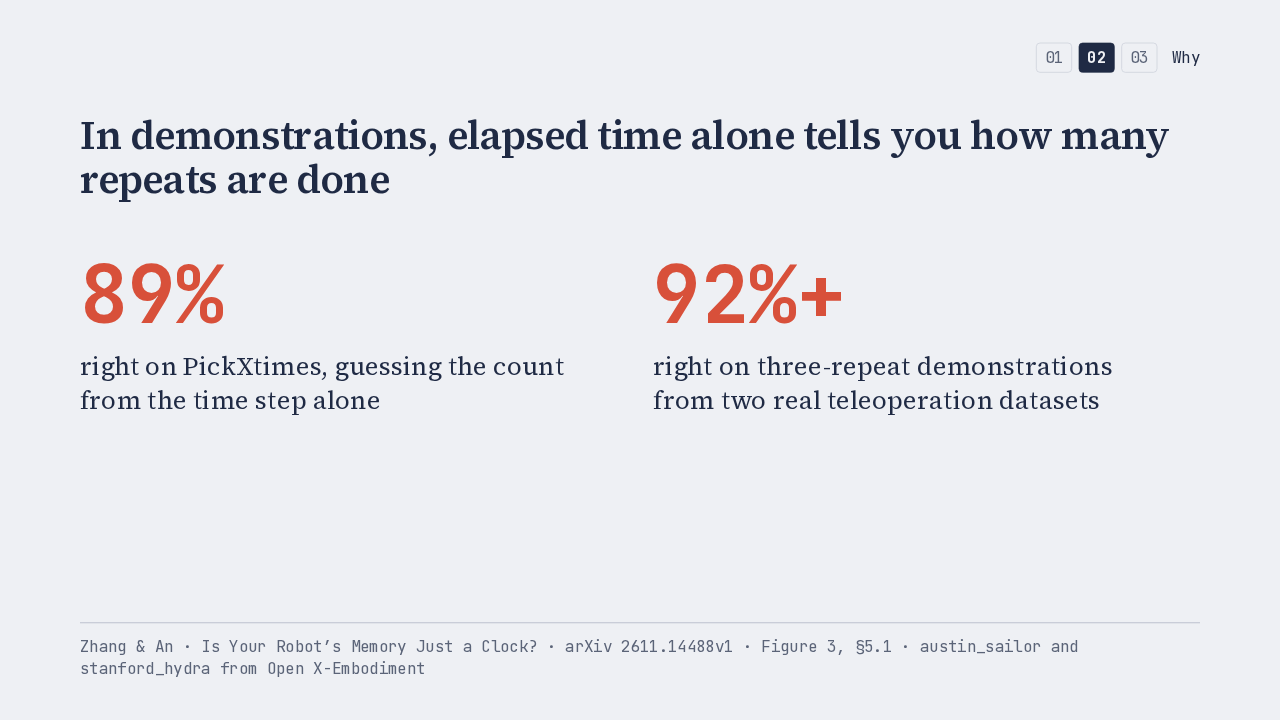
Why would it confuse waiting with working? Demonstrations move at a steady pace. From the clock alone, you can guess how many repeats are done eight or nine times in ten, in simulation and in real robot data.
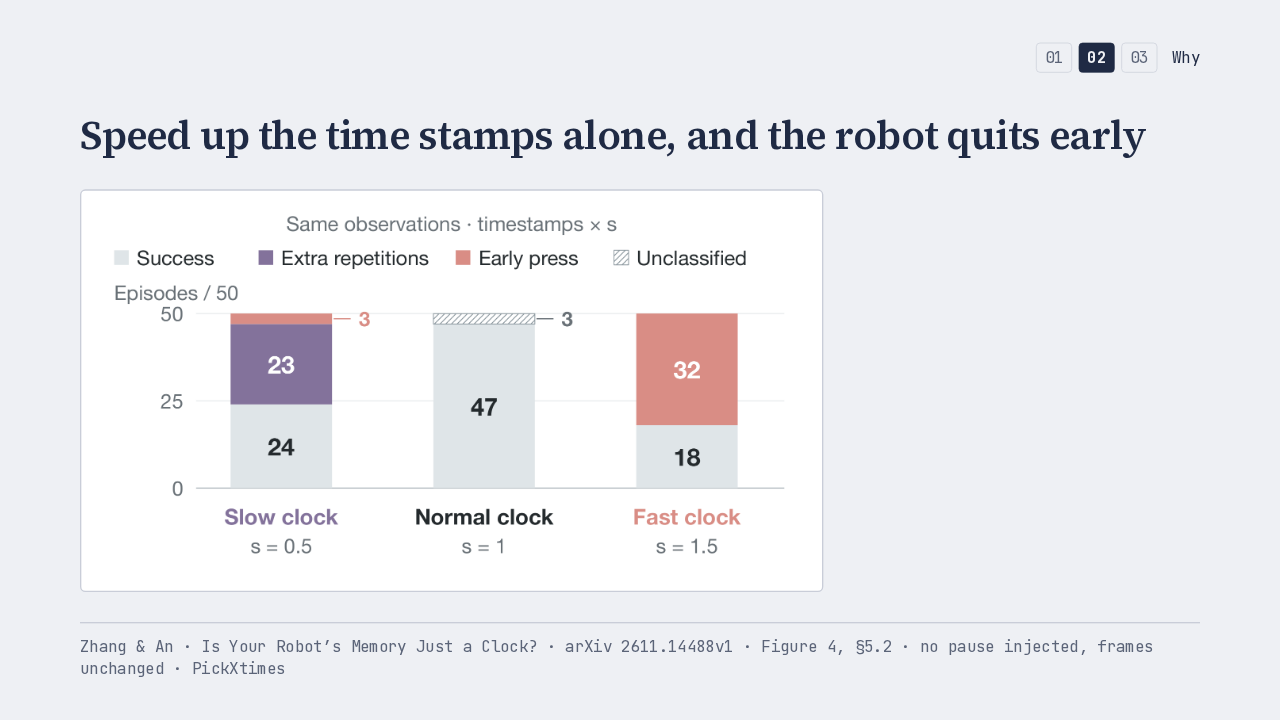
So the robot reads the clock. With no pause at all, making its time stamps run fast cuts success from nearly every run to about a third, all early presses. A slow clock makes it repeat too many times.
Slide text
01 02 03 WhySpeed up the time stamps alone, and the robot quits early
 Zhang & An · Is Your Robot’s Memory Just a Clock? · arXiv 2611.14488v1 · Figure 4, §5.2 · no pause injected, frames unchanged · PickXtimes
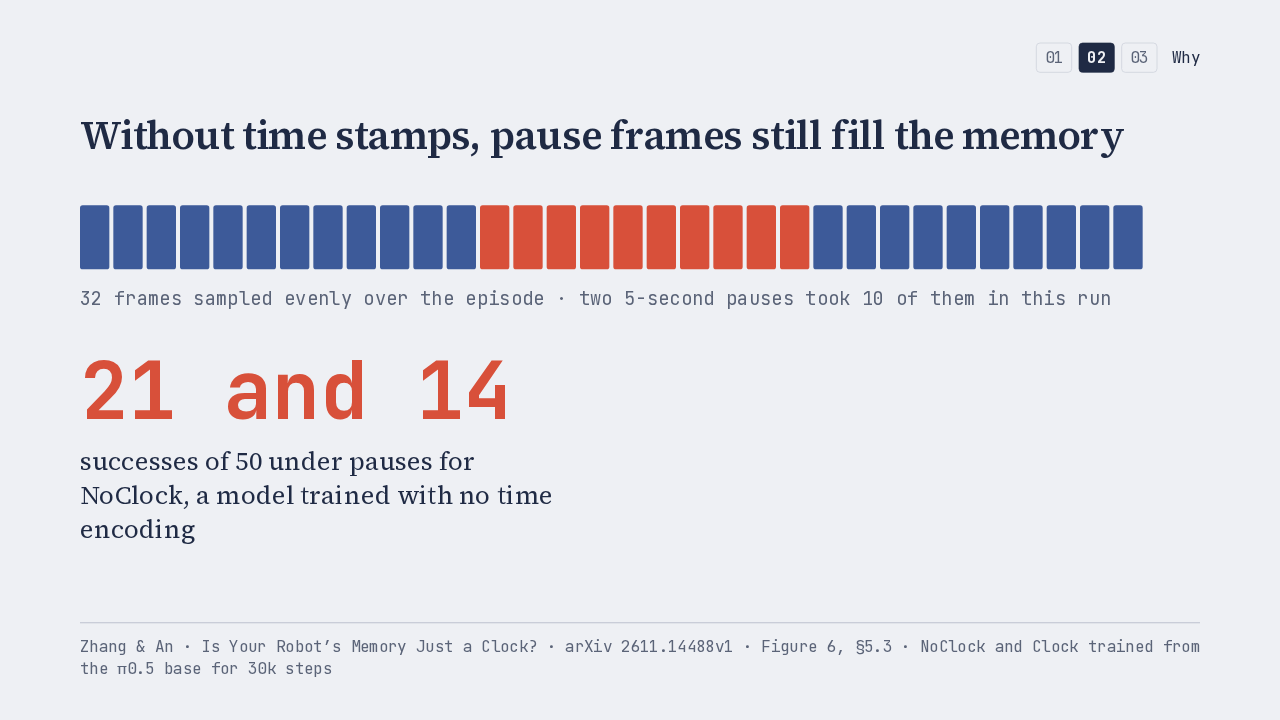
Deleting the time stamps doesn't cure it. The memory keeps thirty-two frames spread evenly over the episode, so a pause still takes up slots. A model trained with no clock still failed most runs under pauses.
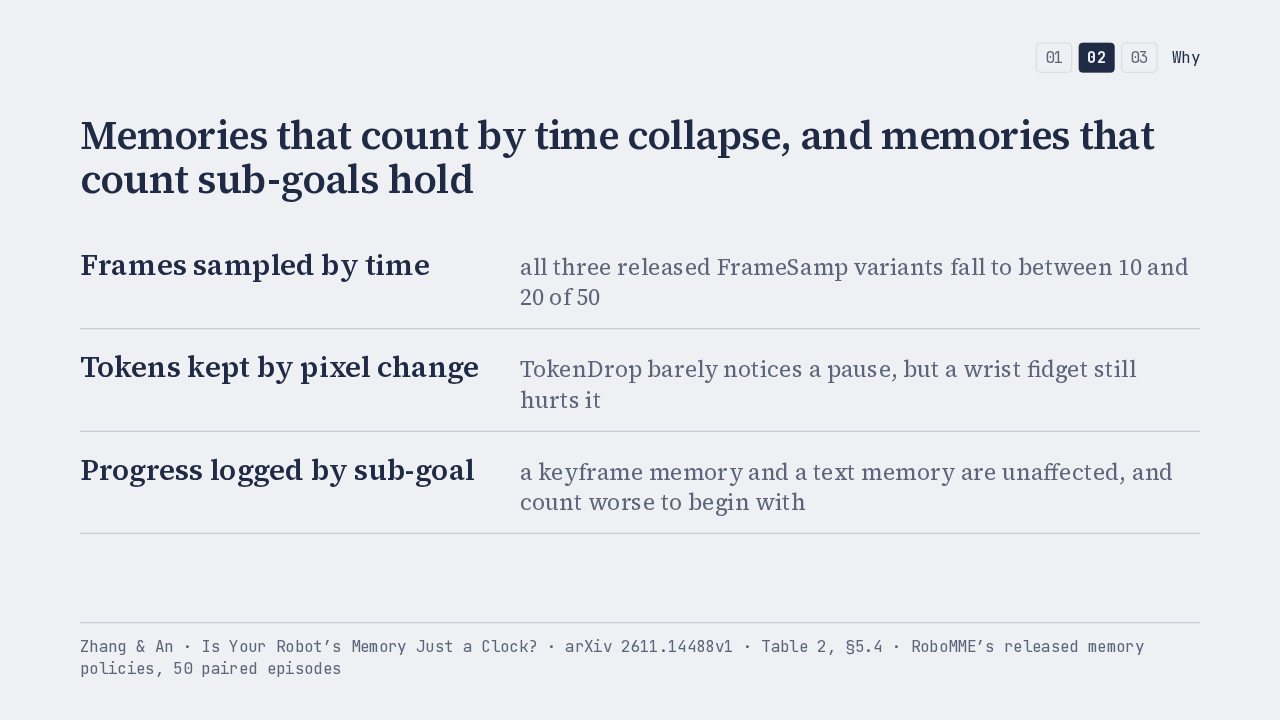
Every released Robo MME memory that samples frames by time collapses. One that keeps changed pixels shrugs off pauses but not a fidgeting wrist. Memories that log sub-goals hold up, though they count less well.
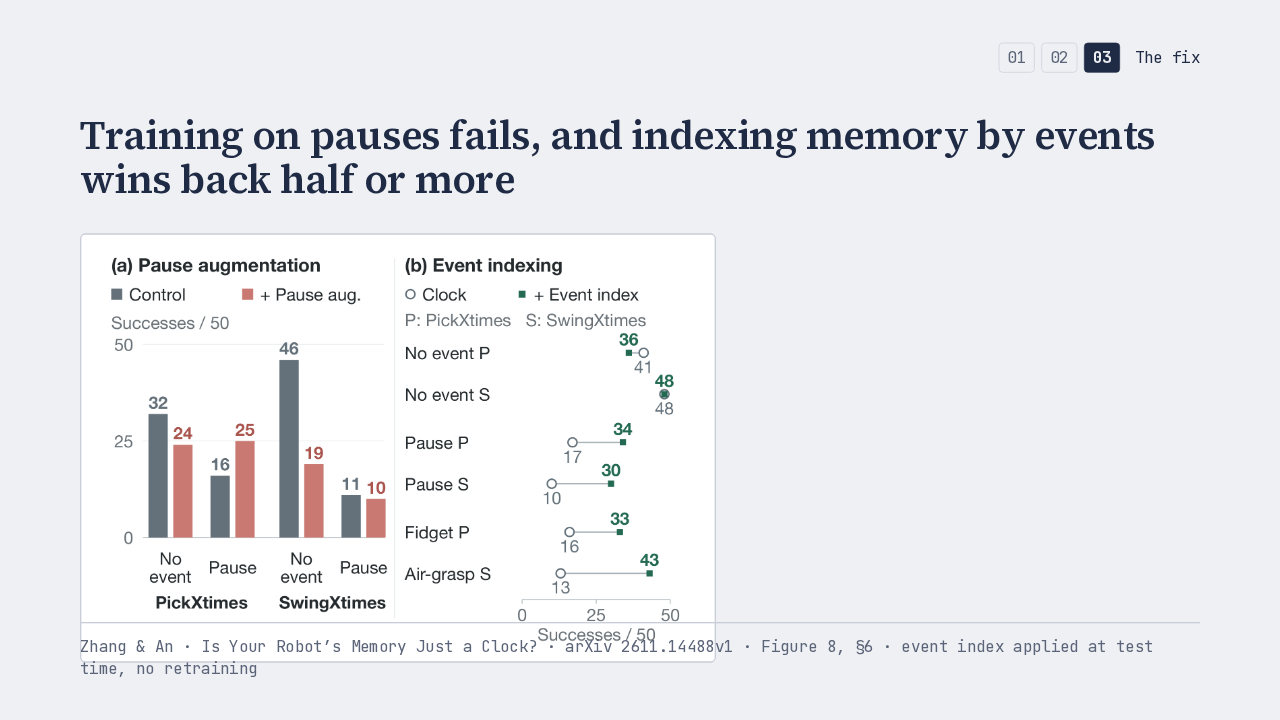
Training with fake pauses didn't fix it, and the robot got worse at counting. Keeping only frames where the world actually changed did, with no retraining. It at least doubled success under every kind of pause.
Slide text
01 02 03 The fixTraining on pauses fails, and indexing memory by events wins back half or more
 Zhang & An · Is Your Robot’s Memory Just a Clock? · arXiv 2611.14488v1 · Figure 8, §6 · event index applied at test time, no retraining
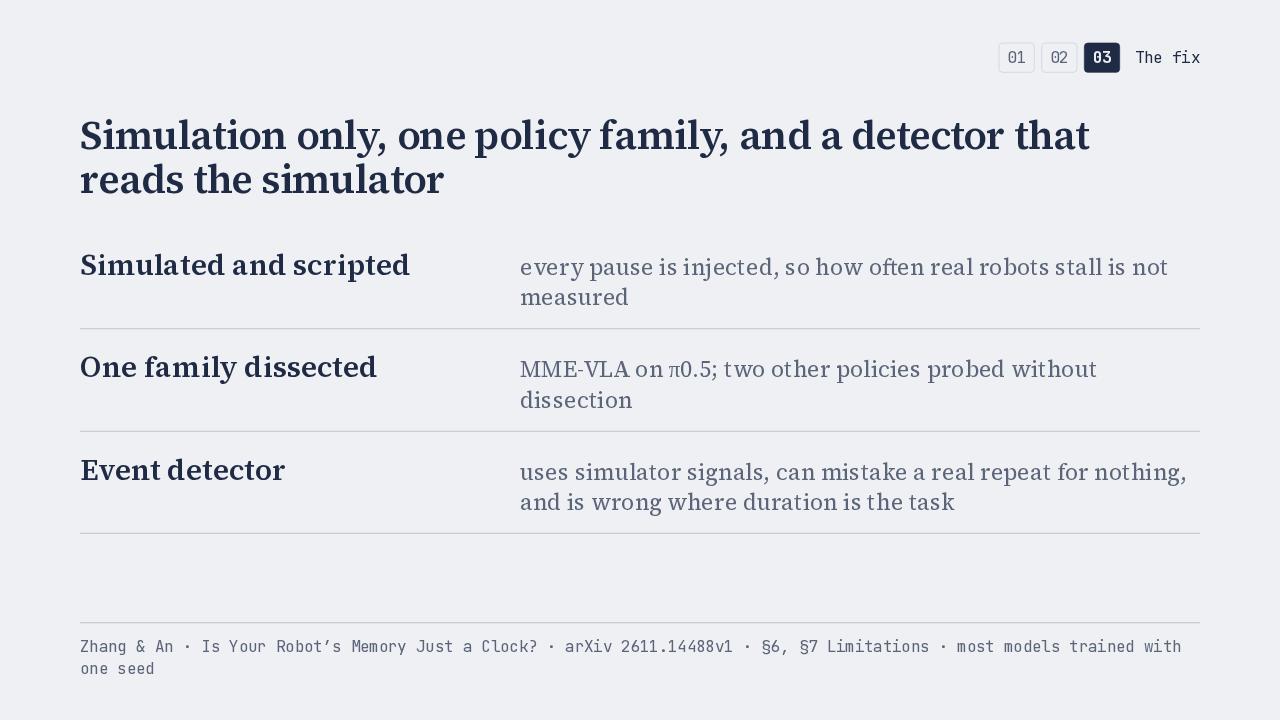
All of it runs in simulation, with scripted pauses, on one family of policies. The event detector reads simulator signals, can mistake a real repeat for nothing, and is wrong for tasks where timing matters.
If I were giving a robot memory, I'd advance it on events and pass time in as a separate input. The paper is on arXiv, and the test harness is on GitHub.
Up next
 2:49
NestOne cuts a Qwen3.5 decision model to 24 layers at nearly full accuracy
@ai-papers
1 day ago
 2:16
GPT-6 Astra fixed a small Qwen’s math by editing 1,023 of its weights
@ai-papers
5 days ago
 2:42
LoopVQ cuts looped models’ KV cache to half a bit and lifts Ouro’s throughput up to 6×
@ai-papers
1 week ago
 2:35
CUA-Master-27B is an open computer-use agent that trails only Claude Opus 5 and GPT-5.6-Sol on Agents' Last Exam
@ai-papers
1 week ago
 2:37
CaPtain trains Qwen3.5-4B to control a robot in code and beats several frontier-model agents
@ai-papers
1 week ago
 2:45
Trajectory2Gym data lifts a 4B Qwen3 agent past the stock 30B model on Tau2
@ai-papers
2 weeks ago
 2:46
“Wait” in reasoning models comes from training data, and RL almost never invents it
@ai-papers
3 weeks ago
 2:08
Looking Ahead makes Wan video models more physically plausible, with generation unchanged
@ai-papers
3 weeks ago
 2:30
OpenVLHarness gives vision models tools and a memory, and seven models each gain about 10 points
@ai-papers
3 weeks ago
 2:41
3DCodeVerse makes the same model write better 3D code than Claude Code, Codex or Gemini CLI
@ai-papers
4 weeks ago
 2:53
Agent-Reflex trains an 8B agent to recover when its MCP tools fail, and it gets derailed half as often
@ai-papers
1 month ago
 2:45
EmbodiedCLBench: one practice task gives AI agents most of their gain, and more practice doesn’t add to it
@ai-papers
1 month ago