Reasoning models inherit wait

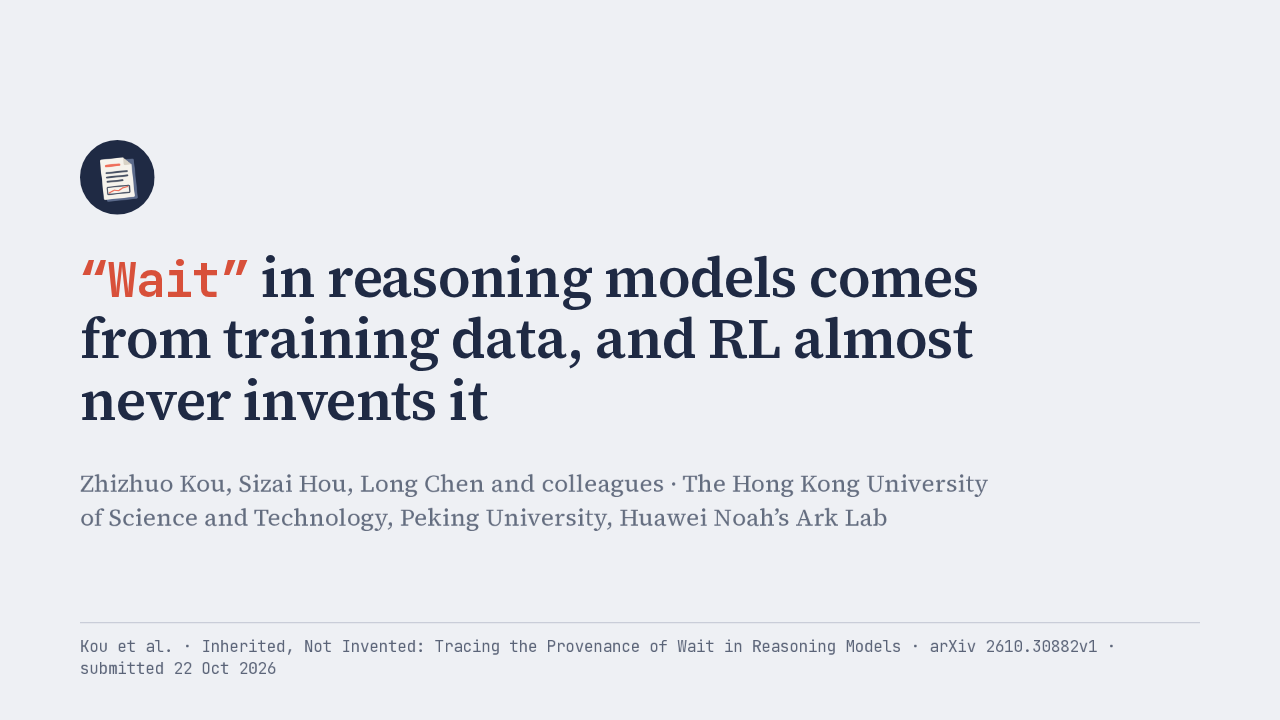
“Wait” in reasoning models comes from training data, and RL almost never invents it
Zhizhuo Kou, Sizai Hou, Long Chen and colleagues · The Hong Kong University of Science and Technology, Peking University, Huawei Noah’s Ark Lab
Reinforcement learning gets the credit for teaching reasoning models to write wait before they recheck a step. Traced through open models' training histories, the word almost always arrives earlier, with the training data.
Zero-RL raises accuracy without wait
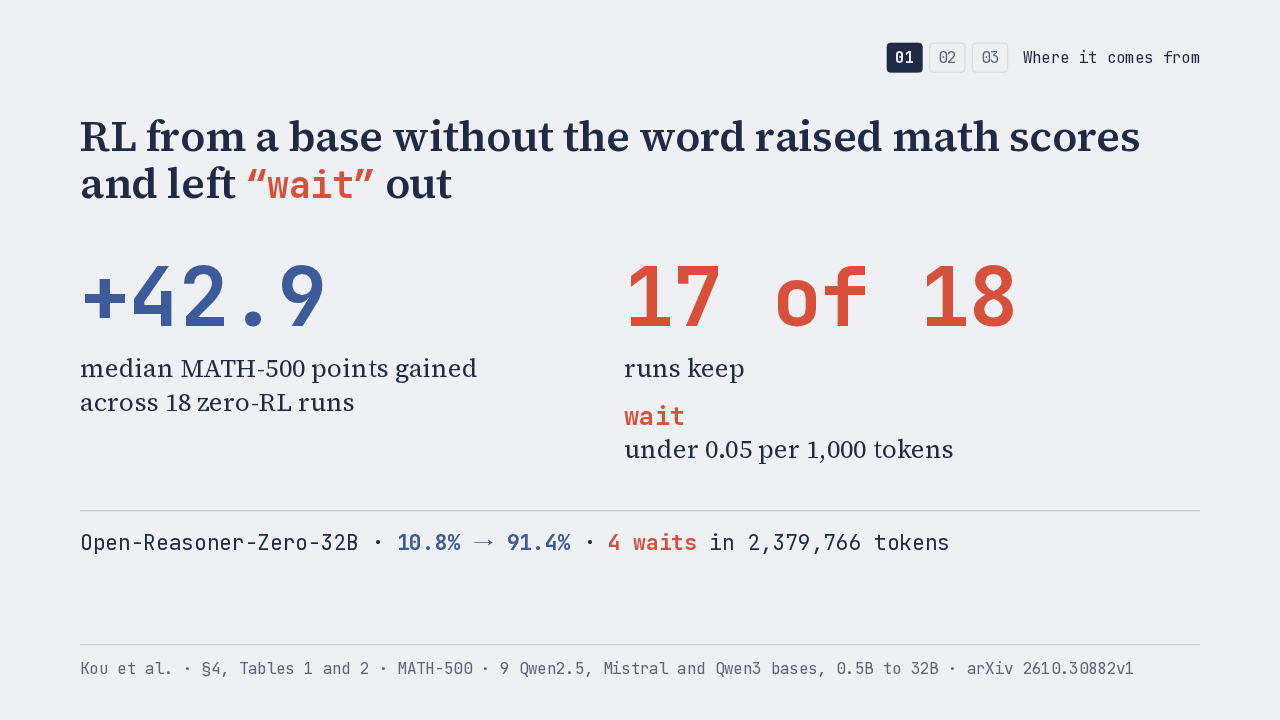
RL from a base without the word raised math scores and left “wait” out
Start with RL on base models that never write wait. Across 18 runs on Qwen, Mistral and Qwen3 bases, math accuracy rose by a median of about 43 points, and wait stayed almost absent in 17. One 32B run reached 91 percent and wrote wait four times.
OLMo-3 gets wait in mid-training
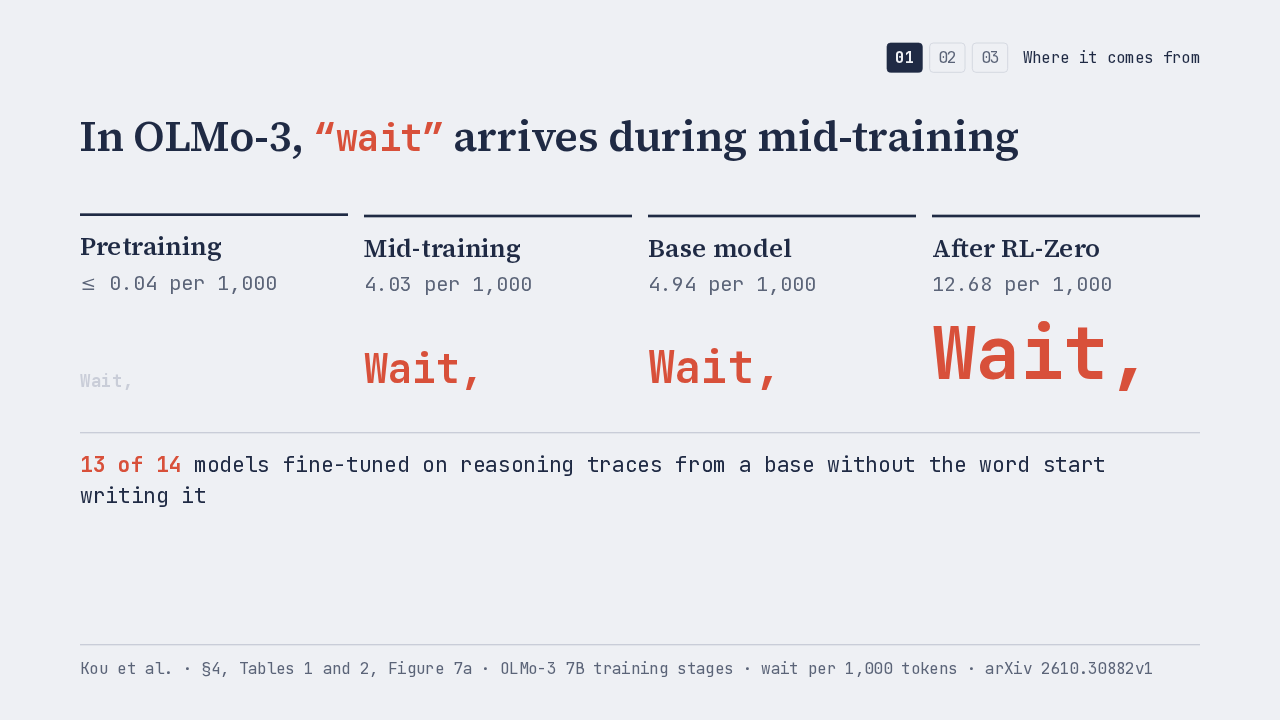
In OLMo-3, “wait” arrives during mid-training
OLMo-3 releases every training stage, so the word can be dated. Through pretraining it almost never appears. After mid-training, it shows up about four times per thousand tokens. Fine-tuning on reasoning traces installs it too, in 13 of 14 models.
Released RL-Zero recipes multiply it
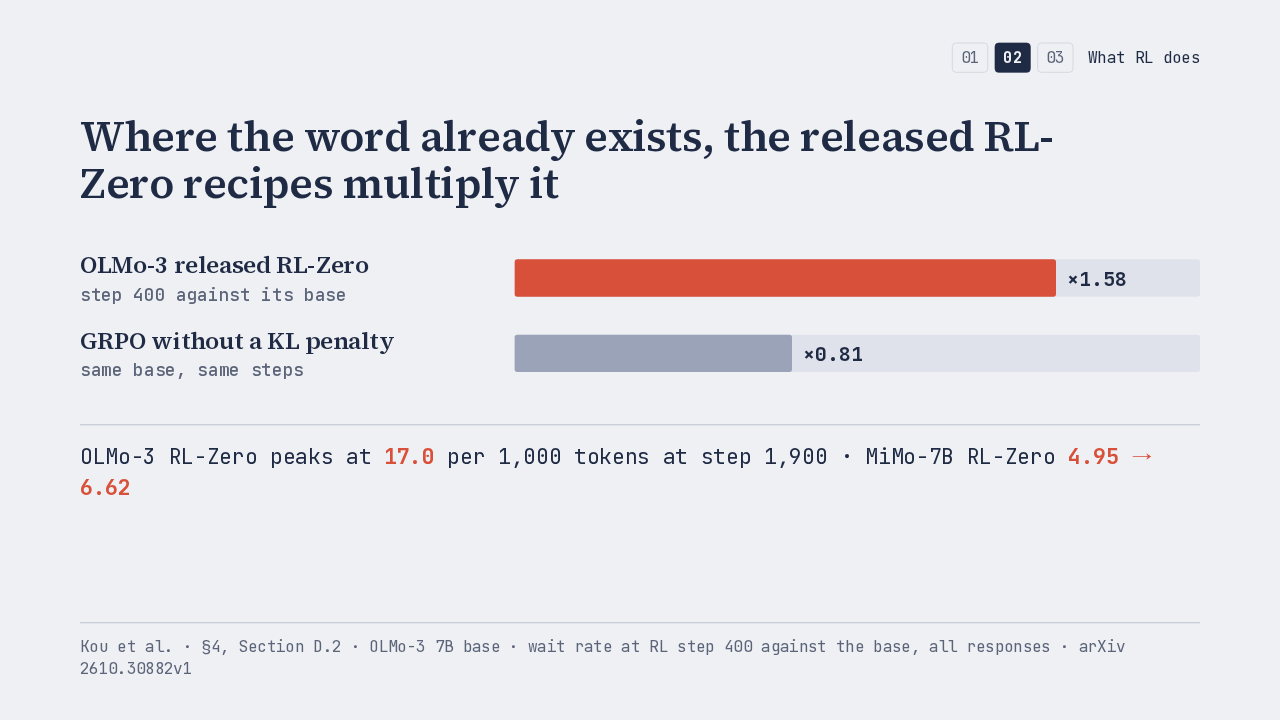
Where the word already exists, the released RL-Zero recipes multiply it
When the base already writes wait, RL can amplify it. OLMo-3's released RL-Zero run more than tripled it at its peak, and MiMo's recipe raised it too. GRPO without a KL penalty, from the same base, ended slightly lower.
RL-Zero wears the word down
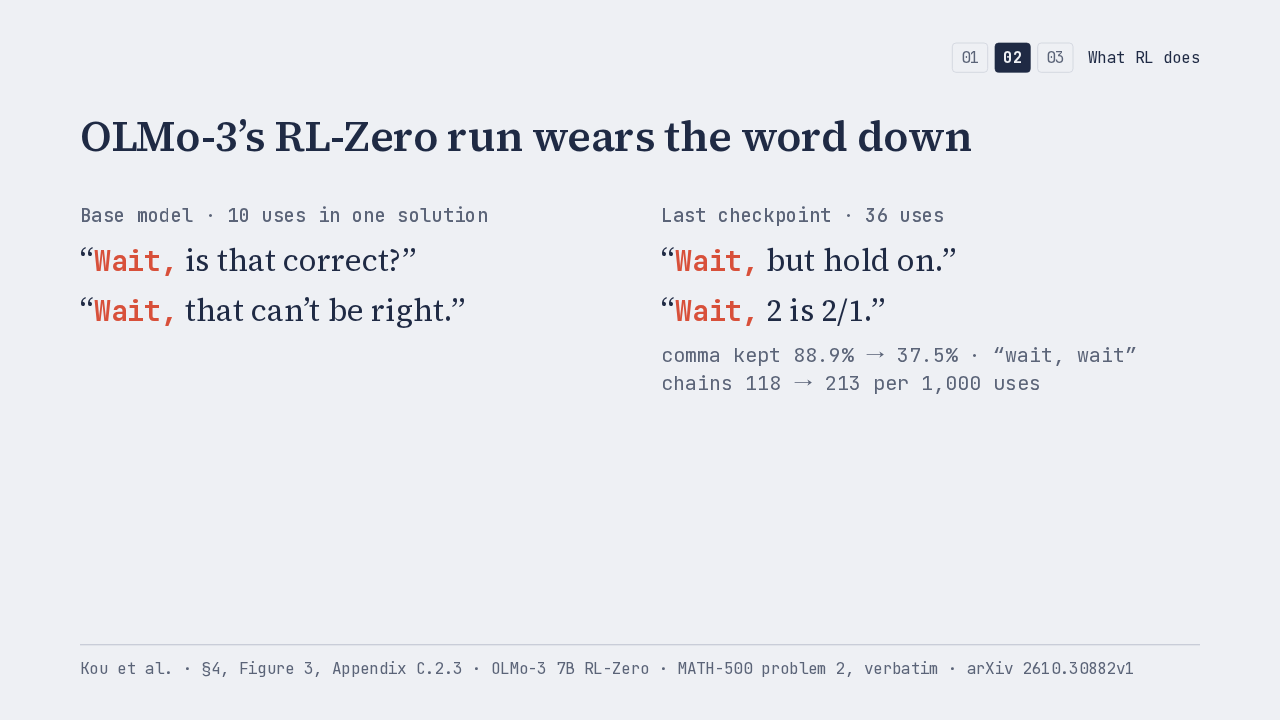
OLMo-3’s RL-Zero run wears the word down
Base model · 10 uses in one solution
“Wait, is that correct?”
“Wait, that can’t be right.”
Last checkpoint · 36 uses
“Wait, but hold on.”
“Wait, 2 is 2/1.”
The form changes too. On one problem, the base model writes wait ten times, mostly to question a result. The last checkpoint writes it 36 times, often before restating a correct value, and drops the comma.
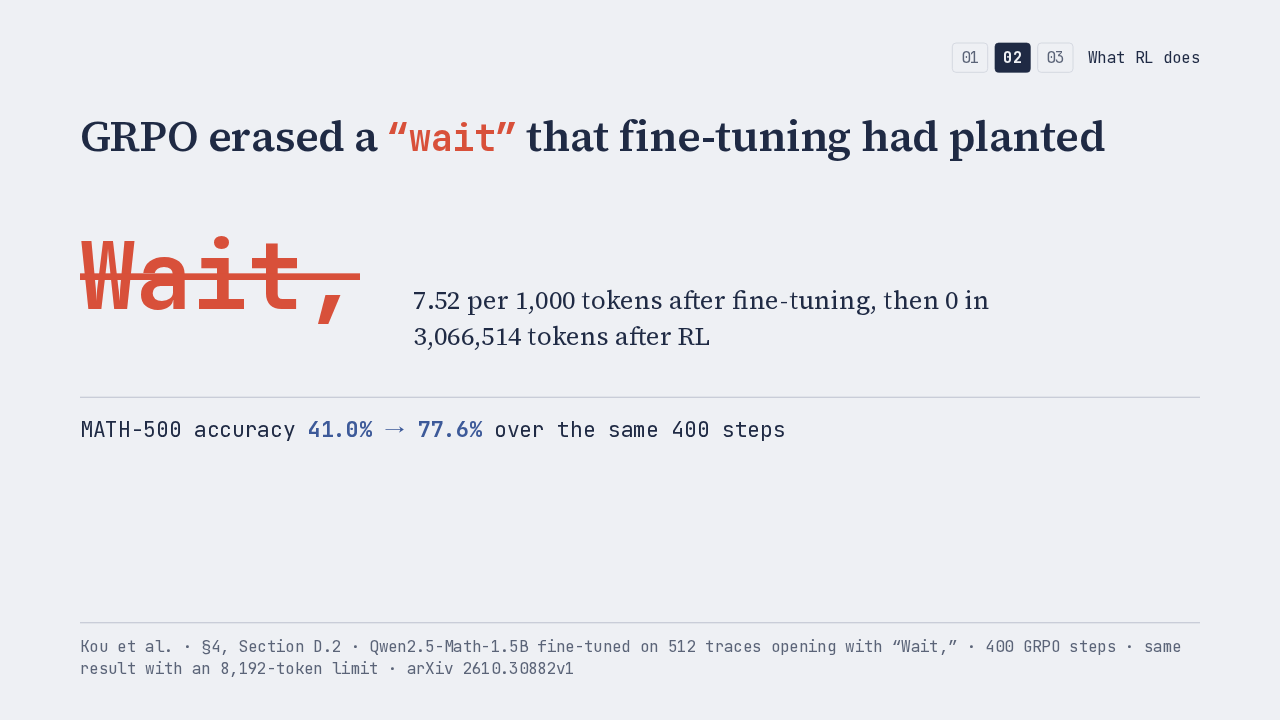
GRPO erased a planted wait
GRPO erased a “wait” that fine-tuning had planted
The word can also be planted. A small Qwen math model was fine-tuned on 512 solutions whose sentences open with wait, then trained with GRPO. After 400 steps, wait was gone. Accuracy still rose, from 41 to about 78 percent.
A more sensitive, more liberal alarm
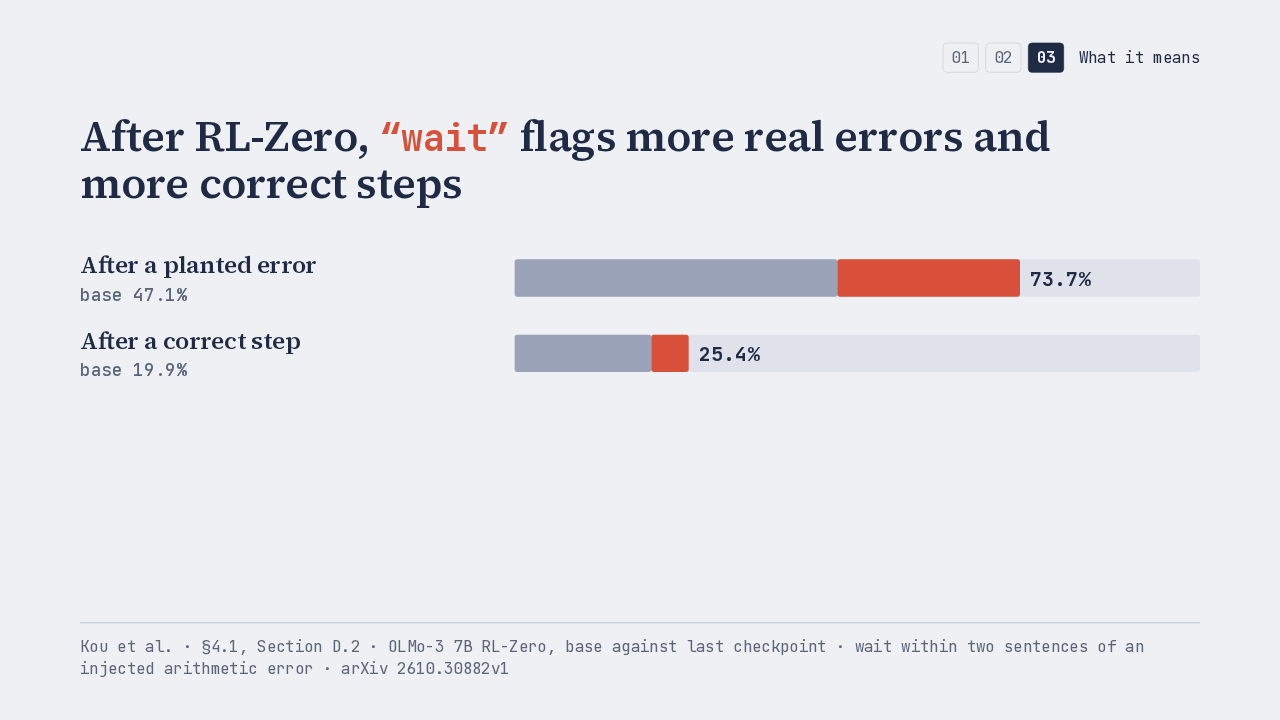
After RL-Zero, “wait” flags more real errors and more correct steps
That matters if you read wait as a sign of doubt. After RL-Zero, OLMo-3 writes it after three in four planted errors, up from under half. It also fires after a quarter of correct steps, so measure it on the checkpoint you run.
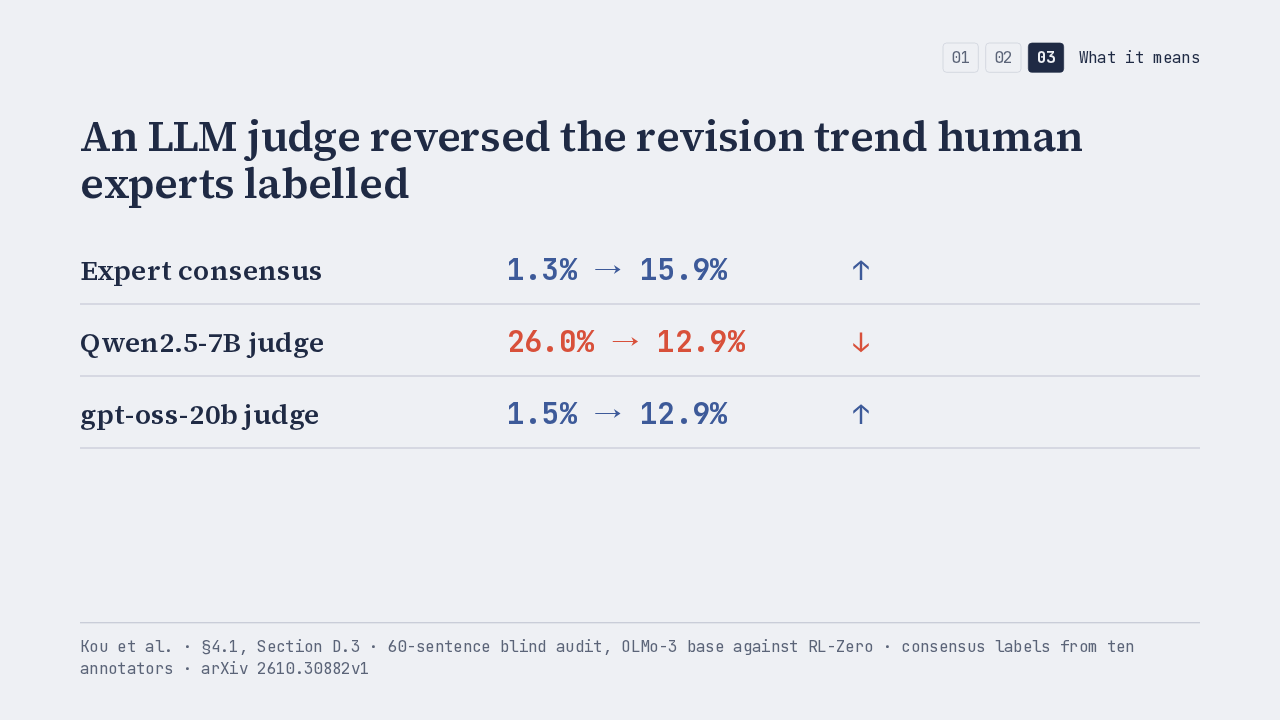
An LLM judge reversed the human trend
An LLM judge reversed the revision trend human experts labelled
Papers often count reflection with an LLM judge. On 60 blind sentences, experts saw revisions rise during RL-Zero. A Qwen judge saw them halve, because it over-counted them in the base model. A gpt-oss judge tracked the experts.
What the study covers
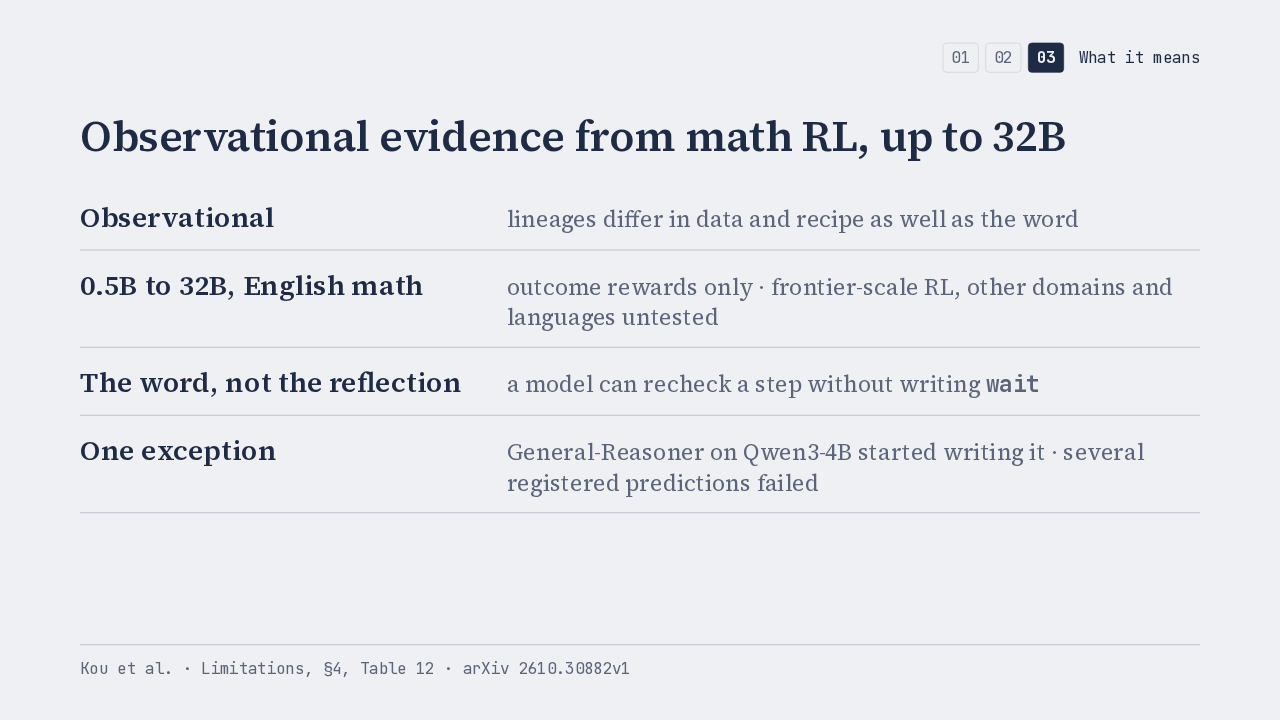
Observational evidence from math RL, up to 32B
The evidence is observational, from models up to 32B trained on English math. It tracks the word, and a model can recheck a step without writing it. One zero-RL run, General-Reasoner on Qwen3 4B, did start writing wait.
The paper and its code
Does anything in your stack count “wait” as a sign the model is unsure?
The provenance map of 120 models, the result files and the expert labels are in the wait-provenance repository on GitHub. Does anything in your stack count wait as a sign the model is unsure?