One practice task, then a plateau

EmbodiedCLBench: one practice task gives AI agents most of their gain, and more practice doesn’t add to it
Jie Huang, Yanan Chen, Ruixun Liu, Yiwu Zhong and colleagues · Peking University, BIGAI Beijing, University of Hong Kong
AI agents running in Claude Code, Codex, OpenClaw and Hermes get much better at unseen chores after practicing simpler ones. The first practice chore gives most of that gain, and more adds no consistent improvement. The benchmark is EmbodiedCLBench, from Peking University.
Basic chores, then unseen advanced ones
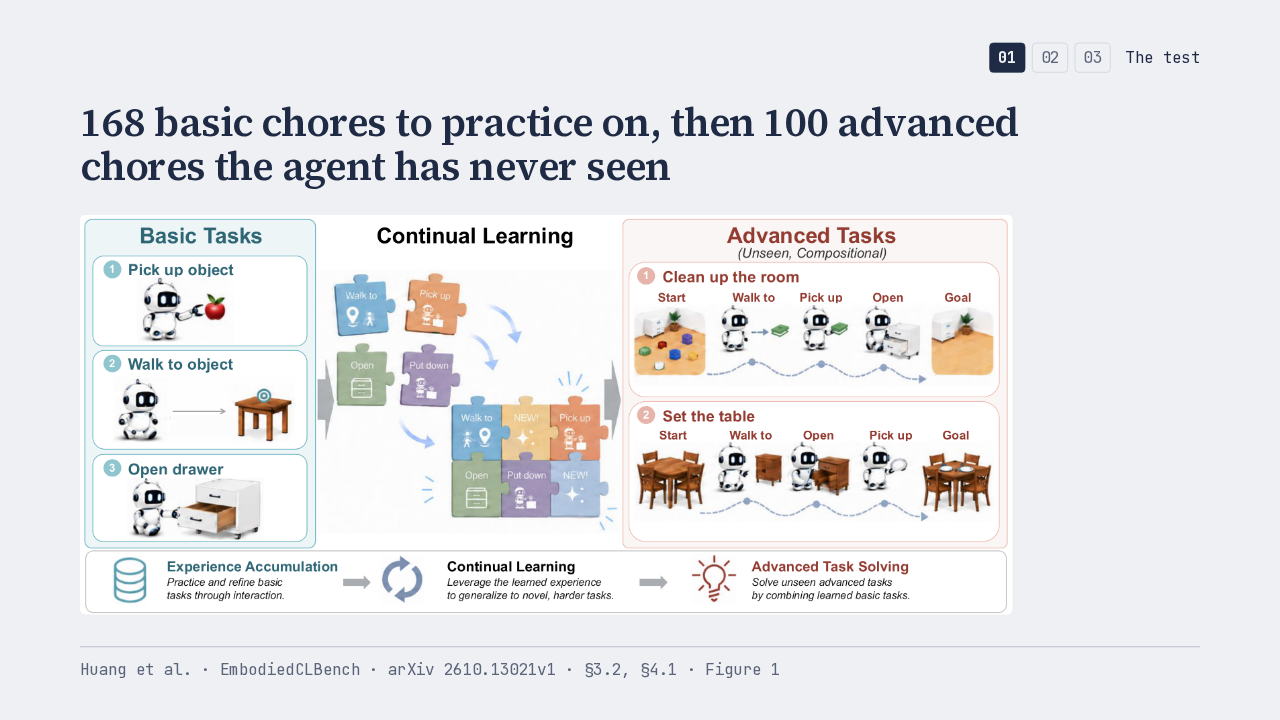
168 basic chores to practice on, then 100 advanced chores the agent has never seen

The agent works in a simulated home. It practices basic chores, like opening a drawer. Then it gets an unseen advanced chore that chains four such actions, like tidying a room before bed.
Each step is a four-way choice
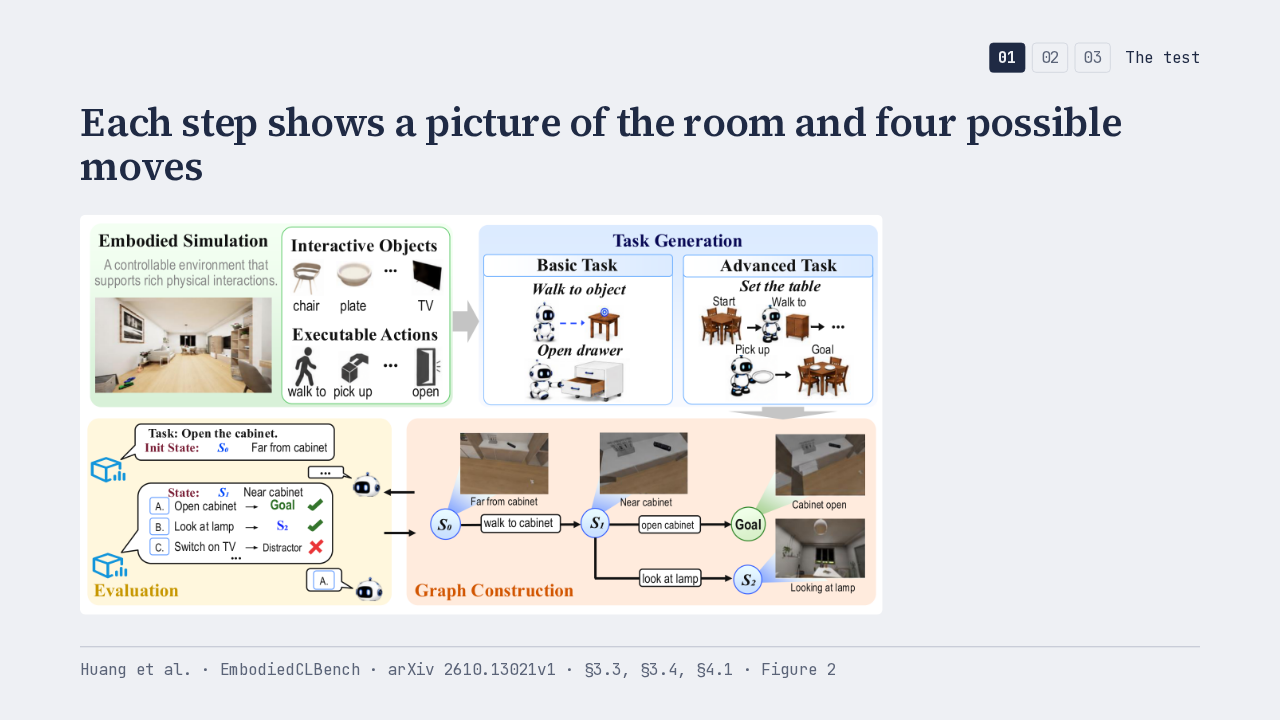
Each step shows a picture of the room and four possible moves

At every step the agent sees a picture of the room and picks one of four moves. One heads for the goal, and some are impossible from where it stands. Advanced chores take twelve steps.
Without practice
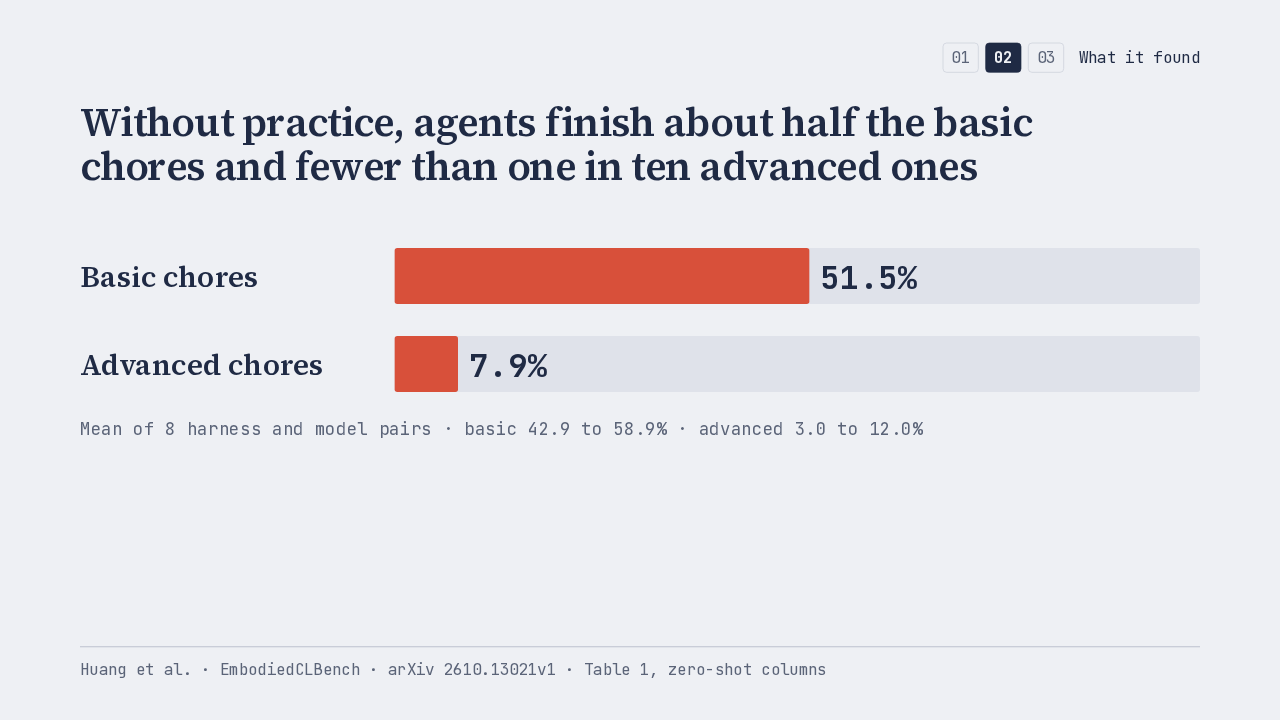
Without practice, agents finish about half the basic chores and fewer than one in ten advanced ones
Mean of 8 harness and model pairs · basic 42.9 to 58.9% · advanced 3.0 to 12.0%
With no practice, the agents finish about half of the basic chores. That holds across all four harnesses and both models, Qwen3.8-Flash and GPT5.6-Terra. On the advanced chores they finish fewer than one in ten.
Two practice chores, every harness
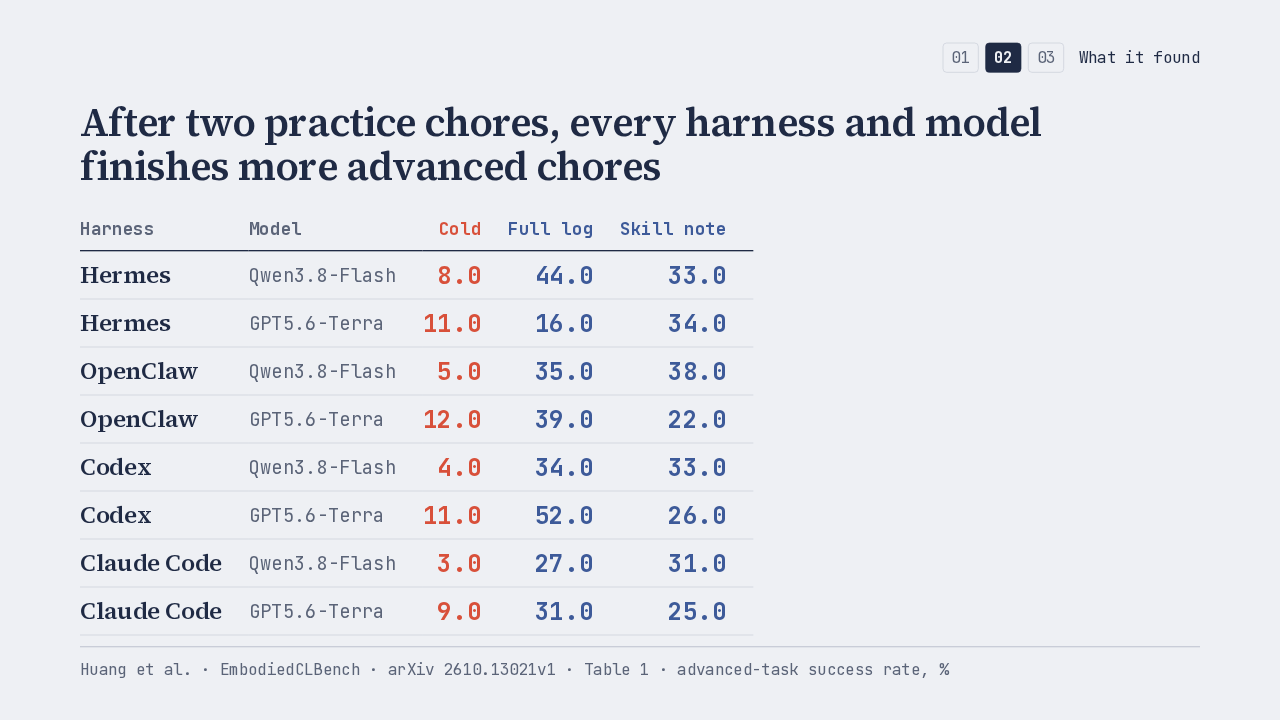
After two practice chores, every harness and model finishes more advanced chores
| Harness | Model | Cold | Full log | Skill note |
|---|---|---|---|---|
| Hermes | Qwen3.8-Flash | 8.0 | 44.0 | 33.0 |
| Hermes | GPT5.6-Terra | 11.0 | 16.0 | 34.0 |
| OpenClaw | Qwen3.8-Flash | 5.0 | 35.0 | 38.0 |
| OpenClaw | GPT5.6-Terra | 12.0 | 39.0 | 22.0 |
| Codex | Qwen3.8-Flash | 4.0 | 34.0 | 33.0 |
| Codex | GPT5.6-Terra | 11.0 | 52.0 | 26.0 |
| Claude Code | Qwen3.8-Flash | 3.0 | 27.0 | 31.0 |
| Claude Code | GPT5.6-Terra | 9.0 | 31.0 | 25.0 |
Now give the agent two related basic chores before the advanced one. Advanced success climbs from about one in ten to around one in three, in every harness. Codex with GPT5.6-Terra goes furthest, to about half.
Full log or a skill note
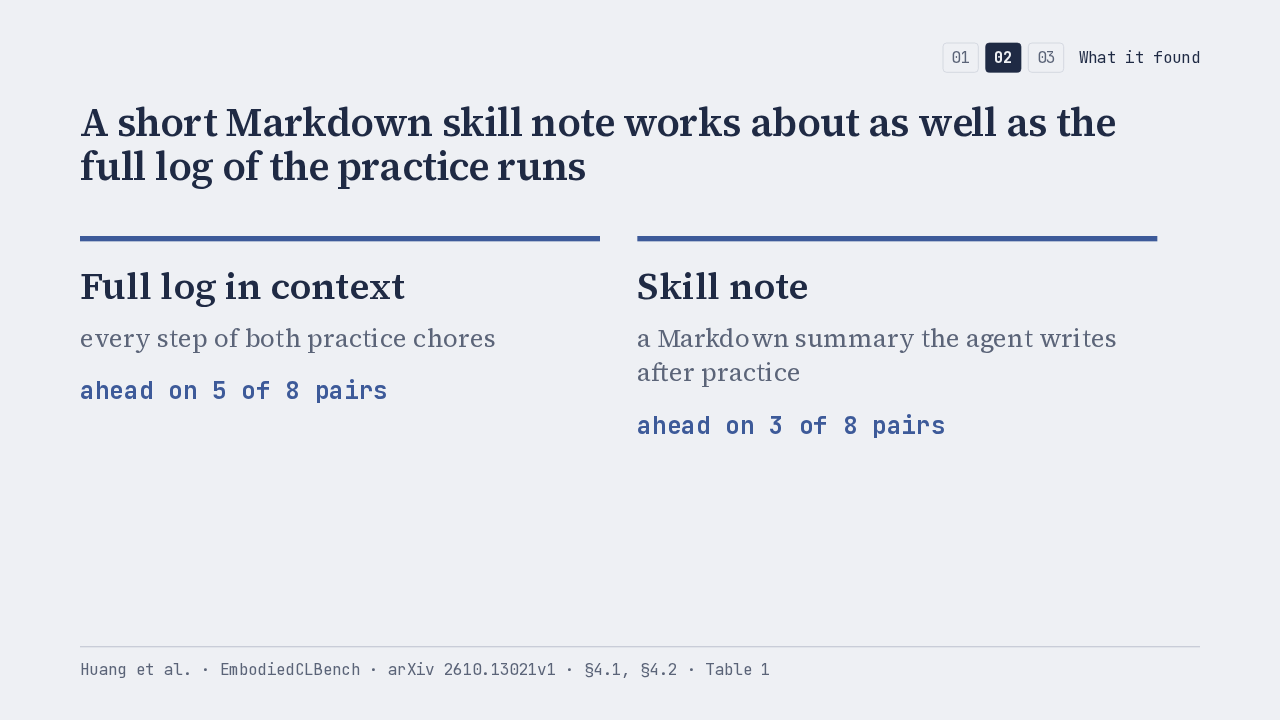
A short Markdown skill note works about as well as the full log of the practice runs
One setup keeps the full log of every practice step in context. The other keeps only a short Markdown skill note the agent wrote for itself. Neither has a consistent advantage.
Fewer impossible moves
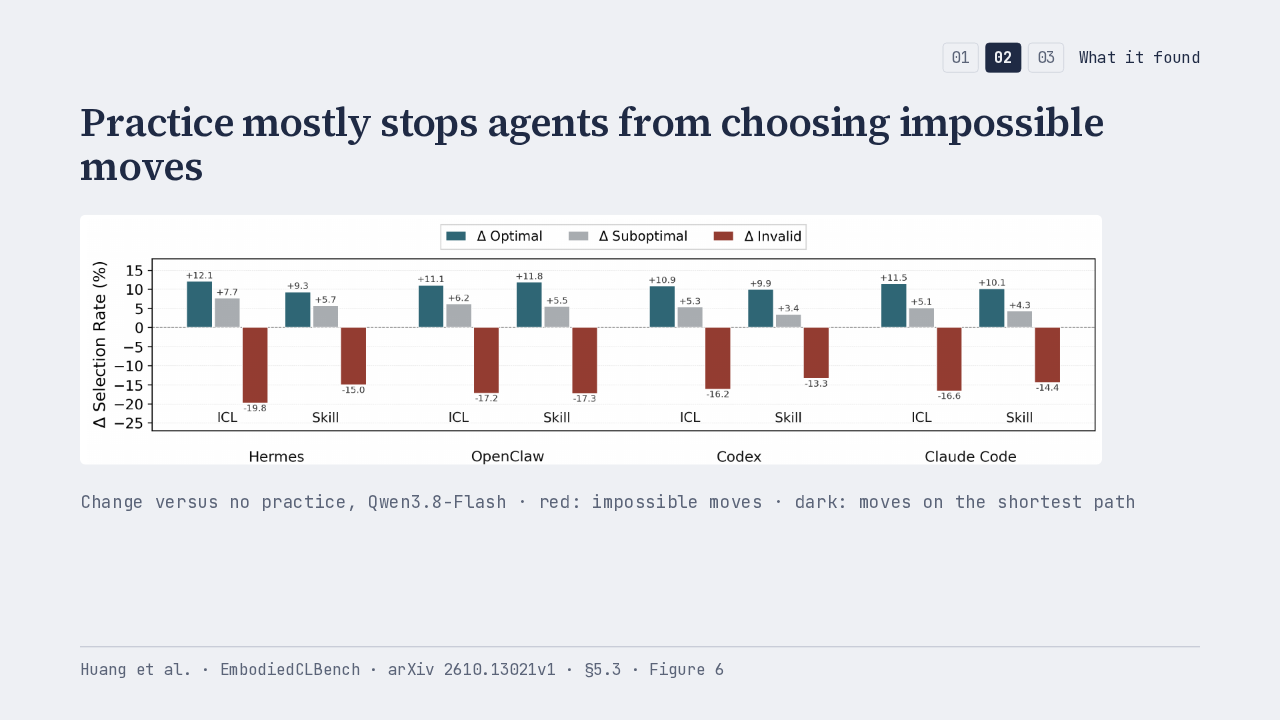
Practice mostly stops agents from choosing impossible moves

Change versus no practice, Qwen3.8-Flash · red: impossible moves · dark: moves on the shortest path
With practice, impossible moves drop by 13 to 20 points in every harness, and moves straight toward the goal rise by about 10. The skill note shifts these choices less than the full log.
The gain holds on longer chores
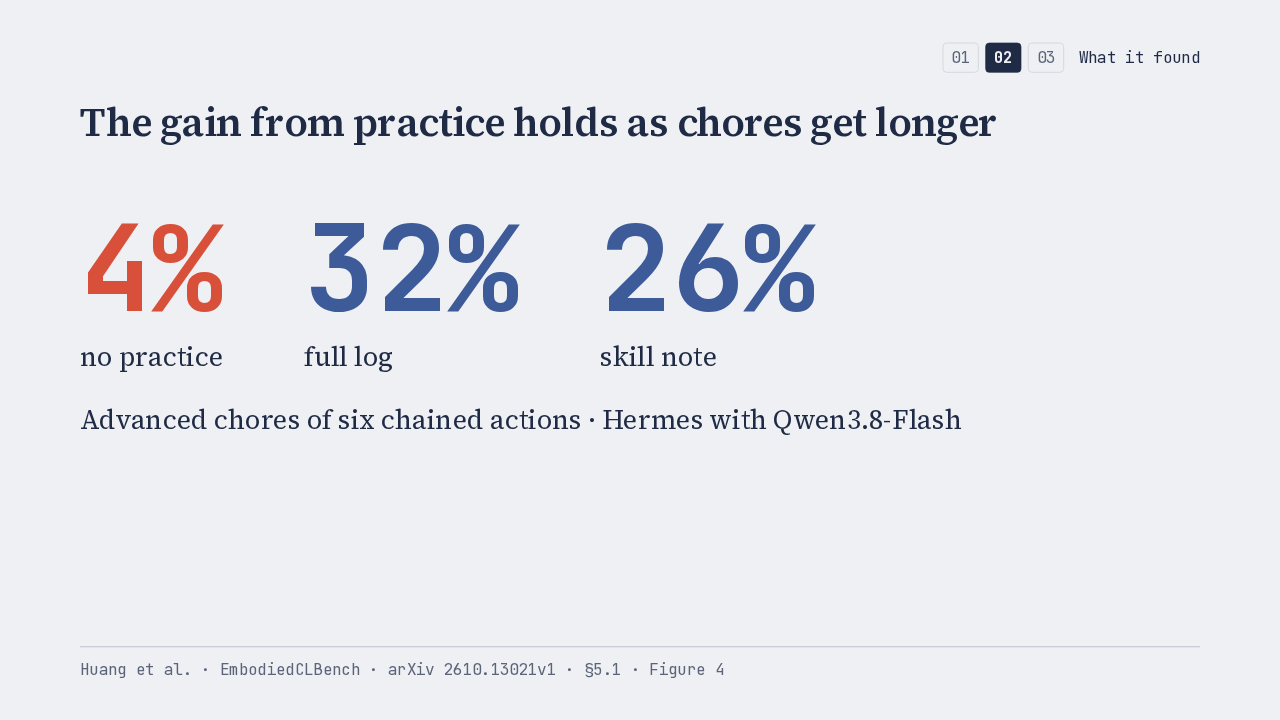
The gain from practice holds as chores get longer
Advanced chores of six chained actions · Hermes with Qwen3.8-Flash
Longer chores keep the benefit. At six chained actions, an agent without practice finishes 4 percent. With practice it finishes about a quarter to a third. The full log keeps a gain of roughly 30 points.
More practice, no further gain
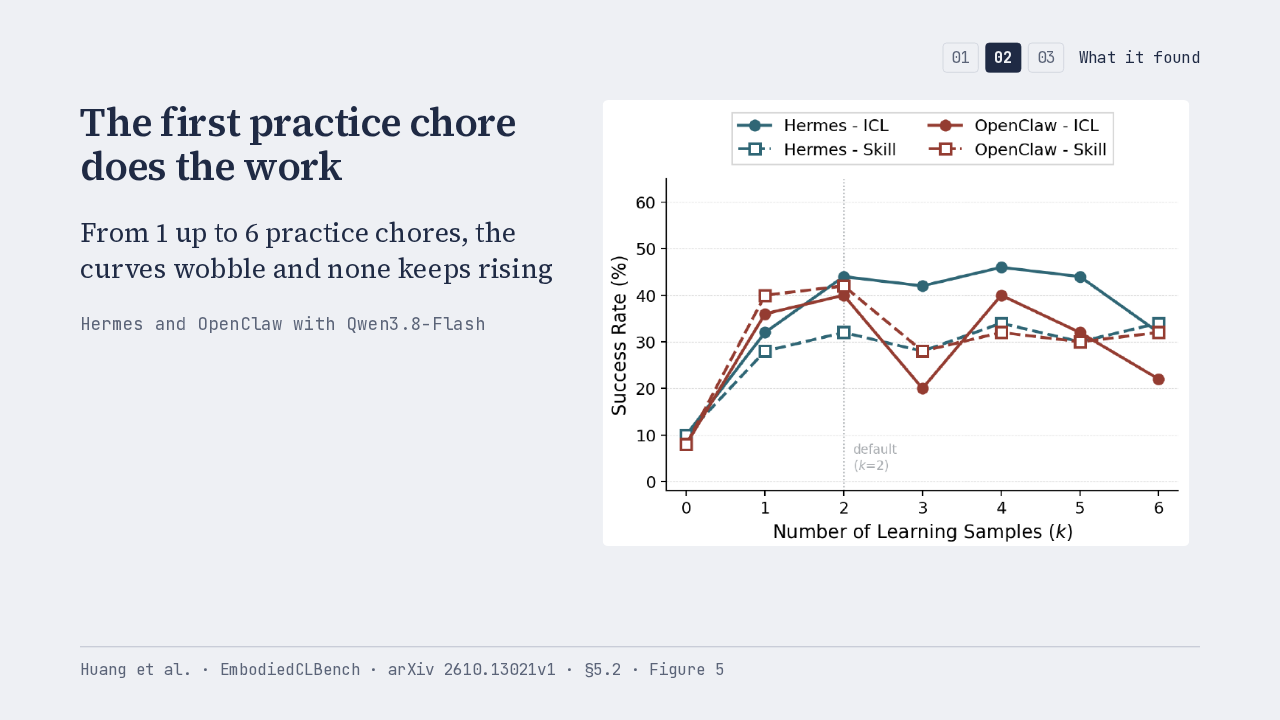
The first practice chore does the work
From 1 up to 6 practice chores, the curves wobble and none keeps rising
Hermes and OpenClaw with Qwen3.8-Flash

A single practice chore lifts success from about one in ten to between 28 and 40 percent. Past that first chore, up to six, the curves wobble and none keeps climbing.
Where the result stops
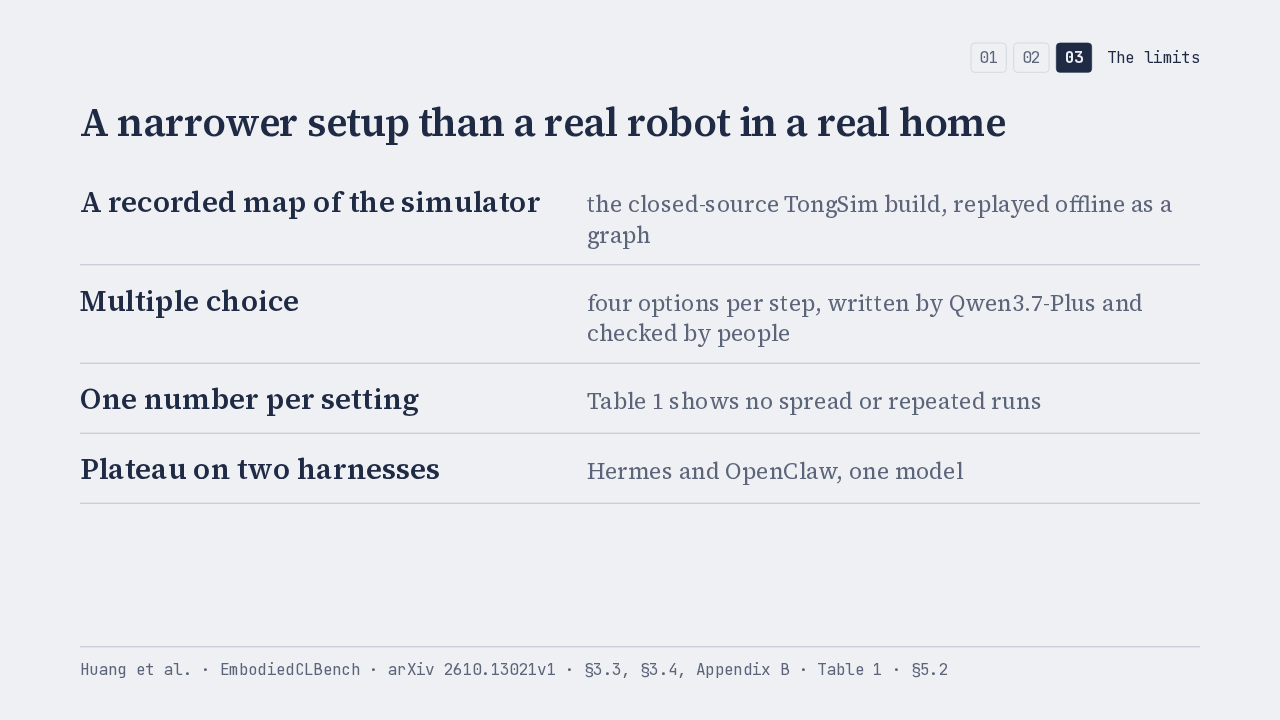
A narrower setup than a real robot in a real home
The chores replay a recorded map of a closed-source simulator called TongSim, and every step is a four-way choice. Each result is a single success rate with no spread, and the plateau was measured on two harnesses with one model.
Code and data
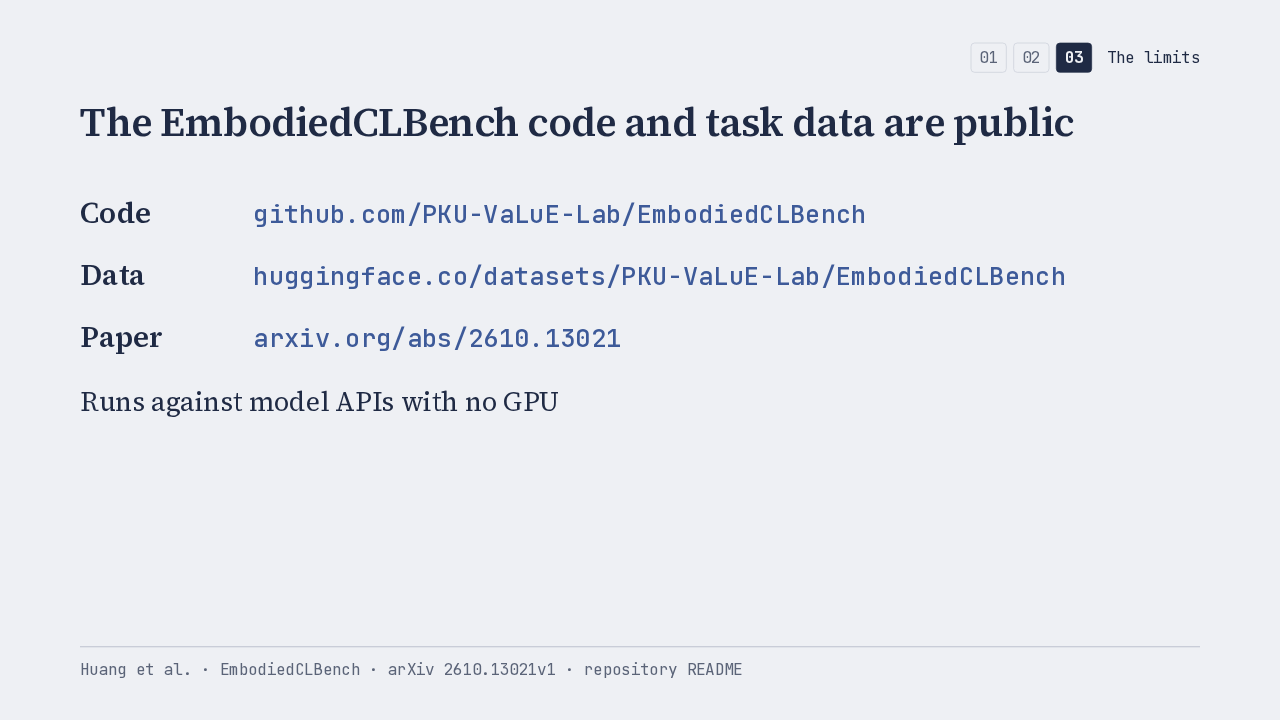
The EmbodiedCLBench code and task data are public
Runs against model APIs with no GPU
The code and task data are public, and it runs against model APIs with no GPU. For agents that learn from their own runs, the open problem is the second practice chore, which adds no consistent gain.