3DCodeVerse makes the same model write better 3D code than Claude Code, Codex or Gemini CLI

1 hour ago

3DCodeVerse is a harness that builds 3D objects as code: it plans the parts, runs the code, measures and renders the result, has a vision model judge it, and fixes the code. With the same model inside, people preferred its objects over Claude Code, Codex and Gemini CLI in 7 to 9 of every 10 pairs, at many times the cost per object. The paper also releases 3DCodeVerse-2M, about two million runnable 3D programs, and fine-tuned Qwen models whose Blender scripts mostly run. Paper (arXiv 2610.22341v1, 15 Oct 2026): https://arxiv.org/abs/2610.22341 Code: https://github.com/gaoypeng/3dcodeverse Dataset: https://huggingface.co/datasets/ilabai/3dcodeverse

Ask

Ask about this presentation

Answers are generated from this presentation.

Chapters

  1. 0:003DCodeVerse and Claude Code, Codex, Gemini CLI
  2. 0:20People preferred the harness
  3. 0:36The build, check and fix loop
  4. 0:52Against Claude Design
  5. 1:073DCodeVerse-2M
  6. 1:24Fine-tuned open models
  7. 1:41Claude Sonnet 5
  8. 1:54One pass against a loop
  9. 2:10What the loop costs
  10. 2:27Code, dataset and paper
Show transcript

3DCodeVerse and Claude Code, Codex, Gemini CLI

AI Papers

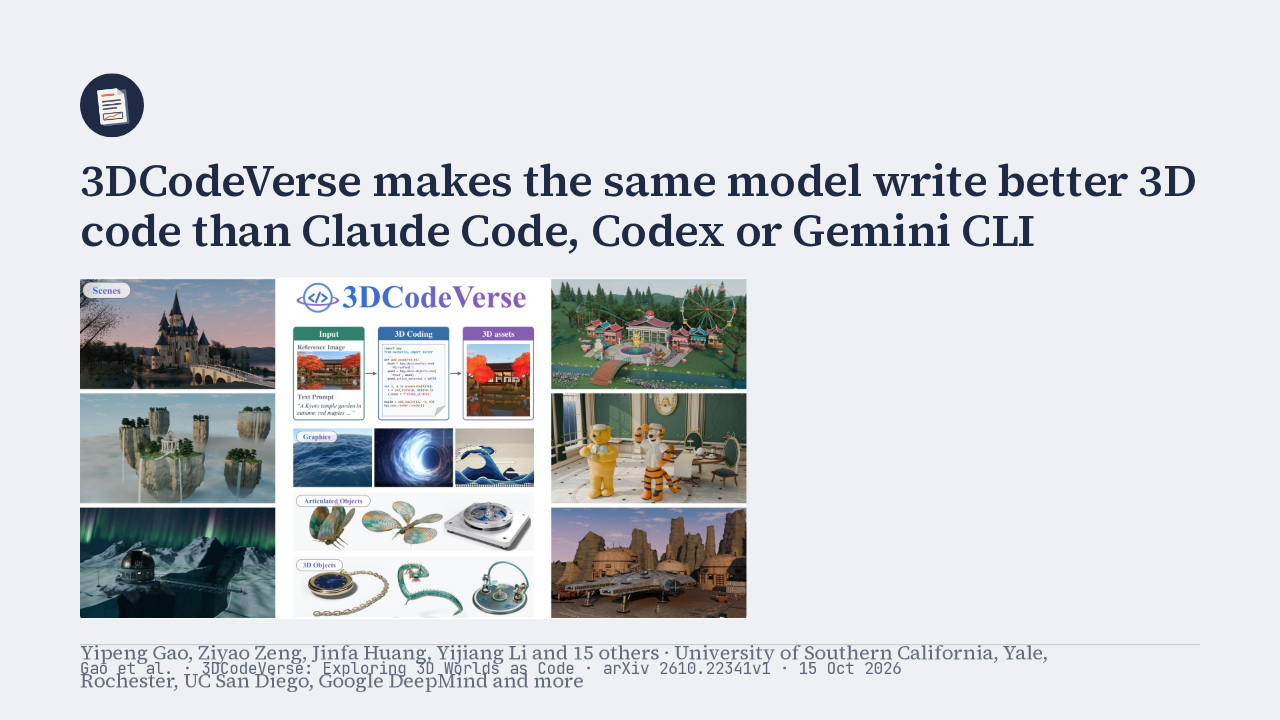
3DCodeVerse makes the same model write better 3D code than Claude Code, Codex or Gemini CLI

3D objects, articulated objects, scenes and graphics built only by code

Yipeng Gao, Ziyao Zeng, Jinfa Huang, Yijiang Li and 15 others · University of Southern California, Yale, Rochester, UC San Diego, Google DeepMind and more

Gao et al. · 3DCodeVerse: Exploring 3D Worlds as Code · arXiv 2610.22341v1 · 15 Oct 2026

3DCodeVerse is a harness for building 3D objects as code. With the same model inside, people preferred its objects over those from Claude Code, Codex and Gemini CLI. It comes from the University of Southern California, Google DeepMind and others.

People preferred the harness

010203The result

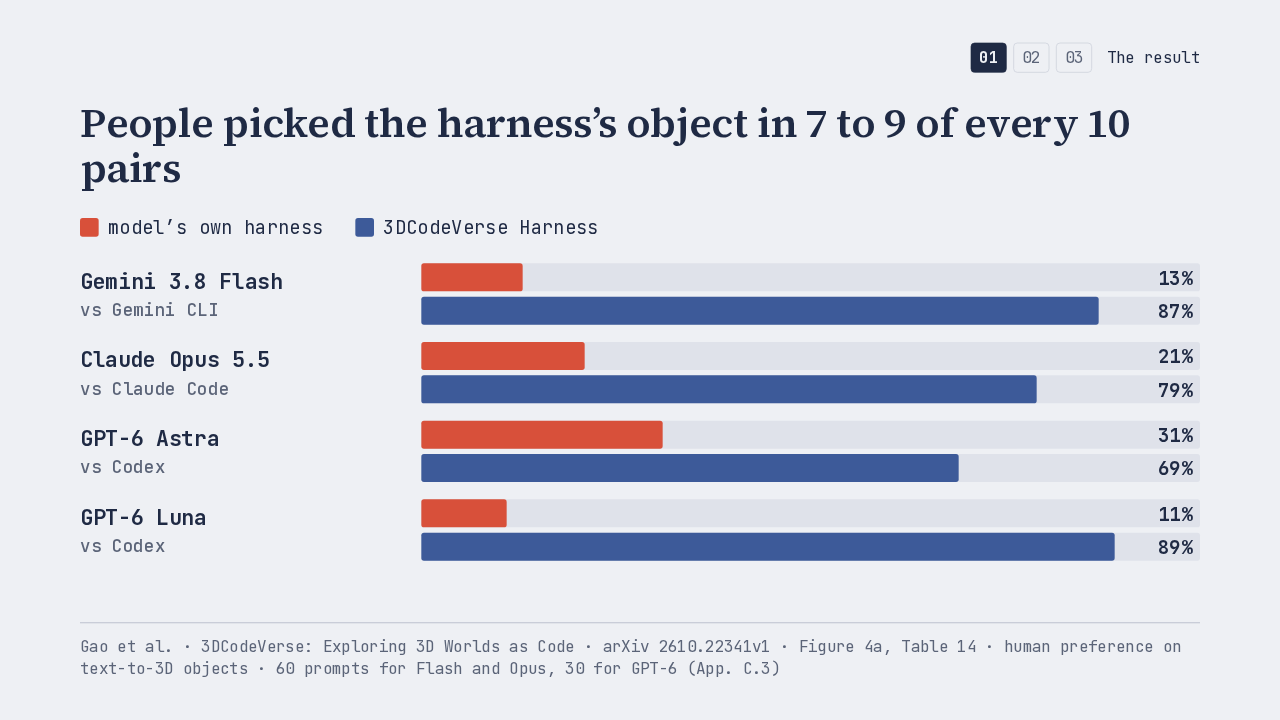
People picked the harness’s object in 7 to 9 of every 10 pairs

model’s own harness3DCodeVerse Harness
Gemini 3.8 Flashvs Gemini CLI
13%
87%
Claude Opus 5.5vs Claude Code
21%
79%
GPT-6 Astravs Codex
31%
69%
GPT-6 Lunavs Codex
11%
89%
Gao et al. · 3DCodeVerse: Exploring 3D Worlds as Code · arXiv 2610.22341v1 · Figure 4a, Table 14 · human preference on text-to-3D objects · 60 prompts for Flash and Opus, 30 for GPT-6 (App. C.3)

Each model built the same objects in its usual coding agent and inside the harness. Shown both, people picked the harness version about four times in five. Claude Code with Opus 5.5 won about one pair in five.

The build, check and fix loop

010203The pieces

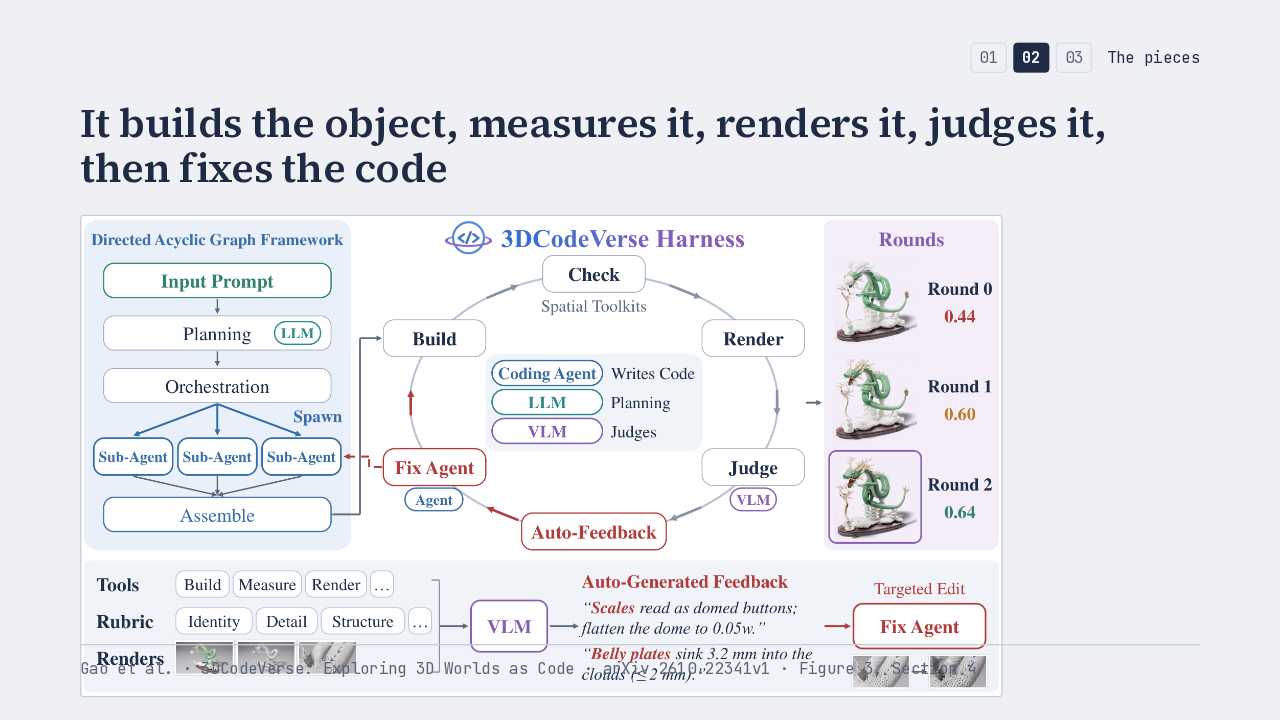
It builds the object, measures it, renders it, judges it, then fixes the code

3DCodeVerse Harness: planning, sub-agents, build, check, render, judge, auto-feedback and a fix agent over refinement rounds
Gao et al. · 3DCodeVerse: Exploring 3D Worlds as Code · arXiv 2610.22341v1 · Figure 3, Section 4

A planner splits the request into parts and sub-agents code each one. The harness runs the code, measures the parts for gaps and collisions, renders it, and a vision model judges the render. A fix agent edits the code, and the loop repeats.

Against Claude Design

010203The result

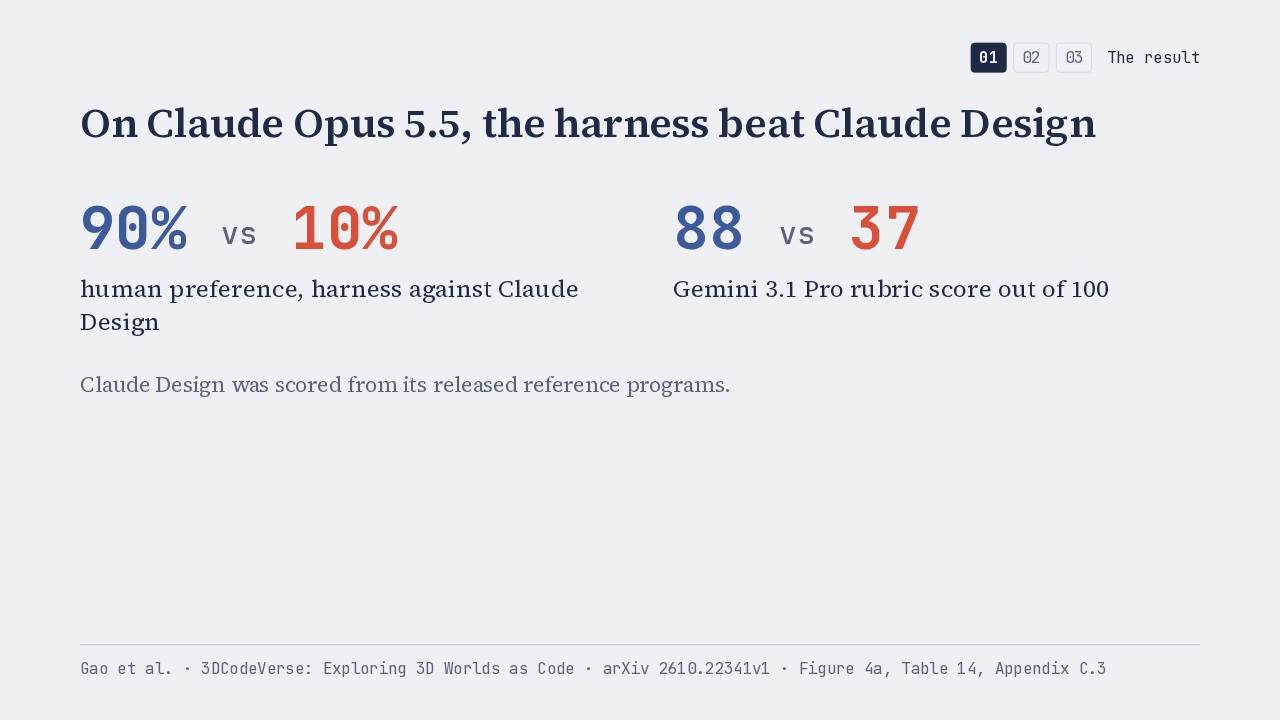
On Claude Opus 5.5, the harness beat Claude Design

90% vs 10%human preference, harness against Claude Design
88 vs 37Gemini 3.1 Pro rubric score out of 100

Claude Design was scored from its released reference programs.

Gao et al. · 3DCodeVerse: Exploring 3D Worlds as Code · arXiv 2610.22341v1 · Figure 4a, Table 14, Appendix C.3

Claude Design runs on the same Claude Opus 5.5. People preferred the harness's object nine times in ten. On the rubric that grades every object out of 100, Claude Design's objects scored less than half as much.

3DCodeVerse-2M

010203The pieces

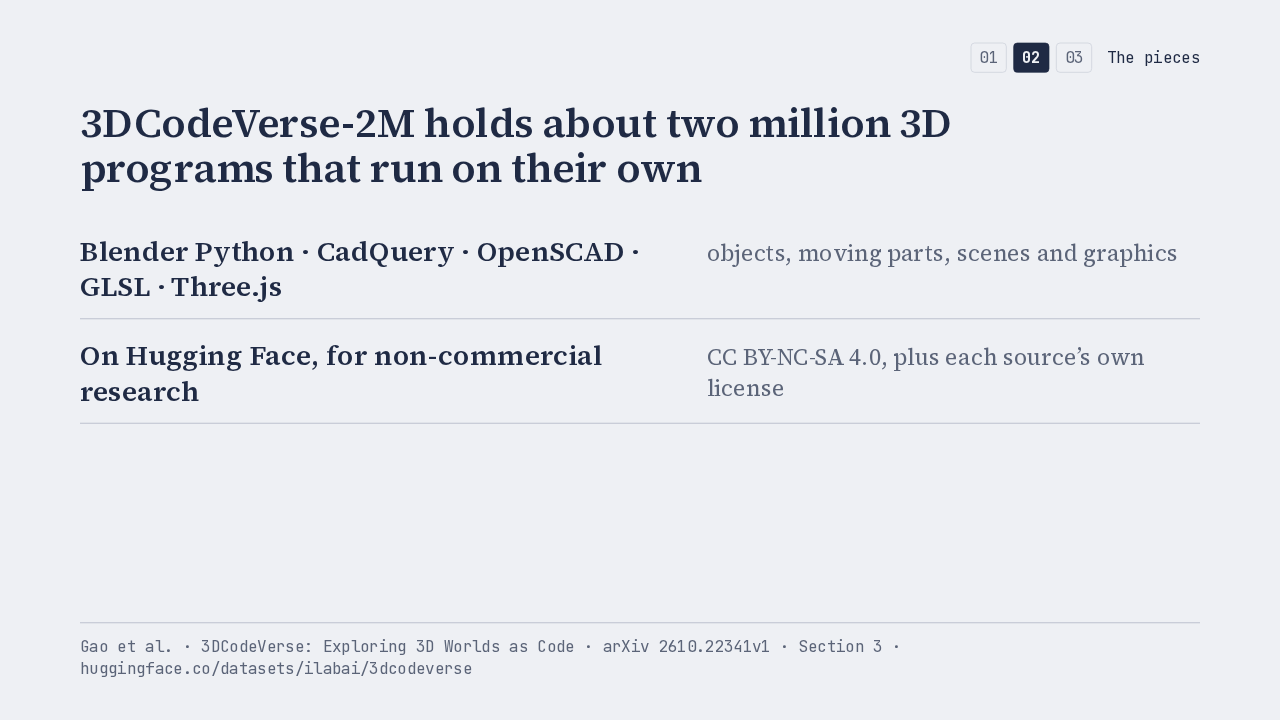
3DCodeVerse-2M holds about two million 3D programs that run on their own

Blender Python · CadQuery · OpenSCAD · GLSL · Three.jsobjects, moving parts, scenes and graphics
On Hugging Face, for non-commercial researchCC BY-NC-SA 4.0, plus each source’s own license
Gao et al. · 3DCodeVerse: Exploring 3D Worlds as Code · arXiv 2610.22341v1 · Section 3 · huggingface.co/datasets/ilabai/3dcodeverse

The team also released the training data. 3DCodeVerse-2M is about two million 3D programs that each run on their own, in Blender, CadQuery, OpenSCAD, shader code and Three.js. The license allows non-commercial research only.

Fine-tuned open models

010203The pieces

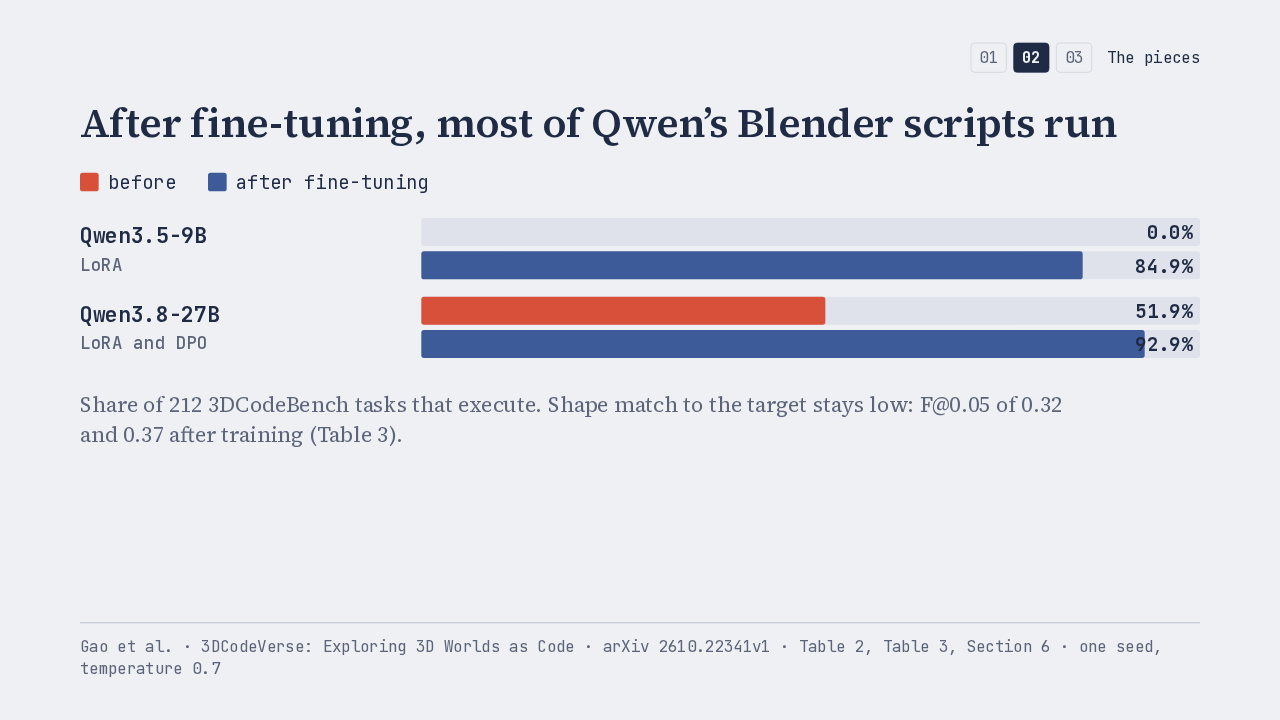
After fine-tuning, most of Qwen’s Blender scripts run

beforeafter fine-tuning
Qwen3.5-9BLoRA
0.0%
84.9%
Qwen3.8-27BLoRA and DPO
51.9%
92.9%

Share of 212 3DCodeBench tasks that execute. Shape match to the target stays low: F@0.05 of 0.32 and 0.37 after training (Table 3).

Gao et al. · 3DCodeVerse: Exploring 3D Worlds as Code · arXiv 2610.22341v1 · Table 2, Table 3, Section 6 · one seed, temperature 0.7

Before training, every Blender script Qwen3.5 9B wrote failed, mostly by calling a scene-clearing command Blender 5 no longer has. After LoRA fine-tuning, about 85 percent ran. The shapes they make still match their targets only loosely.

Claude Sonnet 5

010203The limits

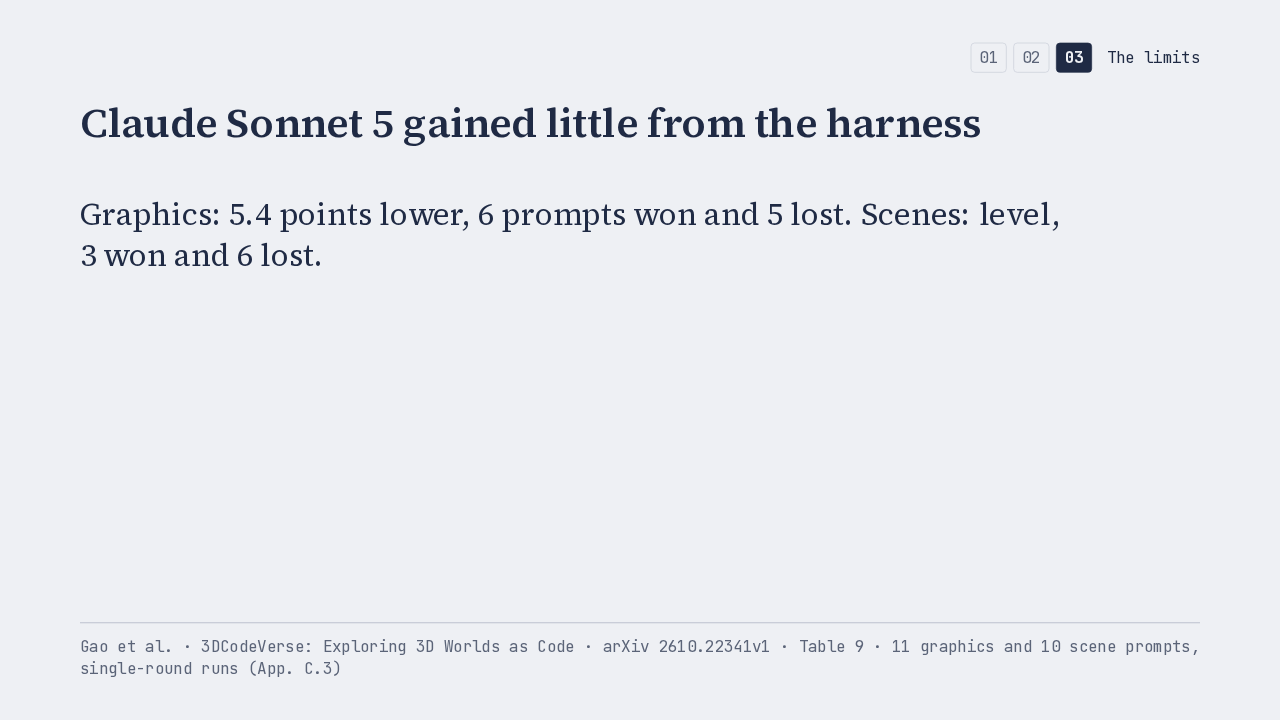
Claude Sonnet 5 gained little from the harness

Graphics: 5.4 points lower, 6 prompts won and 5 lost. Scenes: level, 3 won and 6 lost.

Gao et al. · 3DCodeVerse: Exploring 3D Worlds as Code · arXiv 2610.22341v1 · Table 9 · 11 graphics and 10 scene prompts, single-round runs (App. C.3)

Claude Sonnet 5 is the exception. On shader graphics the harness scored it slightly below Sonnet working alone, and on scenes about the same. Those runs used one round of the loop.

One pass against a loop

010203The limits

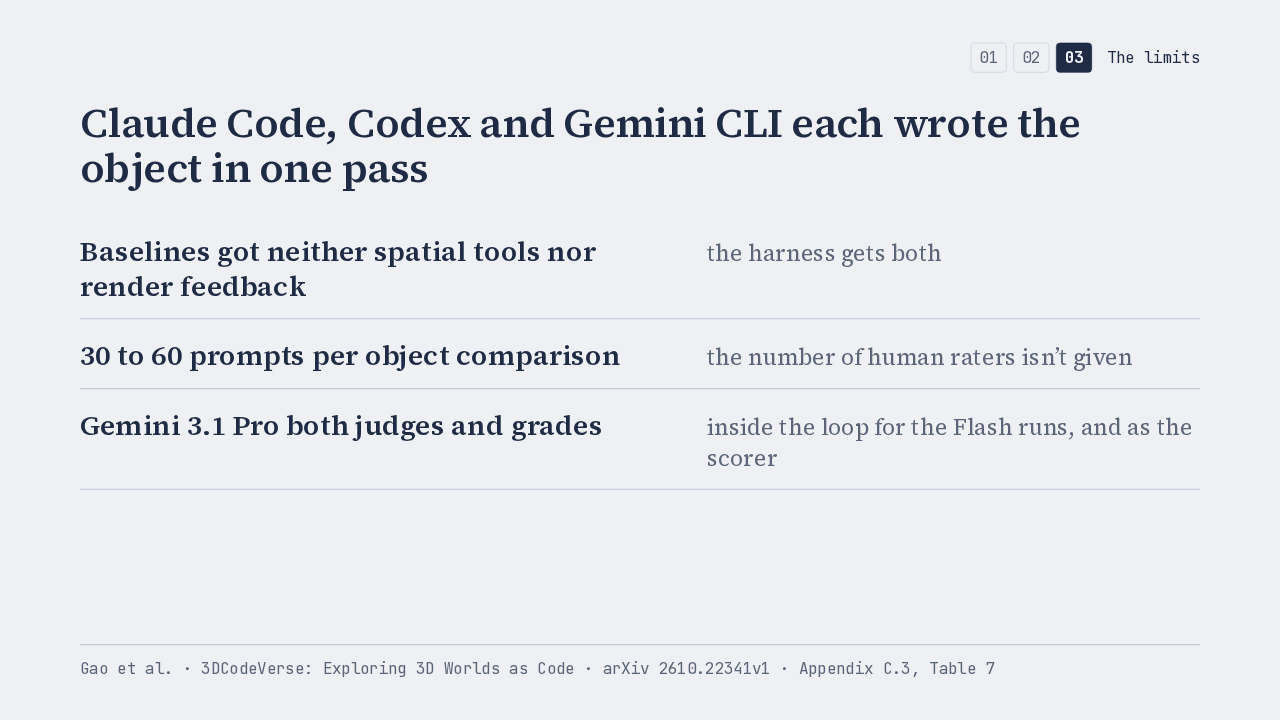
Claude Code, Codex and Gemini CLI each wrote the object in one pass

Baselines got neither spatial tools nor render feedbackthe harness gets both
30 to 60 prompts per object comparisonthe number of human raters isn’t given
Gemini 3.1 Pro both judges and gradesinside the loop for the Flash runs, and as the scorer
Gao et al. · 3DCodeVerse: Exploring 3D Worlds as Code · arXiv 2610.22341v1 · Appendix C.3, Table 7

Claude Code, Codex and Gemini CLI each wrote the object in one pass, without measurements or render feedback, while the harness checked and fixed its work. Each comparison used 30 to 60 prompts, and the count of human raters isn't stated.

What the loop costs

010203The limits

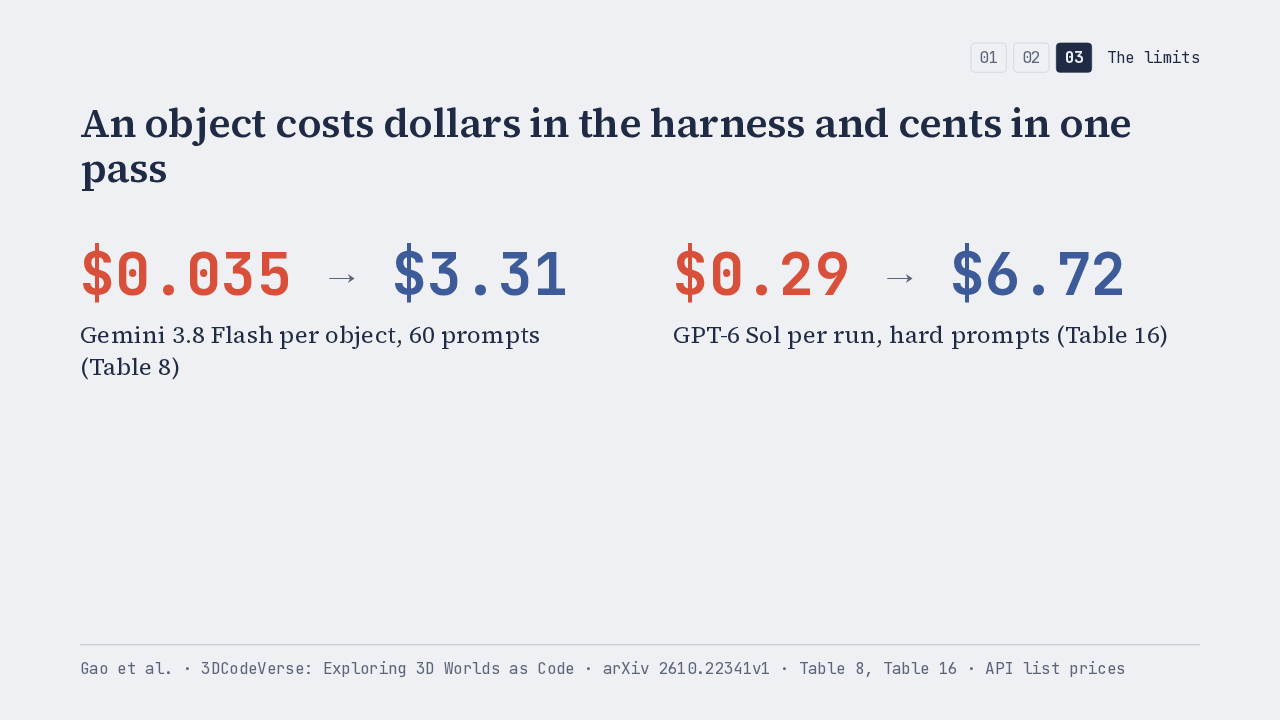
An object costs dollars in the harness and cents in one pass

$0.035 → $3.31Gemini 3.8 Flash per object, 60 prompts (Table 8)
$0.29 → $6.72GPT-6 Sol per run, hard prompts (Table 16)
Gao et al. · 3DCodeVerse: Exploring 3D Worlds as Code · arXiv 2610.22341v1 · Table 8, Table 16 · API list prices

The loop costs more. Gemini 3.8 Flash in one pass cost about 4 cents an object, and inside the harness about 3 dollars 30. On hard prompts, GPT-6 Sol went from about 30 cents a run to almost 7 dollars.

Code, dataset and paper

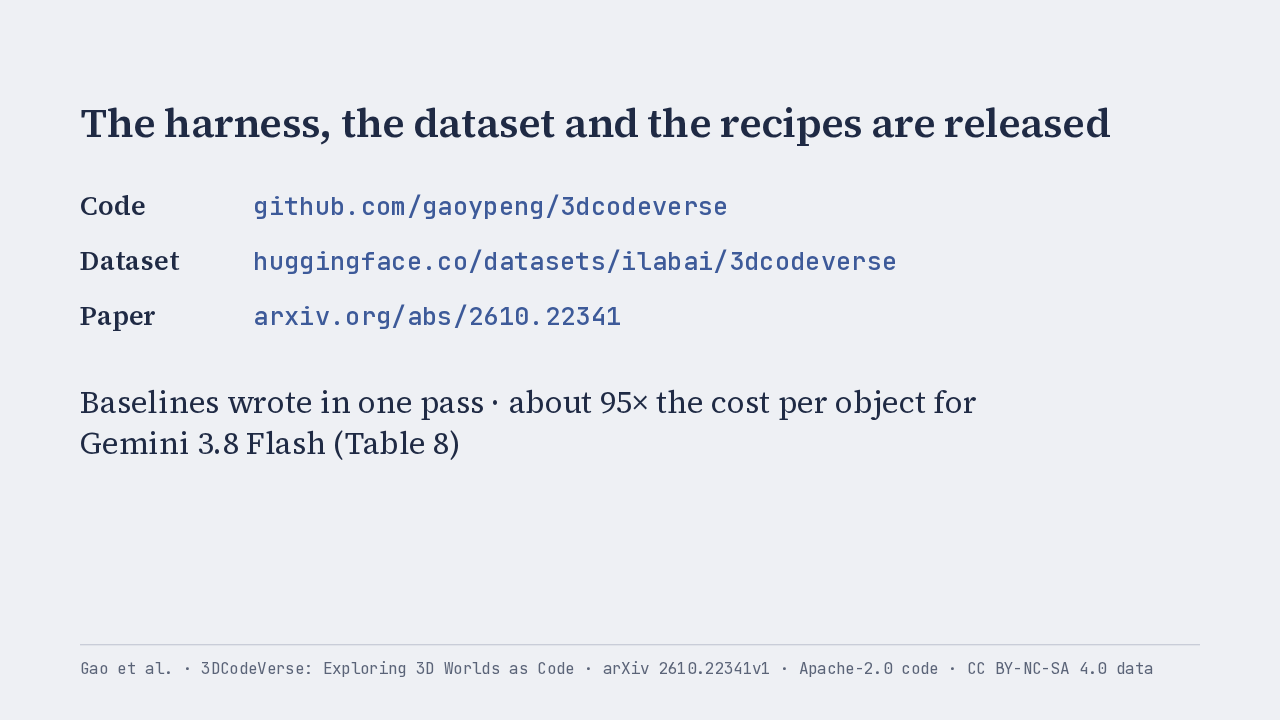
The harness, the dataset and the recipes are released

Codegithub.com/gaoypeng/3dcodeverse
Datasethuggingface.co/datasets/ilabai/3dcodeverse
Paperarxiv.org/abs/2610.22341

Baselines wrote in one pass · about 95× the cost per object for Gemini 3.8 Flash (Table 8)

Gao et al. · 3DCodeVerse: Exploring 3D Worlds as Code · arXiv 2610.22341v1 · Apache-2.0 code · CC BY-NC-SA 4.0 data

The harness code is on GitHub under Apache 2.0, and the dataset is on Hugging Face. Every win came against agents writing in one pass, and for Gemini 3.8 Flash the loop cost about a hundred times as much per object.