Babies sugar-rationed in 1950s Britain had less dementia 70 years later, in 60,394 UK adults
Babies sugar-rationed in 1950s Britain had less dementia 70 years later.
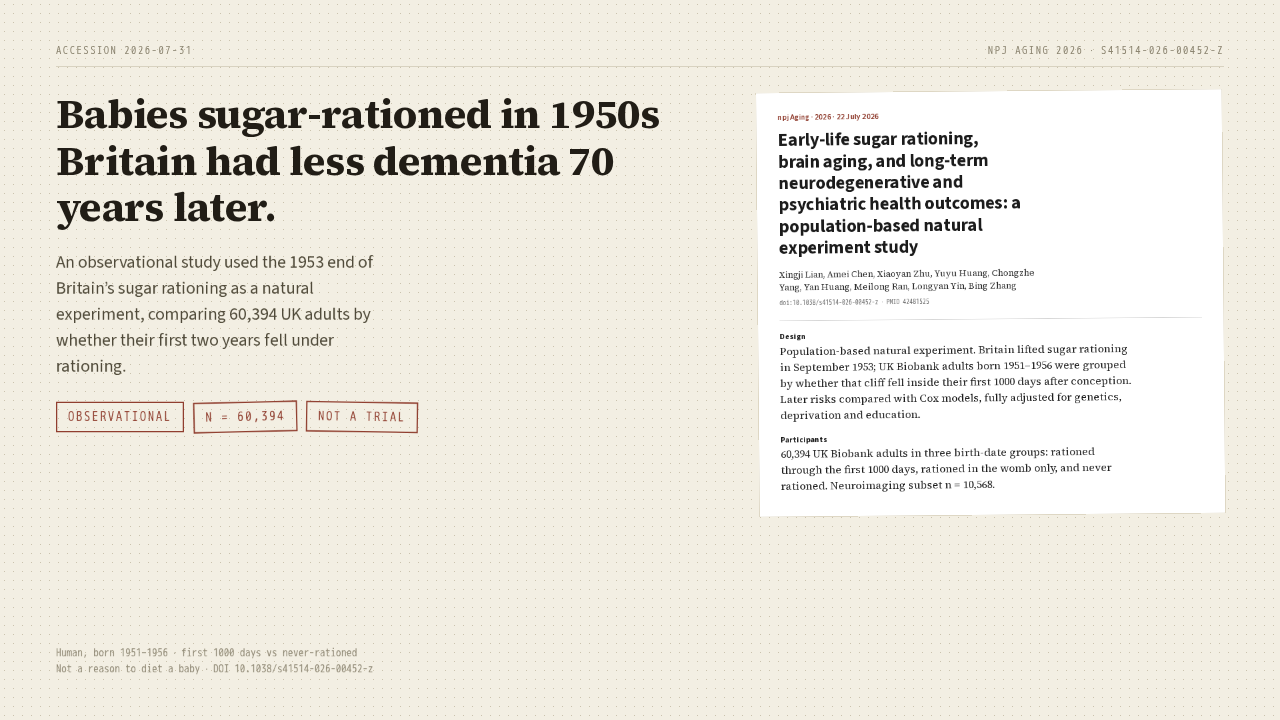
An observational study used the 1953 end of Britain’s sugar rationing as a natural experiment, comparing 60,394 UK adults by whether their first two years fell under rationing.
Not a reason to diet a baby · DOI 10.1038/s41514-026-00452-z
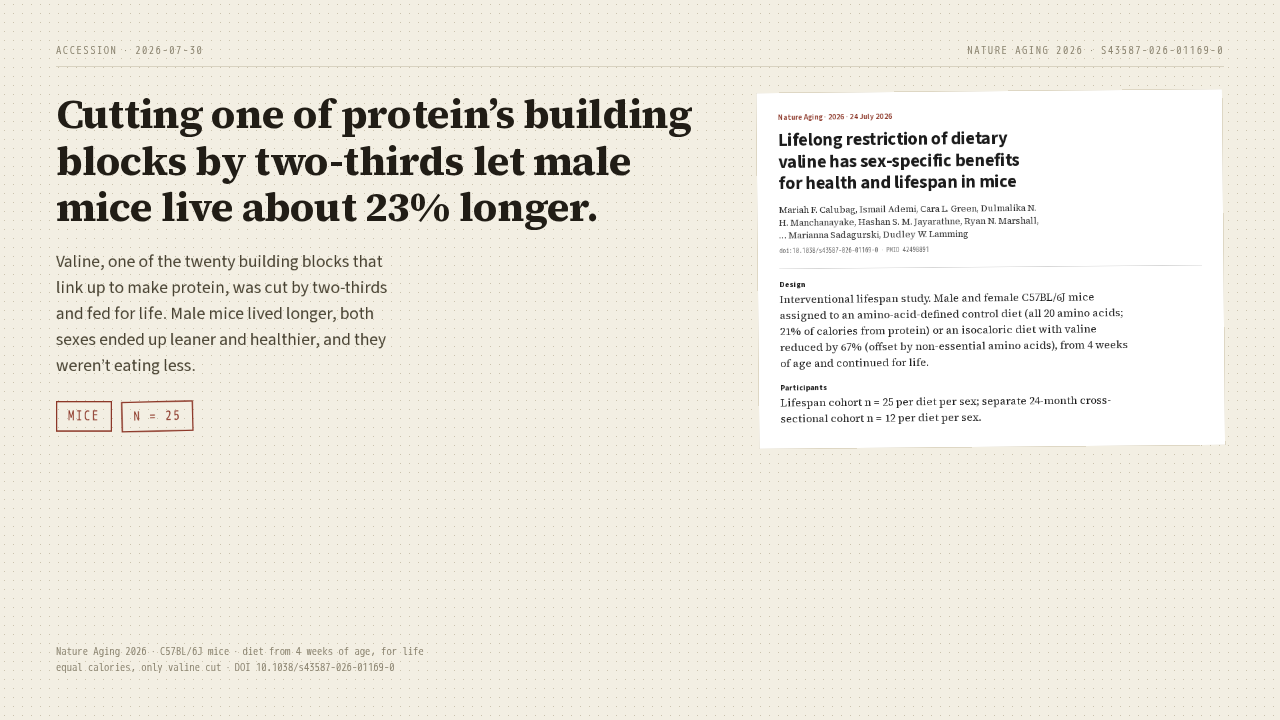
Early-life sugar rationing, brain aging, and long-term neurodegenerative and psychiatric health outcomes: a population-based natural experiment study
Babies whose first two years fell under Britain's post-war sugar rationing grew into adults with less dementia and less Alzheimer's, seventy years later. That comes from an observational study of sixty thousand British adults. It's a real link, not a diet anyone should copy.
The rationed-era group had 27% less dementia and about half the Alzheimer's risk
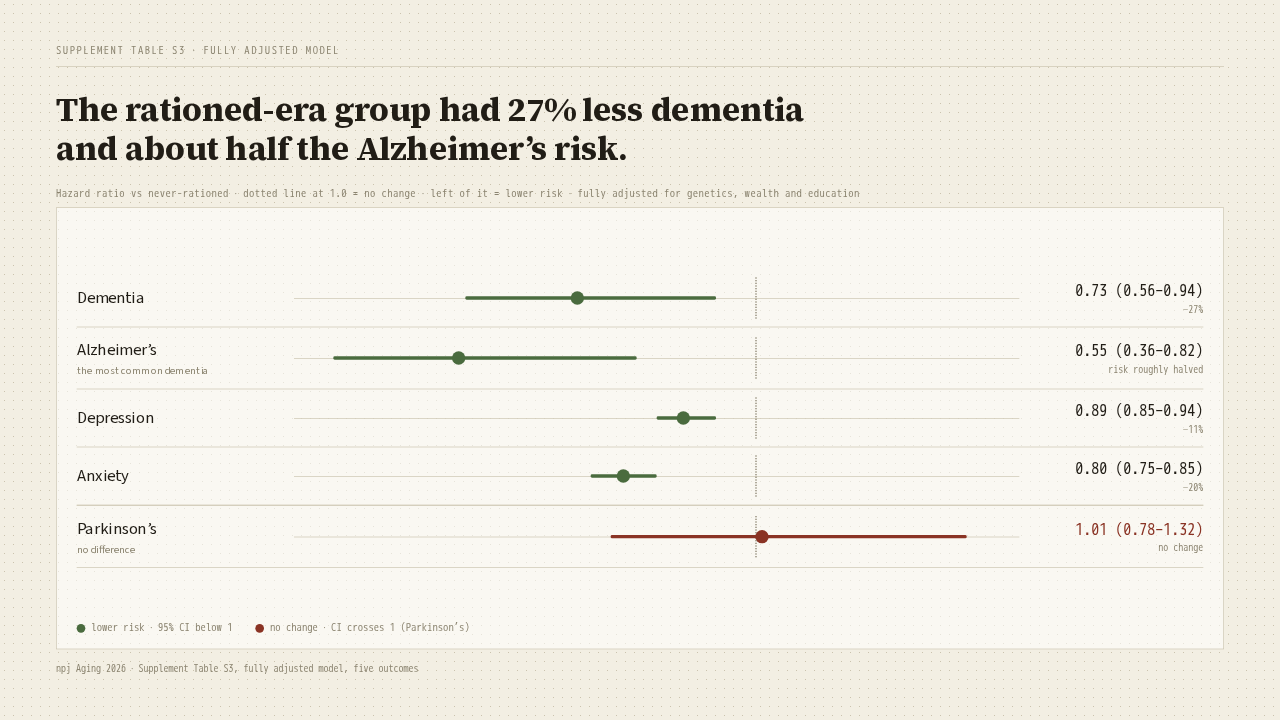
The rationed-era group had 27% less dementia and about half the Alzheimer’s risk.
In these adults, the researchers compared people whose first two years fell under rationing with people born just after it ended. Even after accounting for genetics, wealth and education, the rationed group had twenty-seven percent less dementia and about half the Alzheimer's risk, the most common cause of dementia. The same group had eleven percent less depression and twenty percent less anxiety. But it didn't touch everything. Parkinson's showed no difference.
The study never asked what anyone ate; it used a birthday
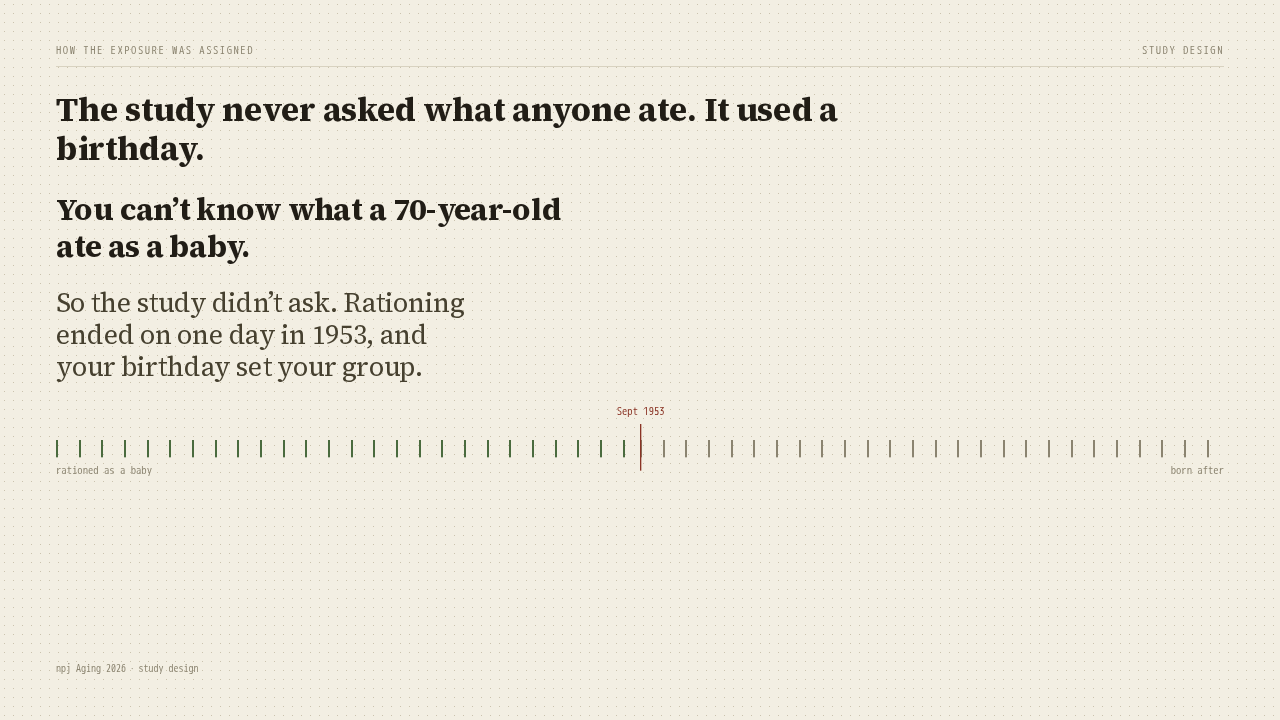
The study never asked what anyone ate. It used a birthday.
You can’t know what a 70-year-old ate as a baby.
So the study didn’t ask. Rationing ended on one day in 1953, and your birthday set your group.
Your first instinct is that this can't be real. You can't know what a seventy-year-old ate as a baby. There's no record, and memory doesn't reach age two. So how could anyone measure it? The study never asked. It used a birthday. Sugar rationing ended on one day in nineteen fifty-three, and your birthday decided your side of it.
One 1953 law split near-identical babies into rationed and not, by birth date
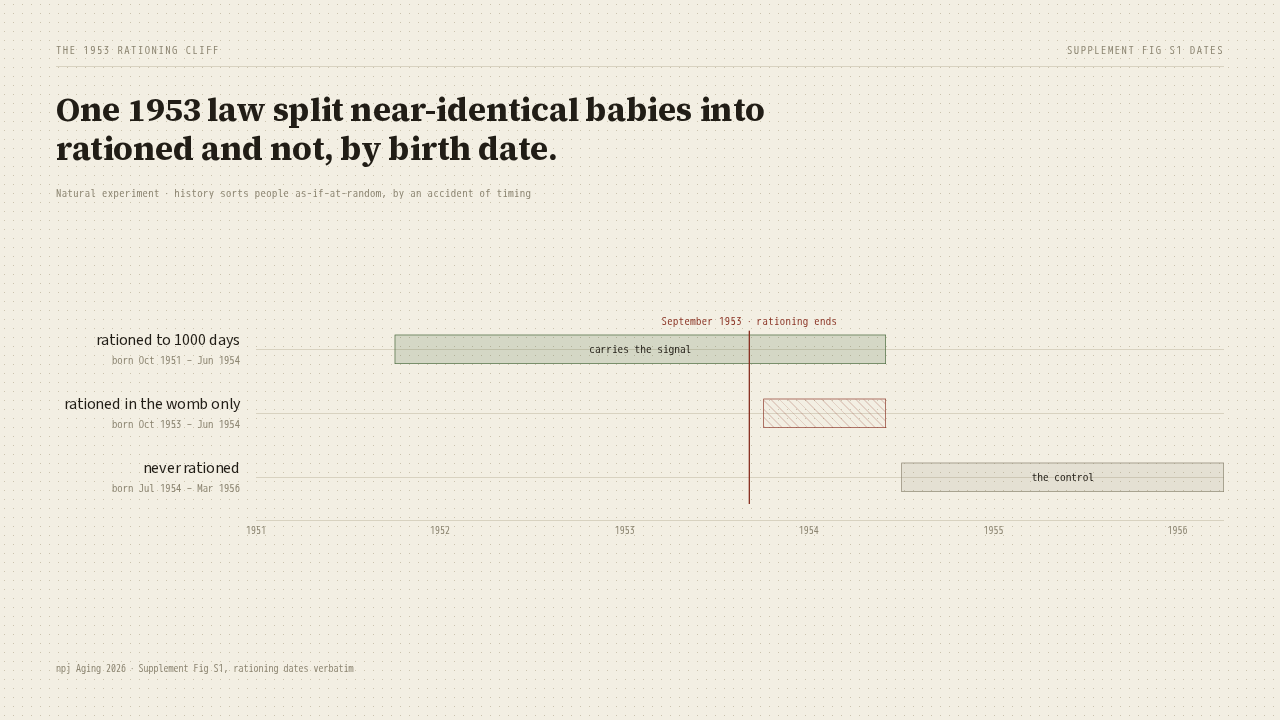
One 1953 law split near-identical babies into rationed and not, by birth date.
Here's why a birthday can stand in for an experiment. You could never run this on purpose. No ethics board lets a scientist assign babies to more sugar or less. But history ran it by accident. Take two babies born a few months apart. The one born just before nineteen fifty-three spent its first thousand days, conception to about age two, under rationing. The one born just after did not. Otherwise they're alike. Same country, same families, same era. So which side of that date a baby fell on is almost as random as a coin flip. That's a natural experiment. History does the sorting a researcher never could, by an accident of timing, not by choice.
The 1953 cliff lifted the whole wartime diet, not sugar alone
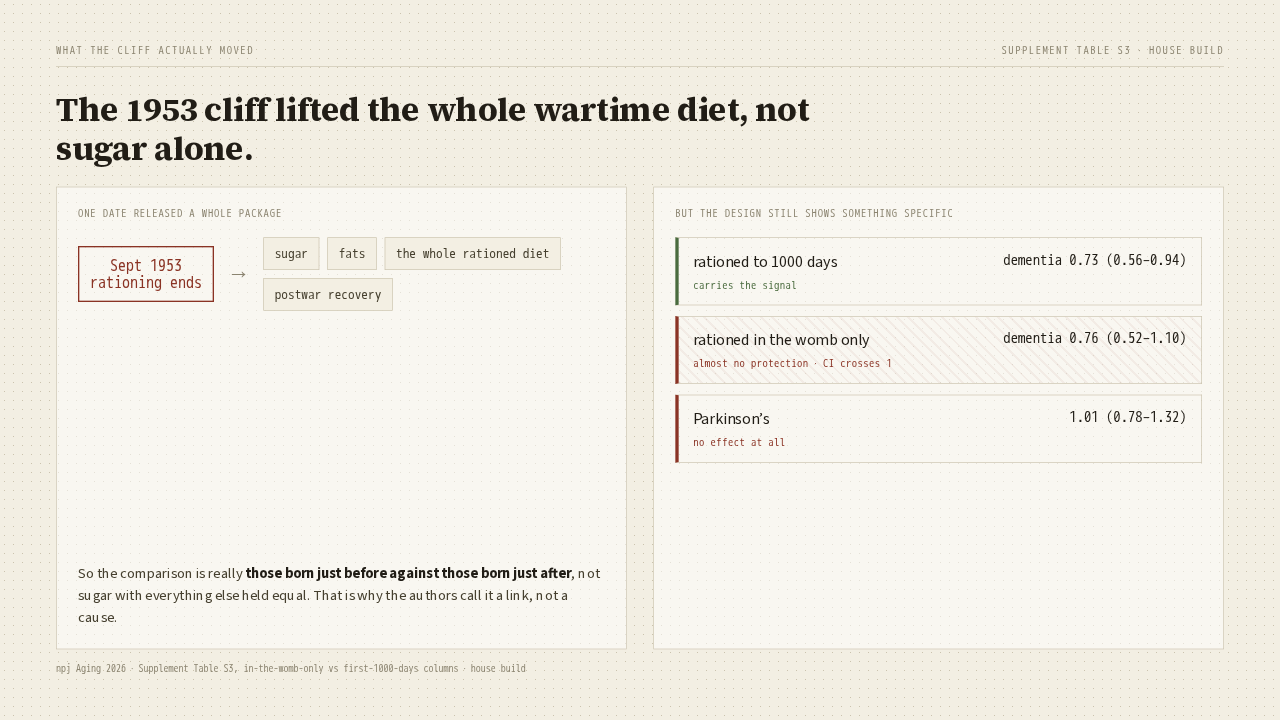
The 1953 cliff lifted the whole wartime diet, not sugar alone.
rationing ends
But that same cliff hides a catch. It didn't lift only sugar. It lifted everything at once. Sweets, yes, but also fats, the whole rationed wartime diet, and the start of Britain's recovery. So the comparison is really those born just before rationing ended against those born just after, not sugar with everything else held equal. That's why the authors call it a link, not a cause. But the study's own structure still shows something real. The protection appeared only when the restriction continued after birth. Babies rationed only in the womb showed almost no protection. And Parkinson's showed no effect at all. A blanket healthier-era story wouldn't be that specific.
Alzheimer's risk roughly halved, on about 138 cases in 60,394 people
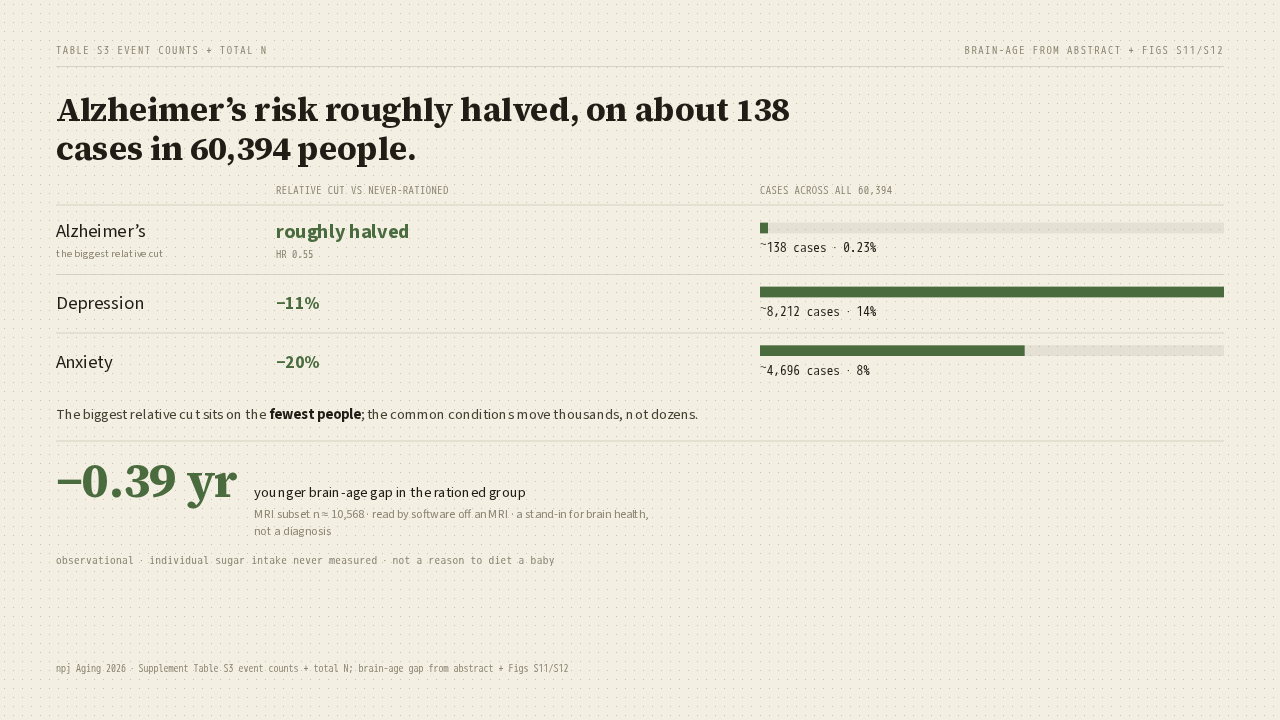
Alzheimer’s risk roughly halved, on about 138 cases in 60,394 people.
Now, put a size on it. Alzheimer's had the biggest relative cut, roughly halved. But that's half of a very small number. Across all sixty thousand people, there were only about a hundred and thirty-eight Alzheimer's cases, under a quarter of one percent. Depression and anxiety are common, so their smaller cuts move far more people, thousands, not dozens. About ten thousand of them also had brain scans, and in the rationed group those brains looked about four-tenths of a year younger than real age, measured by software that reads a brain's age off an MRI. It's real but small, a stand-in for brain health, not a diagnosis.
The next test: individual childhood-diet records, outside 1950s Britain
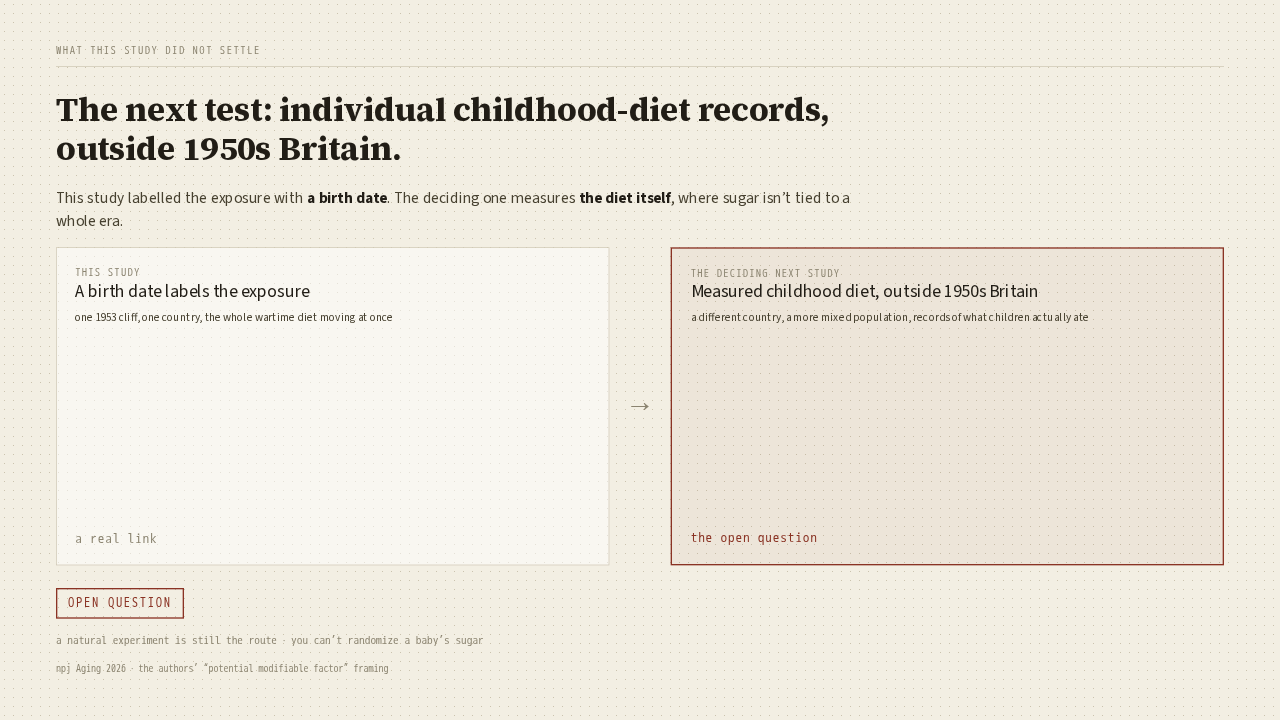
The next test: individual childhood-diet records, outside 1950s Britain.
So the study that would settle this runs the same natural experiment where sugar isn't tied to an entire era. A different country, a more mixed population, and records of what children actually ate, not a label read off a birth date. You can't randomize babies to sugar, so a natural experiment is still the route.
A link between early-life sugar and the aging brain, not a reason to change a baby's diet
A link between early-life sugar and the aging brain, drawn by an experiment history ran for us.
Babies rationed sugar in nineteen fifties Britain grew into adults with less dementia and less Alzheimer's. The study never watched anyone's plate. It read a birth date, on either side of a law that lifted a whole way of life at once. That's a real link between early-life sugar and the aging brain, but never a reason to change a baby's diet.