Six 'biological age' tests on the same 970 adults — the DNA-reading ones predicted who kept working
Six "biological age" tests on the same 970 adults: the DNA-reading ones predicted who kept their body and mind working.
Six blood tests were run on the same nine hundred and seventy adults. Each claims to read your "biological age," how old your body seems, whatever your birthday says. The researchers asked which one predicts who keeps their body and mind working with age. The DNA tests did best. The one built from inflammation signals didn't.
The DNA-reading tests tracked lower function, GrimAge strongest; the inflammation test showed no link
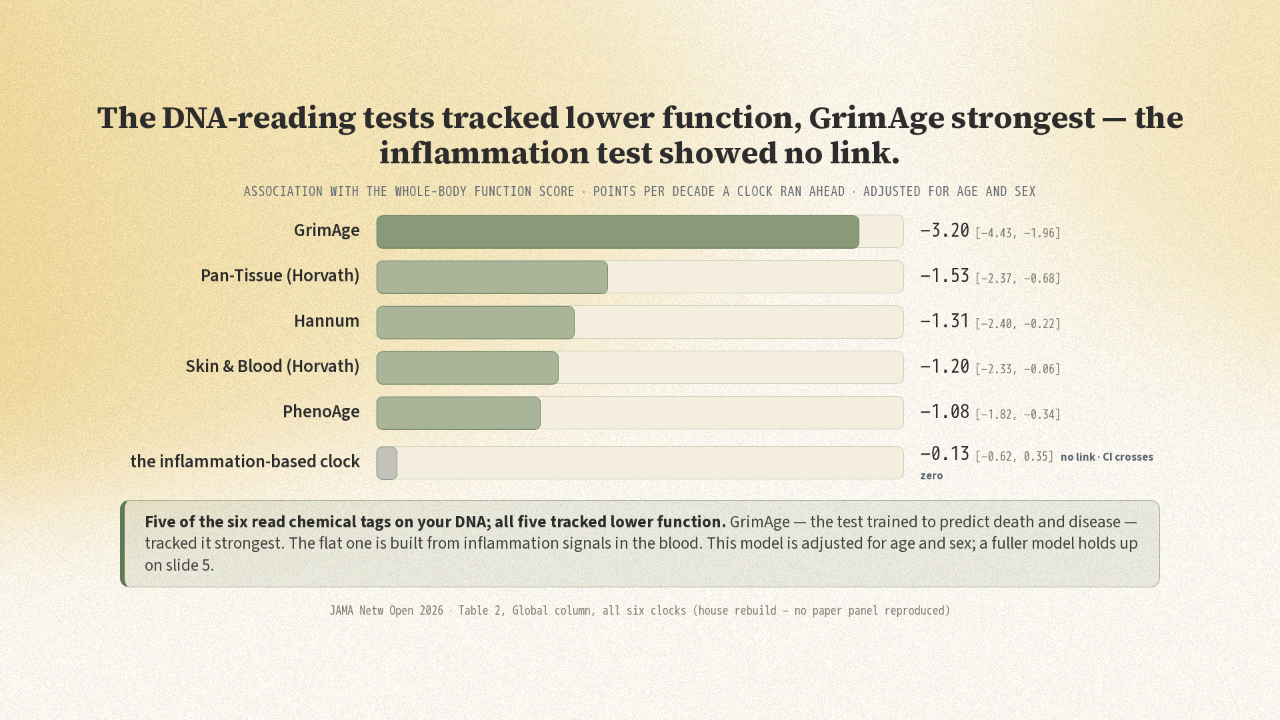
The DNA-reading tests tracked lower function, GrimAge strongest — the inflammation test showed no link.
The researchers ran all six tests on these nine hundred and seventy adults, followed for three years, against one function score, a measure of how well people walk, think, see and hear, grip, and hold their mood. Five of the tests read chemical tags on your DNA, and all five tracked lower function in people whose tests ran fast. GrimAge, the one trained to predict death and disease, tracked it strongest. The inflammation test showed no link.
The six tests disagreed — and one even flipped direction with age
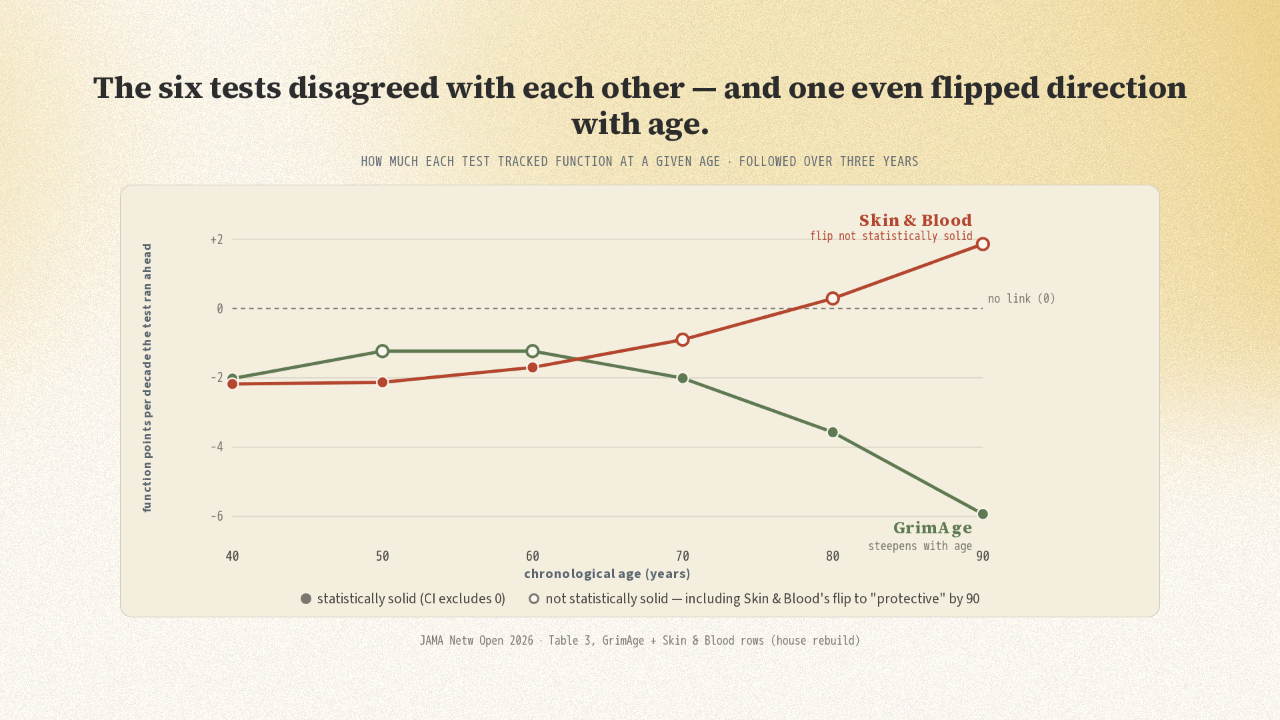
The six tests disagreed with each other — and one even flipped direction with age.
You'd expect the six tests to agree, since "your biological age" should be one number. And inflammation is famously blamed for aging, so that test should have won. But the six tests disagreed, and the inflammation one was the flat one. And one DNA test even flipped in old age, reading faster aging as slightly protective by ninety, though that flip isn't statistically solid.
A 'biological age' test is a trained guess from chemical tags on your DNA — not a reading off a dial
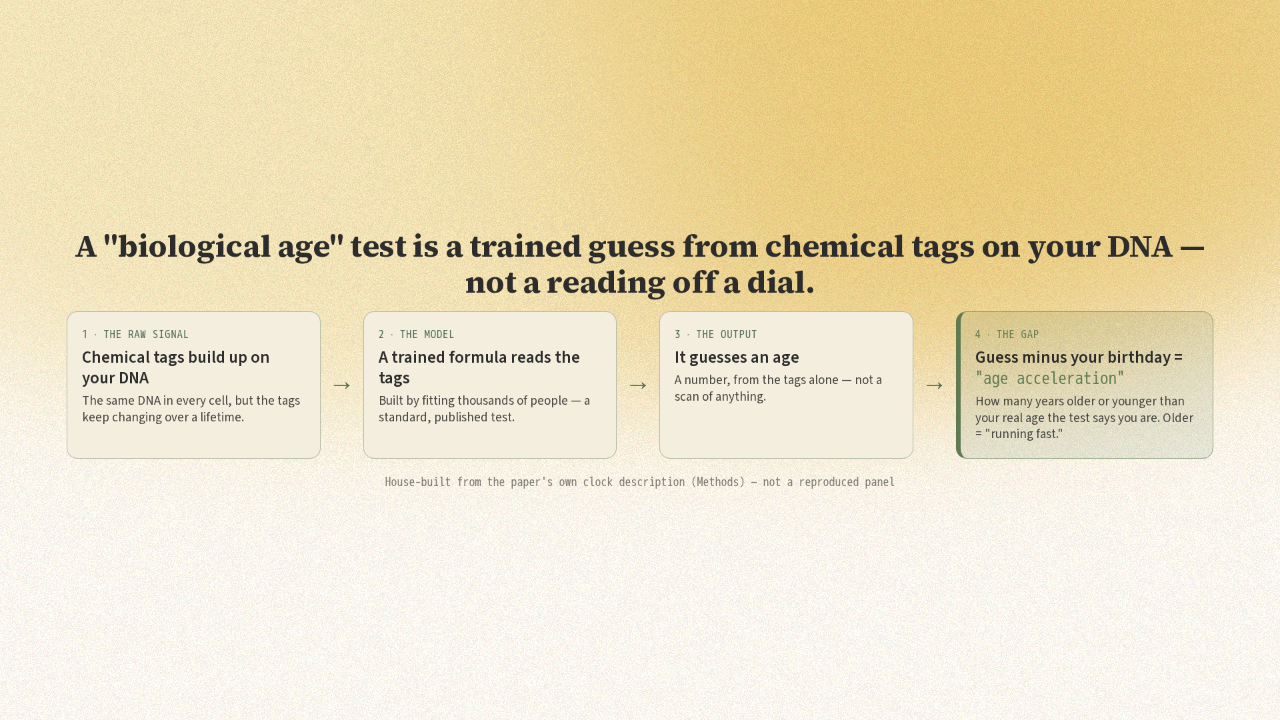
A "biological age" test is a trained guess from chemical tags on your DNA — not a reading off a dial.
Here's what one of these tests actually does. As you age, tiny chemical tags build up at specific spots along your DNA. It's the same DNA in every cell, but the tags keep changing over a lifetime. A clock is a formula the researchers trained on thousands of people. It reads those tags and guesses an age. Compare that guess to your birthday, and if it comes out older, your clock is running fast. That gap, how many years older or younger than your real age the test says you are, is all "age acceleration" means.
Each test only predicts what it was trained on — so the six disagree by design
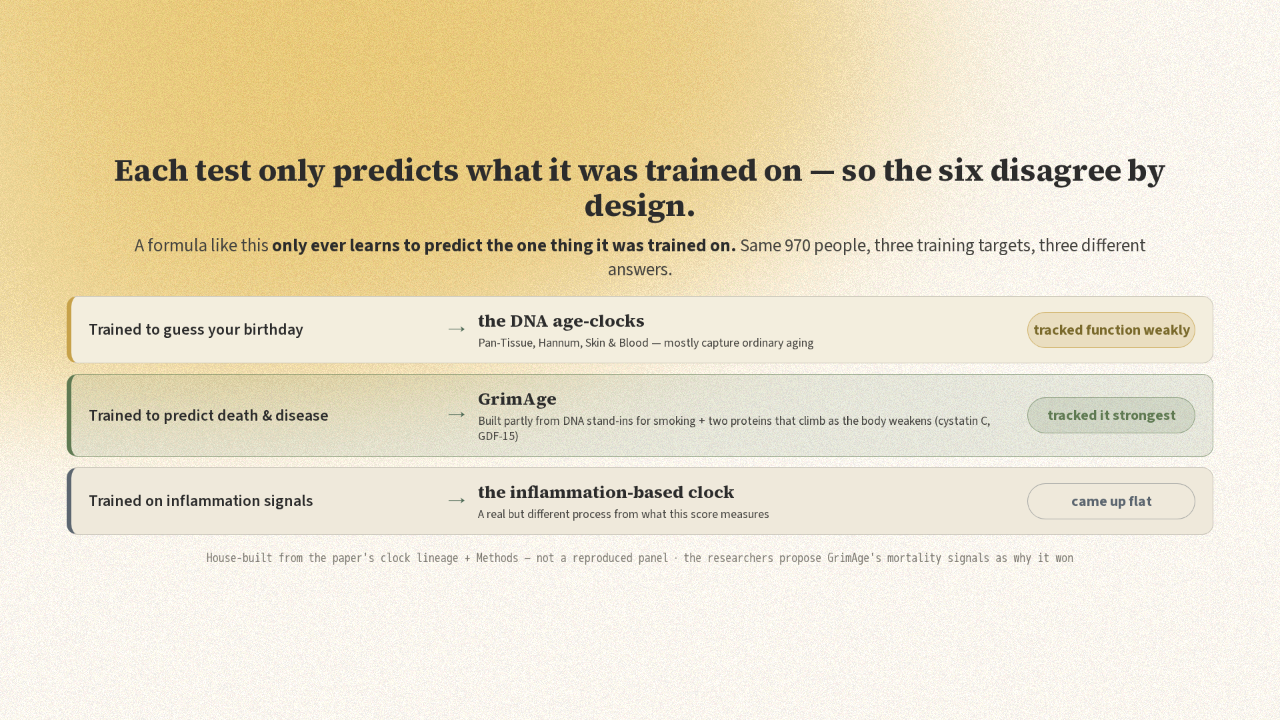
Each test only predicts what it was trained on — so the six disagree by design.
Here's why they disagree. A formula like this only ever learns to predict the one thing it was trained on. Three of the tests were trained just to guess your birthday, so they mostly capture ordinary aging, and tracked function weakly. GrimAge was trained on something different, to predict death and disease. It was built partly from DNA stand-ins for smoking and two proteins that climb as the body weakens. So it was already tuned to decline, and tracked function best. The researchers think that's why it won. The inflammation test was trained on inflammation signals, a real but different process, so here it came up flat.
For GrimAge, a decade of extra age tracked about three fewer function points, mobility hardest
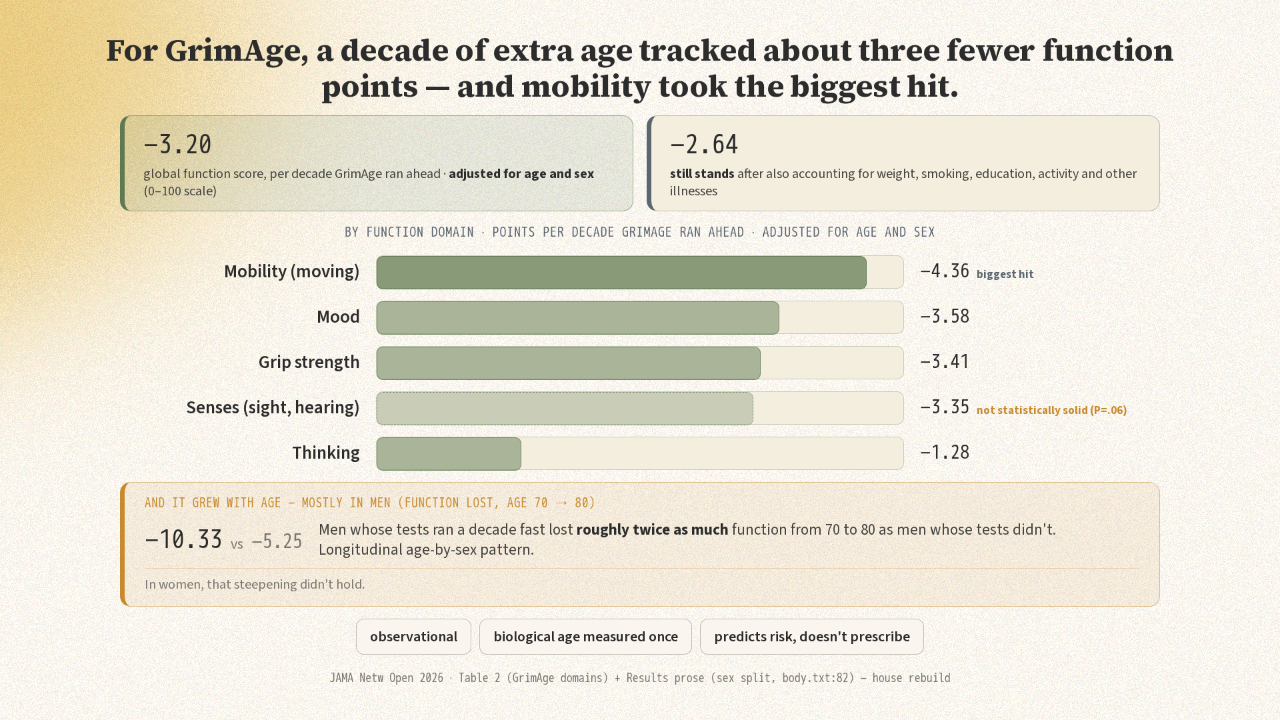
For GrimAge, a decade of extra age tracked about three fewer function points — and mobility took the biggest hit.
For GrimAge, each decade the test ran ahead of your birthday tracked about three points lower on the hundred-point function score. The link held at two point six even after accounting for weight, smoking, education and other illnesses. Mobility took the biggest hit, more than four points. The gap also grew with age, up to about six points by ninety, and mostly in men. From seventy to eighty, men whose tests ran a decade fast lost roughly twice as much function as men whose tests didn't. In women, that steepening didn't hold.
The same team's next step: a clock trained on function itself
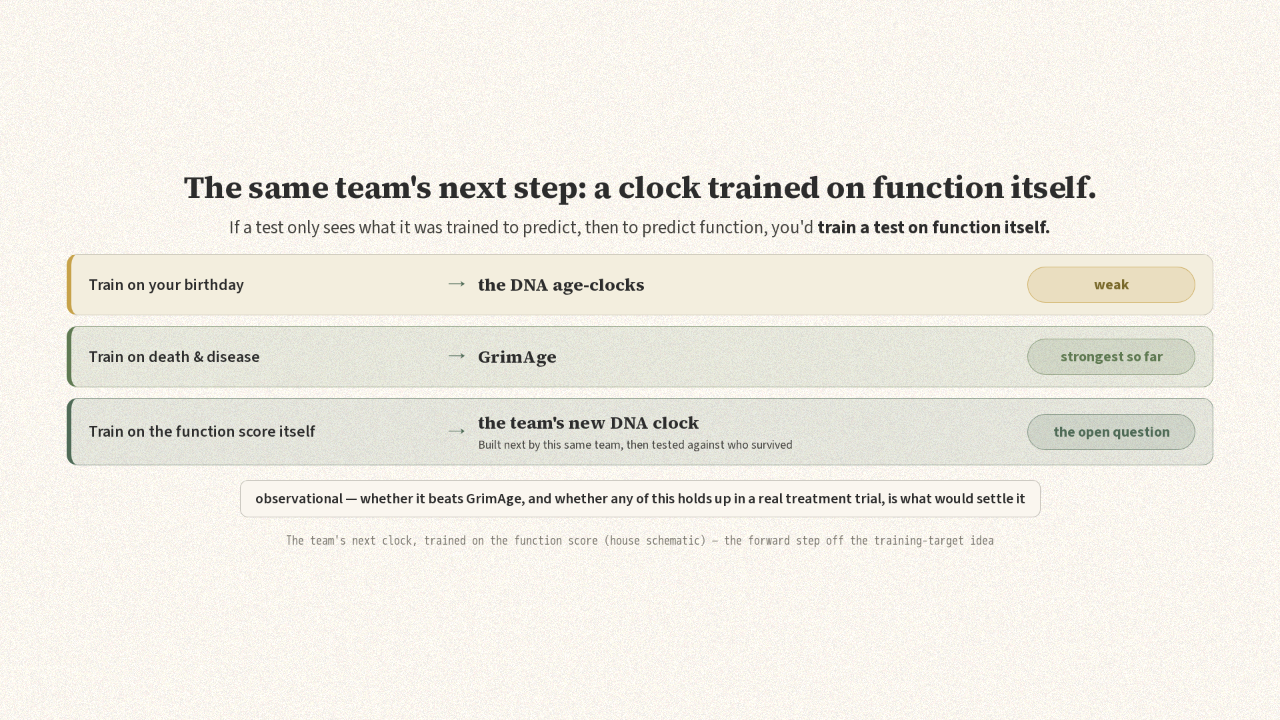
The same team's next step: a clock trained on function itself.
If a test only sees what it was trained to predict, then to predict function, you'd train a test on function itself. That's exactly what this same team did next. They built a new DNA clock trained on the function score, and tested it against who survived. Whether that function-trained test beats GrimAge, and whether any of this holds up in a real treatment trial, is what would settle it.
'Your biological age' isn't one number — it's a guess shaped by what the test was trained on
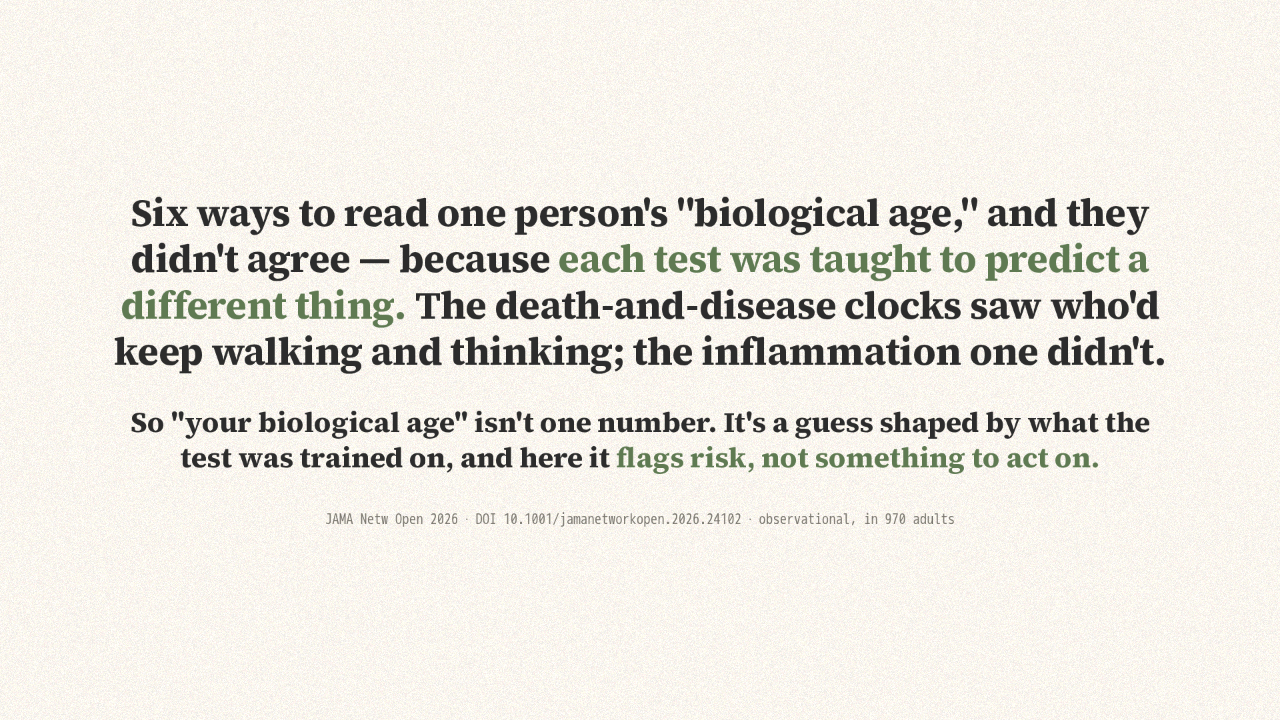
Six ways to read one person's "biological age," and they didn't agree — because each test was taught to predict a different thing. The death-and-disease clocks saw who'd keep walking and thinking; the inflammation one didn't.
Six ways to read one person's "biological age," and they didn't agree, because each test was taught to predict a different thing. The death-and-disease clocks saw who'd keep walking and thinking; the inflammation one didn't. So "your biological age" isn't one number. It's a guess shaped by what the test was trained on, and here it flags risk, not something to act on.