Cutting one of protein's building blocks by two-thirds let male mice live about 23% longer

2 months ago

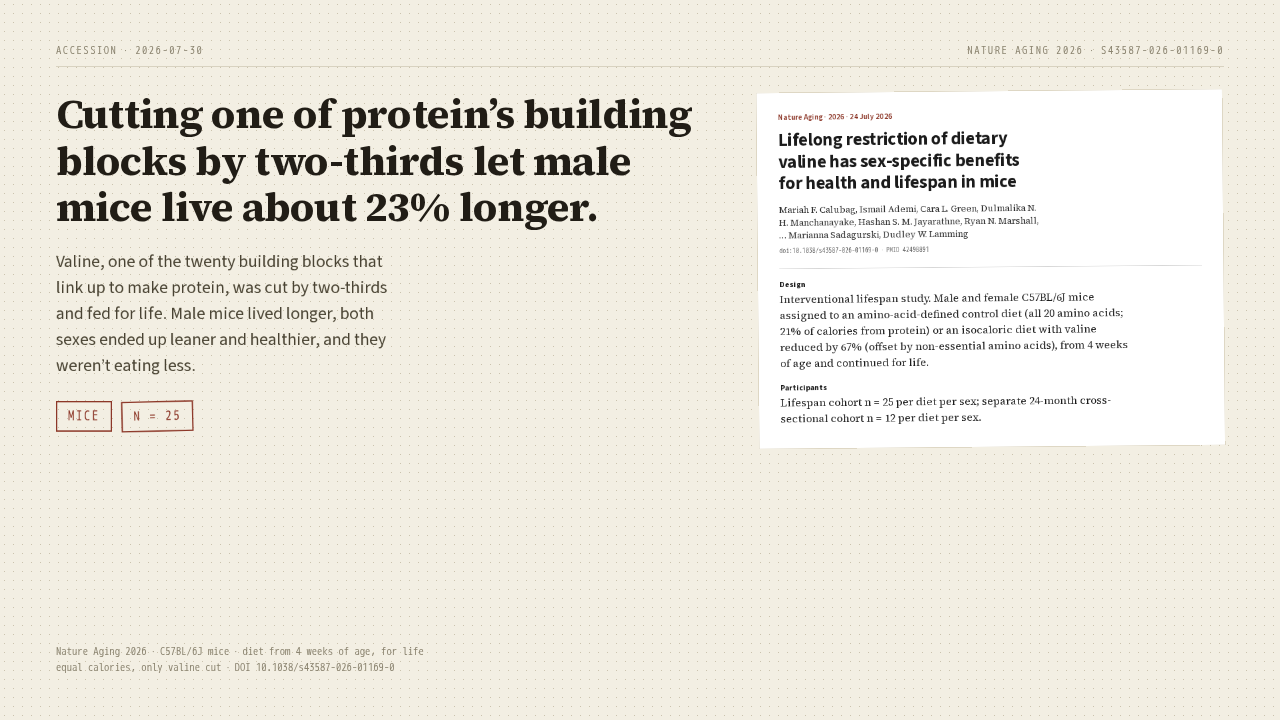
Scientists cut one of protein's building blocks by two-thirds and fed it to mice for life. The block is valine, one of the twenty that link up to make protein. Male mice lived about twenty-three percent longer. And not because they ate less.

Ask

Ask about this presentation

Answers are generated from this presentation.

Chapters

  1. 0:00Cutting one of protein's building blocks by two-thirds let male mice live about 23% longer
  2. 0:12Cut valine by two-thirds on equal calories, and male mice lived about 23% longer
  3. 0:38The valine mice ate more and burned more, so the longer life wasn't hidden dieting
  4. 0:59The proposed engine: in the male liver, the same power plants each burned fuel harder
  5. 1:30The famous 'less protein, less growth' route went the wrong way here
  6. 2:01Male mice lived about 23% longer at the median, and the lifespan gain was males only
  7. 2:32The test that would matter for people: start the cut in adulthood, in genetically varied mice
  8. 2:55A longer, healthier life that didn't come from eating less, or from the famous less-protein route
Show transcript

Cutting one of protein's building blocks by two-thirds let male mice live about 23% longer

Accession · 2026-07-30 Nature Aging 2026 · s43587-026-01169-0

Cutting one of protein’s building blocks by two-thirds let male mice live about 23% longer.

Valine, one of the twenty building blocks that link up to make protein, was cut by two-thirds and fed for life. Male mice lived longer, both sexes ended up leaner and healthier, and they weren’t eating less.

Mice n = 25
Nature Aging 2026 · C57BL/6J mice · diet from 4 weeks of age, for life
equal calories, only valine cut · DOI 10.1038/s43587-026-01169-0
Nature Aging · 2026 · 24 July 2026

Lifelong restriction of dietary valine has sex-specific benefits for health and lifespan in mice

Mariah F. Calubag, Ismail Ademi, Cara L. Green, Dulmalika N. H. Manchanayake, Hashan S. M. Jayarathne, Ryan N. Marshall, … Marianna Sadagurski, Dudley W. Lamming
doi:10.1038/s43587-026-01169-0 · PMID 42498891
Design
Interventional lifespan study. Male and female C57BL/6J mice assigned to an amino-acid-defined control diet (all 20 amino acids; 21% of calories from protein) or an isocaloric diet with valine reduced by 67% (offset by non-essential amino acids), from 4 weeks of age and continued for life.
Participants
Lifespan cohort n = 25 per diet per sex; separate 24-month cross-sectional cohort n = 12 per diet per sex.

Scientists cut one of protein's building blocks by two-thirds and fed it to mice for life. The block is valine, one of the twenty that link up to make protein. Male mice lived about twenty-three percent longer. And not because they ate less.

Cut valine by two-thirds on equal calories, and male mice lived about 23% longer

Nature Aging 2026 · Fig 6 survival · Source Data

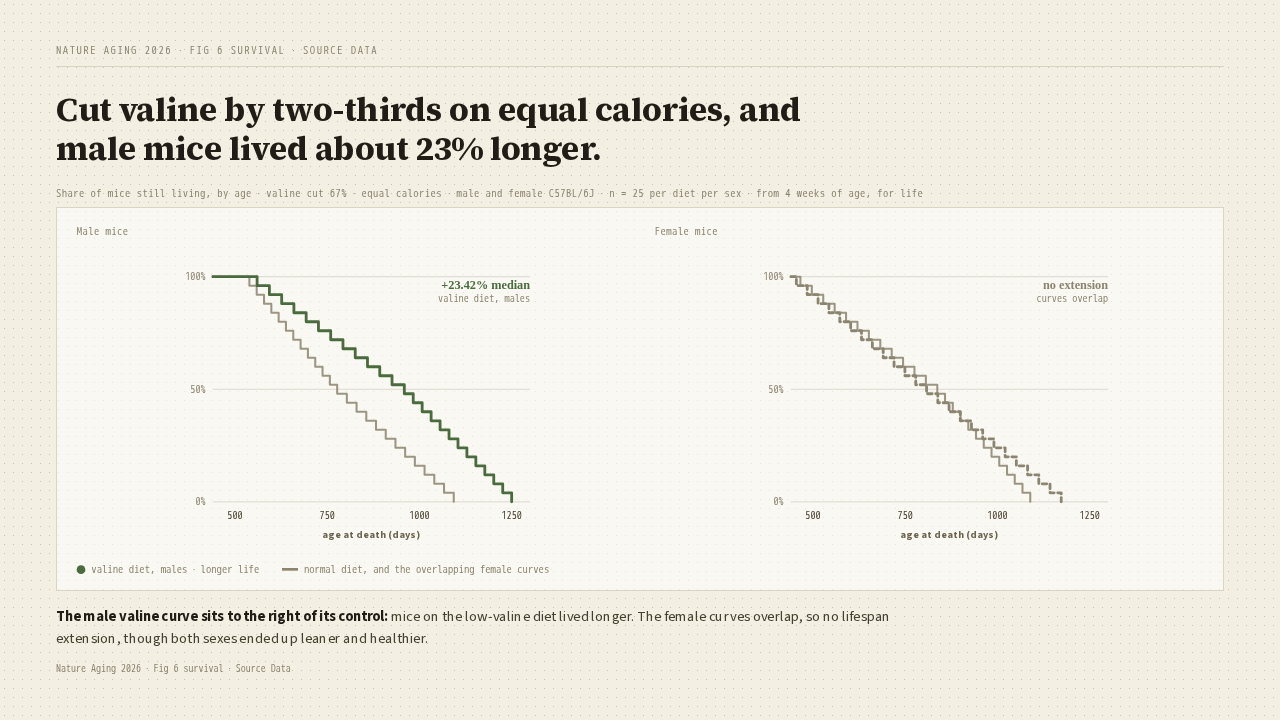
Cut valine by two-thirds on equal calories, and male mice lived about 23% longer.

Share of mice still living, by age · valine cut 67% · equal calories · male and female C57BL/6J · n = 25 per diet per sex · from 4 weeks of age, for life
Male mice
100% 50% 0% 500 750 1000 1250 age at death (days) +23.42% median valine diet, males
Female mice
100% 50% 0% 500 750 1000 1250 age at death (days) no extension curves overlap
valine diet, males · longer life normal diet, and the overlapping female curves
The male valine curve sits to the right of its control: mice on the low-valine diet lived longer. The female curves overlap, so no lifespan extension, though both sexes ended up leaner and healthier.
Nature Aging 2026 · Fig 6 survival · Source Data

We're all told to eat more protein as we age. Here, researchers cut one piece of it instead. They fed mice a diet with valine cut by two-thirds. Valine is one of three building blocks that gym supplements are built around. The diet kept the same calories as normal food. Only the valine was low, offset by other building blocks. The male mice lived about twenty-three percent longer. The females didn't, but both sexes ended up leaner and healthier.

The valine mice ate more and burned more, so the longer life wasn't hidden dieting

Nature Aging 2026 · Fig 2 · Source Data

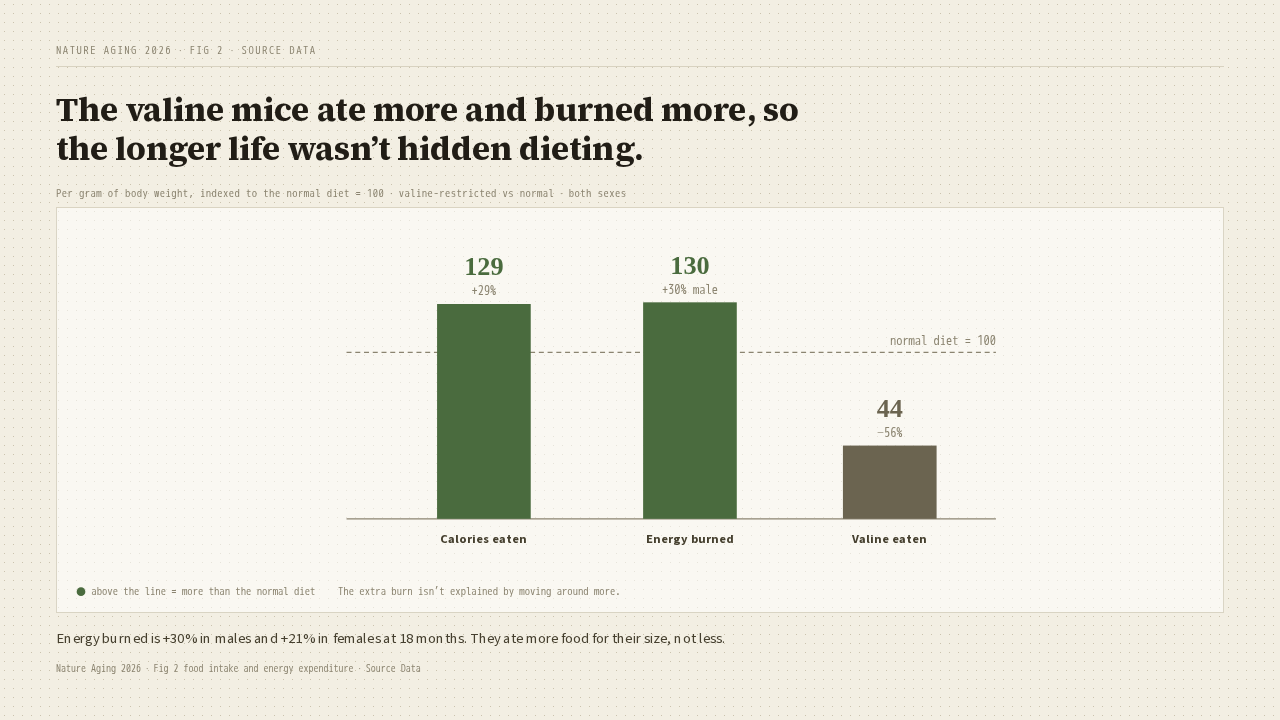
The valine mice ate more and burned more, so the longer life wasn’t hidden dieting.

Per gram of body weight, indexed to the normal diet = 100 · valine-restricted vs normal · both sexes
normal diet = 100 129 +29% Calories eaten 44 −56% Valine eaten 130 +30% male Energy burned
above the line = more than the normal diet The extra burn isn’t explained by moving around more.
Energy burned is +30% in males and +21% in females at 18 months. They ate more food for their size, not less.
Nature Aging 2026 · Fig 2 food intake and energy expenditure · Source Data

You'd assume these mice simply ate less. When an animal ends up leaner and longer-lived, that's usually why: it ate fewer calories. Eating less is the most reliable way to make a lab animal live longer. But these mice weren't eating less. For their size, they ate more food and burned more energy. So the longer life wasn't hidden dieting. Something inside had changed.

The proposed engine: in the male liver, the same power plants each burned fuel harder

Nature Aging 2026 · Fig 8 liver mitochondria · Source Data

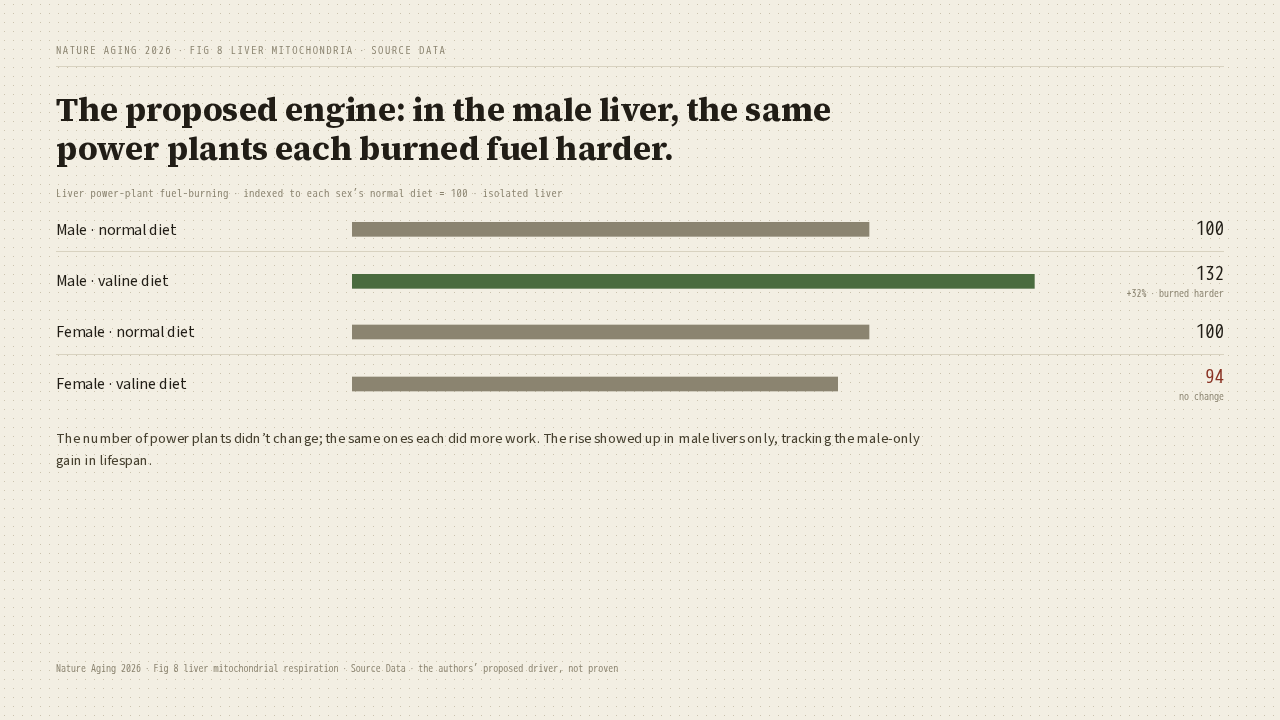
The proposed engine: in the male liver, the same power plants each burned fuel harder.

Liver power-plant fuel-burning · indexed to each sex’s normal diet = 100 · isolated liver
Male · normal diet
100
Male · valine diet
132+32% · burned harder
Female · normal diet
100
Female · valine diet
94no change
The number of power plants didn’t change; the same ones each did more work. The rise showed up in male livers only, tracking the male-only gain in lifespan.
Nature Aging 2026 · Fig 8 liver mitochondrial respiration · Source Data · the authors’ proposed driver, not proven

So if they weren't eating less, what changed? Every cell holds tiny power plants called mitochondria. They turn food into usable energy. The liver is packed with them. In the valine males, the authors found the liver's power plants were burning fuel harder, running hotter. But the mice hadn't grown any more of them. The same number of power plants were each doing more work. And this showed up in males only, tracking the male-only gain in lifespan. The authors propose this is the engine behind it. Whether it truly caused the longer life, they say, still has to be worked out.

The famous 'less protein, less growth' route went the wrong way here

Nature Aging 2026 · Discussion + Extended Data

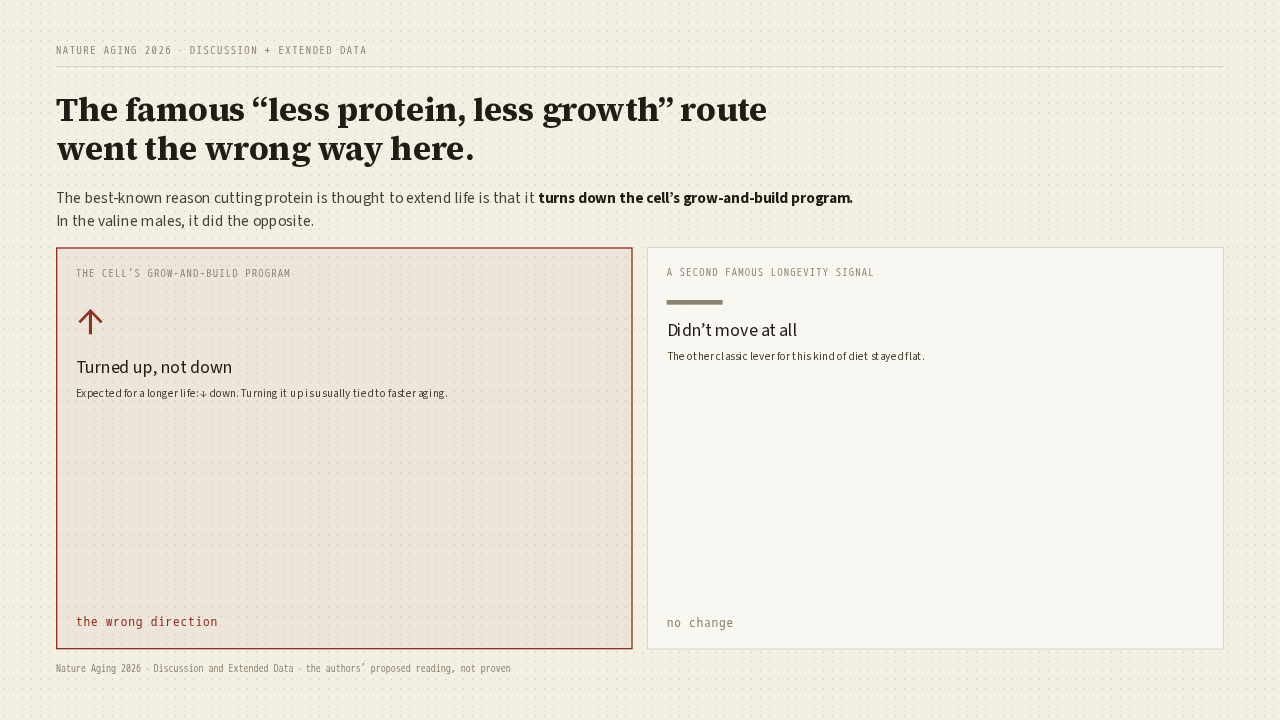
The famous “less protein, less growth” route went the wrong way here.

The best-known reason cutting protein is thought to extend life is that it turns down the cell’s grow-and-build program. In the valine males, it did the opposite.
The cell’s grow-and-build program
↑
Turned up, not downExpected for a longer life: ↓ down. Turning it up is usually tied to faster aging.
the wrong direction
A second famous longevity signal
Didn’t move at allThe other classic lever for this kind of diet stayed flat.
no change
Nature Aging 2026 · Discussion and Extended Data · the authors’ proposed reading, not proven

Now the part that surprised the authors. There's a famous explanation for why eating less protein extends life. It's supposed to turn down the cell's grow-and-build program, one of the best-known longevity levers. Here, it went the wrong way. In the valine males, that program was turned up, not down. That's a change usually tied to faster aging. And a second famous longevity signal didn't move at all. So the longer life didn't run on the textbook route. The authors say it's unlikely the grow-and-build change is helping. They point to the liver's power plants instead.

Male mice lived about 23% longer at the median, and the lifespan gain was males only

Nature Aging 2026 · Fig 6 · Source Data male mice · from 4 weeks of age

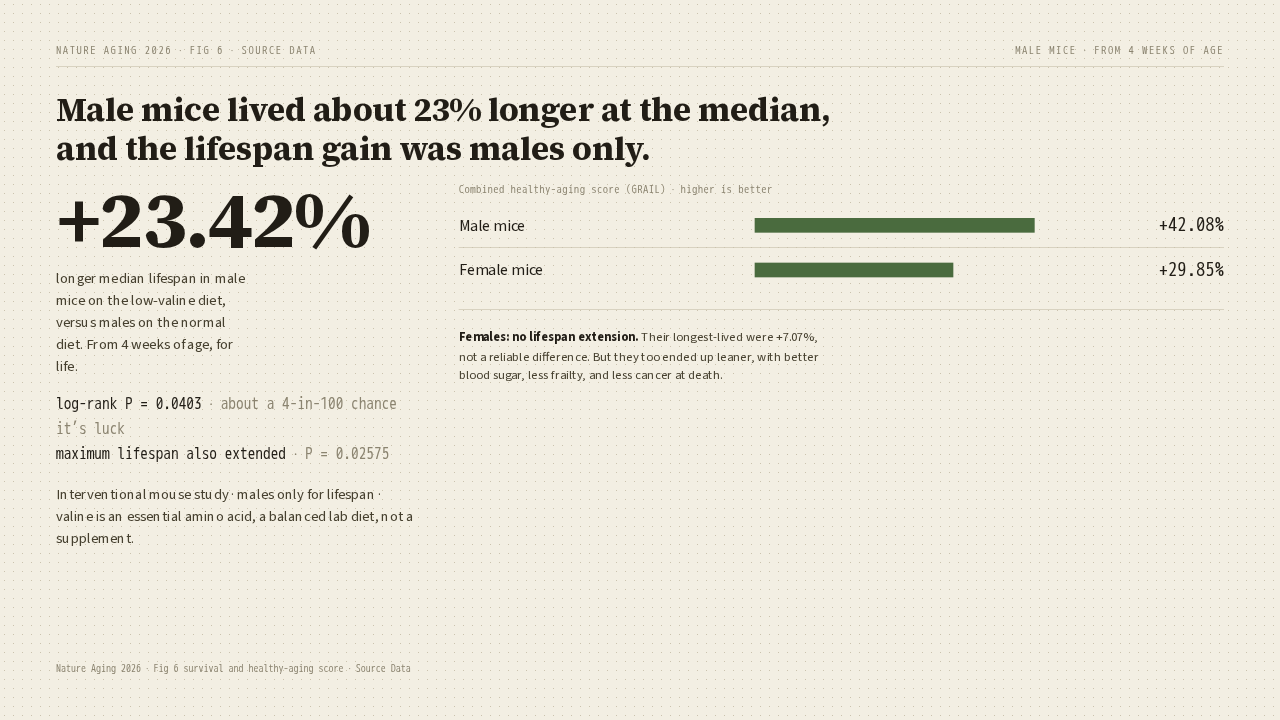
Male mice lived about 23% longer at the median, and the lifespan gain was males only.

+23.42%
longer median lifespan in male mice on the low-valine diet, versus males on the normal diet. From 4 weeks of age, for life.
log-rank P = 0.0403 · about a 4-in-100 chance it’s luck
maximum lifespan also extended · P = 0.02575
Interventional mouse study · males only for lifespan · valine is an essential amino acid, a balanced lab diet, not a supplement.
Combined healthy-aging score (GRAIL) · higher is better
Male mice
+42.08%
Female mice
+29.85%
Females: no lifespan extension. Their longest-lived were +7.07%, not a reliable difference. But they too ended up leaner, with better blood sugar, less frailty, and less cancer at death.
Nature Aging 2026 · Fig 6 survival and healthy-aging score · Source Data

Now put a size on it. The valine-restricted males lived about twenty-three percent longer at the median than males on the normal diet. That gap is unlikely to be chance: the survival curves separate with about a four-in-a-hundred probability. Their maximum lifespan stretched too. On a combined healthy-aging score, males scored about forty-two percent higher, females about thirty. But the extra lifespan was in males only. The females still got healthier: leaner, better blood sugar, less frailty, less cancer. They just didn't live longer.

The test that would matter for people: start the cut in adulthood, in genetically varied mice

The authors’ stated next step open question

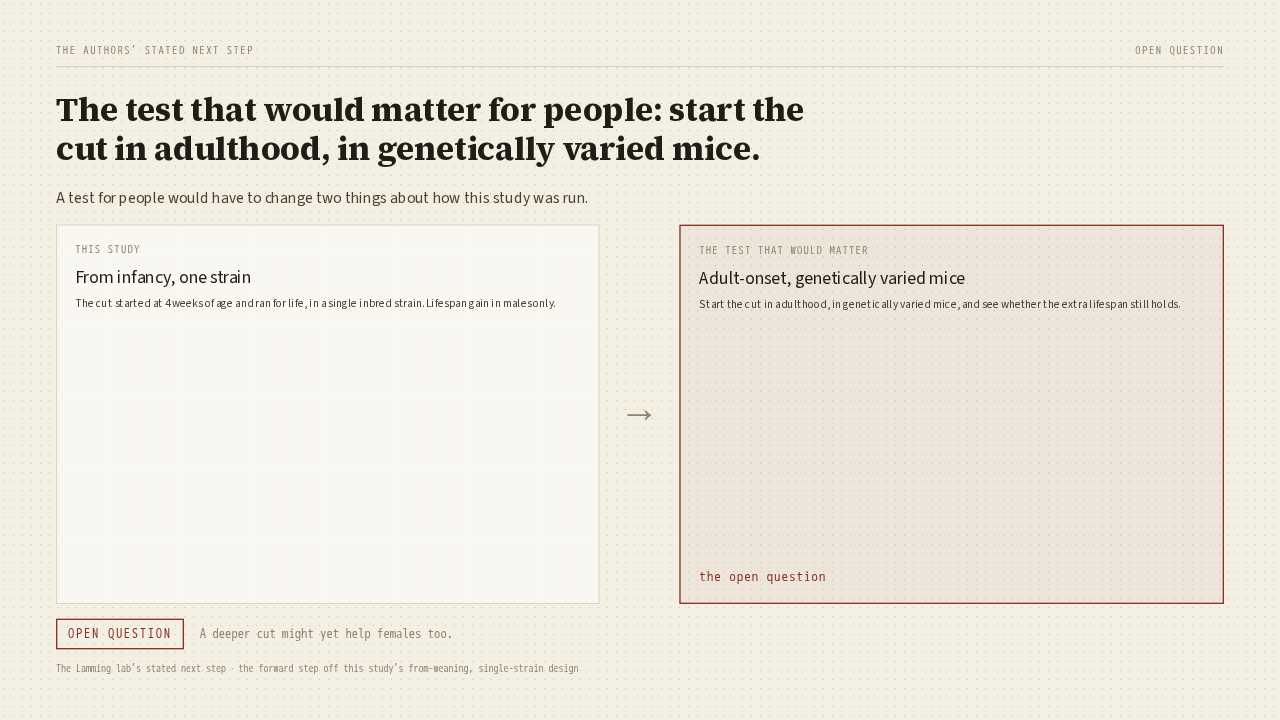
The test that would matter for people: start the cut in adulthood, in genetically varied mice.

A test for people would have to change two things about how this study was run.
This study
From infancy, one strainThe cut started at 4 weeks of age and ran for life, in a single inbred strain. Lifespan gain in males only.
→
The test that would matter
Adult-onset, genetically varied miceStart the cut in adulthood, in genetically varied mice, and see whether the extra lifespan still holds.
the open question
Open question A deeper cut might yet help females too.
The Lamming lab’s stated next step · the forward step off this study’s from-weaning, single-strain design

These mice started the valine cut in infancy and stayed on it for life. So some of the benefit might be an early-life effect. And they were all one genetic strain. The Lamming lab, who ran this study, names the real test for people. Start the cut in adulthood, in genetically varied mice. See if the extra lifespan still holds. A deeper cut might yet help females too.

A longer, healthier life that didn't come from eating less, or from the famous less-protein route

Accession · 2026-07-30 · closed Nature Aging 2026

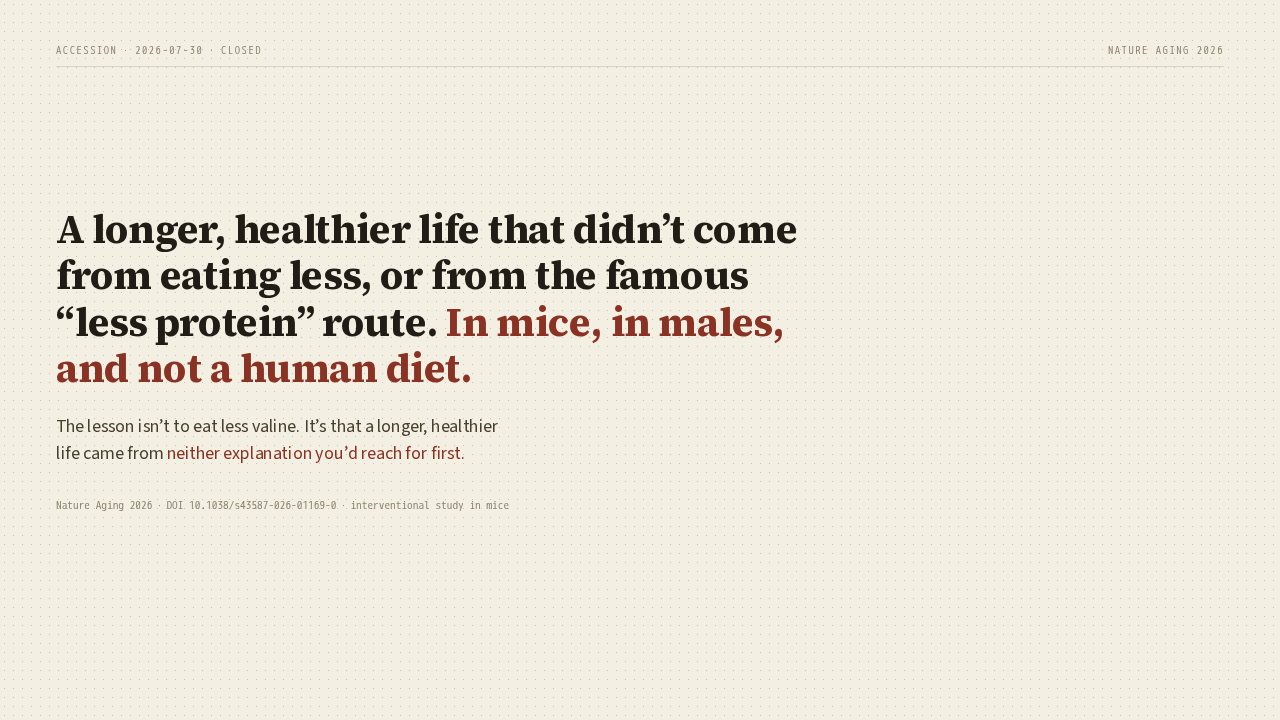
A longer, healthier life that didn’t come from eating less, or from the famous “less protein” route. In mice, in males, and not a human diet.

The lesson isn’t to eat less valine. It’s that a longer, healthier life came from neither explanation you’d reach for first.
Nature Aging 2026 · DOI 10.1038/s43587-026-01169-0 · interventional study in mice

The researchers cut one of protein's building blocks by two-thirds, and male mice lived longer. Not by eating less, and not through the textbook less-protein route. The lesson isn't to eat less valine. It's that a longer, healthier life came from neither explanation you'd reach for first. In mice, in males, and not yet a diet for people.