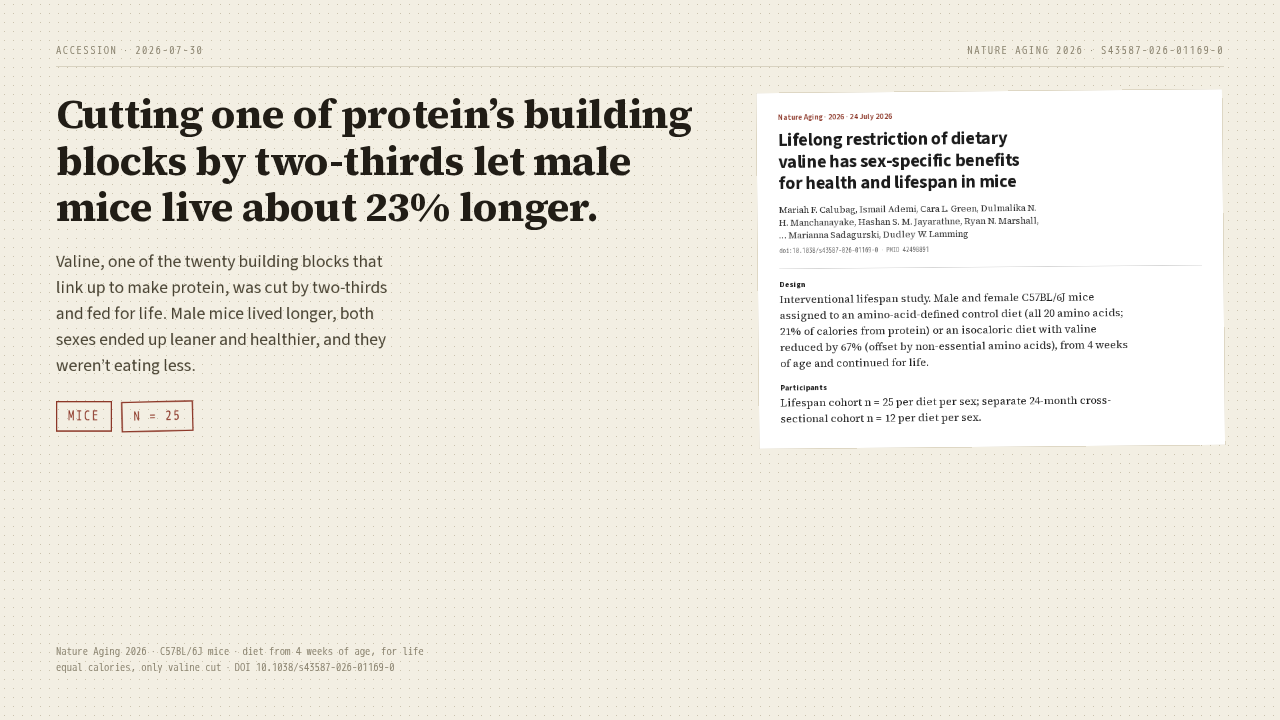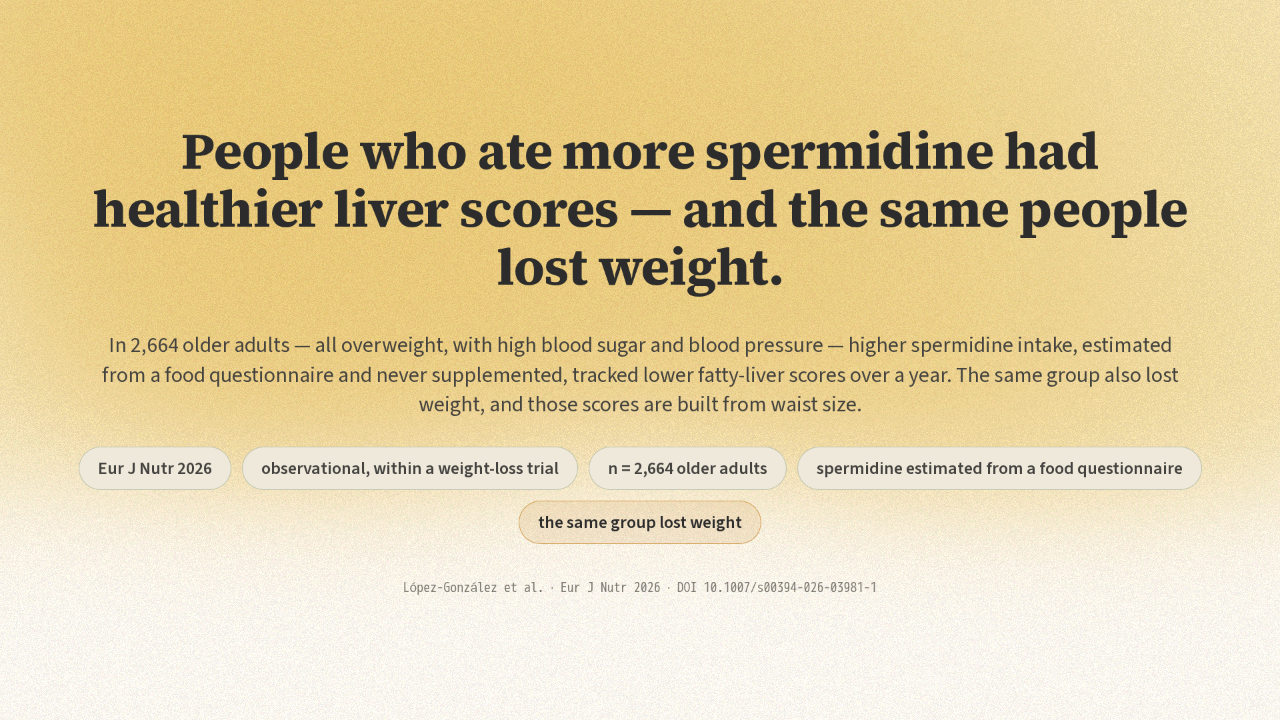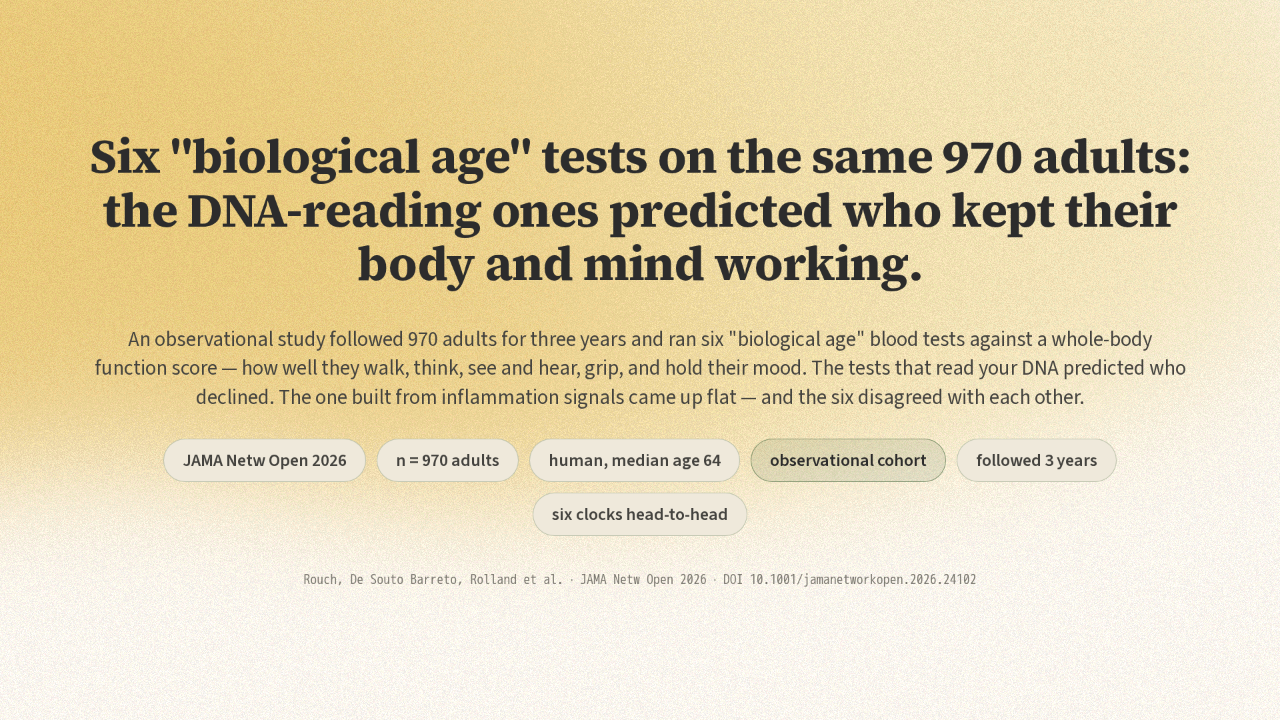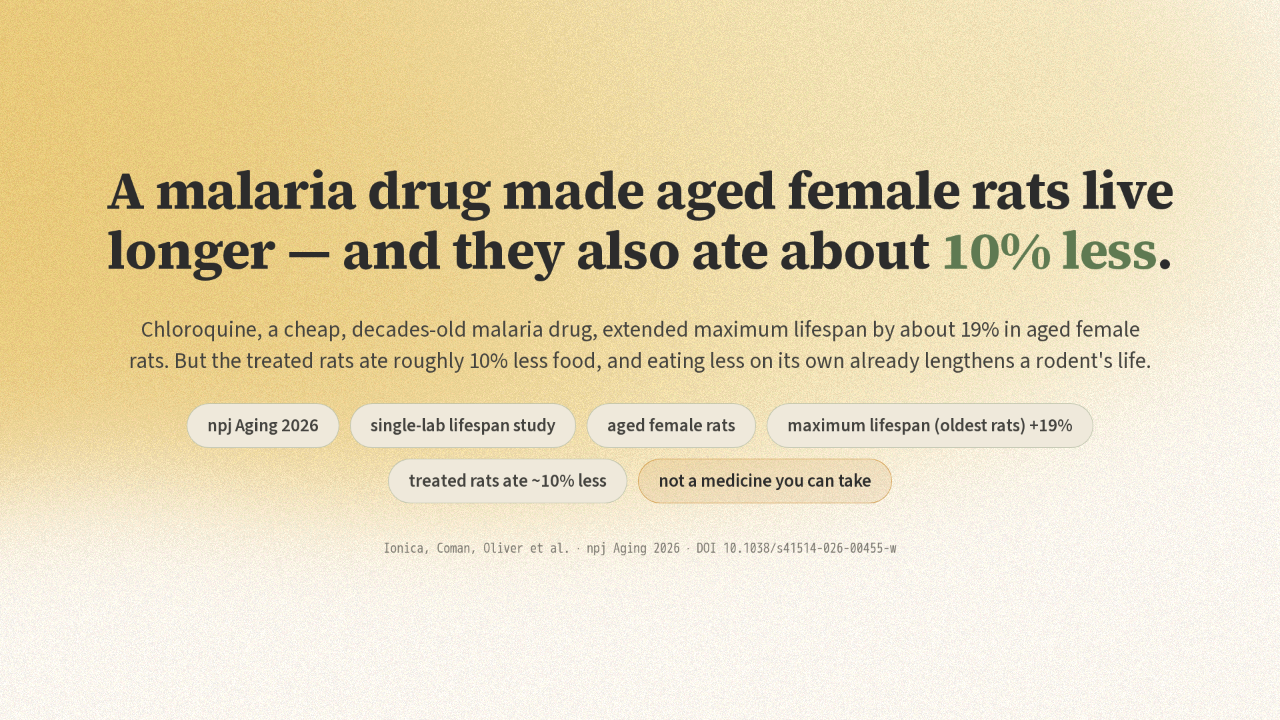
Aging organs aren't worn out. In mice, 'zombie' cells piled up.

2 months ago

Our organs seem to age all together. We picture that as parts wearing out. But in aged mice, one change to the immune system moved the brain, heart, muscle and fat back toward youth at once. This looks less like wear and tear, and more like a cleanup crew that quit.

Ask

Ask about this presentation

Answers are generated from this presentation.

Chapters

  1. 0:00Aging organs aren't worn out. In mice, 'zombie' cells piled up.
  2. 0:15One change to the cleanup crew. Five organs moved toward youth.
  3. 0:37Aging you can't square with wear and tear.
  4. 0:57Every organ keeps a cleanup crew. Aging jams its brake.
  5. 1:34Release the brake two ways. The cleanup comes back.
  6. 2:06The clearest proof: the crew fails at the zombies, then recovers.
  7. 2:33The same brake is already jammed in aging human organs.
  8. 2:57In these aged mice, some of what looked like organs wearing out was a cleanup crew held back by a single brake — release it, and the crew went back to work.
Show transcript

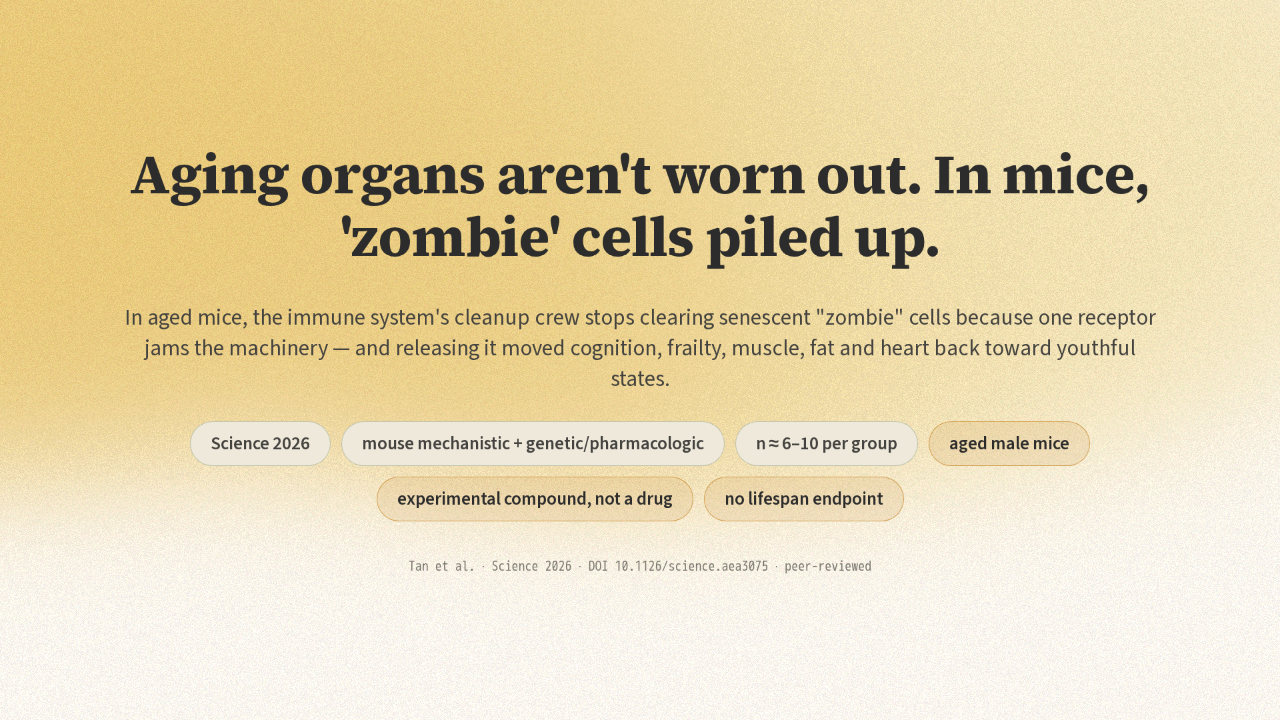
Aging organs aren't worn out. In mice, 'zombie' cells piled up.

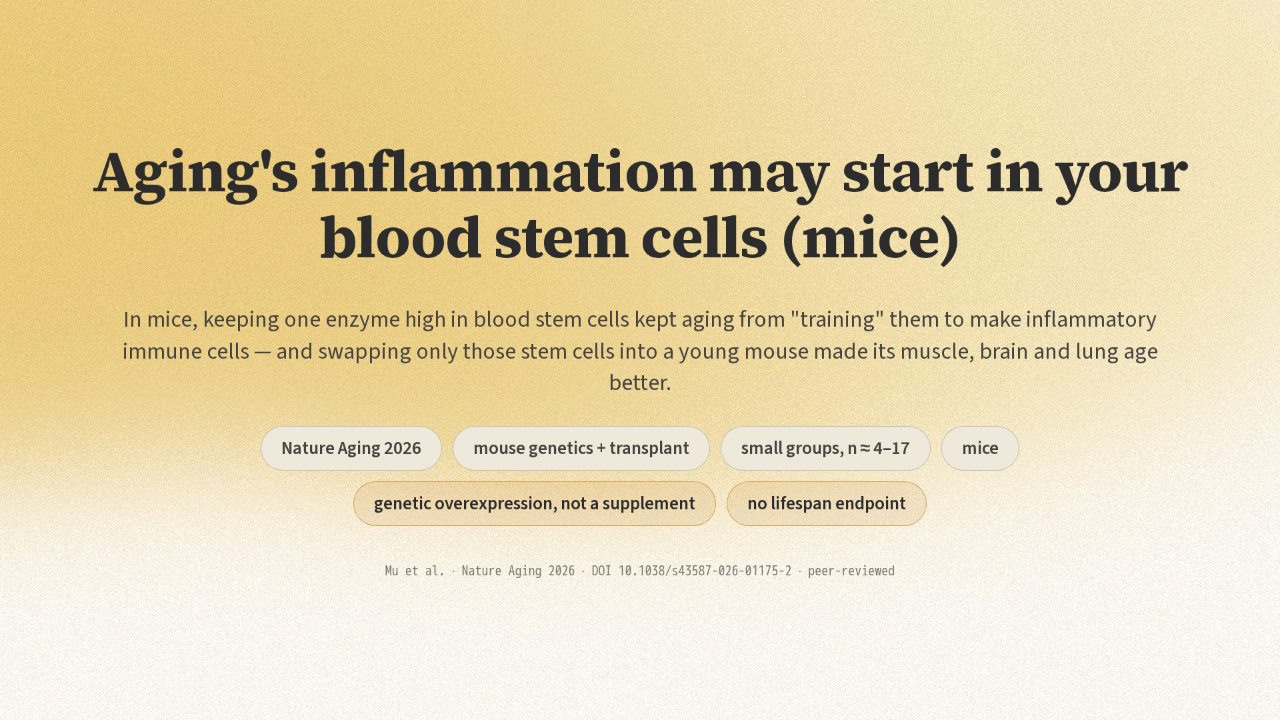
In aged mice, the immune system's cleanup crew stops clearing senescent "zombie" cells because one receptor jams the machinery — and releasing it moved cognition, frailty, muscle, fat and heart back toward youthful states.
Science 2026 mouse mechanistic + genetic/pharmacologic n ≈ 6–10 per group aged male mice experimental compound, not a drug no lifespan endpoint
Tan et al. · Science 2026 · DOI 10.1126/science.aea3075 · peer-reviewed

Our organs seem to age all together. We picture that as parts wearing out. But in aged mice, one change to the immune system moved the brain, heart, muscle and fat back toward youth at once. This looks less like wear and tear, and more like a cleanup crew that quit.

One change to the cleanup crew. Five organs moved toward youth.

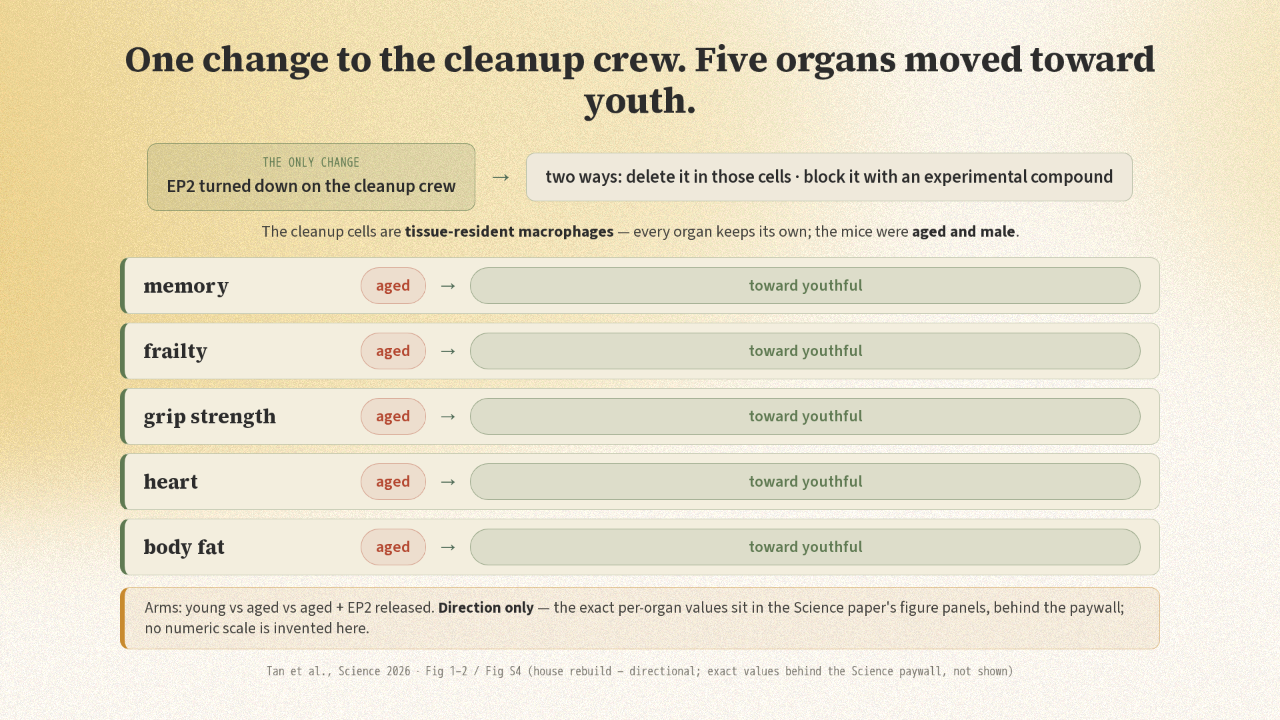
the only changeEP2 turned down on the cleanup crew → two ways: delete it in those cells · block it with an experimental compound
The cleanup cells are tissue-resident macrophages — every organ keeps its own; the mice were aged and male.
memory
aged→toward youthful
frailty
aged→toward youthful
grip strength
aged→toward youthful
heart
aged→toward youthful
body fat
aged→toward youthful
Arms: young vs aged vs aged + EP2 released. Direction only — the exact per-organ values sit in the Science paper's figure panels, behind the paywall; no numeric scale is invented here.
Tan et al., Science 2026 · Fig 1–2 / Fig S4 (house rebuild — directional; exact values behind the Science paywall, not shown)

Here's what they did. In aged male mice, they turned down one receptor, called EP2, on the immune system's cleanup cells. Those cells are tissue-resident macrophages. They did it two ways. They deleted EP2 in those cells, and they blocked it with an experimental compound. Either way, the mice's memory, frailty, grip strength, body fat and heart all moved toward youthful states.

Aging you can't square with wear and tear.

The intuition
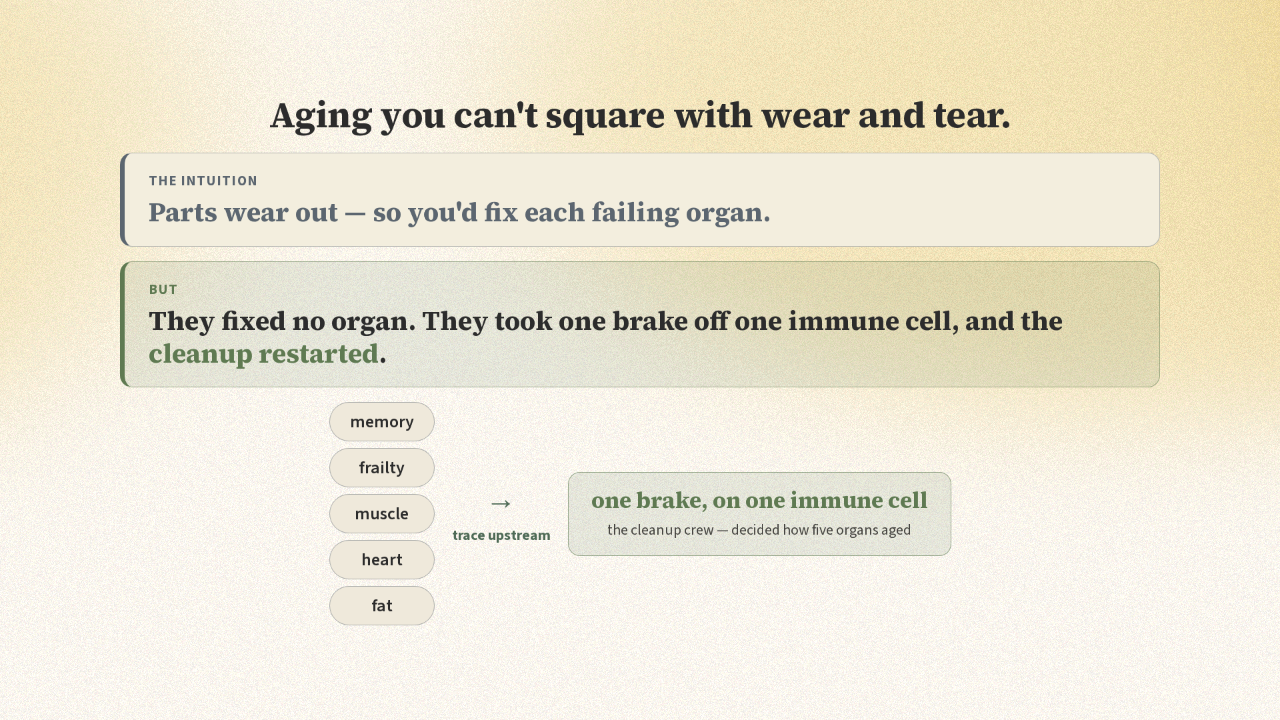
Parts wear out — so you'd fix each failing organ.
But
They fixed no organ. They took one brake off one immune cell, and the cleanup restarted.
memory
frailty
muscle
heart
fat
→trace upstream
one brake, on one immune cell
the cleanup crew — decided how five organs aged

Think about how we picture aging. Parts wear out. You'd fix each failing organ. But they fixed no organ. They took one brake off one kind of immune cell. And the brain, heart, muscle and fat all moved back toward youth together. Wear and tear can't do that. It points to a cleanup that stopped.

Every organ keeps a cleanup crew. Aging jams its brake.

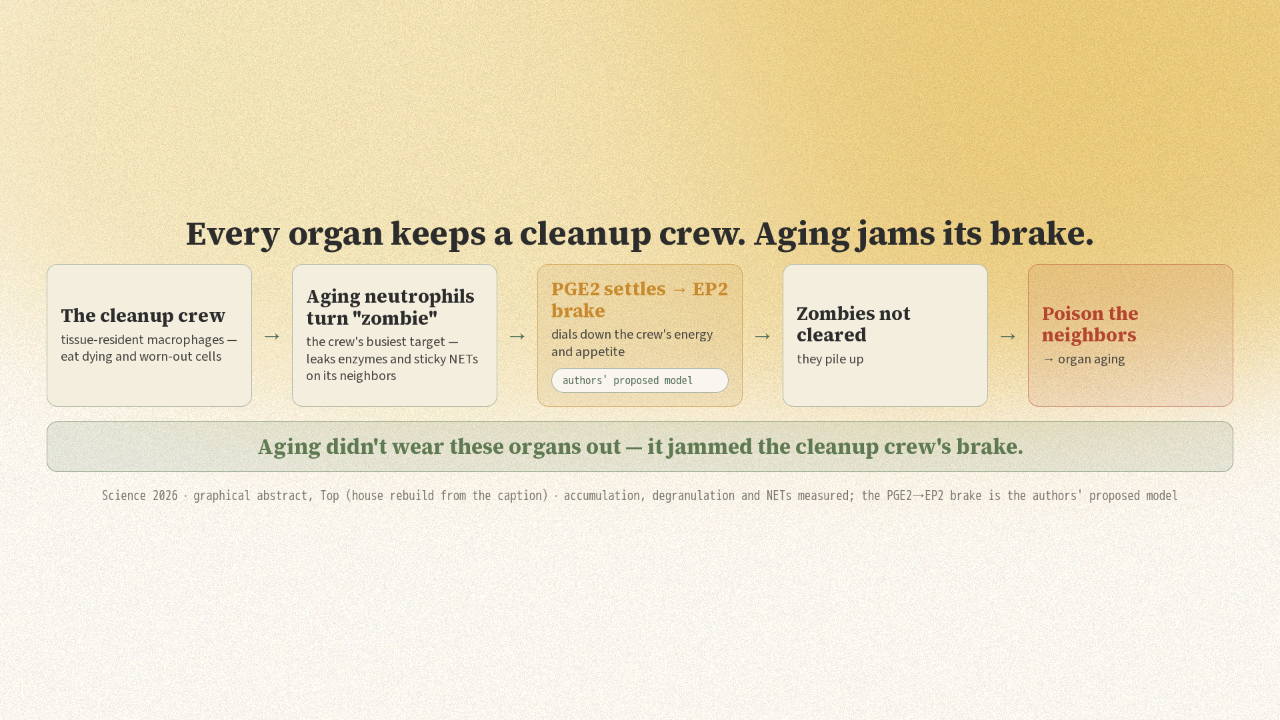
The cleanup crew
tissue-resident macrophages — eat dying and worn-out cells
→
Aging neutrophils turn "zombie"
the crew's busiest target — leaks enzymes and sticky NETs on its neighbors
→
PGE2 settles → EP2 brake
dials down the crew's energy and appetite
authors' proposed model
→
Zombies not cleared
they pile up
→
Poison the neighbors
→ organ aging
Aging didn't wear these organs out — it jammed the cleanup crew's brake.
Science 2026 · graphical abstract, Top (house rebuild from the caption) · accumulation, degranulation and NETs measured; the PGE2→EP2 brake is the authors' proposed model

Every organ keeps its own cleanup crew. These cells are called tissue-resident macrophages. Their job never stops. They eat dying and worn-out cells before those cells cause trouble. Their busiest target is the neutrophil, the body's most common white blood cell. When one grows old and no one clears it, it turns into a kind of zombie. It leaks enzymes and sticky nets onto its neighbors. With age, the authors think, a molecule called PGE2 settles on a receptor on the crew, called EP2. EP2 acts like a brake. It dials down the crew's energy and its appetite. So the zombie cells pile up, and they poison the cells around them.

Release the brake two ways. The cleanup comes back.

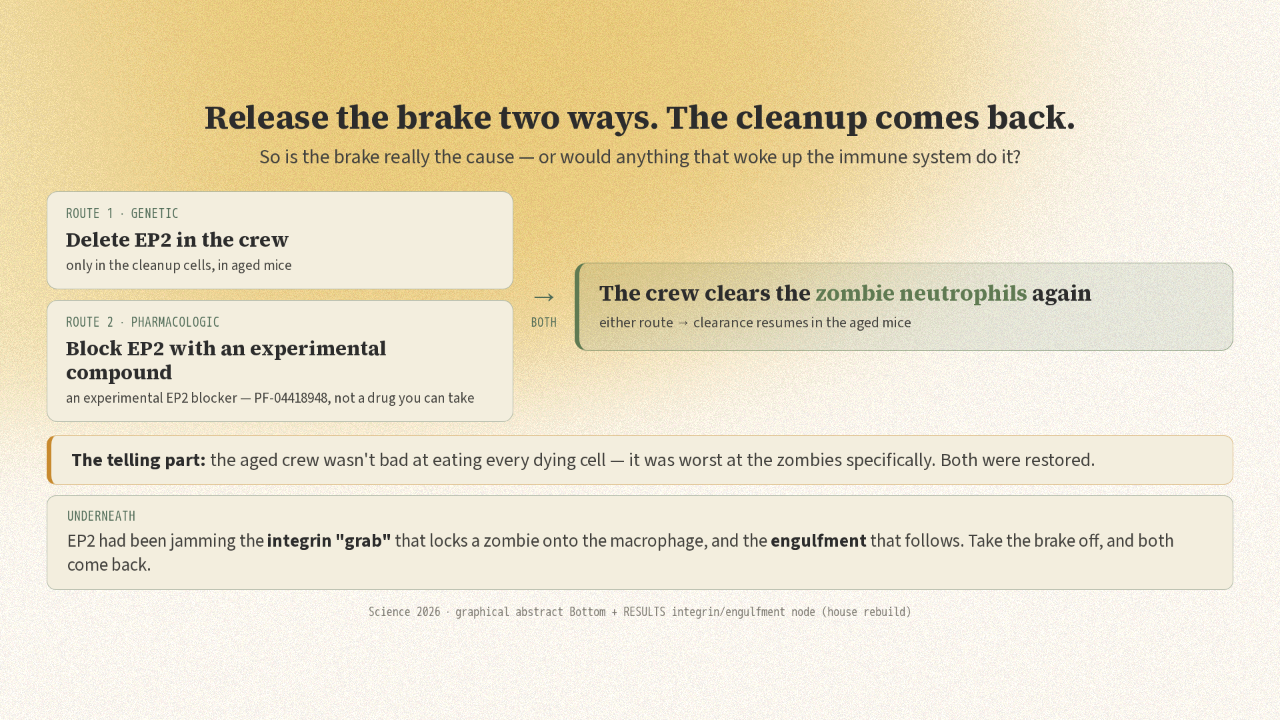
So is the brake really the cause — or would anything that woke up the immune system do it?
Route 1 · genetic
Delete EP2 in the crew
only in the cleanup cells, in aged mice
Route 2 · pharmacologic
Block EP2 with an experimental compound
an experimental EP2 blocker — PF-04418948, not a drug you can take
→both
The crew clears the zombie neutrophils again
either route → clearance resumes in the aged mice
The telling part: the aged crew wasn't bad at eating every dying cell — it was worst at the zombies specifically. Both were restored.
underneath
EP2 had been jamming the integrin "grab" that locks a zombie onto the macrophage, and the engulfment that follows. Take the brake off, and both come back.
Science 2026 · graphical abstract Bottom + RESULTS integrin/engulfment node (house rebuild)

So is the brake really the cause? Or would anything that woke up the immune system do it? They released the brake two separate ways. In one group of aged mice, they deleted EP2 only in the cleanup crew. In another, they gave the experimental compound that blocks it. Both times, the crew went back to clearing the zombie neutrophils. And here's the telling part. The aged crew wasn't bad at eating every dying cell. It was worst at the zombies. Underneath, EP2 had been jamming the grab that locks a zombie onto the macrophage, and the swallow that follows. Take the brake off, and both come back.

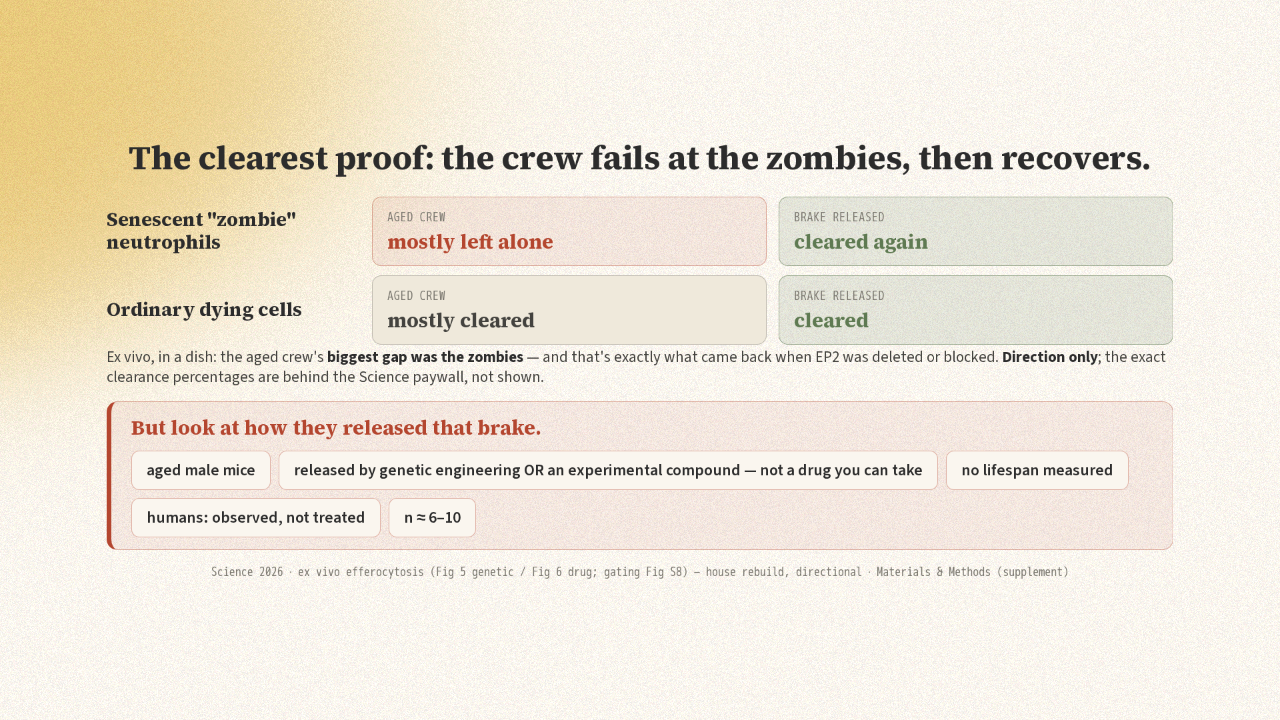
The clearest proof: the crew fails at the zombies, then recovers.

Senescent "zombie" neutrophils
aged crewmostly left alone
brake releasedcleared again
Ordinary dying cells
aged crewmostly cleared
brake releasedcleared
Ex vivo, in a dish: the aged crew's biggest gap was the zombies — and that's exactly what came back when EP2 was deleted or blocked. Direction only; the exact clearance percentages are behind the Science paywall, not shown.
But look at how they released that brake.
aged male mice released by genetic engineering OR an experimental compound — not a drug you can take no lifespan measured humans: observed, not treated n ≈ 6–10
Science 2026 · ex vivo efferocytosis (Fig 5 genetic / Fig 6 drug; gating Fig S8) — house rebuild, directional · Materials & Methods (supplement)

You can watch this in a dish. Put aged cleanup cells next to senescent neutrophils, and they mostly leave them alone. Release the brake, and they clear them again. That points one way, from failing to fixed. But look at how they released that brake. In one group it was genetic engineering in a mouse. In the other, an experimental compound. Neither is a drug a person could take. And no one measured how long these mice lived. Every result here is about clearing cells and organ function, not living longer.

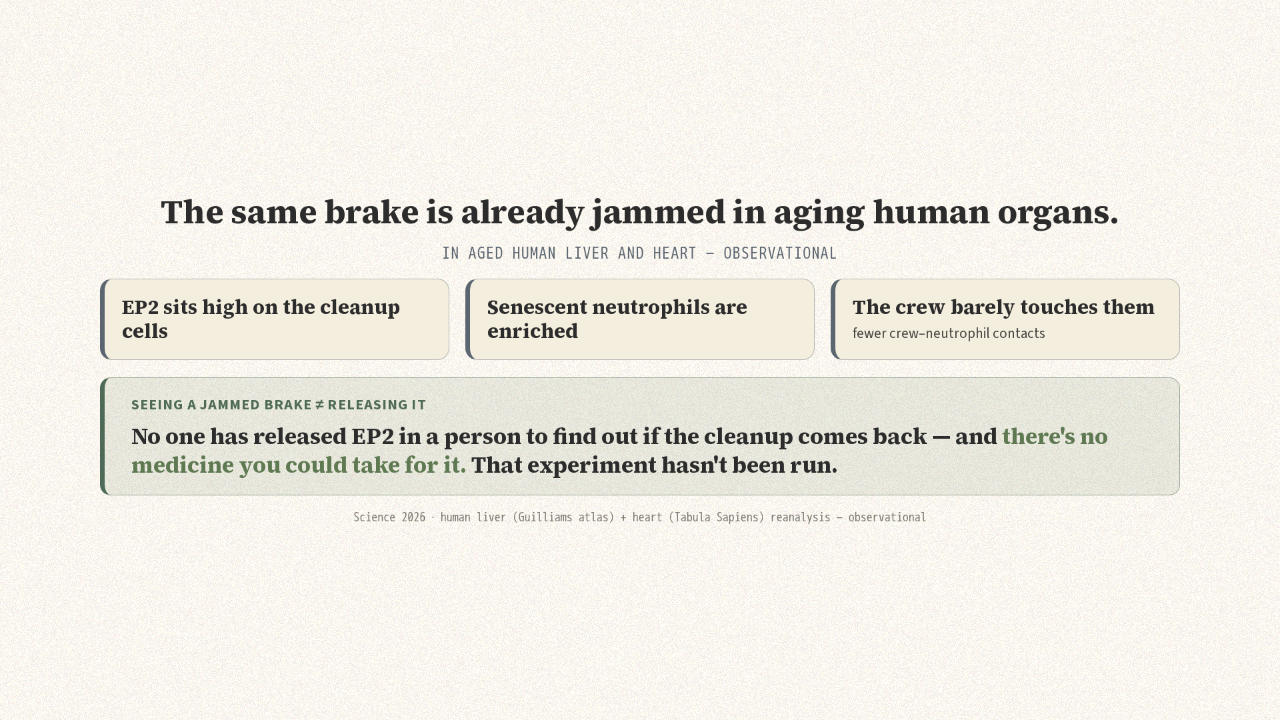
The same brake is already jammed in aging human organs.

In aged human liver and heart — observational
EP2 sits high on the cleanup cells
Senescent neutrophils are enriched
The crew barely touches them
fewer crew–neutrophil contacts
seeing a jammed brake ≠ releasing it
No one has released EP2 in a person to find out if the cleanup comes back — and there's no medicine you could take for it. That experiment hasn't been run.
Science 2026 · human liver (Guilliams atlas) + heart (Tabula Sapiens) reanalysis — observational

Here's the part that makes you lean in. The same brake is already jammed in aging people. In aged human liver and heart, EP2 sits high on the cleanup cells, the zombie neutrophils pile up, and the crew barely touches them. The same pattern as the mice, only seen, never released. But no one has released that brake in a person to find out if the cleanup comes back. There's no medicine you could take for it, and that experiment hasn't been run.

In these aged mice, some of what looked like organs wearing out was a cleanup crew held back by a single brake — release it, and the crew went back to work.

Some of aging was a cleanup that stopped.
10.1126/science.aea3075 · Tan et al., Science 2026 · mouse study

So in these aged mice, some of what looked like organs wearing out was really a cleanup crew held back by one brake. Release it, and the crew went back to work, and several organs moved back toward youth. In these mice, some of aging was a cleanup that stopped.