More spermidine tracked healthier liver scores — but those scores are body-size formulas, and the same people lost weight.

2 months ago

People who ate more spermidine had healthier liver scores a year later. That's what a study of over two thousand six hundred older adults found. Spermidine is a compound in vegetables, whole grains and mushrooms, and it's sold as a longevity supplement. But the same people also lost the most weight.

Ask

Ask about this presentation

Answers are generated from this presentation.

Chapters

  1. 0:00People who ate more spermidine had healthier liver scores — and the same people lost weight
  2. 0:16People who ate the most spermidine had the biggest drop in two fatty-liver scores
  3. 0:37The same group that ate the most spermidine also lost the most weight
  4. 0:59Those 'liver scores' aren't scans — they're formulas built mostly from your waist and weight
  5. 1:26A questionnaire and a body-size formula turn weight loss into 'your liver improved'
  6. 1:53Isolate spermidine, and the direct liver tests stay flat while cholesterol rises
  7. 2:24The test that would settle it: give spermidine directly, hold weight steady, scan the liver
  8. 2:47A marker of a better diet, not a pill that fixes your liver
Show transcript

People who ate more spermidine had healthier liver scores — and the same people lost weight

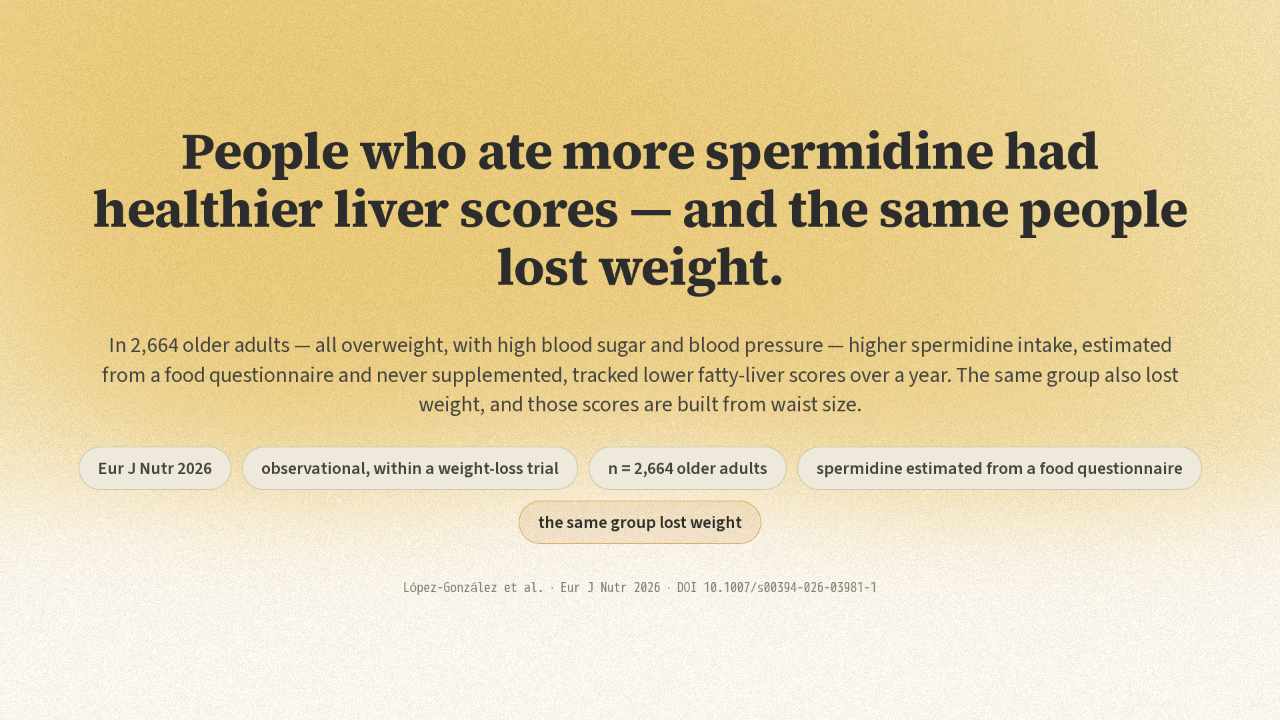
People who ate more spermidine had healthier liver scores — and the same people lost weight.

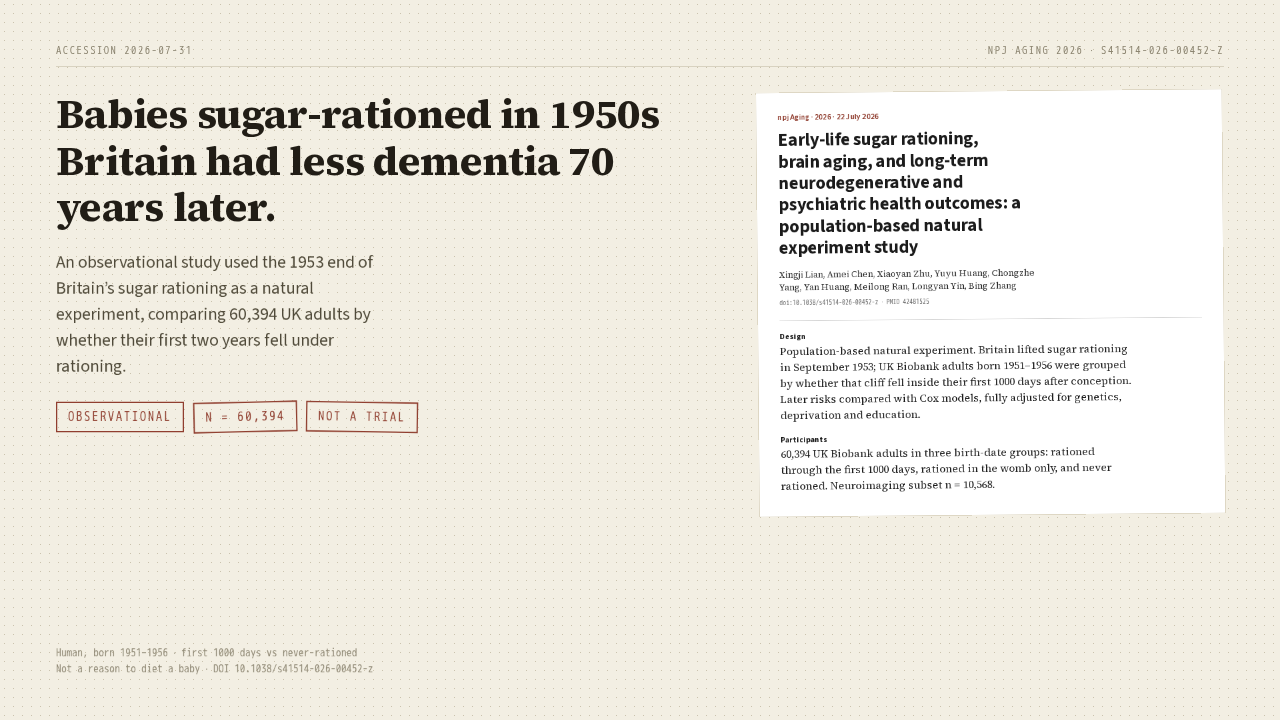
In 2,664 older adults — all overweight, with high blood sugar and blood pressure — higher spermidine intake, estimated from a food questionnaire and never supplemented, tracked lower fatty-liver scores over a year. The same group also lost weight, and those scores are built from waist size.
Eur J Nutr 2026 observational, within a weight-loss trial n = 2,664 older adults spermidine estimated from a food questionnaire the same group lost weight
López-González et al. · Eur J Nutr 2026 · DOI 10.1007/s00394-026-03981-1

People who ate more spermidine had healthier liver scores a year later. That's what a study of over two thousand six hundred older adults found. Spermidine is a compound in vegetables, whole grains and mushrooms, and it's sold as a longevity supplement. But the same people also lost the most weight.

People who ate the most spermidine had the biggest drop in two fatty-liver scores

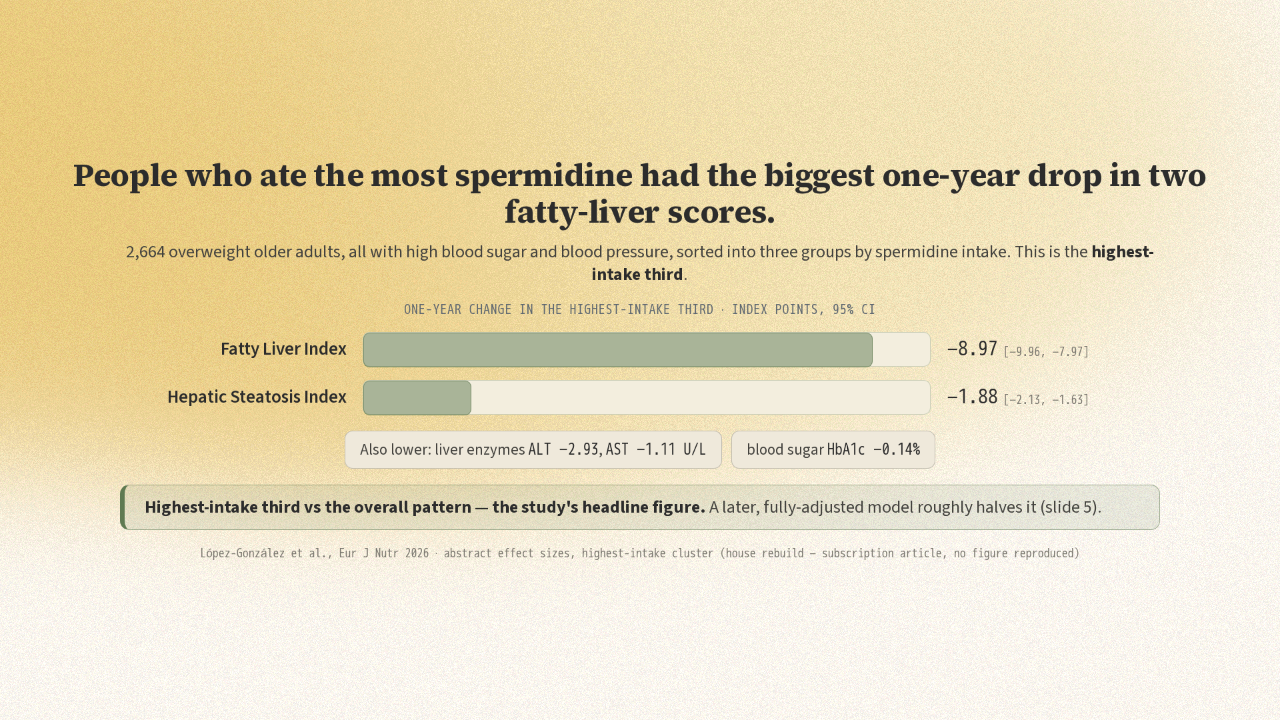
People who ate the most spermidine had the biggest one-year drop in two fatty-liver scores.

2,664 overweight older adults, all with high blood sugar and blood pressure, sorted into three groups by spermidine intake. This is the highest-intake third.
One-year change in the highest-intake third · index points, 95% CI
Fatty Liver Index
−8.97[−9.96, −7.97]
Hepatic Steatosis Index
−1.88[−2.13, −1.63]
Also lower: liver enzymes ALT −2.93, AST −1.11 U/L blood sugar HbA1c −0.14%
Highest-intake third vs the overall pattern — the study's headline figure. A later, fully-adjusted model roughly halves it (slide 5).
López-González et al., Eur J Nutr 2026 · abstract effect sizes, highest-intake cluster (house rebuild — subscription article, no figure reproduced)

The researchers followed over two thousand six hundred overweight older adults, all with high blood sugar and blood pressure, for a year. They estimated everyone's spermidine from a questionnaire about what people usually ate. Then they sorted people into three groups by intake. The highest third had the biggest drop in two scores doctors use to gauge a fatty liver, plus slightly lower liver enzymes and blood sugar.

The same group that ate the most spermidine also lost the most weight

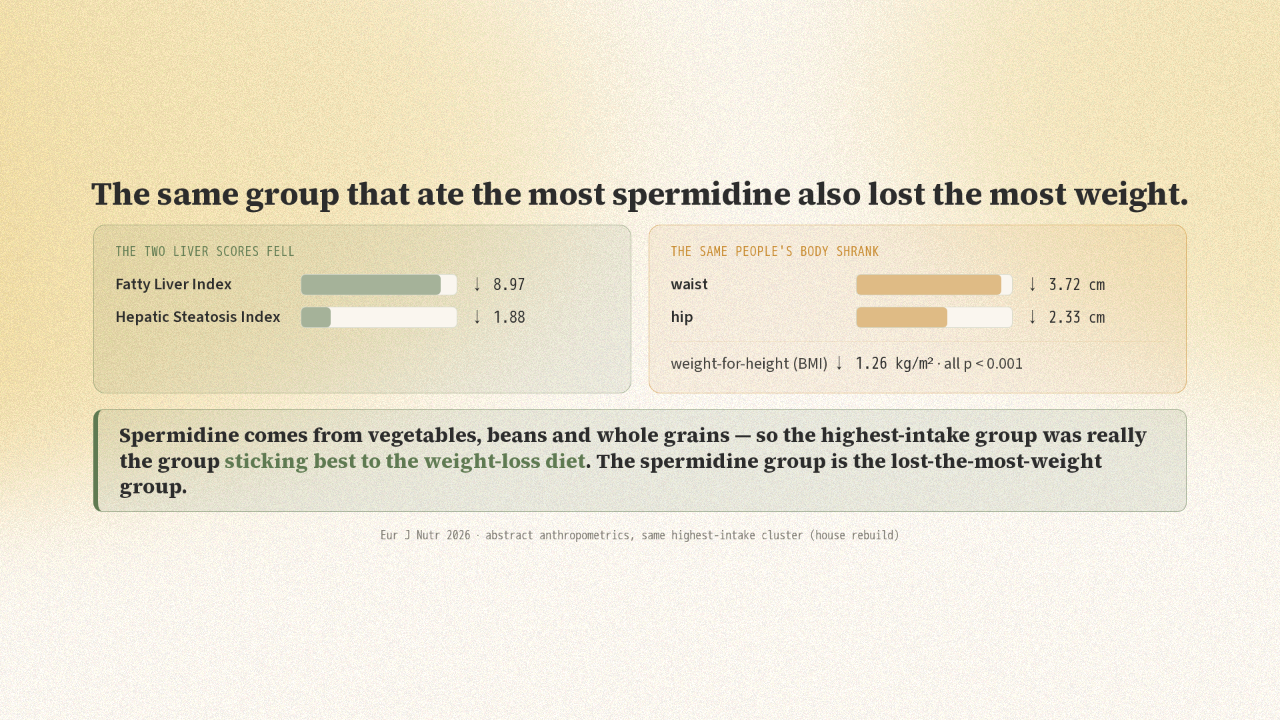
The same group that ate the most spermidine also lost the most weight.

The two liver scores fell
Fatty Liver Index
↓ 8.97
Hepatic Steatosis Index
↓ 1.88
The same people's body shrank
waist
↓ 3.72 cm
hip
↓ 2.33 cm
weight-for-height (BMI) ↓ 1.26 kg/m² · all p < 0.001
Spermidine comes from vegetables, beans and whole grains — so the highest-intake group was really the group sticking best to the weight-loss diet. The spermidine group is the lost-the-most-weight group.
Eur J Nutr 2026 · abstract anthropometrics, same highest-intake cluster (house rebuild)

You'd think that means the spermidine helped their livers. But look at that same group again. They also lost the most weight. Their waist shrank almost four centimetres. Spermidine comes from vegetables, beans and whole grains, so the people eating the most of it were the ones sticking best to the Mediterranean weight-loss diet everyone in the study was already on. The spermidine group is really the lost-the-most-weight group.

Those 'liver scores' aren't scans — they're formulas built mostly from your waist and weight

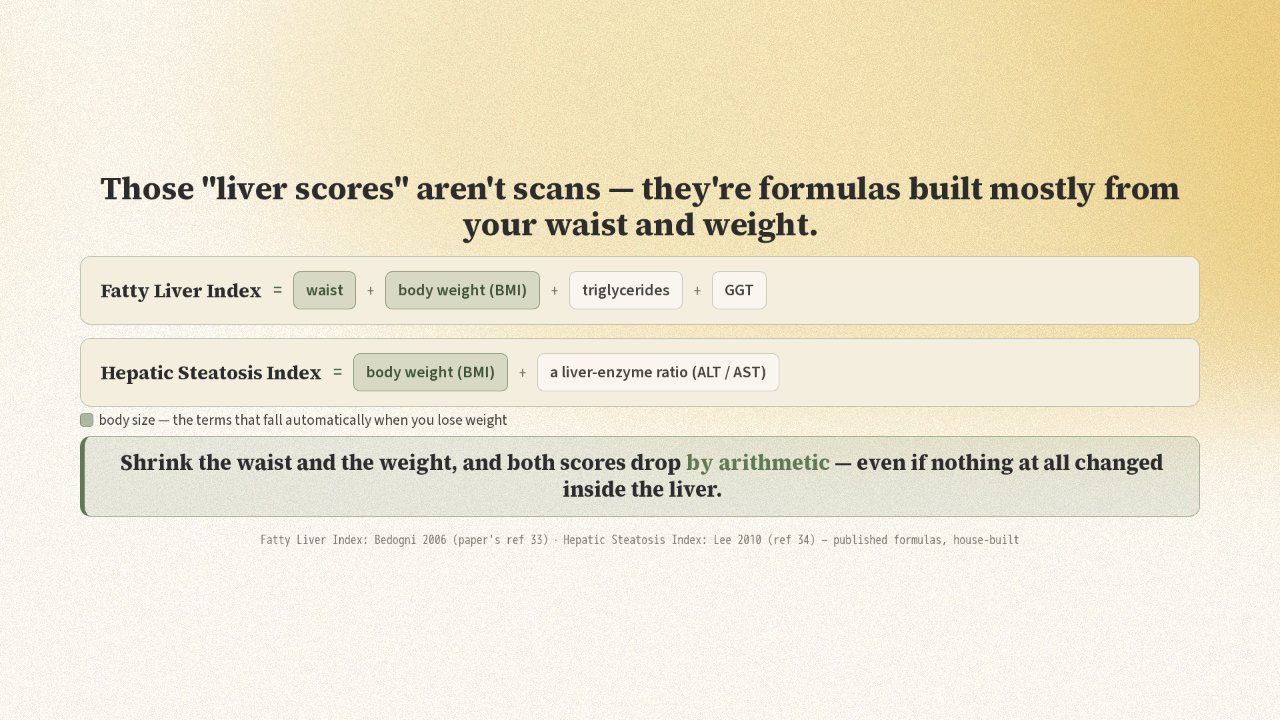
Those "liver scores" aren't scans — they're formulas built mostly from your waist and weight.

Fatty Liver Index = waist + body weight (BMI) + triglycerides + GGT
Hepatic Steatosis Index = body weight (BMI) + a liver-enzyme ratio (ALT / AST)
body size — the terms that fall automatically when you lose weight
Shrink the waist and the weight, and both scores drop by arithmetic — even if nothing at all changed inside the liver.
Fatty Liver Index: Bedogni 2006 (paper's ref 33) · Hepatic Steatosis Index: Lee 2010 (ref 34) — published formulas, house-built

Here's the fact that changes everything. The two numbers that dropped the most aren't liver scans. They're formulas, and both are built mostly from body size. The Fatty Liver Index is calculated from your waist size and your weight-for-height, plus two blood measures. The Hepatic Steatosis Index has that same weight-for-height baked right into it. So when this group shrank its waist and its weight, those liver scores dropped automatically. The formula guarantees it, even if nothing at all changed inside the liver.

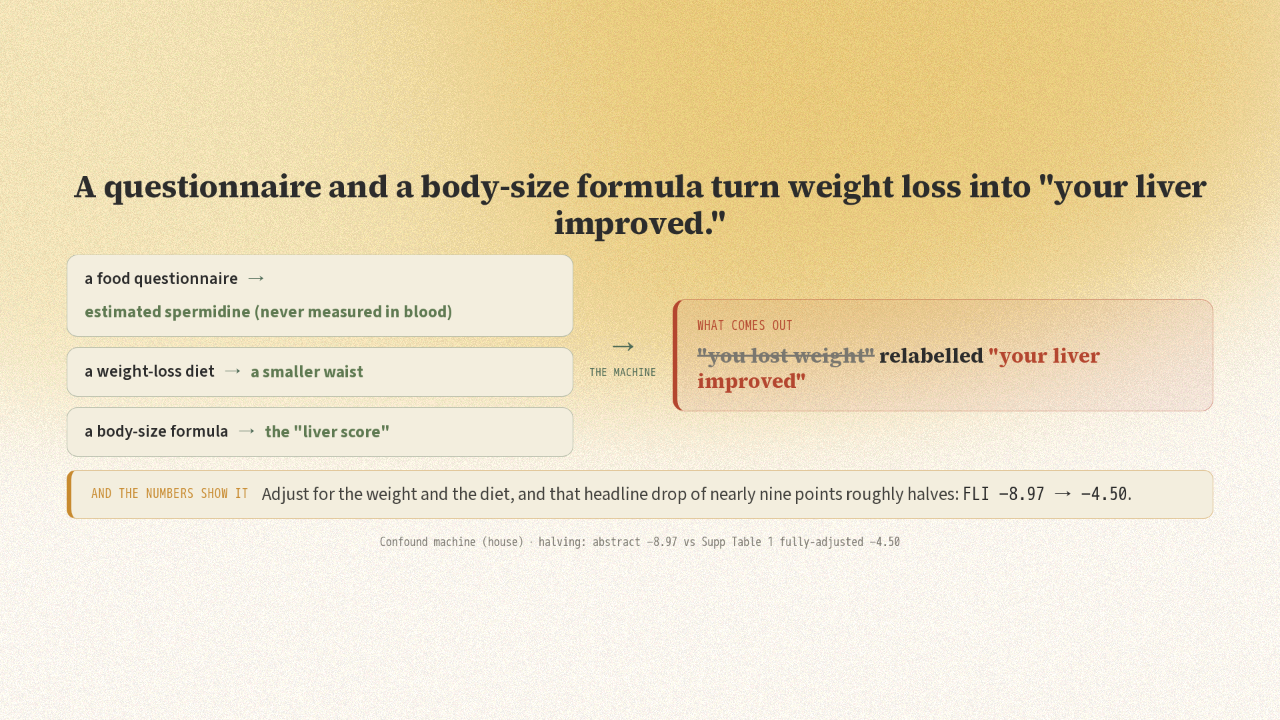
A questionnaire and a body-size formula turn weight loss into 'your liver improved'

A questionnaire and a body-size formula turn weight loss into "your liver improved."

a food questionnaire→estimated spermidine (never measured in blood)
a weight-loss diet→a smaller waist
a body-size formula→the "liver score"
→the machine
what comes out
"you lost weight" relabelled "your liver improved"
and the numbers show it Adjust for the weight and the diet, and that headline drop of nearly nine points roughly halves: FLI −8.97 → −4.50.
Confound machine (house) · halving: abstract −8.97 vs Supp Table 1 fully-adjusted −4.50

Now put the three pieces together. The researchers never measured spermidine in anyone's blood. They estimated it from that food questionnaire. The people who reported eating the most of it were the best dieters, so they lost the most weight. And the liver score is really a formula built from that weight. So the machine quietly relabels ordinary weight loss: you lost weight becomes your liver improved. And the numbers show it. Once the researchers adjust for the weight and the diet, that headline drop of nearly nine points roughly halves.

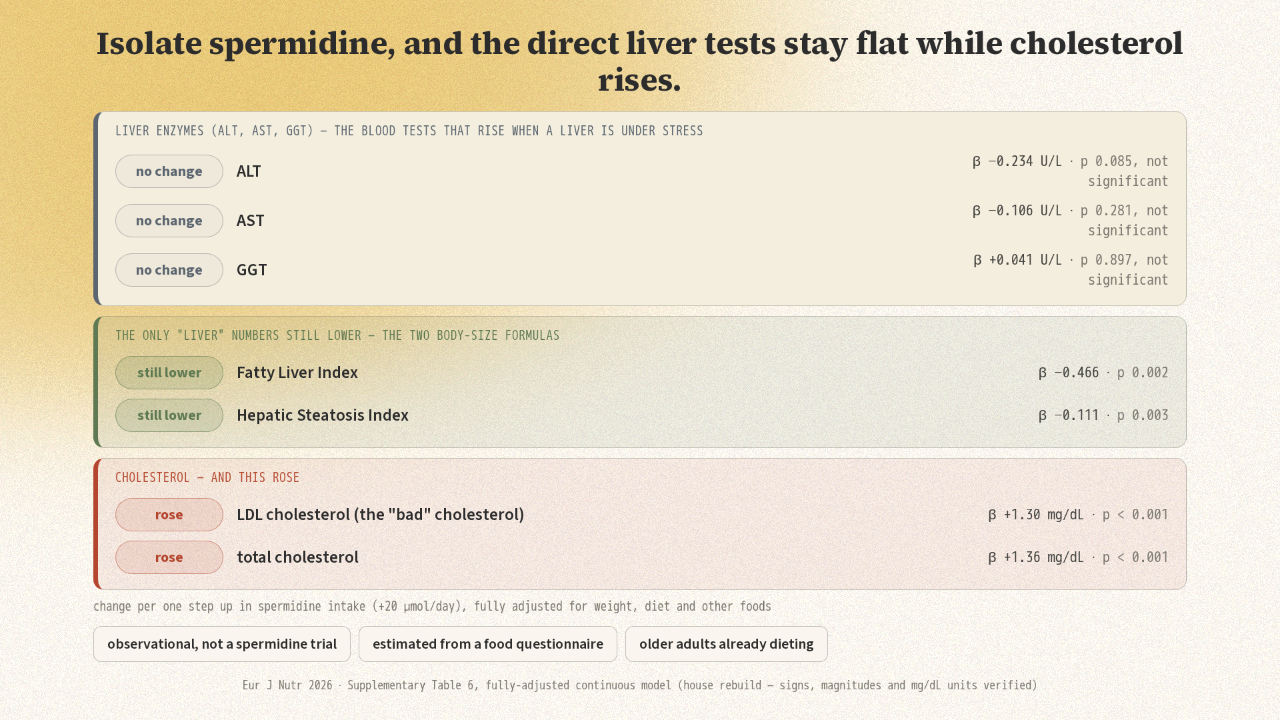
Isolate spermidine, and the direct liver tests stay flat while cholesterol rises

Isolate spermidine, and the direct liver tests stay flat while cholesterol rises.

liver enzymes (ALT, AST, GGT) — the blood tests that rise when a liver is under stress
no changeALTβ −0.234 U/L · p 0.085, not significant
no changeASTβ −0.106 U/L · p 0.281, not significant
no changeGGTβ +0.041 U/L · p 0.897, not significant
the only "liver" numbers still lower — the two body-size formulas
still lowerFatty Liver Indexβ −0.466 · p 0.002
still lowerHepatic Steatosis Indexβ −0.111 · p 0.003
cholesterol — and this rose
roseLDL cholesterol (the "bad" cholesterol)β +1.30 mg/dL · p < 0.001
rosetotal cholesterolβ +1.36 mg/dL · p < 0.001
change per one step up in spermidine intake (+20 µmol/day), fully adjusted for weight, diet and other foods
observational, not a spermidine trial estimated from a food questionnaire older adults already dieting
Eur J Nutr 2026 · Supplementary Table 6, fully-adjusted continuous model (house rebuild — signs, magnitudes and mg/dL units verified)

So the researchers ran the clean test. They isolated spermidine, stripping out the weight loss and every other food. And the blood tests that truly rise when a liver is under stress didn't budge. The only liver numbers still lower were the two body-size formulas. And the LDL, the bad cholesterol that clogs arteries, actually rose. So on its own, the molecule left the real liver flat and cholesterol higher. This is an association in older adults already dieting, estimated from a questionnaire. It's not a trial of a spermidine supplement, and not a reason to take one.

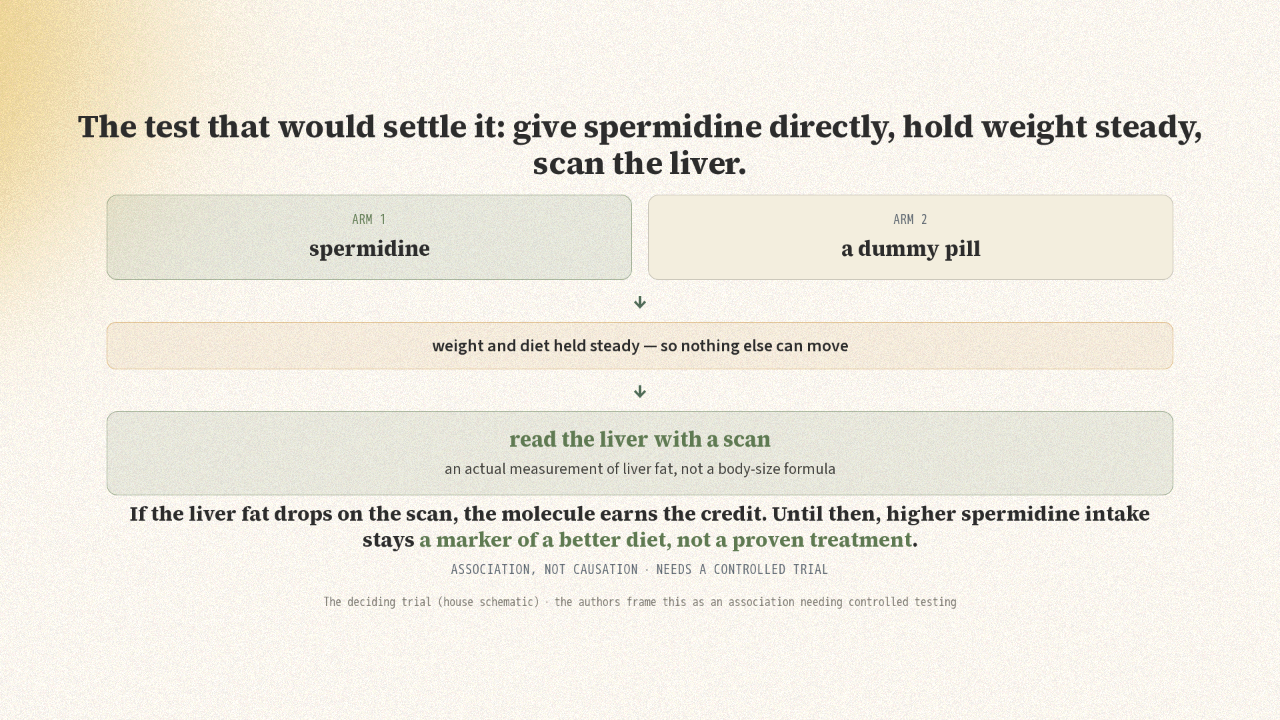
The test that would settle it: give spermidine directly, hold weight steady, scan the liver

The test that would settle it: give spermidine directly, hold weight steady, scan the liver.

arm 1
spermidine
arm 2
a dummy pill
↓
weight and diet held steady — so nothing else can move
↓
read the liver with a scan
an actual measurement of liver fat, not a body-size formula
If the liver fat drops on the scan, the molecule earns the credit. Until then, higher spermidine intake stays a marker of a better diet, not a proven treatment.
association, not causation · needs a controlled trial
The deciding trial (house schematic) · the authors frame this as an association needing controlled testing

Here's the experiment that would settle it. Give some people spermidine and some a dummy pill, and hold their weight and diet steady, so nothing else can move. Then read the liver with a scan, not a body-size formula. If the spermidine group's liver fat drops on the scan, the molecule earns the credit. Until a trial like that runs, higher spermidine intake stays a marker of a better diet, not a proven treatment.

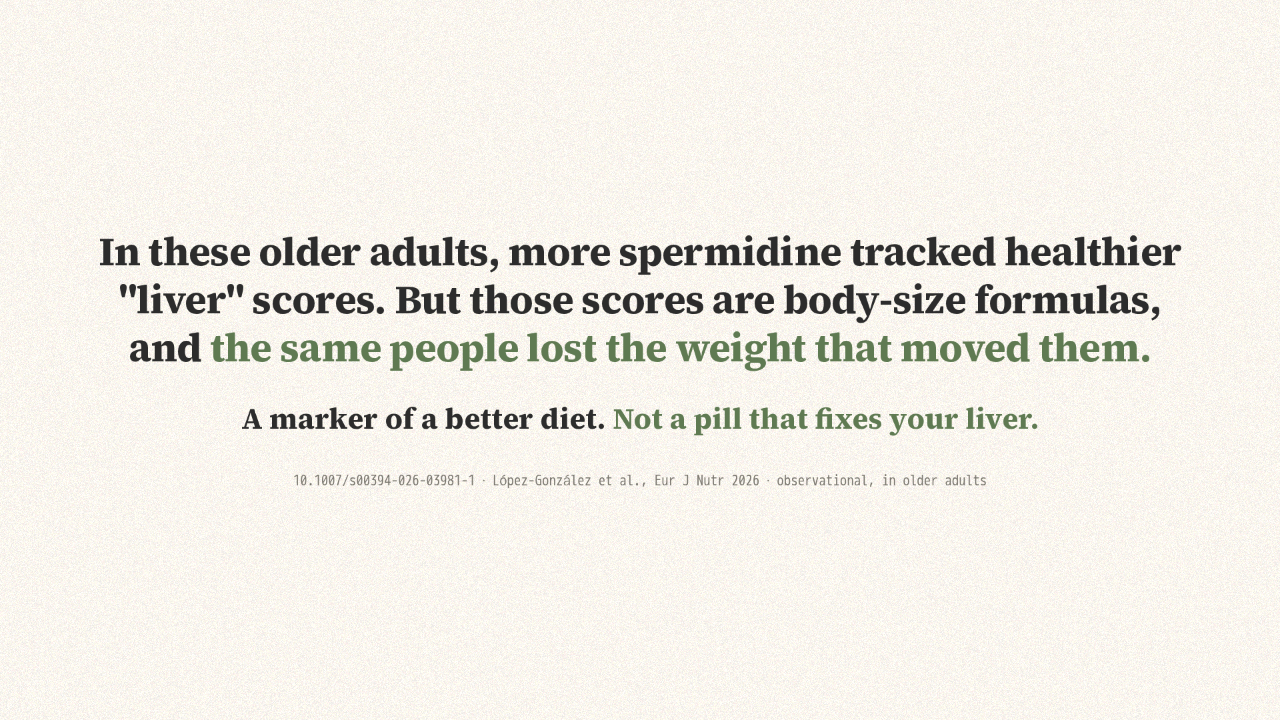
A marker of a better diet, not a pill that fixes your liver

In these older adults, more spermidine tracked healthier "liver" scores. But those scores are body-size formulas, and the same people lost the weight that moved them.

A marker of a better diet. Not a pill that fixes your liver.
10.1007/s00394-026-03981-1 · López-González et al., Eur J Nutr 2026 · observational, in older adults

So in these older adults, more spermidine tracked healthier liver scores. But that score is a body-size formula, and on its own the molecule moved no real liver test. So for the next supplement headline, you'll know what to ask. Was the food measured, or guessed from a questionnaire? Is the marker a real test, or a formula? And did the group also lose weight?