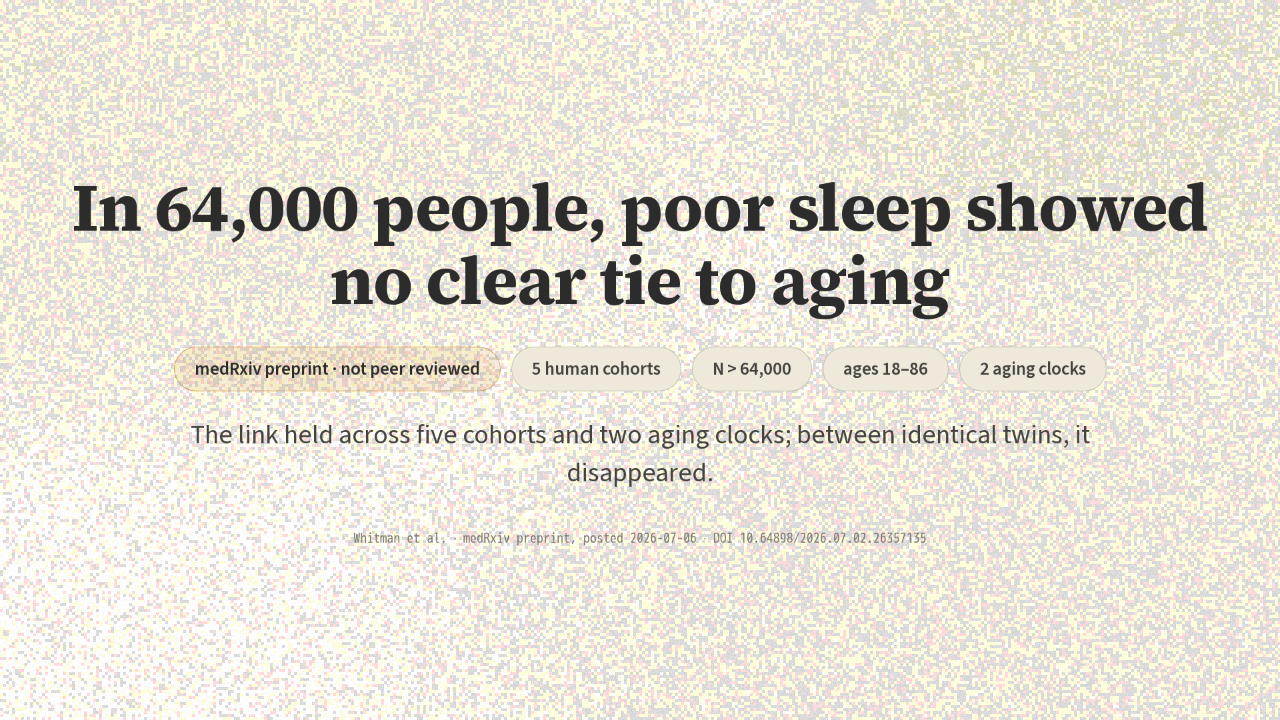
In 64,000 people, poor sleep showed no clear tie to aging
In more than sixty-four thousand people, worse sleep came with a faster pace of aging. Five separate groups. Two different aging clocks. Ages eighteen to eighty-six. Then the same team compared identical twins to each other. The twin who slept worse was not aging faster.
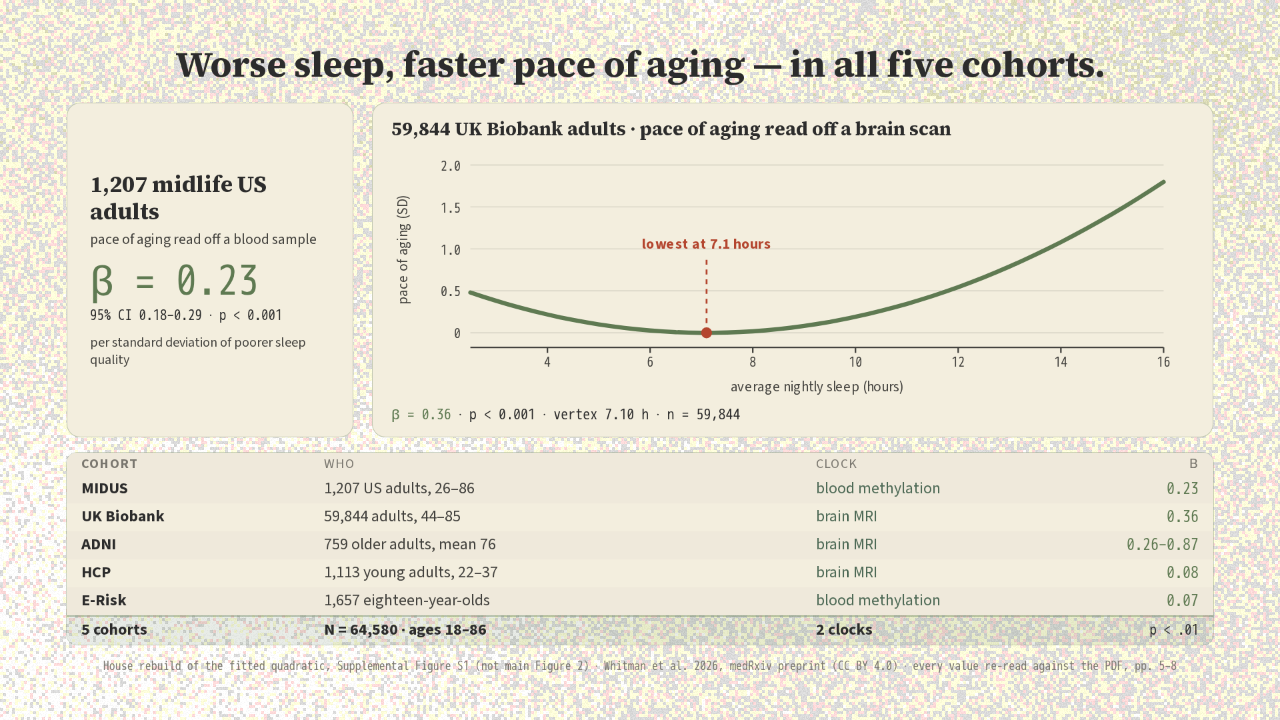
Worse sleep, faster pace of aging — in all five cohorts.
In a new preprint, the team that built these clocks went looking for the cause. In twelve hundred American adults, they read a pace of aging off a blood sample. The worse people slept, the faster that pace ran. In fifty-nine thousand UK Biobank adults they read it off a brain scan instead. The line came out as a U, with seven hours at the bottom. And it was already there in eighteen-year-olds, before chronic disease starts.
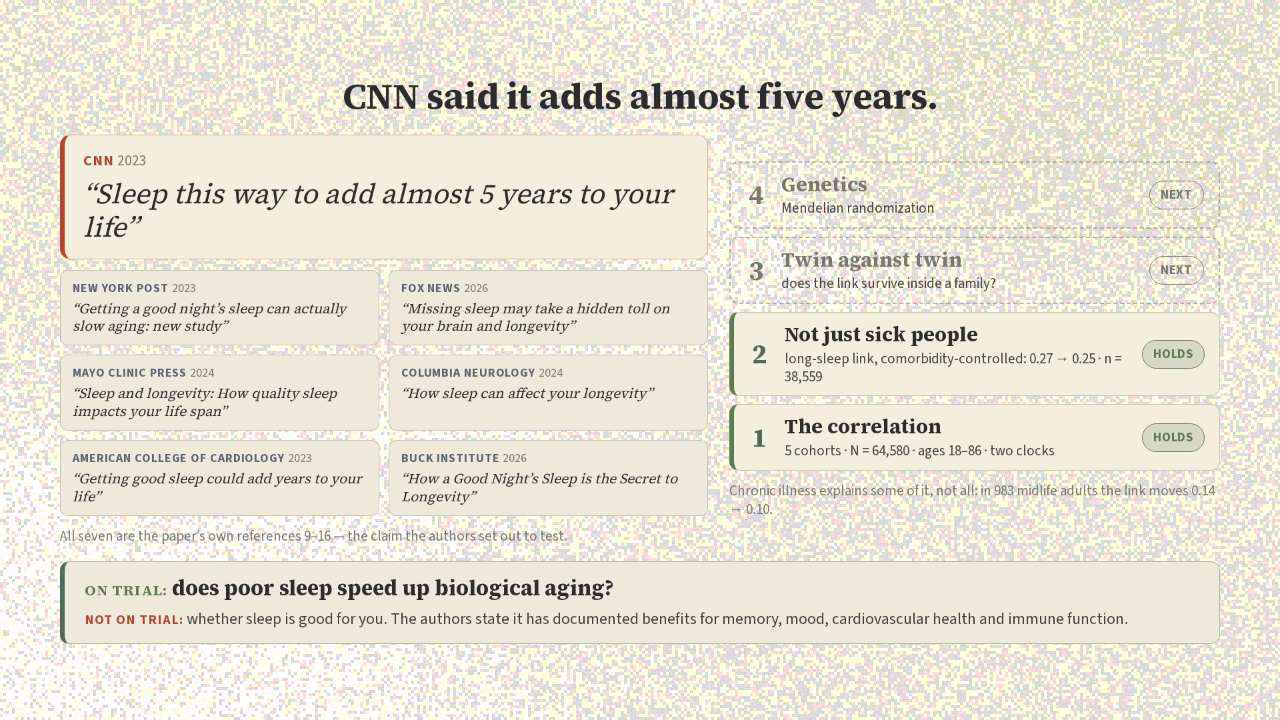
CNN said it adds almost five years.
CNN said sleeping well can add almost five years to your life. Mayo Clinic and the Buck Institute say the same. And it survives the obvious objection. Sick people sleep badly, so the team controlled for chronic illness in thirty-eight thousand adults. The link barely moved. But all of this is still correlation. And the question here is narrow. Does sleeping badly actually speed up biological aging? Not whether sleep is good for you. The authors say plainly that it is, for memory, mood, your heart and your immune system.
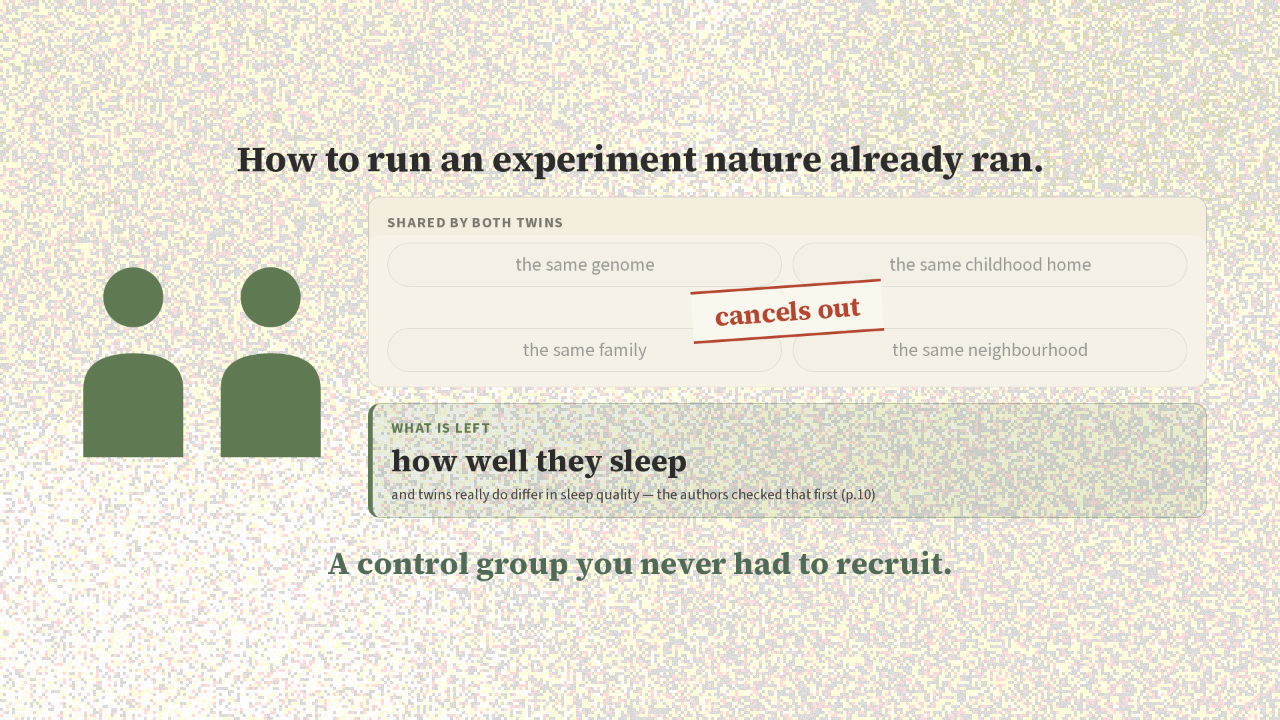
How to run an experiment nature already ran.
So how do you test whether one thing causes another, when you cannot run the experiment? You find a place where nature already ran it. Identical twins share a genome. They share a childhood home, a family, a neighbourhood. Compare one twin against the other, and all of that subtracts out. It is the same on both sides, so it cancels. What is left is where they differ. And one of those differences is how well they sleep. The authors checked that part first, and twins really do differ. It is a control group you never had to recruit.
Randomised at conception.
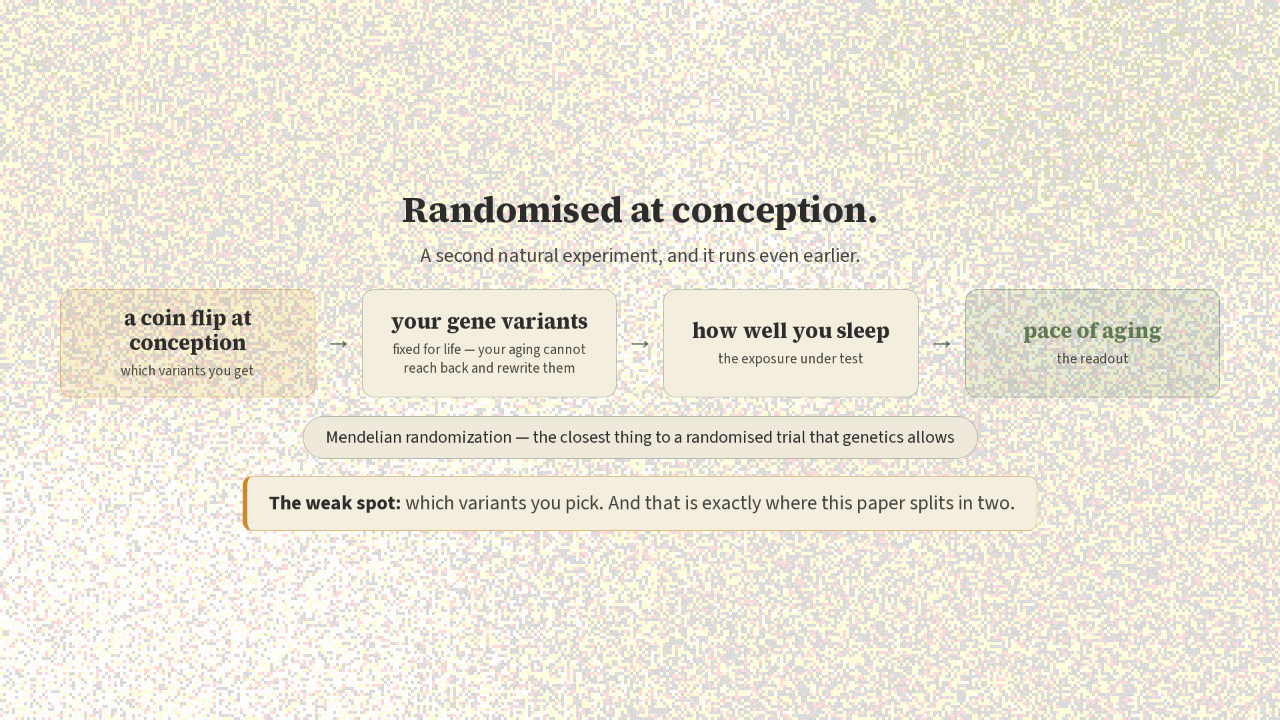
There is a second natural experiment, and it runs even earlier. You get your genes at conception. Nothing you do changes them, and your aging cannot reach back and rewrite them. So the arrow only points one way. Take the gene variants that push people toward bad sleep. Ask whether the people carrying them age faster. That is Mendelian randomization. It is the closest thing to a randomised trial that genetics allows. Its weak spot is the variants you pick. And that is exactly where this paper splits in two.
The twin who slept worse was not aging faster.
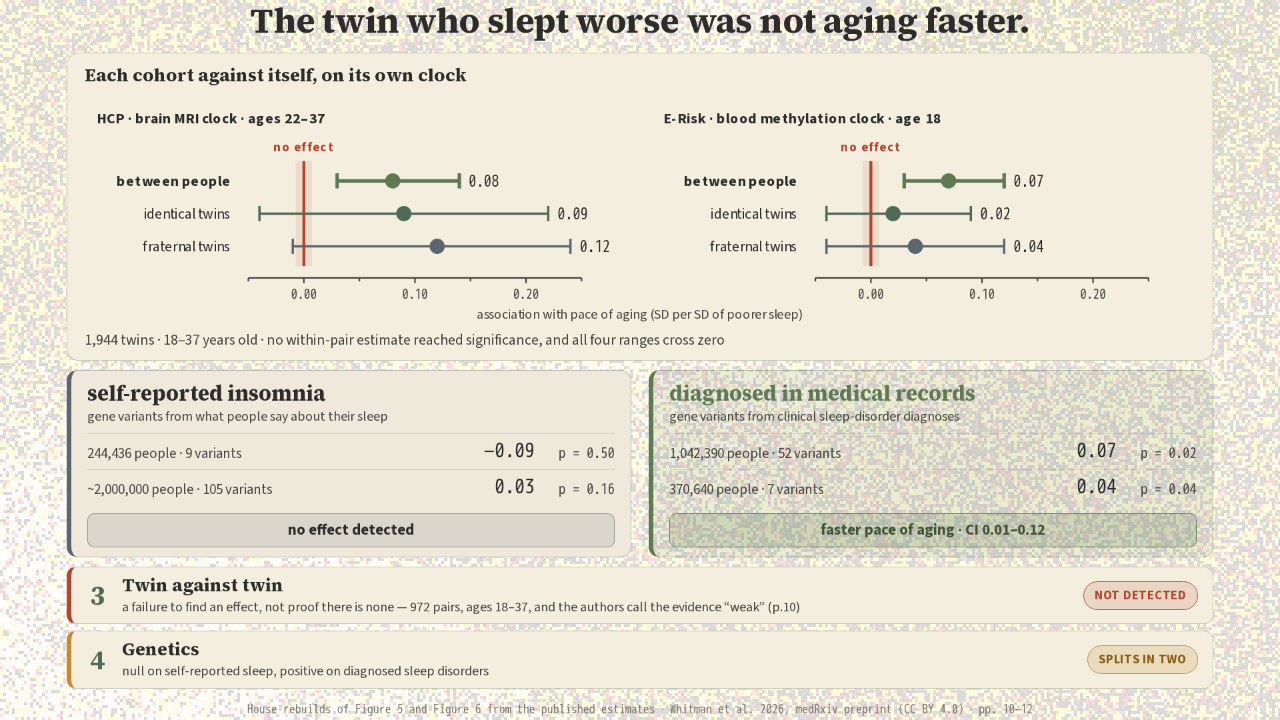
Take two identical twins. One sleeps badly, one sleeps well. The bad sleeper was not aging faster. They ran it four times, in identical and fraternal twins, across nineteen hundred people. The largest came out at point one two, and its range still runs through zero. Then the genetics. Variants for self-reported bad sleep showed nothing, in a quarter of a million people and again in two million. But sleep disorders diagnosed in medical records did. Across a million people, the carriers had a faster pace of aging. Point zero seven, and the range stays above zero. So the twins are a failure to find an effect, not proof there is none. These twins are eighteen to thirty-seven. In both groups the link was small to begin with. The authors call the evidence weak.
Nobody has treated anyone’s sleep and looked again.
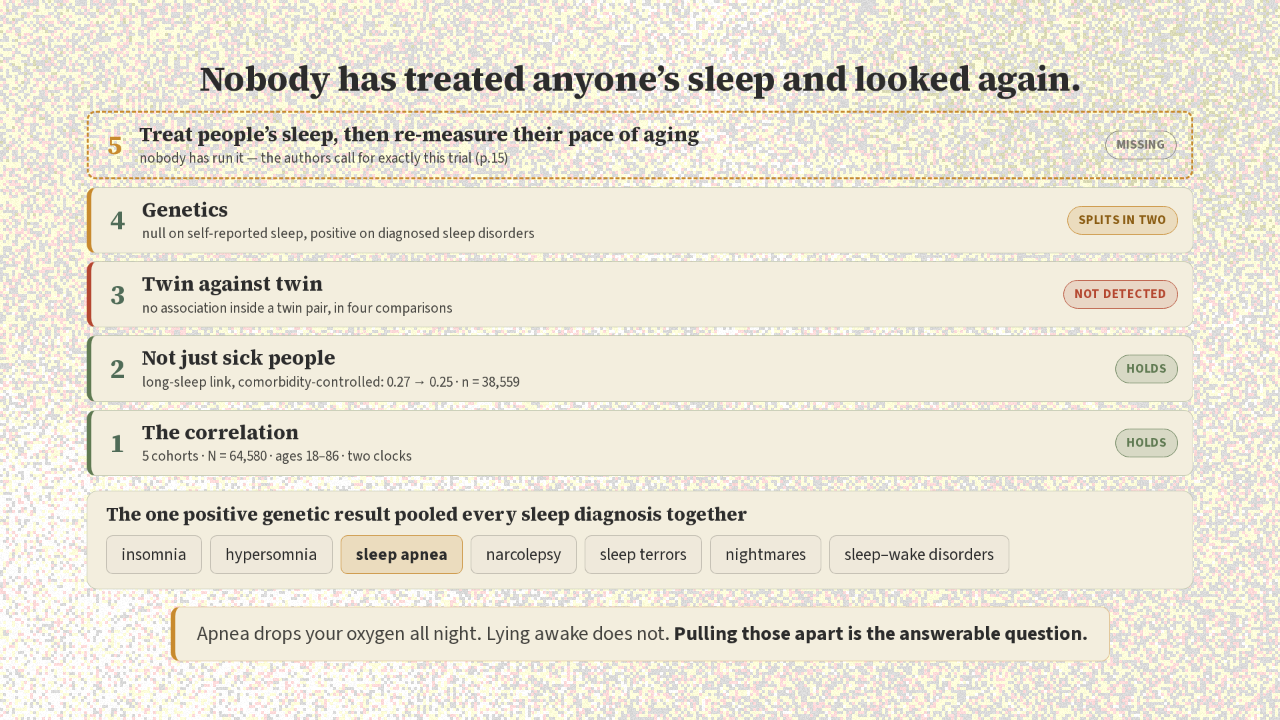
Nobody has improved a group of people's sleep and then re-measured their pace of aging. The authors ask for exactly that trial. And the one positive genetic result lumped every sleep diagnosis together. Insomnia. Apnea. Narcolepsy. Night terrors. Apnea drops your oxygen all night. Lying awake does not. Pulling those apart is the answerable question.
The correlation is robust. The cause is not settled.
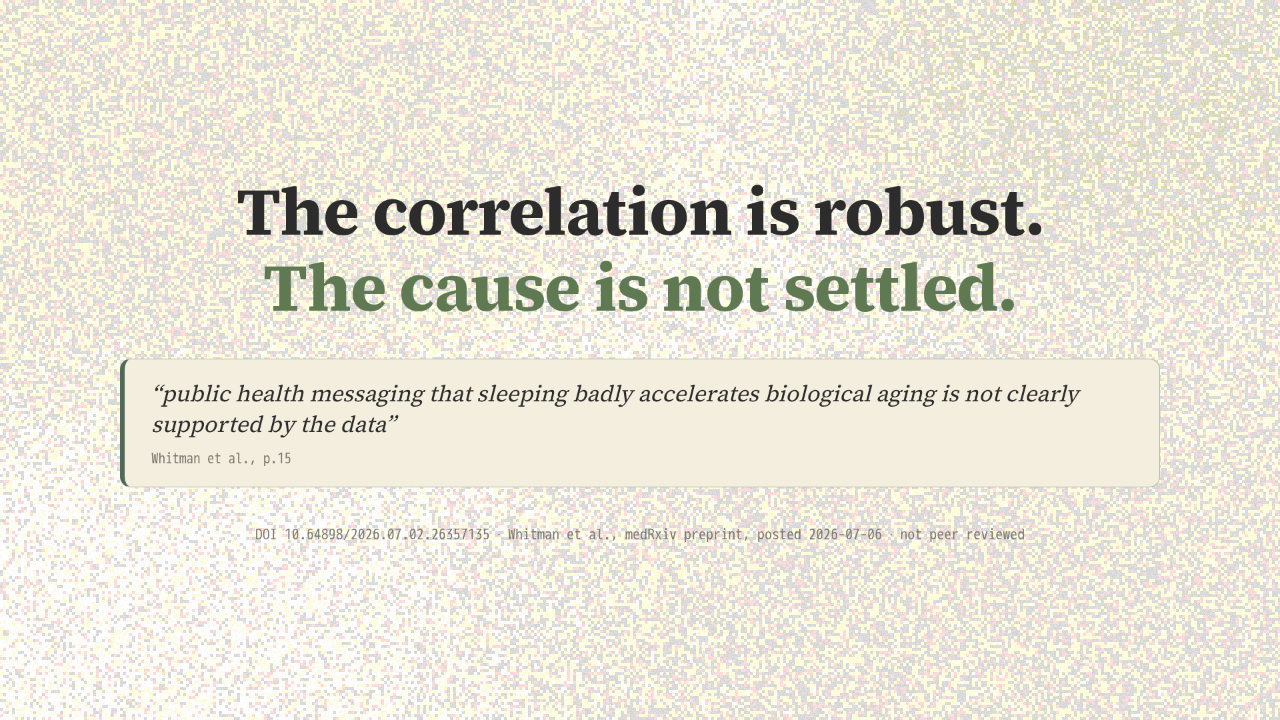
In more than sixty-four thousand people, worse sleep tracked faster aging. In this preprint, neither test that could show cause gave a clear answer. In their words: public health messaging that sleeping badly accelerates biological aging is not clearly supported by the data.