A big lifestyle trial barely changed aging brain scans

2 months ago

US POINTER is the landmark lifestyle trial that improved cognition in older adults last year. Now its brain scans are out, and the structured program slowed one marker of small-vessel injury. But only in people under seventy. One marker, one age group, in nine hundred and fifty-nine adults. Is that protecting the brain, or the catch?

Ask

Ask about this presentation

Answers are generated from this presentation.

Chapters

  1. 0:00Slide 1
  2. 0:20Under 70, free water rose more slowly
  3. 0:40Six markers tested. One moved.
  4. 1:00A prespecified imaging sub-study of a real RCT
  5. 1:13Same program, opposite sides of 70
  6. 1:32Free water predicts later small-vessel damage
  7. 1:48Read it carefully
  8. 2:20Slide 8
Show transcript

Slide 1

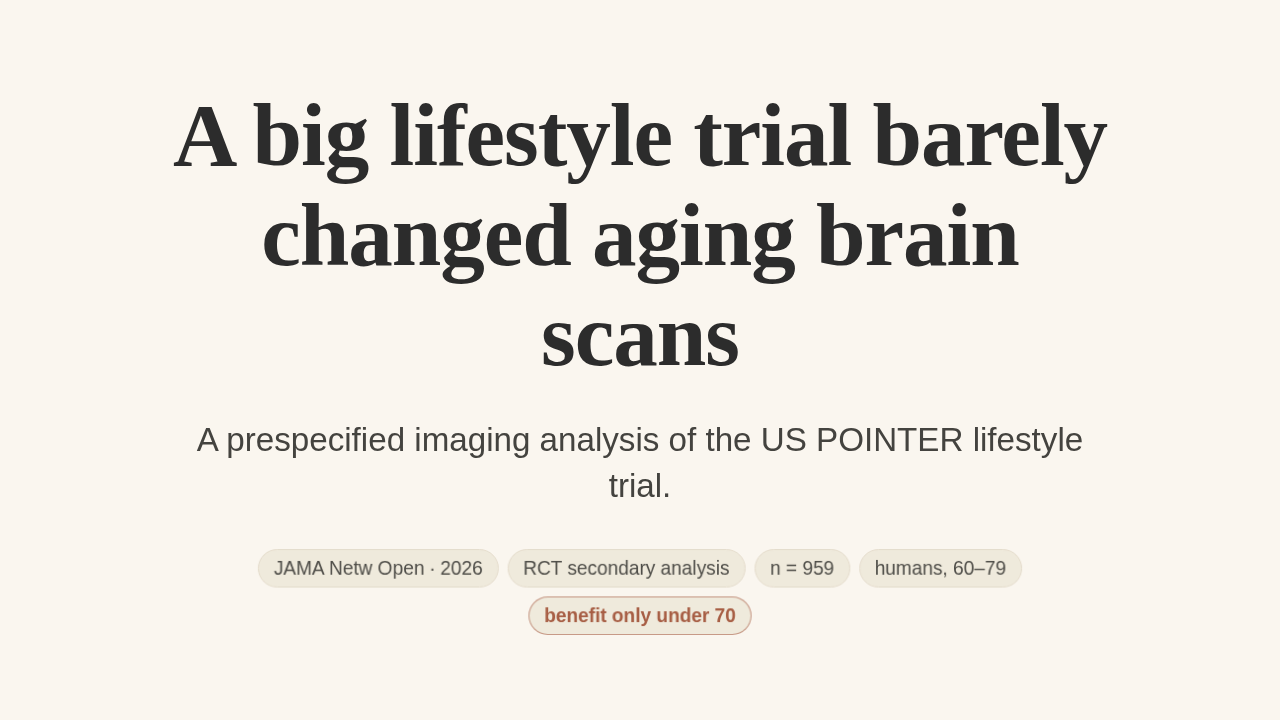
A big lifestyle trial barely changed aging brain scans
A prespecified imaging analysis of the US POINTER lifestyle trial.
JAMA Netw Open · 2026 RCT secondary analysis n = 959 humans, 60–79 benefit only under 70

US POINTER is the landmark lifestyle trial that improved cognition in older adults last year. Now its brain scans are out, and the structured program slowed one marker of small-vessel injury. But only in people under seventy. One marker, one age group, in nine hundred and fifty-nine adults. Is that protecting the brain, or the catch?

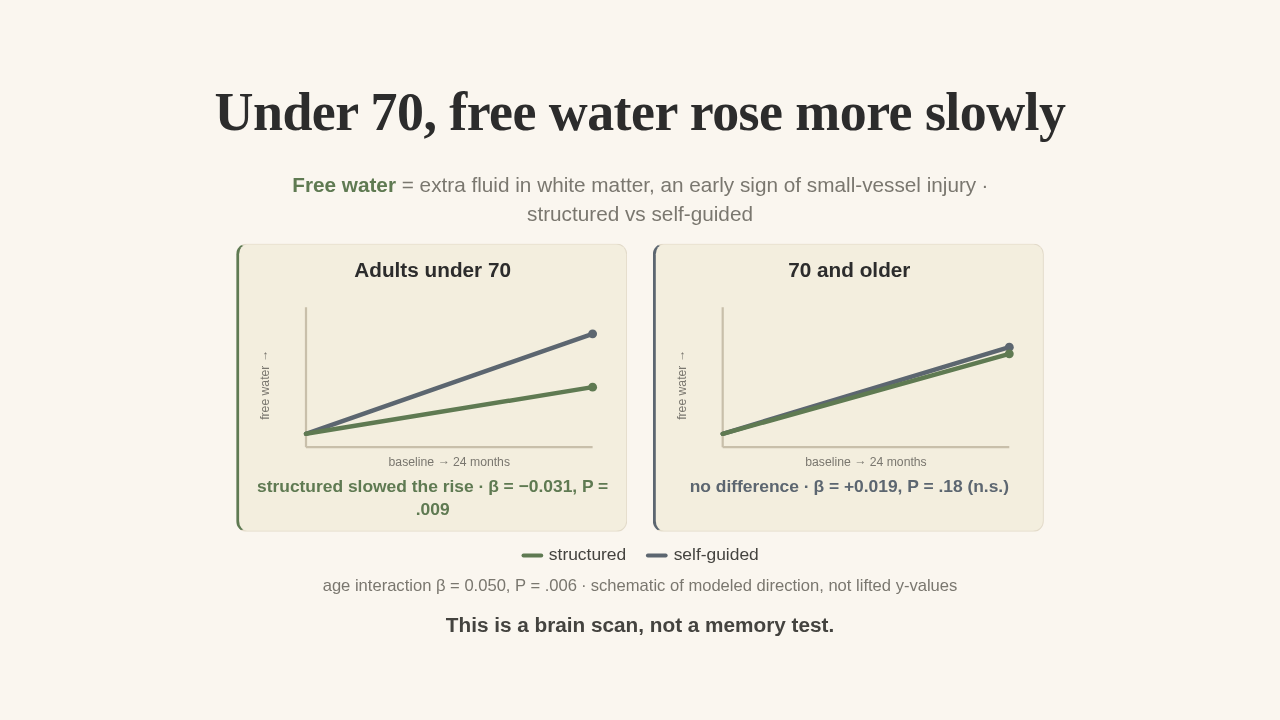
Under 70, free water rose more slowly

Free water = extra fluid in white matter, an early sign of small-vessel injury · structured vs self-guided
Adults under 70
free water → baseline → 24 months
structured slowed the rise · β = −0.031, P = .009
70 and older
free water → baseline → 24 months
no difference · β = +0.019, P = .18 (n.s.)
structured self-guided
age interaction β = 0.050, P = .006 · schematic of modeled direction, not lifted y-values
This is a brain scan, not a memory test.

The marker is free water: extra fluid in the brain's white matter, an early sign of small-vessel injury. In adults under seventy, the structured program slowed its rise. In those seventy and older, no difference, and that age gap was significant, with a p-value of point zero zero six. This is a brain scan, not a memory test.

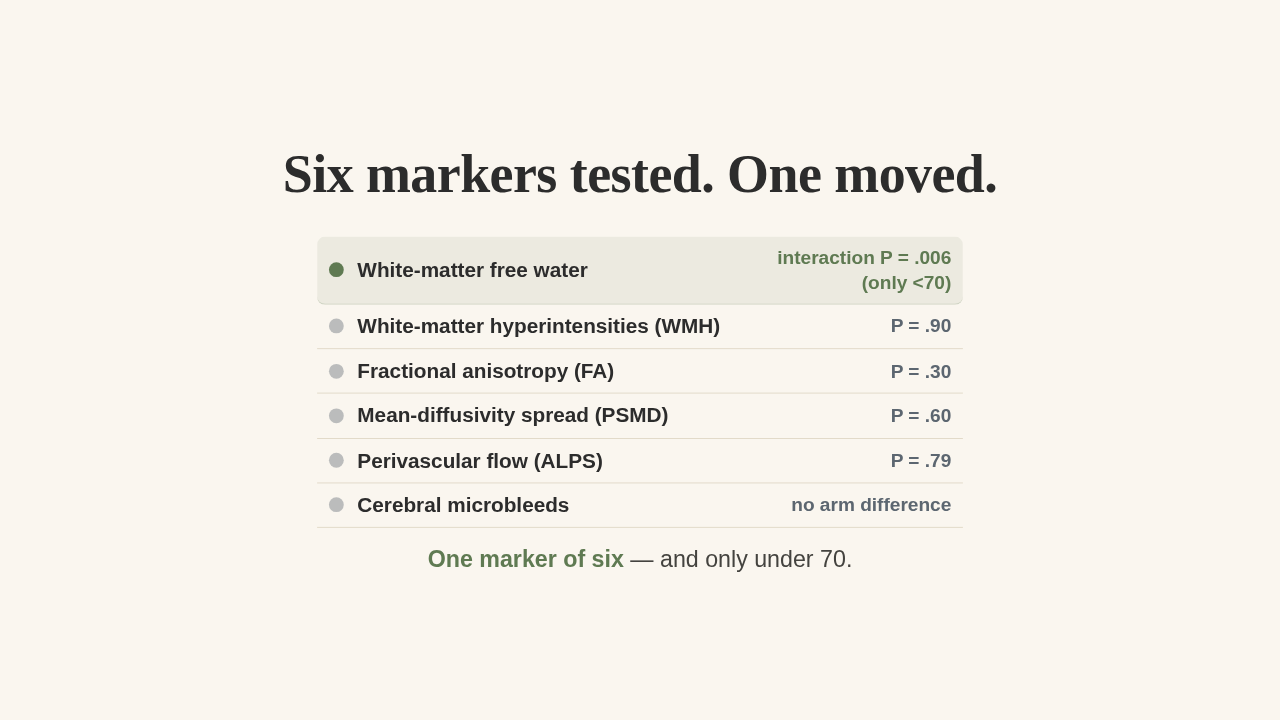
Six markers tested. One moved.

White-matter free water interaction P = .006 (only <70)
White-matter hyperintensities (WMH) P = .90
Fractional anisotropy (FA) P = .30
Mean-diffusivity spread (PSMD) P = .60
Perivascular flow (ALPS) P = .79
Cerebral microbleeds no arm difference
One marker of six — and only under 70.

And free water was the only one of six markers that moved. Five of six showed no difference between the programs: white-matter hyperintensities, with a p-value of point nine; fractional anisotropy, point three; and two more small-vessel measures. Only free water responded, and only under seventy. One marker of six.

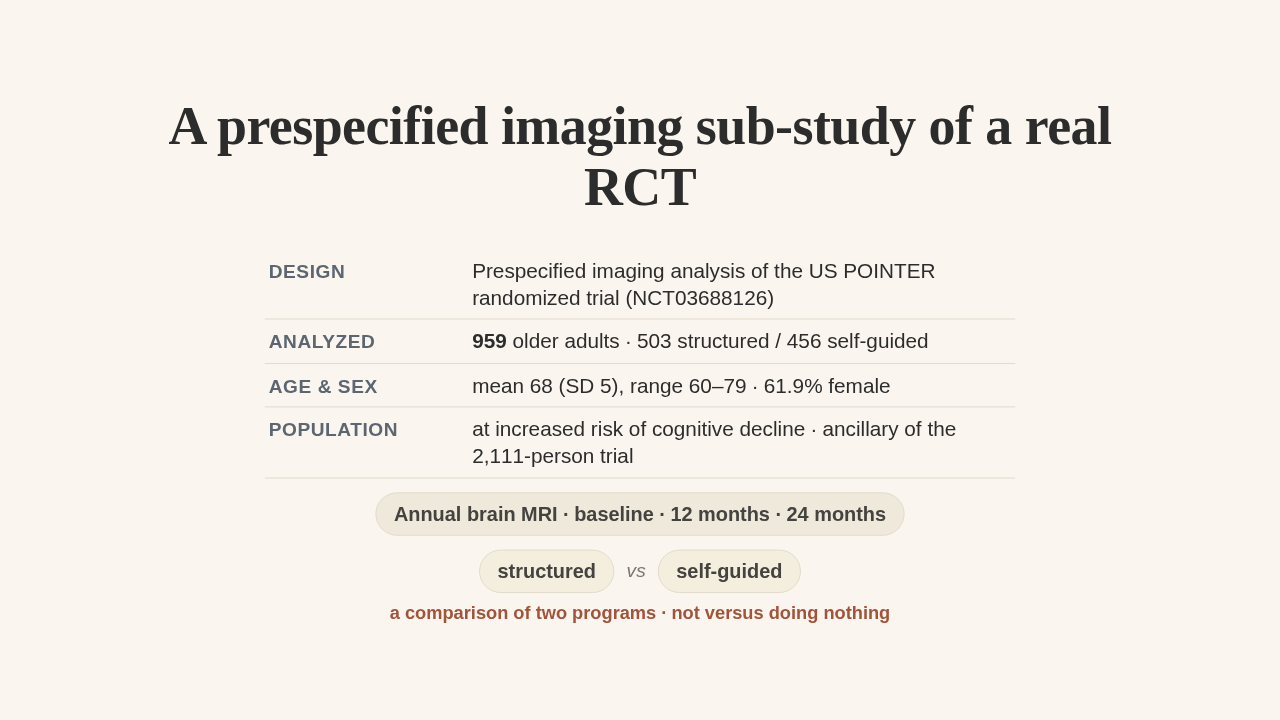
A prespecified imaging sub-study of a real RCT

Design Prespecified imaging analysis of the US POINTER randomized trial (NCT03688126)
Analyzed 959 older adults · 503 structured / 456 self-guided
Age & sex mean 68 (SD 5), range 60–79 · 61.9% female
Population at increased risk of cognitive decline · ancillary of the 2,111-person trial
Annual brain MRI · baseline · 12 months · 24 months
structured vs self-guided
a comparison of two programs · not versus doing nothing

This was a prespecified imaging sub-study of nine hundred and fifty-nine older adults. Brain scans at the start, one year, and two years. And the comparison is structured versus self-guided, not versus doing nothing.

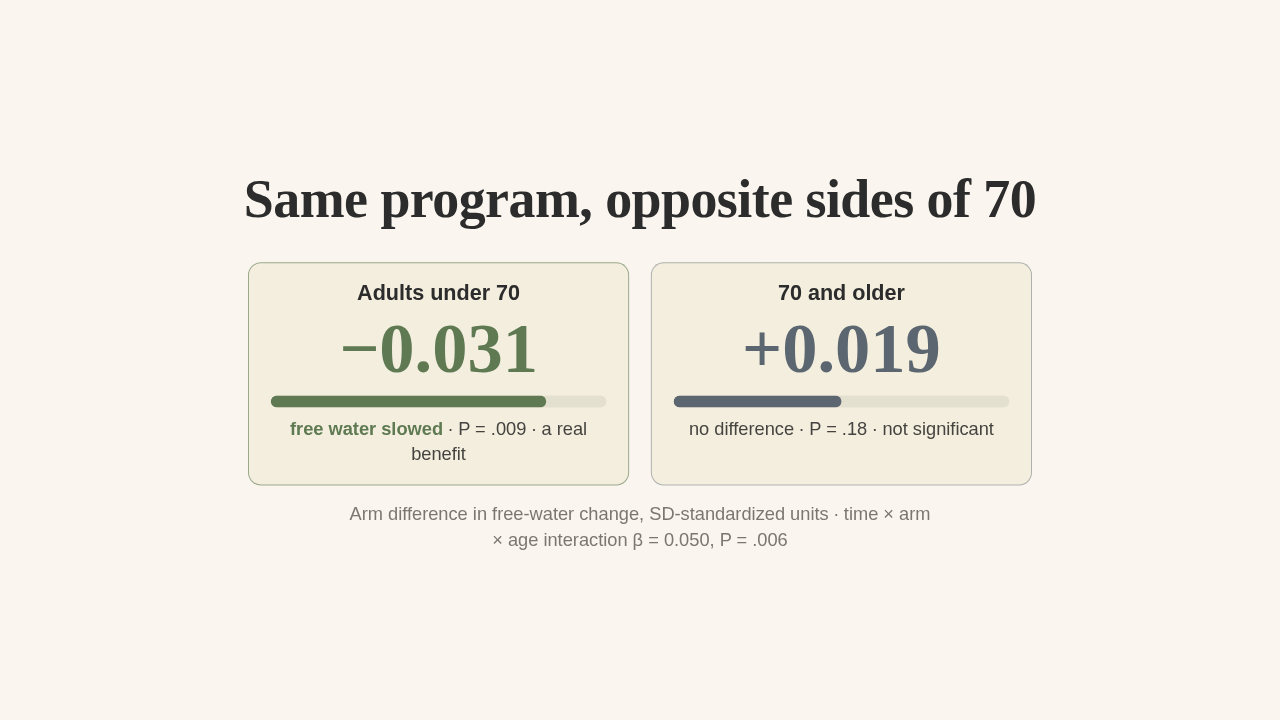
Same program, opposite sides of 70

Adults under 70
−0.031
free water slowed · P = .009 · a real benefit
70 and older
+0.019
no difference · P = .18 · not significant
Arm difference in free-water change, SD-standardized units · time × arm × age interaction β = 0.050, P = .006

The whole result sits on one side of seventy. In adults under seventy, the effect on free water was minus zero point zero three one, with a p-value of point zero zero nine. A real benefit. At seventy and older, plus zero point zero one nine, and not significant. Same program, opposite sides of seventy.

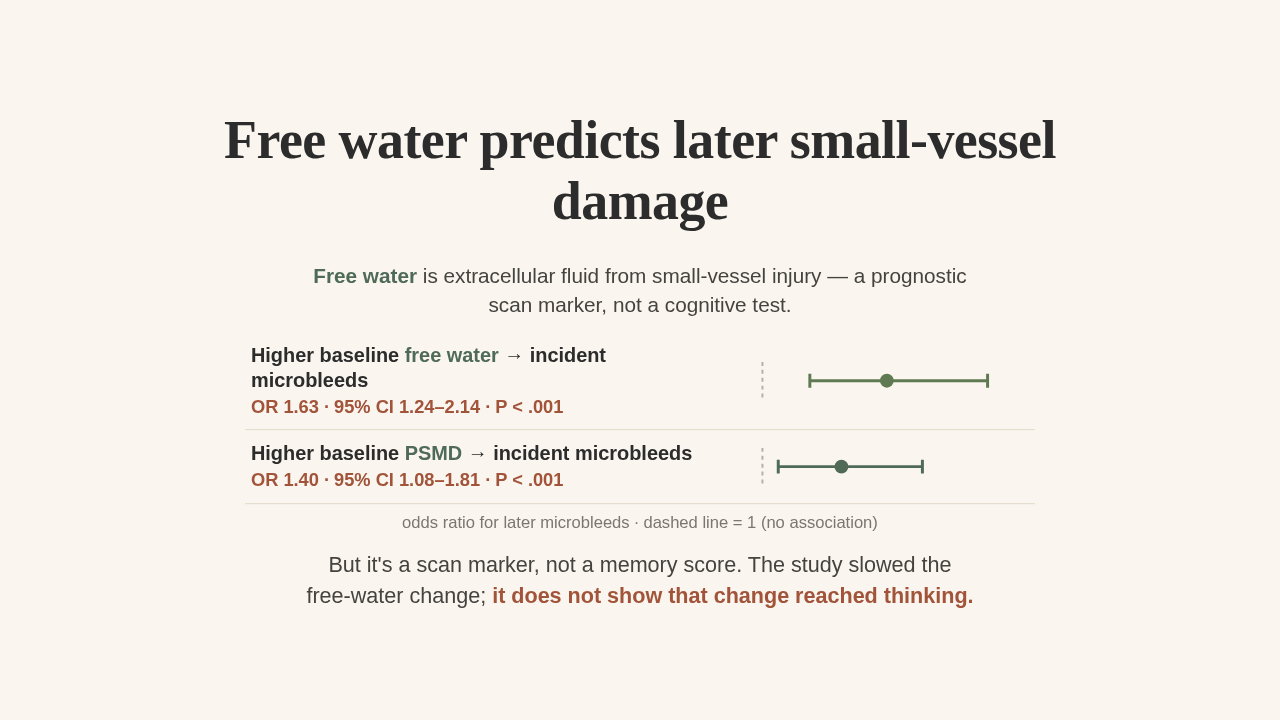
Free water predicts later small-vessel damage

Free water is extracellular fluid from small-vessel injury — a prognostic scan marker, not a cognitive test.
Higher baseline free water → incident microbleeds
OR 1.63 · 95% CI 1.24–2.14 · P < .001
Higher baseline PSMD → incident microbleeds
OR 1.40 · 95% CI 1.08–1.81 · P < .001
odds ratio for later microbleeds · dashed line = 1 (no association)
But it's a scan marker, not a memory score. The study slowed the free-water change; it does not show that change reached thinking.

Free water matters because it's prognostic. Adults who started with more of it later had more small brain bleeds, an odds ratio of one point six three. But it's a scan marker, not a memory score. The study slowed the free-water change; it does not show that change reached thinking.

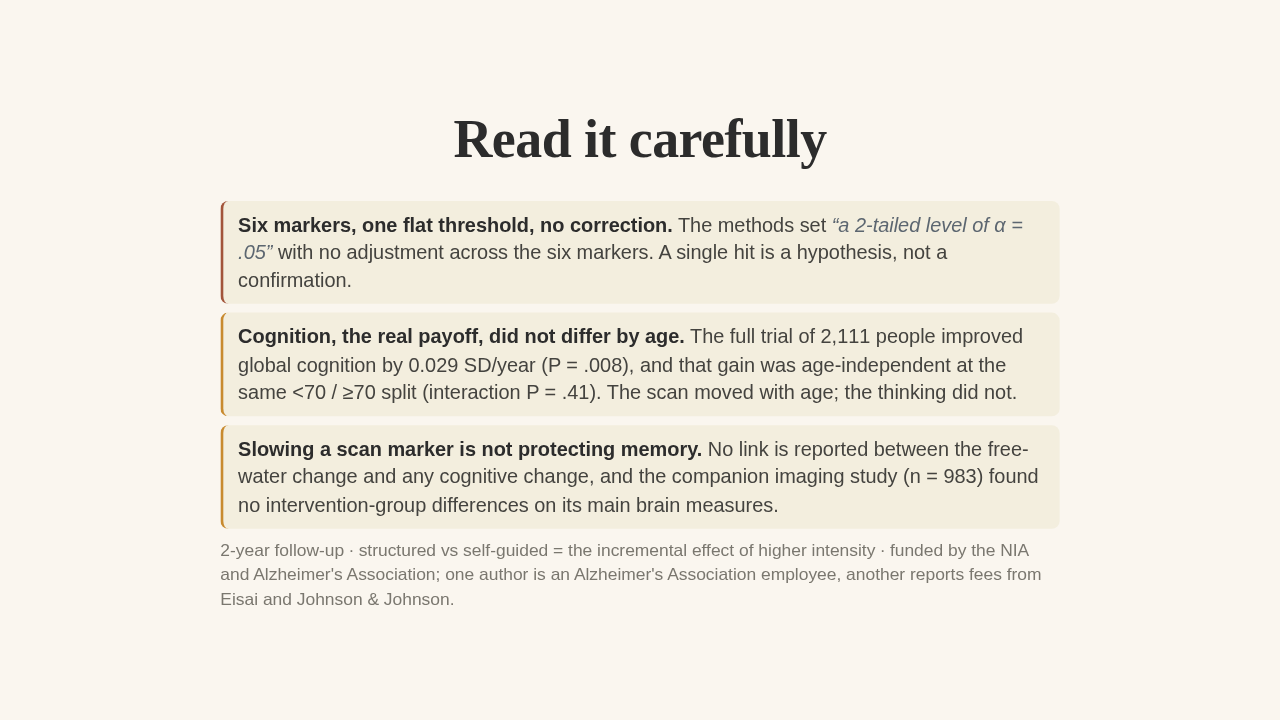
Read it carefully

Six markers, one flat threshold, no correction. The methods set “a 2-tailed level of α = .05” with no adjustment across the six markers. A single hit is a hypothesis, not a confirmation.
Cognition, the real payoff, did not differ by age. The full trial of 2,111 people improved global cognition by 0.029 SD/year (P = .008), and that gain was age-independent at the same <70 / ≥70 split (interaction P = .41). The scan moved with age; the thinking did not.
Slowing a scan marker is not protecting memory. No link is reported between the free-water change and any cognitive change, and the companion imaging study (n = 983) found no intervention-group differences on its main brain measures.
2-year follow-up · structured vs self-guided = the incremental effect of higher intensity · funded by the NIA and Alzheimer's Association; one author is an Alzheimer's Association employee, another reports fees from Eisai and Johnson & Johnson.

Three real limits. One: six markers were tested with no correction for multiple comparisons, so a single hit is a hypothesis, not a confirmation. Two: the trial's real payoff, cognition, did not differ by age. In the full trial of two thousand one hundred and eleven people, thinking improved under and over seventy alike. The scan moved with age. The thinking did not. Three: the companion imaging study found no difference between the programs on its main brain measures.

Slide 8

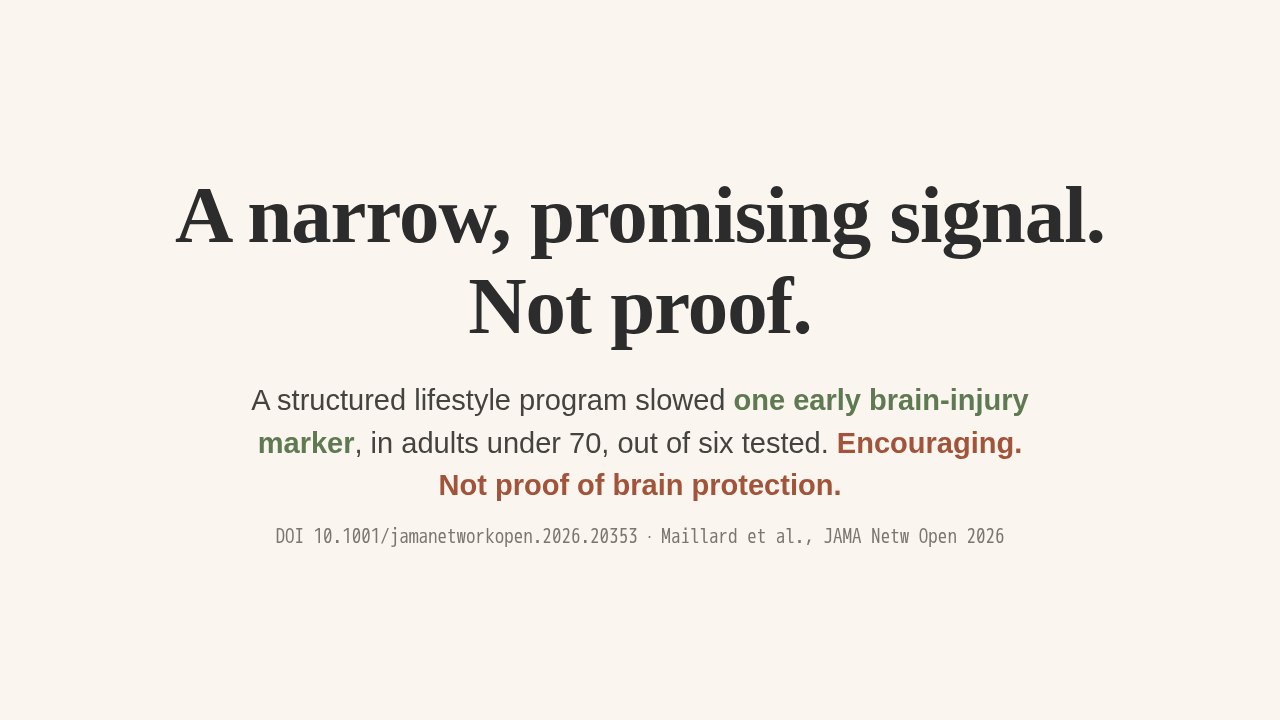
A narrow, promising signal. Not proof.
A structured lifestyle program slowed one early brain-injury marker, in adults under 70, out of six tested. Encouraging. Not proof of brain protection.
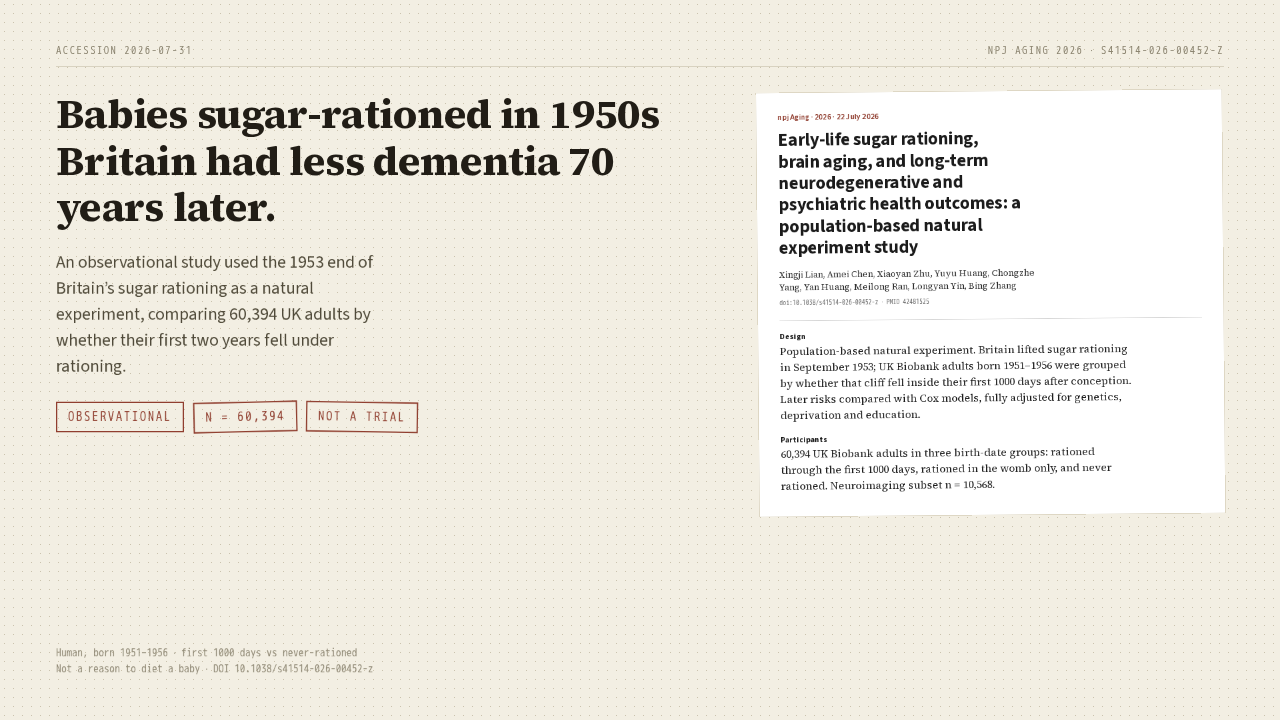
DOI 10.1001/jamanetworkopen.2026.20353 · Maillard et al., JAMA Netw Open 2026

So, the takeaway. A structured lifestyle program slowed one early brain-injury marker, in adults under seventy, out of six tested. An encouraging, biologically plausible lead. Not proof that starting before seventy protects the brain, and not a reason to change anything today.