A blood test trained on death pointed at the liver
Researchers trained a blood test to predict death instead of age. And it out-predicted the standard checkup. This was in eight hundred and forty-eight older adults in Taiwan. And the loudest part of the signal didn't come from the heart, or the brain. It came from the liver.
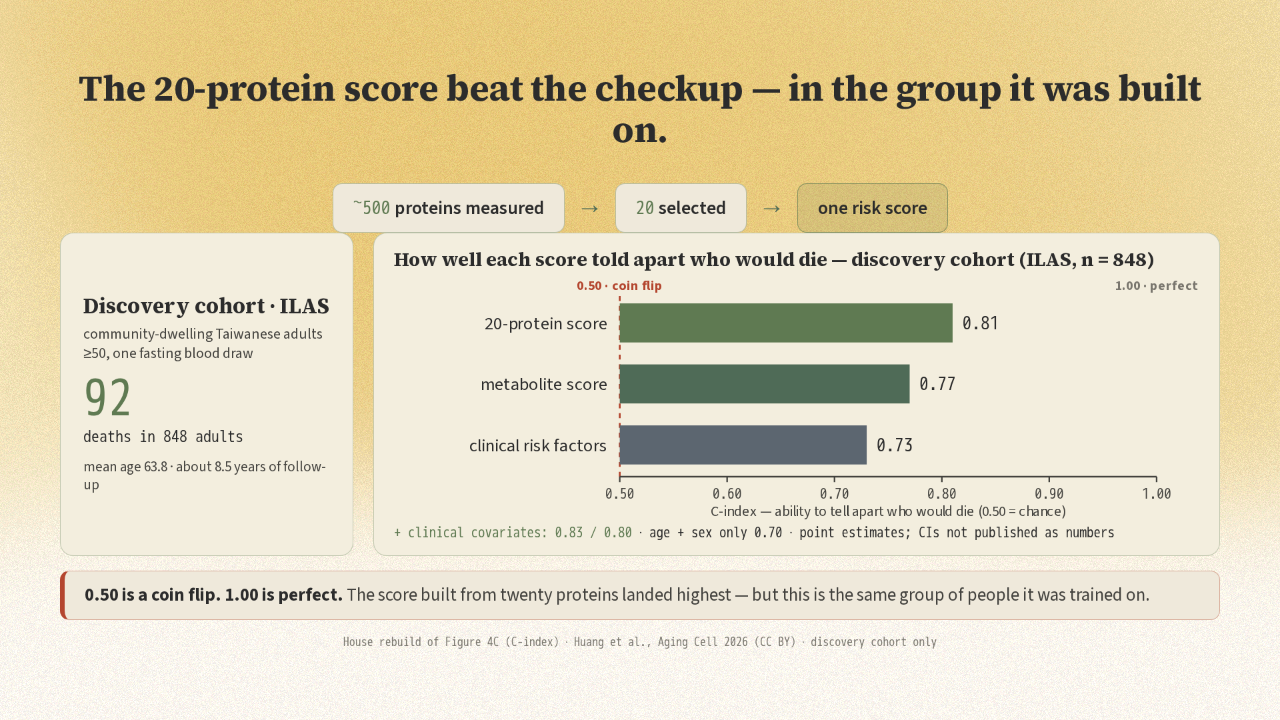
The 20-protein score beat the checkup — in the group it was built on.
In these eight hundred and forty-eight adults, ninety-two died. The team measured hundreds of proteins from each blood sample, then picked twenty and built them into one risk score. In the group they built it on, that score landed at point eight one. A metabolite score came in at point seven seven. And the usual clinical risk factors, like age and blood pressure, came in at point seven three. Point five would be a coin flip.
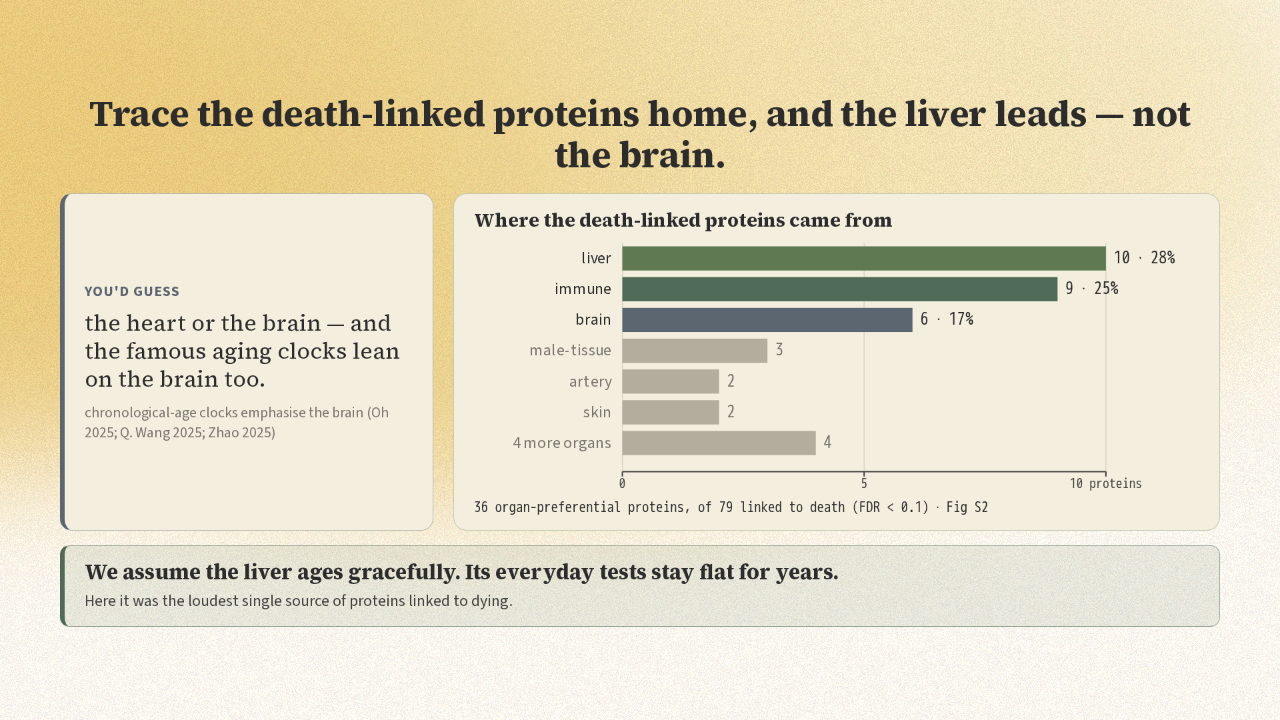
Trace the death-linked proteins home, and the liver leads — not the brain.
So which organ would you expect that signal to come from? You'd probably say the heart or the brain. The famous aging clocks lean on the brain too. But of the death-linked proteins they could trace to an organ, ten came from the liver, nine from the immune system, and only six from the brain. We assume the liver ages gracefully. Its everyday tests stay flat for years. Here it was the loudest signal for dying.
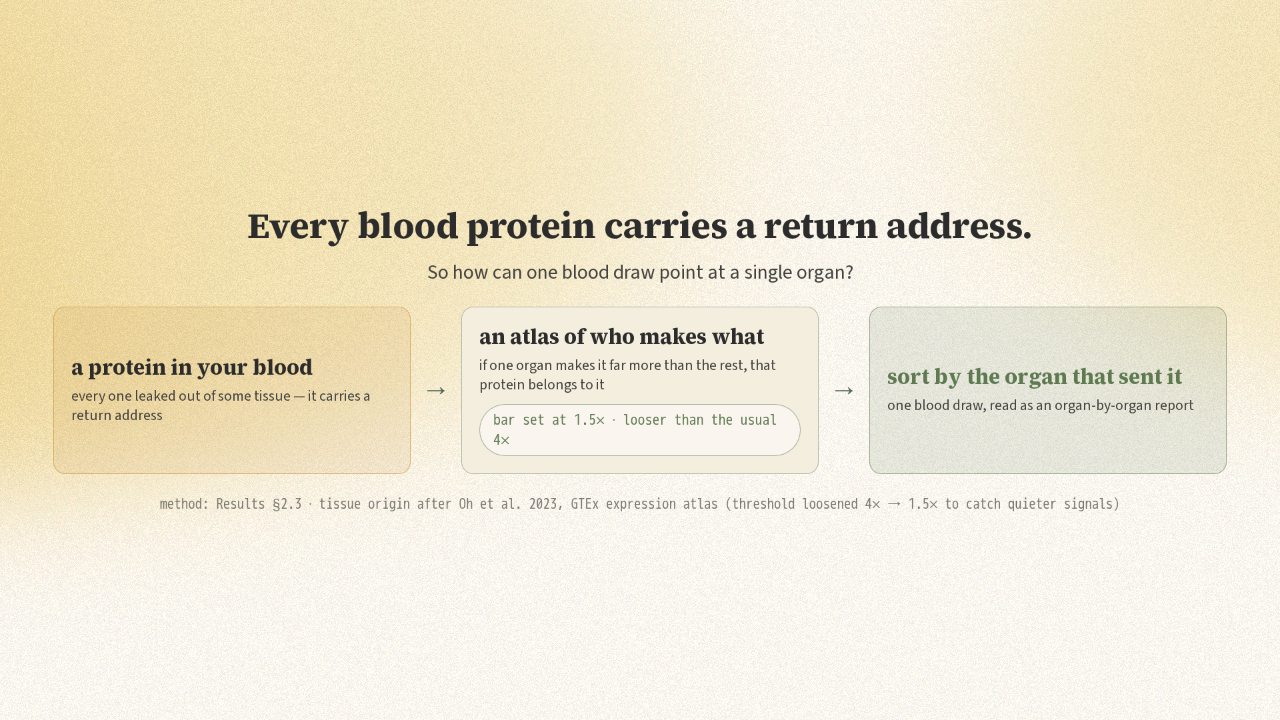
Every blood protein carries a return address.
So how can blood point at one organ? Every protein in your blood leaked out of some tissue. Each one carries a return address. The team used an atlas of which organs make which proteins. When one organ makes a protein far more than the rest, that protein belongs to it. They set the bar at one and a half times, looser than the usual four, to catch quieter signals. Now you can sort every death-linked protein by the organ that sent it. That's one blood draw, read as an organ-by-organ report.
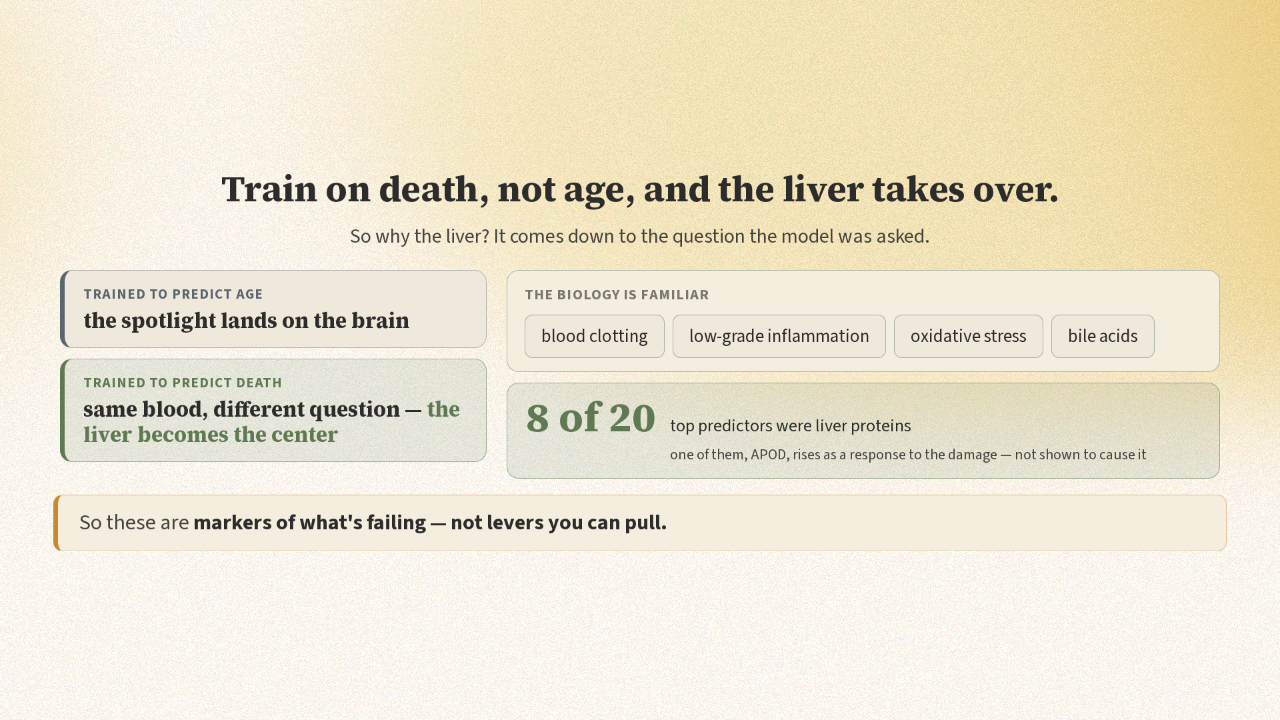
Train on death, not age, and the liver takes over.
So why the liver? Most aging clocks are trained to predict your age, and those spotlight the brain. This model was trained on death instead. Same blood, different question. Under that question, the liver became the center. The biology is familiar. Blood clotting. Slow, low-grade inflammation. Oxidative stress. And bile acids from the liver. Eight of the top twenty predictors were liver proteins. One of them, APOD, looks like a response to the damage, not a cause of it. So these are markers of what's failing, not levers you can pull.
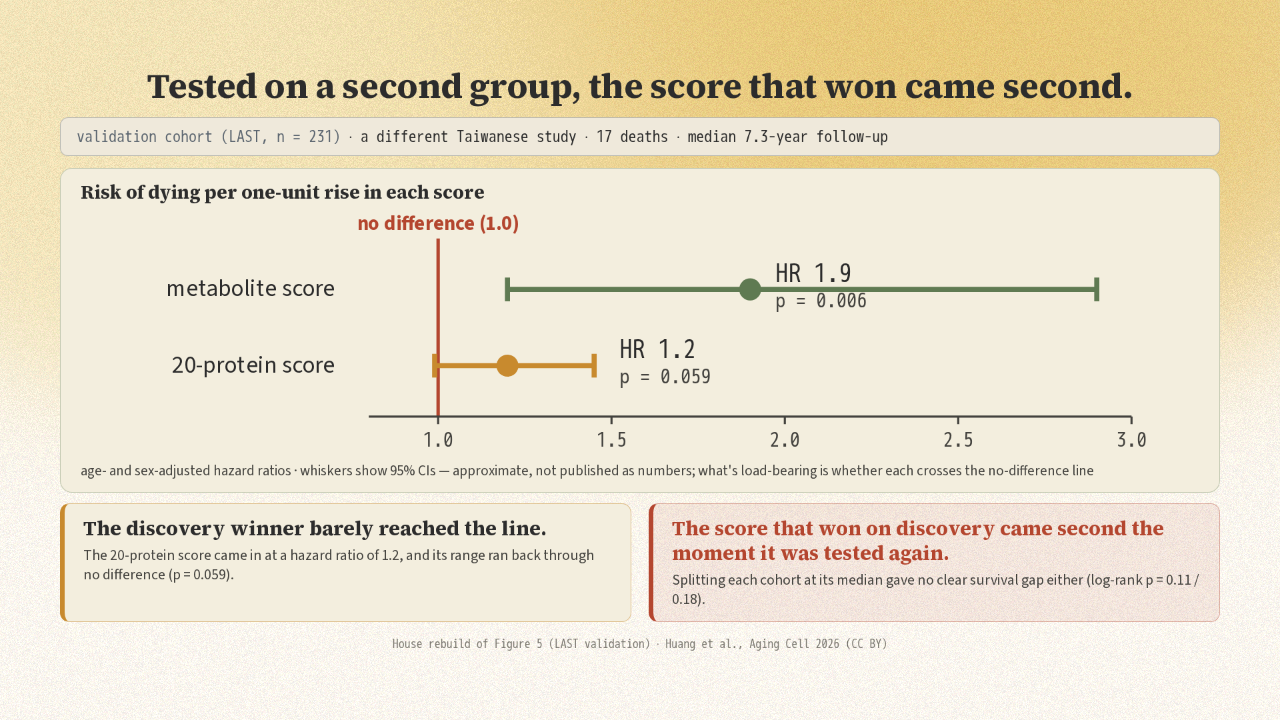
Tested on a second group, the score that won came second.
The team tested both scores on a fresh, separate group of older adults, in a different Taiwanese study. It had two hundred and thirty-one people. Seventeen of them died. This time the humble metabolite score was the one that held. Higher scores meant a higher risk of dying. But the protein score, the discovery winner, barely reached the line, at a hazard ratio of one point two, and its range ran back through the no-difference line. The score that won on discovery came second the moment they tested it again.
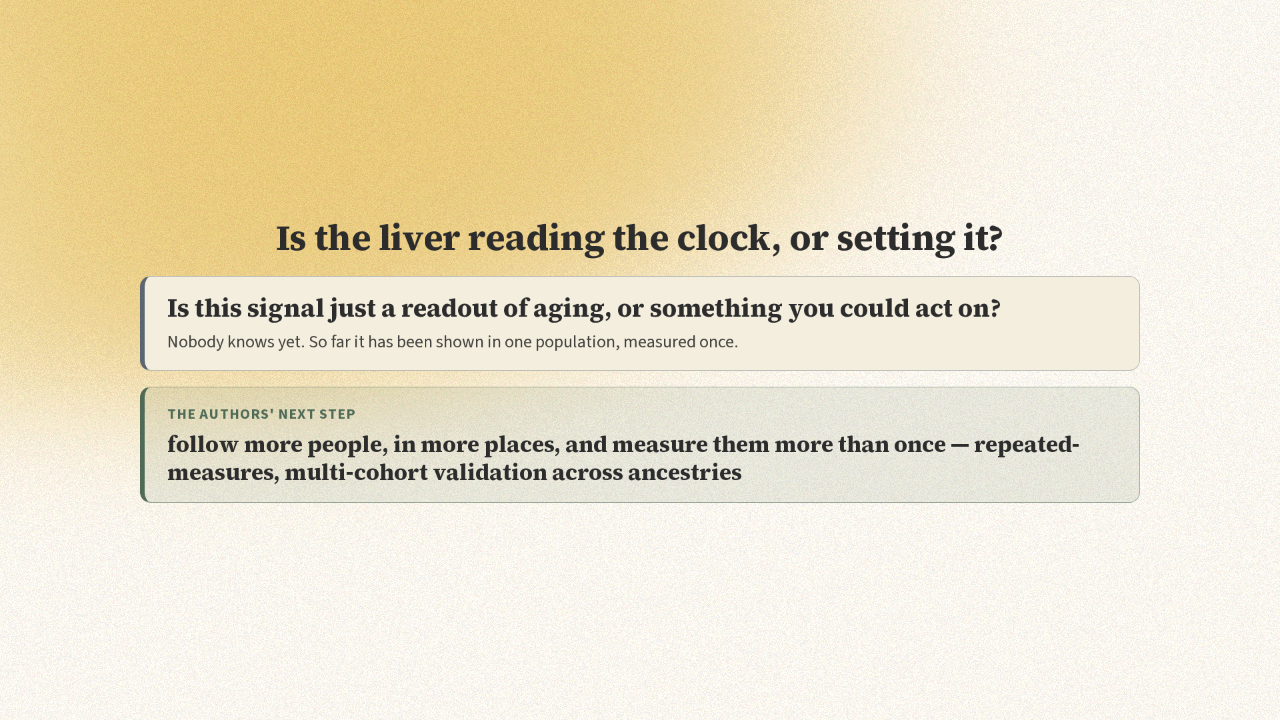
Is the liver reading the clock, or setting it?
So is the liver reading the clock, or setting it? Is this signal just a readout of aging, or something you could act on? Nobody knows yet. So far it's been shown in one population, measured once. The authors call for the obvious next step. Follow more people, in more places, and measure them more than once.
The blood a doctor calls normal keeps an organ-by-organ record of what's aging you toward death.
So the next time a blood draw comes back normal, remember what else is in it. That same blood keeps an organ-by-organ record of what's aging you toward death. And read that way, the loudest chapter isn't the brain's. It's the liver's.