In aged mice, the brain's cleanup crew breaks in the wiring

2 months ago

When a brain gets old, we picture neurons dying. In naturally aged mice, the sharpest damage sits somewhere else. It's in the wiring, not the thinking cells. And it traces to the brain's own cleanup crew, breaking down in one exact spot.

Ask

Ask about this presentation

Answers are generated from this presentation.

Chapters

  1. 0:00In aged mice, the brain's cleanup crew breaks in the wiring
  2. 0:14Rare in young brains. Dense in aged wiring. Densest in one tract.
  3. 0:35The aging signal is in the cables, not the processors.
  4. 1:03A cleanup cell, broken by its own cleanup.
  5. 1:34Why this tract, and not the one beside it.
  6. 2:01“A more youthful organization” = number, size, and direction.
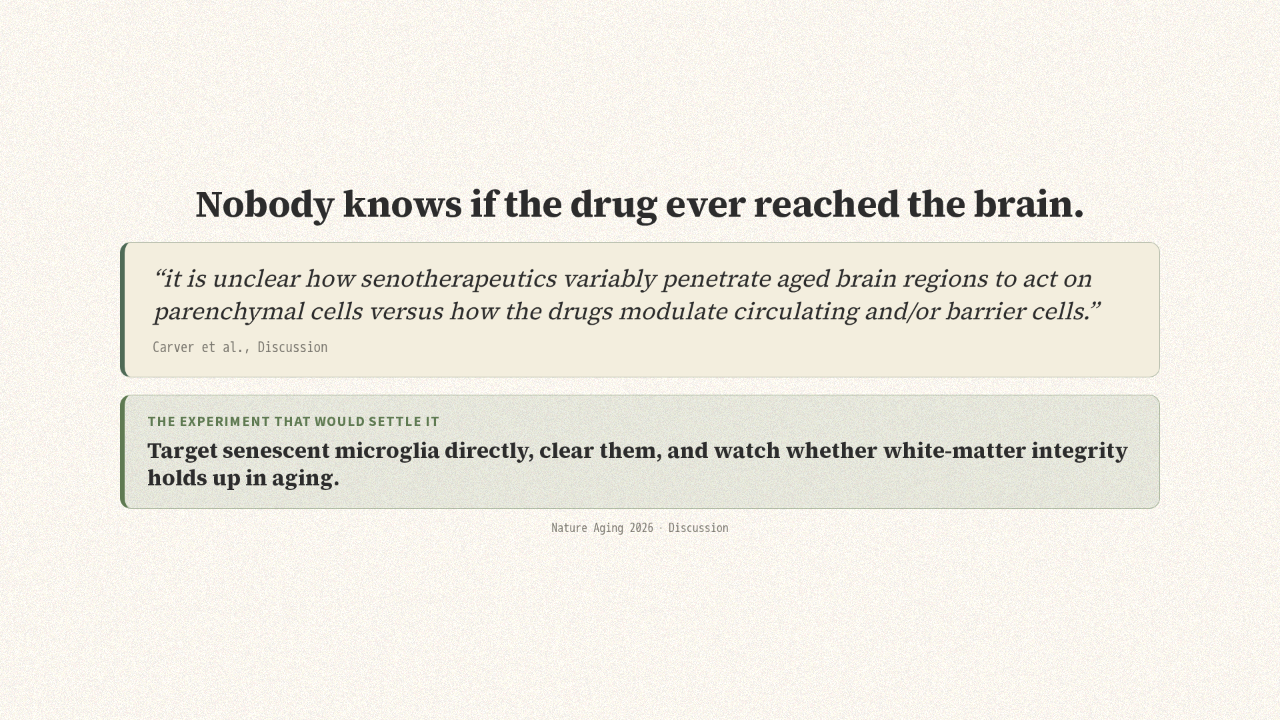
  7. 2:39Nobody knows if the drug ever reached the brain.
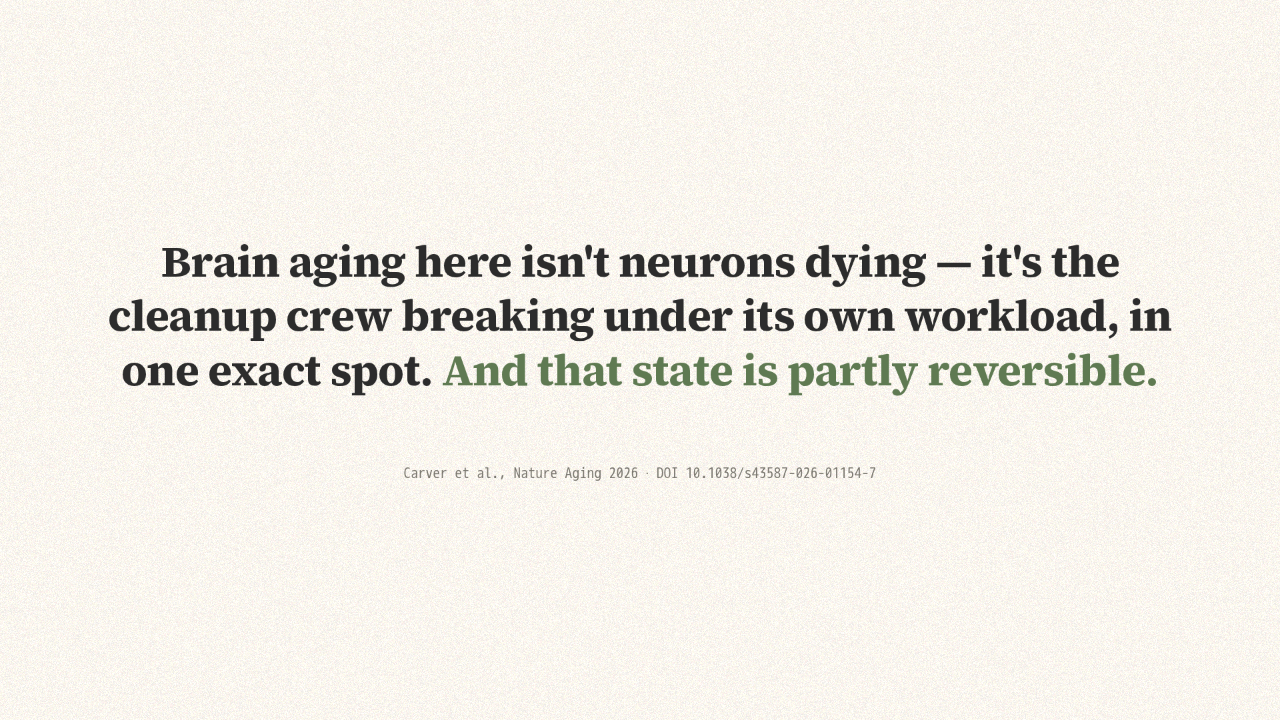
  8. 3:01Brain aging here isn't neurons dying — it's the cleanup crew breaking under its own workload, in one exact spot. And that state is partly reversible.
Show transcript

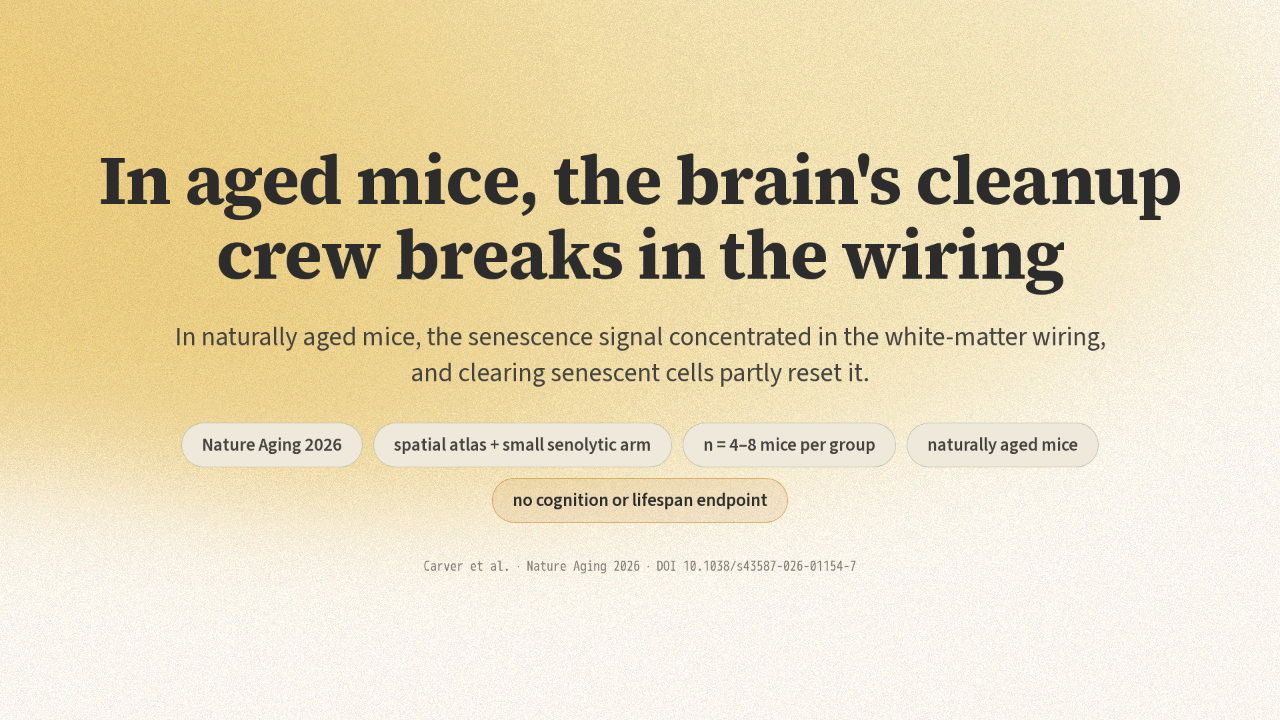
In aged mice, the brain's cleanup crew breaks in the wiring

In naturally aged mice, the senescence signal concentrated in the white-matter wiring, and clearing senescent cells partly reset it.
Nature Aging 2026 spatial atlas + small senolytic arm n = 4–8 mice per group naturally aged mice no cognition or lifespan endpoint
Carver et al. · Nature Aging 2026 · DOI 10.1038/s43587-026-01154-7

When a brain gets old, we picture neurons dying. In naturally aged mice, the sharpest damage sits somewhere else. It's in the wiring, not the thinking cells. And it traces to the brain's own cleanup crew, breaking down in one exact spot.

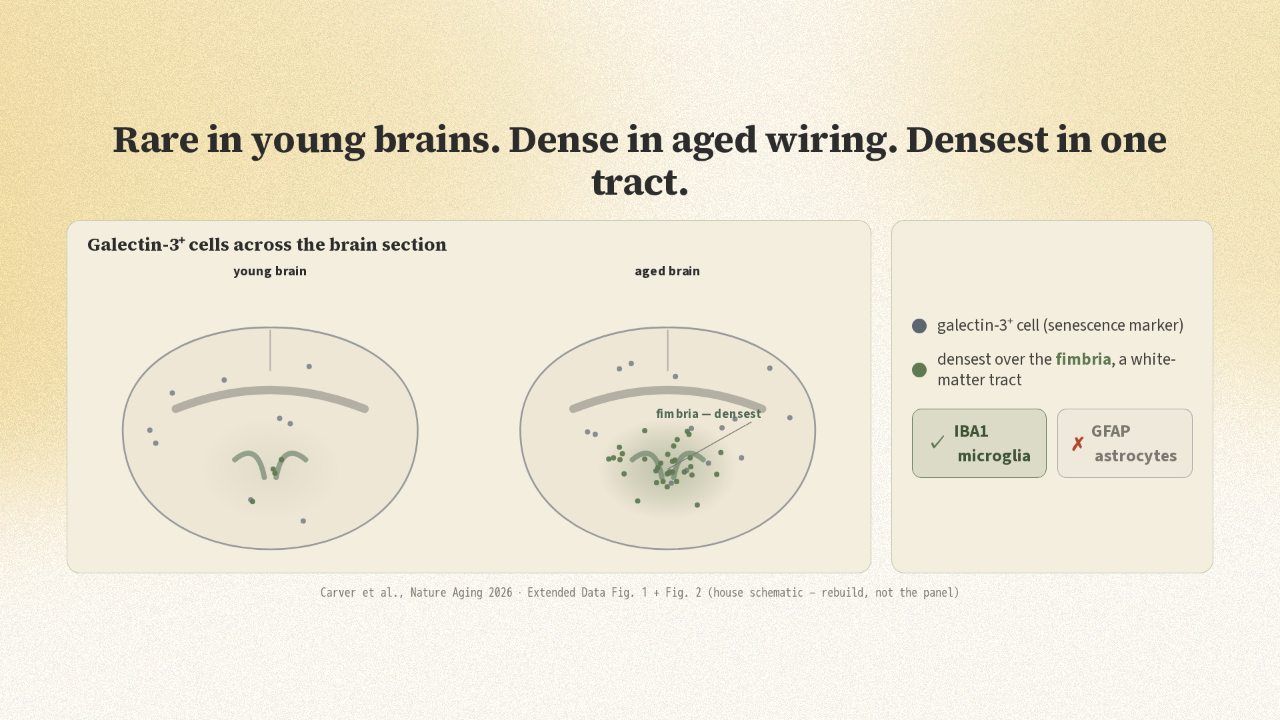
Rare in young brains. Dense in aged wiring. Densest in one tract.

Galectin-3⁺ cells across the brain section
young brainaged brainfimbria — densest
galectin-3⁺ cell (senescence marker)
densest over the fimbria, a white-matter tract
✓ IBA1  microglia
✗ GFAP  astrocytes
Carver et al., Nature Aging 2026 · Extended Data Fig. 1 + Fig. 2 (house schematic — rebuild, not the panel)

The researchers stained aged mouse brains for a senescence marker, galectin-3. In young brains it was rare. In aged white matter it was dense, thickest in one tract, the fimbria. The marker sat on microglia, the brain's cleanup cells, not on the astrocytes. So this is one cell type, in one place.

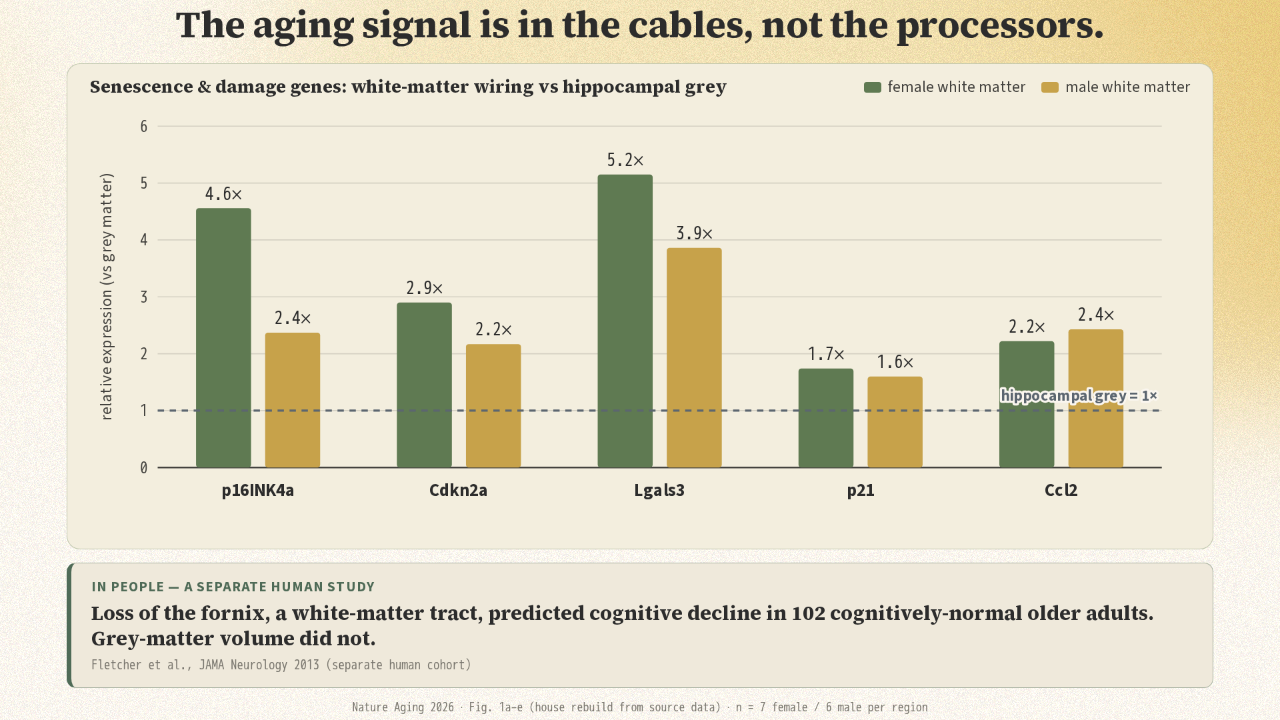
The aging signal is in the cables, not the processors.

Senescence & damage genes: white-matter wiring vs hippocampal grey
female white matter male white matter
01234564.6×2.4×p16​INK4a2.9×2.2×Cdkn2a5.2×3.9×Lgals31.7×1.6×p212.2×2.4×Ccl2hippocampal grey = 1×relative expression (vs grey matter)
In people — a separate human study
Loss of the fornix, a white-matter tract, predicted cognitive decline in 102 cognitively-normal older adults. Grey-matter volume did not.
Fletcher et al., JAMA Neurology 2013 (separate human cohort)
Nature Aging 2026 · Fig. 1a–e (house rebuild from source data) · n = 7 female / 6 male per region

When we picture an aging brain, we picture neurons dying in the hippocampus. But here, the senescence and damage genes ran higher in the wiring than in the hippocampus, in both males and females. The signal was in the cables, not the processors. A separate human study saw the same shape. It followed 102 older adults with healthy memory. The ones who lost a wiring tract, the fornix, were the ones who declined. Their grey matter gave no warning.

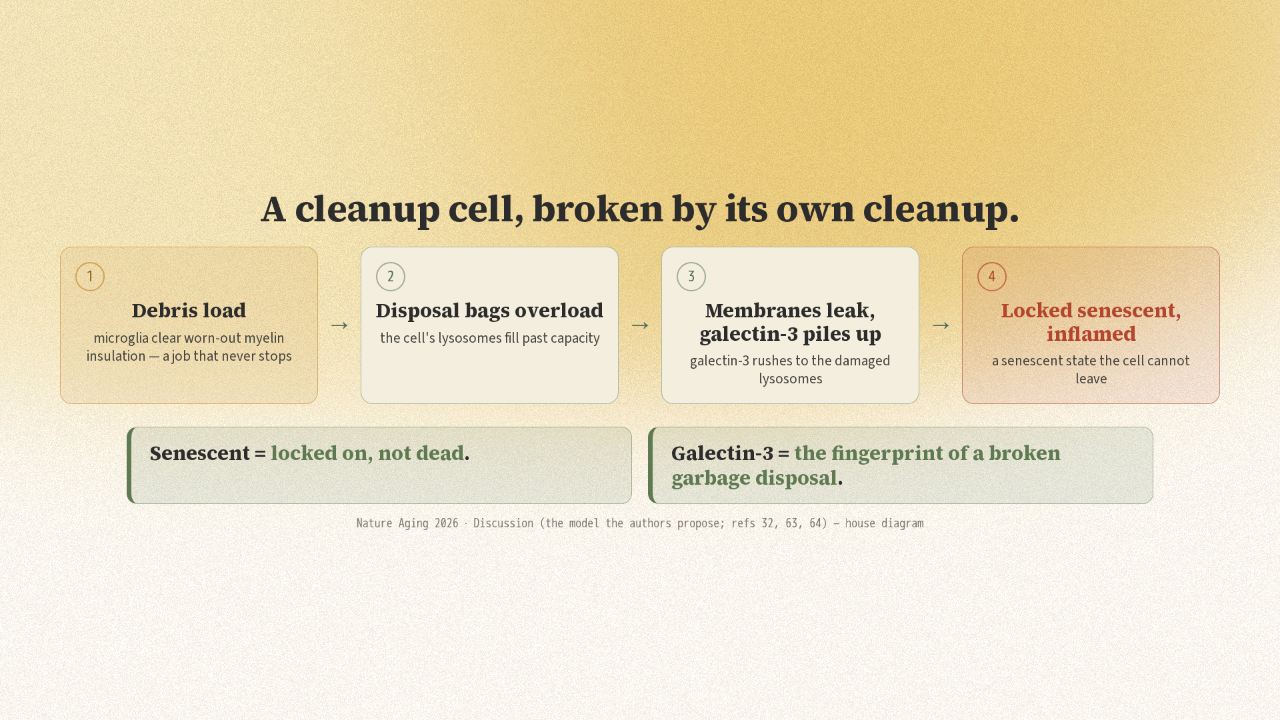
A cleanup cell, broken by its own cleanup.

1
Debris load
microglia clear worn-out myelin insulation — a job that never stops
→
2
Disposal bags overload
the cell's lysosomes fill past capacity
→
3
Membranes leak, galectin-3 piles up
galectin-3 rushes to the damaged lysosomes
→
4
Locked senescent, inflamed
a senescent state the cell cannot leave
Senescent = locked on, not dead.
Galectin-3 = the fingerprint of a broken garbage disposal.
Nature Aging 2026 · Discussion (the model the authors propose; refs 32, 63, 64) — house diagram

So why would a cleanup cell break? Here's the model the authors propose. Microglia clear worn-out insulation from the brain's wiring, and that job never stops. Swallow enough debris, and the cell's disposal bags overload. Overloaded, they spring leaks. Galectin-3 rushes in and piles up at the leaks. That's why the marker sits on these cells at all. Then the cell locks into a senescent, inflamed state it cannot leave. Senescent doesn't mean dead. It means locked on. Galectin-3 is the fingerprint of a broken garbage disposal.

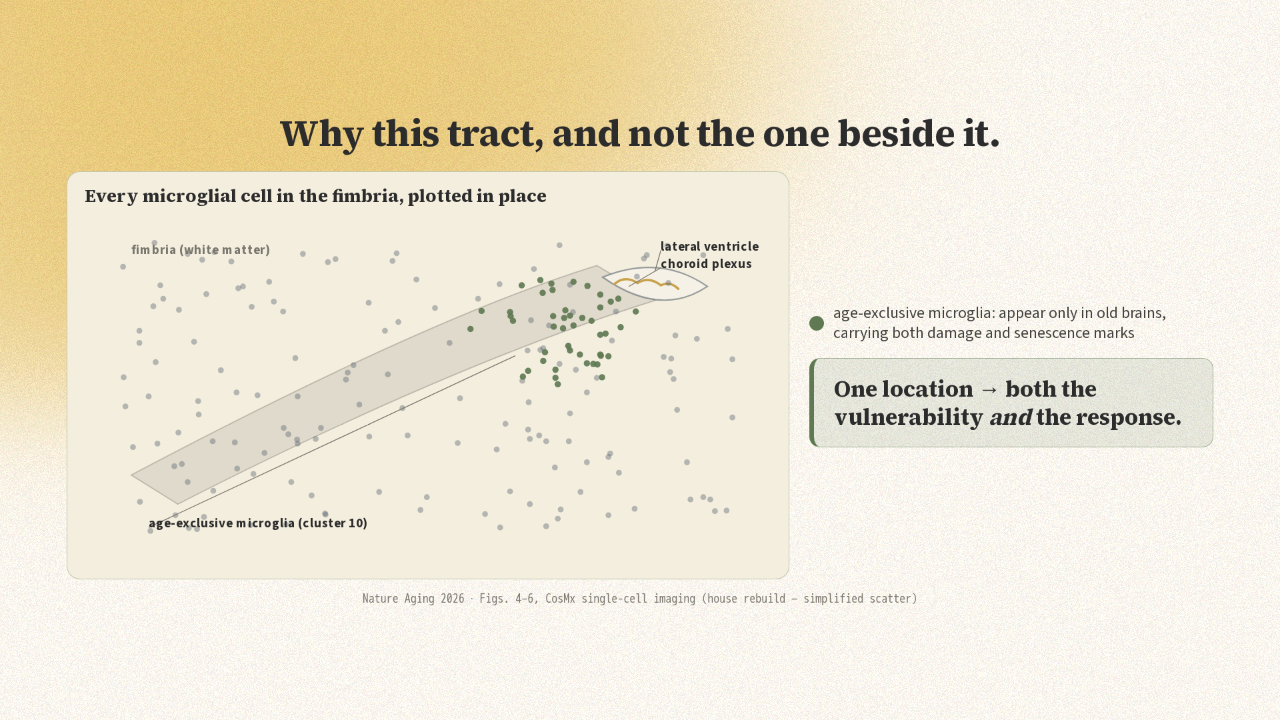
Why this tract, and not the one beside it.

Every microglial cell in the fimbria, plotted in place
lateral ventriclechoroid plexusage-exclusive microglia (cluster 10)fimbria (white matter)
age-exclusive microglia: appear only in old brains, carrying both damage and senescence marks
One location → both the vulnerability and the response.
Nature Aging 2026 · Figs. 4–6, CosMx single-cell imaging (house rebuild — simplified scatter)

But why this tract, and not the one beside it? The authors point to geography. The fimbria sits right against the choroid plexus and the fluid-filled ventricle. That leaves it unusually exposed to whatever the blood and brain fluid carry. And they posit that this one spot explains two opposite things: why the fimbria breaks first, and why it responds first. Single-cell imaging found a group of microglia that appears only in old brains, carrying both the damage and senescence marks.

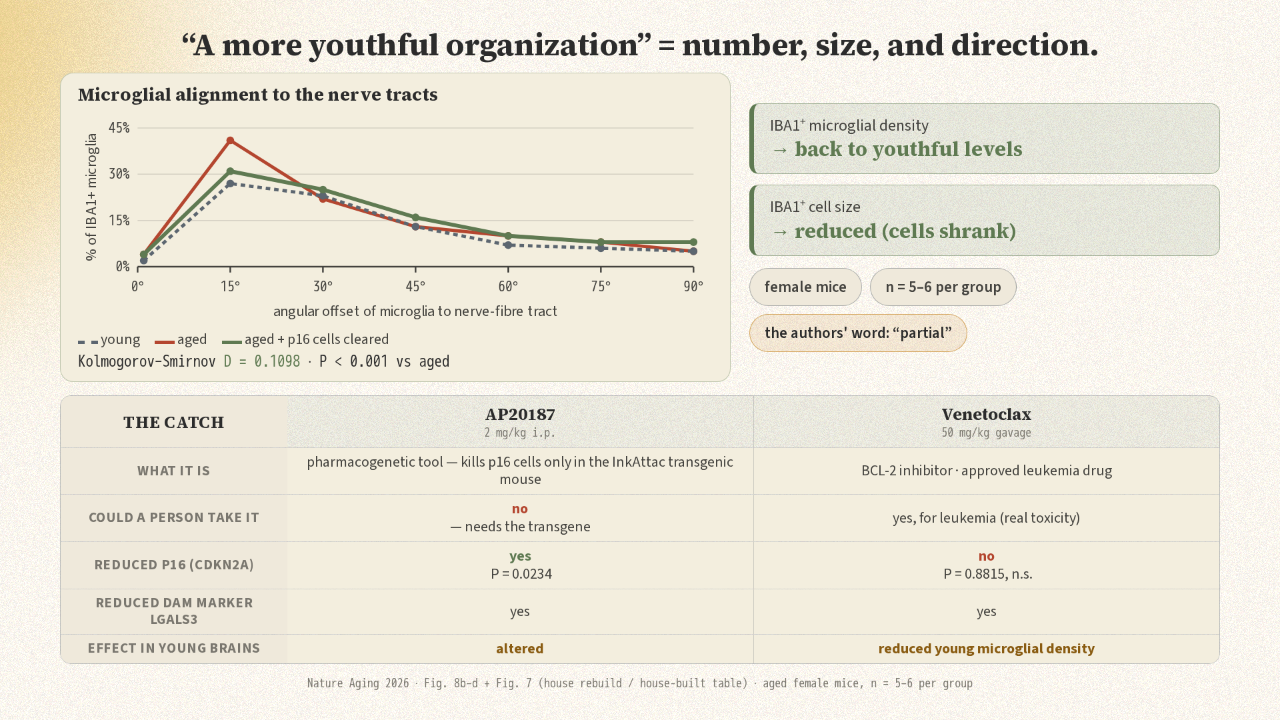
“A more youthful organization” = number, size, and direction.

“A more youthful organization” = number, size, and direction.

Microglial alignment to the nerve tracts
0%15%30%45%0°15°30°45°60°75°90°angular offset of microglia to nerve-fibre tract% of IBA1+ microglia
young aged aged + p16 cells cleared
Kolmogorov–Smirnov D = 0.1098 · P < 0.001 vs aged
IBA1⁺ microglial density
→ back to youthful levels
IBA1⁺ cell size
→ reduced (cells shrank)
female mice n = 5–6 per group the authors' word: “partial”
the catch
AP20187
2 mg/kg i.p.
Venetoclax
50 mg/kg gavage
what it is
pharmacogenetic tool — kills p16 cells only in the InkAttac transgenic mouse
BCL-2 inhibitor · approved leukemia drug
could a person take it
no — needs the transgene
yes, for leukemia (real toxicity)
reduced p16 (Cdkn2a)
yes  P = 0.0234
no  P = 0.8815, n.s.
reduced DAM marker Lgals3
yes
yes
effect in young brains
altered
reduced young microglial density
Nature Aging 2026 · Fig. 8b–d + Fig. 7 (house rebuild / house-built table) · aged female mice, n = 5–6 per group

Can any of it be undone? In aged female mice, the team cleared the p16 cells. In the fimbria, three things reset. The microglia thinned back to youthful numbers. The swollen cells shrank. And the cells that had lined up along the nerve fibres swung back toward youth. Five or six mice per group. The authors call it partial. And nobody tested whether the mice could think any better. But here's the catch. The tool that did the most is not a drug. It's a genetic self-destruct switch that only works in an engineered mouse. The one that is a drug, venetoclax, approved for leukemia, cut a damage marker but never reduced p16, and it altered young brains too.

Nobody knows if the drug ever reached the brain.

“it is unclear how senotherapeutics variably penetrate aged brain regions to act on parenchymal cells versus how the drugs modulate circulating and/or barrier cells.”
Carver et al., Discussion
The experiment that would settle it
Target senescent microglia directly, clear them, and watch whether white-matter integrity holds up in aging.
Nature Aging 2026 · Discussion

Here's what nobody has settled. It isn't clear that these treatments acted on the brain at all. The authors say so plainly. It's unclear whether the drugs reach the brain and act there directly, or whether they clear senescent cells elsewhere in the body and only change the brain from a distance. And they name the experiment that would settle it. Target senescent microglia directly, clear them, and watch whether the wiring holds up.

Brain aging here isn't neurons dying &#8212; it's the cleanup crew breaking under its own workload, in one exact spot. And that state is partly reversible.

Brain aging here isn't neurons dying — it's the cleanup crew breaking under its own workload, in one exact spot. And that state is partly reversible.

Carver et al., Nature Aging 2026 · DOI 10.1038/s43587-026-01154-7

In these mice, aging in the brain's wiring isn't neurons dying. It's the cleanup crew breaking down under its own workload, in one exact spot. And that broken state is partly reversible. A support cell, undone by the job it was built to do.