Aging's inflammation may start in your blood stem cells (mice)

2 months ago

The inflammation that comes with age may not start where you'd think. In mice, a lot of it may begin in the blood stem cells, deep in the bone marrow. Swap only those stem cells into a young mouse, and its muscle, brain and lung grow old differently.

Ask

Ask about this presentation

Answers are generated from this presentation.

Chapters

  1. 0:00Aging's inflammation may start in your blood stem cells (mice)
  2. 0:13Change one thing in the marrow. Read it out in muscle, brain and lung.
  3. 0:33Inflammation you can't square with wear and tear.
  4. 0:53Aging leaves a memory in the stem cell. SIRT3 erases it.
  5. 1:25Portable inflammation: a few cells carry it, one antibody undoes it.
  6. 2:00You can count the training: the inflammatory cells creep up.
  7. 2:34How does an enzyme in the mitochondria change the marks on the DNA?
  8. 2:56In these mice, aging's inflammation wasn't only wear and tear — part of it was a memory written into the blood stem cell, and one enzyme kept it from forming.
Show transcript

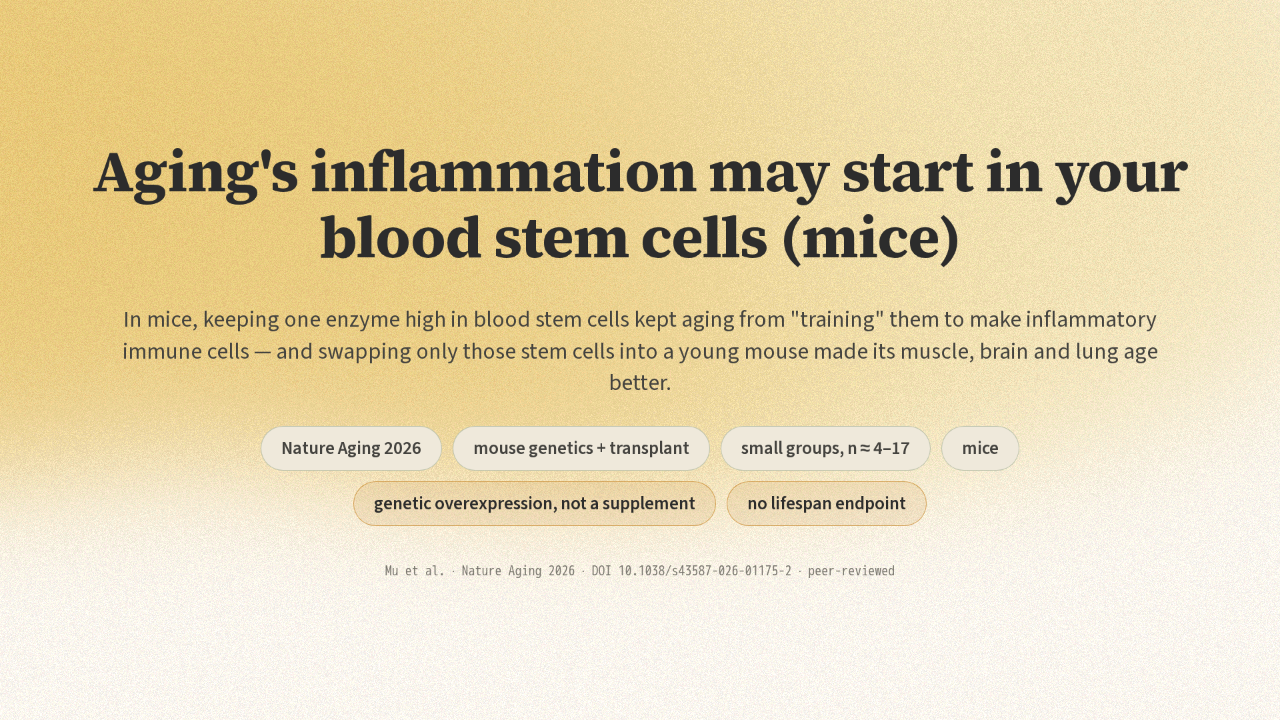
Aging's inflammation may start in your blood stem cells (mice)

In mice, keeping one enzyme high in blood stem cells kept aging from "training" them to make inflammatory immune cells — and swapping only those stem cells into a young mouse made its muscle, brain and lung age better.
Nature Aging 2026 mouse genetics + transplant small groups, n ≈ 4–17 mice genetic overexpression, not a supplement no lifespan endpoint
Mu et al. · Nature Aging 2026 · DOI 10.1038/s43587-026-01175-2 · peer-reviewed

The inflammation that comes with age may not start where you'd think. In mice, a lot of it may begin in the blood stem cells, deep in the bone marrow. Swap only those stem cells into a young mouse, and its muscle, brain and lung grow old differently.

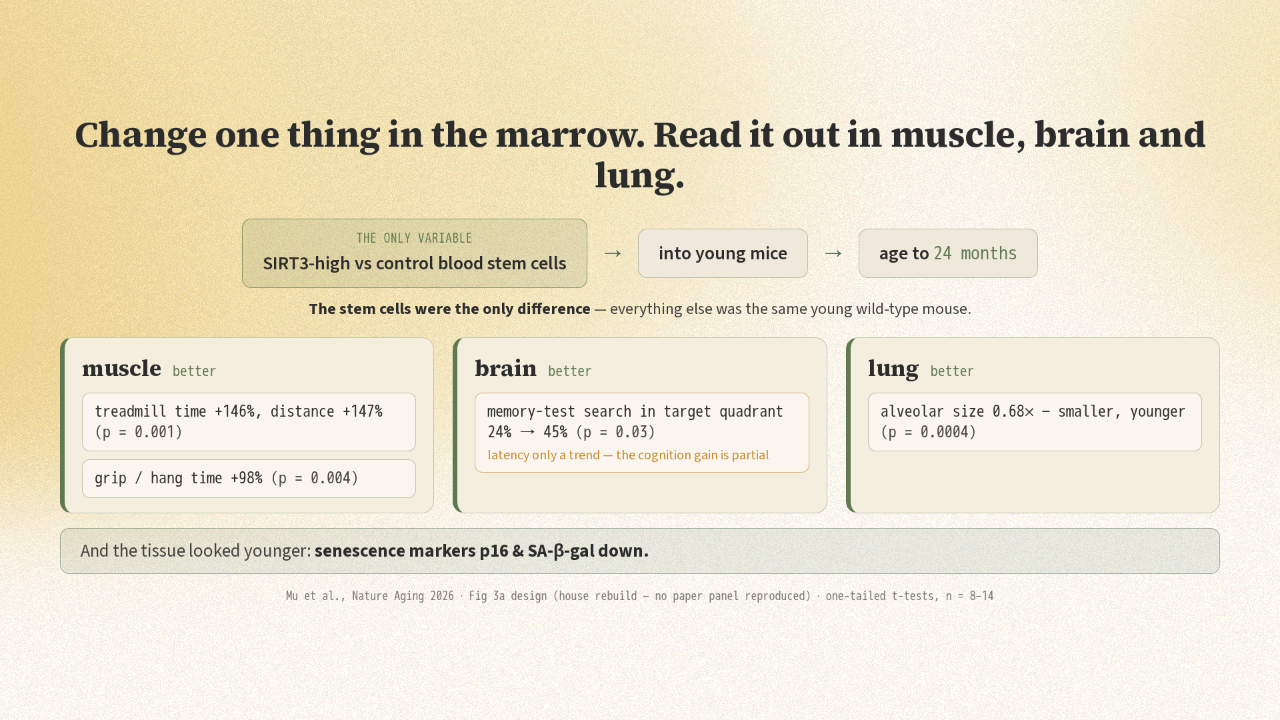
Change one thing in the marrow. Read it out in muscle, brain and lung.

the only variableSIRT3-high vs control blood stem cells → into young mice → age to 24 months
The stem cells were the only difference — everything else was the same young wild-type mouse.
muscle better
treadmill time +146%, distance +147% (p = 0.001)
grip / hang time +98% (p = 0.004)
brain better
memory-test search in target quadrant 24% → 45% (p = 0.03)latency only a trend — the cognition gain is partial
lung better
alveolar size 0.68× — smaller, younger (p = 0.0004)
And the tissue looked younger: senescence markers p16 & SA-β-gal down.
Mu et al., Nature Aging 2026 · Fig 3a design (house rebuild — no paper panel reproduced) · one-tailed t-tests, n = 8–14

Here's what they did. They took blood stem cells and switched on an enzyme called SIRT3. They put those cells into young mice and aged them to two years. The stem cells were the only difference. Everything else was the same mouse. And the SIRT3-high mice ran longer on a treadmill, did better on part of a memory test, and had younger-looking lungs.

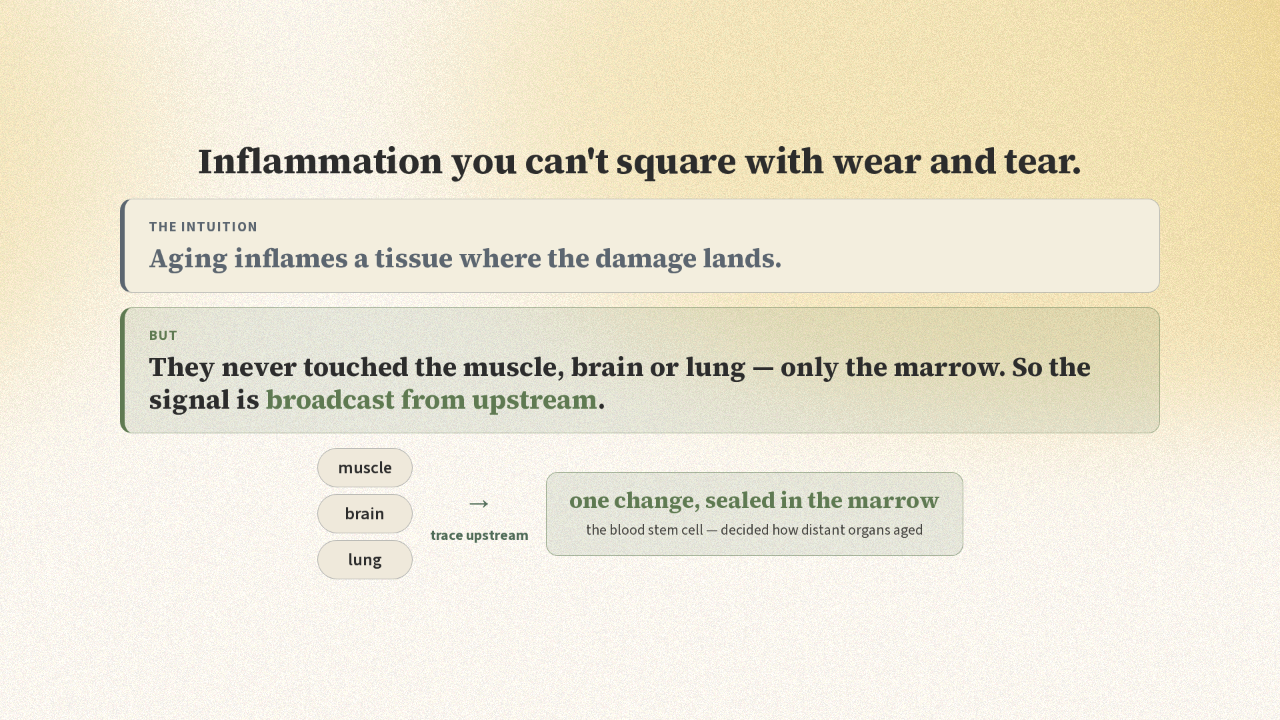
Inflammation you can't square with wear and tear.

The intuition
Aging inflames a tissue where the damage lands.
But
They never touched the muscle, brain or lung — only the marrow. So the signal is broadcast from upstream.
muscle
brain
lung
→trace upstream
one change, sealed in the marrow
the blood stem cell — decided how distant organs aged

We picture the inflammation of aging as wear and tear. Tissues take damage, so they get inflamed, right where the damage lands. But nobody touched the muscle, brain, or lung. They changed one thing in the marrow, then let the mouse age. If a change sealed in the marrow can decide how a brain ages, the inflammation isn't made where it lands. It's broadcast from upstream.

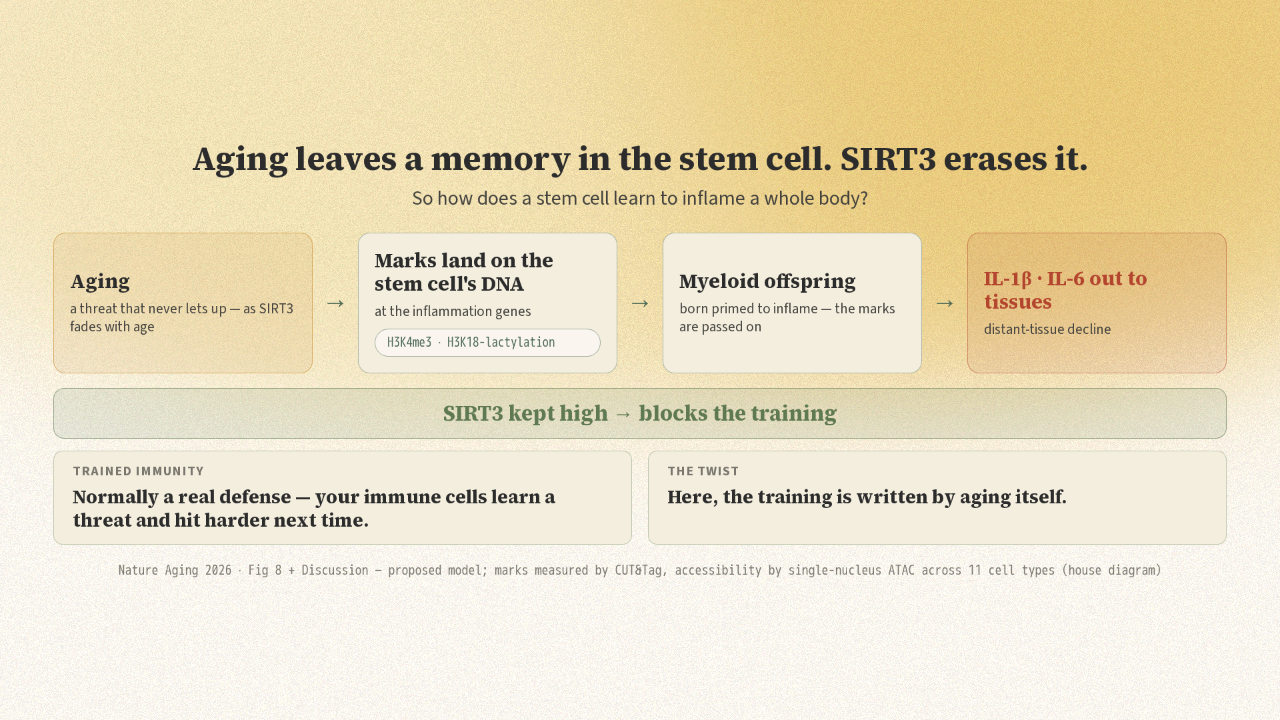
Aging leaves a memory in the stem cell. SIRT3 erases it.

So how does a stem cell learn to inflame a whole body?
Aging
a threat that never lets up — as SIRT3 fades with age
→
Marks land on the stem cell's DNA
at the inflammation genes
H3K4me3 · H3K18-lactylation
→
Myeloid offspring
born primed to inflame — the marks are passed on
→
IL-1β · IL-6 out to tissues
distant-tissue decline
SIRT3 kept high → blocks the training
Trained immunityNormally a real defense — your immune cells learn a threat and hit harder next time.
The twistHere, the training is written by aging itself.
Nature Aging 2026 · Fig 8 + Discussion — proposed model; marks measured by CUT&Tag, accessibility by single-nucleus ATAC across 11 cell types (house diagram)

So how does a stem cell learn to inflame a whole body? Your fast-response immune cells can remember a threat and hit harder next time. It's a real defense. The authors think aging becomes a threat that never lets up. And it trains the blood stem cells themselves. Aging marks their DNA at the inflammation genes. The stem cells pass those marks to the myeloid immune cells they make. So those cells are born primed to inflame. Aging's inflammation isn't only wear and tear. Part of it is a memory, written into the stem cell. SIRT3 erases that memory. And SIRT3 fades with age.

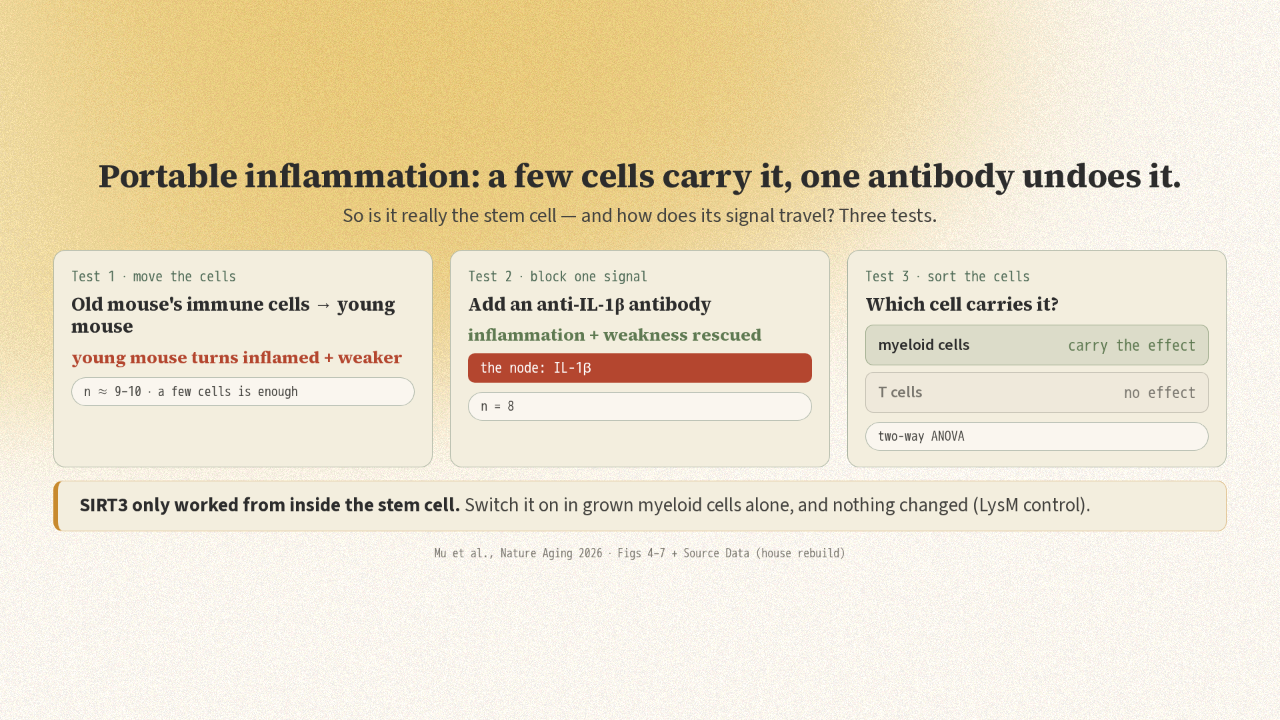
Portable inflammation: a few cells carry it, one antibody undoes it.

So is it really the stem cell — and how does its signal travel? Three tests.
Test 1 · move the cells
Old mouse's immune cells → young mouse
young mouse turns inflamed + weaker
n ≈ 9–10 · a few cells is enough
Test 2 · block one signal
Add an anti-IL-1β antibody
inflammation + weakness rescued
the node: IL-1β n = 8
Test 3 · sort the cells
Which cell carries it?
myeloid cells carry the effect
T cells no effect
two-way ANOVA
SIRT3 only worked from inside the stem cell. Switch it on in grown myeloid cells alone, and nothing changed (LysM control).
Mu et al., Nature Aging 2026 · Figs 4–7 + Source Data (house rebuild)

So is it really the stem cell, and how does its signal travel? Three tests. First, they moved the immune cells from an old mouse into a young one. The young mouse turned inflamed and weaker. A few altered cells were enough to carry it. Second, they blocked one signal, IL-1β, with an antibody. The inflammation and the weakness went away. So that signal was carrying the harm. Third, they sorted the cells. The myeloid cells carried the effect. The T cells didn't. And SIRT3 only helped from inside the stem cell. Switch it on in grown immune cells alone, and nothing changed.

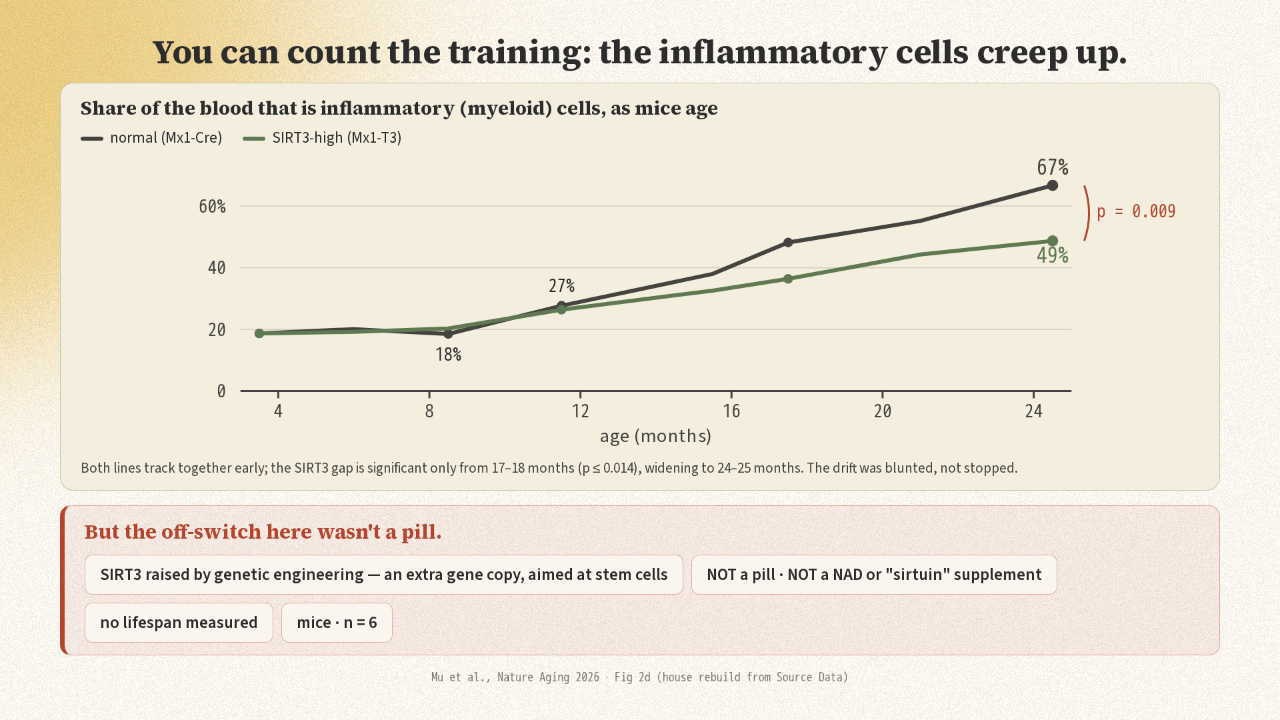
You can count the training: the inflammatory cells creep up.

Share of the blood that is inflammatory (myeloid) cells, as mice age
normal (Mx1-Cre) SIRT3-high (Mx1-T3)
0 20 40 60% 18% 27% 67% 49% p = 0.009 4 8 12 16 20 24 age (months)
Both lines track together early; the SIRT3 gap is significant only from 17–18 months (p ≤ 0.014), widening to 24–25 months. The drift was blunted, not stopped.
But the off-switch here wasn't a pill.
SIRT3 raised by genetic engineering — an extra gene copy, aimed at stem cells NOT a pill · NOT a NAD or "sirtuin" supplement no lifespan measured mice · n = 6
Mu et al., Nature Aging 2026 · Fig 2d (house rebuild from Source Data)

Now, the number. As a mouse ages, its stem cells drift toward making the inflammatory cells. In the normal mice, their share of the blood rose from eighteen to twenty-seven percent in a year, and kept climbing. In the SIRT3-high mice, the climb was slower. But here's the catch. The way they kept SIRT3 high was genetic engineering. They switched on an extra copy of the gene, aimed at the stem cells. It was not a pill, not a NAD booster, not a sirtuin supplement. And no one measured how long these mice lived. Every result here is about inflammation, function, and cells.

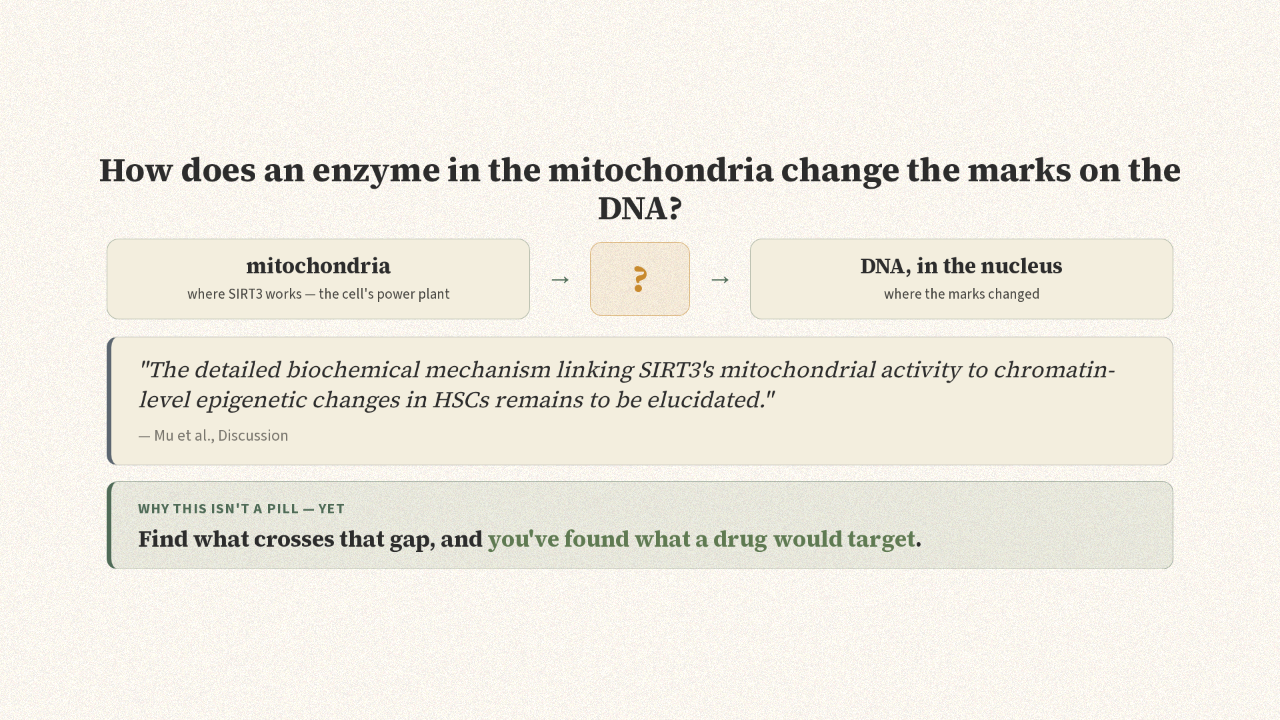
How does an enzyme in the mitochondria change the marks on the DNA?

mitochondria
where SIRT3 works — the cell's power plant
→
?
→
DNA, in the nucleus
where the marks changed
"The detailed biochemical mechanism linking SIRT3's mitochondrial activity to chromatin-level epigenetic changes in HSCs remains to be elucidated."
— Mu et al., Discussion
why this isn't a pill — yet
Find what crosses that gap, and you've found what a drug would target.

One thing still puzzles even the authors. SIRT3 works in the mitochondria, the cell's power plants. Yet the marks changed on the DNA, in the nucleus. How the signal crosses from one to the other, they write, remains to be elucidated. And that missing link is why this isn't a pill. Find what crosses that gap, and you've found what a drug would target.

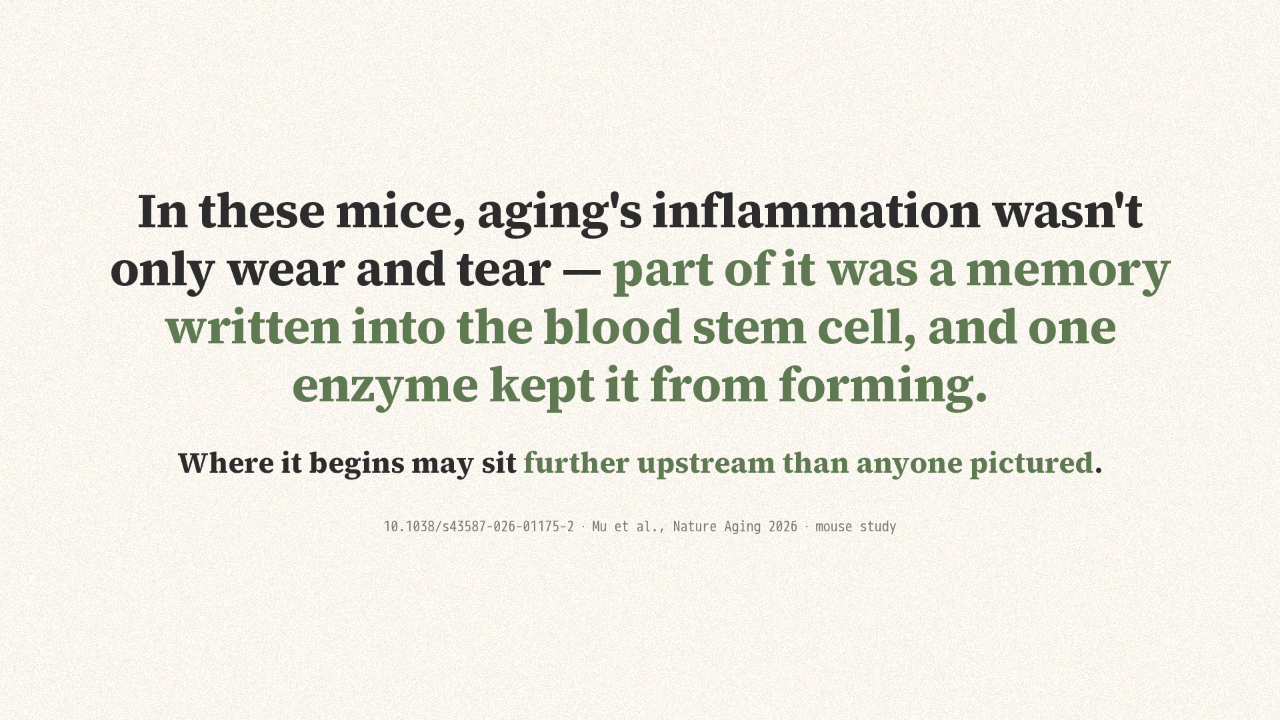
In these mice, aging's inflammation wasn't only wear and tear — part of it was a memory written into the blood stem cell, and one enzyme kept it from forming.

Where it begins may sit further upstream than anyone pictured.
10.1038/s43587-026-01175-2 · Mu et al., Nature Aging 2026 · mouse study

So in these mice, aging's inflammation wasn't only wear and tear. Part of it was a memory, written into the blood stem cells, carried outward by the cells they make. One enzyme kept that memory from forming. Where it begins may sit further upstream than anyone pictured.