Trained older muscle is missing half of aging's fingerprint

2 months ago

In older adults who train, about half of aging's molecular fingerprint in muscle simply isn't there. A new Nature Aging study read it straight from the tissue, gene by gene.

Ask

Ask about this presentation

Answers are generated from this presentation.

Chapters

  1. 0:00Slide 1
  2. 0:10About half of aging's muscle changes are absent in trained older adults
  3. 0:26Half of what? Aging turns down the muscle's power supply
  4. 0:38Four groups, one muscle, before and after a bout of cycling
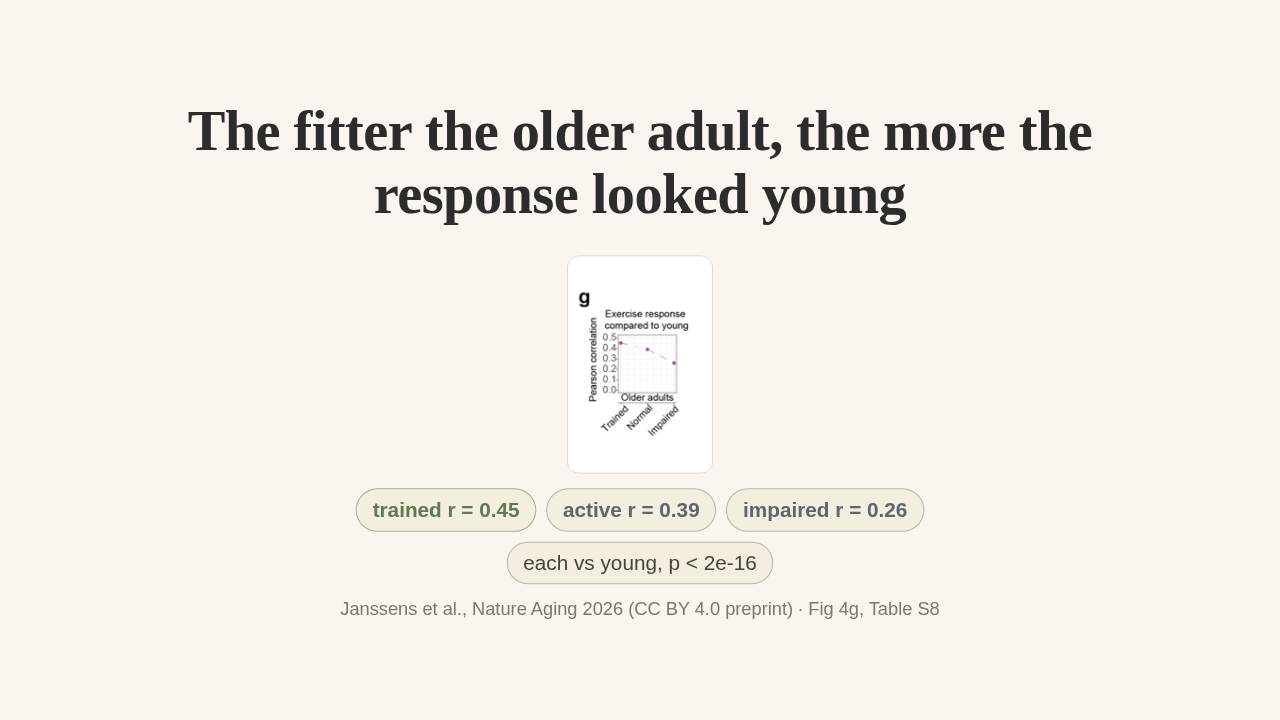
  5. 0:55The fitter the older adult, the more the response looked young
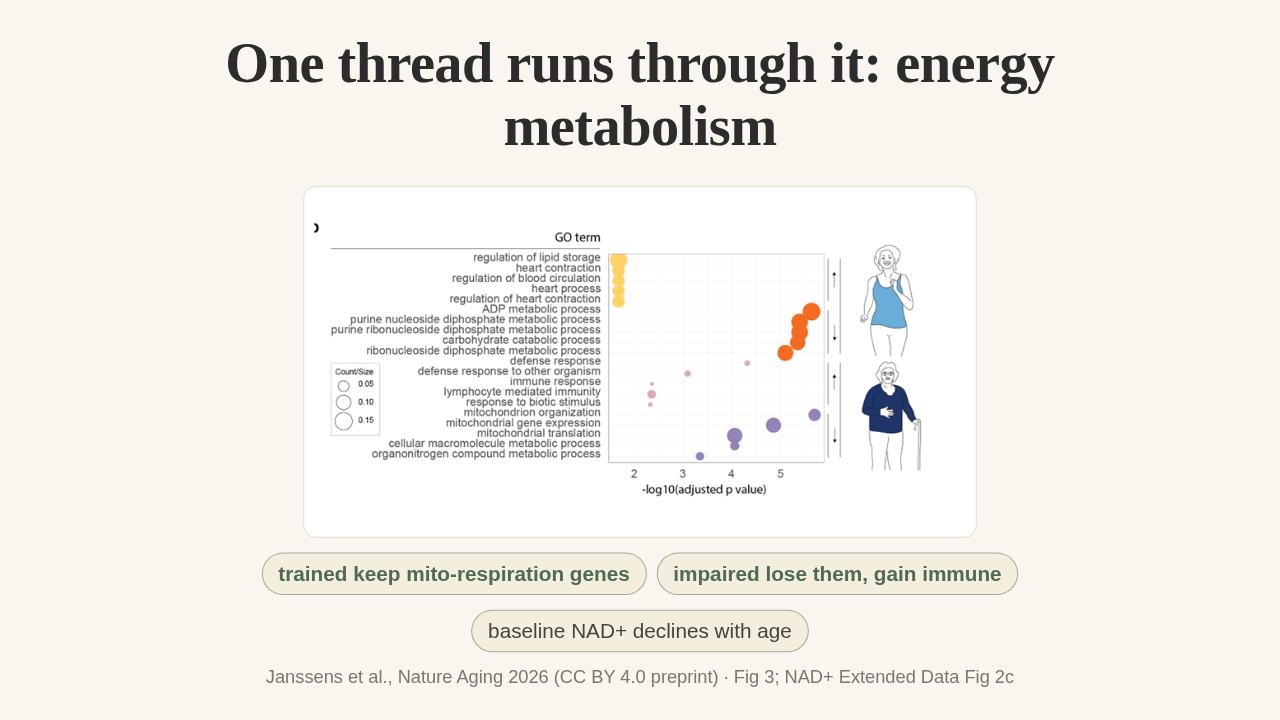
  6. 1:09One thread runs through it: energy metabolism
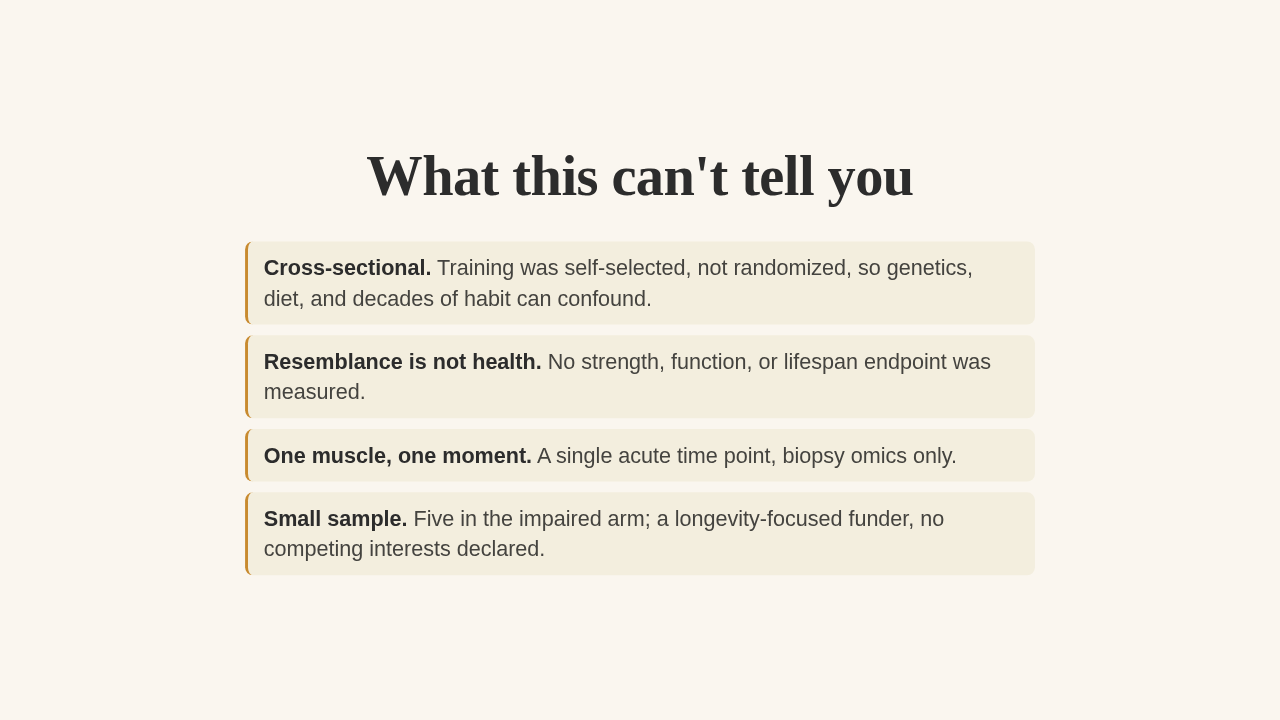
  7. 1:26What this can't tell you
  8. 1:51Slide 8
Show transcript

Slide 1

Trained older muscle is missing half of aging's fingerprint
In muscle energy metabolism, the trained older profile reads young
Nature Aging · 2026 human m. vastus lateralis cross-sectional multiomics n = 11 young / 36 older

In older adults who train, about half of aging's molecular fingerprint in muscle simply isn't there. A new Nature Aging study read it straight from the tissue, gene by gene.

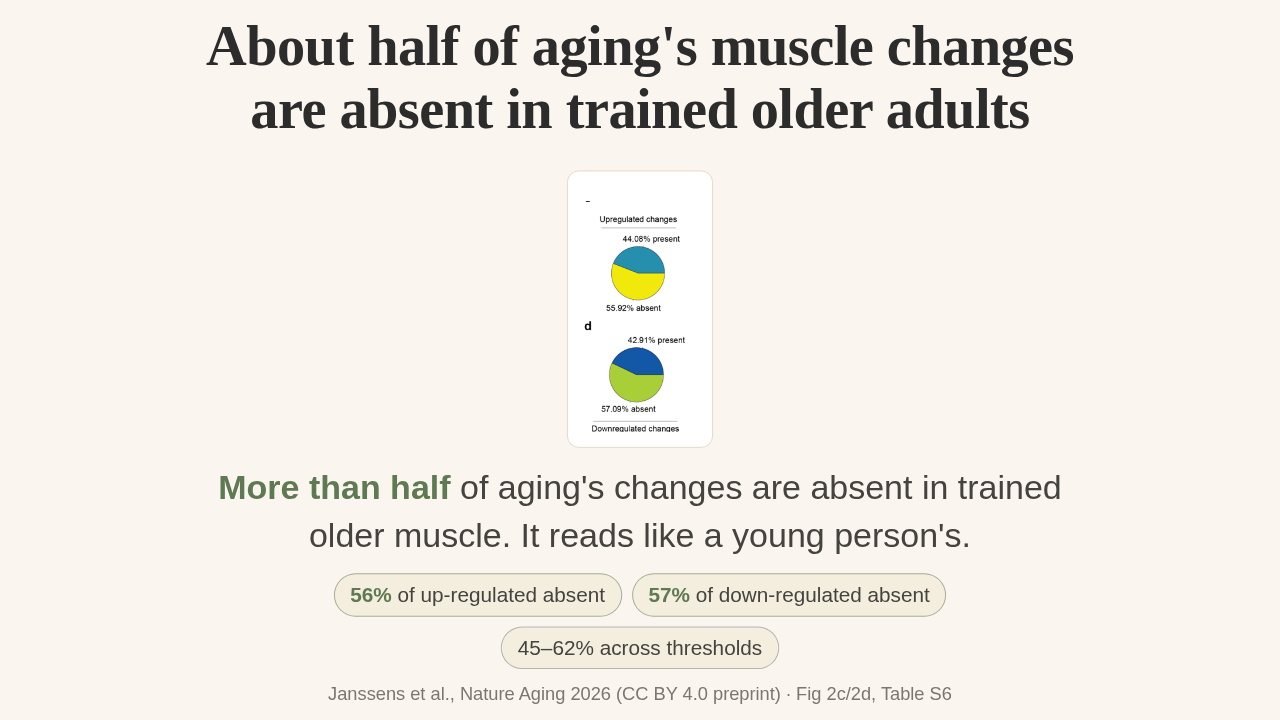
About half of aging's muscle changes are absent in trained older adults

Two pie charts: 55.92% of up-regulated and 57.09% of down-regulated age-related changes are absent in trained older adults
More than half of aging's changes are absent in trained older muscle. It reads like a young person's.
56% of up-regulated absent 57% of down-regulated absent 45–62% across thresholds
Janssens et al., Nature Aging 2026 (CC BY 4.0 preprint) · Fig 2c/2d, Table S6

At rest, older muscle carries aging's signature: energy genes turned down. But in the older adults who trained, more than half of those changes were absent. Their muscle read like a young person's. Fifty-six percent of the raised genes, and fifty-seven percent of the lowered ones, gone.

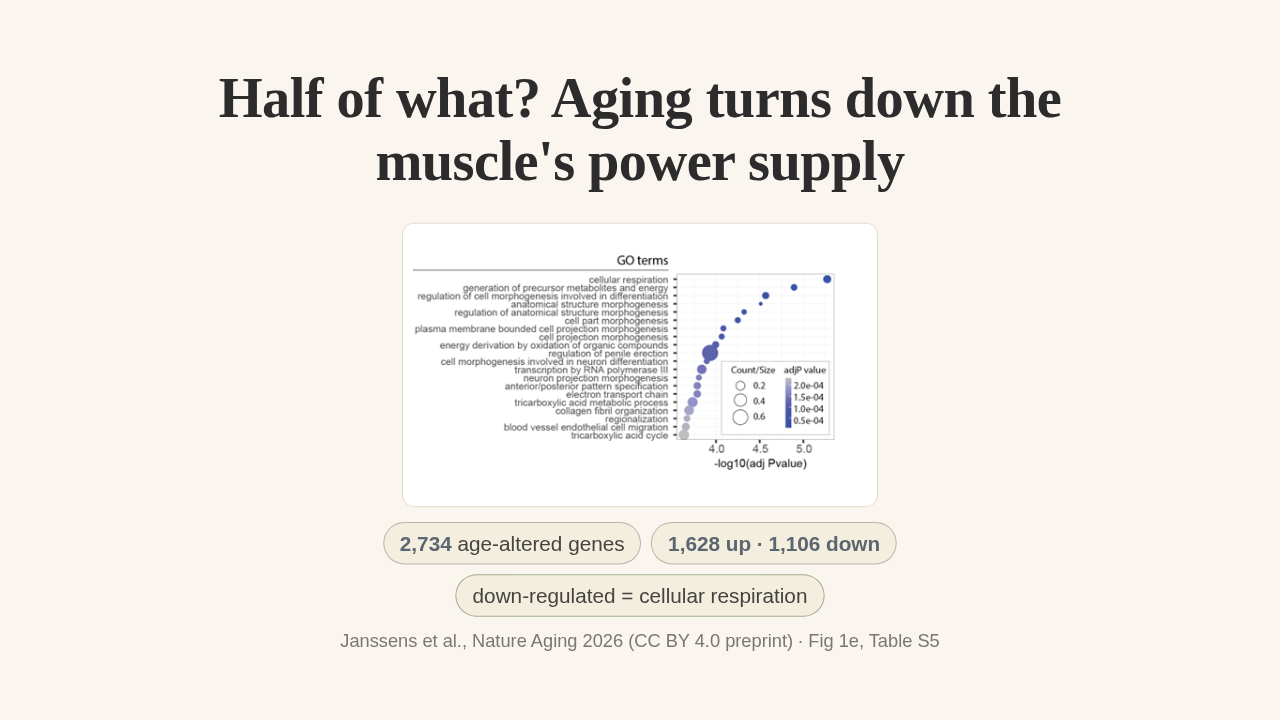
Half of what? Aging turns down the muscle's power supply

GO-term enrichment of the down-regulated aging genes: cellular respiration, energy metabolism, electron transport chain, TCA cycle
2,734 age-altered genes 1,628 up · 1,106 down down-regulated = cellular respiration
Janssens et al., Nature Aging 2026 (CC BY 4.0 preprint) · Fig 1e, Table S5

Half of what? Next to young adults who moved about as much each day, the older group differed in over two thousand seven hundred genes. The ones turned down ran cellular respiration, the muscle's power supply.

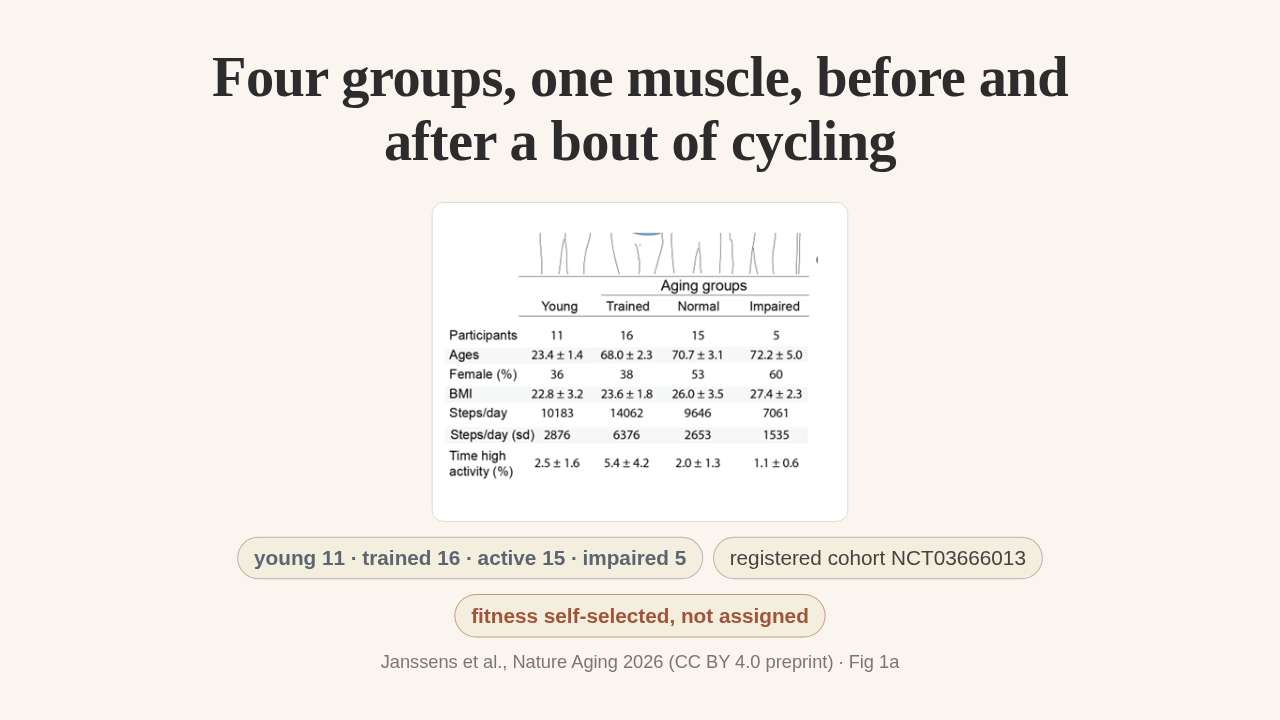
Four groups, one muscle, before and after a bout of cycling

Cohort table: young 11, trained 16, normally active 15, impaired 5; ages, percent female, BMI, steps per day
young 11 · trained 16 · active 15 · impaired 5 registered cohort NCT03666013
fitness self-selected, not assigned
Janssens et al., Nature Aging 2026 (CC BY 4.0 preprint) · Fig 1a

How they tested it decides how much to trust it. Forty-seven people in four groups: young adults, and older adults split into trained, normally active, and physically impaired. Each gave a muscle biopsy before and just after an hour of cycling. It's a registered cohort, but fitness was self-selected, not assigned.

The fitter the older adult, the more the response looked young

Pearson correlation of the acute exercise response to young, stepping down across trained, normal, then impaired older adults
trained r = 0.45 active r = 0.39 impaired r = 0.26 each vs young, p < 2e-16
Janssens et al., Nature Aging 2026 (CC BY 4.0 preprint) · Fig 4g, Table S8

There's a second, stranger result. A single bout of exercise triggers an immune and stress response in every group's genes. But the fitter the older group, the more that response resembled a young person's, strongest in the trained, weakest in the impaired.

One thread runs through it: energy metabolism

Baseline pathways: trained older adults up in lipid and energy metabolism; physically impaired up in immune, down in mitochondrial and respiration genes
trained keep mito-respiration genes impaired lose them, gain immune
baseline NAD+ declines with age
Janssens et al., Nature Aging 2026 (CC BY 4.0 preprint) · Fig 3; NAD+ Extended Data Fig 2c

The thread through all of it is energy. The genes that stayed youthful in trained muscle were mitochondrial. In the impaired, it flipped: energy genes down, immune signaling up. And a fuel molecule called NAD+ fell with age. The authors frame these as links, not a mechanism proven here.

What this can't tell you

Cross-sectional. Training was self-selected, not randomized, so genetics, diet, and decades of habit can confound.
Resemblance is not health. No strength, function, or lifespan endpoint was measured.
One muscle, one moment. A single acute time point, biopsy omics only.
Small sample. Five in the impaired arm; a longevity-focused funder, no competing interests declared.

Now the limits. This compared people who already train with people who don't. Nobody was randomly assigned, so genetics, diet, and years of habit could be doing the work. And looking younger at the gene level is not the same as being stronger or living longer, which the study never measured. The groups were small, five in the impaired arm, and a longevity foundation helped fund it, though the authors declare no competing interests.

Slide 8

A younger-looking muscle, honestly framed
An observational study, not a trial: a strong association, not proof training rewound the clock.
DOI 10.1038/s43587-026-01150-x · Janssens et al., Nature Aging 2026

So an observational study found that trained older muscle reads younger in its energy genes. It's a strong, coherent association. What it isn't, yet, is proof that the training is what did it.