Two years of eating less: real benefit, unproven mechanism
For two years, healthy adults cut their calories, and researchers tracked their blood sugar. Eating less improved how they handled insulin after a meal, in a hundred and ninety-one non-obese adults aged twenty-one to fifty. This is the CALERIE 2 trial, and the same paper tells you exactly how far the result goes.
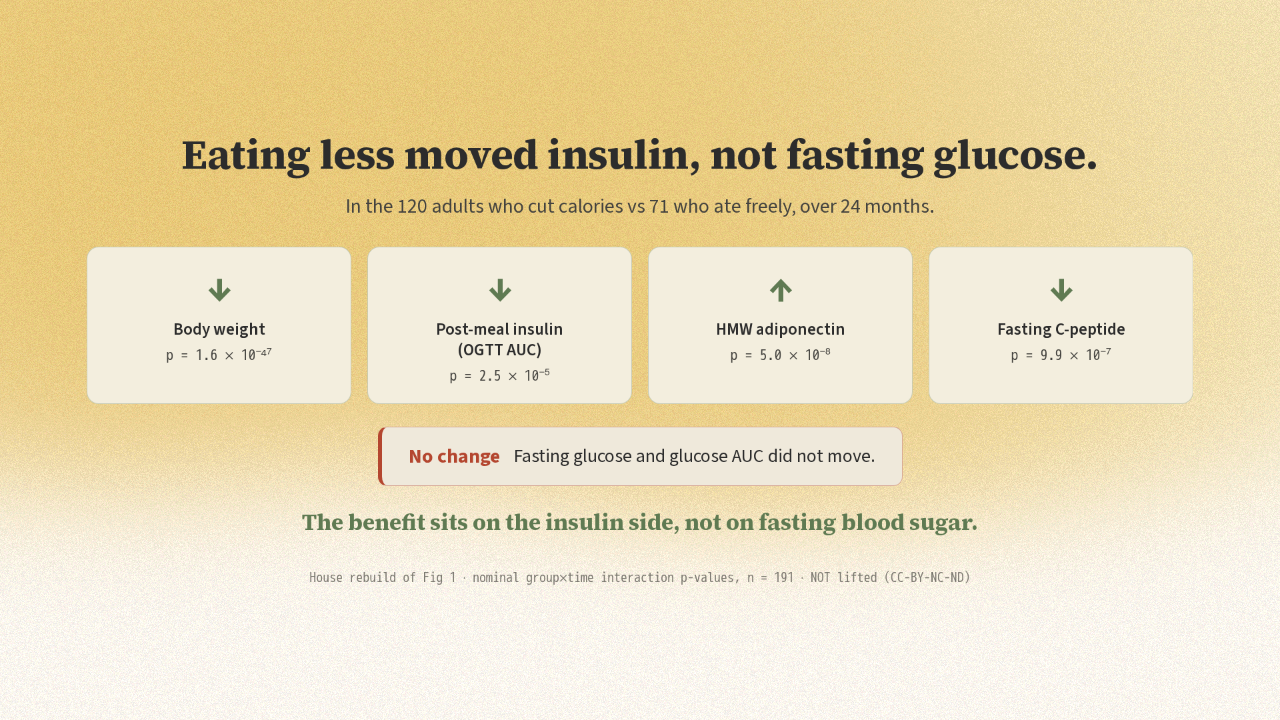
Eating less moved insulin, not fasting glucose.
(OGTT AUC)
In the hundred and twenty adults who cut calories, post-meal insulin fell, fasting C-peptide fell, and a protective hormone called adiponectin rose, each with a p-value well below one in ten thousand. But fasting glucose did not move. The benefit sits on the insulin side, not on fasting blood sugar.
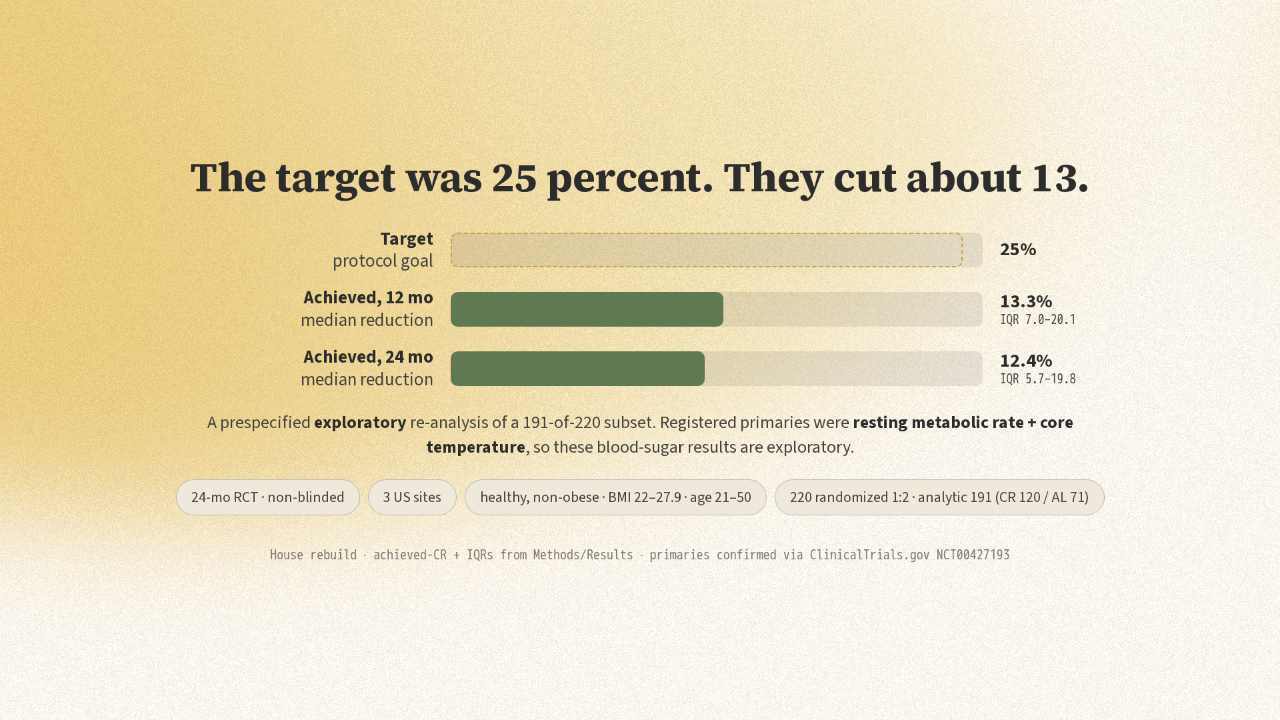
The target was 25 percent. They cut about 13.
protocol goal
median reduction
median reduction
The trial asked for a twenty-five percent calorie cut. Even under supervision, these adults managed a median of about thirteen percent at one year, and twelve at two. And this was a re-analysis of a subset, whose registered goals were resting metabolism and body temperature. So these blood-sugar results are exploratory. The benefit came from a modest cut, not the number on the label.
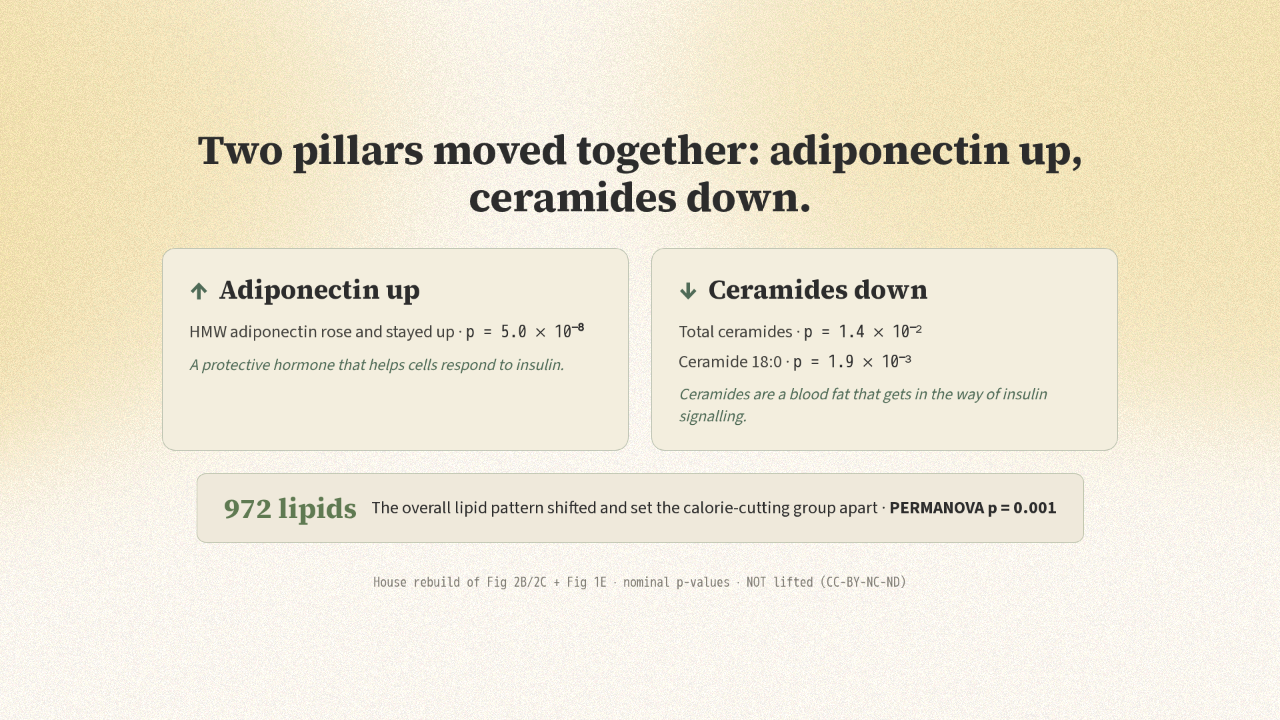
Two pillars moved together: adiponectin up, ceramides down.
So why might eating less help? Two things moved together in the calorie-cutting group. Adiponectin rose and stayed up, and a family of blood fats called ceramides fell. Ceramides get in the way of insulin signalling. Across all nine hundred and seventy-two lipids they measured, the overall pattern shifted, and it set the calorie-cutting group apart.
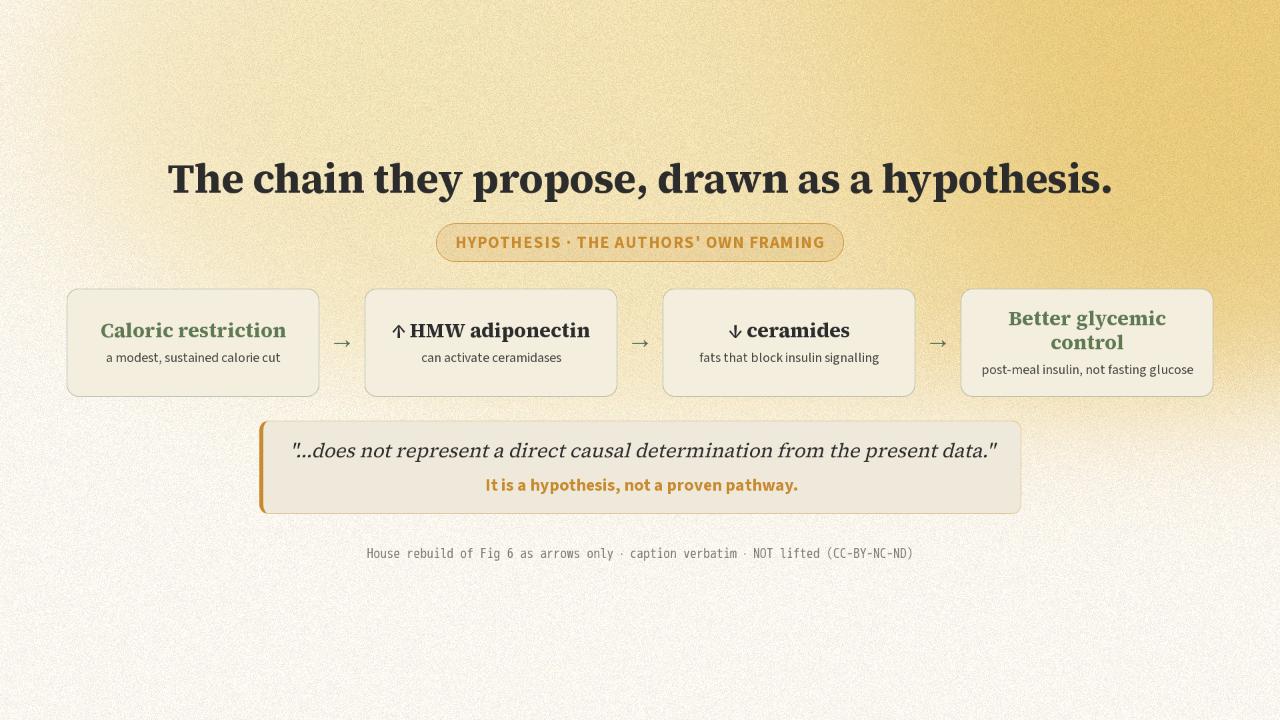
The chain they propose, drawn as a hypothesis.
Here is the chain the authors propose to connect them. Eating less raises adiponectin, adiponectin can help break ceramides down, and fewer ceramides tracks the better blood sugar. But they write that this does not represent a direct causal determination. It is a hypothesis. So how much of the benefit does that chain carry?
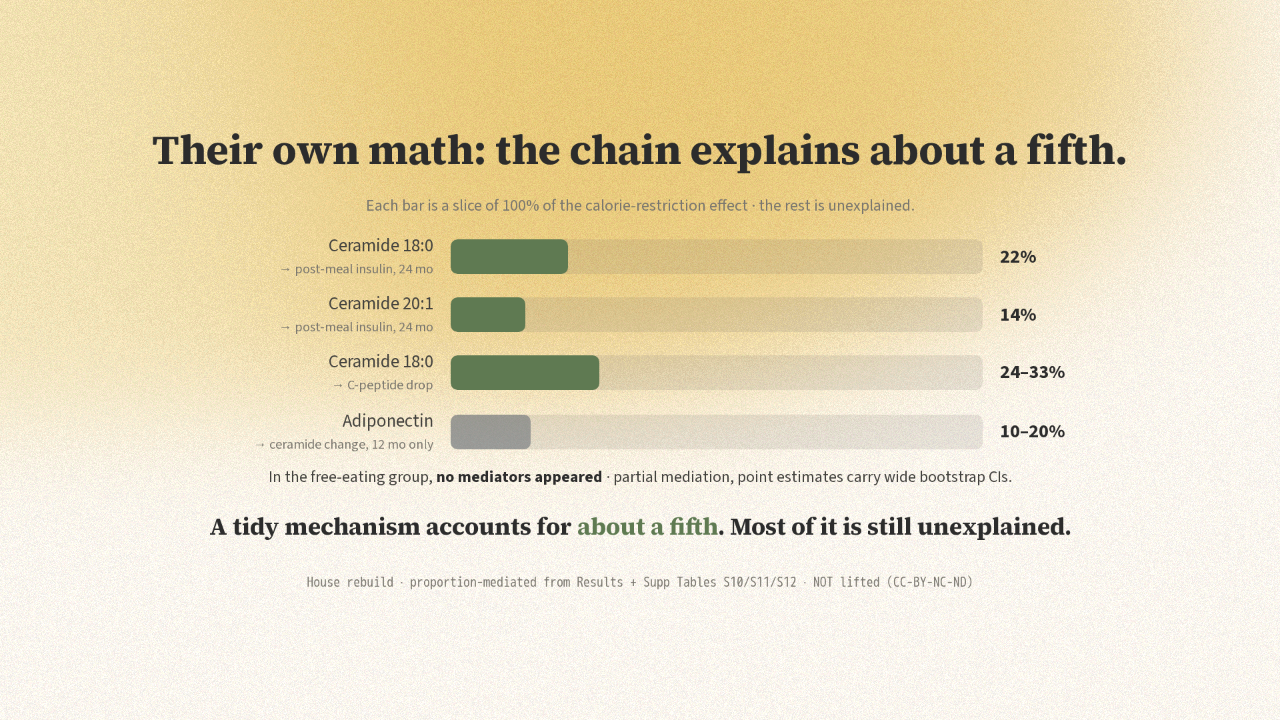
Their own math: the chain explains about a fifth.
→ post-meal insulin, 24 mo
→ post-meal insulin, 24 mo
→ C-peptide drop
→ ceramide change, 12 mo only
Their own math says the answer is partial. At two years, one ceramide accounted for about twenty-two percent of the effect on post-meal insulin, and another about fourteen. The same ceramide accounted for a quarter to a third of the C-peptide drop. The adiponectin step accounted for ten to twenty percent, and only at one year. And in the free-eating group, no such links appeared. So a tidy mechanism accounts for about a fifth of what happened, and most of it is still unexplained.
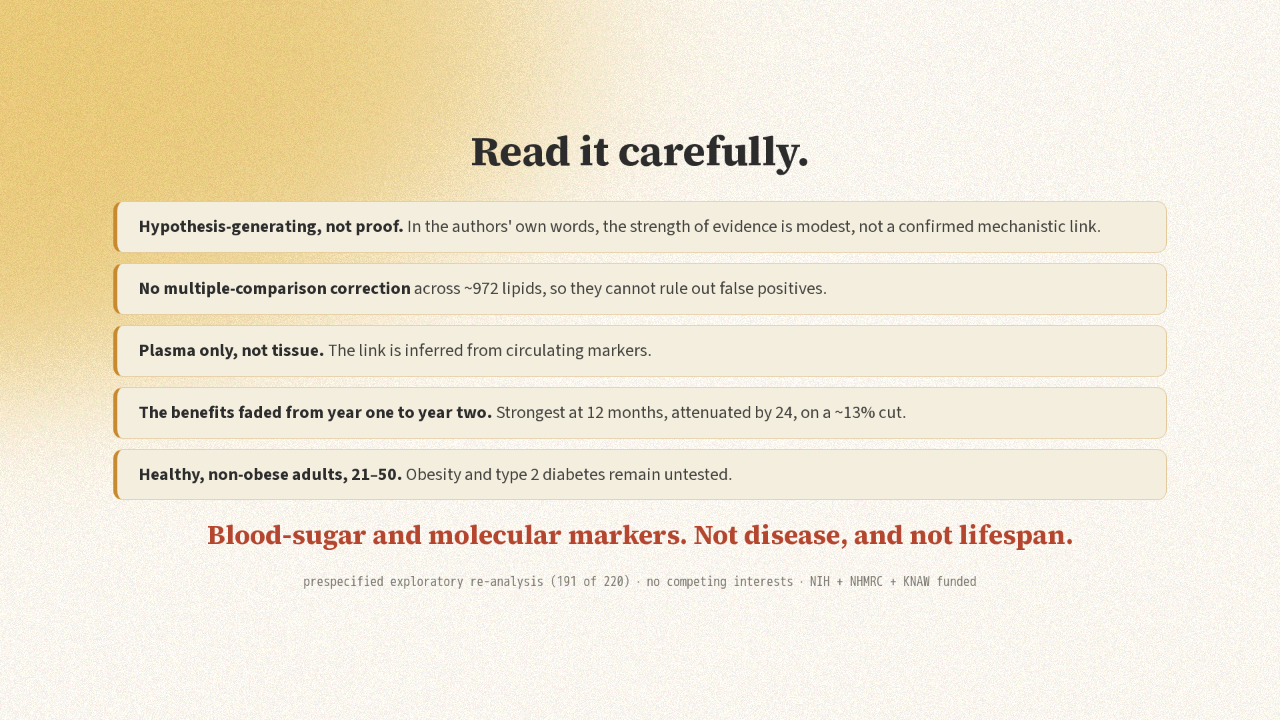
Read it carefully.
The authors do the careful reading for you. In their own words, the mechanism is hypothesis-generating, not a confirmed mechanistic link, and the strength of evidence is modest. They ran no correction for multiple comparisons across those nine hundred and seventy-two lipids, so they cannot rule out false positives. And every measurement was in blood plasma, not tissue. The benefits were strongest at one year and had faded by two. The cohort was healthy and non-obese, so this says nothing yet about obesity or type two diabetes. These are blood-sugar and molecular markers. Not disease, and not lifespan.
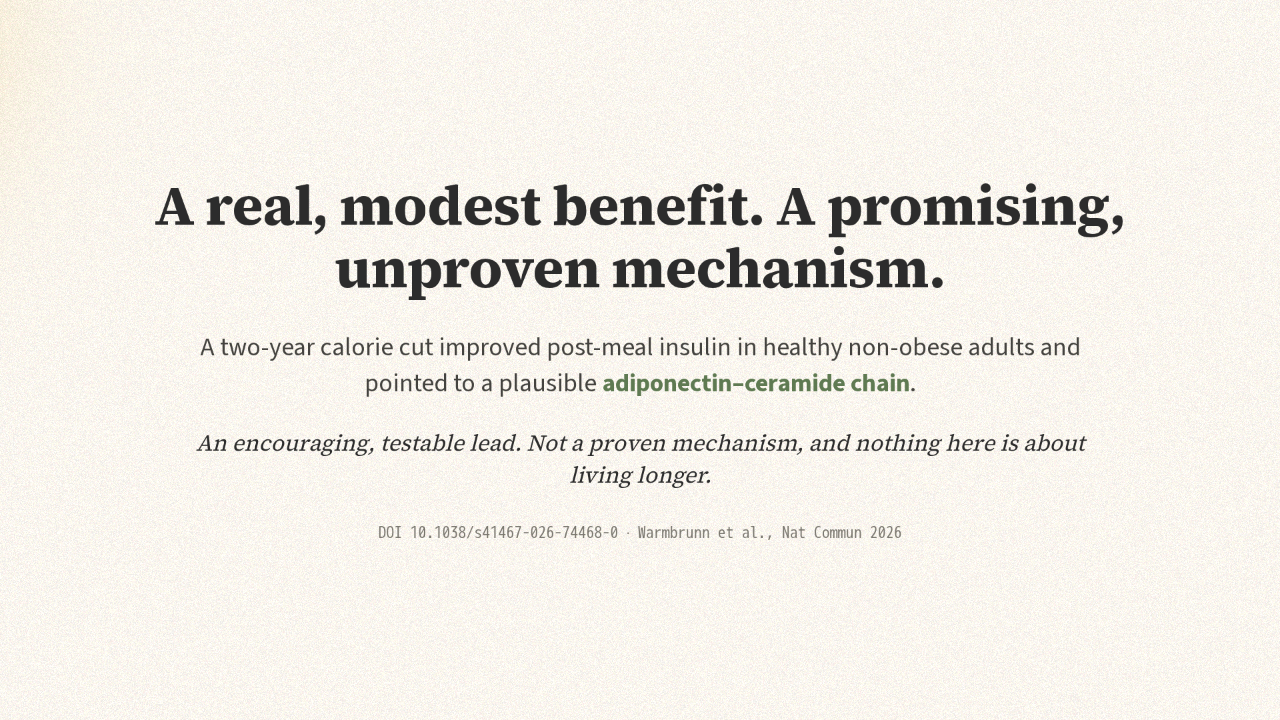
A real, modest benefit. A promising, unproven mechanism.
So the takeaway. A modest, real-world calorie cut improved post-meal insulin in healthy non-obese adults, and pointed to a plausible adiponectin and ceramide chain. An encouraging, testable lead. Not a proven mechanism, and nothing here is about living longer, or a reason to change anything today.