MemOnce gives Qwen3.5 a million-token memory in 25 MB of GPU cache
2 days ago
MemOnce adds a compact, retrievable memory to frozen Qwen3.5 models. At a million tokens it keeps 25 MB of cache on the GPU where plain Qwen3.5-4B needs 32 GB, cuts prefill from about 287 s to 41 s, and scores higher than the full-context model on five memory benchmarks. From Nanjing University and USTC, arXiv 2611.27973v1, submitted 20 November 2026.
Links
Ask about this presentation
Chapters
Show transcriptHide transcript
MemOnce lets a small Qwen3.5 model remember a million tokens of conversation with only 25 megabytes of it on the GPU, and it answers memory questions better than the same model reading everything. It comes from Nanjing University and USTC.
Slide text

MemOnce gives Qwen3.5 a million-token memory in 25 MB of GPU cache
Chang Nie, Chaoyou Fu, Songlin Liu, Yiqing Hu, Caifeng Shan · Nanjing University, University of Science and Technology of China
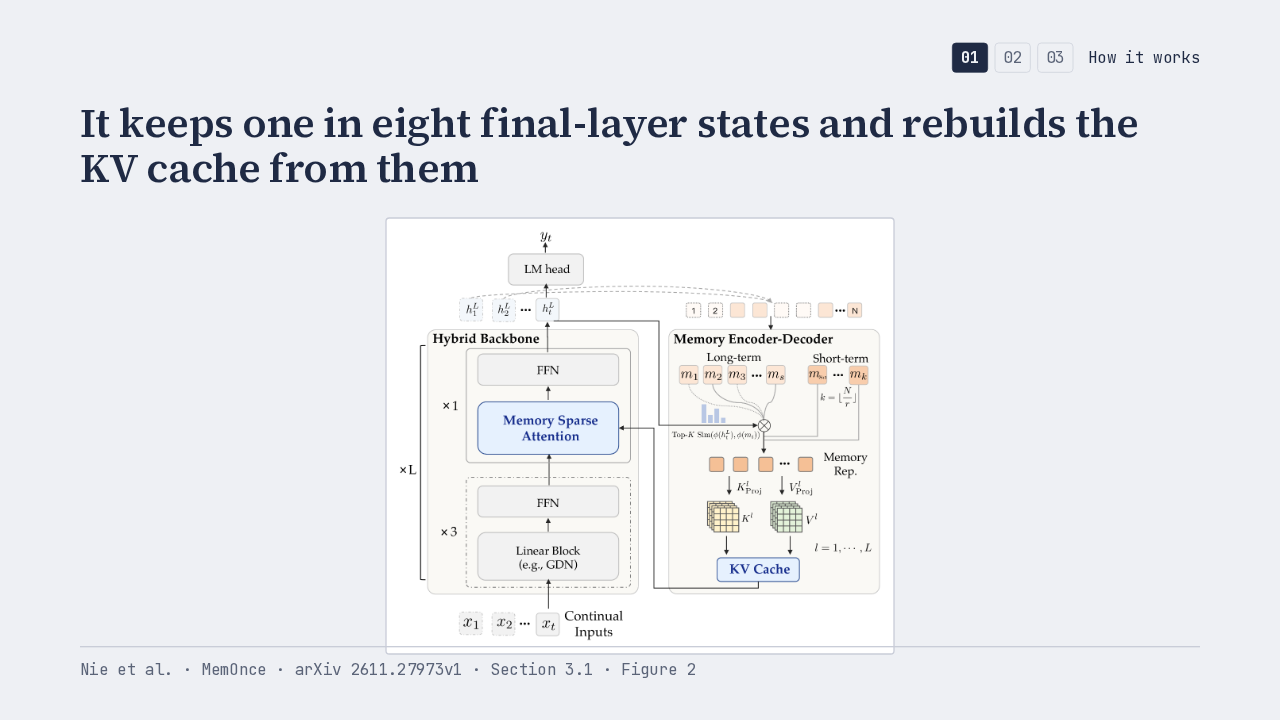
Nie et al. · MemOnce · arXiv 2611.27973v1 · submitted 20 Nov 2026A normal transformer caches keys and values for every token at every layer. MemOnce keeps only the last eighth of each chunk's final-layer states, and small decoders rebuild a KV cache from them when a question needs it.
Slide text
01 02 03 How it worksIt keeps one in eight final-layer states and rebuilds the KV cache from them
 Nie et al. · MemOnce · arXiv 2611.27973v1 · Section 3.1 · Figure 2
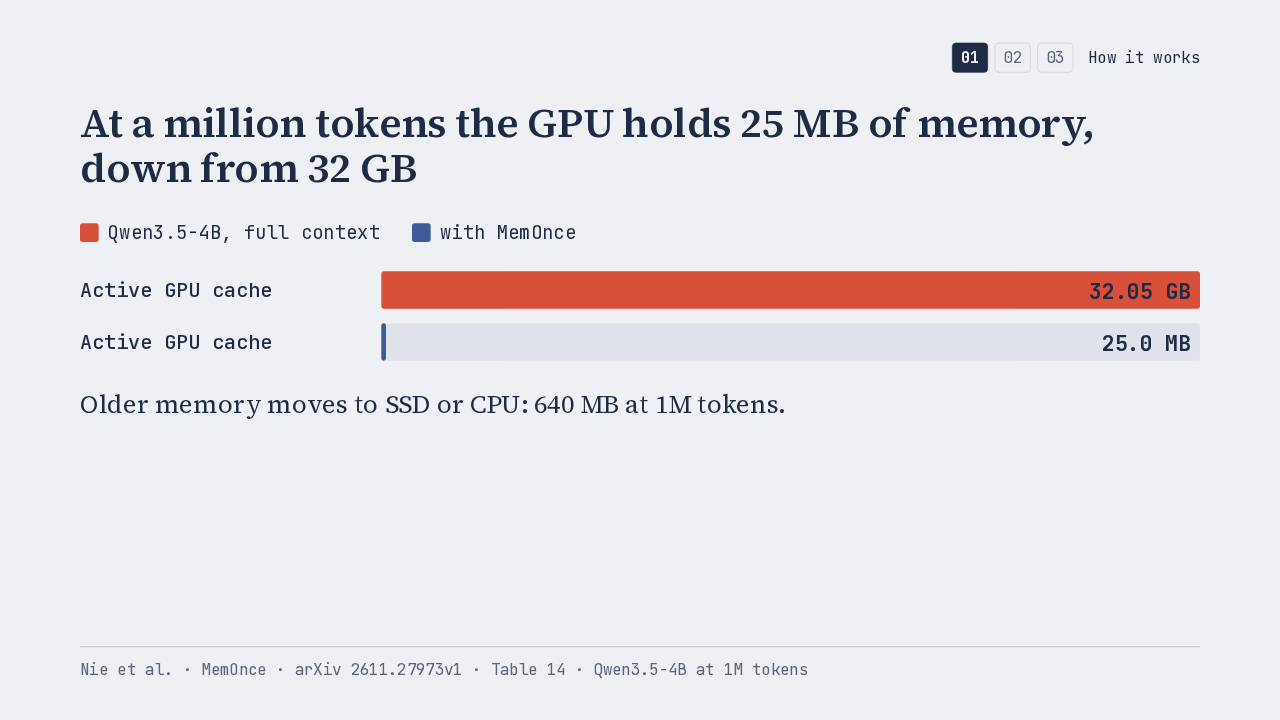
That is what moves memory off the graphics card. At a million tokens, plain Qwen3.5 4B needs about 32 gigabytes of cache on the GPU. MemOnce keeps 25 megabytes there and moves older memory, about 640 megabytes, out to an SSD.
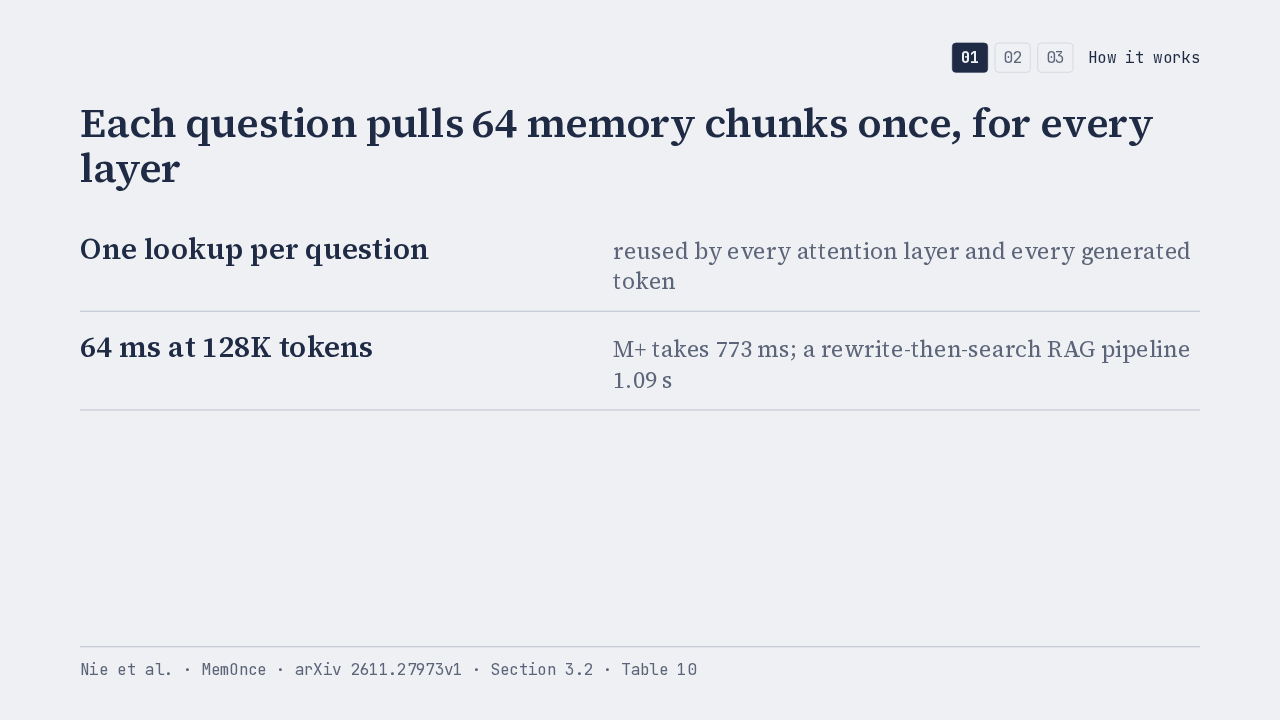
For each new question, MemOnce picks the best 64 stored chunks once. Every layer and every generated token reuses that pick. With 128,000 tokens of history, the lookup takes about 64 milliseconds, around 12 times faster than the earlier M+ model.
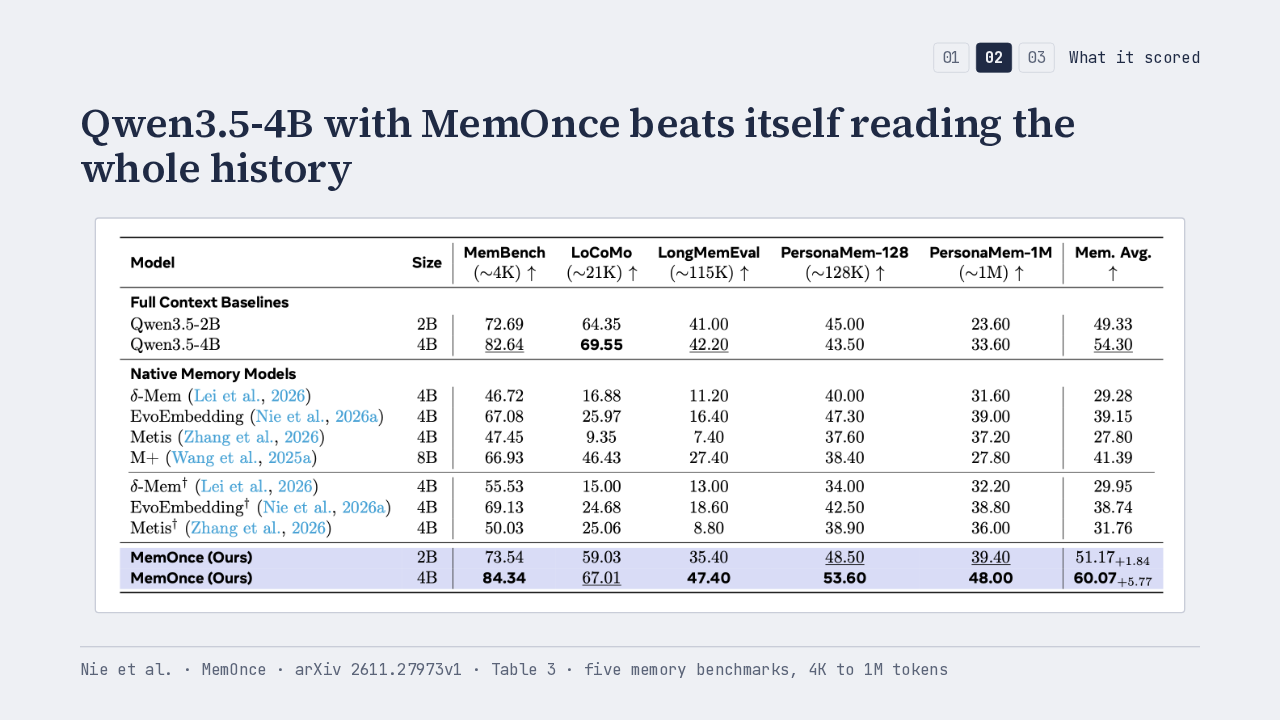
On five memory benchmarks, from 4,000 to a million tokens, the adapted 4B model gets about six more answers in a hundred right than plain Qwen3.5 4B reading everything. The gap is widest at a million tokens, where retrieval filters out unrelated history.
Slide text
01 02 03 What it scoredQwen3.5-4B with MemOnce beats itself reading the whole history
 Nie et al. · MemOnce · arXiv 2611.27973v1 · Table 3 · five memory benchmarks, 4K to 1M tokens
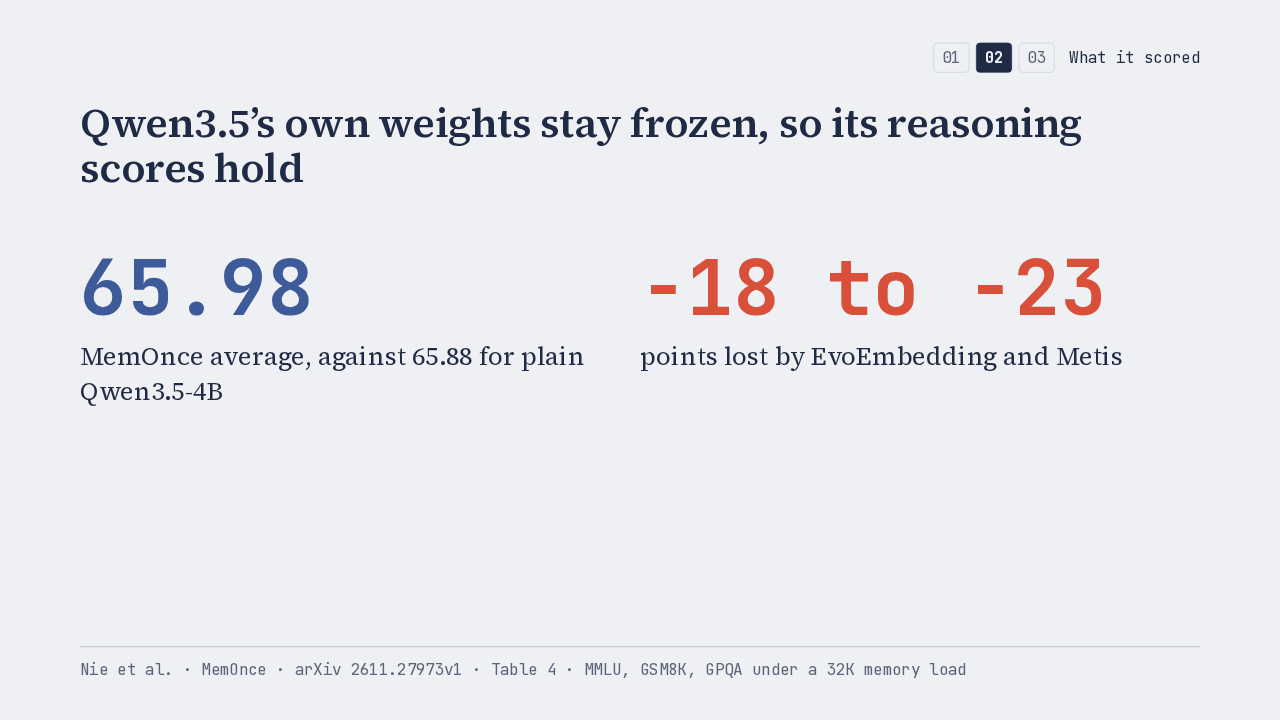
The adapter runs only while memory is written, so Qwen3.5 answers with its own weights. With 32,000 tokens in memory, its MMLU, GSM8K and GPQA scores stay level. EvoEmbedding and Metis, two earlier memory methods, lose around 20 points.
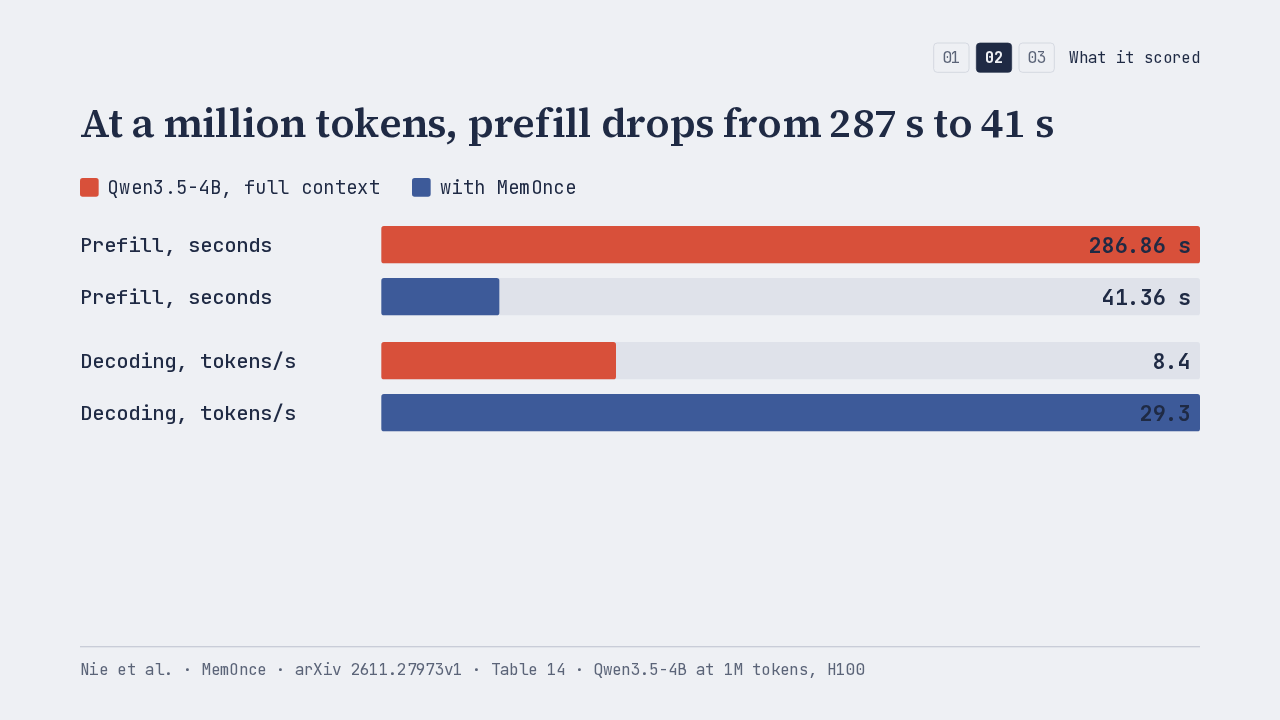
Reading in a million tokens takes plain Qwen3.5 4B close to five minutes on an H100. With MemOnce it takes about 41 seconds. Generation holds near 29 tokens a second, while the full-context model slows to about 8.
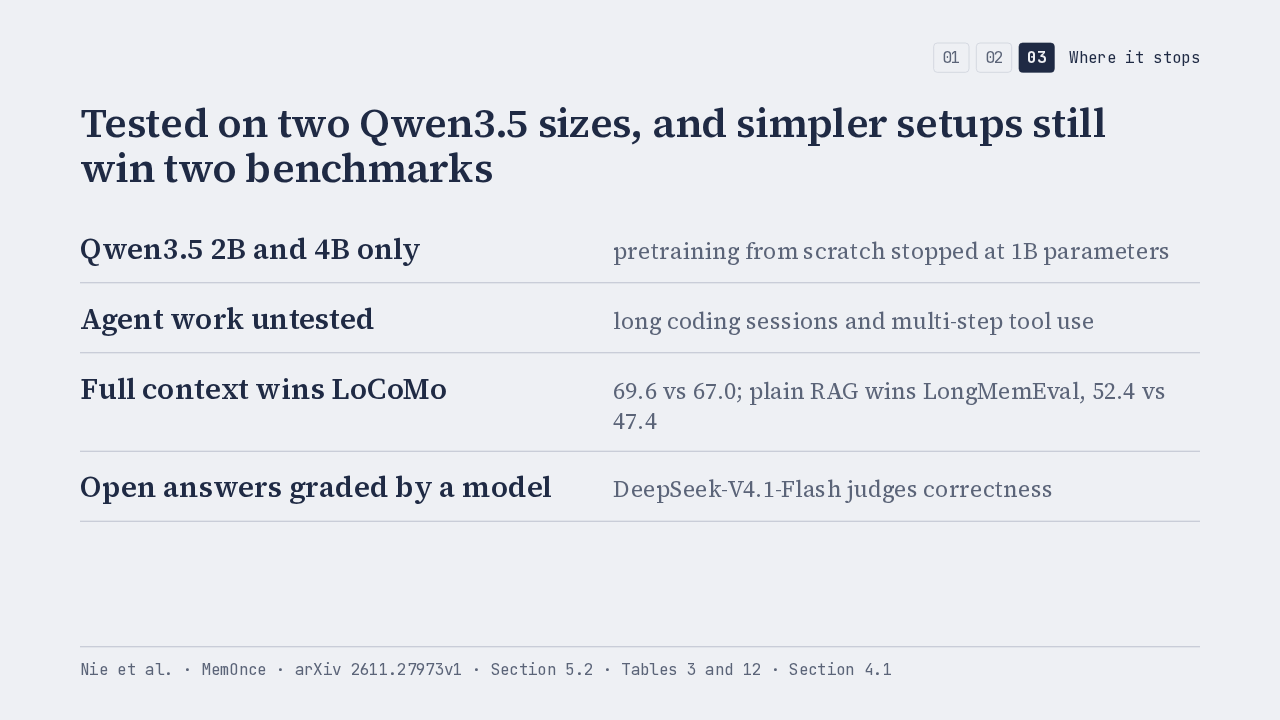
MemOnce has only been fitted to Qwen3.5 at 2 and 4 billion parameters. Long coding sessions and multi-step tool use are untested. Full context still wins on LoCoMo, plain retrieval wins on LongMemEval, and a DeepSeek model grades the open answers.
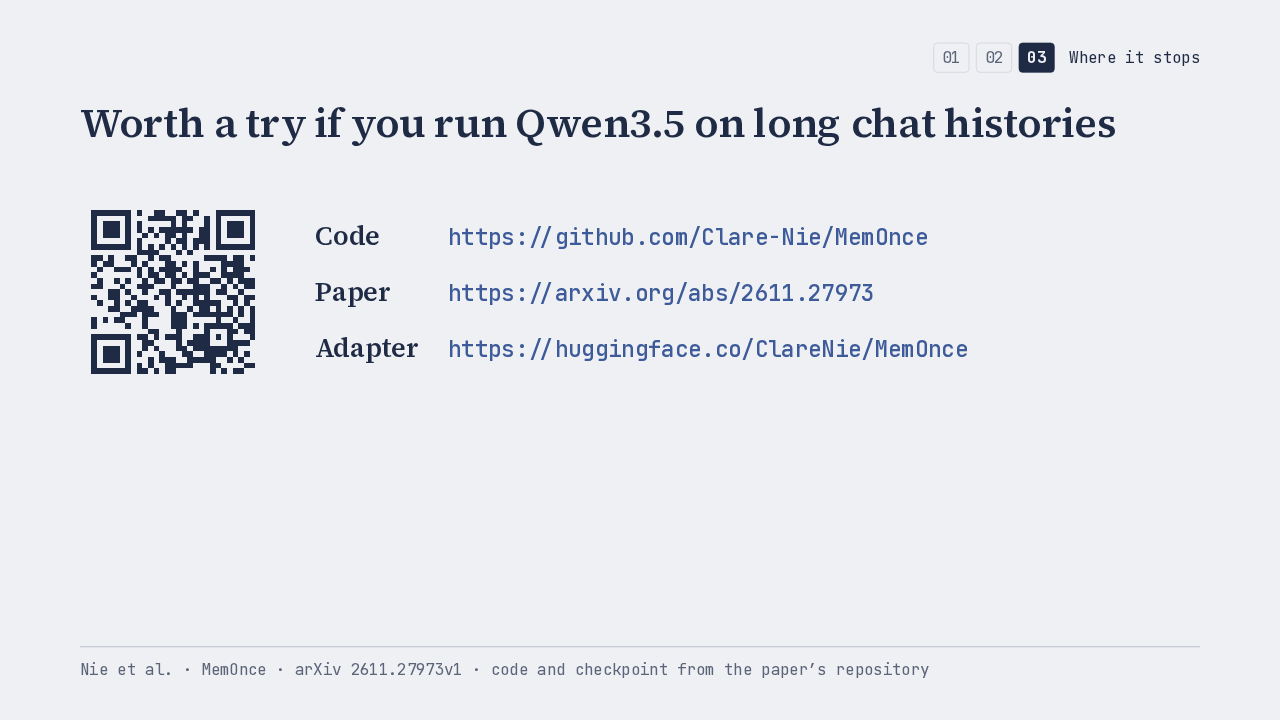
I would say yes, if you run Qwen3.5 at 2 or 4 billion parameters, your app re-reads long chat histories every turn, and you can add a 264 megabyte adapter. The limit is that it was measured on memory benchmarks, never inside a working agent. The code is in the MemOnce repository.
Up next
 2:34
Jeveration makes a 512-pixel image in 78 ms with one pass of Qwen3.5
@ai-papers
1 week ago
 2:45
Accelerate Bench: Claude Sonnet 5.5 leads 16 agents at making programs faster
@ai-papers
1 week ago
 2:49
NestOne cuts a Qwen3.5 decision model to 24 layers at nearly full accuracy
@ai-papers
2 weeks ago
 2:33
MME-VLA robot memory counts a pause as work done and stops early
@ai-papers
2 weeks ago
 2:16
GPT-6 Astra fixed a small Qwen’s math by editing 1,023 of its weights
@ai-papers
2 weeks ago
 2:42
LoopVQ cuts looped models’ KV cache to half a bit and lifts Ouro’s throughput up to 6×
@ai-papers
3 weeks ago
 2:35
CUA-Master-27B is an open computer-use agent that trails only Claude Opus 5 and GPT-5.6-Sol on Agents' Last Exam
@ai-papers
3 weeks ago
 2:37
CaPtain trains Qwen3.5-4B to control a robot in code and beats several frontier-model agents
@ai-papers
3 weeks ago
 2:45
Trajectory2Gym data lifts a 4B Qwen3 agent past the stock 30B model on Tau2
@ai-papers
1 month ago
 2:46
“Wait” in reasoning models comes from training data, and RL almost never invents it
@ai-papers
1 month ago
 2:08
Looking Ahead makes Wan video models more physically plausible, with generation unchanged
@ai-papers
1 month ago
 2:30
OpenVLHarness gives vision models tools and a memory, and seven models each gain about 10 points
@ai-papers
1 month ago