Jeveration makes a 512-pixel image in 78 ms with one pass of Qwen3.5
21 hours ago
Jeveration turns a frozen Qwen3.5-4B vision-language model into an image generator: one forward pass makes a 512-pixel image in about 78 ms on one H200, 122 times faster than Janus-Pro-7B, at 0.74 on GenEval. The same checkpoint also does image-to-image and indoor segmentation and depth. It makes 512-pixel images only and was timed on one GPU at batch size one.
Links
Ask about this presentation
Chapters
Show transcriptHide transcript
Jeveration turns a frozen Qwen3.5 vision-language model into an image generator that makes a 512-pixel picture in one forward pass, in about 78 milliseconds. It comes from the National University of Singapore.
Slide text

Jeveration makes a 512-pixel image in 78 ms with one pass of Qwen3.5
Yuhe Liu, Qi Li, Shihua Zhang, Xinchao Wang · National University of Singapore
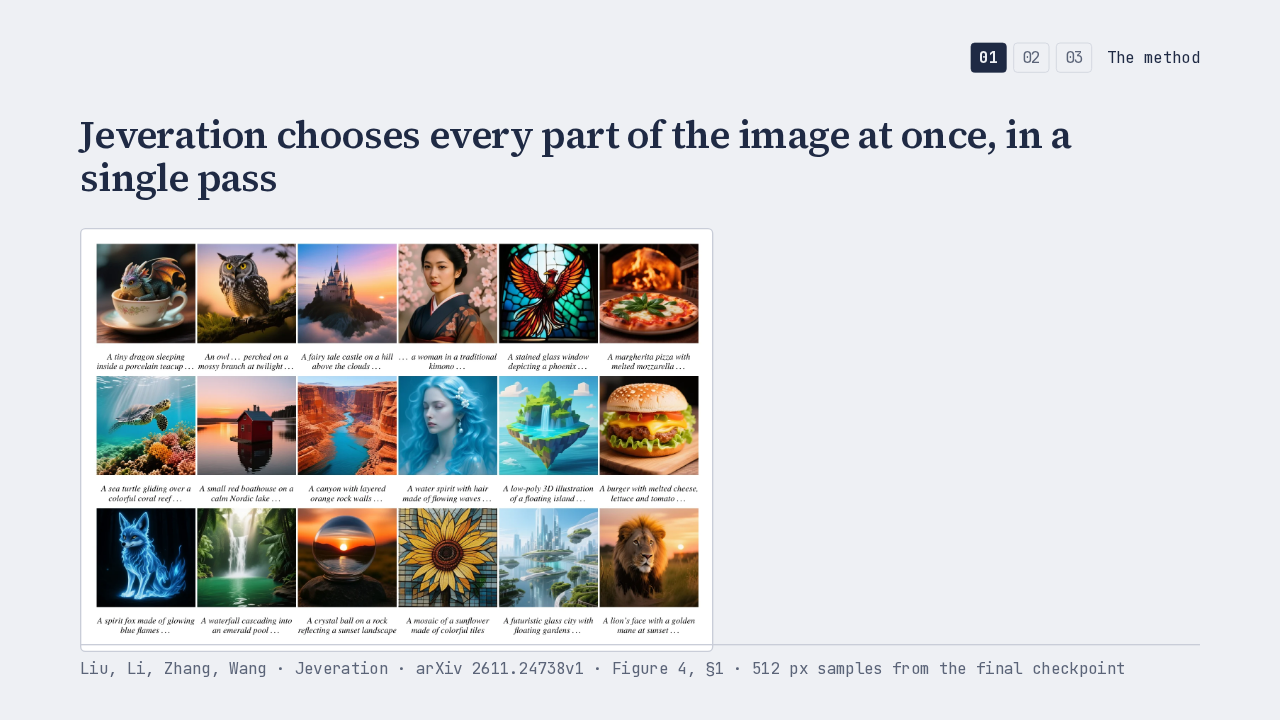
Liu, Li, Zhang, Wang · Jeveration · arXiv 2611.24738v1 · submitted 18 Nov 2026 · Table 1 · one H200, batch 1Diffusion models clean up an image over many steps, and autoregressive models write it out token by token. Jeveration picks all 128 image codes in parallel, so a whole picture costs one pass of the model.
Slide text
01 02 03 The methodJeveration chooses every part of the image at once, in a single pass
 Liu, Li, Zhang, Wang · Jeveration · arXiv 2611.24738v1 · Figure 4, §1 · 512 px samples from the final checkpoint
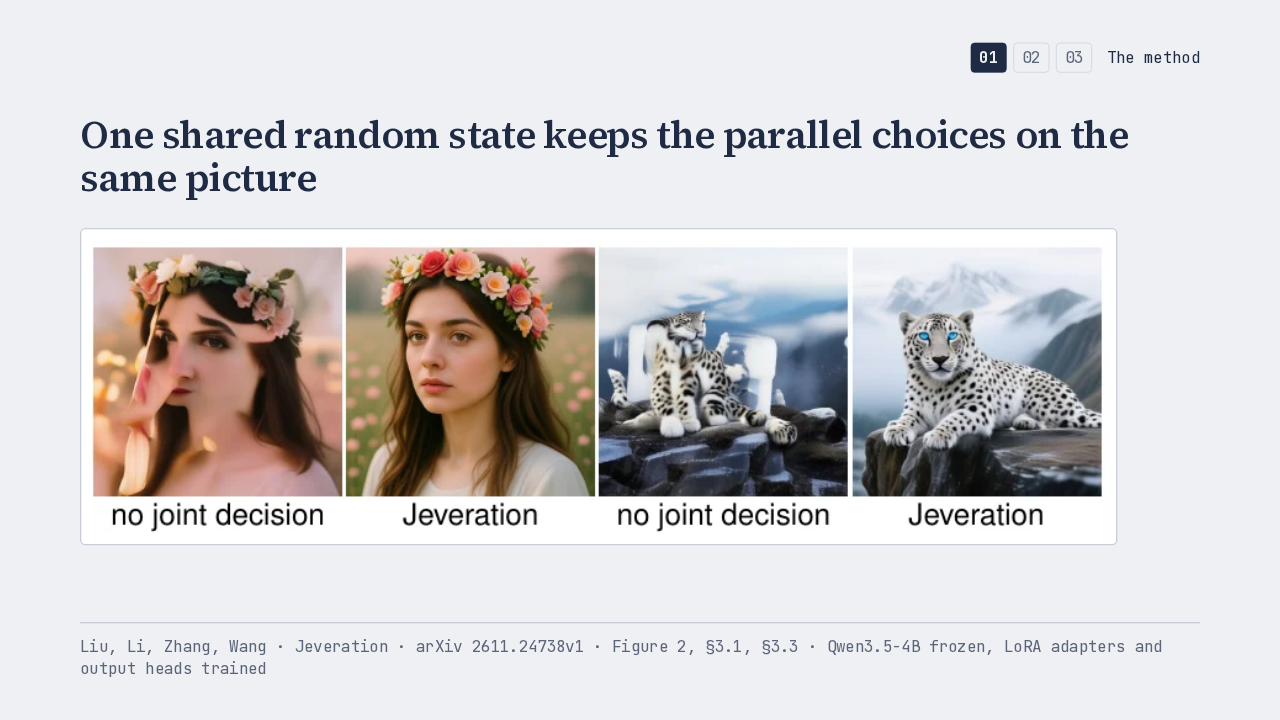
Chosen independently, the codes drift toward different pictures and the parts don't fit. Jeveration feeds every position one shared random state, and a masked image model, trained first, teaches it to use that state.
Slide text
01 02 03 The methodOne shared random state keeps the parallel choices on the same picture
 Liu, Li, Zhang, Wang · Jeveration · arXiv 2611.24738v1 · Figure 2, §3.1, §3.3 · Qwen3.5-4B frozen, LoRA adapters and output heads trained
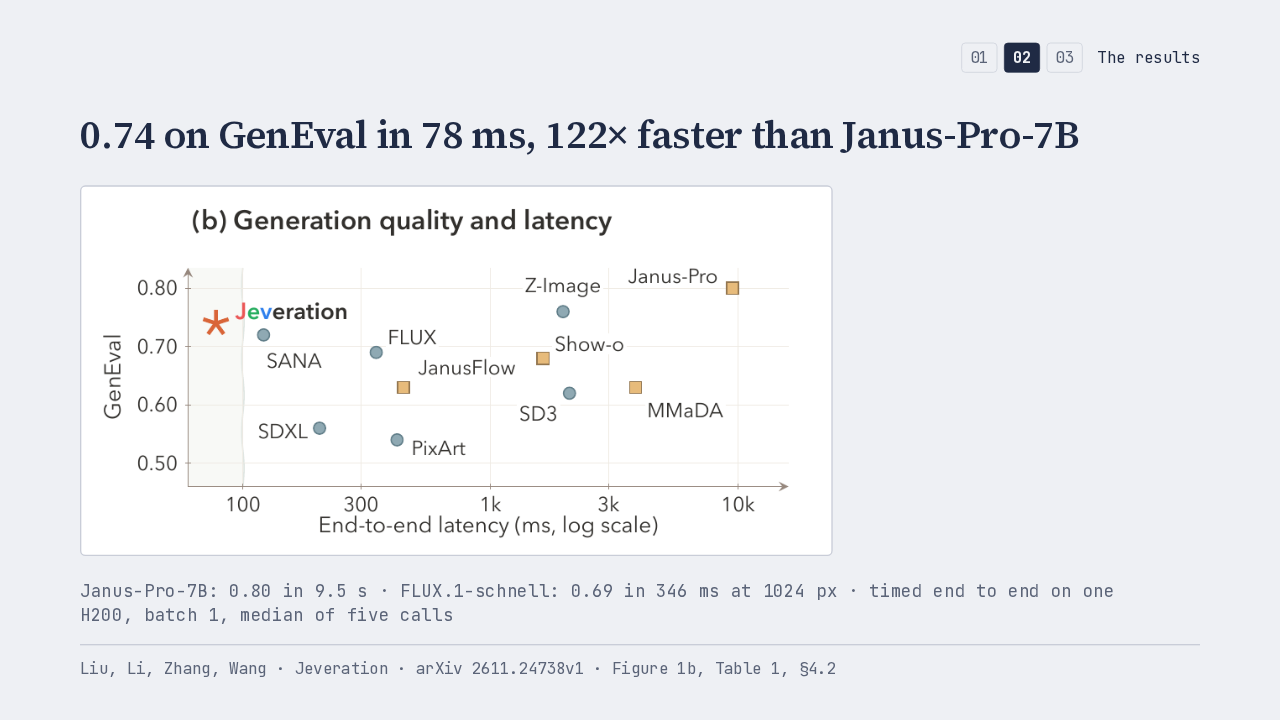
GenEval checks for the objects, counts, colours and positions a prompt asks for, and Jeveration passes about three quarters. Janus-Pro-7B scores a little higher but takes nine and a half seconds.
Slide text
01 02 03 The results0.74 on GenEval in 78 ms, 122× faster than Janus-Pro-7B

Janus-Pro-7B: 0.80 in 9.5 s · FLUX.1-schnell: 0.69 in 346 ms at 1024 px · timed end to end on one H200, batch 1, median of five calls
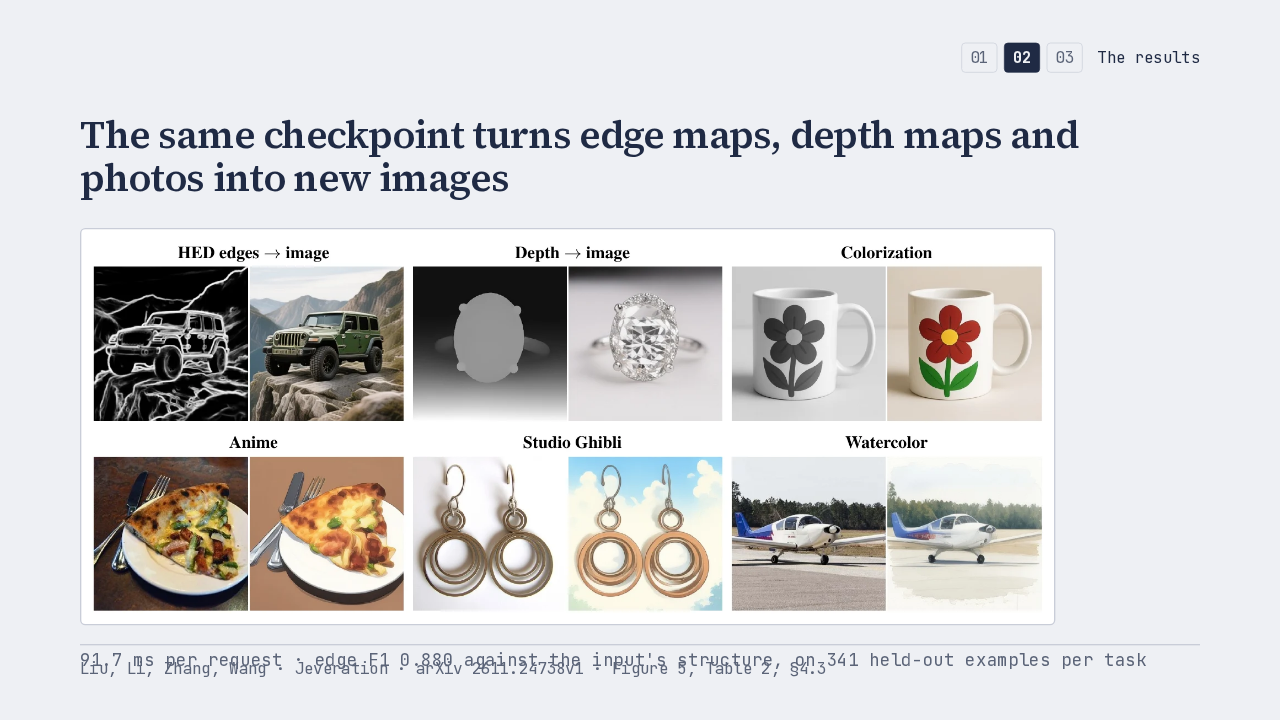
Liu, Li, Zhang, Wang · Jeveration · arXiv 2611.24738v1 · Figure 1b, Table 1, §4.2The same weights turn edge maps and depth maps into photos, colour black-and-white pictures, and restyle photos as anime, Studio Ghibli or watercolour. Each request takes about 92 milliseconds.
Slide text
01 02 03 The resultsThe same checkpoint turns edge maps, depth maps and photos into new images

91.7 ms per request · edge F1 0.880 against the input's structure, on 341 held-out examples per task
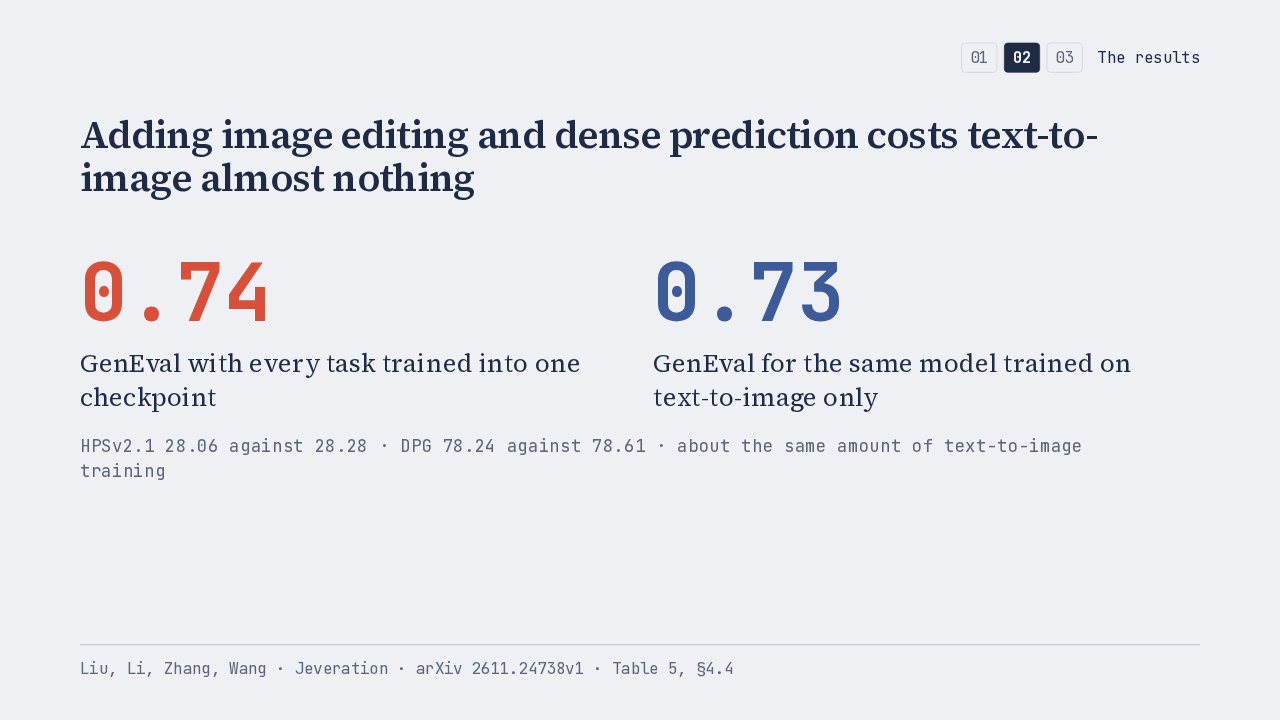
Liu, Li, Zhang, Wang · Jeveration · arXiv 2611.24738v1 · Figure 5, Table 2, §4.3One set of adapters handles all three jobs, and that leaves picture quality about where it was. GenEval sits at 0.74 with every task trained in, against 0.73 for text to image alone.
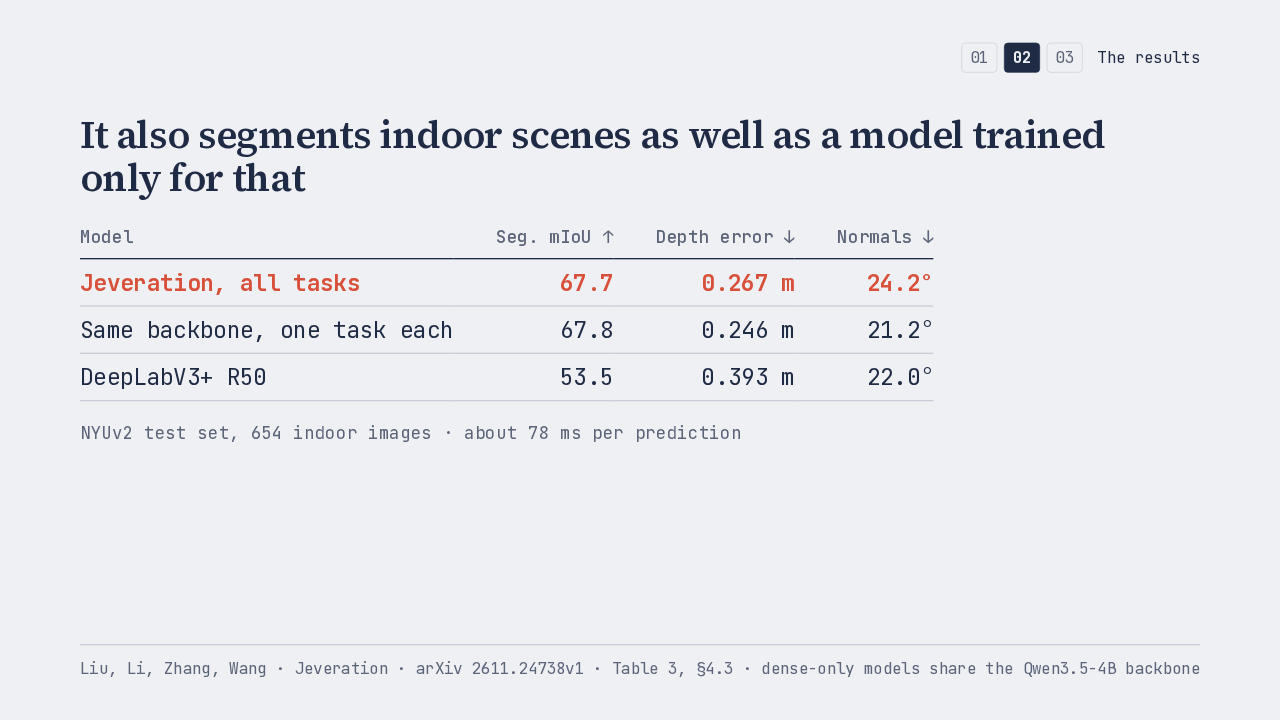
Ask the same checkpoint for segmentation, depth or surface normals on an indoor photo and it answers in one pass. Segmentation matches a model trained for that task alone, while depth and surface normals come out somewhat worse.
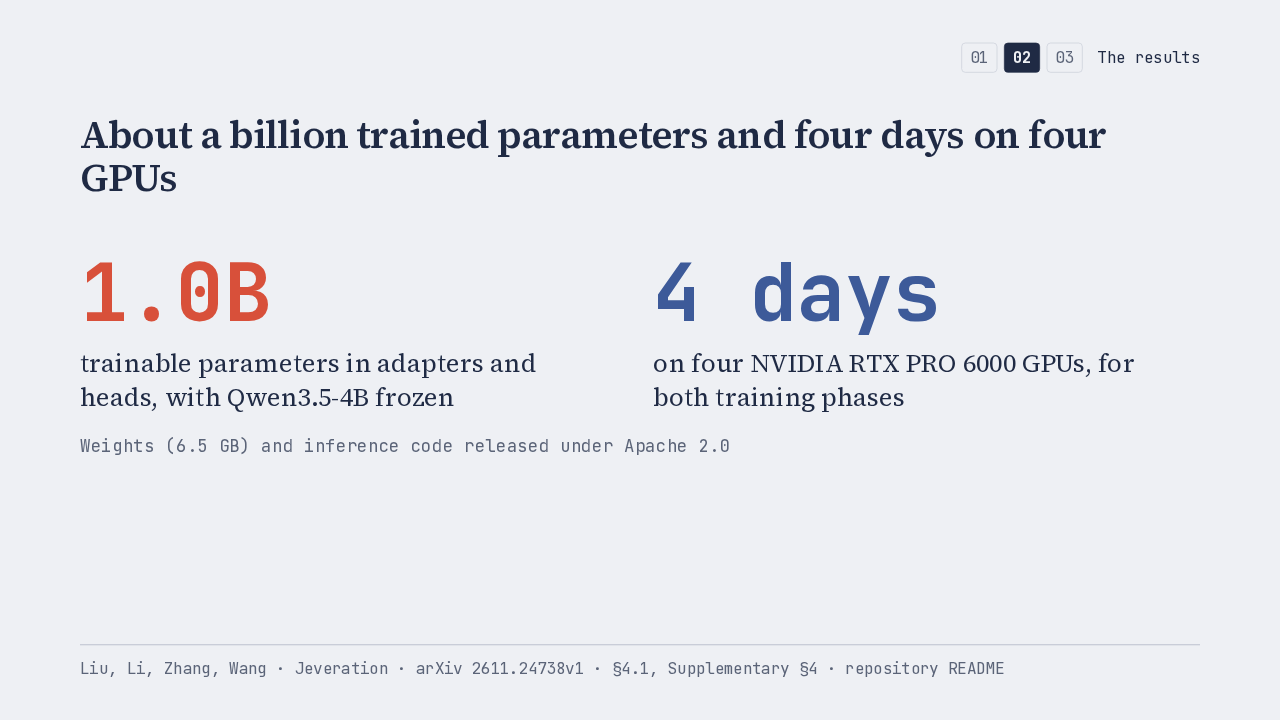
The Qwen3.5 backbone stays frozen. Training touches about a billion parameters of adapters and heads, over four days on four NVIDIA RTX PRO 6000 cards. The weights and inference code are out under the Apache 2.0 license.
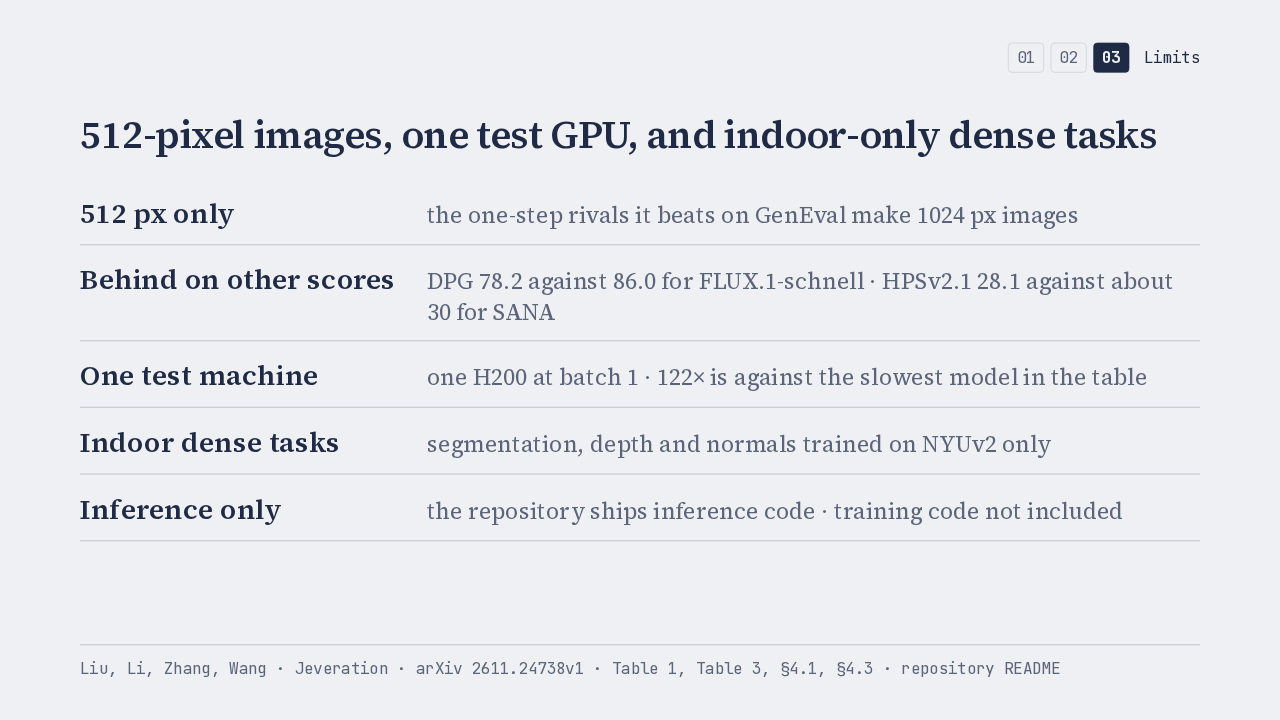
Jeveration makes only 512-pixel images and trails FLUX and SANA on prompt-detail and preference scores. Its speed was measured on one H200, and its depth and segmentation learned indoor rooms only.
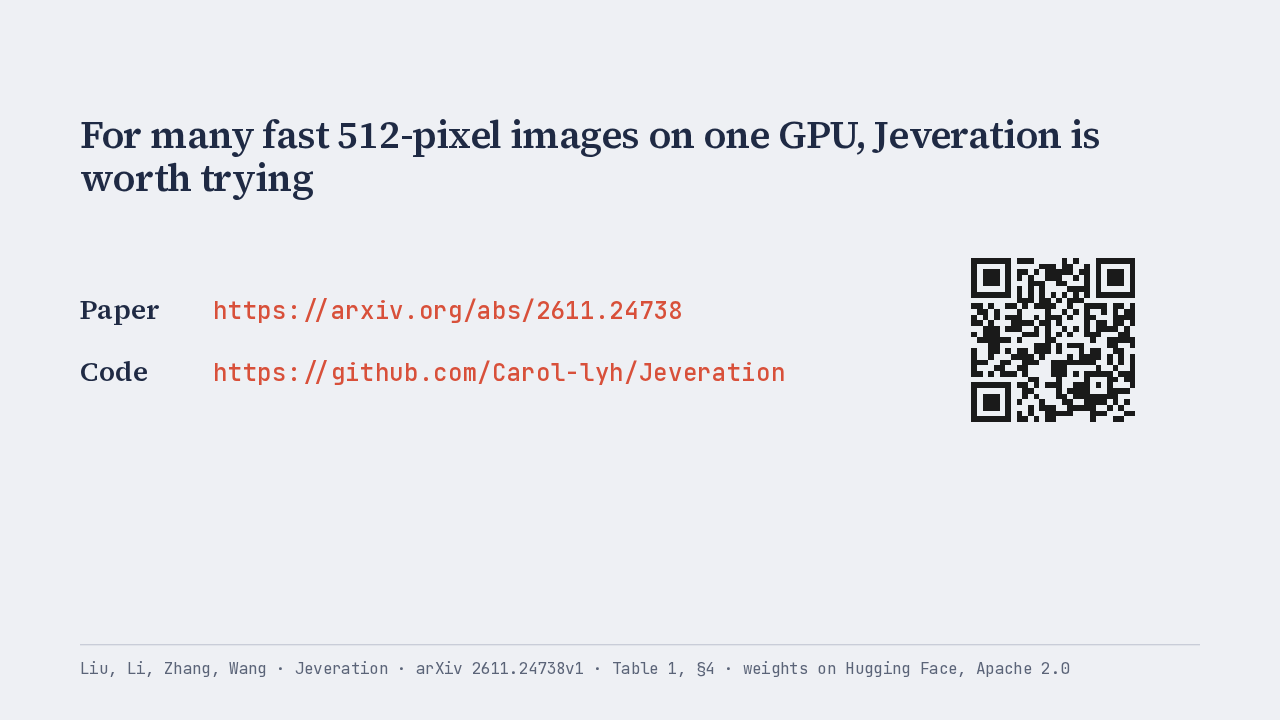
I would say yes, if you need many images fast at 512 pixels. It matches Janus-Pro-1B at nearly a hundred times the speed. Larger images and other GPUs went untested. The code is on GitHub.
Up next
 2:45
Accelerate Bench: Claude Sonnet 5.5 leads 16 agents at making programs faster
@ai-papers
2 days ago
 2:49
NestOne cuts a Qwen3.5 decision model to 24 layers at nearly full accuracy
@ai-papers
1 week ago
 2:33
MME-VLA robot memory counts a pause as work done and stops early
@ai-papers
1 week ago
 2:16
GPT-6 Astra fixed a small Qwen’s math by editing 1,023 of its weights
@ai-papers
1 week ago
 2:42
LoopVQ cuts looped models’ KV cache to half a bit and lifts Ouro’s throughput up to 6×
@ai-papers
2 weeks ago
 2:35
CUA-Master-27B is an open computer-use agent that trails only Claude Opus 5 and GPT-5.6-Sol on Agents' Last Exam
@ai-papers
2 weeks ago
 2:37
CaPtain trains Qwen3.5-4B to control a robot in code and beats several frontier-model agents
@ai-papers
2 weeks ago
 2:45
Trajectory2Gym data lifts a 4B Qwen3 agent past the stock 30B model on Tau2
@ai-papers
3 weeks ago
 2:46
“Wait” in reasoning models comes from training data, and RL almost never invents it
@ai-papers
3 weeks ago
 2:08
Looking Ahead makes Wan video models more physically plausible, with generation unchanged
@ai-papers
4 weeks ago
 2:30
OpenVLHarness gives vision models tools and a memory, and seven models each gain about 10 points
@ai-papers
1 month ago
 2:41
3DCodeVerse makes the same model write better 3D code than Claude Code, Codex or Gemini CLI
@ai-papers
1 month ago