Looking Ahead makes Wan video models more physically plausible, with generation unchanged
3 weeks ago
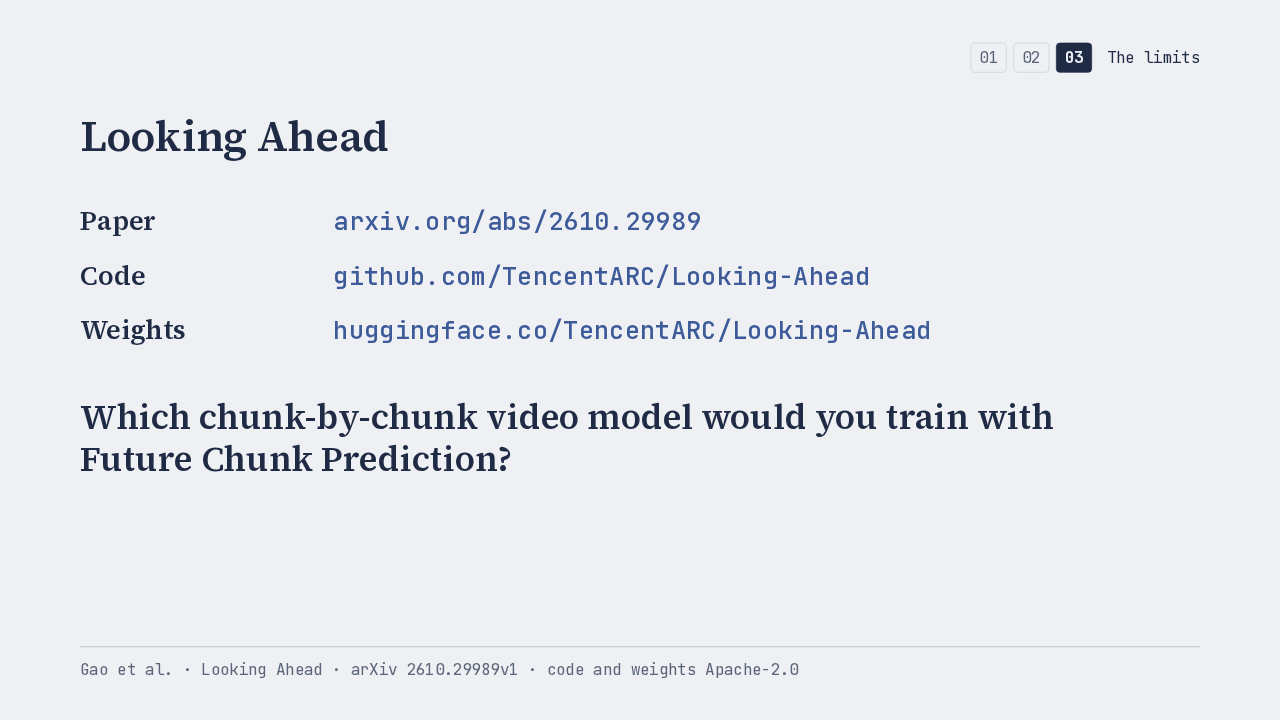
Looking Ahead adds Future Chunk Prediction to autoregressive video model training: small side branches predict chunks one to five steps ahead, then get dropped at inference. On Physics-IQ Verified, Wan 2.1 1.3B and Wan 2.2 5B score about a tenth higher with the same data and budget. Gao et al., Nanjing University, ARC Lab at Tencent IEG and Zhejiang University; arXiv 2610.29989v1, submitted 21 October 2026. Paper: https://arxiv.org/abs/2610.29989 Code: https://github.com/TencentARC/Looking-Ahead Weights: https://huggingface.co/TencentARC/Looking-Ahead
Ask about this presentation
Chapters
Show transcriptHide transcript
Video models that build a clip chunk by chunk get physics right more often when training also makes them predict further ahead. The method is Future Chunk Prediction, and generation runs exactly as before.
Slide text

Looking Ahead makes Wan video models more physically plausible, with generation unchanged
Ruopeng Gao, Yukun Huang, Limin Wang and colleagues · Nanjing University, ARC Lab at Tencent IEG, Zhejiang University
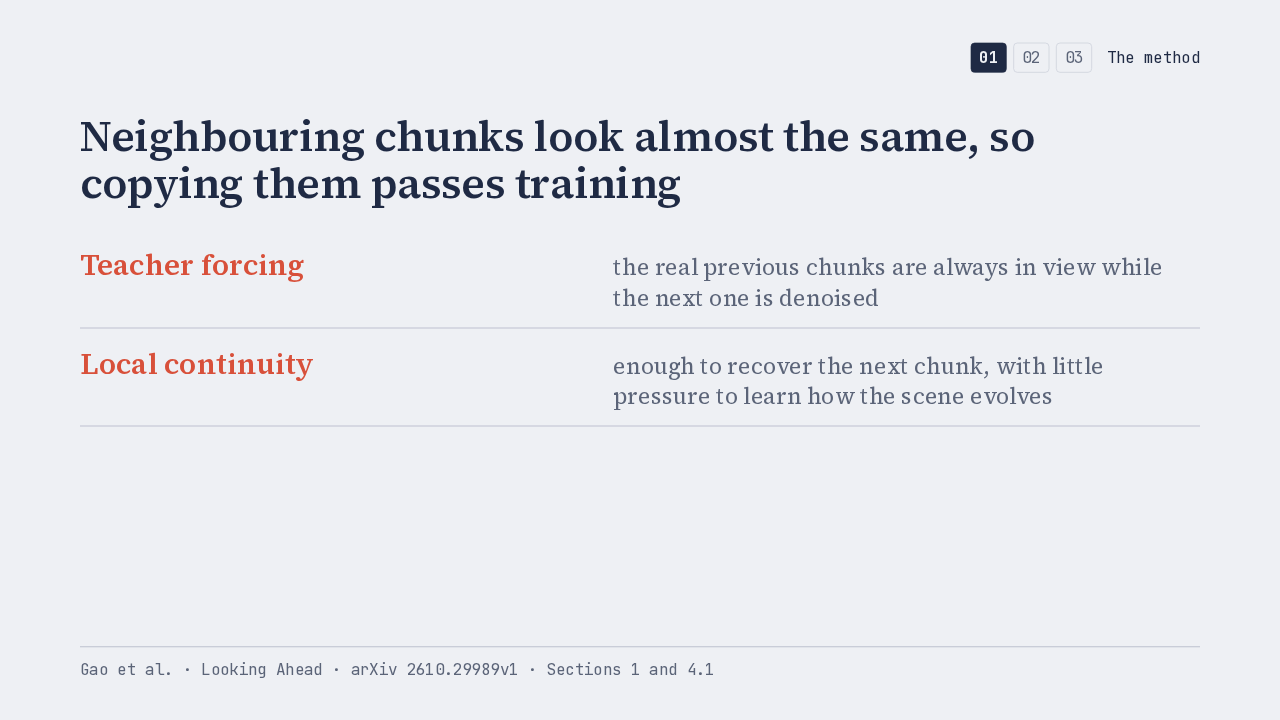
Gao et al. · Looking Ahead · arXiv 2610.29989v1 · submitted 21 Oct 2026These models train with teacher forcing. The model always sees the real chunks right before the one it denoises. Those look nearly identical, so it can copy them and learn little about change.
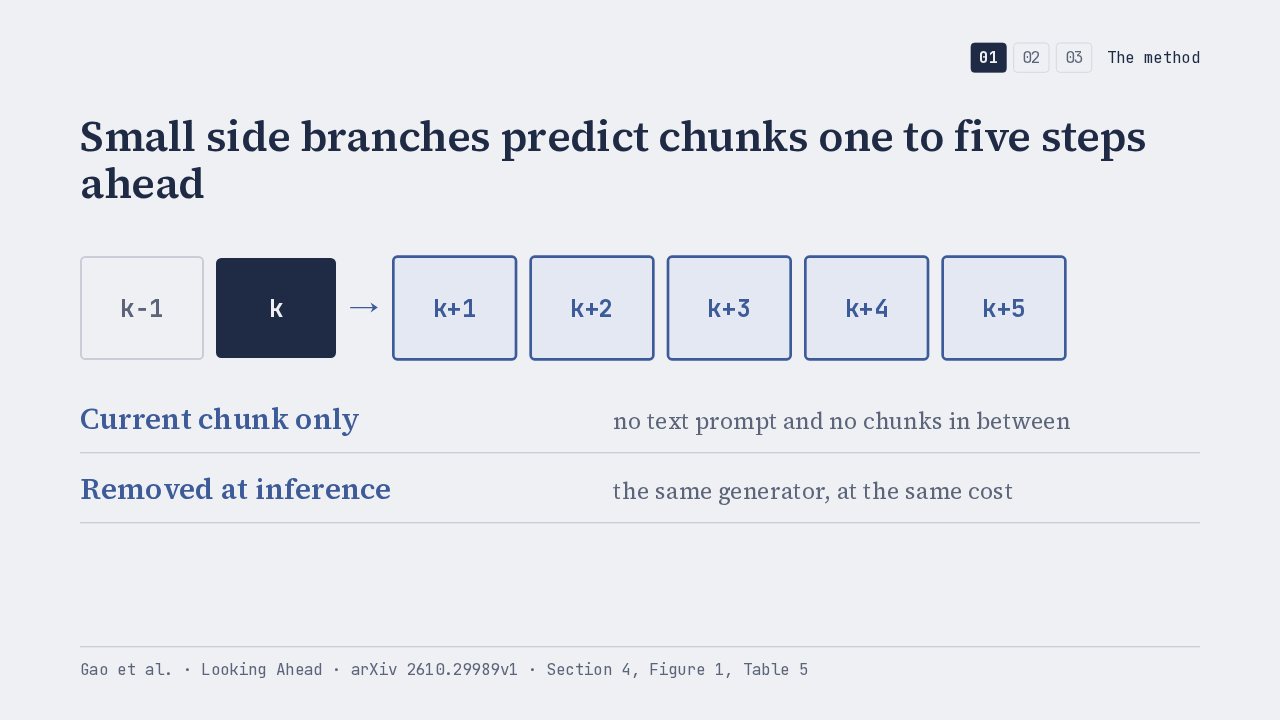
Future Chunk Prediction adds small side branches. Each predicts a chunk one to five steps ahead from the current chunk alone. They get no prompt and no chunks in between. Generation drops them.
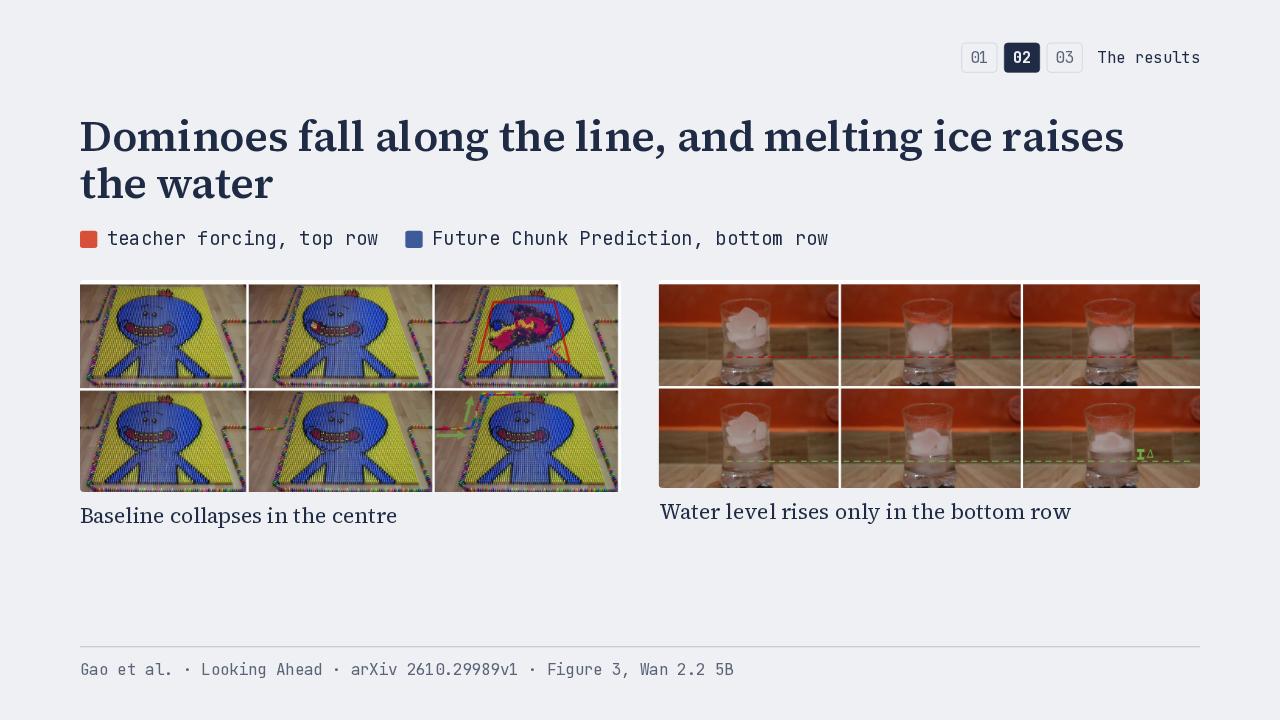
Plain teacher forcing is on top, Future Chunk Prediction underneath. The baseline's dominoes collapse in the middle, while the new model topples them along the line. Only the new model shows melting ice raising the water.
Slide text
01 02 03 The resultsDominoes fall along the line, and melting ice raises the water
teacher forcing, top row Future Chunk Prediction, bottom row
Baseline collapses in the centre

Water level rises only in the bottom row
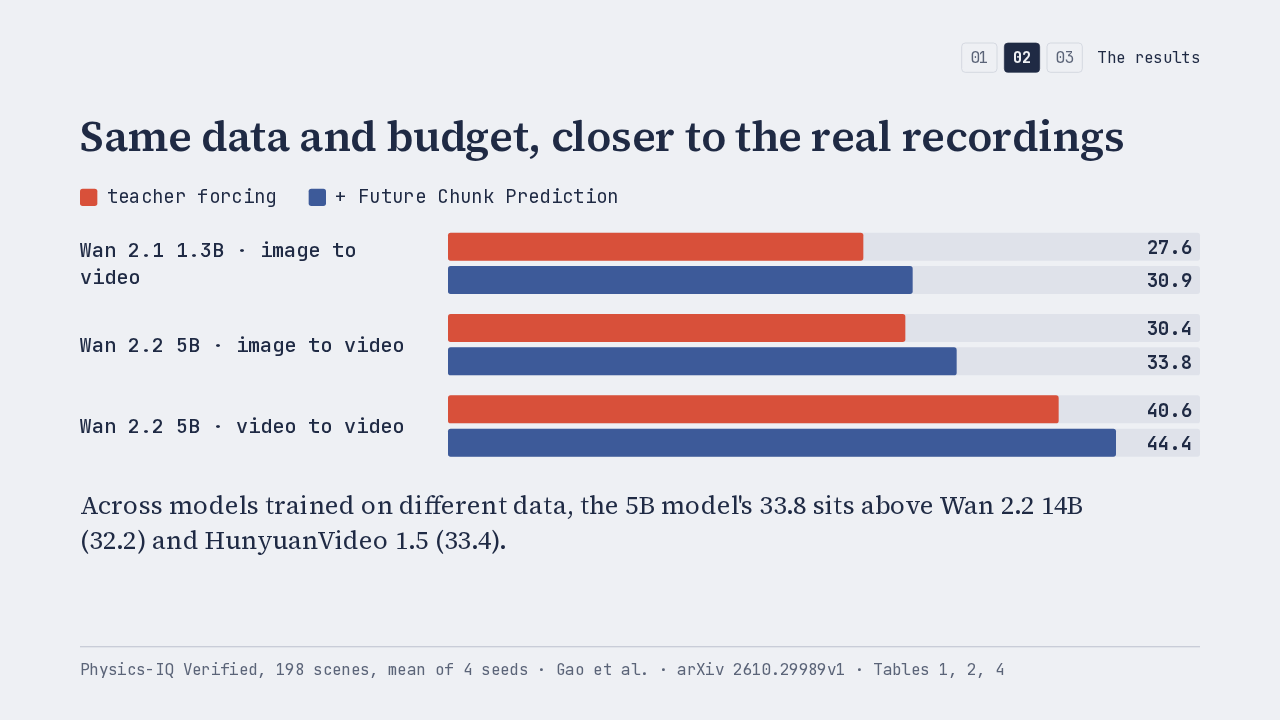
Gao et al. · Looking Ahead · arXiv 2610.29989v1 · Figure 3, Wan 2.2 5BPhysics-IQ Verified scores a generated clip against a real recording of the same experiment. With the same data and budget, both model sizes score roughly a tenth higher. The 5 billion parameter model edges past Wan 2.2 at 14 billion.
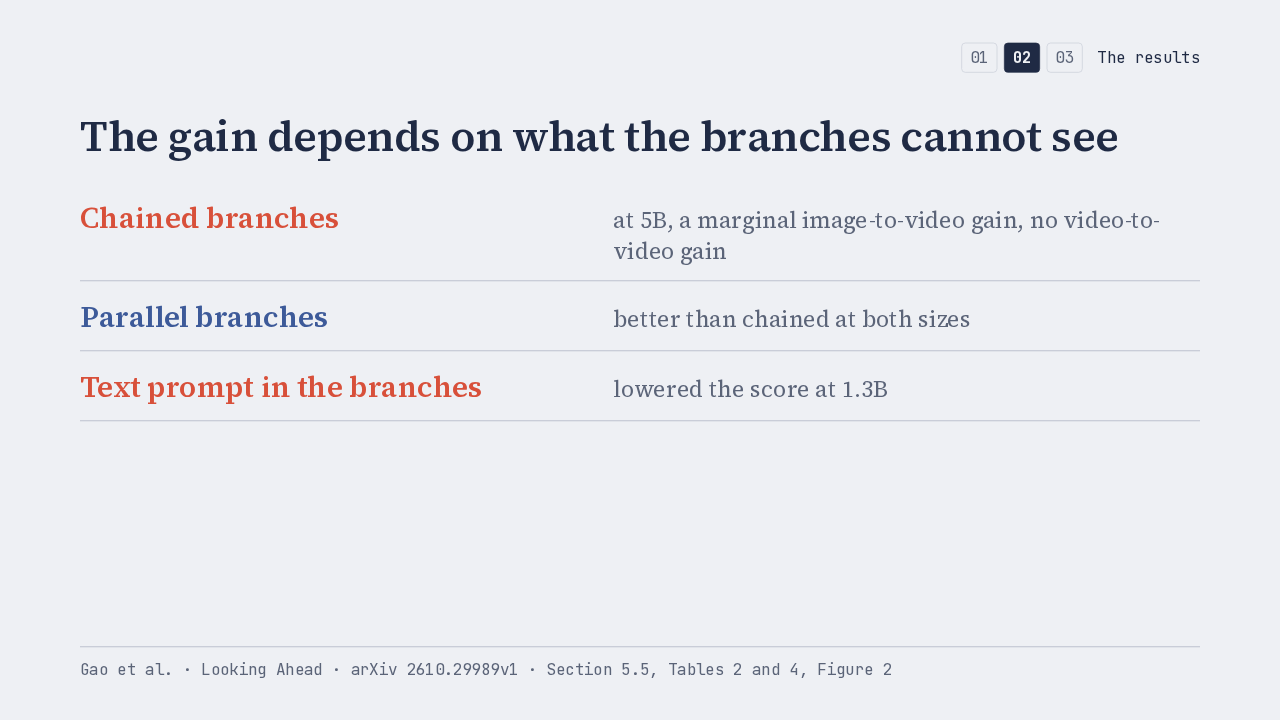
The branches only help when they can't peek. Chained, each branch sees the last one's guess, and the 5 billion parameter model barely improved. Giving them the text prompt also lowered the score.
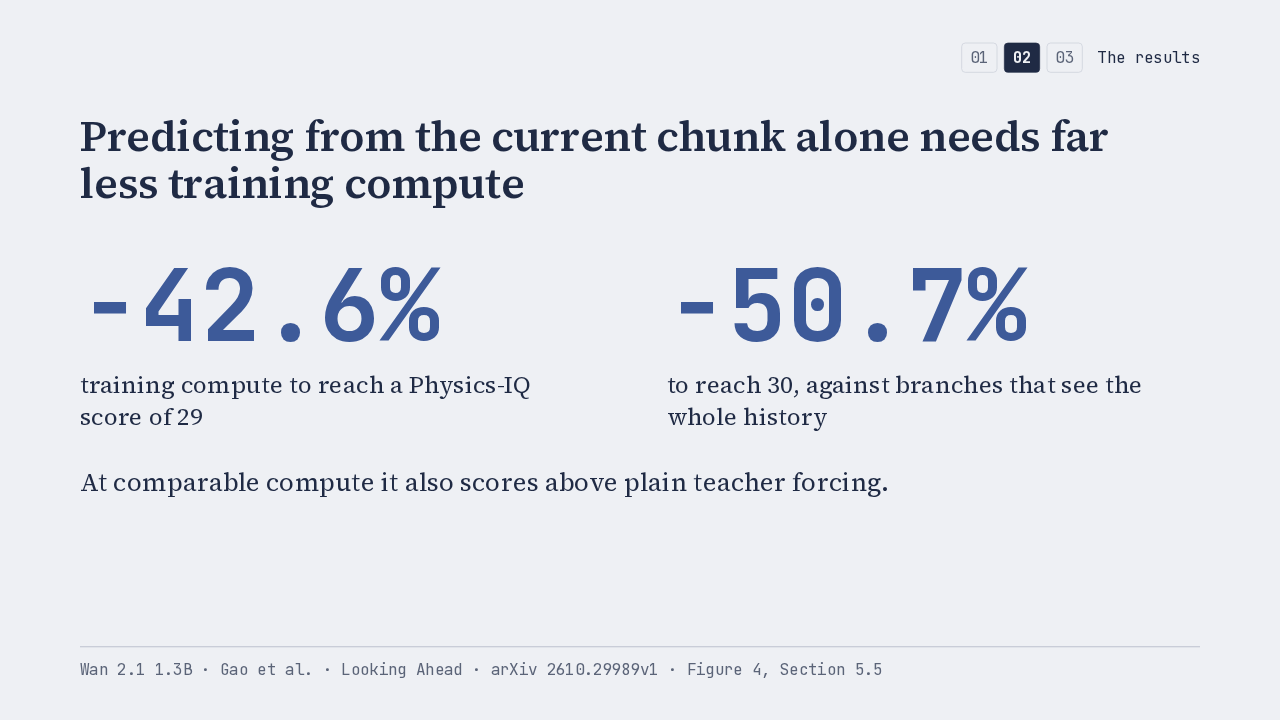
Next Forcing, the closest related method, predicts from the whole history. Using only the current chunk reaches the same physics score with roughly half the training compute. At equal compute it still beats teacher forcing.
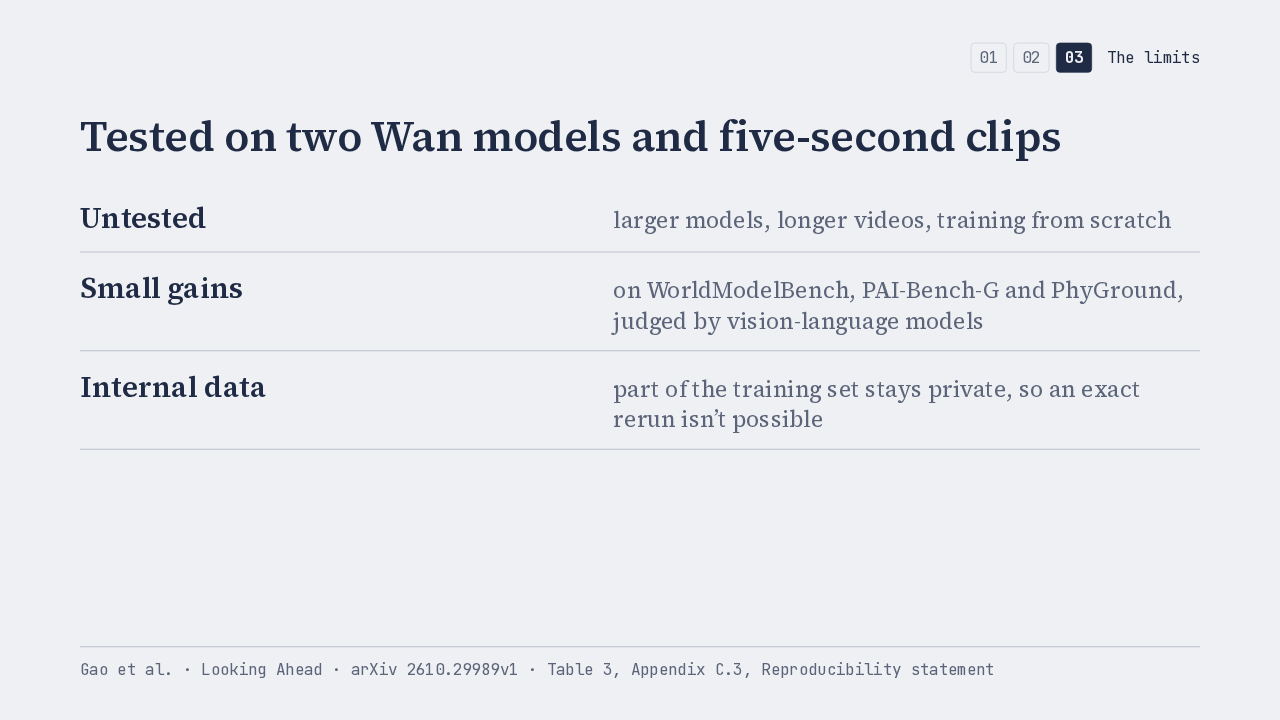
Both test models start from pretrained Wan checkpoints and make five-second clips. Bigger models and longer videos are untested. Gains on three benchmarks judged by vision-language models are small. Some training data is private.
The code and four checkpoints, both Wan sizes with and without Future Chunk Prediction, are out under Apache 2.0. If you train a chunk-by-chunk video model, which one would you try this on?
Up next
 2:49
NestOne cuts a Qwen3.5 decision model to 24 layers at nearly full accuracy
@ai-papers
1 day ago
 2:33
MME-VLA robot memory counts a pause as work done and stops early
@ai-papers
3 days ago
 2:16
GPT-6 Astra fixed a small Qwen’s math by editing 1,023 of its weights
@ai-papers
5 days ago
 2:42
LoopVQ cuts looped models’ KV cache to half a bit and lifts Ouro’s throughput up to 6×
@ai-papers
1 week ago
 2:35
CUA-Master-27B is an open computer-use agent that trails only Claude Opus 5 and GPT-5.6-Sol on Agents' Last Exam
@ai-papers
1 week ago
 2:37
CaPtain trains Qwen3.5-4B to control a robot in code and beats several frontier-model agents
@ai-papers
1 week ago
 2:45
Trajectory2Gym data lifts a 4B Qwen3 agent past the stock 30B model on Tau2
@ai-papers
2 weeks ago
 2:46
“Wait” in reasoning models comes from training data, and RL almost never invents it
@ai-papers
3 weeks ago
 2:30
OpenVLHarness gives vision models tools and a memory, and seven models each gain about 10 points
@ai-papers
3 weeks ago
 2:41
3DCodeVerse makes the same model write better 3D code than Claude Code, Codex or Gemini CLI
@ai-papers
4 weeks ago
 2:53
Agent-Reflex trains an 8B agent to recover when its MCP tools fail, and it gets derailed half as often
@ai-papers
1 month ago
 2:45
EmbodiedCLBench: one practice task gives AI agents most of their gain, and more practice doesn’t add to it
@ai-papers
1 month ago