
AI News: OpenAI's dots, Gemini 4 Argon, GPT-6.1 Sol, Claude Sonnet 5.5
OpenAI's dots, Gemini 4 Argon, GPT-6.1 Sol and Claude Sonnet 5.5
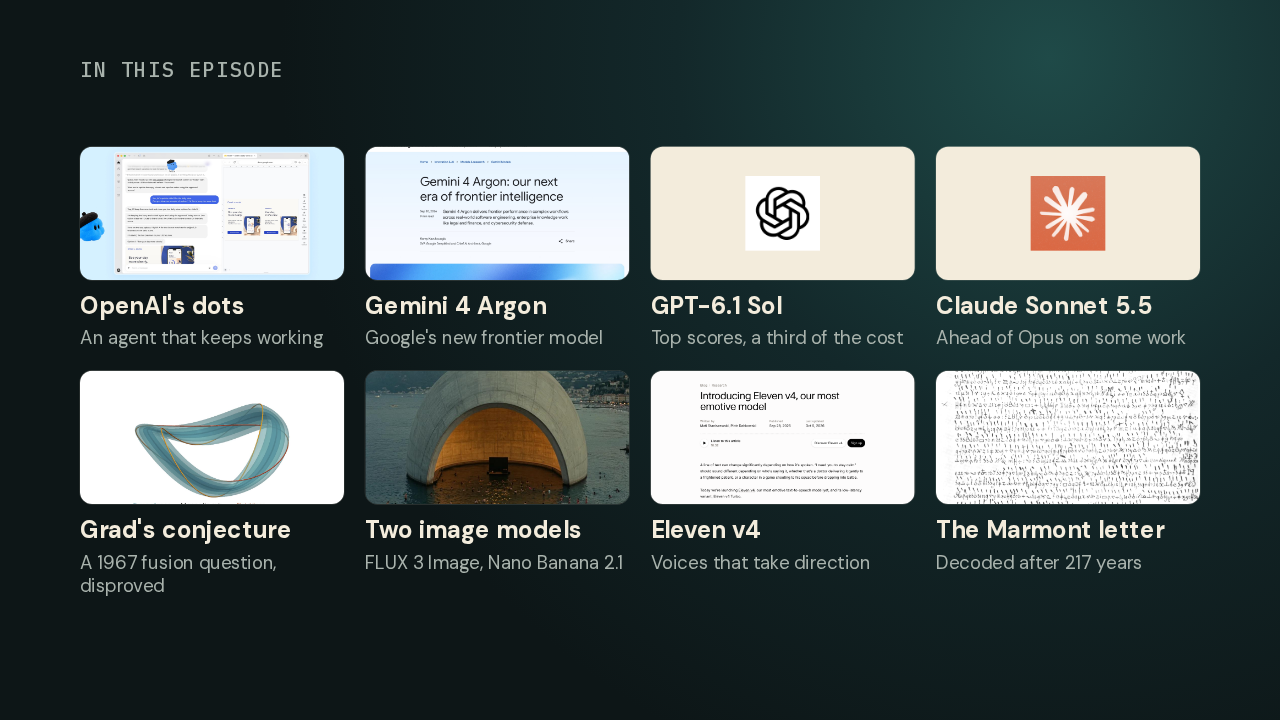
OpenAI just gave ChatGPT an agent that keeps working after you close the chat, and language models helped crack a fusion question from 1967 and a letter from 1809. This is AI News for September 28th to October 8th.
The rundown


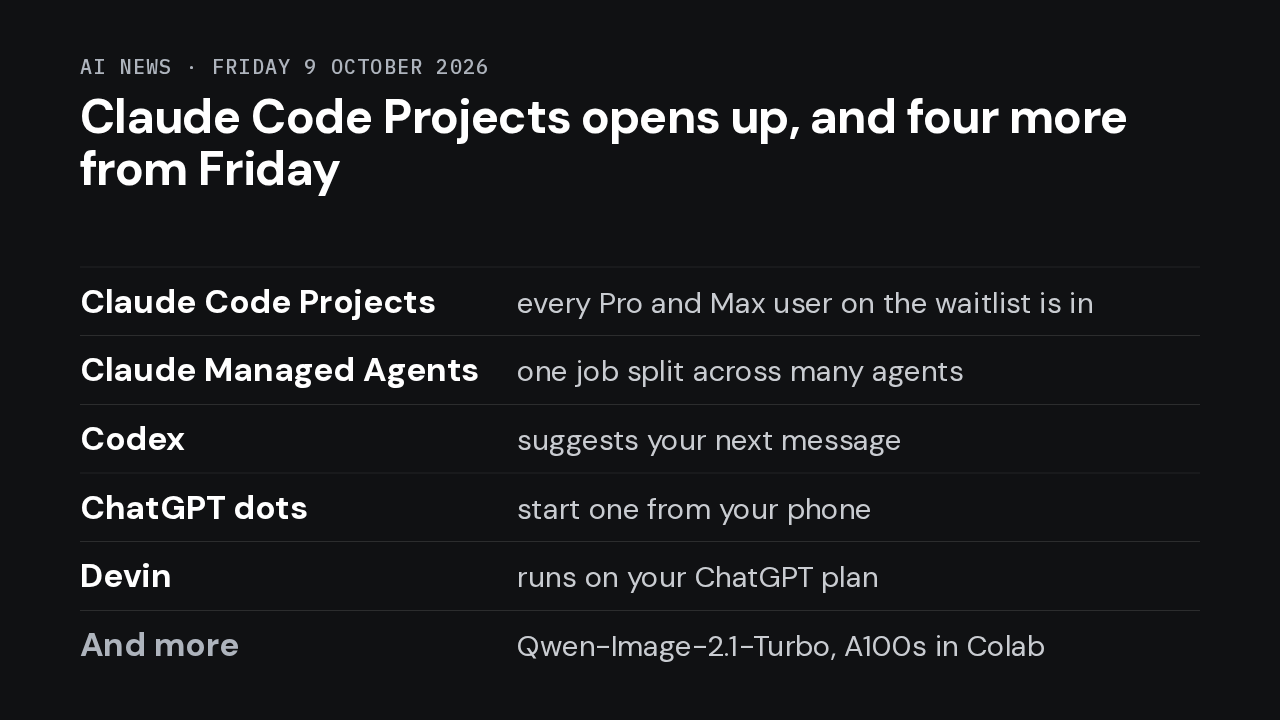
OpenAI's dots, and how they're kept in check. Gemini 4 Argon, Google's new model for long jobs, which developers still can't call. GPT-6.1 Sol, top-model scores for a third of the cost. Claude Sonnet 5.5, ahead of Opus on some work for half the price. The fusion proof. Two image models. ElevenLabs' new voices. And Napoleon's letter, read for the first time in two hundred years.
OpenAI's dots keep working after you leave the chat

Always-on agents in ChatGPT, introduced September 29, 2026
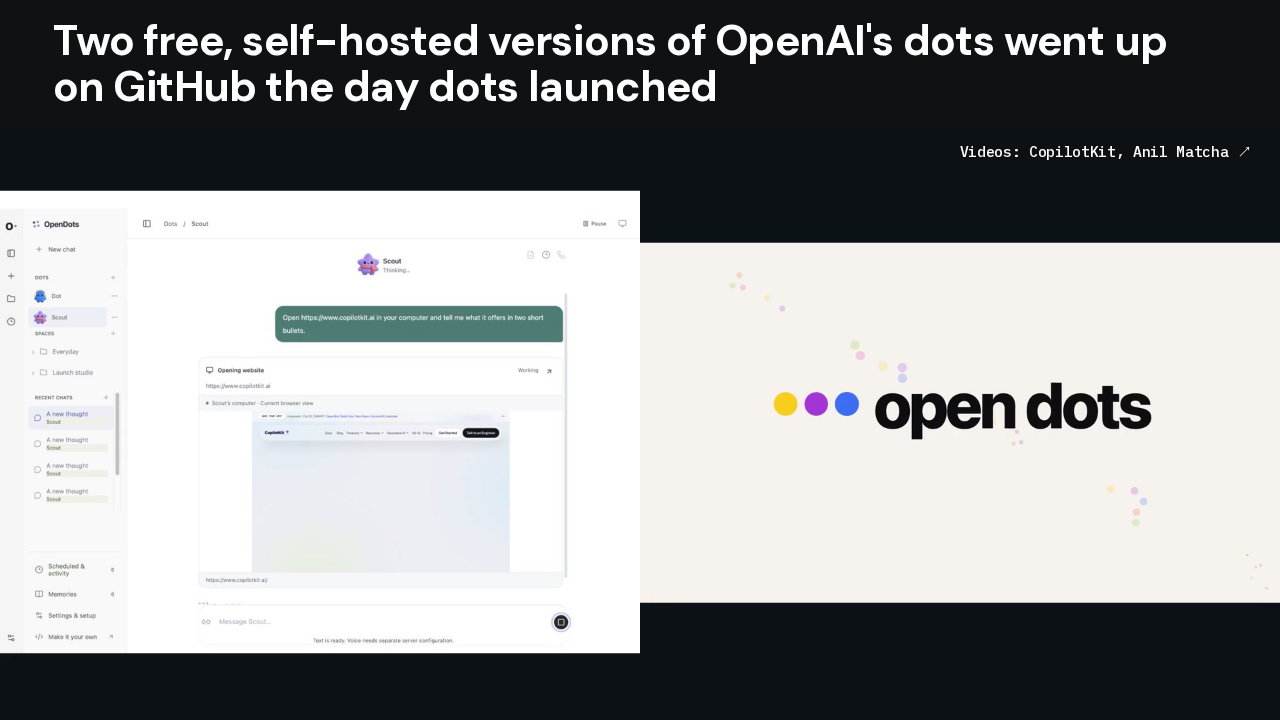
On September 29th, OpenAI introduced dots. A dot is an always-on agent inside ChatGPT that keeps making progress between your conversations. It runs on GPT-6 Astra. Of everything in this roundup, it's the release most people will actually touch, so here's how it works.
Each dot works on its own cloud computer
With its own browser, and the apps you connect from more than 4,000
Each dot gets its own cloud computer, with its own browser, and it can connect to more than 4,000 apps through plugins. You can open that computer at any time and watch the work, and connect your own computer from the ChatGPT desktop app when the dot needs your local skills or your own browser.
Between tasks, your dot looks for work on its own
Its background research is read-only: it can't send messages, edit your apps or control a browser
When you aren't working with it, your dot goes looking for ways to help. One early tester's dot noticed he'd forgotten to invoice a publication, prepared the invoice, and sent it once he approved. This background work is called proactive research, and it uses read-only tools, enforced in code. It can't message anyone, change anything in your apps, or control a browser or computer. Anything the dot wants to do next goes through your rules.
A separate check reviews each action before it runs
It's called Auto-review, and it runs where a dot can't turn it off
Before a dot sends an email or changes a file, a separate system called Auto-review checks the step against your instructions, your rules and the built-in safety requirements. For an email, it checks the recipient and the message. It runs outside anything the dot can change, so the dot can't switch it off. And for supported sign-ins, the model pauses while you type your password, which goes straight to the dot's browser.
Dots are rolling out to Pro and Business Premium first
Rolling out gradually over several days, for people 18 and over.
Dots are rolling out now, to Pro and Business Premium first, with a beta for Enterprise, Edu and Healthcare workspaces. Pro subscribers in the European Economic Area, Switzerland and the UK wait for now, and a dot can take a few days to reach your account.
A second agent, Sentinel, guards what Muse sends out

Muse's actions reach the internet only with Sentinel's approval.
Meta's Muse, out since September 8th, does the same kind of job and guards it in a similar way. Muse runs on its own computer in the cloud. A separate agent called Sentinel runs beside it, and Muse's actions reach the internet only if Sentinel approves.
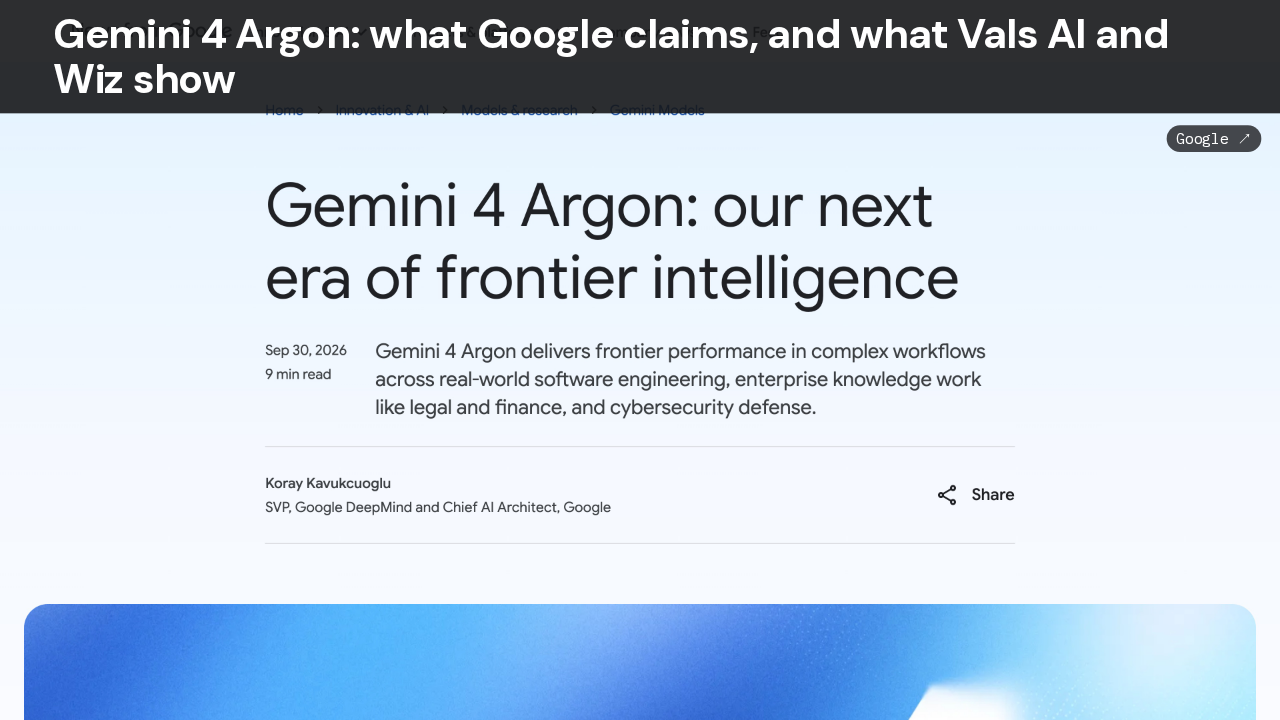
Gemini 4 Argon: what Google claims, and what Vals AI and Wiz show
Google released Gemini 4 Argon on September 30th. It's built for long jobs: coding that runs for hours, legal and finance work, and cyber defense. Here's where it leads.
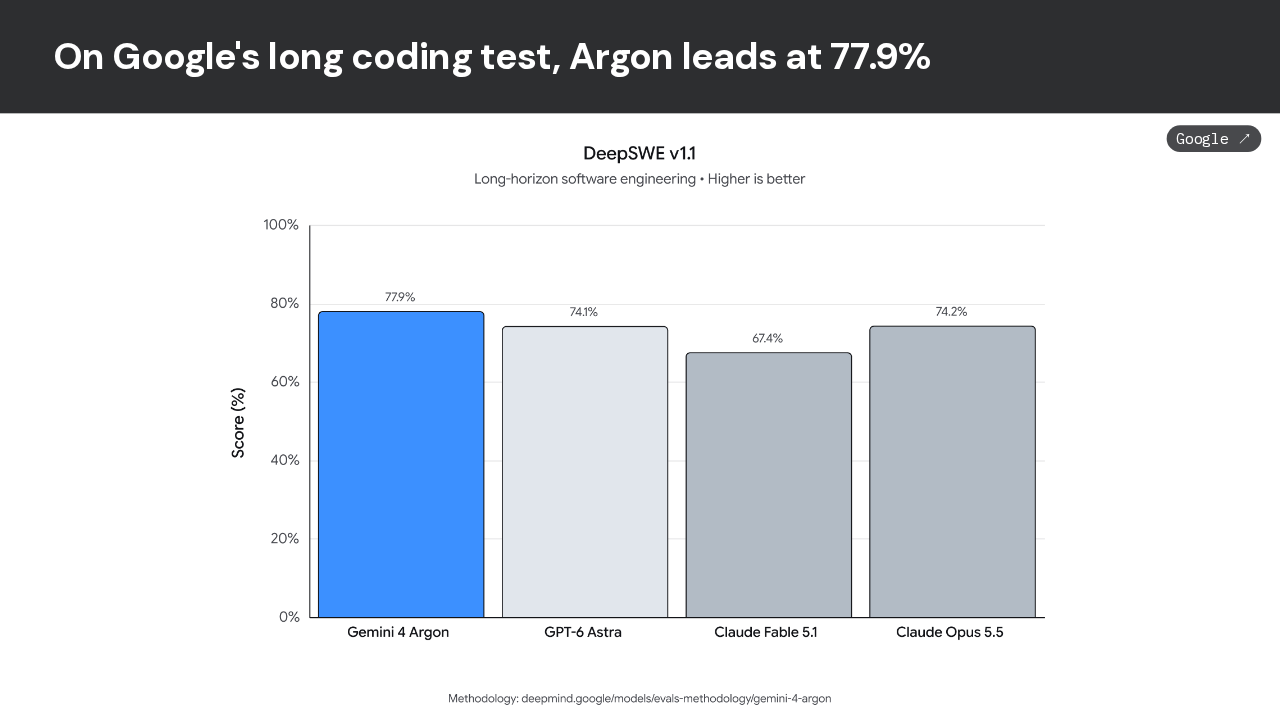
On Google's long coding test, Argon leads at 77.9%

On DeepSWE, a test of long software engineering tasks, it scores about 78 percent, four points clear of Claude Opus 5.5 and GPT-6 Astra. That's the top score.
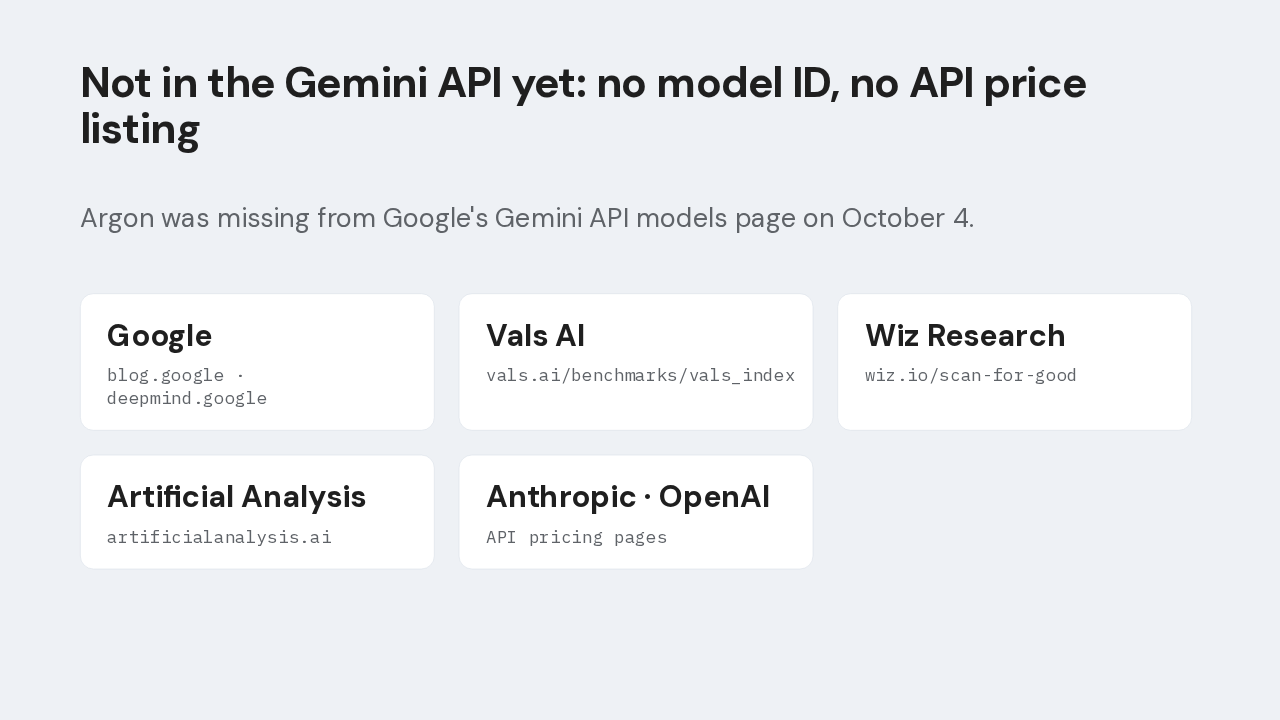
Not in the Gemini API yet: no model ID, no API price listing
Argon was missing from Google's Gemini API models page on October 4.
One thing to watch. Nine days after launch, Argon still isn't on the Gemini API models page, and it has no model ID. When it shows up there, developers can try it themselves.
GPT-6.1 Sol
OpenAI releases GPT-6.1 Sol
On September 29th, OpenAI released GPT-6.1 Sol, a model for complex coding, computer use and professional work. It's in the API, through the Responses and Chat Completions endpoints.
About 51 points
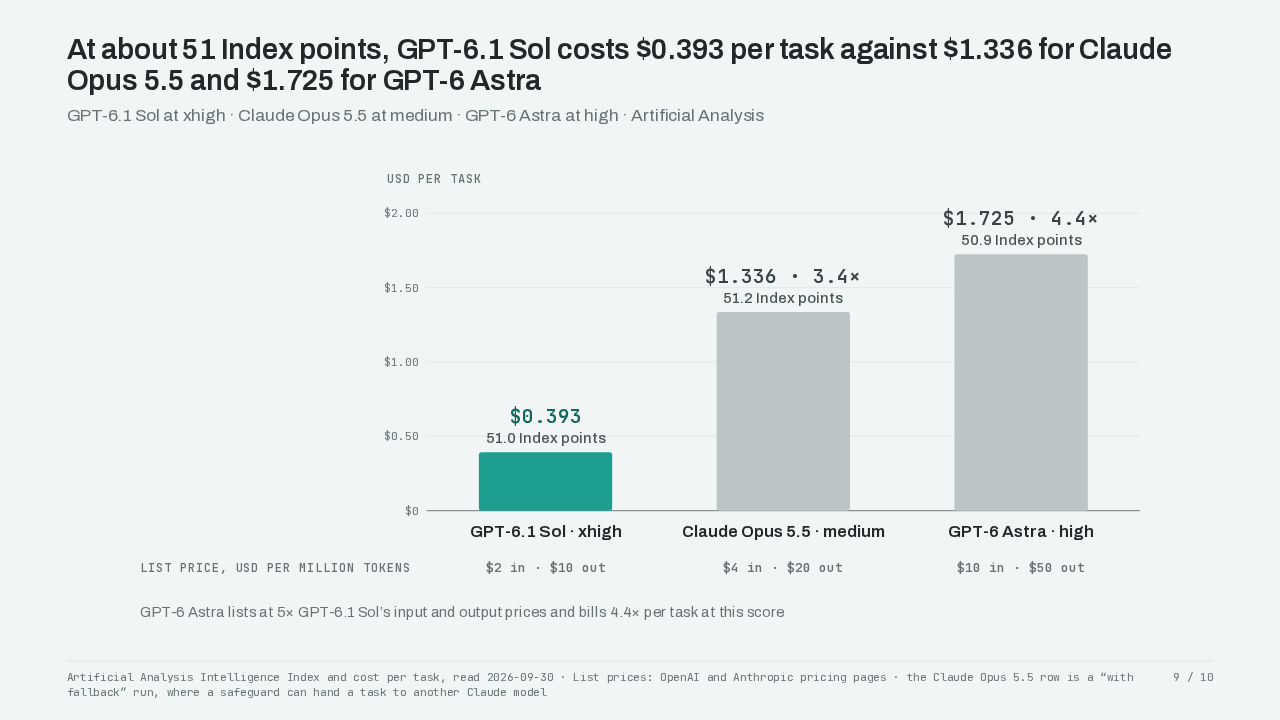
At about 51 Index points, GPT-6.1 Sol costs $0.393 per task against $1.336 for Claude Opus 5.5 and $1.725 for GPT-6 Astra
GPT-6.1 Sol at xhigh · Claude Opus 5.5 at medium · GPT-6 Astra at high · Artificial Analysis
GPT-6 Astra lists at 5× GPT-6.1 Sol’s input and output prices and bills 4.4× per task at this score
Is it worth switching? Artificial Analysis runs the same tests on every model and prices each run. On its Intelligence Index, GPT-6.1 Sol matches Claude Opus 5.5 and GPT-6 Astra for a third of the cost per task, or less. That's why I'd call it the best deal of these two weeks.
Claude Sonnet 5.5: what changed
Claude Sonnet 5.5 nearly matches Opus 5.5 and refuses more security requests
Claude Sonnet 5.5 is Anthropic's new mid-size model, and on some work it now beats Claude Opus 5.5 at half the price: hard command-line tasks, business automation, and questions from health professionals. On coding, Opus still leads.
More refusals on security work
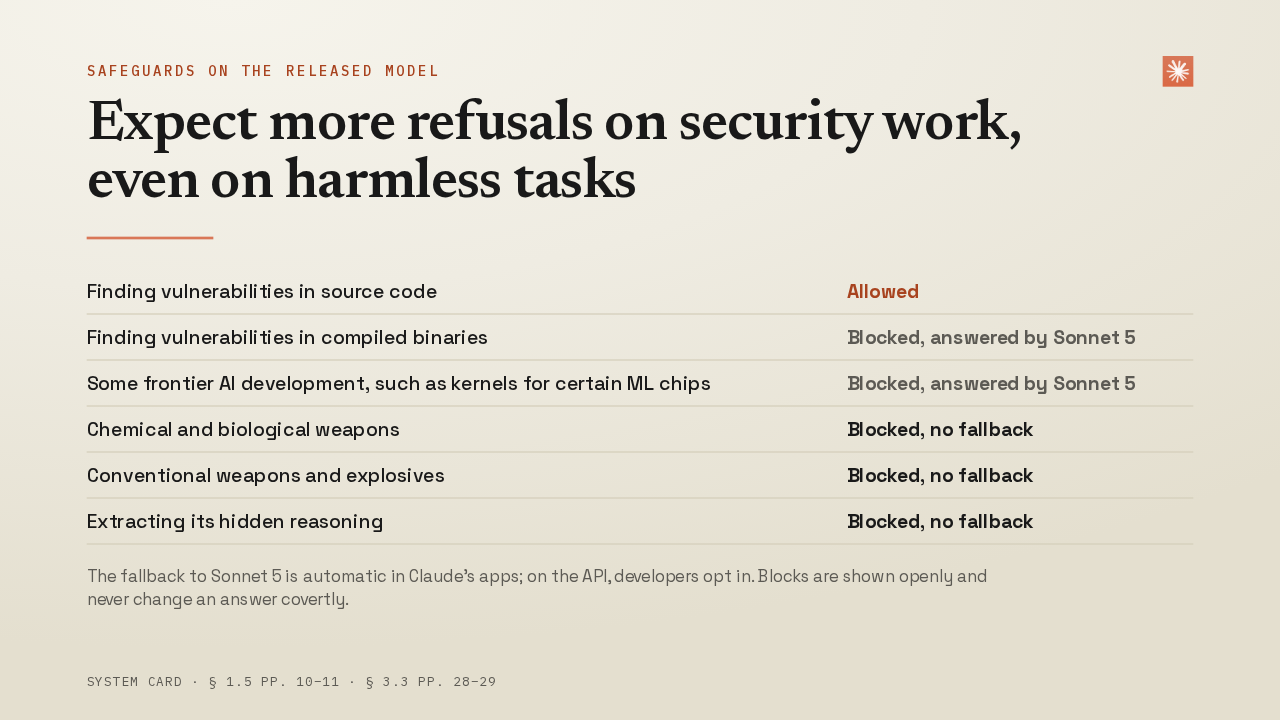
Expect more refusals on security work, even on harmless tasks
It also ships with the same cyber safeguards as Opus 5.5, so expect more refusals, even on harmless security tasks. Finding vulnerabilities in source code is still allowed; in compiled programs it's blocked. A blocked request is answered by Claude Sonnet 5 instead: automatically in Claude's apps, and on the API if the developer opts in.
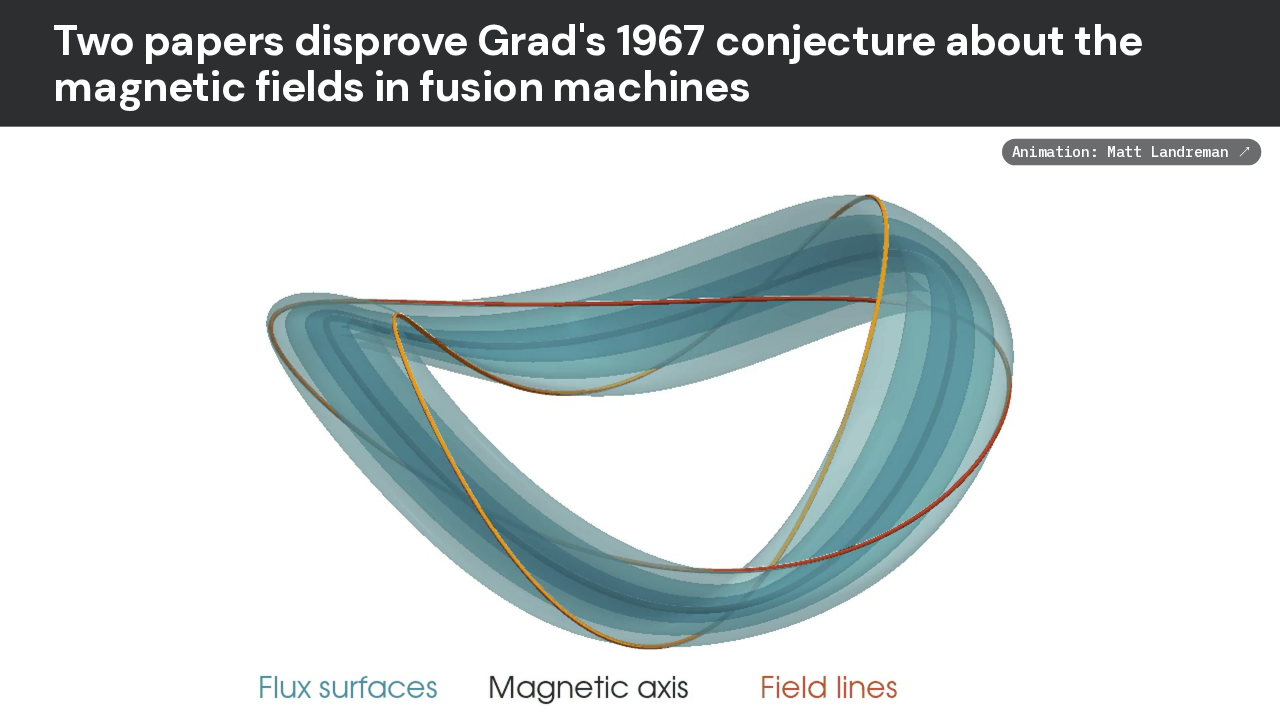
Two papers disprove Grad's 1967 conjecture about the magnetic fields in fusion machines
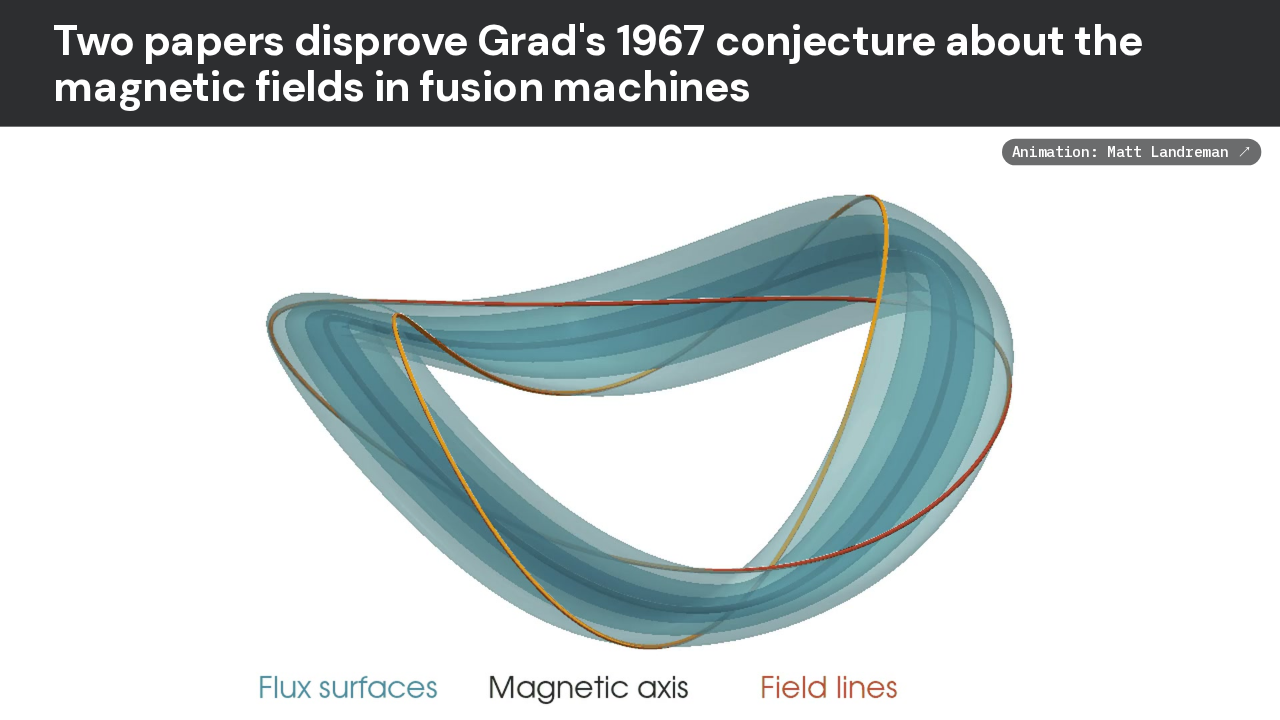
Language models helped settle a fusion question that had stood since 1967. Harold Grad argued that a twisted magnetic field, like the one in a stellarator, probably couldn't hold plasma smoothly without a symmetry. In September, two papers showed that it can. This is one of the counterexamples: magnetic surfaces nested like the layers of a ring-shaped onion, with none of the symmetries Grad said they'd need.
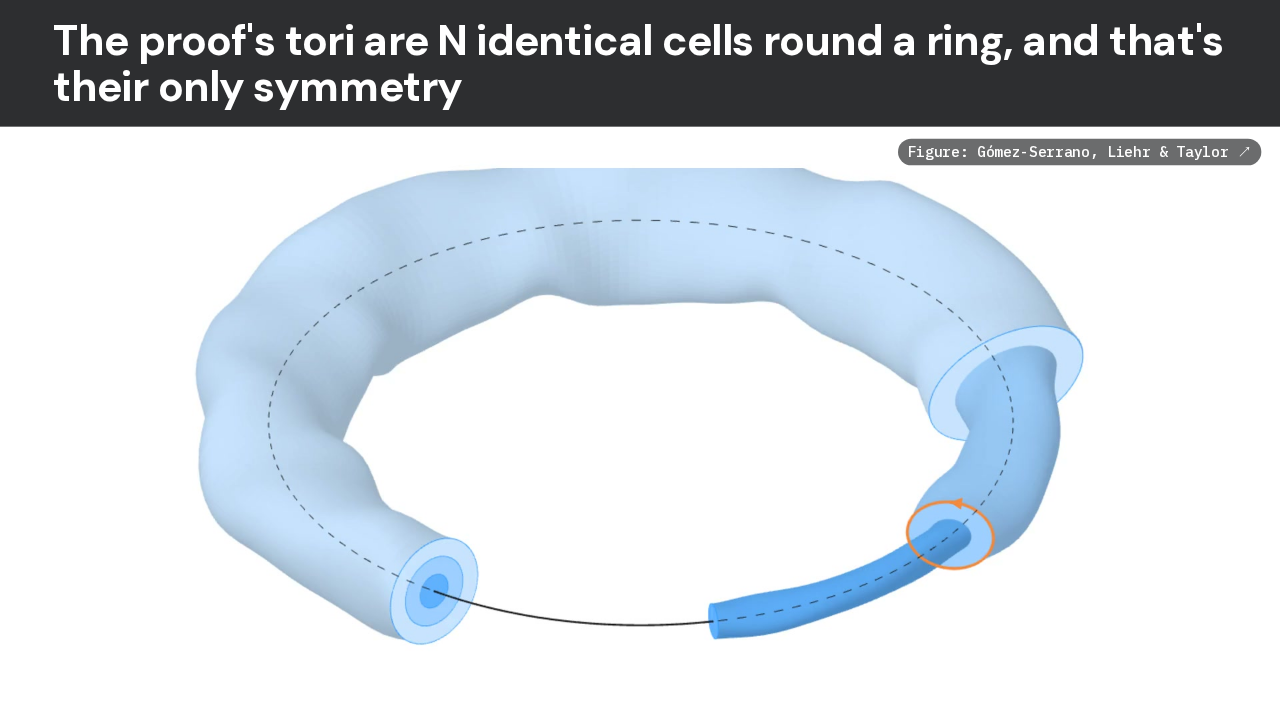
The proof's tori are N identical cells round a ring, and that's their only symmetry
On September 21, Javier Gómez-Serrano, Lukas Liehr and Mitchell Taylor posted a proof that Grad was wrong. Their equilibria are rings built from identical cells; the paper's figure shows eight. Turning the ring by one cell is the only symmetry left: no mirror, no axis to spin around, no helix. And they come in smooth families, which Grad said shouldn't exist either.
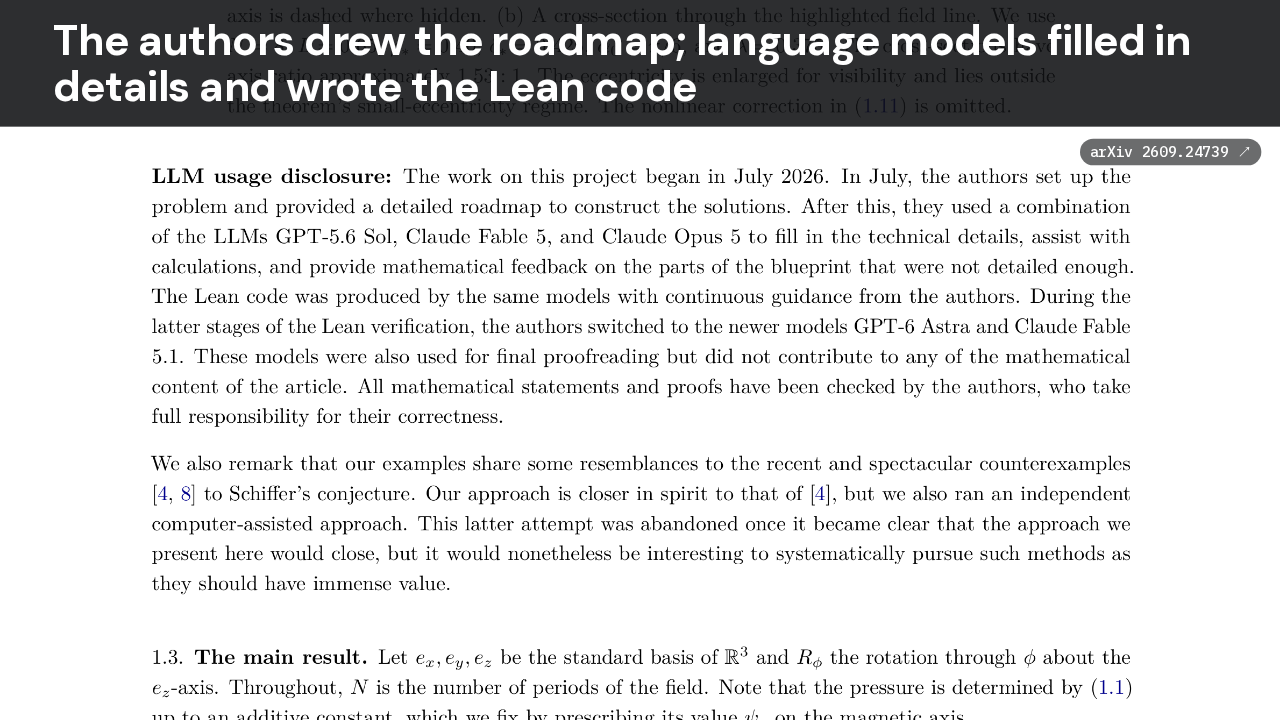
The authors drew the roadmap; language models filled in details and wrote the Lean code

The paper says how it was made. The work began in July 2026. The authors set up the problem and a detailed roadmap. Then language models, GPT 5.6 Sol, Claude Fable 5 and Claude Opus 5, filled in technical details and wrote the Lean code, with the authors guiding them throughout. The authors checked every statement and proof, and take responsibility for them.
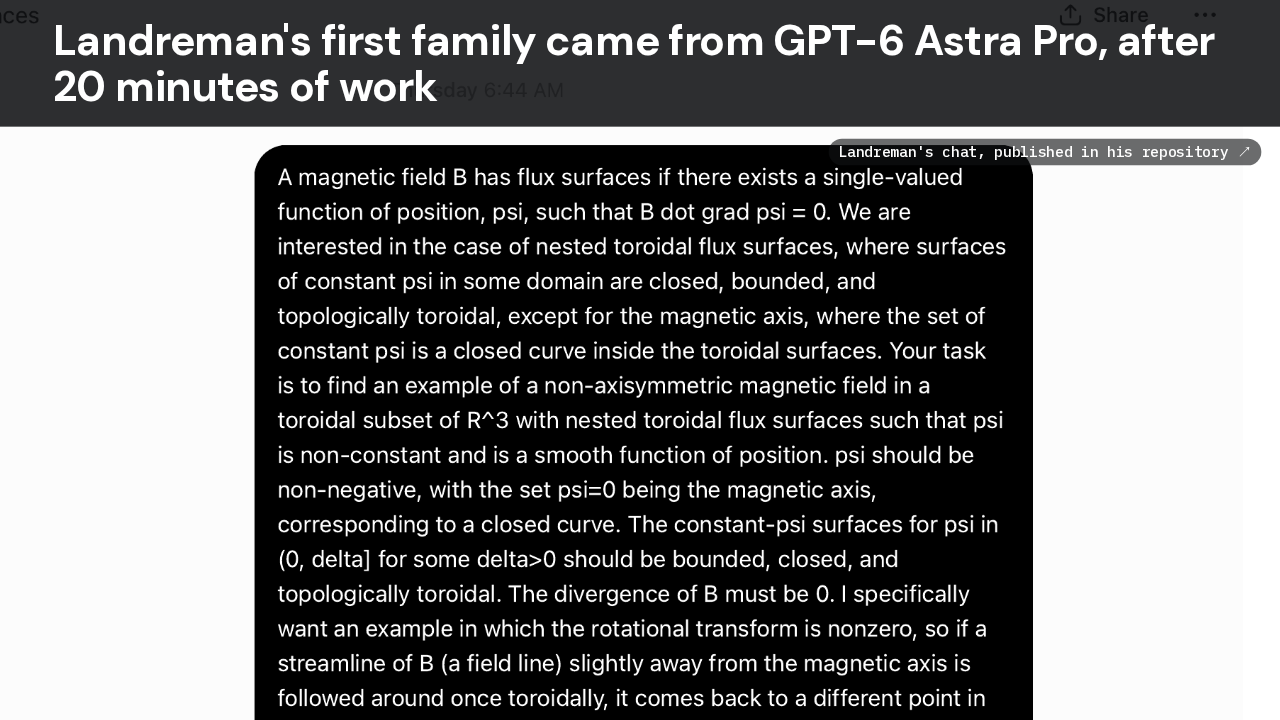
Landreman's first family came from GPT-6 Astra Pro, after 20 minutes of work

A day later, Matt Landreman at the University of Maryland posted exact solutions he found with GPT-6 Astra Pro, and he published the chats. The request spells out the field he wanted, and ends: this is an open problem, so you'll need to be persistent and creative. The answer came back after 20 minutes and 34 seconds: an exact family of fields with nested surfaces. Landreman then confirmed every equation by hand.
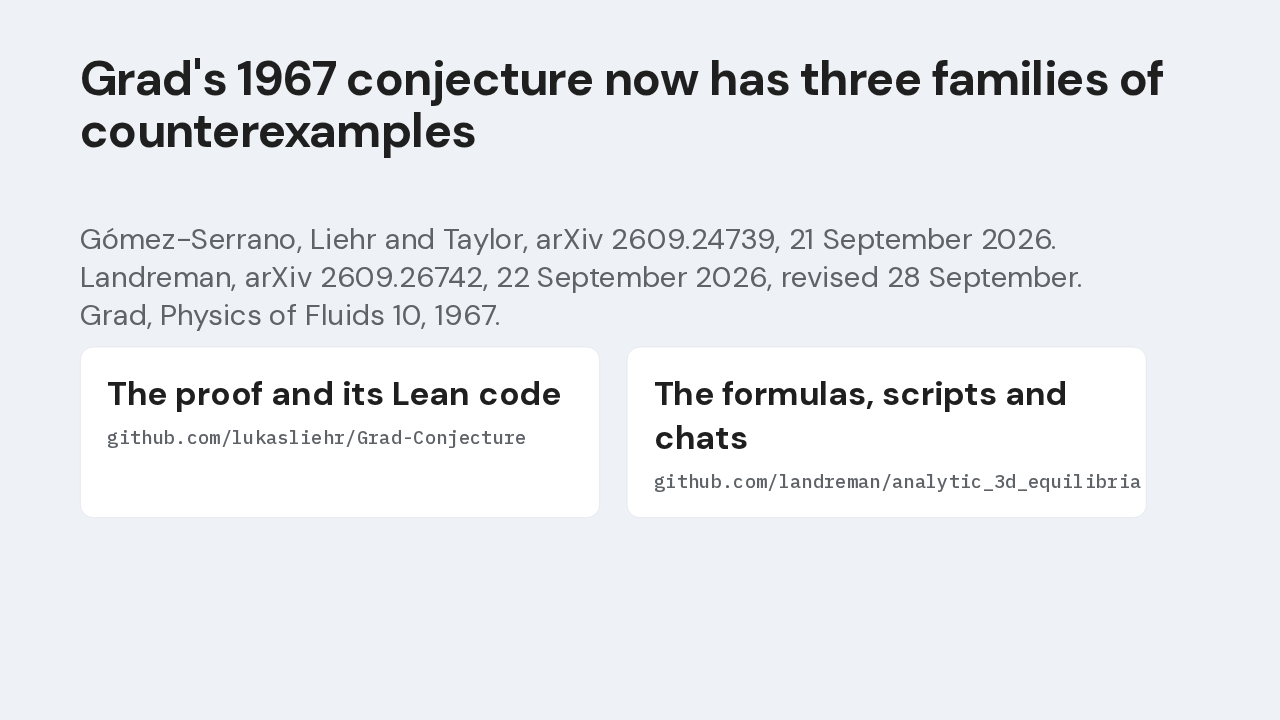
Grad's 1967 conjecture now has three families of counterexamples
Gómez-Serrano, Liehr and Taylor, arXiv 2609.24739, 21 September 2026. Landreman, arXiv 2609.26742, 22 September 2026, revised 28 September. Grad, Physics of Fluids 10, 1967.
So a question open since 1967 now has three families of counterexamples: one proved, with its proof checked by machine, and two written out in full.
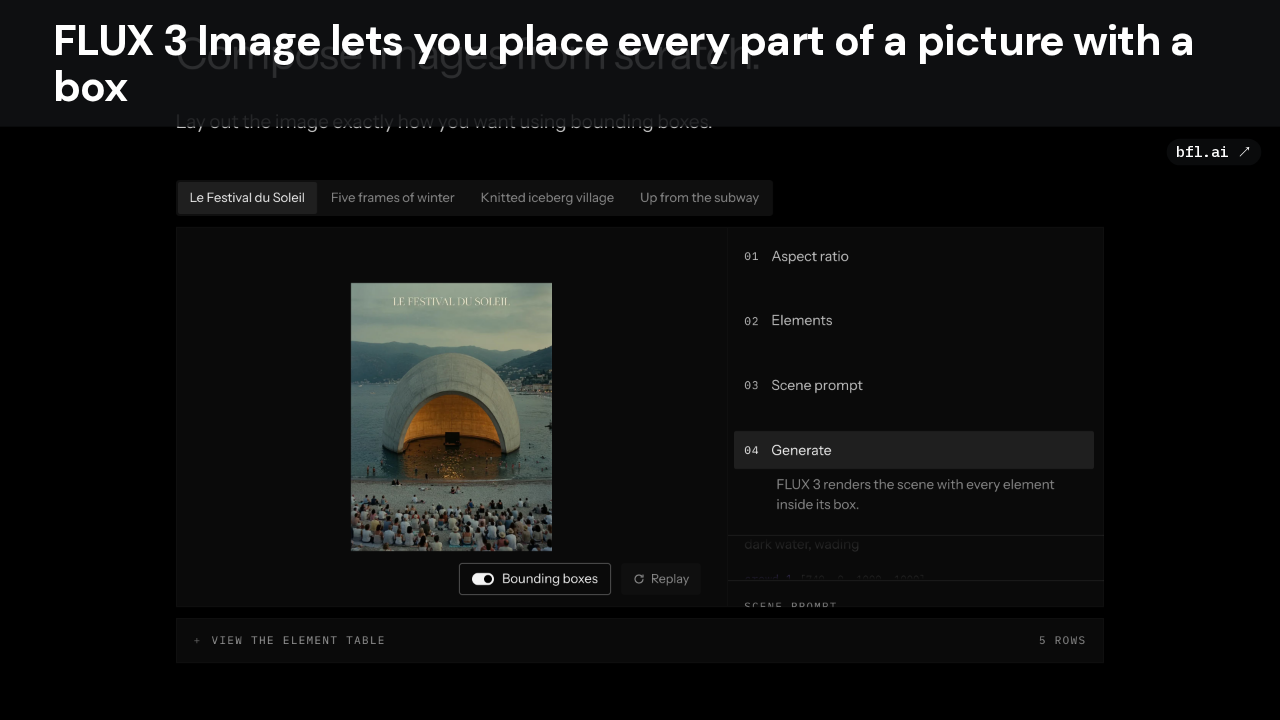
FLUX 3 Image lets you place every part of a picture with a box

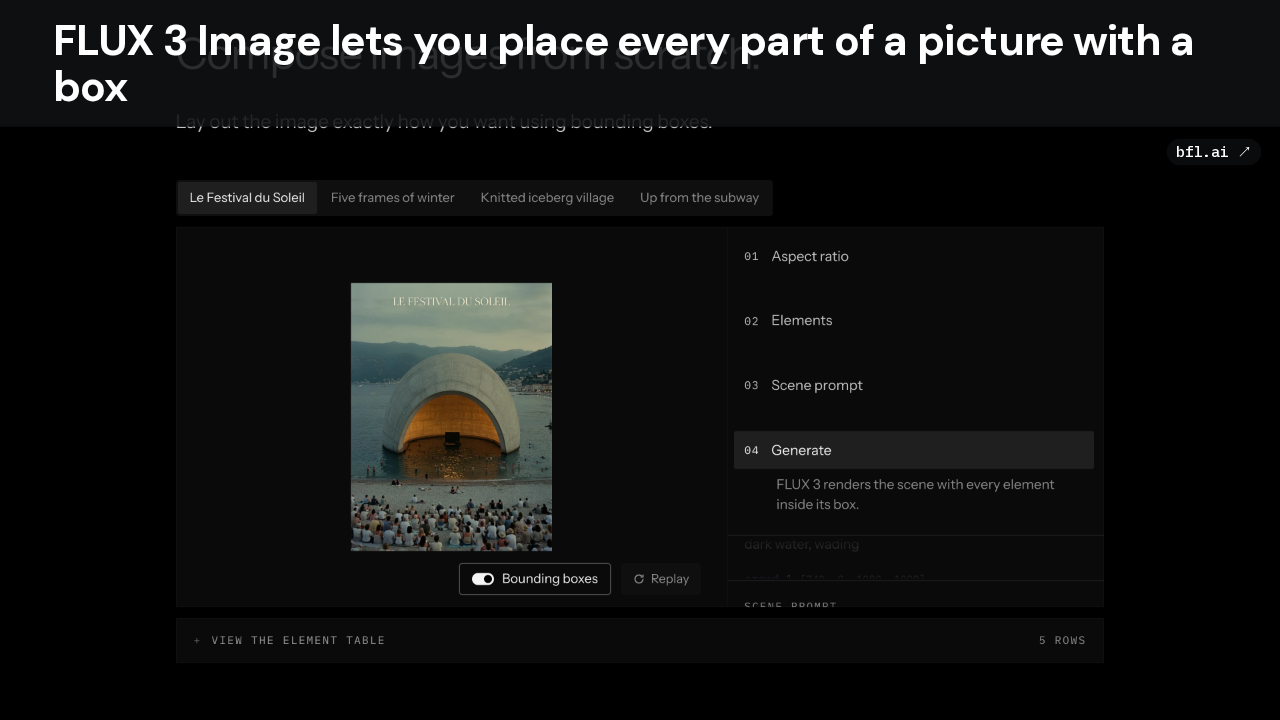
On October first, Black Forest Labs released FLUX three Image. Most image models take a prompt and decide the layout themselves. This one lets you lay the picture out: draw a box for everything that matters, say what goes in it, and add one line for the whole scene.
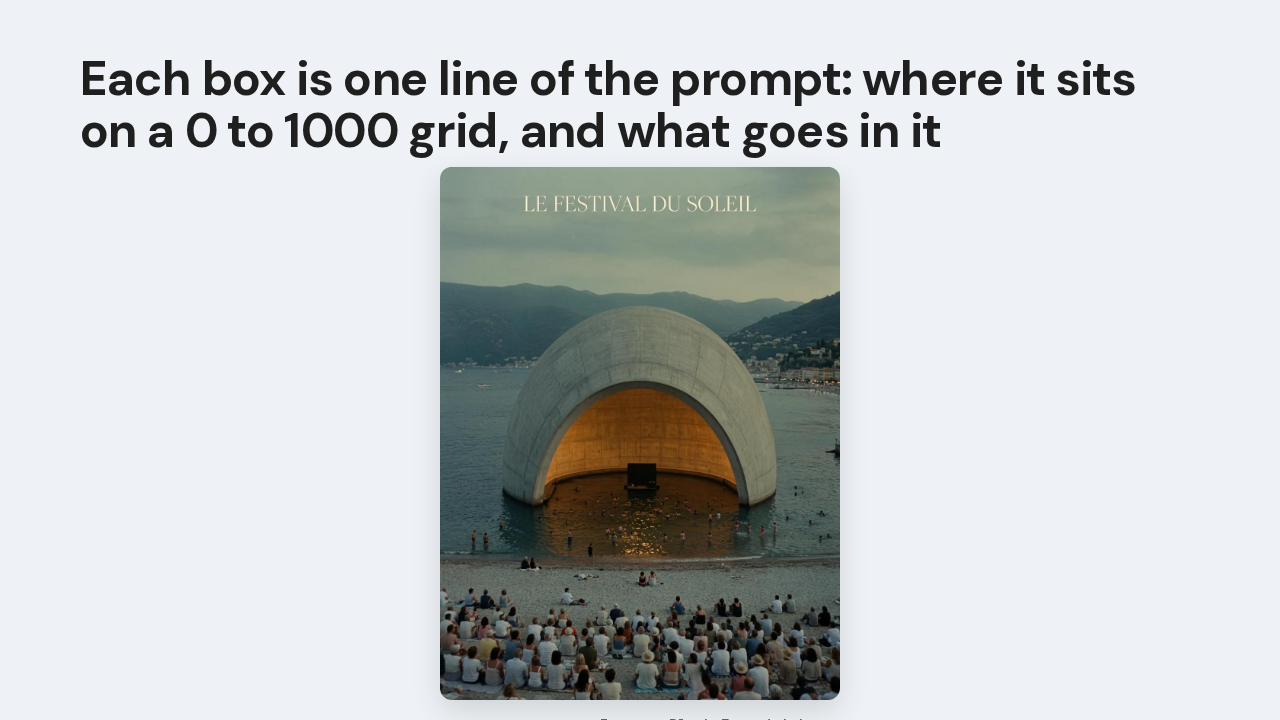
Each box is one line of the prompt: where it sits on a 0 to 1000 grid, and what goes in it
Here's that picture, with B F L's own boxes from the example. The festival's name across the top. A huge concrete dome. Swimmers in the water. A crowd on the beach. And the lights of a town on the hills. Each box is four numbers on a grid from zero to a thousand, plus a description. One more line ties the scene together.
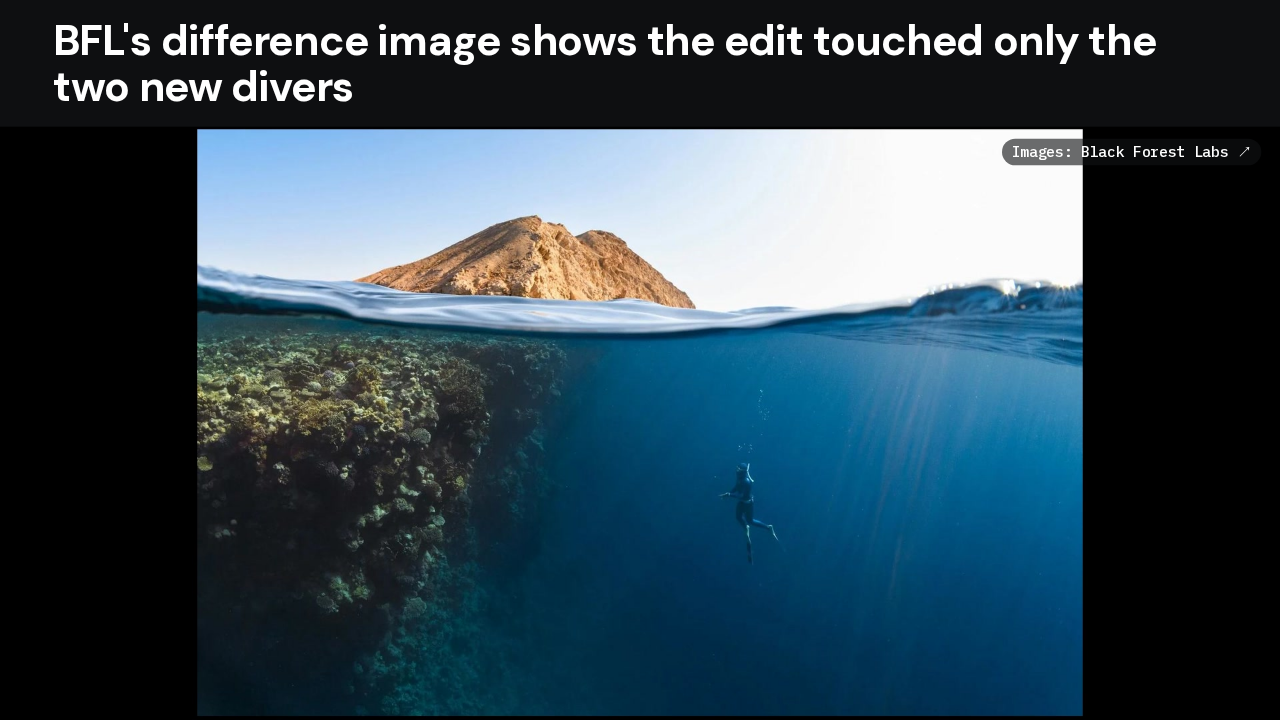
BFL's difference image shows the edit touched only the two new divers
Here's a harder one: add two divers to this underwater photo. Before. After. And then B F L's difference image, which lights up only the pixels that changed. It's black almost everywhere except the two new divers.
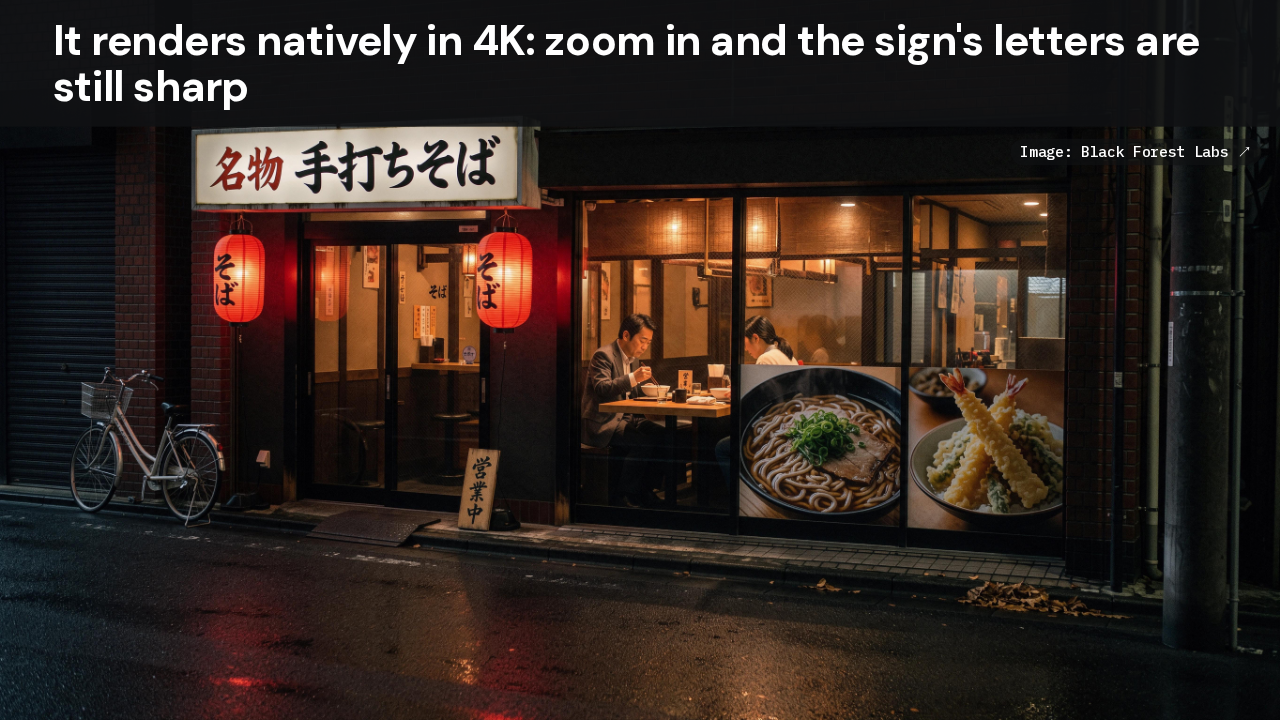
It renders natively in 4K: zoom in and the sign's letters are still sharp

And it renders at full size, up to 4 K, rather than scaling up a small picture. This soba shop is about sixteen megapixels, all from the model. Here's the sign at the file's own pixels: hand-lettered characters, each about two hundred pixels tall. And through the window, a man eating, chopsticks in hand.
Nano Banana 2.1 is generally available

Nano Banana 2.1 is Google's new fast image model
gemini-nano-banana-2.1Google updated its image model too. Nano Banana 2.1 is its fast model for making and editing images. It became generally available in the Gemini API on October 6th.
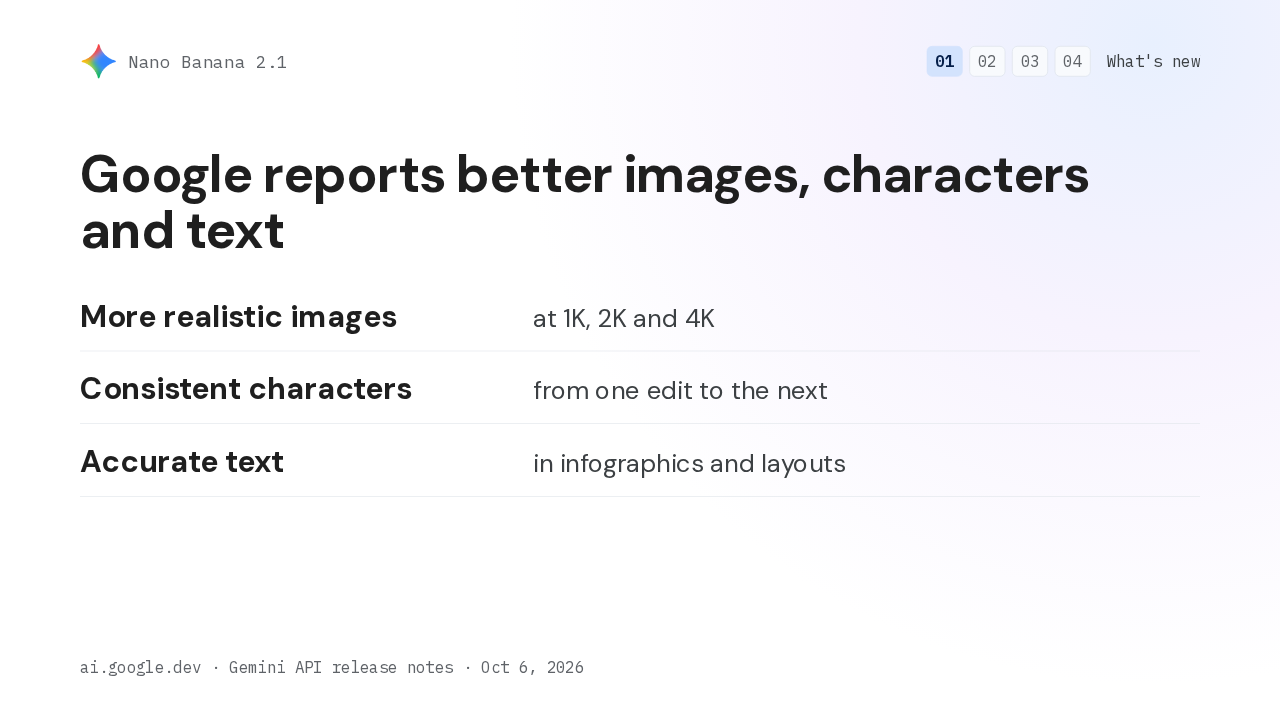
Google reports better images, characters and text
Nano Banana 2.1The images look more realistic, characters stay the same from one edit to the next, and text in infographics comes out more accurately.
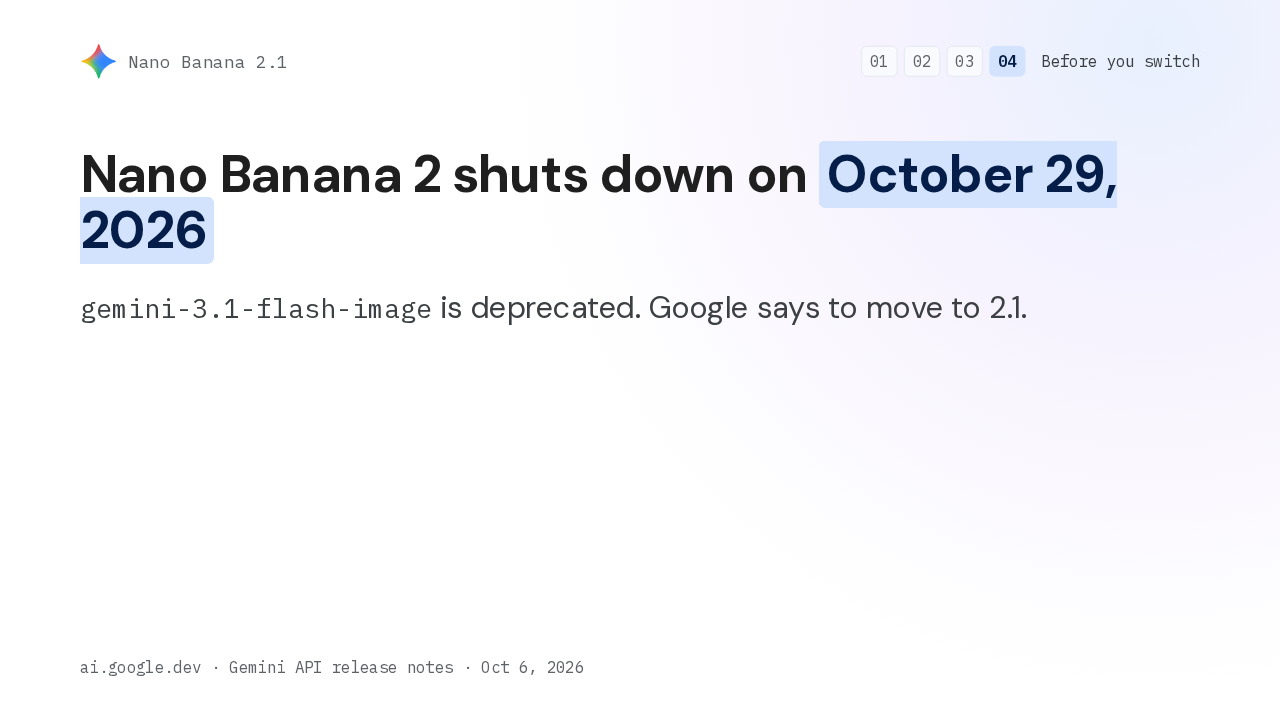
Nano Banana 2 shuts down on October 29, 2026
Nano Banana 2.1gemini-3.1-flash-image is deprecated. Google says to move to 2.1.
If you build on Nano Banana 2, Google has deprecated it. It shuts down on October 29th, and Google tells developers to move to 2.1.
ElevenLabs' Eleven v4 reads a line with the feeling you ask for in brackets
ElevenLabs released Eleven v4 on September 28th, and it's in their apps and API now. The pitch is delivery: the same words, said the way the moment needs. Here's how it sounds.
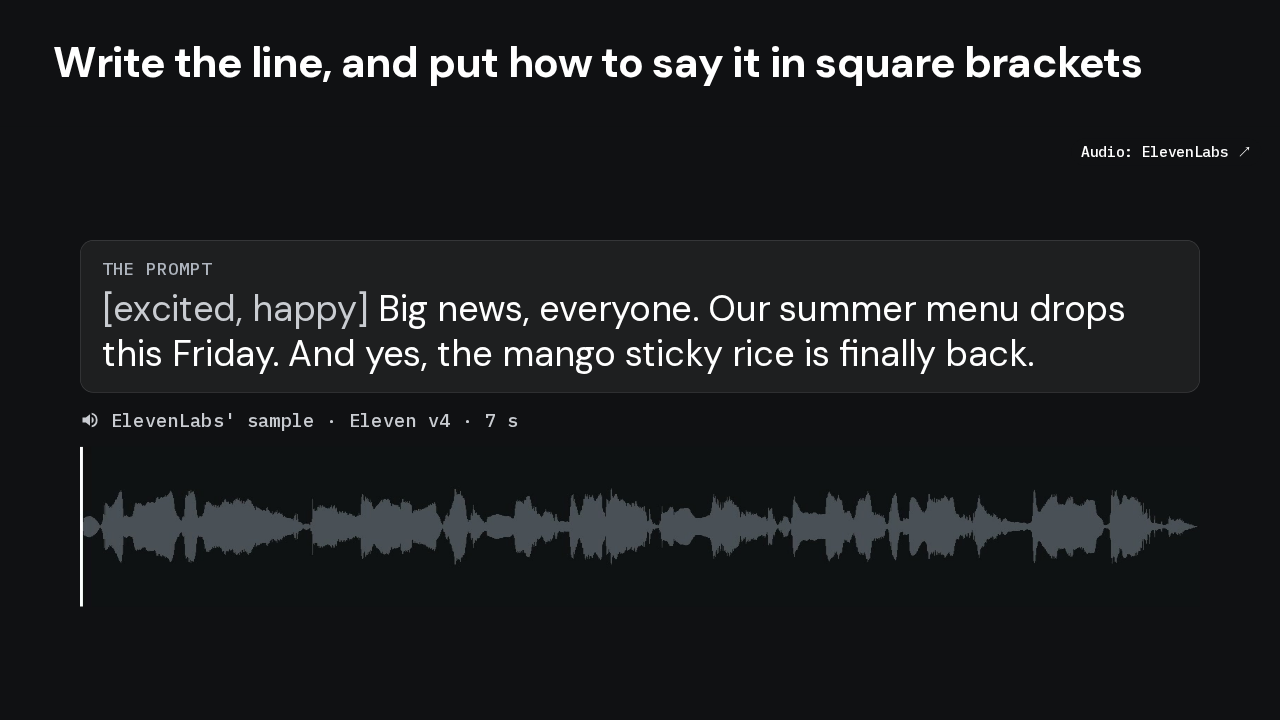
Write the line, and put how to say it in square brackets
[excited, happy] Big news, everyone. Our summer menu drops this Friday. And yes, the mango sticky rice is finally back.
This prompt asks for excited and happy, in square brackets, before the words. Listen. All of that came from two words in brackets.
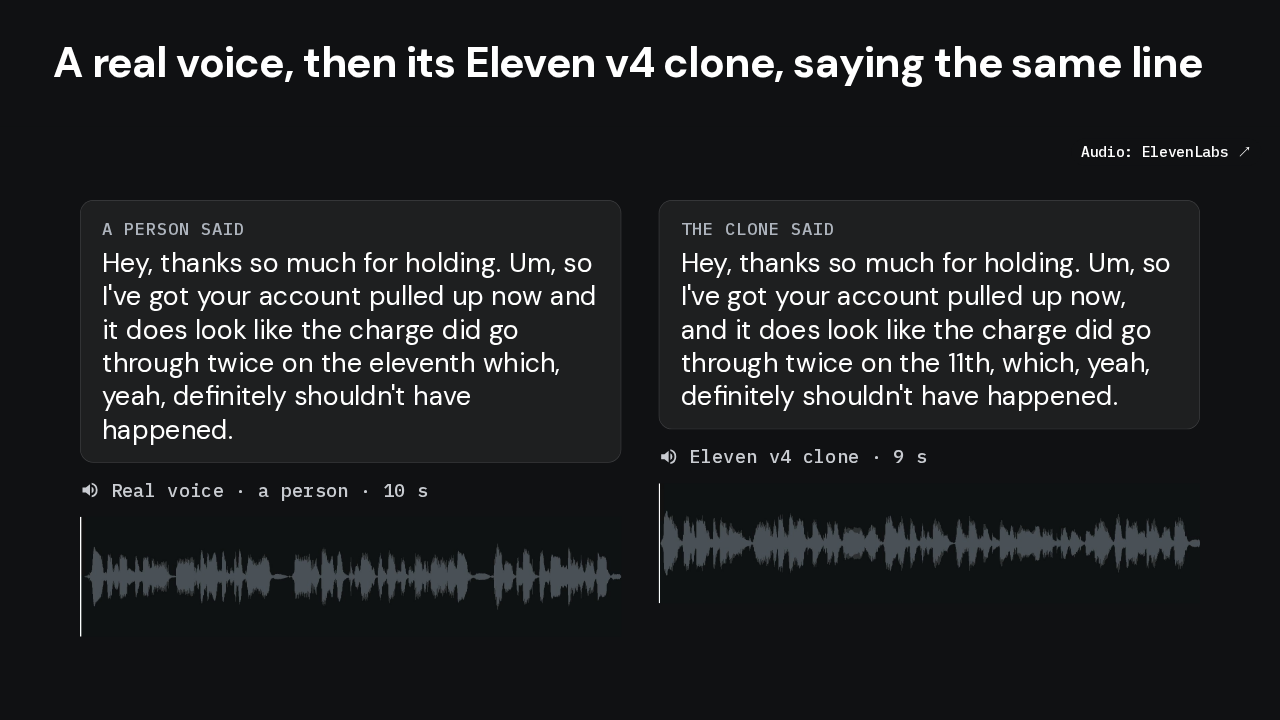
A real voice, then its Eleven v4 clone, saying the same line
Hey, thanks so much for holding. Um, so I've got your account pulled up now and it does look like the charge did go through twice on the eleventh which, yeah, definitely shouldn't have happened.
Hey, thanks so much for holding. Um, so I've got your account pulled up now, and it does look like the charge did go through twice on the 11th, which, yeah, definitely shouldn't have happened.
Cloning a voice now takes just 10 seconds of someone's audio. First, a real person. And here's the Eleven v4 clone of that voice, saying the same thing. Could you tell them apart?
Smaller releases
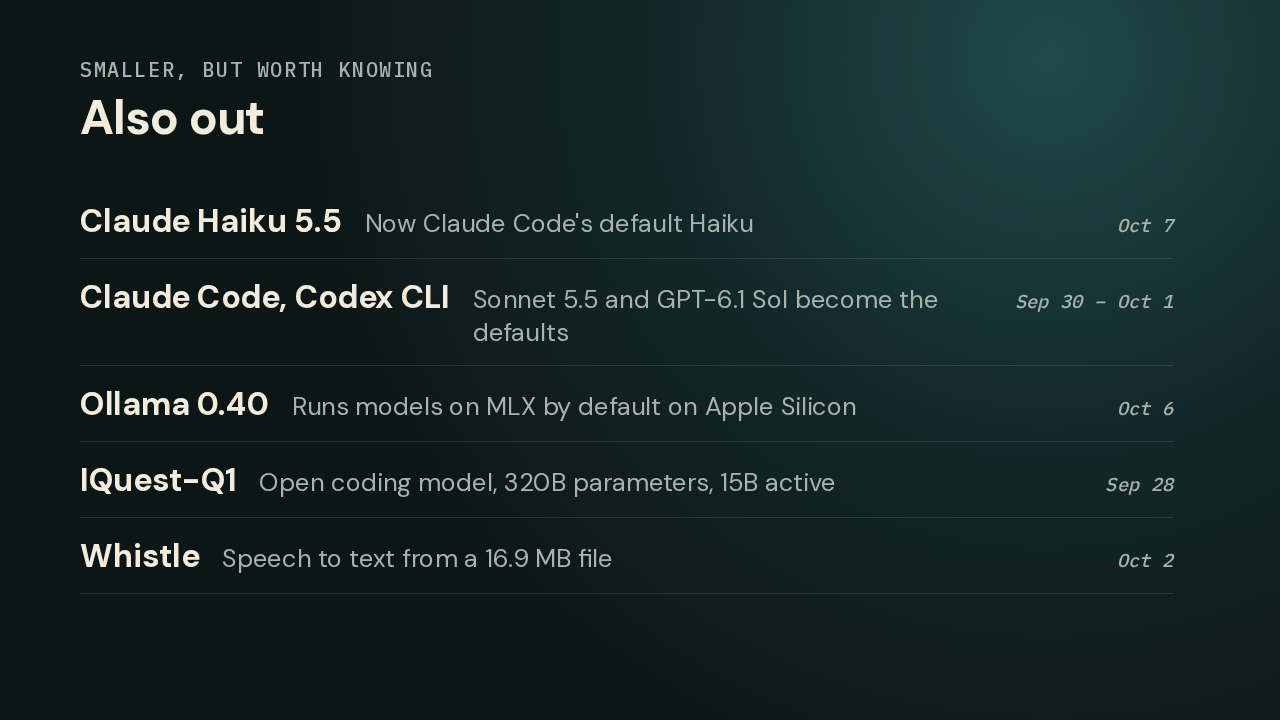
Also out
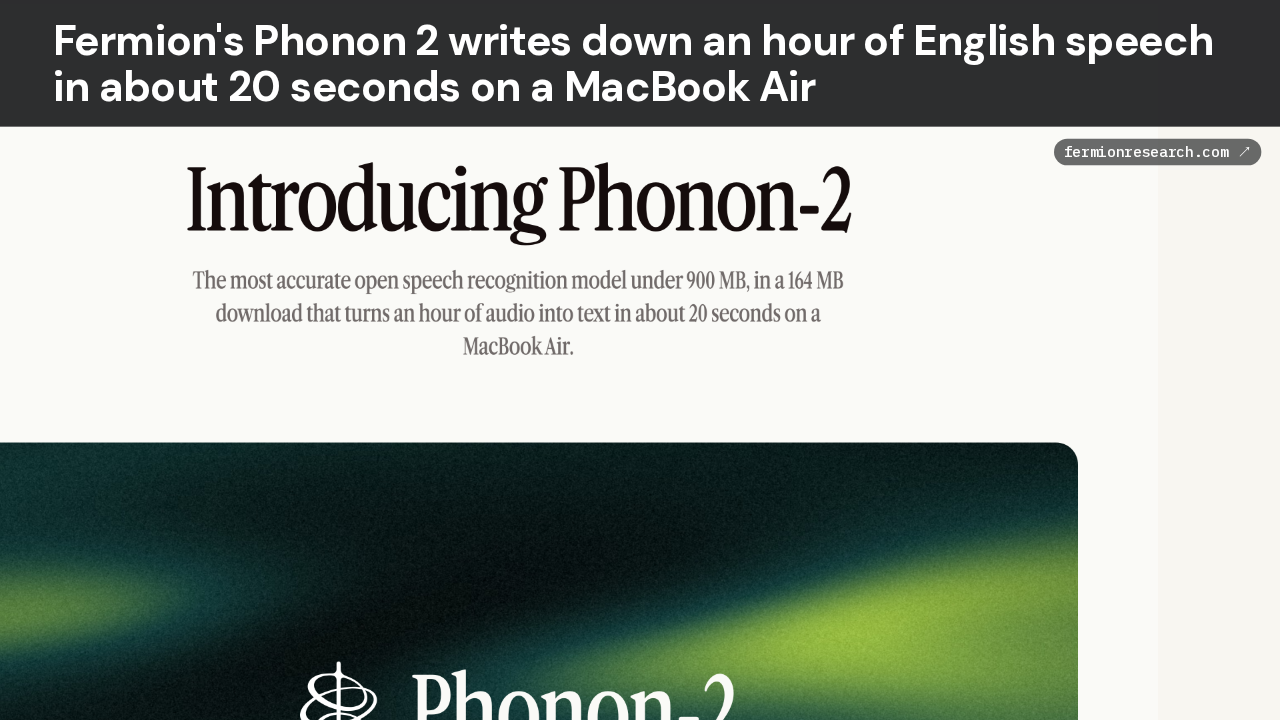
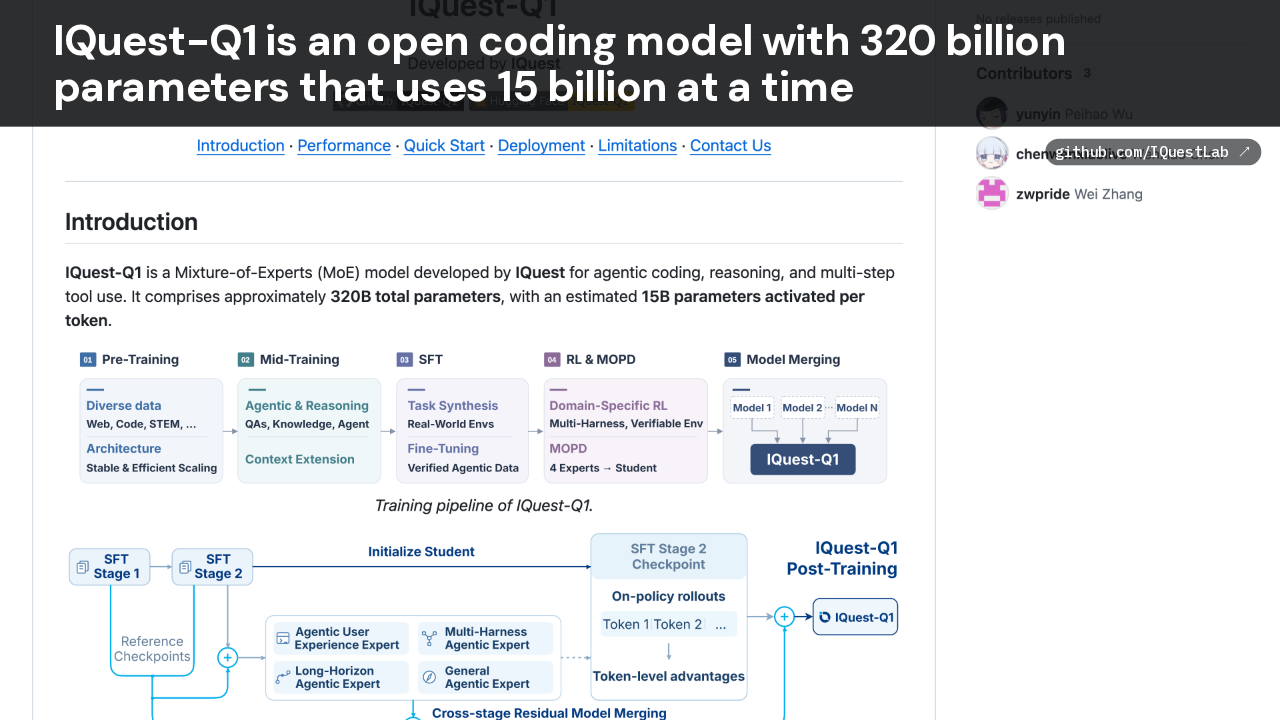
A few smaller ones, quickly. Anthropic released Claude Haiku 5.5, now Claude Code's default Haiku. Claude Code had already moved to Sonnet 5.5, and Codex CLI to GPT-6.1 Sol. Ollama now runs models on Apple's MLX by default on Apple Silicon. IQuest-Q1 is a new open coding model. And Cactus's Whistle turns speech into text from a file small enough for a phone.
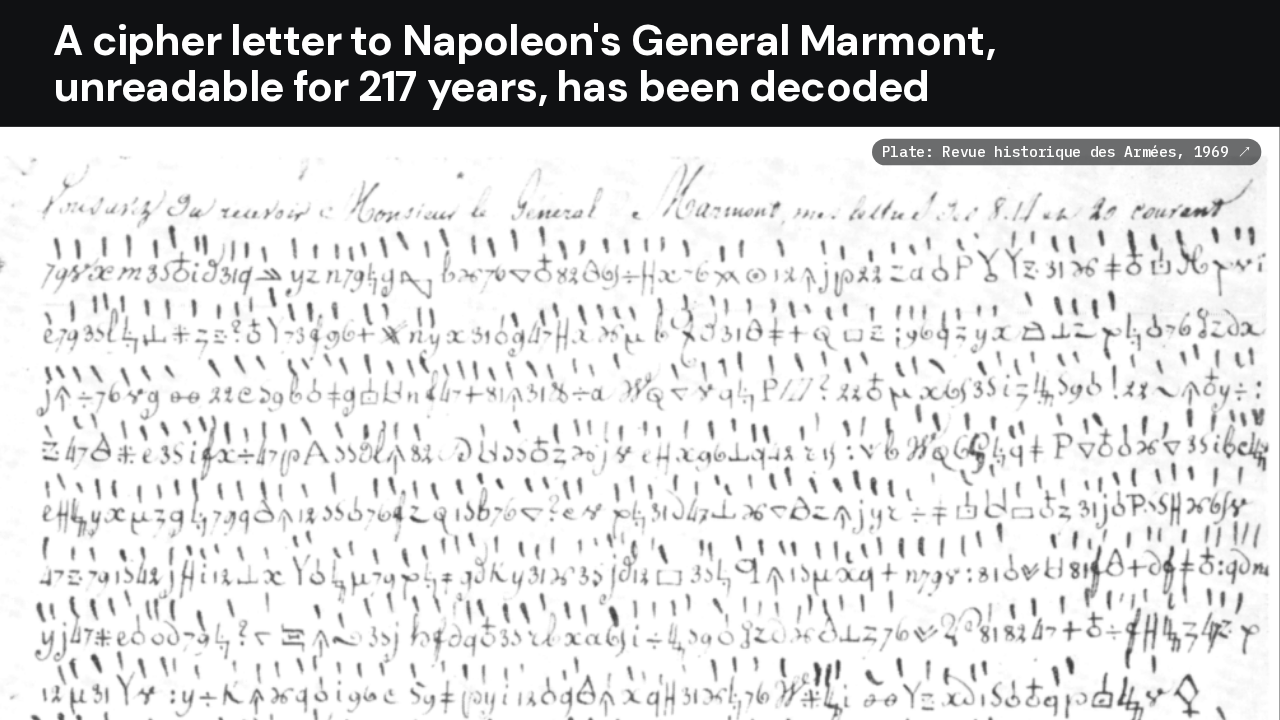
A cipher letter to Napoleon's General Marmont, unreadable for 217 years, has been decoded
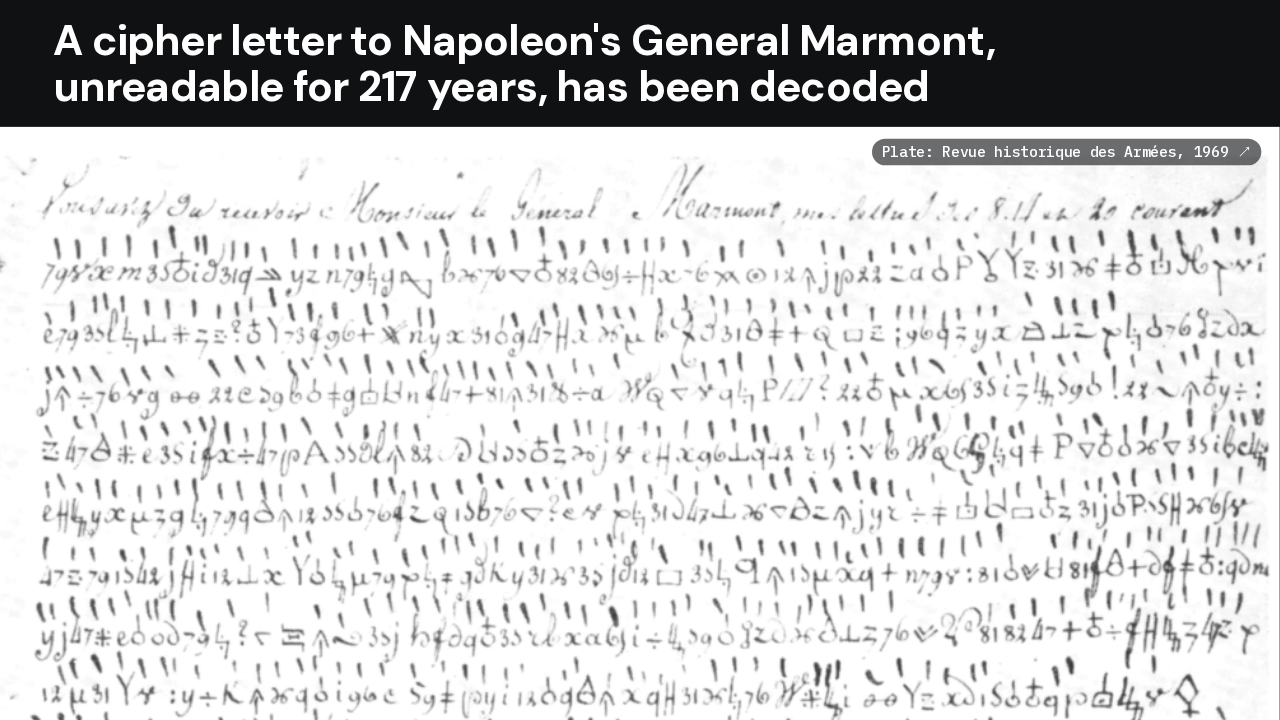
In late March 1809, the headquarters of Eugène, Napoleon's stepson and Viceroy of Italy, sent General Marmont a letter. Its first line is plain French: you must have received, General Marmont, my letters of the 8th, 14th and 20th of this month. Then come 24 rows of numbers, letters and invented signs. The key was lost, and for two centuries nobody could read it. On September 18, 2026, Carter Church published a full reading.
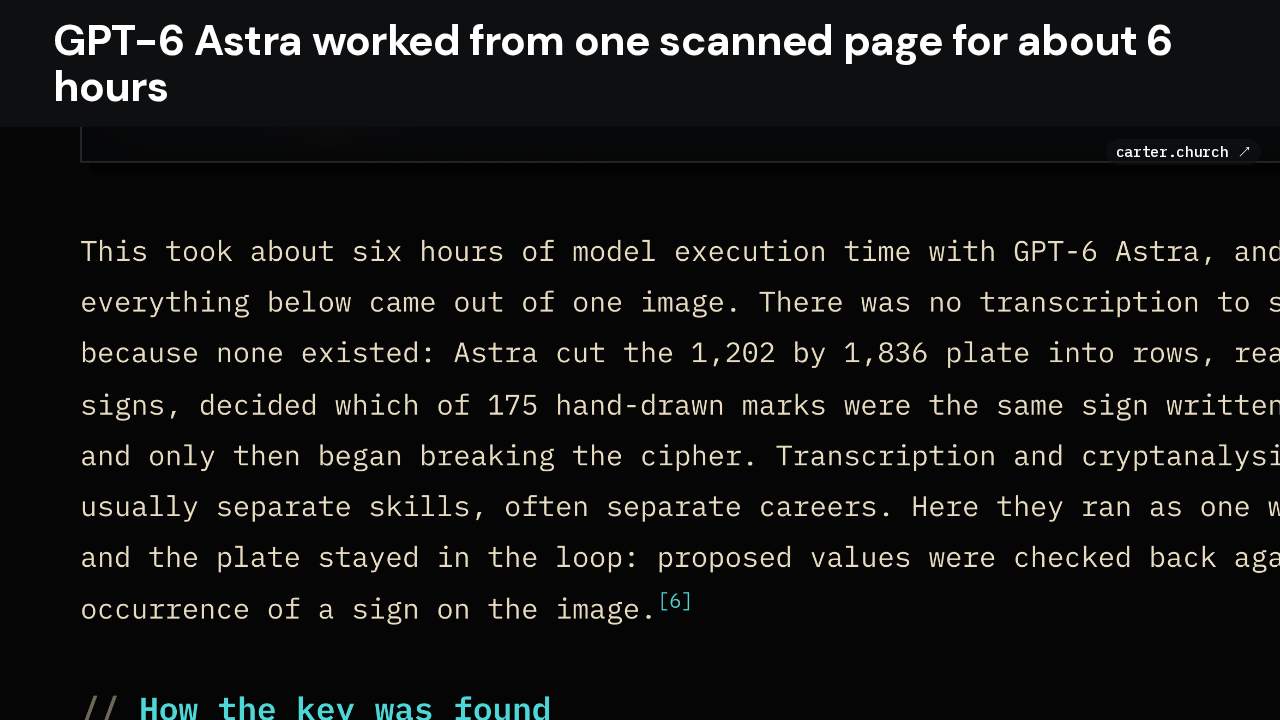
GPT-6 Astra worked from one scanned page for about 6 hours

Church isn't a cryptographer. He set GPT-6 Astra on it, and it ran for about six hours, starting from one scanned image. No transcription existed, so it cut the page into rows, read the signs, and decided which hand-drawn marks were the same sign. Then it searched for the key, scoring each guess against French text. Run again with Napoleon's letters and Marmont's memoirs taken out of that French, it found the same reading.
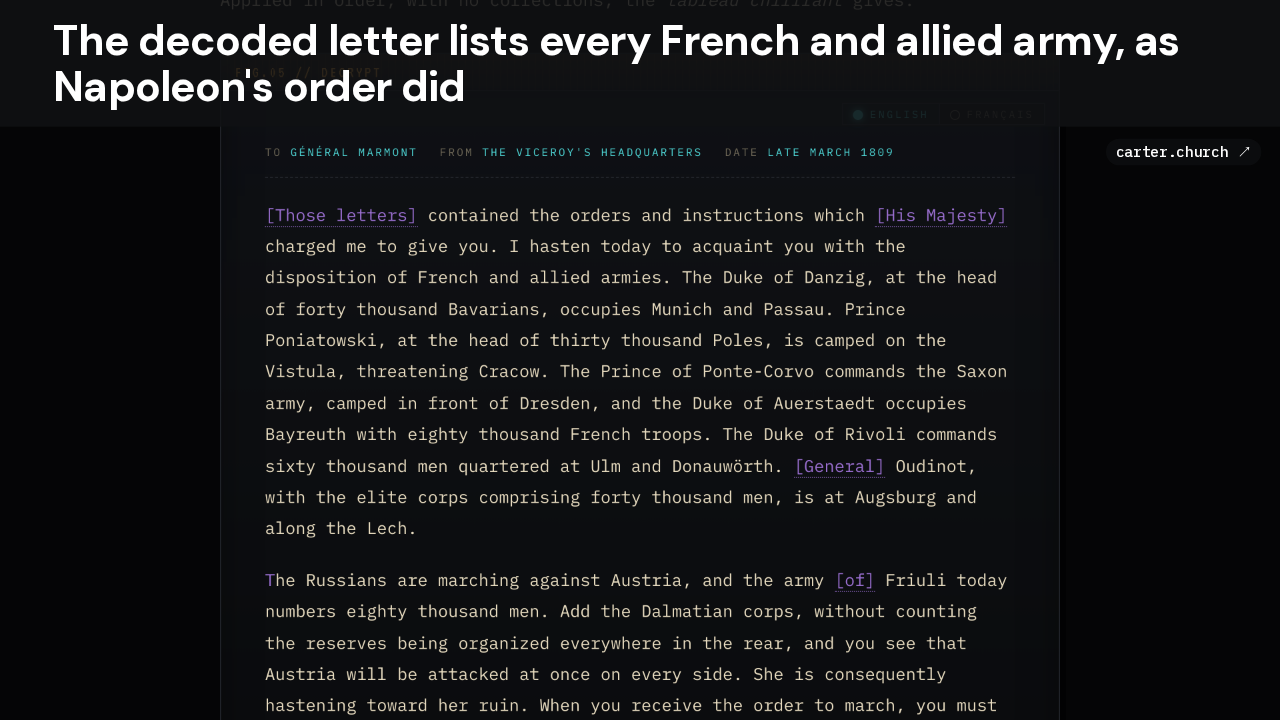
The decoded letter lists every French and allied army, as Napoleon's order did
![The decoded letter in English, from Carter Church's write-up. To Général Marmont, from the Viceroy's headquarters, late March 1809: “[Those letters] contained the orders and instructions which [His Majesty] charged me to give you. I hasten today to acquaint you with the disposition of French and allied armies. The Duke of Danzig, at the head of forty thousand Bavarians, occupies Munich and Passau. Prince Poniatowski, at the head of thirty thousand Poles, is camped on the Vistula, threatening Cracow…”](https://storage.googleapis.com/bisque-presentations/AlY6OT2Cd1YpfqlZ5jsfdWcae933/ai-news-roundup-2026-10-09-00ca7f/assets/marmont/letter-d.png?X-Goog-Algorithm=GOOG4-RSA-SHA256&X-Goog-Credential=firebase-app-hosting-compute%40shell-space.iam.gserviceaccount.com%2F20261016%2Fauto%2Fstorage%2Fgoog4_request&X-Goog-Date=20261016T163501Z&X-Goog-Expires=21600&X-Goog-SignedHeaders=host&X-Goog-Signature=04bebc6018135f9e54f56118f74341b240b9b471d5279b4b75ccab67b1b669769c742b44d3c6feb4ce11676ec8724cf8b9263c8b39cf124a09944a43ae357cc1886bc11bcb8c4e7be1987b3552d3cebf3ebed07787b1e6445cd52a5949387ae884018150b5e99da3cefdb3e4aefbbeb4d642c67ec3d809564dbfab74f7241daca8adc112d68238ece9dd5f3dc9dd66555a32cf592e4a66b44597eb3f16f74200280fdcf774eec47c9a7ab488e9e9f0955e4ab606b73b8a63be340fe6019aad51c289730d152a683232fff932ed27901fa8be582f80b9860acb9af03c7202f07ca4a9aeaf7b412203d2f8932ad3d9a5d1818a36e81361a06613b2cb1976975a10)
Here's what it says. The Duke of Danzig, at the head of 40,000 Bavarians, occupies Munich and Passau. It goes through seven forces, in the same order and with the same numbers as Napoleon's instruction. And it ends the list: you see that Austria will be attacked at once on every side.
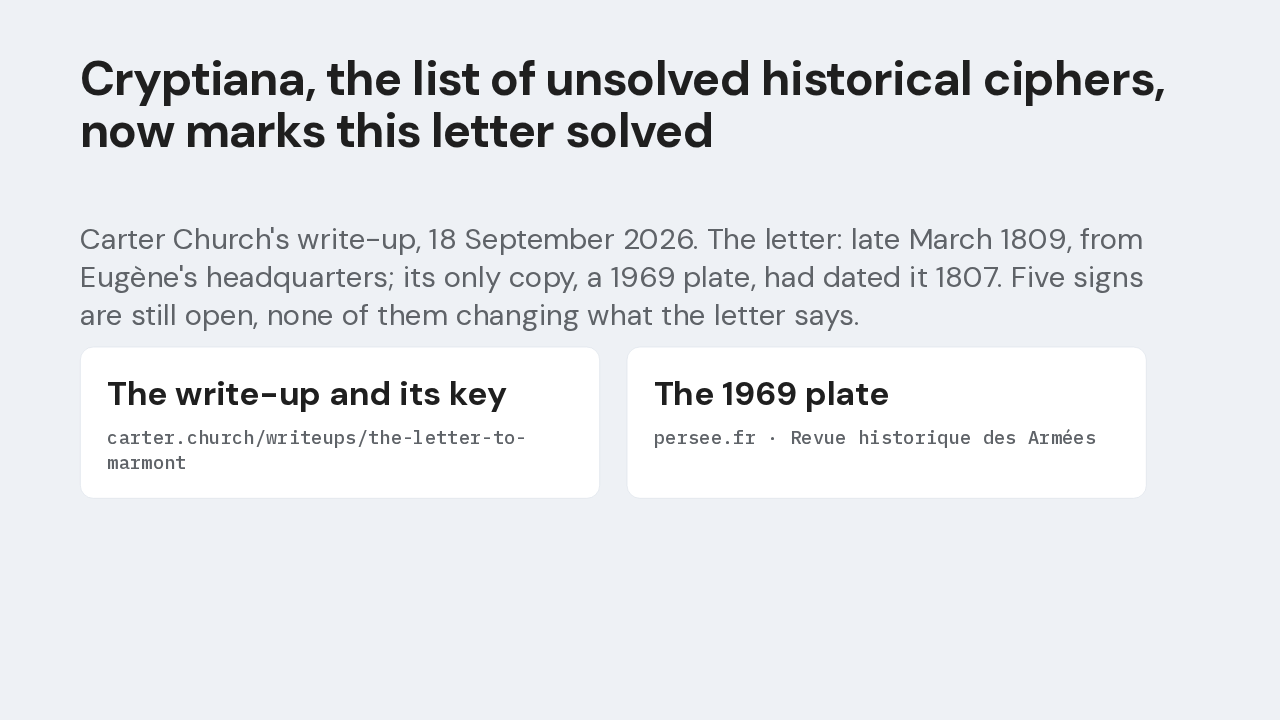
Cryptiana, the list of unsolved historical ciphers, now marks this letter solved
Carter Church's write-up, 18 September 2026. The letter: late March 1809, from Eugène's headquarters; its only copy, a 1969 plate, had dated it 1807. Five signs are still open, none of them changing what the letter says.
Cryptiana, the standard list of unsolved historical ciphers, now marks the letter solved. Five signs are still uncertain, like whether one means His Majesty or the Emperor, and none of them changes what the letter says.
That's the two weeks
Every story has its full episode on bisque.today
That's the two weeks. If you only follow one of these, I'd watch Argon, because the real test starts when developers can call it. Every source is linked in the description.