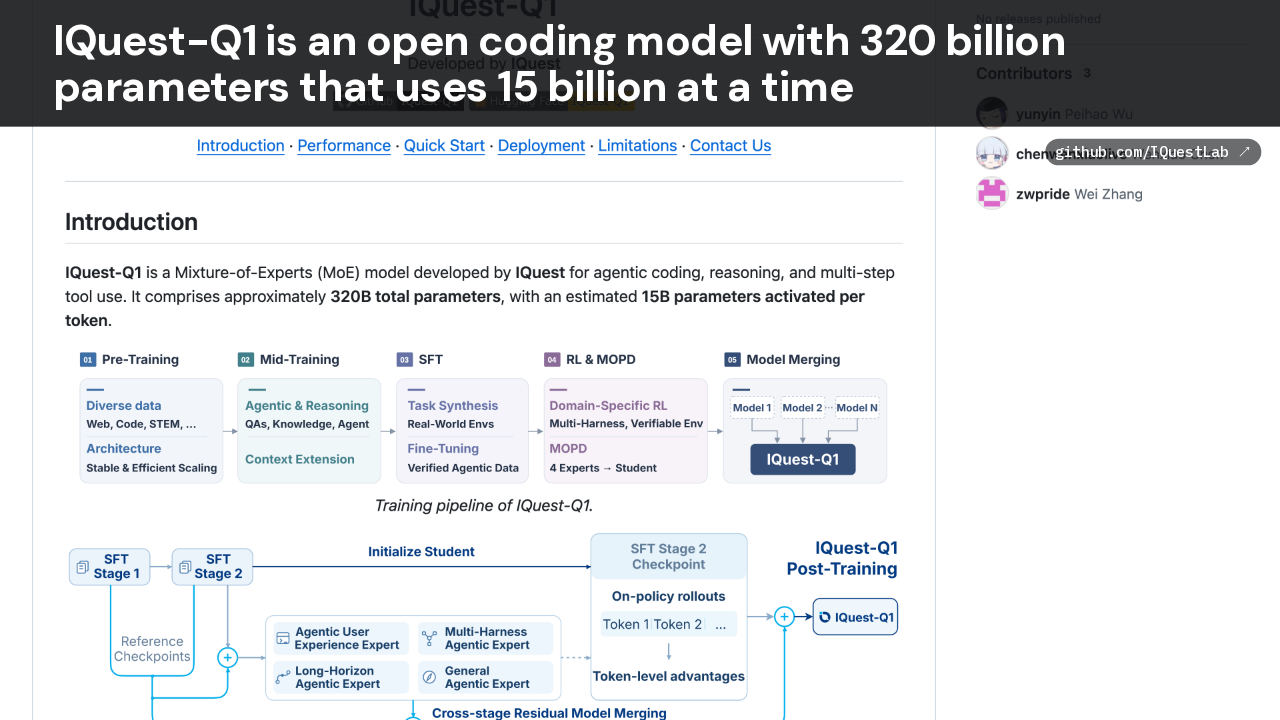
IQuest-Q1 is an open coding model with 320 billion parameters that uses 15 billion at a time

On September 28th, a lab called IQuest put the weights of IQuest-Q1 on Hugging Face, free to download. It's built for coding agents: writing code, running tools, and working through a task step by step. It has about 320 billion parameters, but only about 15 billion of them work on each token.
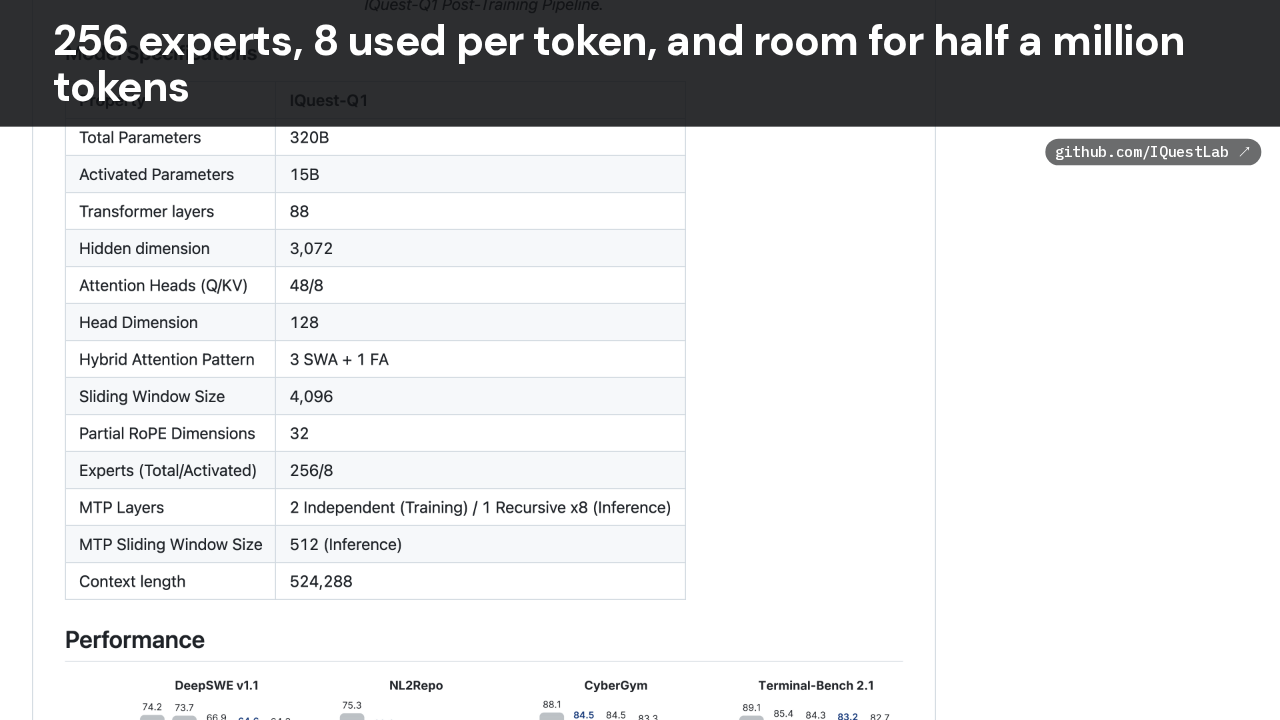
256 experts, 8 used per token, and room for half a million tokens

Here's the spec table from the README. 320 billion parameters in total, 15 billion active. They're split into 256 experts, and a router picks 8 of them for every token. And it reads up to half a million tokens at once.
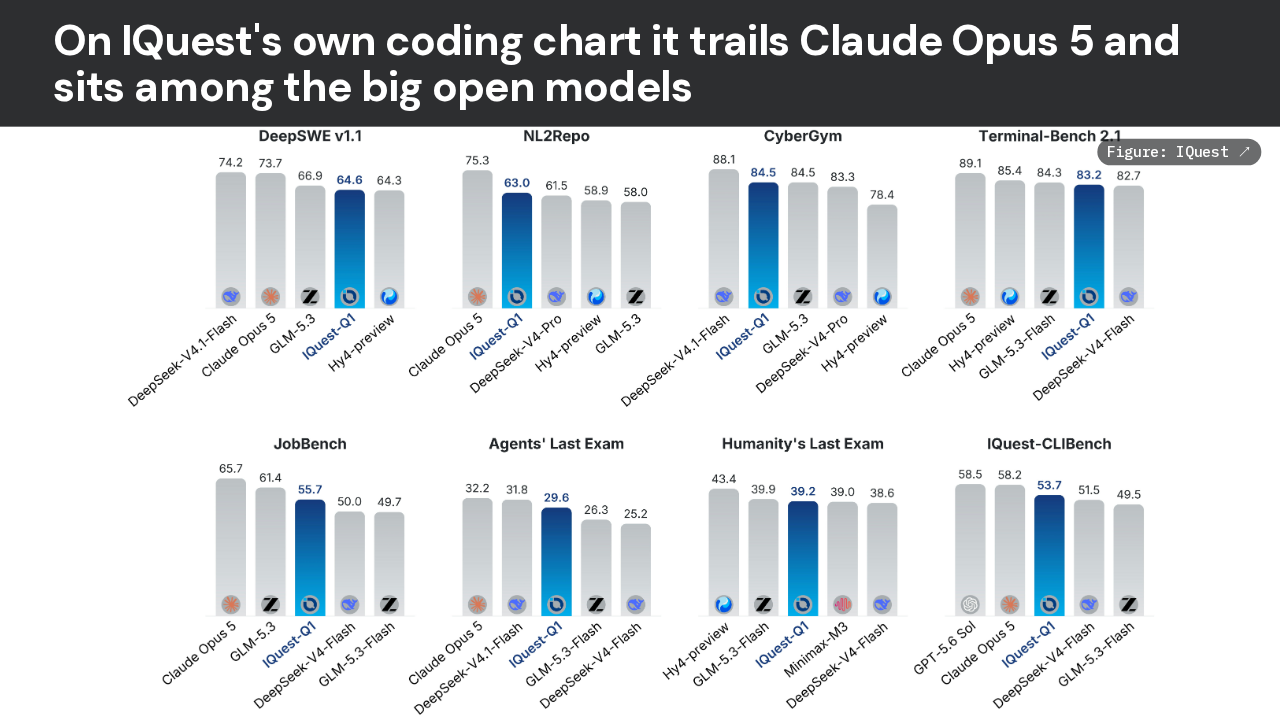
On IQuest's own coding chart it trails Claude Opus 5 and sits among the big open models

How good is it? These are IQuest's own numbers, with the blue bar for IQuest-Q1. On DeepSWE, fixing real software issues, it scores about 65, fourth of five, behind Claude Opus 5 at about 74. On NL2Repo, building a whole repository from a description, it's second, at 63 to Opus's 75. On CyberGym, a security test, it ties GLM 5.3 at about 85. And on Terminal-Bench, it scores 83, six points behind Opus.
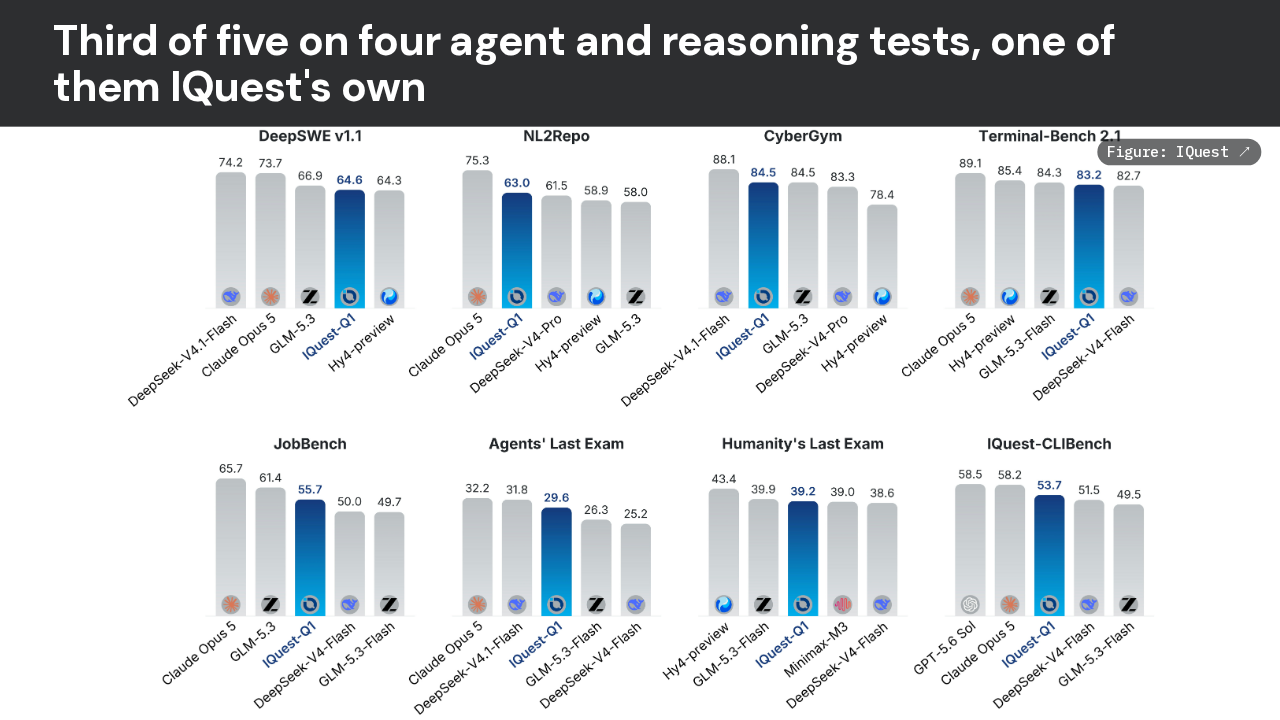
Third of five on four agent and reasoning tests, one of them IQuest's own
The second row is broader. JobBench, everyday work tasks: third, at about 56. Agents' Last Exam: third again, at 30, a couple of points behind Opus. Humanity's Last Exam, without tools: 39, within a point of second place. The last test, CLIBench, is IQuest's own, made in house to measure how it feels to use in a terminal. There it's third, behind GPT-5.6 Sol and Opus.
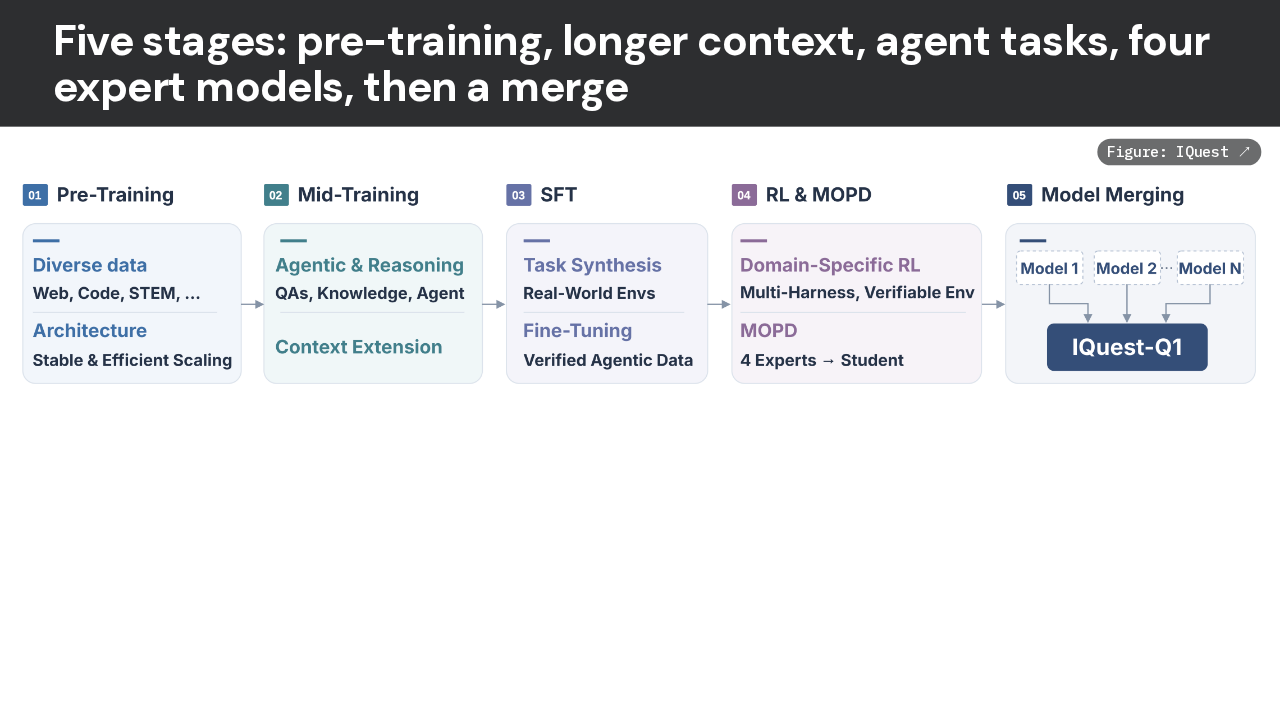
Five stages: pre-training, longer context, agent tasks, four expert models, then a merge

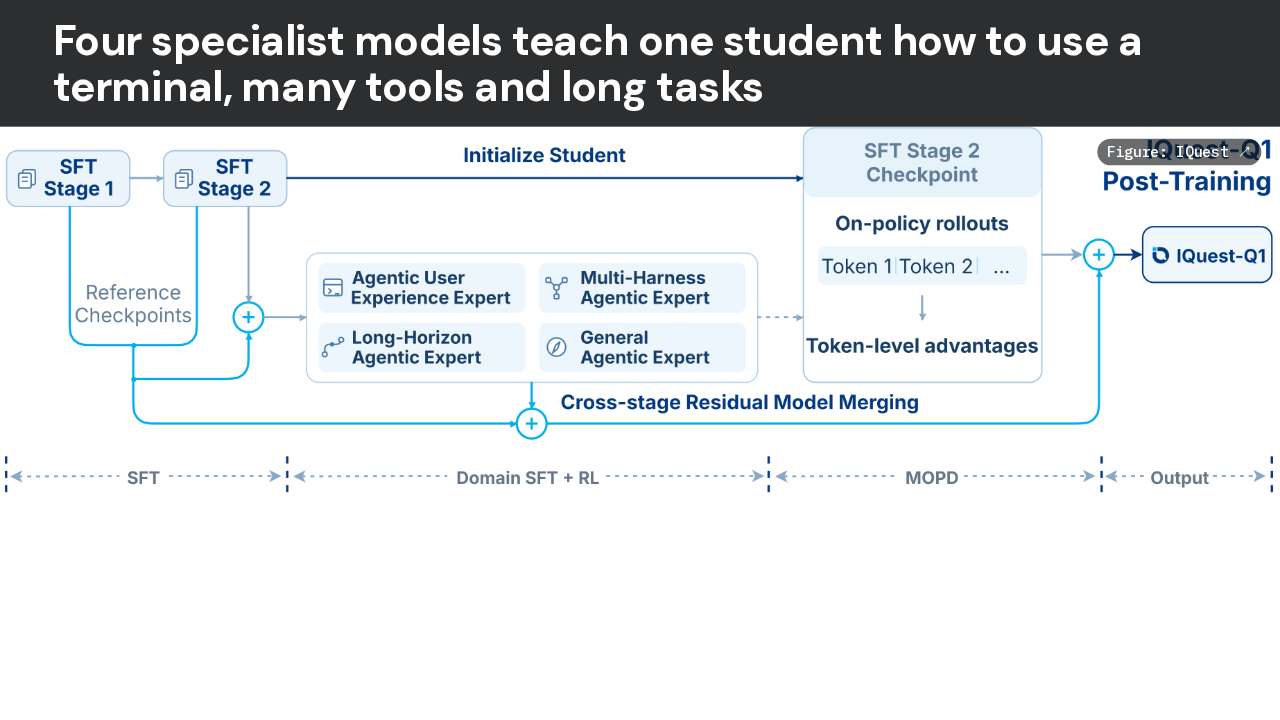
The README sketches how it was trained, in five stages. First, pre-training on web, code and science data, then a middle stage on agent tasks that also stretches the context. Then fine-tuning on agent work in real environments, keeping only data that checks out. Then reinforcement learning, which produces four specialist models, distilled into one student. Finally, several checkpoints are merged into the model that shipped.
Four specialist models teach one student how to use a terminal, many tools and long tasks

Here's that fourth stage in more detail. One specialist is trained for how it feels to use, one for working across different agent harnesses, one for long tasks, and one general. The student, started from the fine-tuned model, learns from all four on its own attempts, and the result is merged with earlier checkpoints.
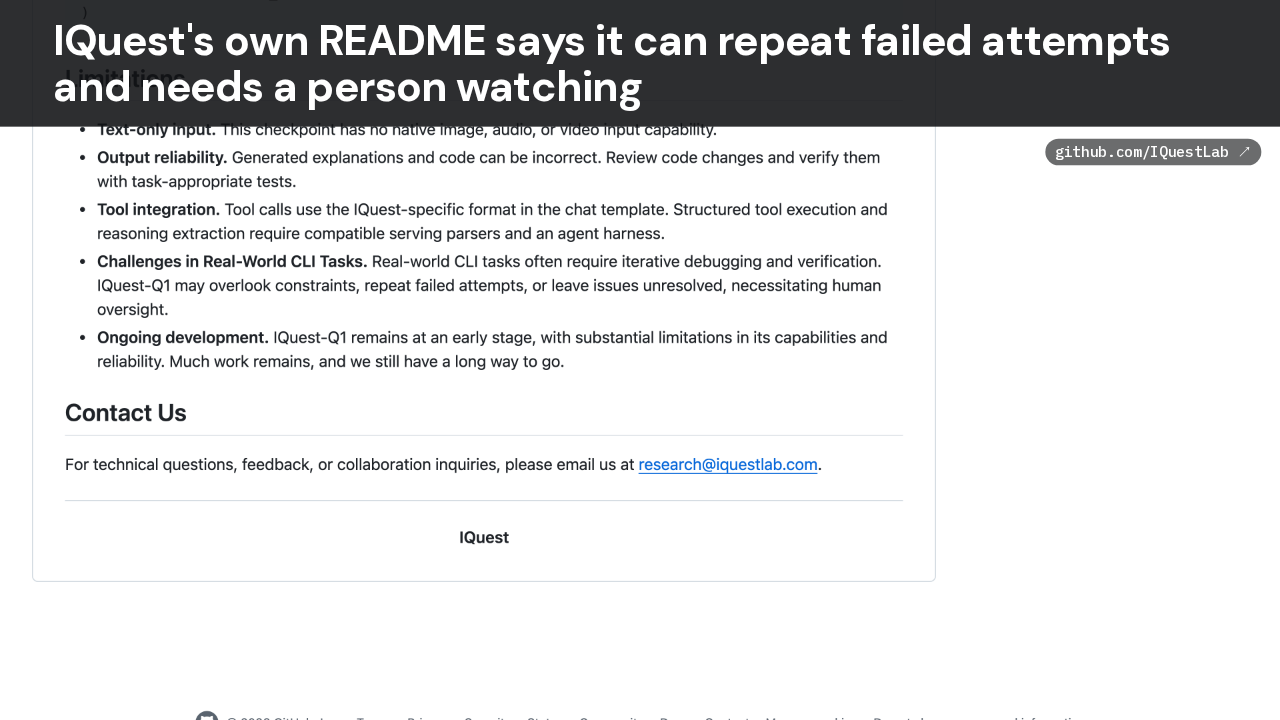
IQuest's own README says it can repeat failed attempts and needs a person watching

IQuest is plain about the limits. It reads text only, no images. On real terminal tasks, it says, the model may miss constraints, repeat attempts that already failed, or leave things unfinished, so a person should keep watch. And it calls this an early stage, with a long way to go.
IQuest-Q1's weights are free on Hugging Face; serving it takes 8 GPUs
Published 28 September 2026 on GitHub and Hugging Face. Every score is IQuest's own chart; IQuest-CLIBench is its in-house test. Licence: MIT, plus showing “IQuest-Q1” in any commercial product that uses it.
IQuest-Q1 went up on September 28th, 2026. The licence is MIT with one addition: a commercial product built on it has to show the name IQuest-Q1 in its interface. The README's serving commands split it across 8 GPUs, with ready-made images for vLLM and SGLang, and settings to drive it from Claude Code or Codex. The README and the weights are linked below.