GPT-6.1 Sol keeps GPT-6 Sol’s prices and halves cached input
1 month ago
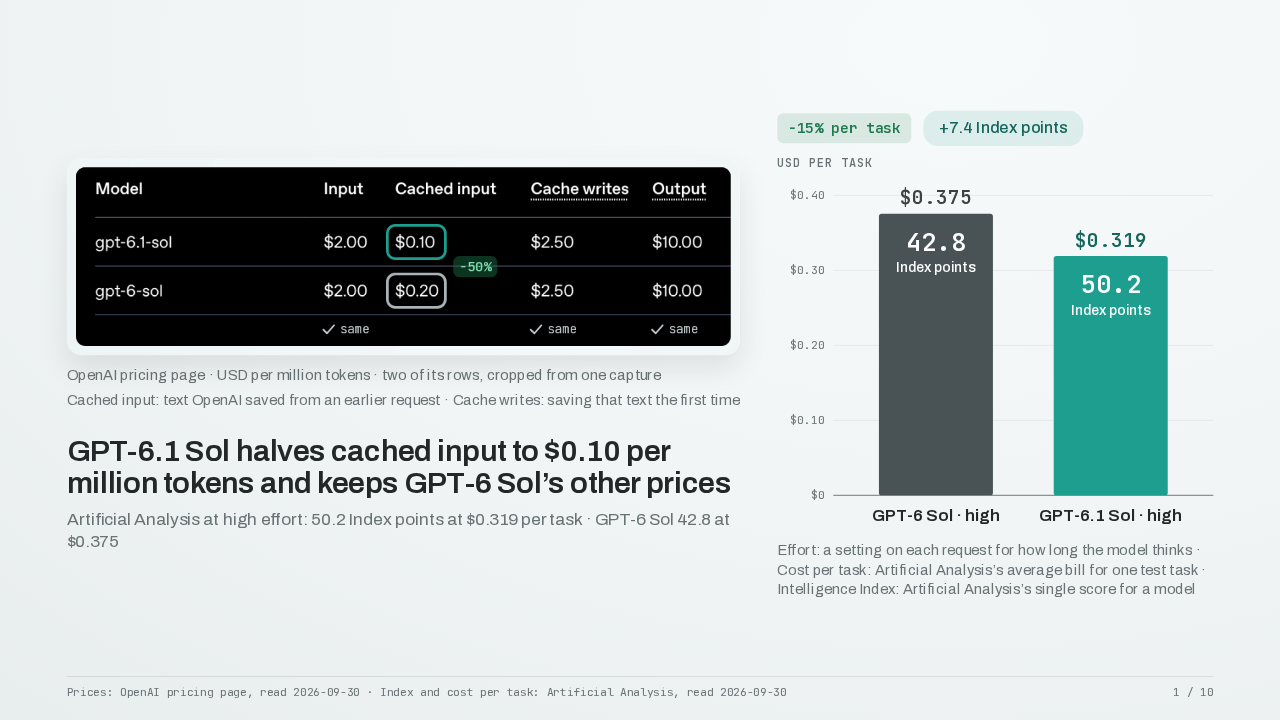
GPT-6.1 Sol has GPT-6 Sol's price list with one price cut in half. OpenAI charges by the token, a small chunk of text. Input, the text you send, costs two dollars per million tokens on both models. Output, the text the model writes back, costs ten dollars per million tokens on both. The price OpenAI halved is cached input, the price for text OpenAI saved from an earlier request. Cached input fell from twenty cents to ten cents per million tokens. Artificial Analysis is an independent company that runs the same tests on every model and records what each task costs. Artificial Analysis's single score for a model is the Intelligence Index. Effort is a setting on each request for how long the model thinks before it answers. At high effort, Artificial Analysis scores GPT-6.1 Sol at fifty point two Index points for about thirty-two cents per task. GPT-6 Sol at high effort scores forty-two point eight Index points for thirty-seven and a half cents per task.
Ask about this presentation
Chapters
Show transcriptHide transcript
GPT-6.1 Sol has GPT-6 Sol's price list with one price cut in half. OpenAI charges by the token, a small chunk of text. Input, the text you send, costs two dollars per million tokens on both models. Output, the text the model writes back, costs ten dollars per million tokens on both. The price OpenAI halved is cached input, the price for text OpenAI saved from an earlier request. Cached input fell from twenty cents to ten cents per million tokens. Artificial Analysis is an independent company that runs the same tests on every model and records what each task costs. Artificial Analysis's single score for a model is the Intelligence Index. Effort is a setting on each request for how long the model thinks before it answers. At high effort, Artificial Analysis scores GPT-6.1 Sol at fifty point two Index points for about thirty-two cents per task. GPT-6 Sol at high effort scores forty-two point eight Index points for thirty-seven and a half cents per task.
Slide text


 −50%same same same
OpenAI pricing page · USD per million tokens · two of its rows, cropped from one capture
Cached input: text OpenAI saved from an earlier request · Cache writes: saving that text the first time
GPT-6.1 Sol halves cached input to $0.10 per million tokens and keeps GPT-6 Sol’s other prices
Artificial Analysis at high effort: 50.2 Index points at $0.319 per task · GPT-6 Sol 42.8 at $0.375
−15% per task +7.4 Index pointsUSD per task$0$0.10$0.20$0.30$0.40$0.37542.8Index pointsGPT-6 Sol · high$0.31950.2Index pointsGPT-6.1 Sol · highEffort: a setting on each request for how long the model thinks · Cost per task: Artificial Analysis’s average bill for one test task · Intelligence Index: Artificial Analysis’s single score for a model
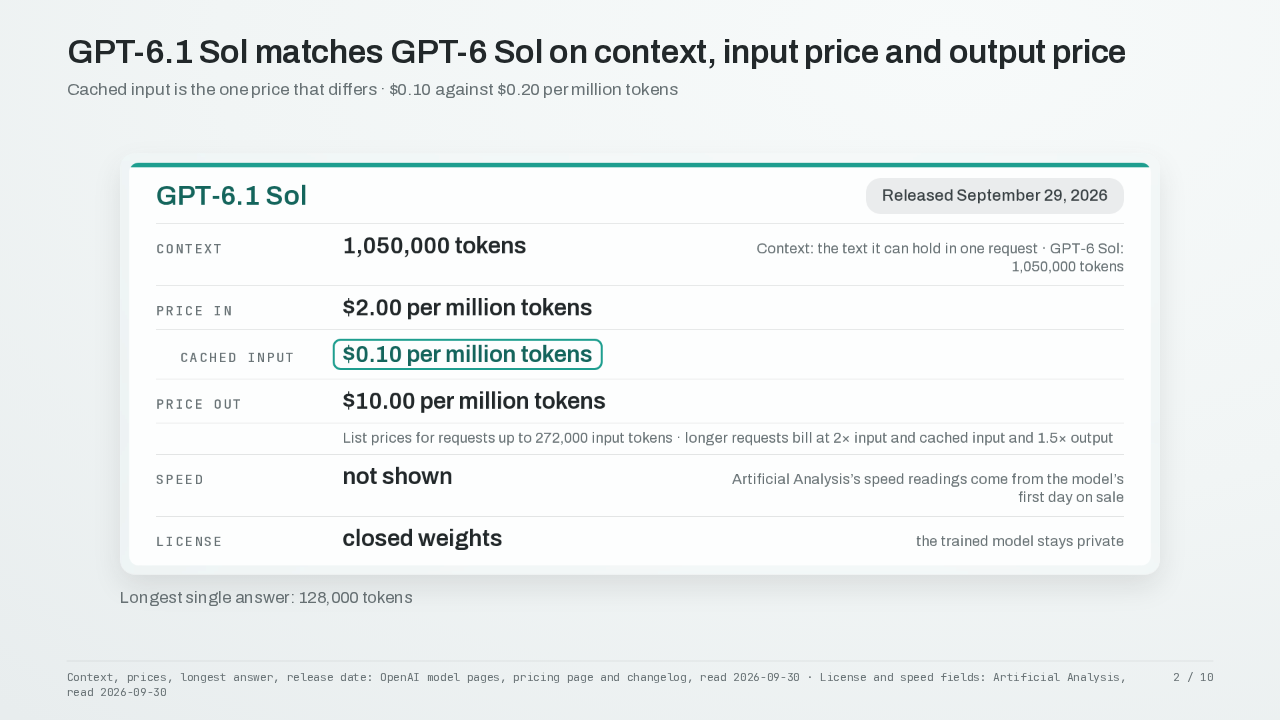
Prices: OpenAI pricing page, read 2026-09-30 · Index and cost per task: Artificial Analysis, read 2026-09-30 1 / 10GPT-6.1 Sol's context window, how much text it can hold in one request, is about a million tokens. Artificial Analysis's speed readings for GPT-6.1 Sol come from its first day on sale, so the speed field reads not shown. OpenAI keeps the weights, the trained model itself, private.
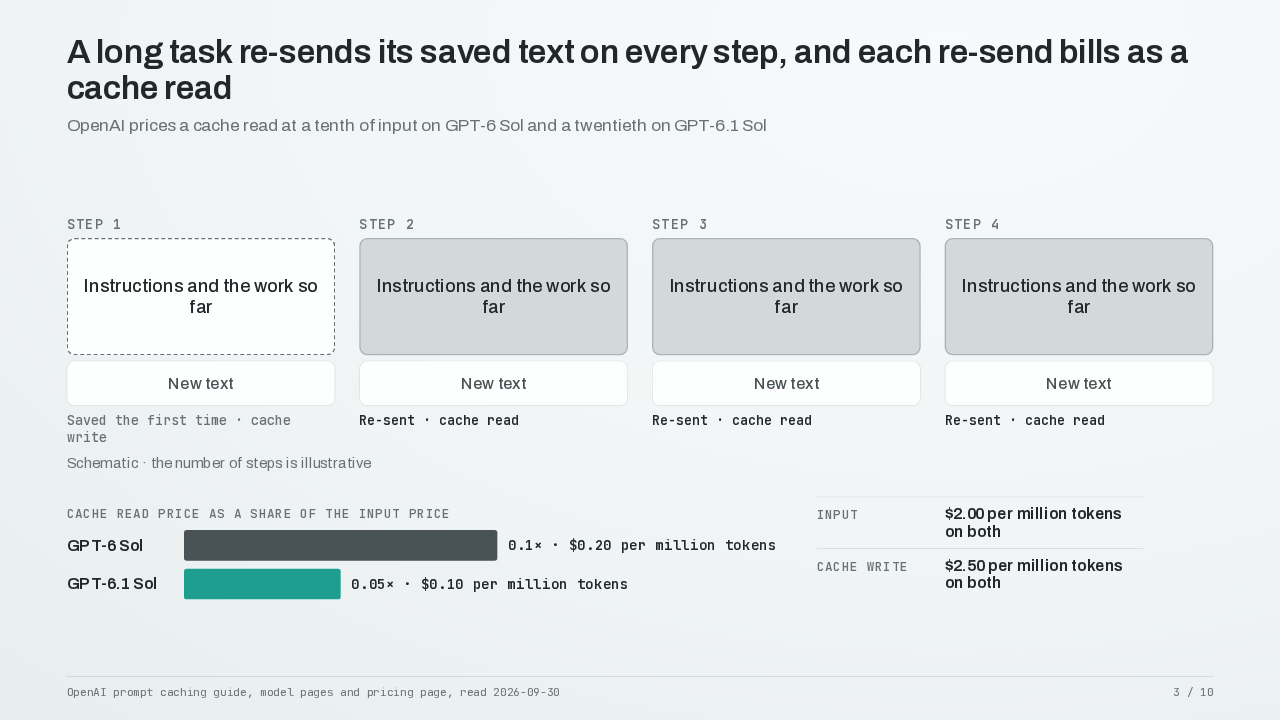
A long task, like fixing a bug across several files, runs in many steps. On every step, the program running the task sends the model its instructions and all the work so far. OpenAI saves that text the first time the program sends it. Every later send of the saved text is a cache read, and OpenAI bills a cache read at the cached input price. A cache read costs a tenth of the input price on GPT-6 Sol, and a twentieth on GPT-6.1 Sol.
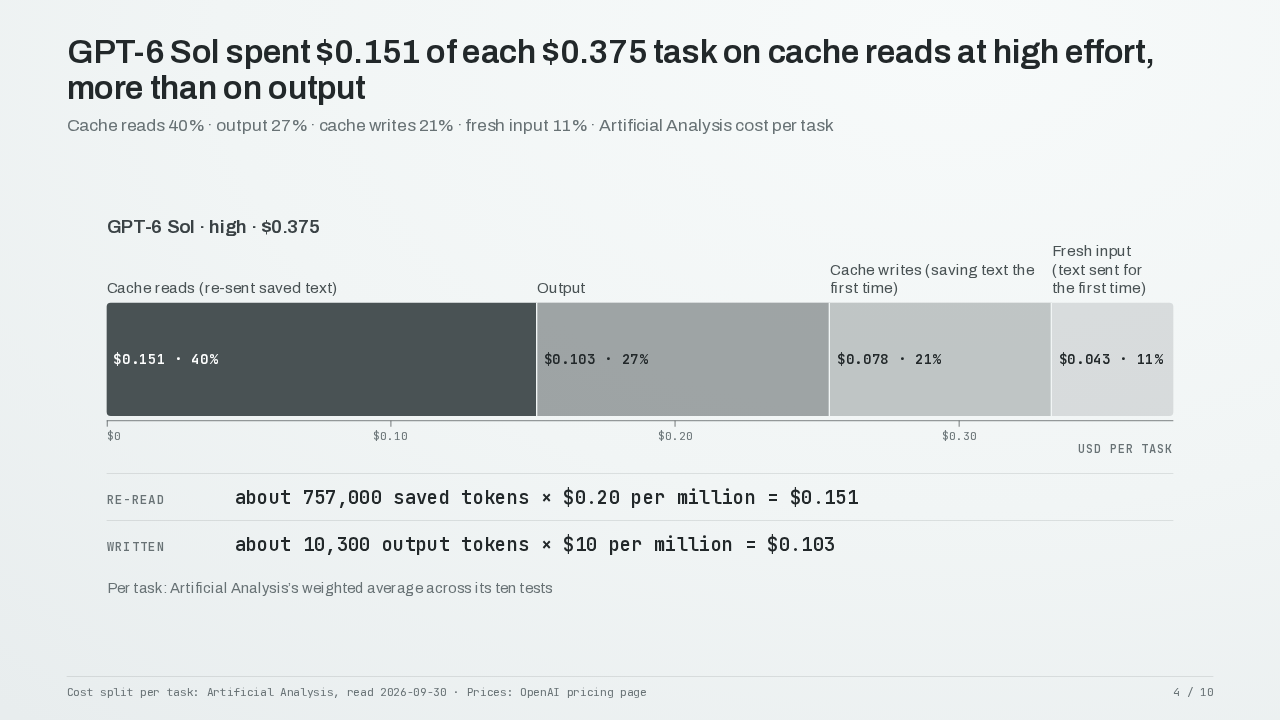
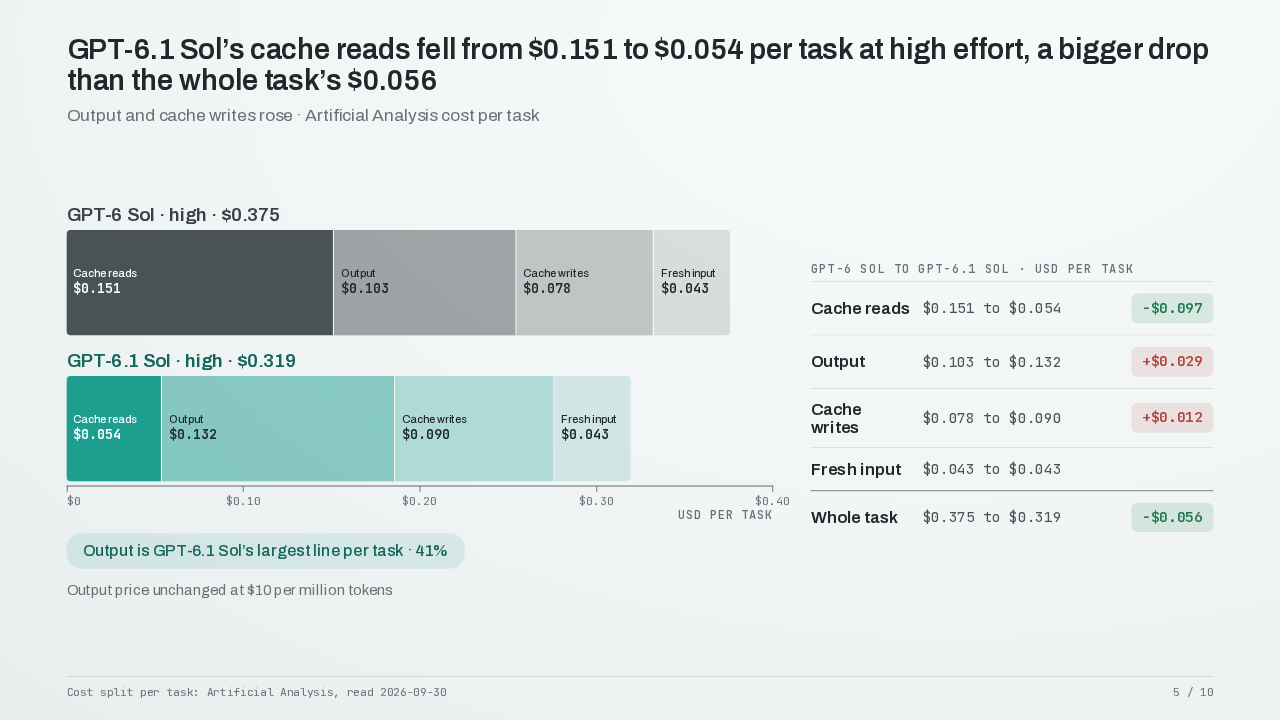
On Artificial Analysis's test at high effort, an average GPT-6 Sol task cost thirty-seven and a half cents. Cache reads took about fifteen cents. Output took about ten cents. Cache writes, the charge for saving text the first time, took about eight cents. Fresh input, text sent for the first time, took about four cents. At high effort, cache reads were forty percent of GPT-6 Sol's bill per task, the largest of the four lines. The cheapest price on the list made the largest line, because a task re-reads far more than it writes. At high effort, an average GPT-6 Sol task re-read about seven hundred and fifty thousand saved tokens and wrote about ten thousand output tokens.
GPT-6.1 Sol halves the price of cache reads, GPT-6 Sol's largest line per task at high effort. On Artificial Analysis's test at high effort, GPT-6.1 Sol spends about five cents per task on cache reads, against about fifteen cents for GPT-6 Sol. At high effort, the cache-read line fell nine point seven cents per task, and the whole bill per task fell five point six cents, to about thirty-two cents. Two other lines rose at high effort: output, from about ten cents to about thirteen cents per task, and cache writes, from about eight cents to nine cents per task.
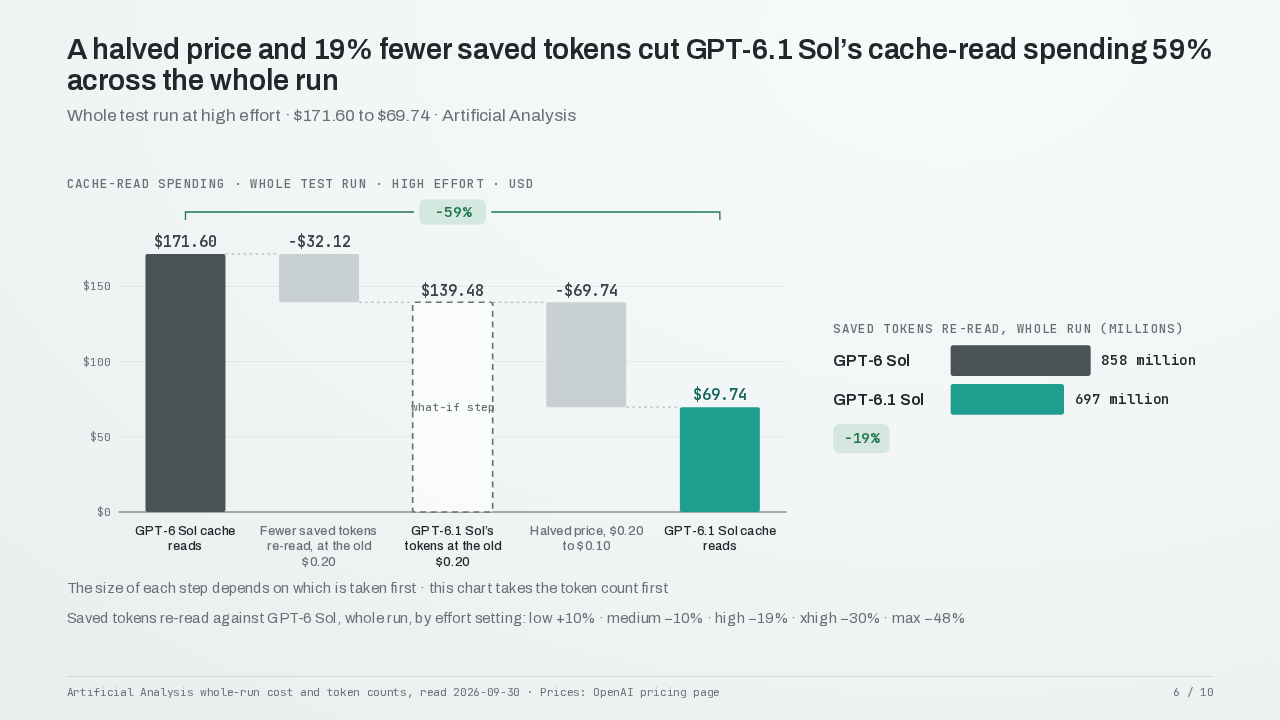
A halved price alone would cut cache-read spending by fifty percent. Across Artificial Analysis's whole test run at high effort, GPT-6.1 Sol's cache-read spending fell fifty-nine percent, from a hundred and seventy-one dollars sixty to sixty-nine dollars seventy-four. The drop passed fifty percent because GPT-6.1 Sol also re-read less saved text at high effort. Across the whole run, GPT-6.1 Sol re-read six hundred and ninety-seven million saved tokens, against eight hundred and fifty-eight million for GPT-6 Sol. That is nineteen percent fewer saved tokens.
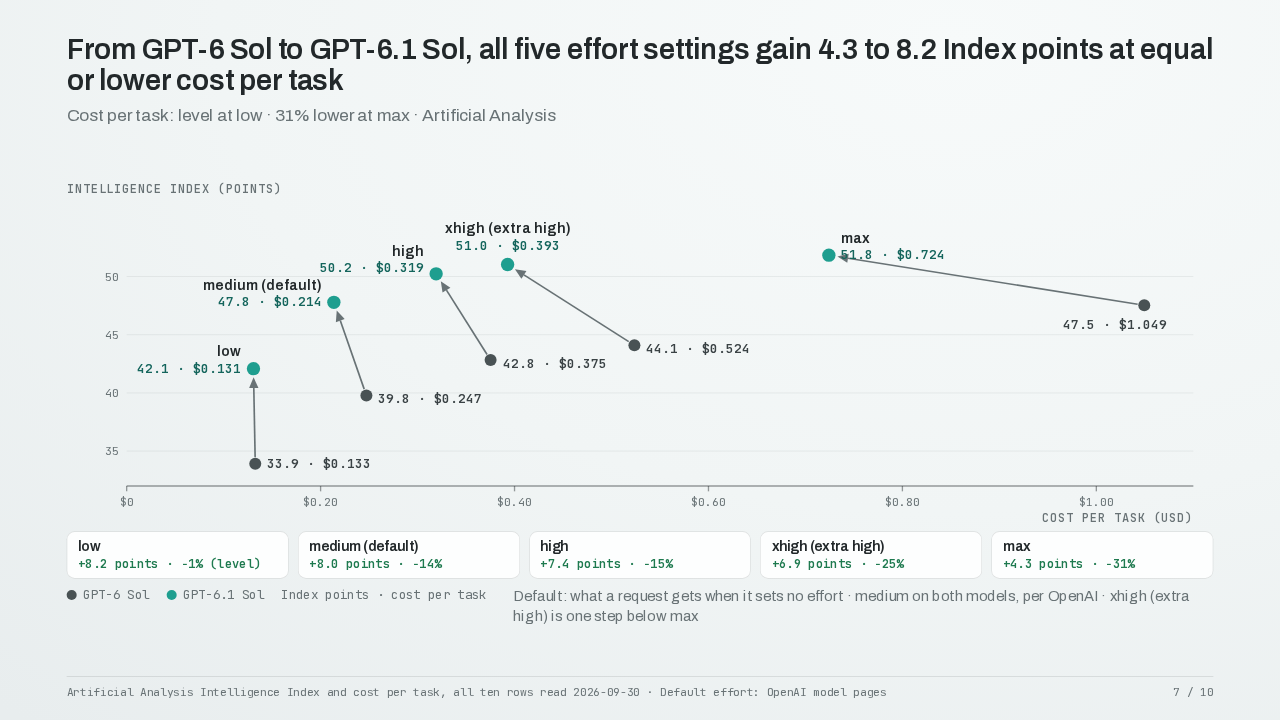
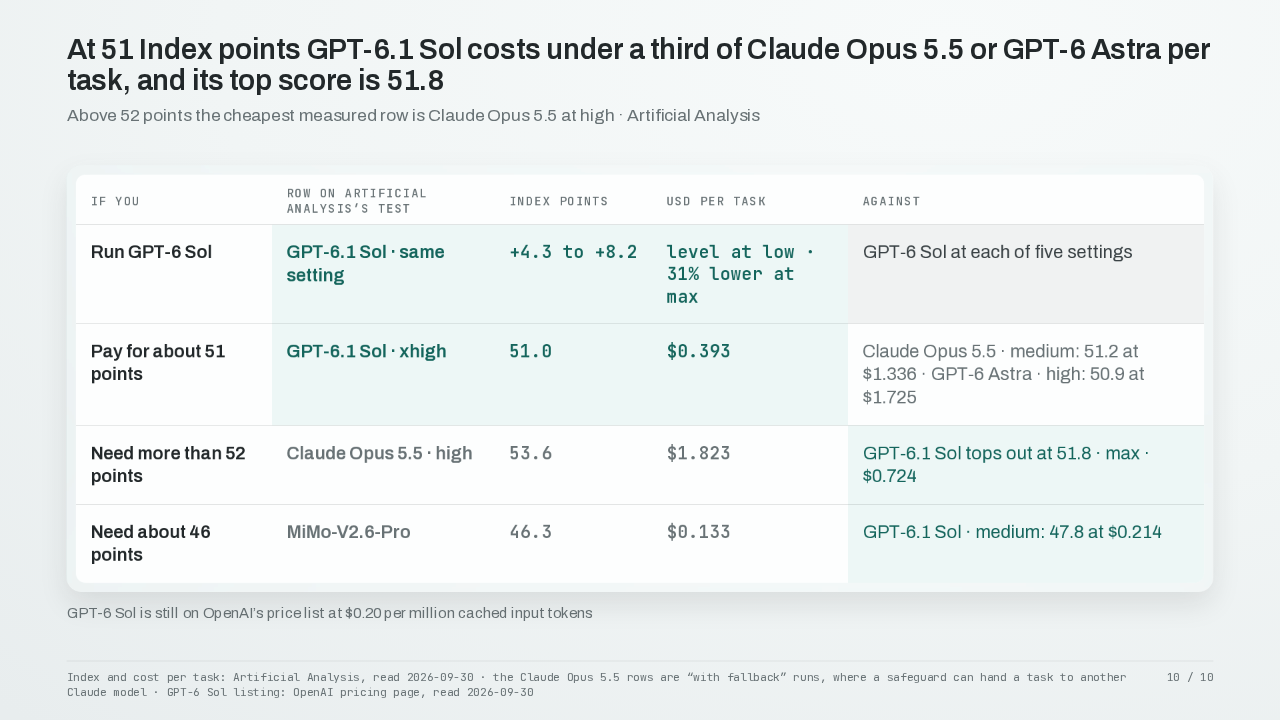
Artificial Analysis ran both models at five effort settings. GPT-6.1 Sol scores four to eight Index points higher at every setting, for the same cost per task or less. Medium is the setting a request gets when it leaves effort unset. At medium, GPT-6.1 Sol scores forty-seven point eight Index points against GPT-6 Sol's thirty-nine point eight, for about twenty-one cents per task against twenty-five cents. At max effort, GPT-6.1 Sol scores fifty-one point eight Index points against GPT-6 Sol's forty-seven point five, for seventy-two cents per task against one dollar and five cents. The score gap narrows from about eight Index points at low to about four at max. The cost per task is level at low and thirty-one percent lower at max.
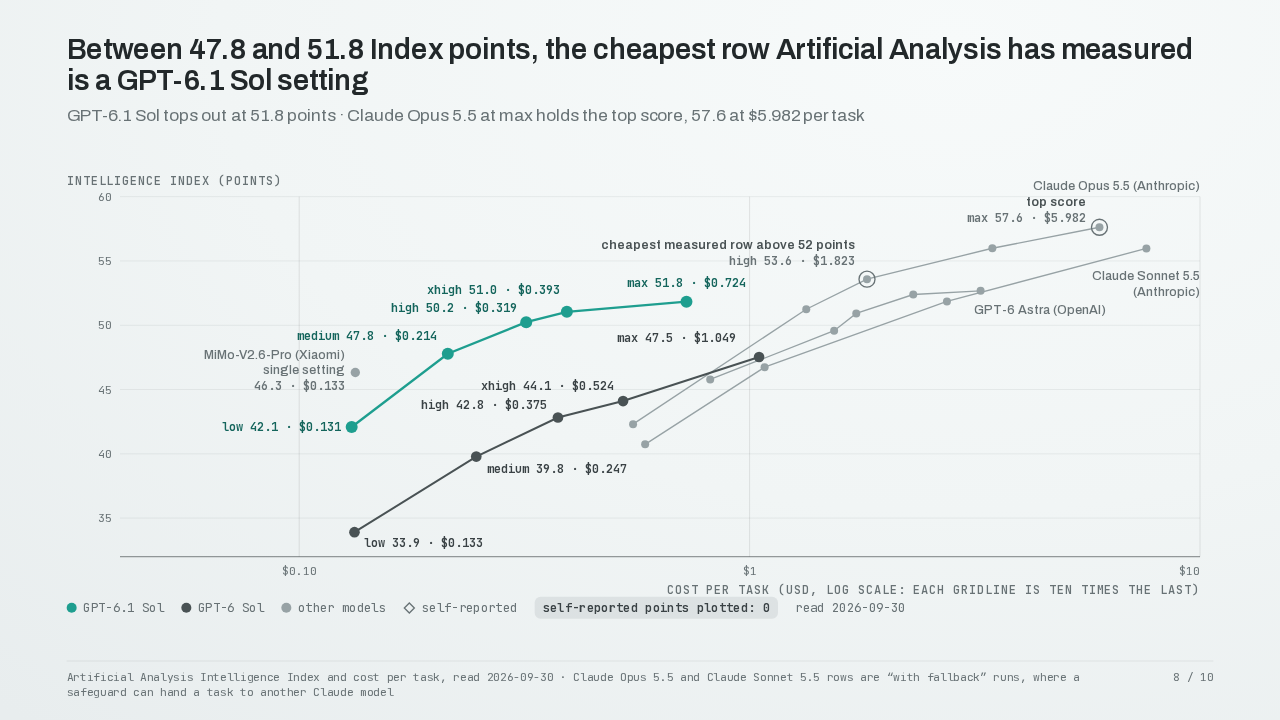
On Artificial Analysis's board, score goes up, cost per task goes right, and each model is a line of dots, one dot per effort setting. From medium effort up to max, each GPT-6.1 Sol dot is the cheapest row Artificial Analysis has measured at that score or higher. The other lines are OpenAI's GPT-6 Astra and Anthropic's Claude Opus 5.5 and Claude Sonnet 5.5. Xiaomi's MiMo-V2.6-Pro sits below GPT-6.1 Sol's medium dot, at forty-six point three Index points against forty-seven point eight, for thirteen cents per task against twenty-one cents.
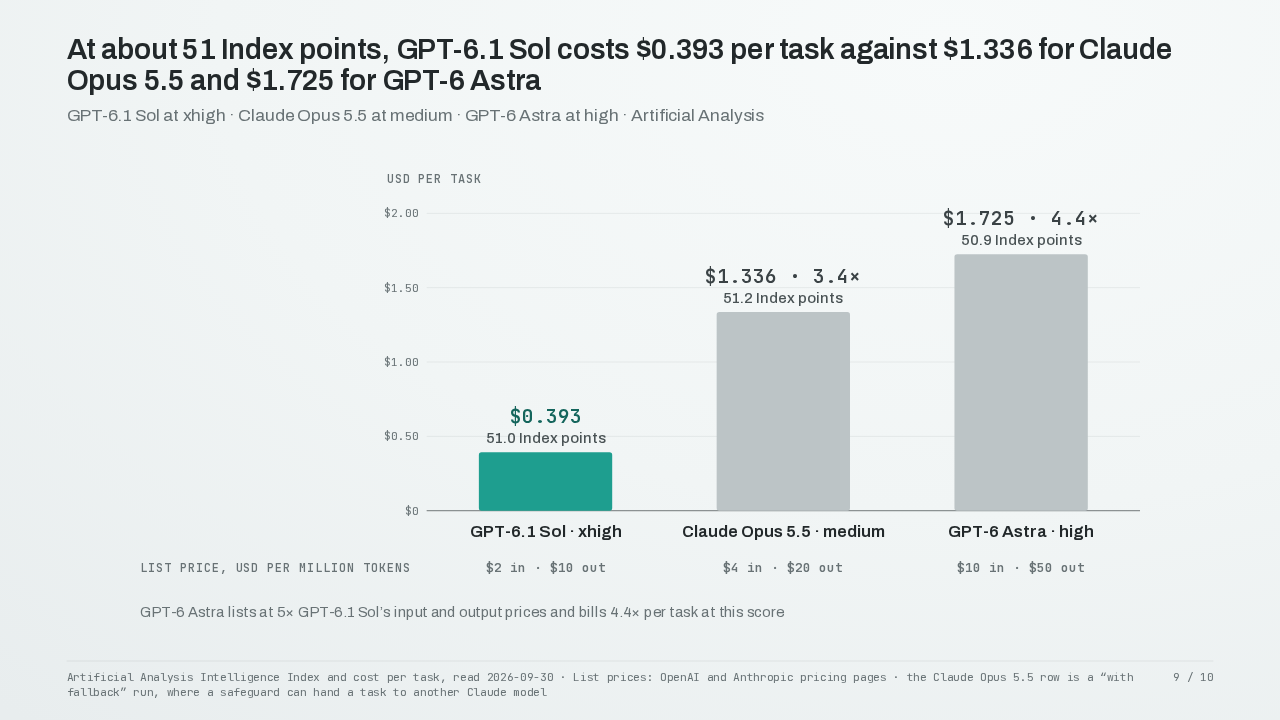
Compare three rows that each score about fifty-one Index points on Artificial Analysis's test. GPT-6.1 Sol at extra high scores fifty-one point zero Index points for thirty-nine cents per task. Claude Opus 5.5 at medium scores fifty-one point two Index points for one dollar thirty-four per task, three point four times GPT-6.1 Sol's cost. GPT-6 Astra, OpenAI's pricier model, scores fifty point nine Index points at high effort for one dollar seventy-three per task, four point four times GPT-6.1 Sol's cost.
If you run GPT-6 Sol, the same effort setting on GPT-6.1 Sol scores higher on Artificial Analysis's test for the same cost per task or less. If you pay for about fifty-one Index points on Claude Opus 5.5 or GPT-6 Astra, GPT-6.1 Sol at extra high reaches that score for under a third of the cost per task. If you need more than fifty-two Index points, the cheapest row Artificial Analysis has measured is Claude Opus 5.5 at high effort, at one dollar eighty-two per task. These numbers come from one test set at Artificial Analysis. The saving on your own bill depends on how much saved text your requests re-read.
Up next
 5:50
Claude Opus 5.5 and GPT-6 Sol redraw the cheapest model per score
@model-watch
2 months ago
 5:10
Claude Opus 5.5 undercuts Opus 5 at four of five effort settings
@model-watch
2 months ago
 5:26
MiMo-V2.6-Pro-UltraSpeed costs ten times the base rate
@model-watch
2 months ago
 5:34
Grok 4.7 costs $2.73 per Index task on Grok 4.6’s rate card
@model-watch
2 months ago
 5:55
GPT-6 Astra bills $3.26 per Index task at $10 in / $50 out
@model-watch
2 months ago
 5:35
GLM-5.3-Flash doubles on September 9
@model-watch
2 months ago
 5:48
Gemini 3.8 Flash costs about forty percent more per measured task at the same token price
@model-watch
2 months ago
 5:41
The cheap tier caught the frontier: GLM-5.3-Flash scores 57 at $0.10
@model-watch
2 months ago
 2:04
Anthropic cancels Sonnet 5's price increase — and the week's biggest release has no spec sheet
@model-watch
3 months ago