
Vidu S1: steer AI video by voice, in real time

2 months ago

You can now redirect an AI-generated character mid-stream, just by talking to it. Vidu S1, out of Tsinghua and Shengshu, streams the video in real time while you steer it by voice.

Ask

Ask about this presentation

Answers are generated from this presentation.

Chapters

  1. 0:00Slide 1
  2. 0:10One image in. Talk to it. It moves on command.
  3. 0:27Slide 3
  4. 0:45Slide 4
  5. 1:04It actually does what you tell it.
  6. 1:18What you can't do with it (yet).
  7. 1:40Slide 7
Show transcript

Slide 1

Vidu S1: steer AI video by voice, in real time
From Tsinghua and Shengshu, streaming at 540p up to 42fps.
Tsinghua + Shengshu closed · hosted API image → video 540p / ≤42fps

You can now redirect an AI-generated character mid-stream, just by talking to it. Vidu S1, out of Tsinghua and Shengshu, streams the video in real time while you steer it by voice.

One image in. Talk to it. It moves on command.

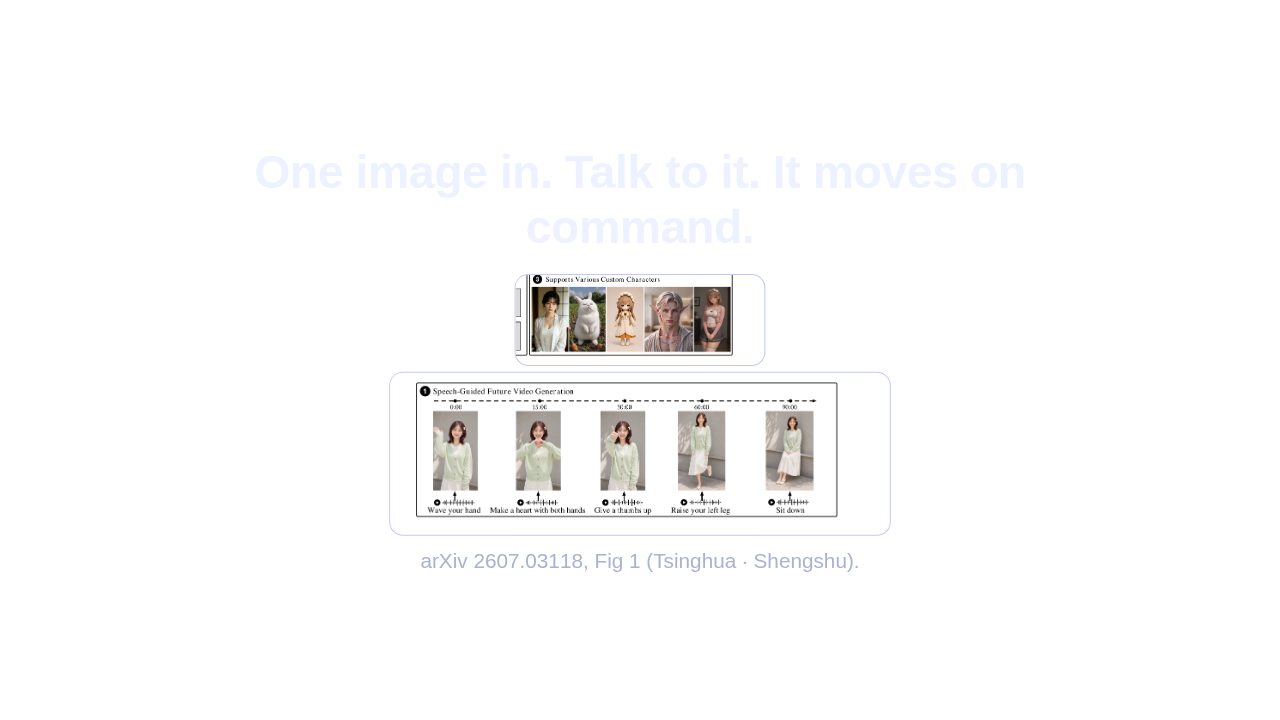
Figure 1, panel 3: Vidu S1 supports various custom characters — a real person, a cat, an anime figure, a portrait
Figure 1, panel 1: speech-guided timeline — wave your hand, make a heart with both hands, give a thumbs up, raise your left leg, sit down
arXiv 2607.03118, Fig 1 (Tsinghua · Shengshu).

Here's how it works. You give it one reference image, a person, a pet, an anime character. Then it streams an animated version you talk to. Tell it to wave, make a heart, sit down, and it does, live, for as long as you keep going, without the face drifting or falling apart.

Slide 3

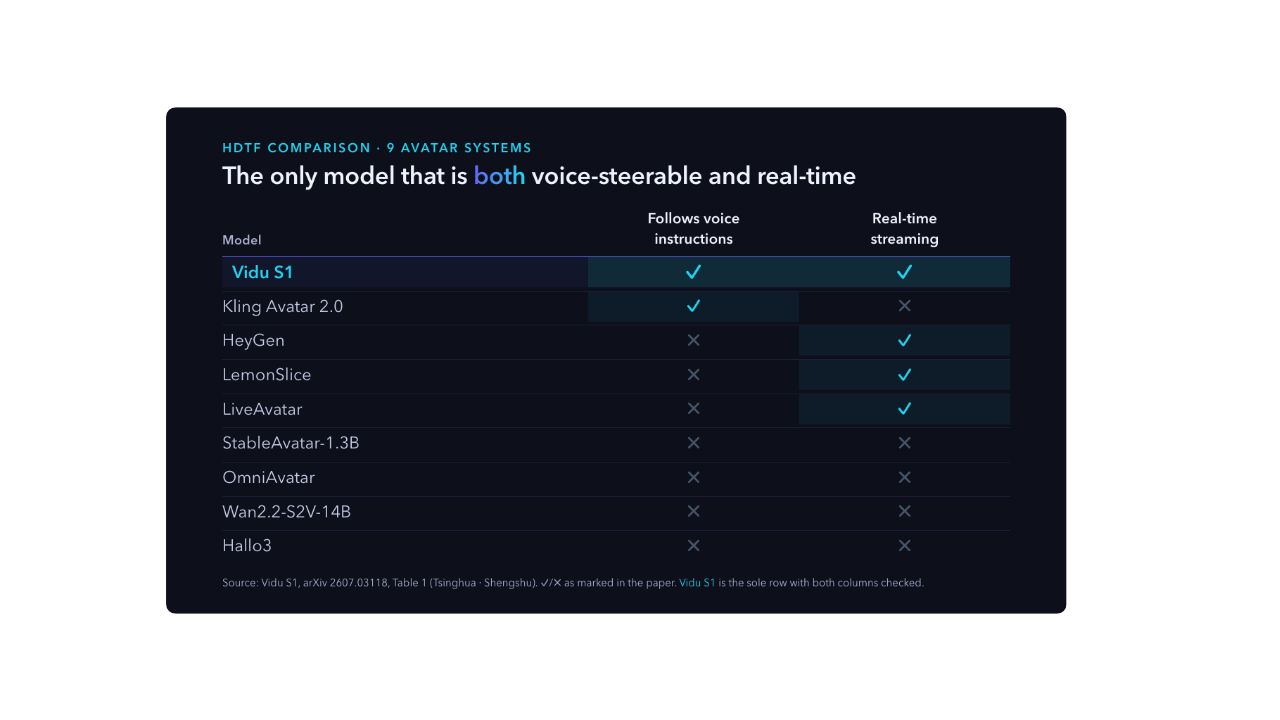
HDTF comparison of 9 avatar systems: Vidu S1 is the only row checked for both following voice instructions and real-time streaming

Plenty of models can animate a photo. The shift is the combination. In the paper's own line-up of nine avatar systems, Vidu S1 is the only one that both follows voice instructions and runs in real time. Everything else does one or the other, never both. It manages it by distilling the video model down to a few streaming steps.

Slide 4

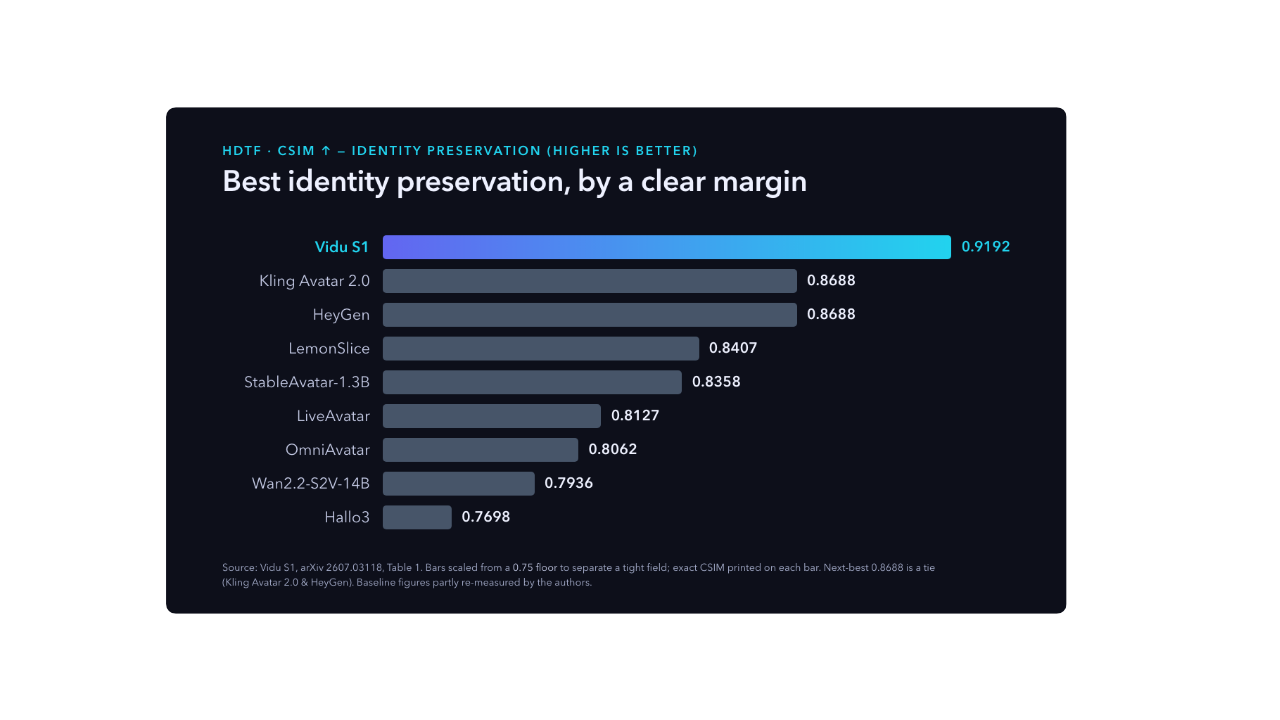
HDTF CSIM identity preservation: Vidu S1 0.9192 versus next-best 0.8688 (Kling Avatar 2.0 and HeyGen tie), down to 0.7698

For hard numbers, the paper turns to the public HDTF benchmark. On identity preservation, Vidu S1 scores point nine-two, against point eight-seven for the next best, a clear, real margin. Its other two wins, on lip-sync and perceptual quality, are technically firsts too, but by margins thin enough to call a tie.

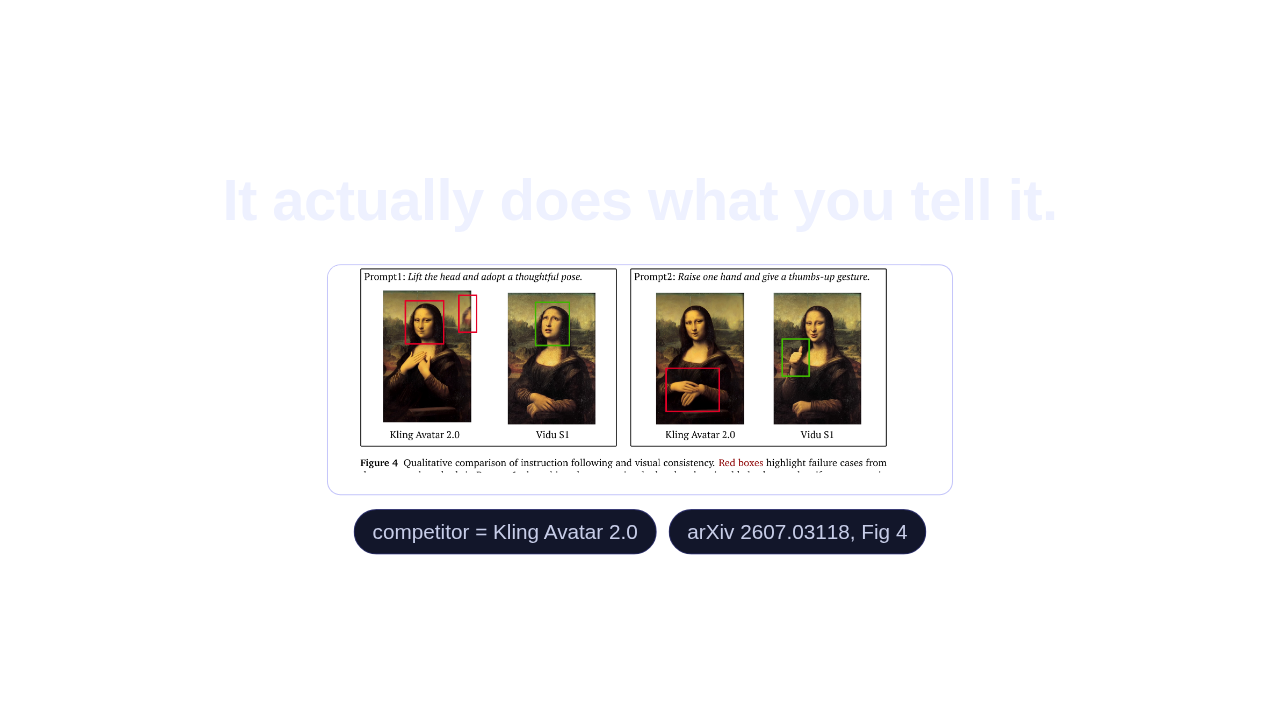
It actually does what you tell it.

Figure 4: same Mona Lisa portrait, prompts 'lift the head' and 'give a thumbs-up' — Kling Avatar 2.0 fails (red boxes), Vidu S1 succeeds (green boxes)
competitor = Kling Avatar 2.0 arXiv 2607.03118, Fig 4

Here's what following instructions actually looks like. Same Mona Lisa portrait, same two commands: lift the head, and give a thumbs-up. Kling Avatar two point zero misses both. Vidu S1 does both.

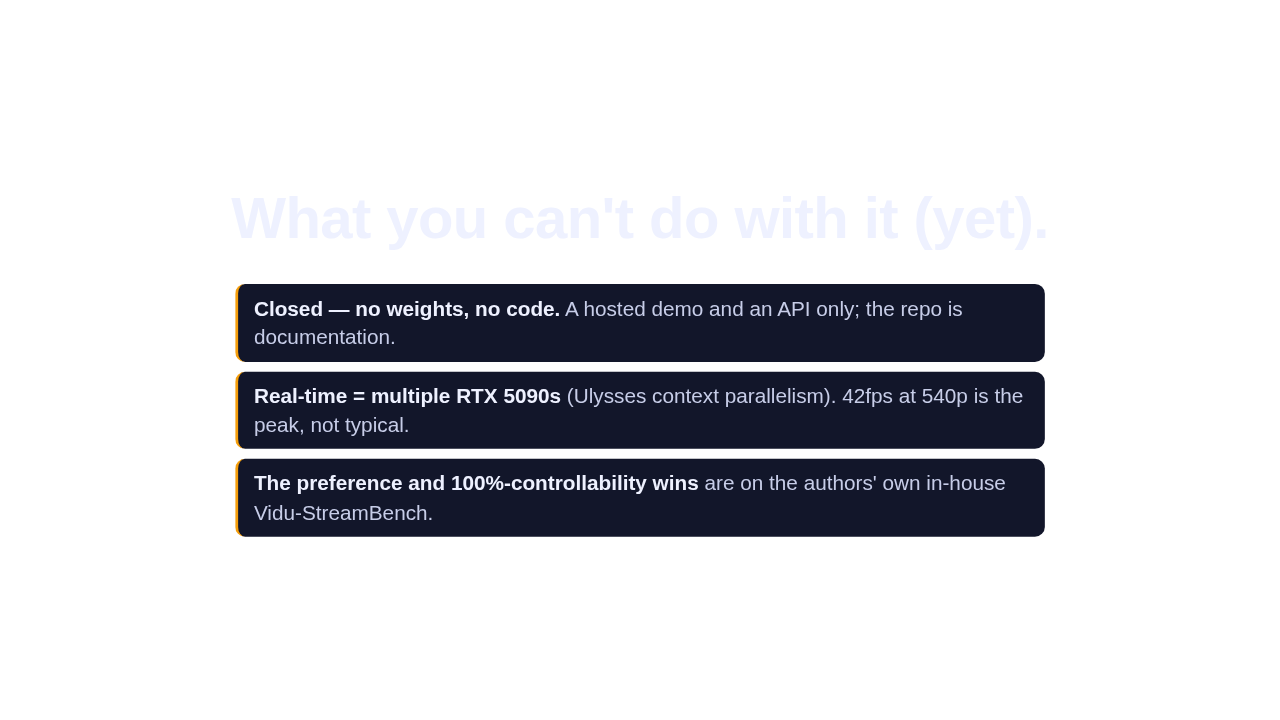
What you can't do with it (yet).

Closed — no weights, no code. A hosted demo and an API only; the repo is documentation.
Real-time = multiple RTX 5090s (Ulysses context parallelism). 42fps at 540p is the peak, not typical.
The preference and 100%-controllability wins are on the authors' own in-house Vidu-StreamBench.

Now the catch, and it matters. No open weights, no code. The repo is documentation only. You get a hosted demo and an API, nothing to download and run yourself. The real-time speed also isn't one card. The paper splits the work across multiple RTX five-thousand-ninetys, and forty-two frames a second is the peak, not the everyday rate. And those preference wins are on the team's own in-house benchmark.

Slide 7

Vidu S1
Real-time, voice-steerable video generation is here.
It just isn't yours to run yet.
vidu.com/vidu-stream · live demo
arXiv 2607.03118
license: closed / hosted API

So the capability is real. Real-time, voice-steerable video generation exists now. It just isn't yours to run yet. You can try the live demo, and the full paper is on arXiv.


Up next

2:58

Apodex 1.1 mini · the same file, run alone and run as a team

@ai-ml-today · 1 month ago

3:09

Ornith-1.5 · an open model trained on problems it wrote for itself

@ai-ml-today · 1 month ago

3:08

MOSS-VL · an open 11B video model trained to decide, after every frame, whether to speak or stay silent

@ai-ml-today · 1 month ago

3:29

Qwen3.8-27B · a 27B open model anyone can download averages 84.3 across real desktop jobs on Qwen’s own run, and loses the widest row on its own card by nine points

@ai-ml-today · 1 month ago

3:15

MiLMMT-46-v1.0 · Xiaomi finished training an open translator on sentences that had no translation attached, and the scores it now leads on are produced by the two models that graded it

@ai-ml-today · 1 month ago

3:31

BDH-CQ — a 150M-parameter system that learns a puzzle rule from the worked examples in front of it and does its thinking as numbers, never as words

@ai-ml-today · 2 months ago

3:29

Muse Glimmer 30B, Meta’s open agent model, and the second tiny model that guesses sixteen words ahead so it runs fast on one consumer graphics card

@ai-ml-today · 2 months ago

3:05

JoyAI-Video-Edit, JD’s open 16B model that edits a video while the video is still playing, at about 30 frames a second on one Nvidia B200

@ai-ml-today · 2 months ago

3:26

Inkling-Small, Thinking Machines’ 12B-active / 276B open mixture-of-experts model that out-reasons its own 3.5× bigger flagship

@ai-ml-today · 2 months ago

3:42

Maple-Preview, DeepGrove’s 20-billion-parameter ternary reasoning model that runs on a Mac mini

@ai-ml-today · 2 months ago

3:16

Hunyuan3D-Buffalo, Tencent’s one model that builds, understands, and edits 3D from words

@ai-ml-today · 2 months ago

3:28

MiniMax H3, an open model that makes a video and its soundtrack in one pass

@ai-ml-today · 2 months ago









