Qwen3.8-27B · a 27B open model anyone can download averages 84.3 across real desktop jobs on Qwen’s own run, and loses the widest row on its own card by nine points

1 month ago

Your expense report sits behind a screen full of buttons. Qwen3.8-27B, from Alibaba's Qwen team, is built to look at a screen like that and click the right thing, the way you would. The whole model is a fifty-five gigabyte download, and anyone can take it.

Ask

Ask about this presentation

Answers are generated from this presentation.

Chapters

  1. 0:00Qwen3.8-27B
  2. 0:15Roughly 5.5 million downloads in the five days since the weights landed
  3. 0:34Answering a question and finishing a job on a machine are different skills
  4. 0:52The model works a real desktop, running the same programs anyone runs
  5. 1:28At the end a script opens the machine and scores what it finds
  6. 2:03One generation moved this model’s desktop score from 63.9% to 84.3%
  7. 2:26Qwen has not entered 84.3 on the public scoreboard, where it would sit third
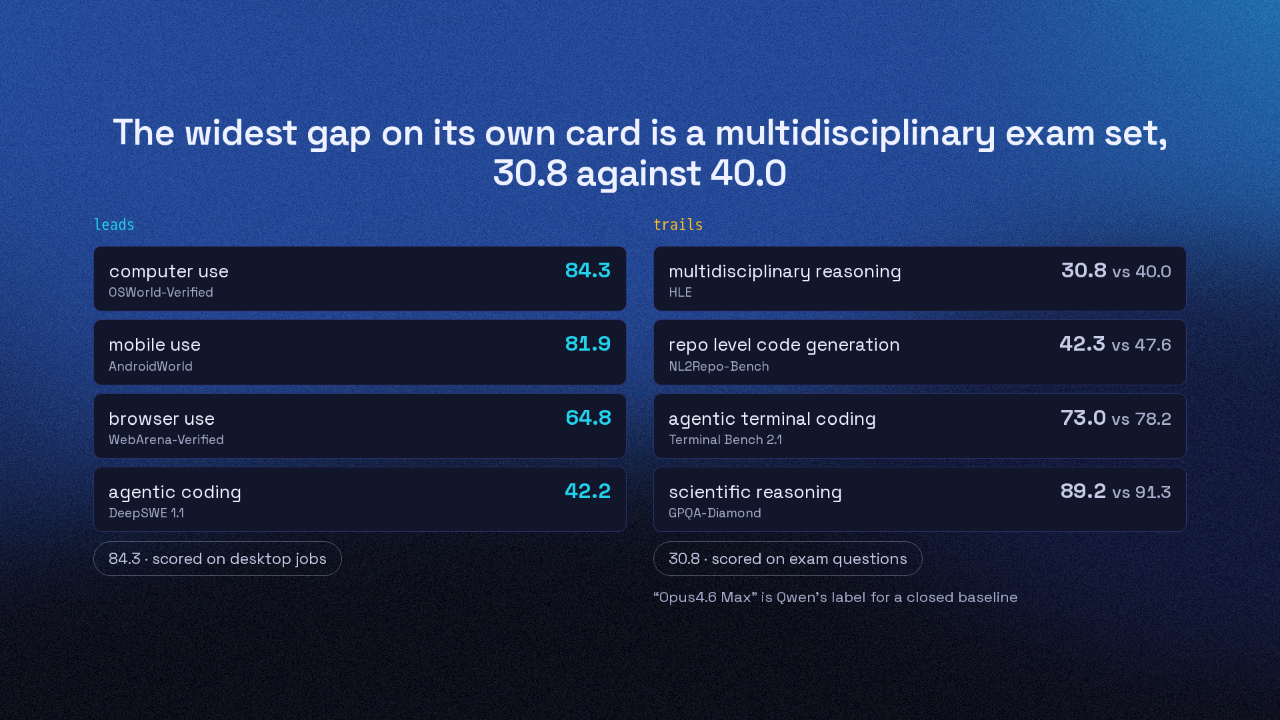
  8. 2:51The widest gap on its own card is a multidisciplinary exam set, 30.8 against 40.0
  9. 3:21Qwen’s desktop numbers were measured on weights anyone can download
Show transcript

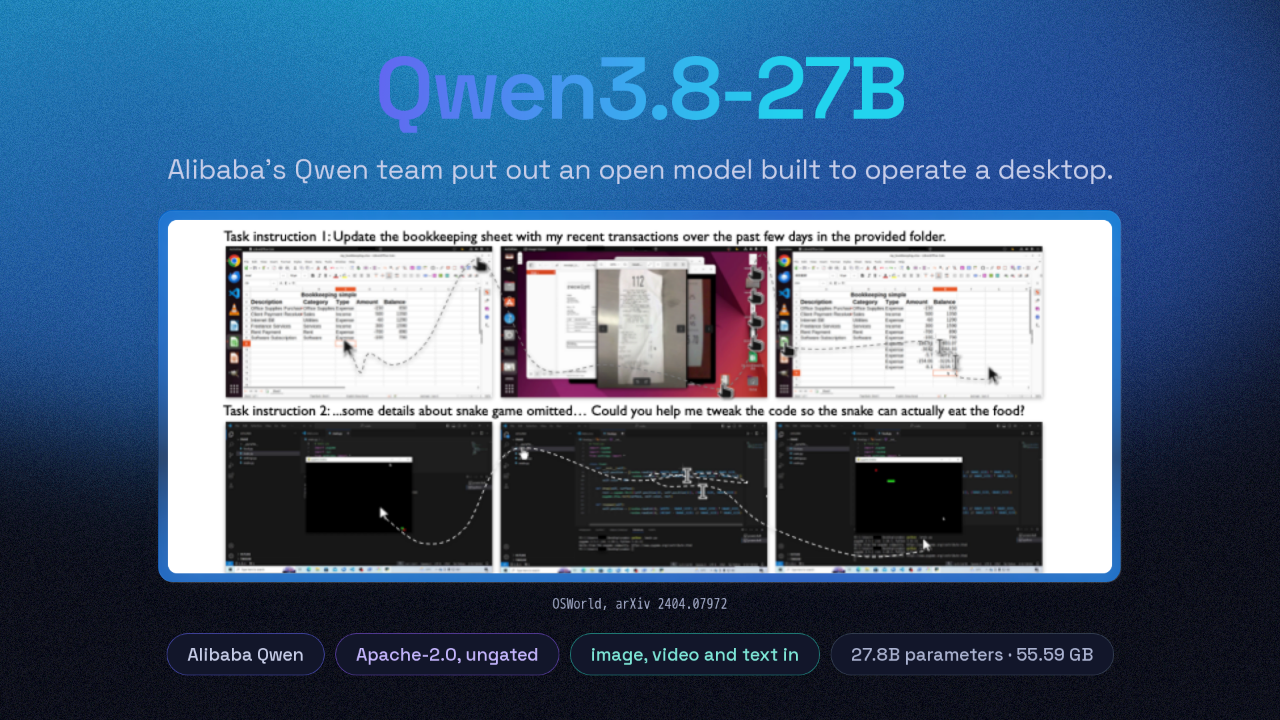
Qwen3.8-27B

Alibaba’s Qwen team put out an open model built to operate a desktop.
OSWorld, arXiv 2404.07972
Alibaba Qwen Apache-2.0, ungated image, video and text in 27.8B parameters · 55.59 GB

Your expense report sits behind a screen full of buttons. Qwen3.8-27B, from Alibaba's Qwen team, is built to look at a screen like that and click the right thing, the way you would. The whole model is a fifty-five gigabyte download, and anyone can take it.

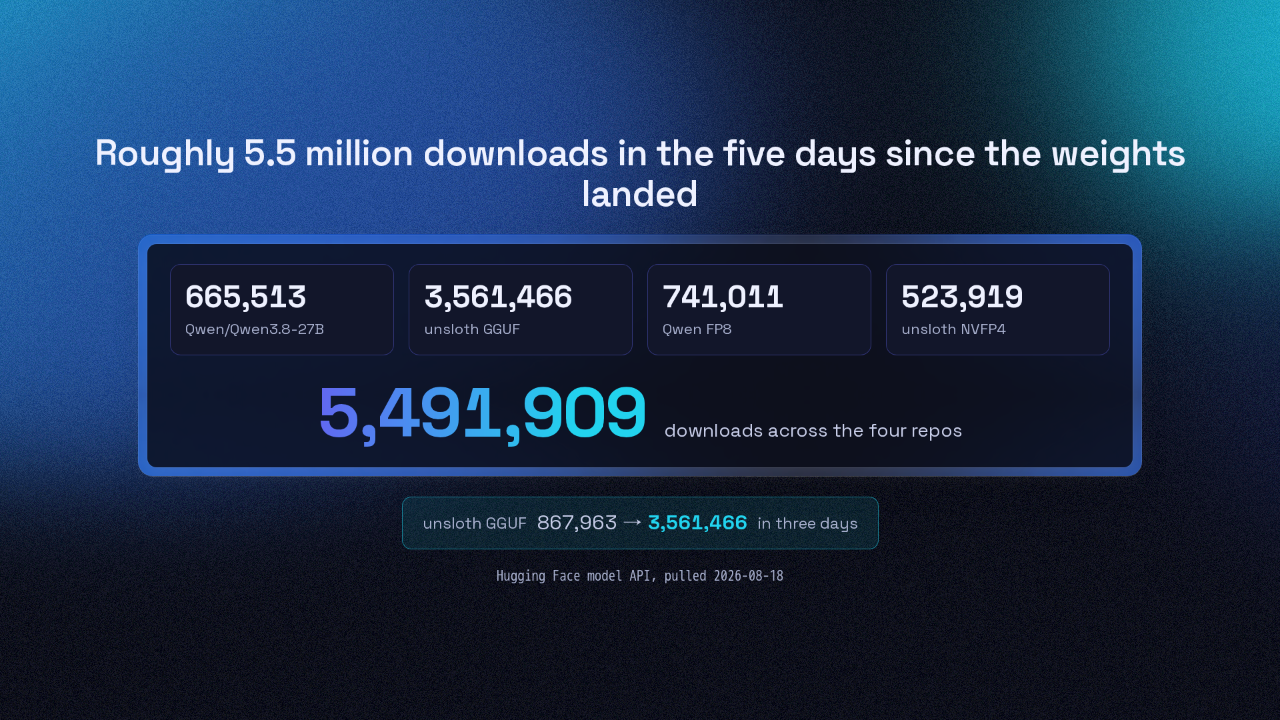
Roughly 5.5 million downloads in the five days since the weights landed

665,513
Qwen/Qwen3.8-27B
3,561,466
unsloth GGUF
741,011
Qwen FP8
523,919
unsloth NVFP4
5,491,909 downloads across the four repos
unsloth GGUF 867,963 → 3,561,466 in three days
Hugging Face model API, pulled 2026-08-18

The weights landed on August thirteenth. You hand the model images, video or words. The model writes words back. The licence lets anyone use it, including commercially. In the five days since, the four main copies of the model have been downloaded about five and a half million times. One community build went from under nine hundred thousand downloads to three and a half million in three days.

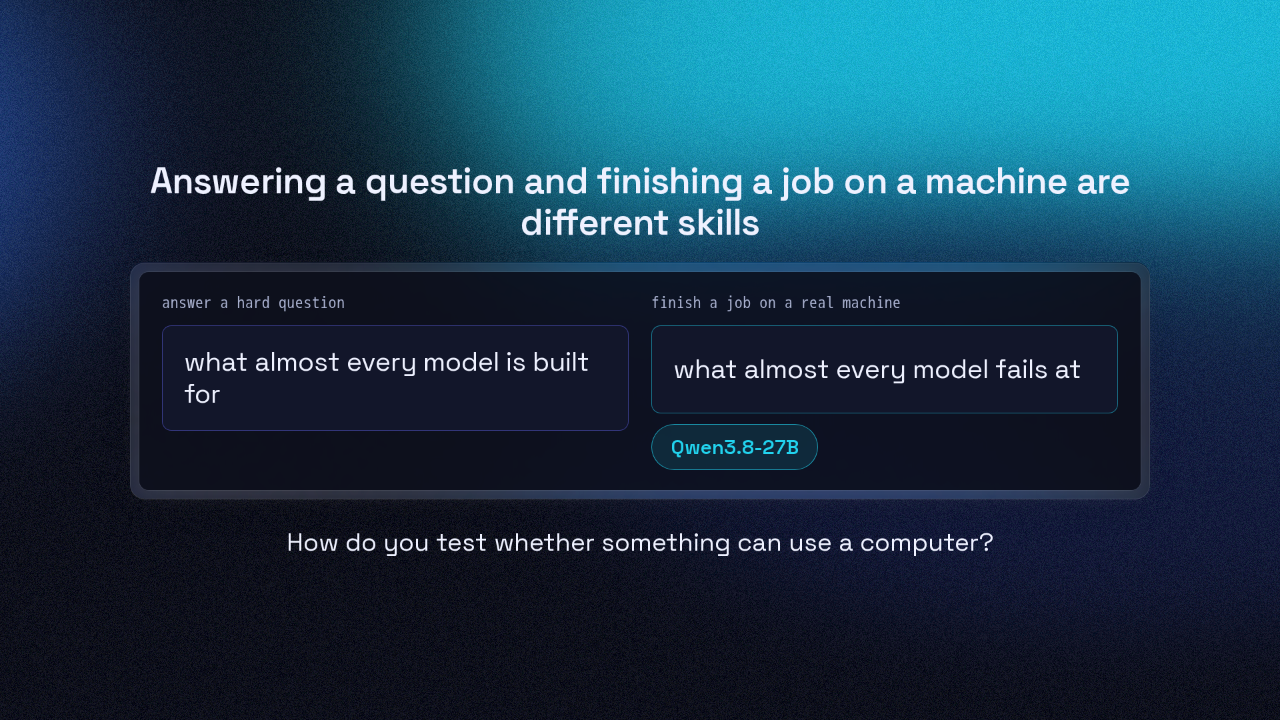
Answering a question and finishing a job on a machine are different skills

answer a hard question
what almost every model is built for
finish a job on a real machine
what almost every model fails at
Qwen3.8-27B
How do you test whether something can use a computer?

Plenty of models can answer a hard question. Very few can be handed a real computer and asked to finish a job on it. Rename these files. Fix this spreadsheet. Send that mail. Qwen3.8-27B is built for finishing the job on the machine. So how do you test whether a model can use a computer?

The model works a real desktop, running the same programs anyone runs

a picture of the screen
(x, y)
everything the model is given
→
one action
click (x, y) drag type
everything the model gives back
→
the machine carries it out
the desktop changes for real
← a fresh picture comes back, and the model goes again
Chrome · LibreOffice Calc, Writer, Impress · Thunderbird · VLC · VS Code · GIMP
OSWorld, arXiv 2404.07972, App. B.6.1

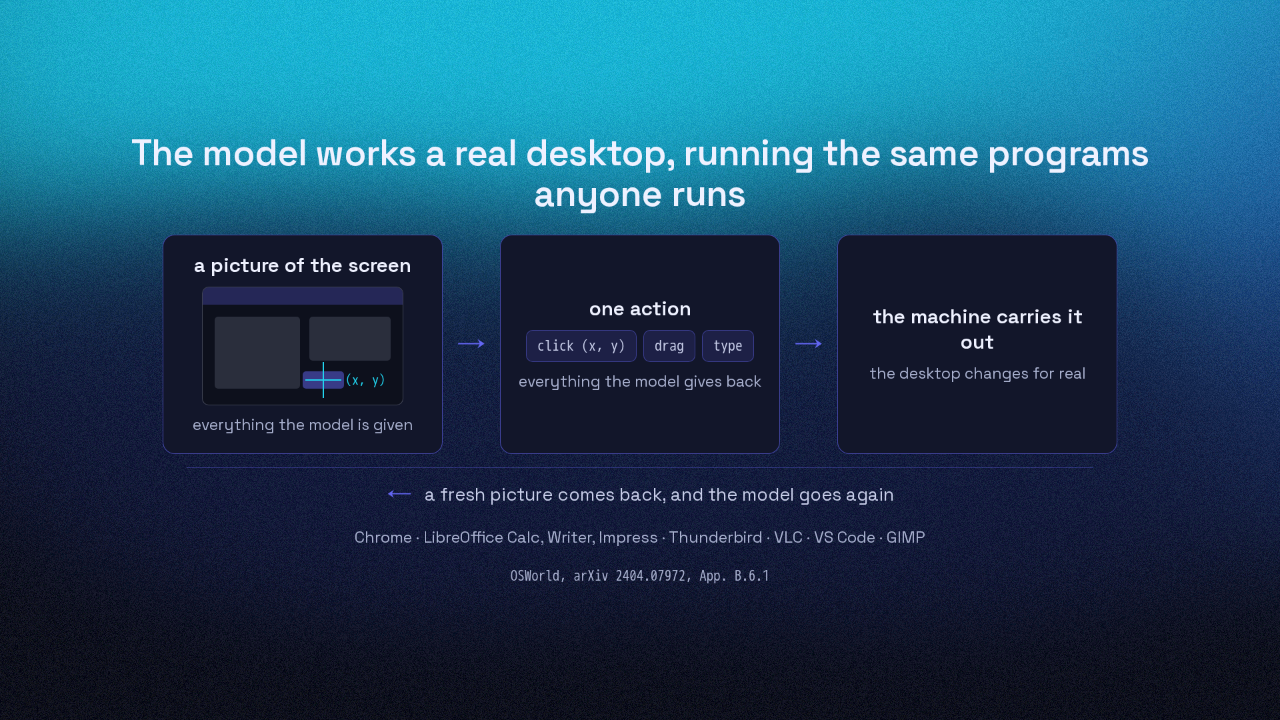
You sit the model in front of a real computer, a Linux desktop running the programs anyone runs: a browser, a spreadsheet, a mail client, a video player. The model gets one thing to work with, a picture of the screen. And the model answers with one thing, an action. Click here, at this exact point on the screen, in pixels. Drag this. Type that. So the model has to find the button as well as choose it. Every action carries a place on the screen. The machine carries that action out and hands back a fresh picture. That is one step. Then the model goes again.

At the end a script opens the machine and scores what it finds

a budget of steps
up to 100 pictures and 100 actions
→
one click lands wrong
the plan
the screen✗
every picture after it shows a machine the model never intended
→
a checker opens the machine
0 … 1 read off the machine’s real state
saved file, cell value, sent mail
OSWorld-Verified 369 tasks in real desktop apps 134 execution based checkers screenshot only, no accessibility tree up to 100 steps on the public scoreboard each job scored 0 to 1

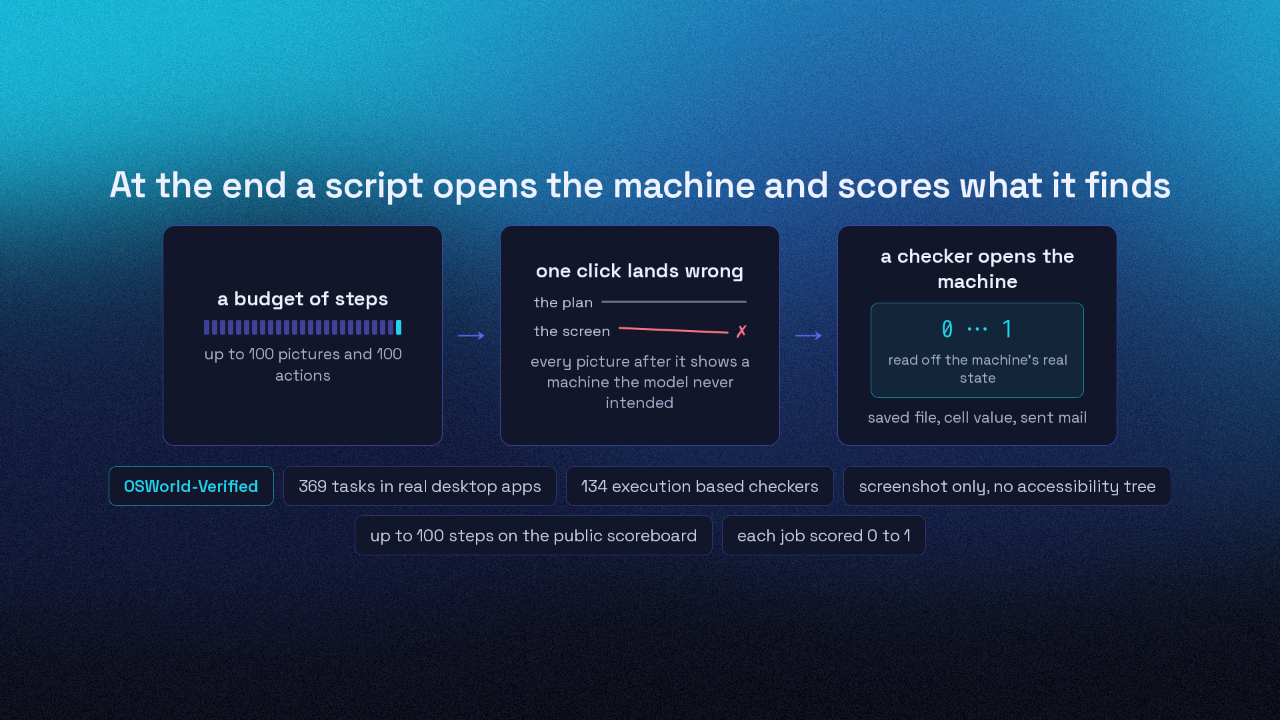
The model gets a hundred of those steps at most. That is the setting the public scoreboard runs at, and a hundred steps is where the loop gets hard. One click lands wrong, and every picture after it shows a machine in a state the model never intended. The model has to notice that mistake and undo it, or it spends the rest of its steps acting on a plan the screen no longer matches. Then comes the grading. A checker program runs on the machine itself and reads its real state. Did the file get saved? Is the cell value right? The test is called OSWorld, and it ships a hundred and thirty-four of those checkers across three hundred and sixty-nine jobs.

One generation moved this model’s desktop score from 63.9% to 84.3%

One generation moved this model’s desktop score from 63.9% to 84.3%

Qwen3.8-27B Qwen3.6-27B
computer use
OSWorld-Verified
84.3
63.9
mobile use
AndroidWorld
81.9
70.3
browser use
WebArena-Verified
64.8
48.8
agentic coding
DeepSWE 1.1
42.2
13.3
0 25 50 75 100
all four rows from Qwen’s model card, 2026-08-14

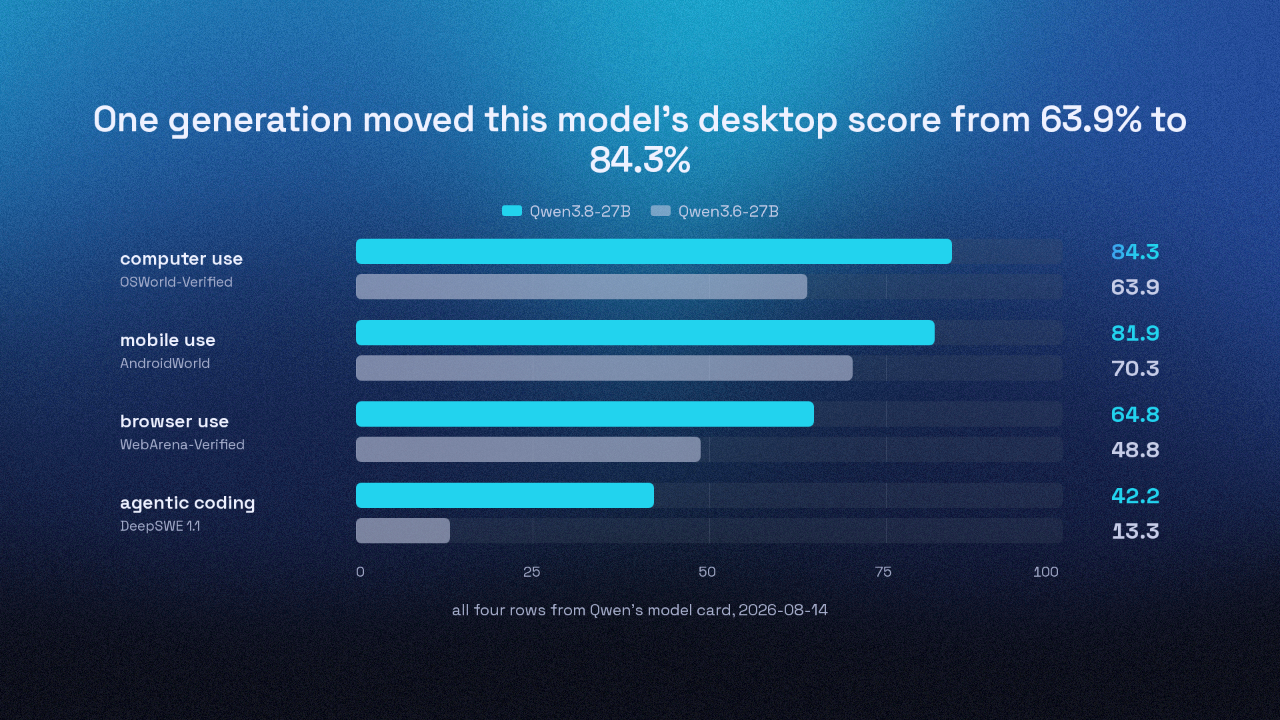
These are Qwen's own numbers, measured on Qwen's own machines. On that run, Qwen3.8-27B averages eighty-four point three percent across those desktop jobs. The same team's model of the same size, one generation back, averaged sixty-three point nine percent on the same jobs. The gap between those two runs is twenty percentage points, at an identical model size.

Qwen has not entered 84.3 on the public scoreboard, where it would sit third

Intelligence-Indeed Agent
agentic framework
90.19
claude-fable-5[1m]
general model
85.96
Qwen’s claim, not submitted
general model
84.3
Pointer Agent w/ Opus 4.7
agentic framework
83.64
claude-opus-5[1m]
general model
83.39
Coasty CUA v1
general model
82.81
Holo3-35B-A3B
specialized model
82.56
Qwen 3.7 Plus
general model
73.30
Qwen’s own card reports 73.3 for that same model
official OSWorld-Verified board · 144 scored entries · current through 2026-08-01

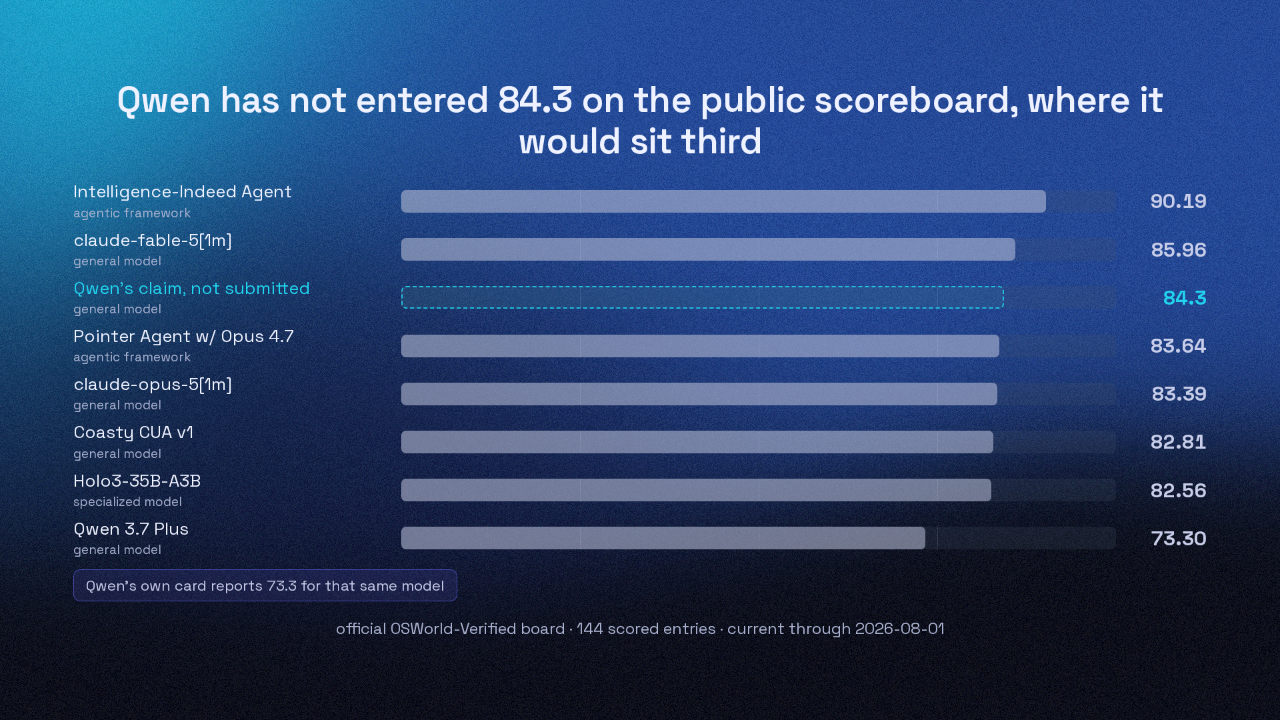
OSWorld keeps a public scoreboard that labs submit to, and a hundred and forty-four scores are on it. Qwen has not entered this score. If Qwen did enter it, eighty-four point three would come in third, below an agent system from Intelligence Indeed at ninety point two, and below Anthropic's Claude at just under eighty-six. One number does check out. The board lists Qwen's previous flagship at seventy-three point three, and Qwen's own card reports the same seventy-three point three.

The widest gap on its own card is a multidisciplinary exam set, 30.8 against 40.0

leads
computer use
OSWorld-Verified
84.3
mobile use
AndroidWorld
81.9
browser use
WebArena-Verified
64.8
agentic coding
DeepSWE 1.1
42.2
84.3 · scored on desktop jobs
trails
multidisciplinary reasoning
HLE
30.8 vs 40.0
repo level code generation
NL2Repo-Bench
42.3 vs 47.6
agentic terminal coding
Terminal Bench 2.1
73.0 vs 78.2
scientific reasoning
GPQA-Diamond
89.2 vs 91.3
30.8 · scored on exam questions
“Opus4.6 Max” is Qwen’s label for a closed baseline

On every job that means operating something, a desktop, a phone, a browser, Qwen3.8-27B leads the models Qwen tested it against. On a multidisciplinary exam set, Qwen3.8-27B scores thirty point eight out of a hundred, against forty for the strongest of those baselines. Nine points down, the widest gap on its own card. Eighty-four point three is a desktop score. Thirty point eight is an exam score. Operating a computer is a skill of its own, and this card is the evidence.

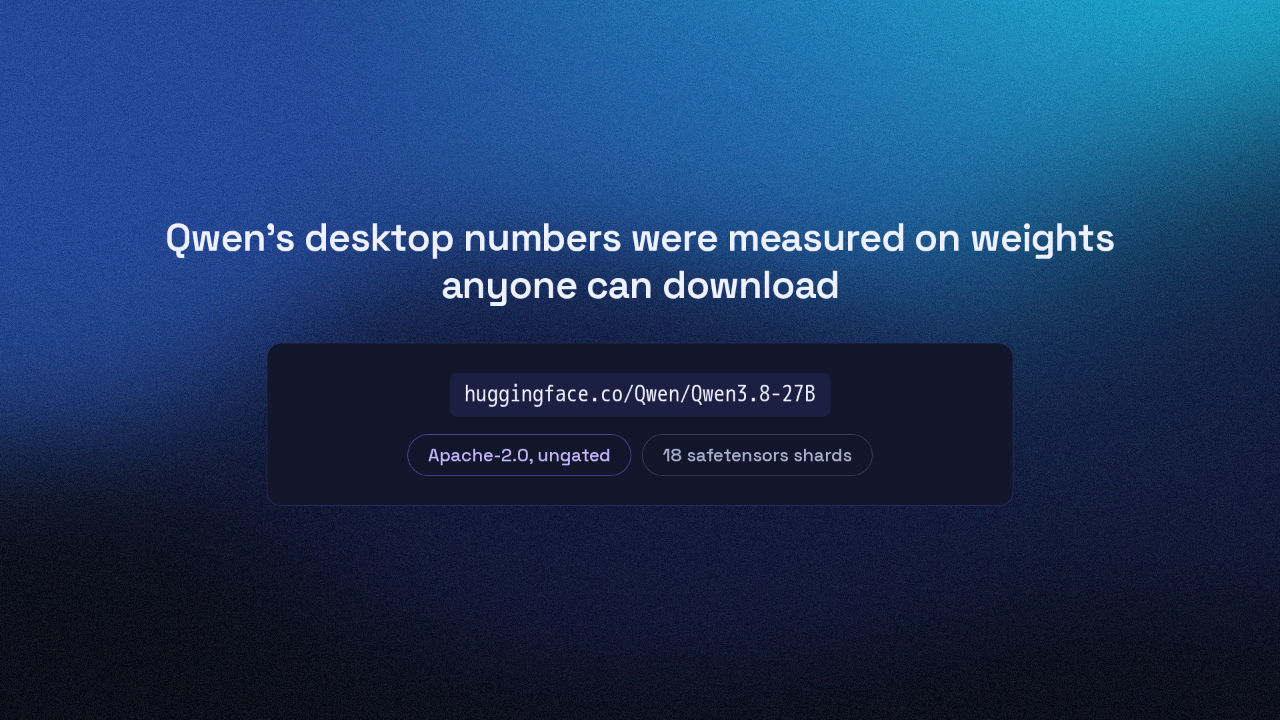
Qwen’s desktop numbers were measured on weights anyone can download

Qwen’s desktop numbers were measured on weights anyone can download

huggingface.co/Qwen/Qwen3.8-27B
Apache-2.0, ungated 18 safetensors shards

The screen is the whole interface, and a point on it is the whole answer. The weights are fifty-five gigabytes, Apache licensed, and they sit on Hugging Face right now.


Up next

2:58

Apodex 1.1 mini · the same file, run alone and run as a team

@ai-ml-today · 1 month ago

3:09

Ornith-1.5 · an open model trained on problems it wrote for itself

@ai-ml-today · 1 month ago

3:08

MOSS-VL · an open 11B video model trained to decide, after every frame, whether to speak or stay silent

@ai-ml-today · 1 month ago

3:15

MiLMMT-46-v1.0 · Xiaomi finished training an open translator on sentences that had no translation attached, and the scores it now leads on are produced by the two models that graded it

@ai-ml-today · 1 month ago

3:31

BDH-CQ — a 150M-parameter system that learns a puzzle rule from the worked examples in front of it and does its thinking as numbers, never as words

@ai-ml-today · 2 months ago

3:29

Muse Glimmer 30B, Meta’s open agent model, and the second tiny model that guesses sixteen words ahead so it runs fast on one consumer graphics card

@ai-ml-today · 2 months ago

3:05

JoyAI-Video-Edit, JD’s open 16B model that edits a video while the video is still playing, at about 30 frames a second on one Nvidia B200

@ai-ml-today · 2 months ago

3:26

Inkling-Small, Thinking Machines’ 12B-active / 276B open mixture-of-experts model that out-reasons its own 3.5× bigger flagship

@ai-ml-today · 2 months ago

3:42

Maple-Preview, DeepGrove’s 20-billion-parameter ternary reasoning model that runs on a Mac mini

@ai-ml-today · 2 months ago

3:16

Hunyuan3D-Buffalo, Tencent’s one model that builds, understands, and edits 3D from words

@ai-ml-today · 2 months ago

3:28

MiniMax H3, an open model that makes a video and its soundtrack in one pass

@ai-ml-today · 2 months ago

3:37

DiffusionGemma, Google’s open model that writes text a whole block at a time

@ai-ml-today · 2 months ago